
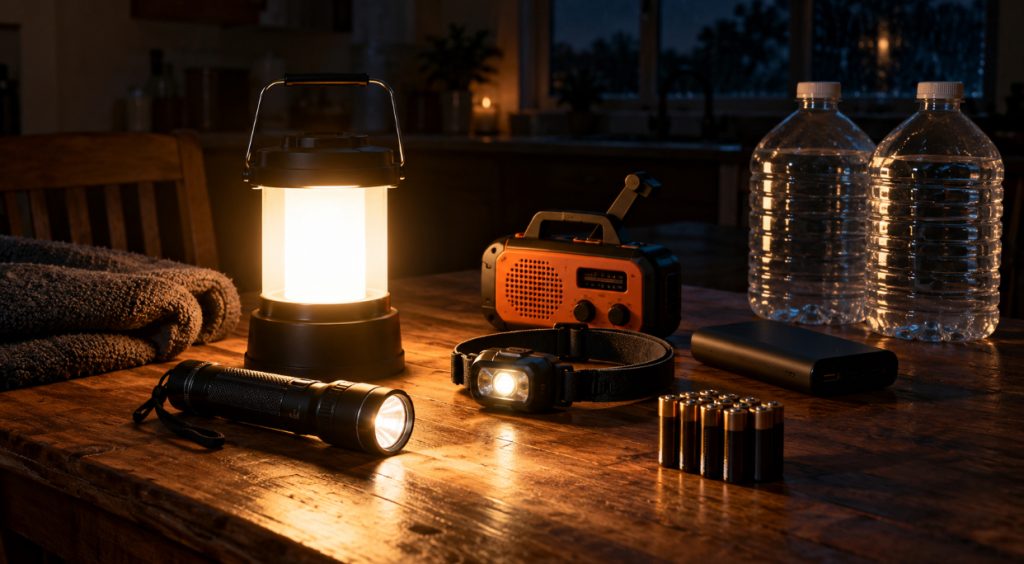
The first thing a long outage takes from you isn’t the lights. It’s your phone. By the second night most households are down to one charged phone and a flashlight on tired batteries, and nobody wants to open the fridge.
A power outage emergency kit fixes that, but only if it’s sized for your house and the outages you actually get. Most checklists stop at “flashlight, batteries, water.” That’s a shopping list, not a plan.
Below is the full checklist, a planner that works out quantities for your household, and the gear I’d put in my own kit. Lighting gets the most attention, because it’s the part most kits get wrong.
Quick Picks: The Gear Worth Buying
Power Outage Emergency Kit Checklist
Here’s everything that belongs in the kit, grouped the way you’ll reach for it in the dark. If you’re wondering what to put in a power outage kit first, start with light and water. You can manage without almost everything else for a day or two, but not those.
- A flashlight for every person
- Auto-on plug-in lights for halls, stairs and the bathroom
- A headlamp for every adult
- A lantern for the main room
- Spare lithium AA and AAA batteries
- A power bank for every phone
- A small power station if anyone uses a CPAP
- A car charger and spare cables
- A battery or crank radio with NOAA alerts
- Family phone numbers written on paper
- Your utility’s outage number
- 1 gallon of water per person per day
- No-cook food for every day
- A manual can opener
- Pet food and water
- A battery CO alarm on every floor
- A first aid kit
- A week of prescription medicine
- Fridge and freezer thermometers
- Blankets or sleeping bags for winter
- Battery fans for summer
- Cash in small bills
- Copies of ID and insurance papers
Outage Kit Planner: Size the Kit for Your Household
A couple in an apartment and a family of five with a dog and a CPAP need very different kits. Tell the planner who lives with you, how long to plan for and the season, and it works out your water, lights, batteries and power. Tick off what you already own to see what’s missing, then print the plan and tape it inside the box.
Battery counts come from the runtimes of the lights in this guide at their everyday settings. Water follows FEMA’s one gallon per person per day, and babies, nursing mothers and anyone who’s sick will need more.
How Long Should Your Kit Last?
Plan for three days as a baseline. That matches FEMA’s advice to keep several days of water and food, and it covers most storm outages. Across the US, the average customer spent about 6.3 hours a year without power from 2014 to 2024, counting major storms, but averages hide the bad years. Louisiana averaged 21.8 hours a year and Maine 18.9, and one ice storm can take out a week. You can look up your state on my power outages by state page.
Plan for a full week if you live rurally, at the end of a long power line or in ice storm or hurricane country. The same goes if you’re on well water, because the pump stops when the power does.
- Flashlights, headlamps and auto-on lights
- A charged power bank per phone
- Fridge and freezer kept closed
- The full checklist above
- 3 gallons of water per person
- A radio for repair updates
- A power station or a safely placed generator
- 7 gallons of water per person
- A plan for where you’d go if the house gets too cold or hot
Lighting Your Home Room by Room
Most kits toss in one flashlight and call it done. In a real outage that light ends up in whoever’s hand is busiest, and everyone else waits in the dark. Plan lighting the way you use your house:
- Halls, stairs and bathrooms: auto-on plug-in lights, because they’re what you need in the first ten seconds.
- The main room: one lantern set high on a shelf, so the light bounces off the ceiling.
- Every adult: a headlamp, since cooking, resetting a breaker and carrying a sleepy kid all take two hands.
- Every person: their own flashlight at the bedside.
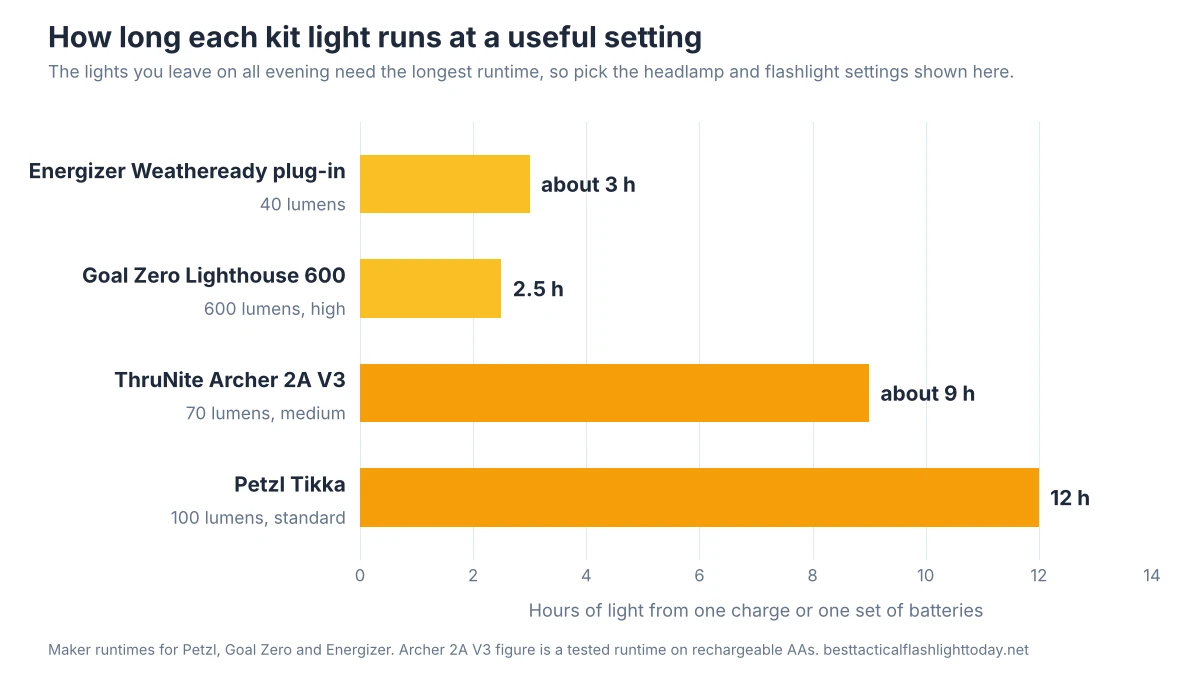
Batteries are where the math matters. Take two adults and two kids planning for three winter nights. A headlamp at 100 lumens runs about 12 hours on three AAAs, so two hours a night means one set for the outage plus a spare: 12 AAAs for two adults. A flashlight at 70 lumens runs about 9 hours on two AAs, so at an hour a night each, four flashlights need 16 AAs.
Store lithium cells rather than alkalines. Energizer rates its Ultimate Lithium batteries to hold power for up to 20 years in storage, and they won’t leak inside a flashlight the way old alkalines can. Leave candles out entirely. For more options, my best flashlight for power outages guide covers seven lights in depth.
1. ThruNite Archer 2A V3: Best Main Flashlight
Why I chose it and who it’s for
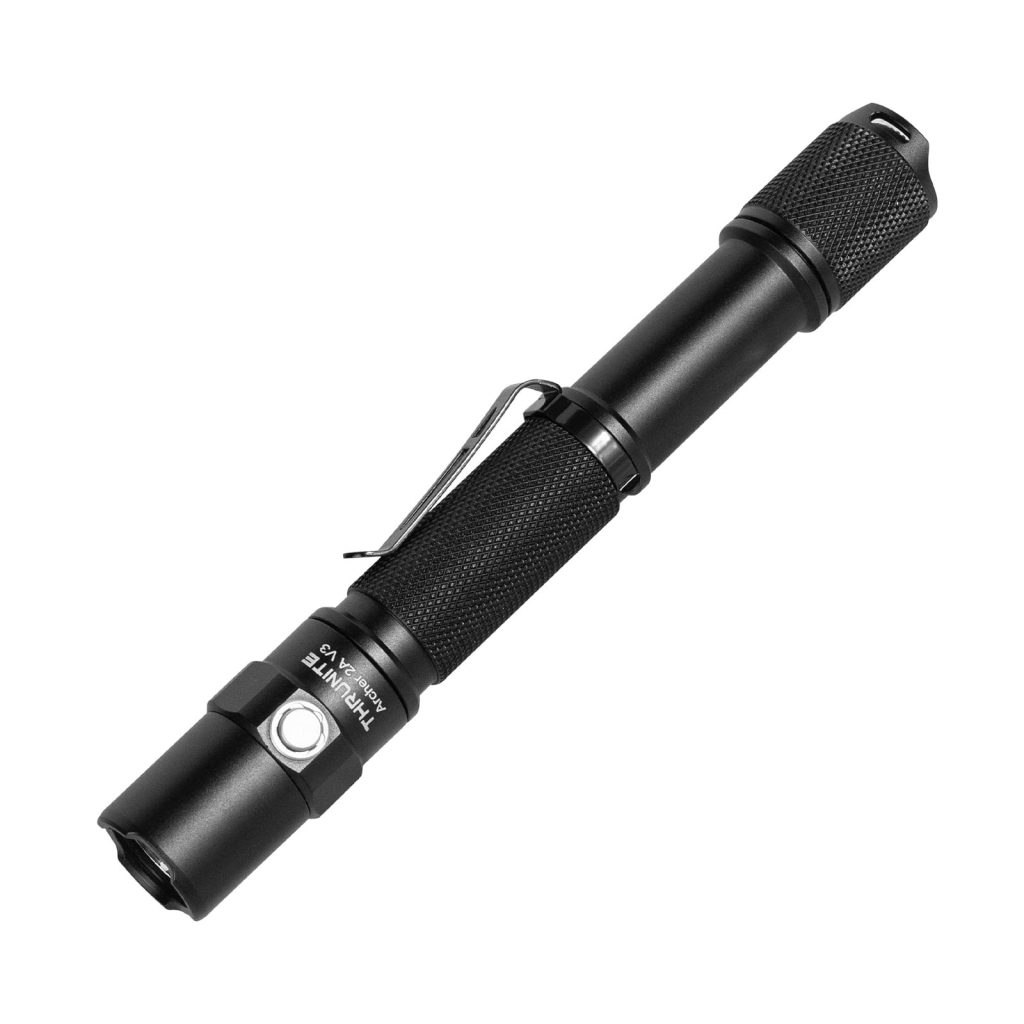
In a blackout your flashlight runs on whatever batteries the house has, and almost every house has AAs. The Archer 2A V3 turns two of them into a clean, bright beam, with a tail switch anyone in the family can find in the dark. It’s best for every adult and teen in the house.
Key specs
- Output: 500 / 70 / 17 / 0.2 lumens
- Runtime: about 9 hours on 70 lumens with rechargeable AAs
- Beam: 2,200 candela, about 95 m
- Power: 2x AA (lithium, NiMH or alkaline)
- Build: 6.1 in long, IPX8, tail switch with momentary on
Pros and cons
Pros
- Runs on the most common battery in any home
- Tail switch is easy to find in the dark
Cons
- The 500 lumen high drops to around 250 after a few minutes
- No built-in charging
Performance analysis
Medium is the mode that matters. 70 lumens is enough to walk the house, find the breaker panel and read, and it stretches a pair of AAs across most of a night. Load it with lithium AAs and it’ll be ready two winters from now.
2. Energizer Weatheready Plug-In (3-Pack): Best Auto-On House Lights
Why I chose it and who it’s for
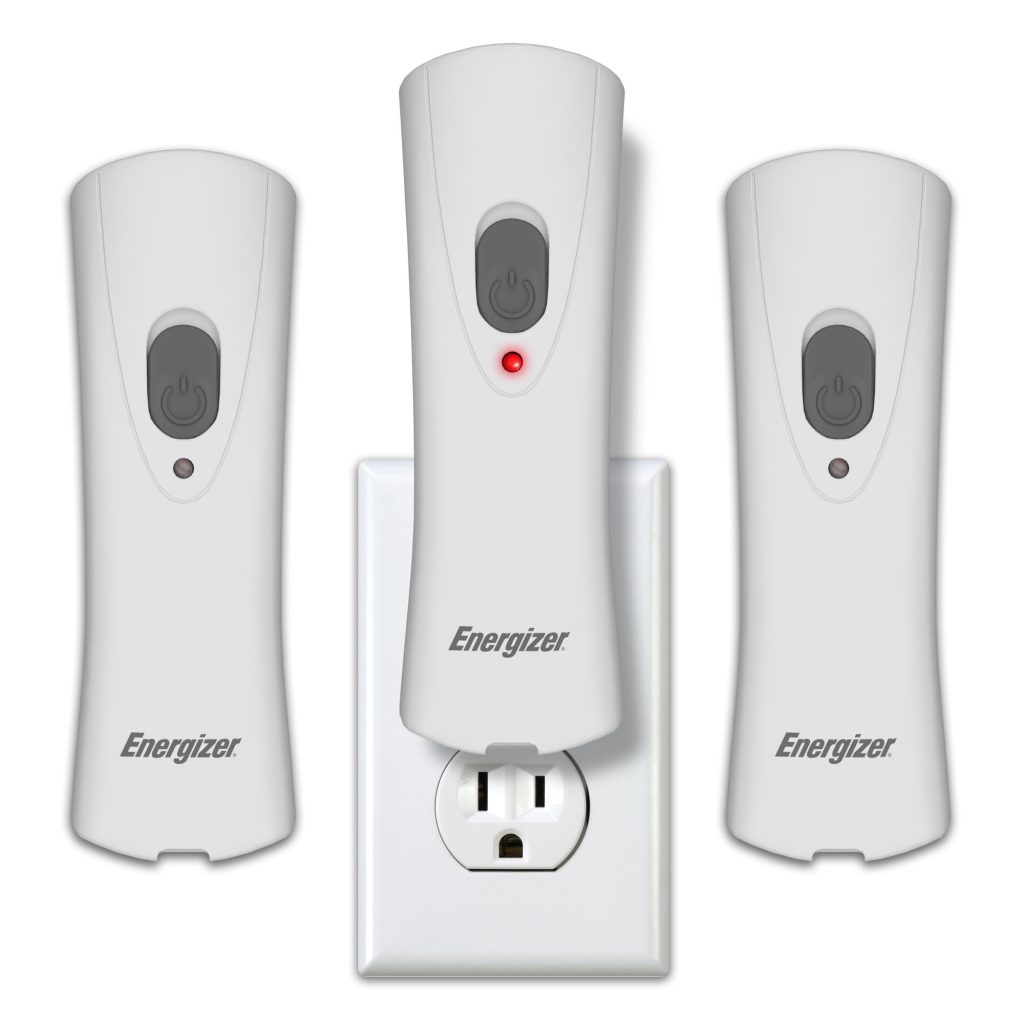
The worst moment of an outage is the first ten seconds, when the house goes black and someone’s halfway down the stairs. These lights live in your outlets, keep themselves charged and switch on when the power fails. They’re best for hallways, stairs, bathrooms and kids’ rooms.
Key specs
- Output: 40 lumens
- Runtime: about 3 hours off the wall
- Battery: built-in rechargeable NiMH, charges while plugged in
- Beam: up to 30 m
- Durability: 1 m drop rating, fold-out prongs
Pros and cons
Pros
- Comes on by itself, so nobody hunts for a light
- Works as a handheld once unplugged
Cons
- About 3 hours of light is a bridge, not an all-night light
- The battery can’t be swapped
Performance analysis
These are the lights that get you to your real lights. In a two story home, put one at the top of the stairs, one at the bottom and one near the bathroom.
3. Petzl Tikka: Best Headlamp
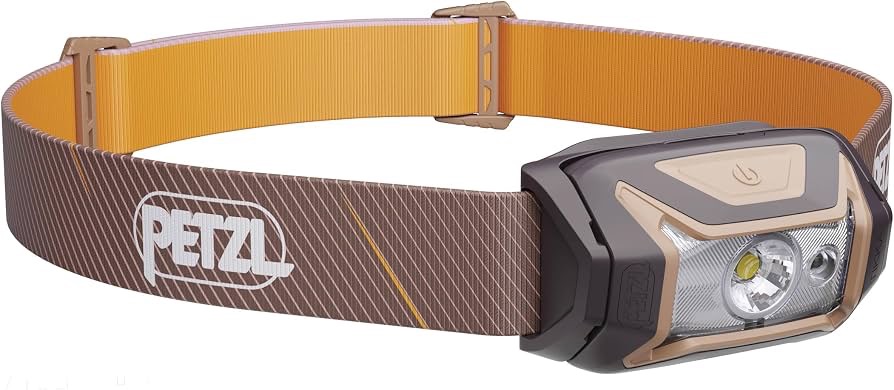
Why I chose it and who it’s for
Every outage job needs two hands, whether that’s cooking on a camp stove outside or getting a toddler dressed. The Tikka puts light wherever you look with one simple button and batteries you probably already own. It’s best as the headlamp each adult keeps by the bed.
Key specs
- Output: 350 / 100 / 7 lumens, plus red light
- Runtime: 2 h at 350, 12 h at 100, 110 h at 7 lumens
- Beam: up to 70 m
- Power: 3x AAA or Petzl’s CORE rechargeable pack
- Build: IPX4, lock function, tilting head
Pros and cons
Pros
- 12 hours at 100 lumens on one set of AAAs
- Red light won’t wake the kids
Cons
- IPX4 handles rain, not a dunk
- The CORE rechargeable pack is sold separately
Performance analysis
Live on the 100 lumen setting. It’s plenty for close work, and one set of AAAs covers a three night outage at a couple of hours a night.
4. Goal Zero Lighthouse 600: Best Room Lantern
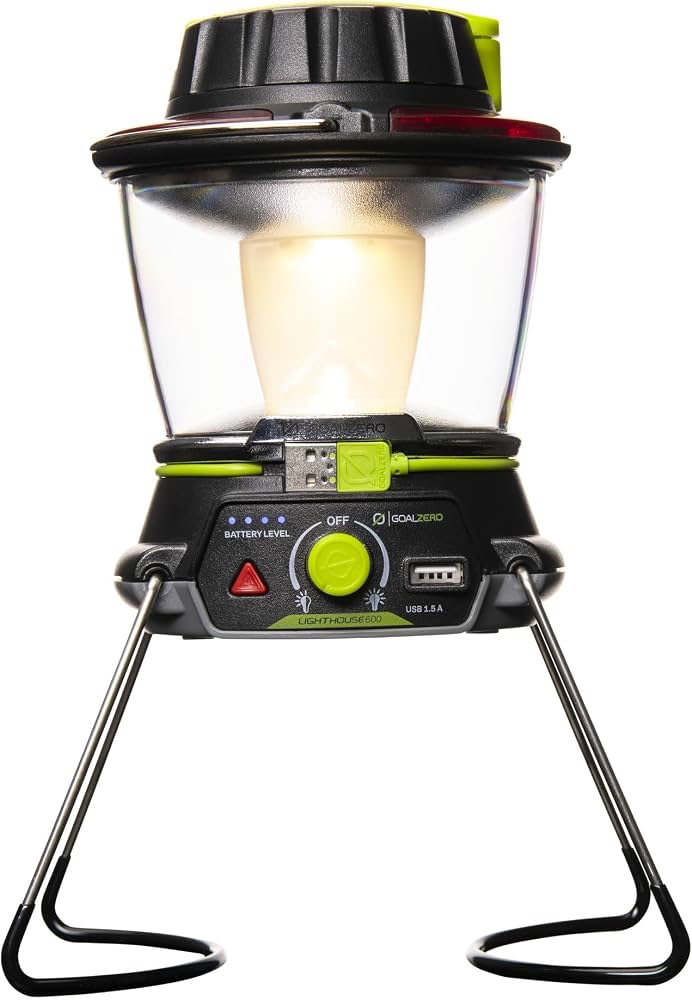
Why I chose it and who it’s for
A flashlight lights what you point it at. A lantern lights the room, and that’s what keeps a family calm after dark. The Lighthouse 600 throws light all the way around, dims to stretch its battery and doubles as a small phone charger. It’s best for the main living room or kitchen.
Key specs
- Output: up to 600 lumens, dimmable
- Runtime: 2.5 h on high, up to 180 h on low
- Battery: 5,200mAh lithium-ion
- Charging: USB, solar panel (sold separately) or built-in hand crank
- Extras: USB port for a phone, 1 lb 1.6 oz
Pros and cons
Pros
- Fills a room in a way a flashlight can’t
- The hand crank means it’s never fully dead
Cons
- High mode lasts only about 2.5 hours
- Cranking gives short top ups, not a full charge
Performance analysis
Don’t run it on high. Set it in the middle and put it up high so the light spreads off the ceiling. Recharge it from a power bank each morning.
5. Midland ER310: Best Emergency Radio
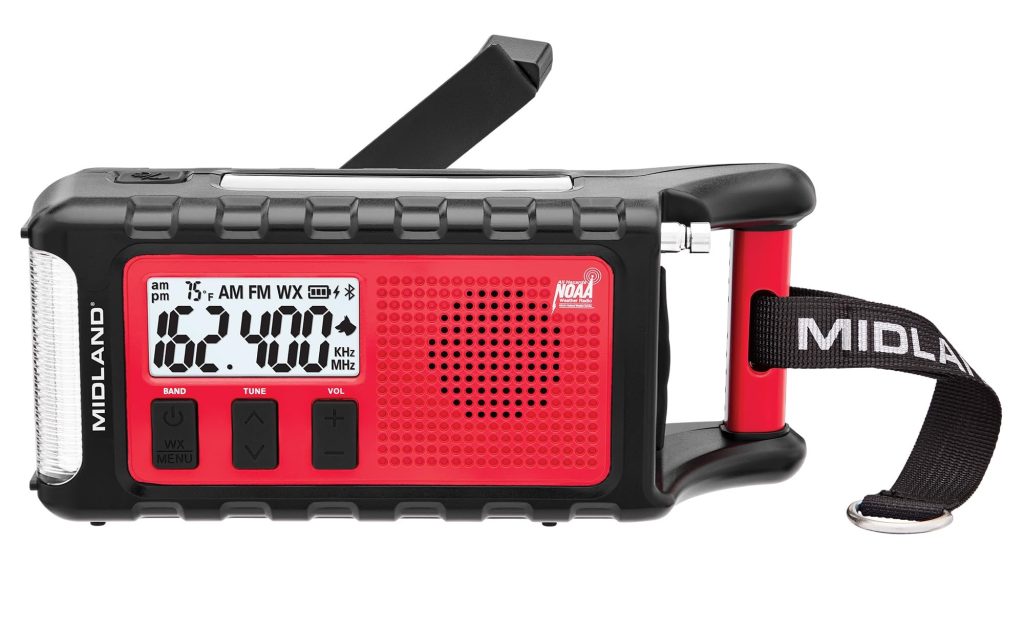
Why I chose it and who it’s for
When cell service is jammed or towers lose power, a radio is how you learn when the storm is over and when crews are coming. The ER310 picks up NOAA weather alerts and takes power from four sources, so it keeps talking on the fourth day. It’s best as the one radio for the household.
Key specs
- Bands: digital AM, FM and NOAA weather with alerts
- Power: rechargeable lithium-ion, 6x AA backup, solar panel and hand crank
- Runtime: up to 32 hours
- Extras: SOS flashlight, USB output for devices, high frequency dog whistle
- Size: 8 x 3.4 x 2.4 in
Pros and cons
Pros
- Four ways to power it
- Sounds an alert when officials issue a warning for your area
Cons
- Charging by crank is slow work
- No shortwave band
Performance analysis
Keep the internal battery charged and a fresh set of AAs in a bag beside it. The crank and solar panel are for day three and beyond.
Power Banks, Power Stations and Generators
Phones are the easy part. A phone needs about one full charge a day in an outage, and a 20,000mAh power bank gives you roughly three, so one bank per phone covers most three day outages. Rechargeable lights can share those banks too, and my best rechargeable flashlight guide covers the ones worth owning.
A CPAP changes the picture. Depending on the machine and your pressure, a night can use roughly 50 to 150 watt hours with the humidifier off and several hundred with it on. That’s power station territory. Check your machine’s manual for its DC adapter and battery guidance, and talk to your doctor before relying on battery power overnight.
A generator powers far more, but it’s also the most dangerous thing in an outage. The CDC says to keep generators outside, at least 20 feet from doors, windows and vents, and never to run one in the home, garage or carport.
6. Anker Zolo 20K Power Bank: Best Phone Backup
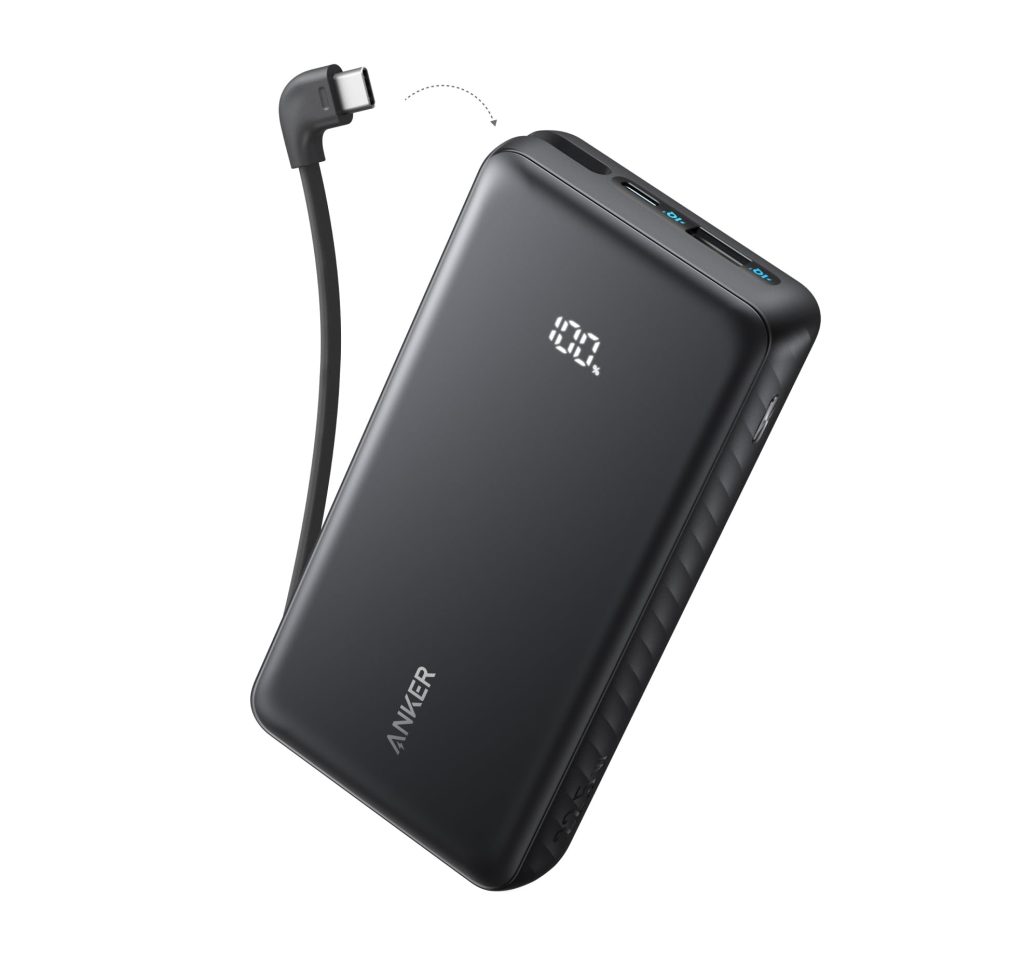
Why I chose it and who it’s for
Your phone is your news source, your link to family and your flashlight of last resort. A 20,000mAh bank keeps one going for days, and the built-in cable means nobody’s searching for a charger in the dark. It’s best as one bank per phone.
Key specs
- Capacity: 20,000mAh
- Cable: built-in USB-C
- Phone charges: roughly three for a typical phone, fewer for large ones
- Recharge: over USB-C
Pros and cons
Pros
- Built-in cable can’t go missing
- Small enough to live in the car the rest of the year
Cons
- Can’t run anything with a wall plug
- Takes hours to recharge itself
Performance analysis
Charge every bank to full the moment a storm shows up in the forecast. Turn screen brightness down and close apps you don’t need, and one charge goes a long way.
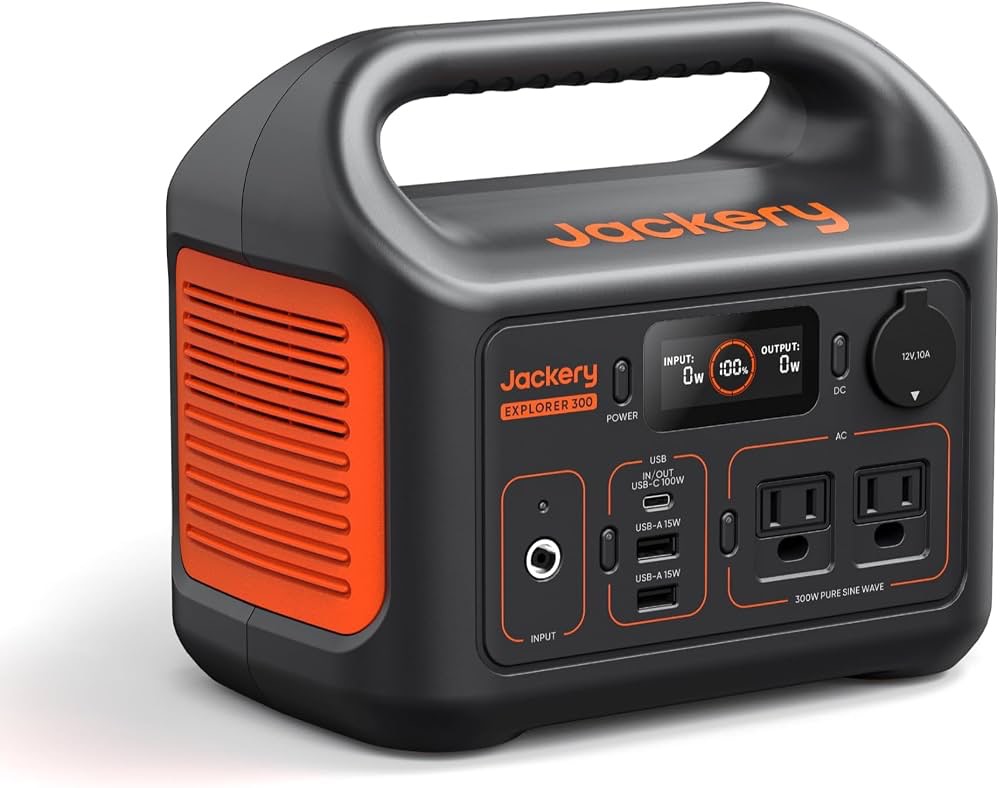
7. Jackery Explorer 300 Plus: Best Small Power Station
Why I chose it and who it’s for
Once you add a CPAP or a lot of phones, power banks stop adding up. The 300 Plus gives you a real AC outlet and enough capacity for several days of phones and lights, or a CPAP with the humidifier off for a couple of nights, depending on the machine. It’s best for households with a CPAP or three or more phones.
Key specs
- Capacity: 288Wh, LiFePO4 battery
- Output: 300W AC (600W surge), one AC outlet, two 100W USB-C ports
- Recharge: about 2 hours from the wall, solar input supported
- Weight: 8.3 lb
Pros and cons
Pros
- A real outlet for small AC devices
- Recharges from the wall in about 2 hours
Cons
- 300W won’t run a fridge, space heater or microwave
- Much heavier than a power bank
Performance analysis
Use the USB-C ports whenever you can, since the AC outlet wastes some power converting it. If your CPAP maker sells a DC adapter, use it with the humidifier off to get the most nights. To keep a fridge cold, you need a 1,000Wh class station or a generator.
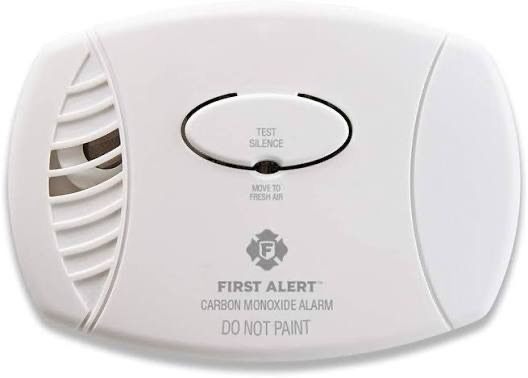
8. First Alert CO400: Best CO Alarm
Why I chose it and who it’s for
Outages are when carbon monoxide turns deadly, because people bring generators, grills and camp stoves too close to the house. Many CO alarms plug into the wall, which is the wrong design for a blackout. The CO400 runs on batteries and keeps working when everything else is off. It’s best as one alarm on every floor, near the bedrooms.
Key specs
- Power: battery operated, no outlet needed
- Sensor: electrochemical CO sensor
- Alarm: 85 dB
Pros and cons
Pros
- Works with the power out
- Easy to mount or move
Cons
- You have to test it and change the batteries
- Detects CO only, not smoke
Performance analysis
Put one near each sleeping area and one near any door where a generator or grill might end up. Of everything in this kit, this is the item most likely to save a life.
Water and Food: What to Store and What to Toss
FEMA’s rule is one gallon of water per person per day, for drinking and basic washing, so a family of four needs 12 gallons for three days. Swap out water you bottle yourself every six months. Before a storm, fill the bathtub too, so you have water to flush toilets.
For food, stock no-cook things you’d actually eat: canned soup and beans, peanut butter, crackers, cereal and protein bars. Count three meals per person per day, and pack a manual can opener.
Then there’s the fridge. FoodSafety.gov says a closed refrigerator keeps food safe for about 4 hours, a full freezer about 48 hours and a half full one about 24. Keep the doors shut, and toss perishables like meat, dairy and leftovers that sat above 40°F for more than two hours. An appliance thermometer in each one ends the guessing.
Staying Warm or Cool Without Power
In a winter outage, pick one room, close the doors and bring everyone and their blankets into it. Sleeping bags and layers do more than any battery heater. Never heat the house with a gas oven or grill, which the CDC warns against for the same carbon monoxide reasons as generators.
In summer, battery fans, wet cloths and plenty of shade go a long way, and water needs can double in real heat. If the house gets dangerously hot or cold, head to a cooling or warming center rather than toughing it out.
Ready-Made Kit or Build Your Own?
Ready-made kits save a shopping trip, but almost all of them skimp on water and light, the two things a home outage needs most. They’re built to be carried, so water comes in tiny pouches and light comes as glow sticks. The middle path I’d take is a starter kit plus the lights, radio and water from this guide.
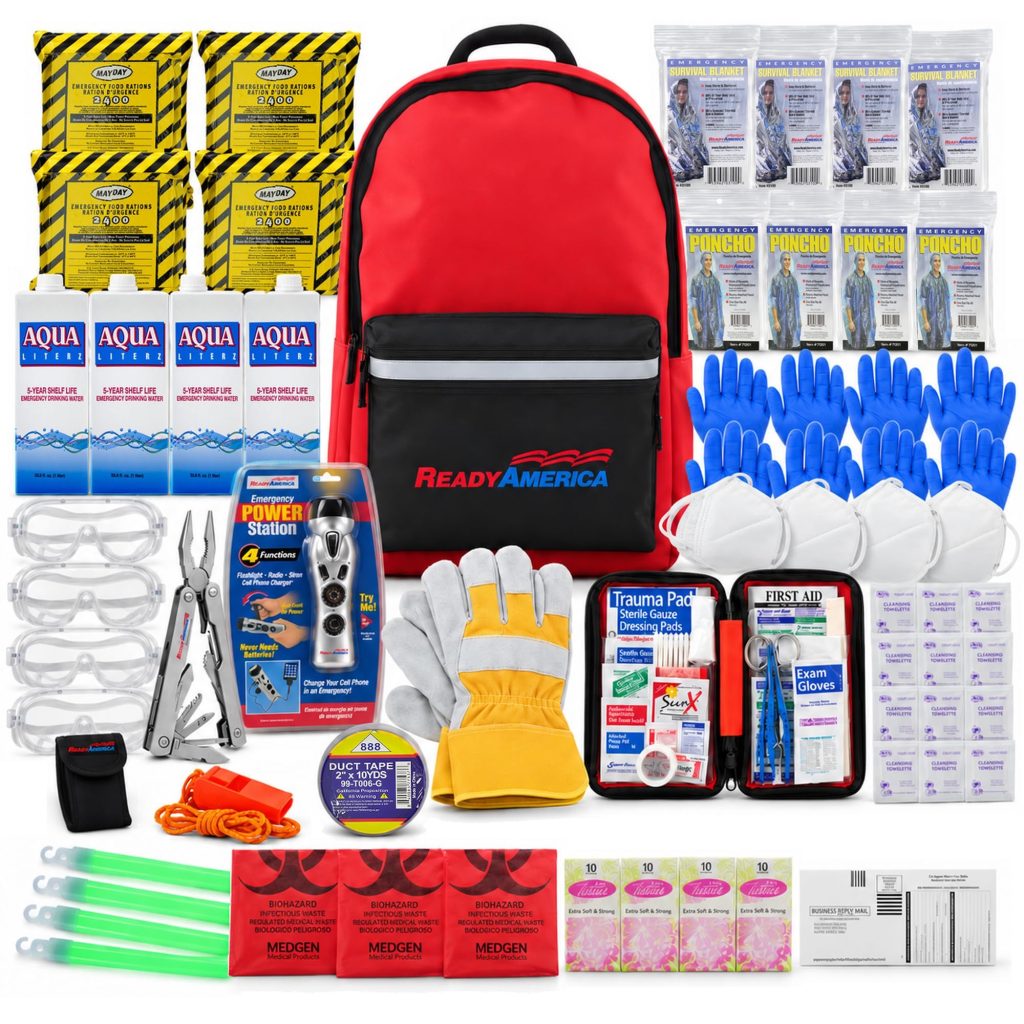
9. Ready America 72 Hour Emergency Kit: Best Ready-Made Starter
Why I chose it and who it’s for
If you want one bag you can buy today and add to later, this is a good base. It’s best for a fast start, a car kit or a grab bag in case you have to leave home.
Key specs
- Covers: 2 people for 72 hours
- Food: two 2,400 calorie bars
- Water: 12 pouches of 4.225 oz
- Light: 2 light sticks, 12 hours each
- Also: 33 piece first aid kit, 2 survival blankets, ponchos, dust masks, whistle
- Shelf life: 5 years on food and water
Pros and cons
Pros
- Everything in one backpack
- 5 year shelf life on food and water
Cons
- About 50 ounces of water in total, far short of the 6 gallons two people need for three days
- Light sticks are no substitute for flashlights
- No radio
Performance analysis
Treat it as a base layer. Add water, lights, a radio and power and you have a proper home kit. On its own it’s a go-bag, and if that’s what you’re building, pair it with one of my best survival flashlight picks.
Where to Keep Your Kit and How to Keep It Fresh
Keep the water, food and spares in one tote in a cool closet everyone knows about. Spread the lights out, though: a flashlight at each bedside, a headlamp on each adult’s nightstand and the lantern in the kitchen. A light boxed up in the hall closet won’t help you find the hall closet.
Check the kit twice a year when the clocks change. The fall change is when evenings suddenly get dark, which I cover in my clocks fall back guide. Charge the power banks, test the CO alarm and radio, and check battery and water dates.
FAQ
What should be in a power outage emergency kit?
A flashlight for every person, a headlamp for each adult, spare lithium batteries, a power bank per phone, a battery or crank radio, one gallon of water per person per day, no-cook food, a first aid kit, a week of medicine and a battery CO alarm.
How much water do I need for a power outage?
One gallon per person per day, which is FEMA’s guideline. A family of four needs 12 gallons for three days, plus extra for pets and hot weather.
How long does food last in the fridge during a power outage?
About 4 hours with the door closed. A full freezer stays safe for about 48 hours and a half full one for about 24. Throw out perishables that were above 40°F for more than two hours.
Is a power station worth it for power outages?
For phones alone, power banks are enough. A power station earns its place when someone uses a CPAP or another medical device, or when you need to run small AC devices. A fridge or space heater needs a much bigger station or a generator.
The Bottom Line
A good power outage emergency kit is mostly light, water and a way to keep phones alive, sized for the people in your house. If you only buy a few things this week, make them a ThruNite Archer 2A V3 per person, Energizer Weatheready plug-in lights for the halls, a Petzl Tikka per adult and the water.
Then add the Midland ER310, an Anker Zolo power bank per phone and a First Alert CO400 on every floor. If someone in your home uses a CPAP, the Jackery Explorer 300 Plus is what lets them sleep through it. Run the planner, print your list and tape it inside the box.
