
The power always quits at the worst possible minute. Somebody’s pouring the spaghetti into the colander, the dryer buzzer is going off down the hall, and then the whole house just stops humming. For a second everybody freezes like it’s musical chairs. Then the shuffle starts: a phone flashlight waving from the couch, a shin finding the coffee table, and somebody elbow deep in the junk drawer after the flashlight with the crusty batteries they swore they swapped out last fall.
Short on time? Skip to my picks
Now run that same minute in a house with a few rechargeable bulbs in the right sockets. The kitchen blinks dark for half a breath, and the lamp by the window just keeps glowing like nothing happened. The hallway light does the same. Nobody has to go find anything, and supper makes it to the table hot.
I’ll level with you before you buy a box, though. These bulbs only charge while the switch is on, a cheap one can be running on fumes before the movie’s over, and the cordless kind sold for wall sconces won’t come on by itself in an outage at all. Put one in a 3-way lamp or on a dimmer and it may not work right either. Get those few details right and they’re about the easiest storm prep there is, since they sit in your lamps doing their regular job until the night you need them.
Here’s my short list. The GE LED+ Battery Backup is the bulb I’d put in the lamp everybody heads for first, and it pulls out of the socket and works as a flashlight. NEBO, the flashlight company, makes the Blackout Backup, which I’d want in the hallway because it’ll glow on low for 12 hours, and the Neporal LITE PRO carries the biggest battery here for those long ice storm nights. Right under the picks there’s a house check. Tap the lights you’d want on in an outage, tell it how long your outages usually last, and it shows you which bulb to buy and which rooms stay lit till the power’s back.
Quick Picks: The Best Rechargeable Light Bulbs
- GE LED+ Battery Backup A21: best for the lamp your family heads to first when the lights go out, since it pulls out and works as a flashlight.
- NEBO Blackout Backup: best for hallways, stairs and bathrooms you want lit all night long.
- Neporal LITE PRO: best for ice storms, hurricanes and outages that run into days.
- JackonLux Rechargeable Emergency Bulb: best for putting a backup light in every room without spending much.
- Neporal MagicGlow: best for lamps far from an outlet and wall sconces with no wiring.
- KEHIPI E12 Rechargeable Bulb: best for candelabra sconces and chandeliers with small E12 sockets.
Rechargeable Light Bulbs Compared
Lights Out House Check: Where Do You Want Light?
Tap the lights you’d want on when the power goes out, pick the bulb you’re looking at (or let the check pick one for you), and tell it how long your outages usually last. Then hit the switch. The house goes dark at 9 PM, the bulbs that would really come back on light up, and a clock runs until the power’s back so you can see which rooms are still lit at the end. You’ll get the bulb I’d buy for outages like yours and the reason why, plus what to use in the spots a backup bulb can’t handle, like a dimmer or a 3-way lamp. You can print the whole plan for your outage kit.
1. GE LED+ Battery Backup A21: Best Overall
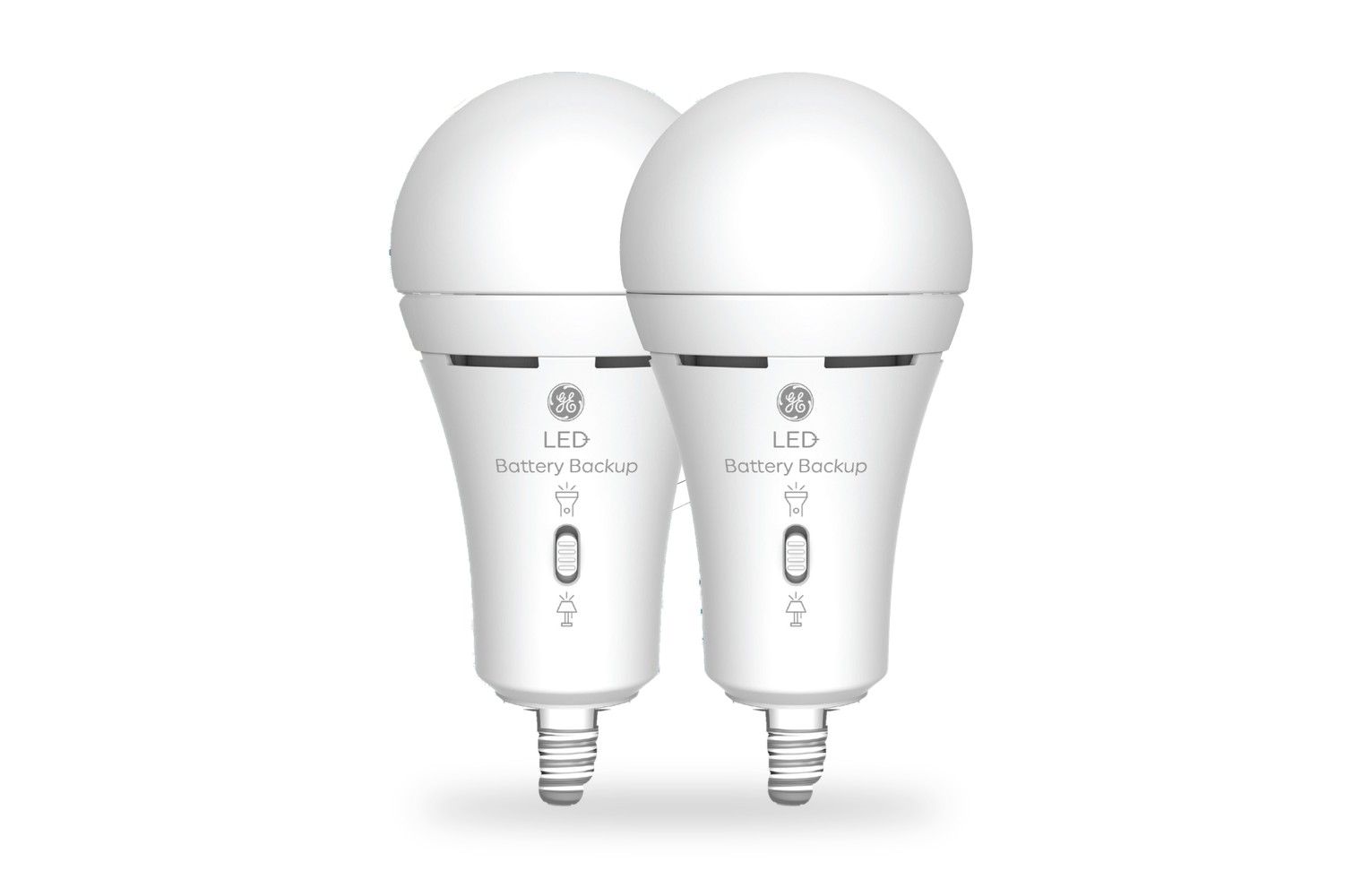
Why I chose it: GE’s backup bulb is the one I’d hand somebody who just wants it to work. Screw it into a lamp or a ceiling fixture, leave the light on for 10 hours straight the first time, and from then on it tops itself off whenever the light’s on. When the power drops, it stays lit. On the wall it puts out 760 lumens of 2700K soft white, about what an old 60 watt bulb gave you.
There’s a small switch on the side of the bulb. Turn the fixture off, unscrew the bulb and slide it to flashlight mode, and you’re carrying light down to the basement to check on the sump pump. The battery inside is LiFePO4, the same long-lived lithium chemistry the better power stations use, and GE puts a 3 year warranty on it.
Key specs
- Brightness on the wall: 760 lumens, 2700K
- Battery runtime: Up to 5 hours
- Battery: LiFePO4 lithium
- First charge: 10 hours, switched on
- Flashlight mode: Built-in switch
- Base and shape: E26, A21
- Dimmable: No
- Warranty: 3 years
Pros
- Comes back on by itself the second the power quits
- Works as a handheld flashlight with no extra parts
- LiFePO4 battery holds up to years of charging
- GE backs it for 3 years
Cons
- No low mode to stretch the battery
- The A21 body runs a little taller than a standard bulb
- Much dimmer on battery than on the wall
In real use: Put the GE in whichever lamp your family drifts toward when the lights go out, usually the one between the kitchen and the living room. Five hours covers supper, the dishes and getting the kids to bed. Since there’s no low setting, I’d switch it off at bedtime and let a battery lantern carry the night.
Expect it to look dimmer once it’s on battery. GE’s own packaging puts battery mode around 95 lumens, a soft lamp glow, and it fades a bit more near the end of a long run. That’s plenty to eat by and walk around by. It isn’t reading light for the whole evening.
2. NEBO Blackout Backup: Best for All-Night Light
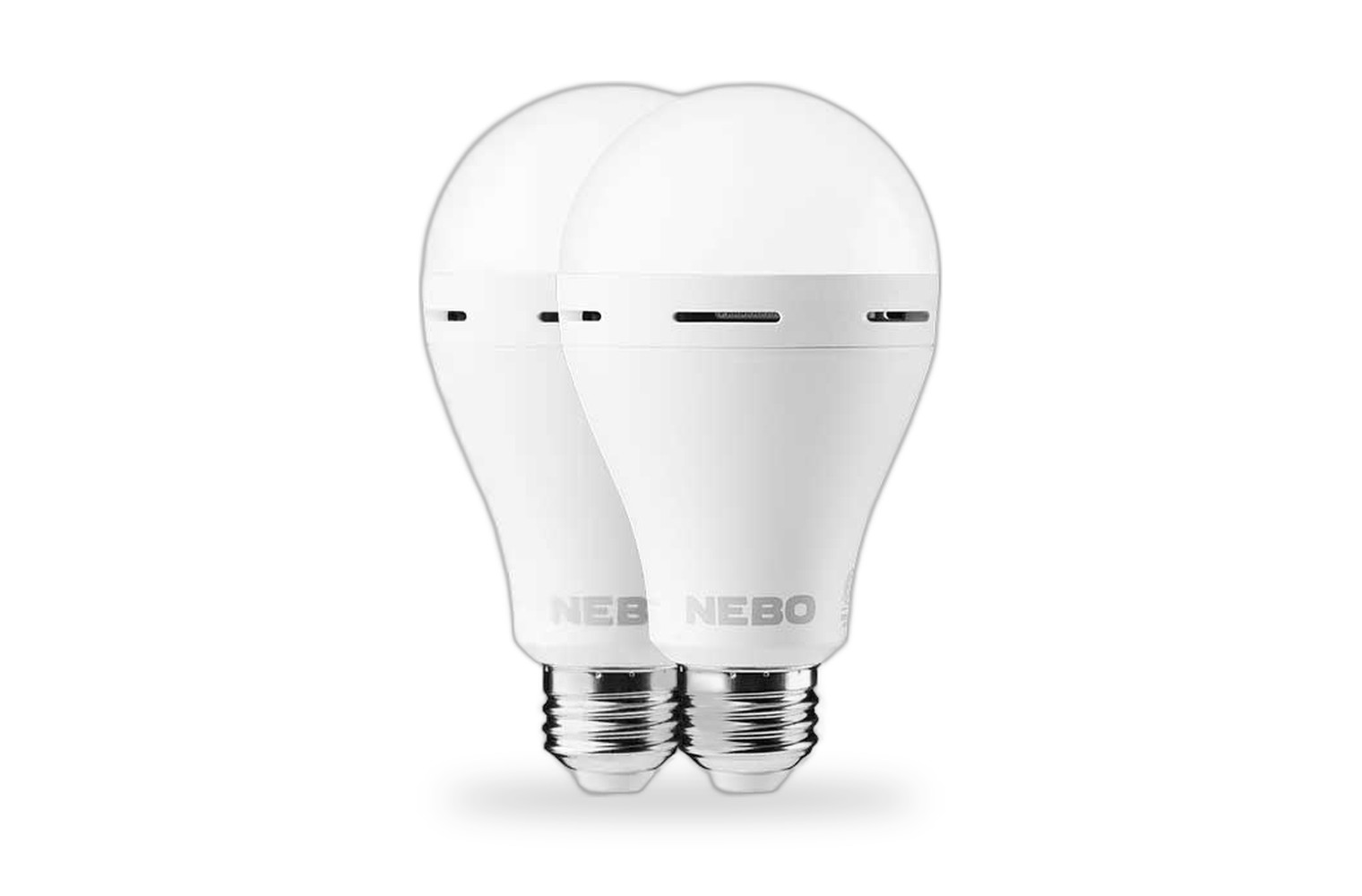
Why I chose it: NEBO makes flashlights first, and it shows here. On the wall the Blackout Backup is an ordinary 850 lumen, 3000K bulb. When the power goes out it switches itself to backup mode, and then you choose how bright it runs with the switch you already have: flick it off and back on within a second and it steps between 500 lumens for about 2 hours, 185 lumens for 6 and 80 lumens for 12. Eighty lumens doesn’t sound like much, but in a dark hallway it’s plenty to see the stairs and the dog at 3 AM.
It also knows the difference between you unplugging a lamp and a real outage, so it won’t light up every time you turn something off. NEBO spells that out in the Blackout Backup FAQ. A power cap with a hook comes in the box, so you can screw the bulb into it, press the button and hang it in the bathroom or garage.
Key specs
- Brightness on the wall: 850 lumens, 3000K
- Backup high: 500 lumens, about 2 hours
- Backup medium: 185 lumens, about 6 hours
- Backup low: 80 lumens, about 12 hours
- First charge: 12 hours, switched on
- Base and shape: E26, A21
- Extras: Power cap with hook
- Dimmable: No
Pros
- Three backup levels from your wall switch
- 12 hours on low gets a hallway to sunrise
- Power cap turns it into a hanging lantern
- Won’t light up when you just unplug the lamp
Cons
- Only about 2 hours at its brightest
- NEBO says not to mix it with other bulbs on the same switch
- One year warranty, shorter than the GE
In real use: Hallways, stairs and bathrooms are where the NEBO earns its spot. On a stormy night, leave the hallway light switched on and set to low, and if the power drops at 2 AM nobody wakes up to a pitch black house. NEBO wants a full 12 hour charge the first time and again after an outage, so once the power’s back, leave that light on through the next day.
If the fixture holds two or three bulbs, put a NEBO in every socket. A mix of regular and backup bulbs on one switch can keep them from turning on and off properly.
3. Neporal LITE PRO: Best for Multi-Day Outages
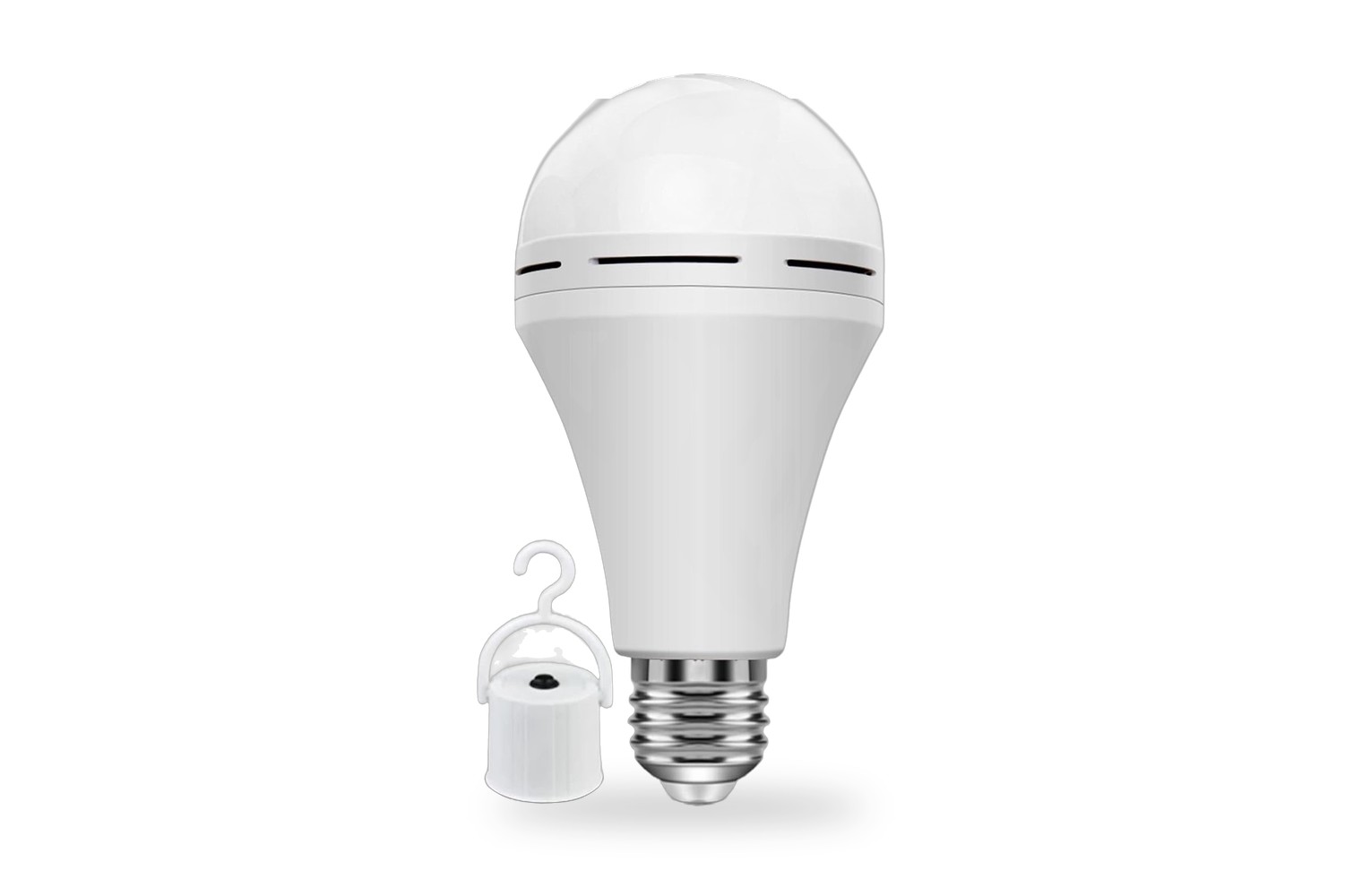
Why I chose it: When an ice storm takes the lines down for three days, battery size is what matters, and the LITE PRO carries a 2600mAh cell, the biggest you’ll find in a screw-in backup bulb. Neporal rates it for at least 8 hours at full battery brightness and up to 3 days on its lowest setting. In battery mode it has three levels, 100, 50 and 10 percent, and it still works off your normal wall or lamp switch with no remote or app to fuss with. It’s UL certified.
On the wall it’s a 15 watt, 800 lumen bulb in daylight, white or soft white, sold in 4 and 6 packs. Don’t expect anywhere near 800 lumens on battery, though. A 2600mAh cell holds a little under 10 watt hours, so full battery mode works out closer to a strong night light, and that’s exactly how it stretches to 8 hours and beyond.
Key specs
- Brightness on the wall: 800 lumens, 15W
- Battery: 2600mAh
- Battery runtime: 8+ hours full, up to 3 days low
- Battery levels: 100, 50 and 10 percent
- Base and shape: E26, A23
- Colors: Daylight, white, soft white
- Safety listing: UL certified
Pros
- Biggest battery in a screw-in backup bulb
- Low setting stretches across several nights
- Plain switch control, nothing to pair
- 4 and 6 packs cover the whole house
Cons
- The A23 body is bigger than a normal bulb
- No charge light, so you can’t tell how full it is
- A little dim for long reading sessions
In real use: Put LITE PROs where you’ll actually live during a long outage: the living room lamp, the kitchen light and the hallway. Run them on full through supper, drop them to 10 percent after the dishes, and they’ll still have something left the next evening. Pair them with a portable power station and you can recharge a couple of bulbs in a lamp plugged into it during the day.
Measure before you order. The A23 body is wider and taller than the bulb that’s probably in your lamp now, and a short harp or a small shade can rub against it.
4. JackonLux Rechargeable Emergency Bulb (4-Pack): Best Budget Multi-Pack
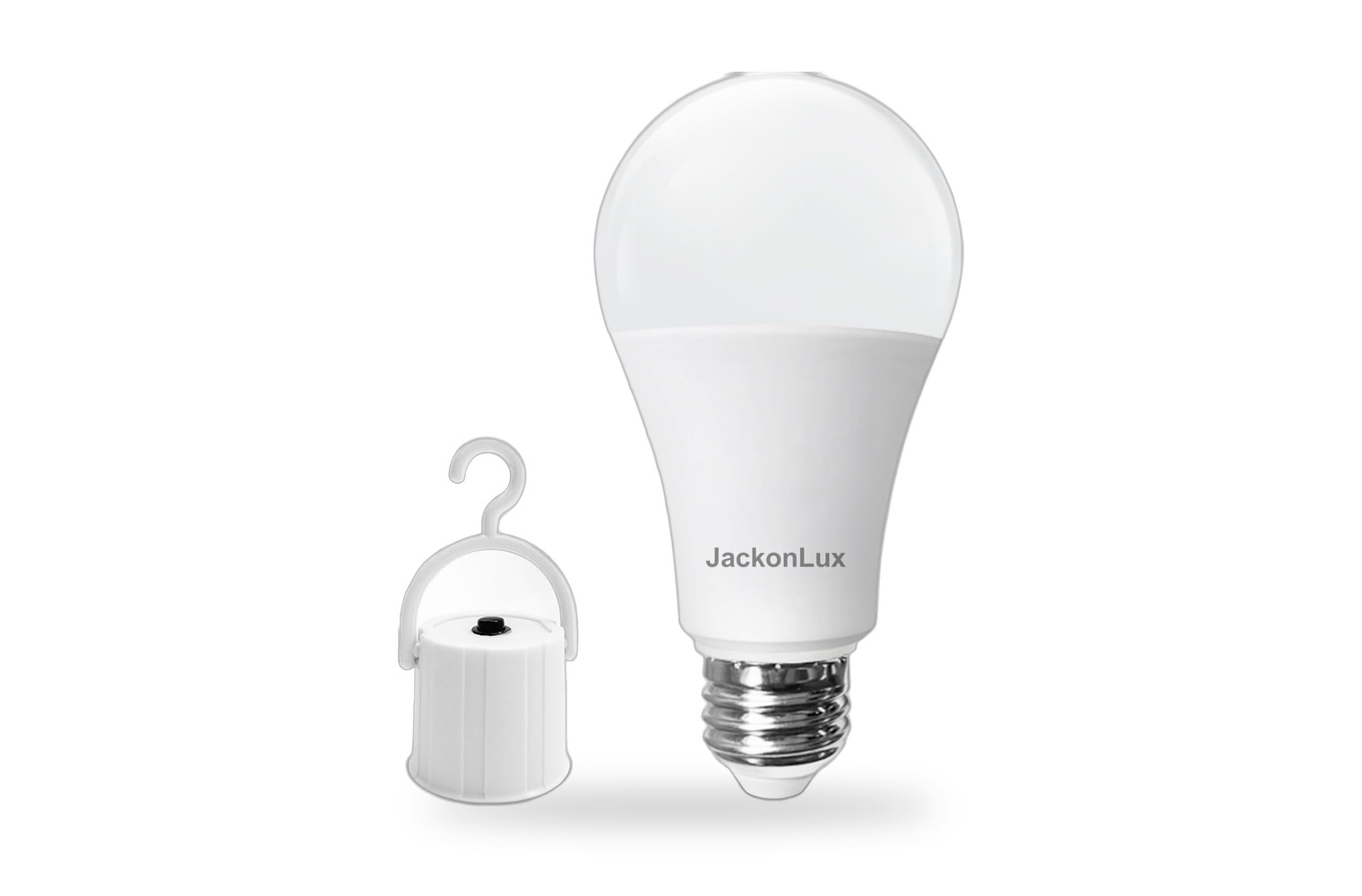
Why I chose it: Not every room needs the fancy bulb. JackonLux makes a plain backup bulb that does the basic job well: UL listed, 9 watts and 850 lumens of warm 3000K light on the wall, sold in packs so the bathroom, the laundry room and the kids’ rooms all get one. Inside is a 2000mAh battery that gives you up to 500 lumens when the power goes out, slowly dimming over 2 to 3 hours.
A full charge takes 10 to 12 hours of on time, and it doesn’t have to be all at once. A few evenings of normal use fills it up.
Key specs
- Brightness on the wall: 850 lumens, 3000K
- Battery: 2000mAh
- Battery runtime: 2 to 3 hours, dimming
- Brightness on battery: Up to 500 lumens
- Full charge: 10 to 12 hours, switched on
- Base: E26
- Safety listing: UL listed
- Dimmable: No
Pros
- UL listed and sold in multi-packs
- Warm 3000K light that looks like a normal bulb
- Charge time can add up over a few evenings
- Bright at the start of an outage
Cons
- Short runtime, so it bridges you to the flashlights
- No low mode
- Fades steadily instead of holding its brightness
In real use: Think of these as the bulbs that keep the house from going pitch black while you get the lanterns going. Bathrooms, closets, the laundry room and a kid’s bedside lamp are the right spots. Two to three hours is enough to finish what you were doing and get everybody settled, and by then the emergency flashlights should be in hand.
5. Neporal MagicGlow: Best for Lamps With No Outlet
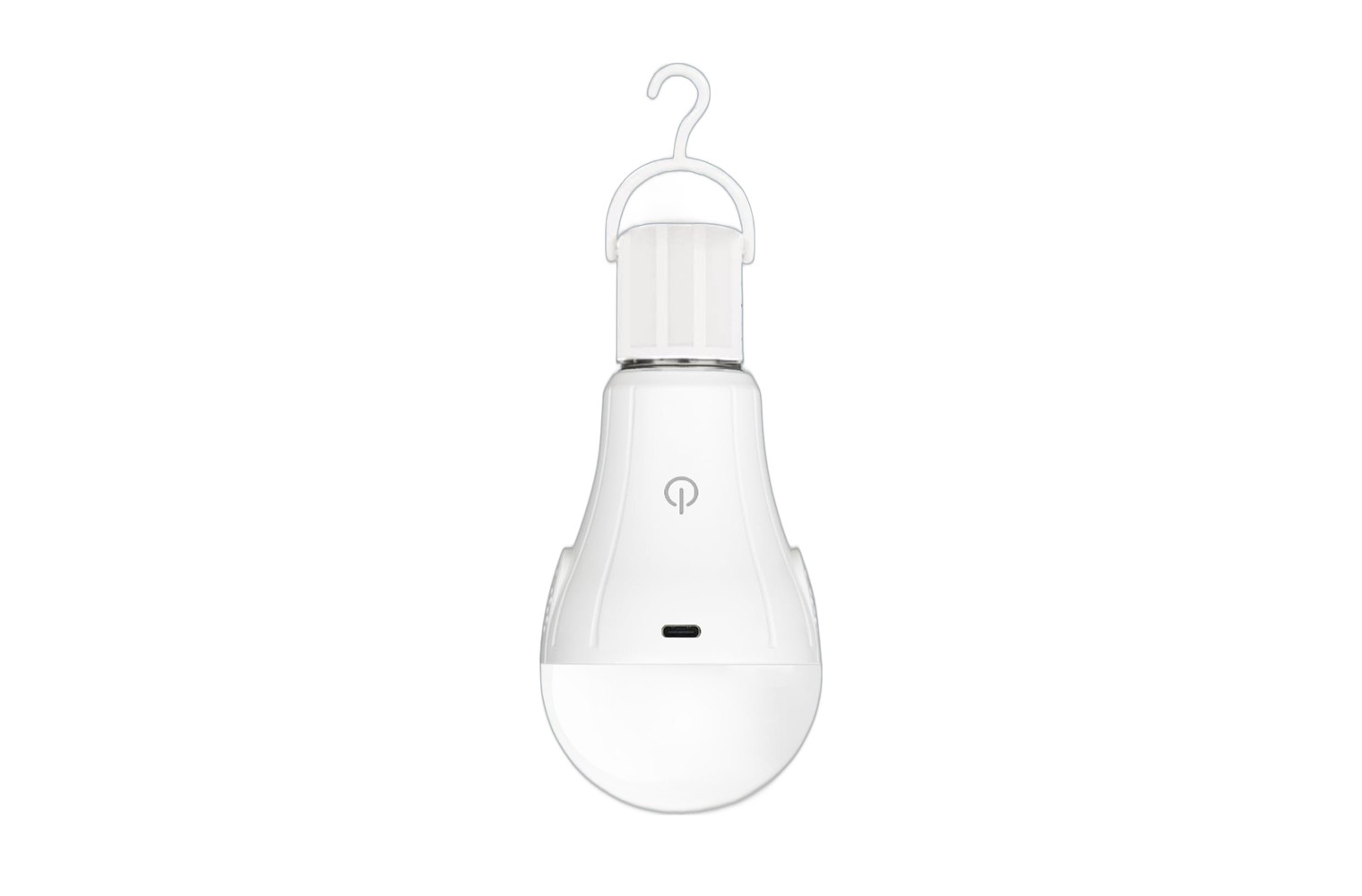
Why I chose it: This one’s a different animal. The MagicGlow doesn’t run off house power at all. It’s a cordless bulb with a battery inside that you charge with a USB-C cable, so it lights a lamp that’s nowhere near an outlet or a wall sconce that was never wired. The remote, or a tap on the bulb, turns it on, dims it smoothly and switches between three shades of white from warm to cool, and there’s a timer that shuts it off on its own.
Neporal rates it at 800 lumens at full and up to 24 hours on low. It comes as a 2-pack with two charging cables and a hook. The catch for outage planning is simple: it won’t come on by itself when the power fails, since it never knew the power was there. You turn it on with the remote.
Key specs
- Brightness: Up to 800 lumens, dimmable
- Battery runtime: Up to 24 hours on low
- Charging: USB-C cable, 2 included
- Light colors: 3 shades of white
- Controls: Remote, touch, timer
- Base and shape: E26, A19
- Pack: 2 bulbs with remote and hook
Pros
- Lights a lamp or sconce with no wiring
- One remote runs several bulbs
- Standard A19 size fits most lamps
- Refills from any USB-C power bank
Cons
- Won’t turn on by itself in an outage
- Has to come out of the fixture to charge
- Full brightness drains it far faster than 24 hours
In real use: Charge both, put one in a bedroom lamp across the room from the outlet and stash the other with the outage kit. When the lights go out you’ve got a lamp you can switch on from bed, and because it charges by USB-C, a solar power bank can top it off the next morning.
In a sconce, turn it on with the remote at dusk and set the timer so it isn’t burning all night. Keep the remote on the nightstand. In the junk drawer it’s as lost as the old flashlight.
6. KEHIPI E12 Rechargeable Bulb With Remote: Best for Candelabra Sconces and Chandeliers
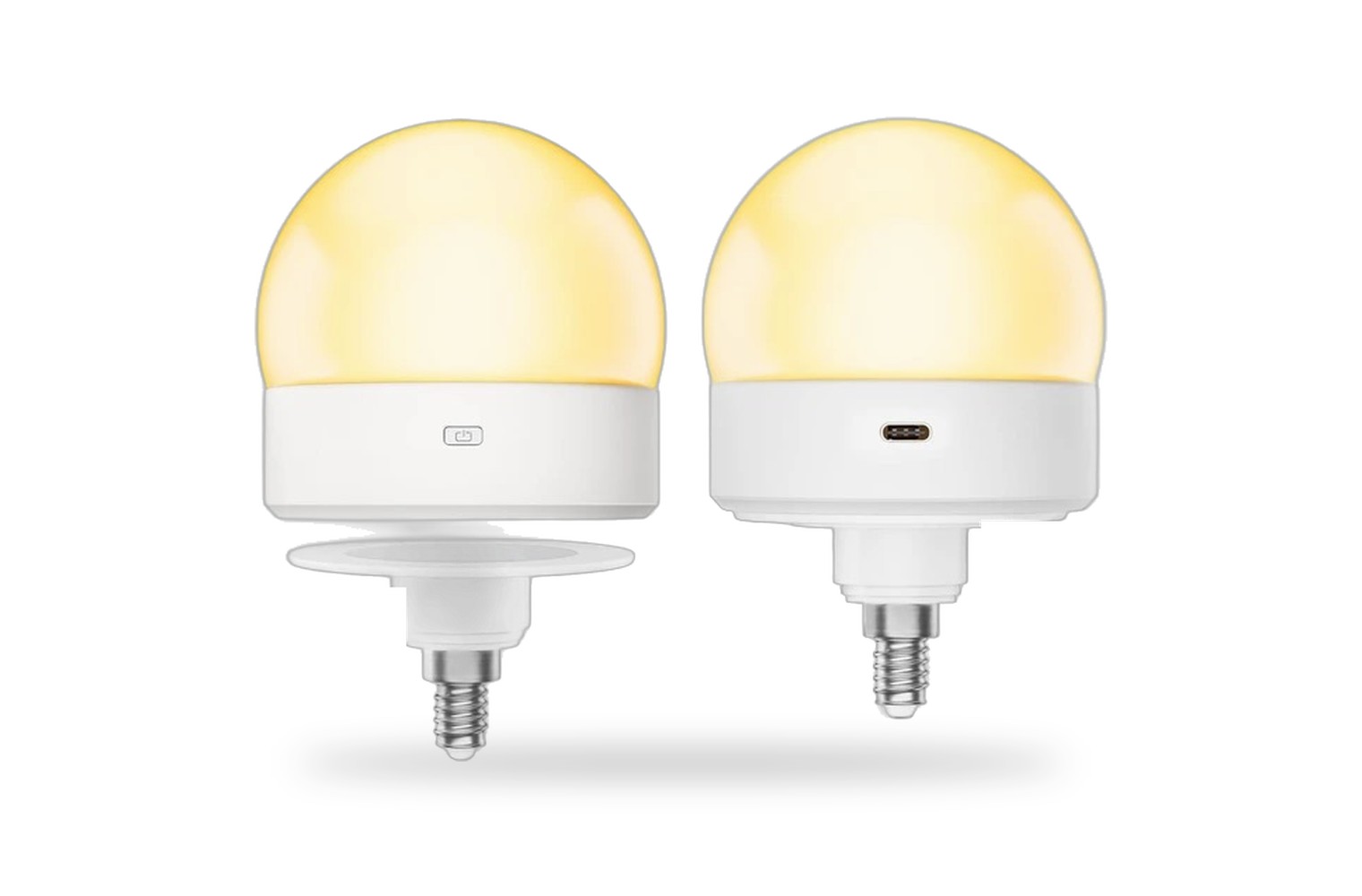
Why I chose it: Candelabra sockets are the small E12 ones in chandeliers, wall sconces and those decorative lamps with a skinny flame shaped bulb, and regular backup bulbs won’t screw into them. KEHIPI makes a cordless E12 bulb with a 4000mAh battery, the biggest on this list, and a magnetic base. The base stays screwed into the socket and the bulb pulls off the top to charge over USB-C, so you’re not twisting it in and out of a chandelier every week.
It puts out up to 400 lumens, about a 40 watt bulb, with three shades of white plus 12 colors, a dimmer and an auto off timer at 30, 60 or 120 minutes. KEHIPI rates it at about 10 to 15 hours, and a full charge takes 4 to 6 hours. Those hours are at the lower settings. At full brightness the battery math says closer to 4.
Key specs
- Brightness: Up to 400 lumens, dimmable
- Battery: 4000mAh
- Battery runtime: About 10 to 15 hours
- Charging: USB-C, pull-off magnetic top
- Charge time: 4 to 6 hours
- Base: E12 candelabra
- Timer: 30, 60 or 120 minutes
- Pack: 2 bulbs with remote
Pros
- Fits candelabra sockets regular backup bulbs can’t
- Magnetic top charges without unscrewing anything
- Biggest battery on this list
- Timer keeps it from draining overnight
Cons
- Won’t come on by itself in an outage
- 400 lumens is sconce light, not room light
- The color modes are more party than prep
In real use: Put a pair in the sconces along the stairs or in the dining room chandelier, and you’ve got light where a flashlight is clumsy. Charge them on the first cold night of the season and again every month or so after that, since any lithium battery slowly loses charge just sitting in a fixture.
Do Rechargeable Light Bulbs Charge When the Switch Is Off?
No. A backup bulb charges from the same electricity that lights it, so it only charges while the switch is on. Turn a lamp off at night and the battery just sits there. GE tells you to keep the light on for 10 consecutive hours for the first charge, and NEBO asks for 12, so plan on using those lights in the evenings like you normally would.
The same rule decides what happens in the outage itself. Most backup bulbs light up only if their switch was already on when the power failed. A bulb in a lamp you turned off at bedtime stays dark at 2 AM, because as far as it can tell nothing happened. On storm nights, leave the hallway light switched on, on its low setting if it has one, and you’ll have light the moment the power drops.
How Long Do Rechargeable Light Bulbs Last in an Outage?
Most backup bulbs give you 2 to 5 hours at their brightest. The ones with a low mode stretch that to 12 hours, and the LITE PRO to days. The number on the front of the box is the wall brightness, though, and the battery can’t keep that up. Multiply the battery’s mAh by 3.7 and divide by 1,000 and you get watt hours. A 1200mAh bulb holds about 4.4 watt hours, and a 2600mAh bulb about 9.6.

A 60 watt equivalent LED pulls 8 or 9 watts on the wall, so a bulb that stayed at full wall brightness would be flat in about an hour. That’s why NEBO’s figures look the way they do: 500 lumens for 2 hours, 80 lumens for 12. When a cheap bulb promises 800 lumens for 6 hours from a 1200mAh battery, the math doesn’t hold up. Cold rooms and old batteries cut every one of these numbers too, so plan on less than the box during a winter storm.
Rechargeable Light Bulbs for Lamps
Two kinds of bulb work in lamps, and they solve different problems. A backup bulb like the GE, NEBO or LITE PRO goes in a lamp that’s plugged in. It acts like a normal bulb every day and keeps the lamp lit when the power fails. A cordless bulb like the MagicGlow goes in a lamp that doesn’t have to be plugged in at all, which is handy for a lamp in a corner with no outlet, a table on the screened porch or a lamp you’d like to carry from room to room.
Watch the size. Backup bulbs carry a battery in the base, so many are A21 or A23, taller and wider than the A19 bulb your lamp probably has now. Measure from the socket to the top of the harp before you buy, and make sure the shade won’t sit right on the bulb.
Battery Operated Light Bulbs With a Remote for Sconces
The bulbs sold as battery operated, wireless or cordless, usually with a remote, are the ones people buy to put light where there’s no wiring: a decorative wall sconce, a picture light over a mantel, a closet with no fixture. Most have a battery top you charge by USB-C, and some have a magnetic base that stays in the fixture while the top comes off to charge.
They make fine outage lights as long as you remember they won’t switch on by themselves. Keep them charged, set the timer so one doesn’t burn all night, and keep the remote somewhere you can find it in the dark. If you’re hanging a brand new sconce on a bare wall, a rechargeable sconce with the battery built into the fixture is the simpler way to go.
E12 Rechargeable Bulbs for Candelabra Sockets
If your sconce or chandelier takes the skinny candle style bulbs, the socket is an E12, and a standard E26 backup bulb won’t fit it. Cordless E12 bulbs like the KEHIPI are the answer there. For a chandelier you only reach with a step stool, the magnetic kind is worth it, since the base stays put and only the top comes down to charge.
3-Way Lamps, Dimmers and Fixtures With Several Bulbs
3-way lamps: The socket in a 3-way lamp has an extra contact and the switch steps through settings, and a backup bulb in one usually won’t charge or behave right. Use a cordless bulb there, or move the backup bulb to a plain lamp.
Dimmers: Every backup bulb on this list is non-dimmable, and on a dimmer they can flicker or fail to charge. Keep them on a plain on and off switch.
Fixtures with two or more bulbs: Use the same backup bulb in every socket on that switch. NEBO warns that a mix of bulbs can keep them from turning on and off properly.
Closed glass globes: Batteries don’t like heat, and a sealed globe on the ceiling traps plenty of it. Check that the box says enclosed fixtures are fine before you put one there, and keep backup bulbs in open lamps and fixtures where you can.
How Many Rechargeable Bulbs Do You Need?
Fewer than you’d think. One in the lamp where everybody gathers, one in the hallway or at the top of the stairs, and one in each bathroom covers most homes. Add one in the kitchen if you cook after dark, and one in each kid’s bedside lamp if they’re scared of the dark. That’s four to six bulbs, which is why the multi-packs make sense.
For anything past the first night, bulbs are only part of the plan. Lanterns and headlamps run longer on a set of batteries, and a power station can recharge the bulbs themselves. My power outage emergency kit list has the rest, and the power outages by state page shows how often the lights go out where you live.
Buying Guide: What to Look For in Rechargeable Light Bulbs
Backup or cordless. Decide this first. Backup bulbs charge in a live socket and turn on by themselves when the power fails. Cordless bulbs charge by USB-C, work with no wiring at all and need you to switch them on.
Battery size and a low mode. A bigger mAh number only helps if the bulb lets you run it dimmer. A low setting is what turns 2 hours into 12.
Brightness on battery. The box lumens are wall lumens. Look for the battery mode figure, or work it out from the battery size the way I did above.
Size and base. Check A19, A21 or A23 against your lamp harp, and E26 against E12 for sconces and chandeliers.
Safety listing and battery type. A UL or ETL listing means the bulb went through outside safety testing. LiFePO4 batteries like the one in the GE handle heat and years of charging better than ordinary lithium cells.
Color temperature. 2700K to 3000K looks like the warm lamps most homes have. 5000K and up is daylight white, good for a garage or a closet and harsh in a bedroom.
Frequently Asked Questions
Do rechargeable light bulbs charge when the switch is off?
No. They charge only while the switch is on and the bulb has power. Leave each one switched on for 10 to 12 hours the first time, then normal evening use keeps it topped off.
How long do rechargeable light bulbs last when the power goes out?
Most last 2 to 5 hours at full battery brightness. Bulbs with a low mode run longer, like the NEBO at 12 hours on low and the Neporal LITE PRO at up to 3 days on its lowest setting. Cold rooms shorten every one of those times.
Can you leave a rechargeable light bulb in the socket all the time?
Yes. Backup bulbs are made to live in the socket and work as your everyday bulb. Their charging circuit stops once the battery is full, so leaving them in place is how they stay ready.
Do rechargeable bulbs work in 3-way lamps or on dimmers?
Usually not. Backup bulbs are non-dimmable, and in a 3-way socket or on a dimmer they may not charge or switch properly. A cordless bulb with a remote works fine in a 3-way lamp since it runs on its own battery.
The Bottom Line
For most homes, the GE LED+ Battery Backup is the rechargeable light bulb I’d buy first. It comes on by itself when the power drops, runs on a battery built to last, and pulls out of the lamp to work as a flashlight. If you want a light that burns all night in the hallway, the NEBO Blackout Backup steps down to 80 lumens for 12 hours with a flick of the wall switch, and when your outages run into days, the Neporal LITE PRO has the battery to cover them.
Fill out the rest of the house with a pack of JackonLux bulbs for the bathrooms and closets. For a lamp with no outlet or a sconce with no wiring, the Neporal MagicGlow is the one to get, and the KEHIPI E12 handles candelabra sockets. Then tap your own house into the check above, cut the power and see which rooms make it to sunrise.
Bulbs are your first hour of light, so keep a battery lantern, a rechargeable headlamp and a good emergency flashlight handy for the rest of the night.
Keep reading