
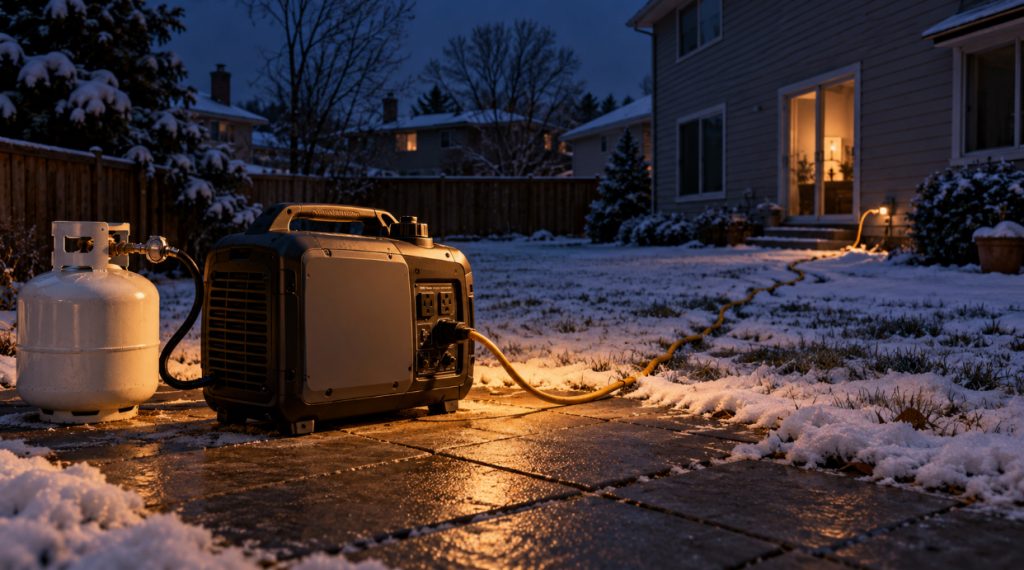
A dual fuel inverter generator runs on gasoline or propane and makes clean, steady power that’s safe for a fridge, a furnace board and the phone in your hand. That combination is why it’s the generator I’d buy for outages.
Most generator lists mix in loud open frame machines and say little about where the thing should sit. Every pick below is an inverter, every one shuts itself off if carbon monoxide builds up around it, and every spec comes from the maker. I looked at how much output each loses on propane, how long a 20 lb tank really lasts, and which ones can feed a transfer switch.
Below are six picks, from a 43 lb unit for a fridge and a CPAP to a 9,000 watt machine that can run most of a house. If you’re not sure what size you need, the What Can It Power? tool further down adds up your appliances and shows which generator fits and how much fuel the outage will take.
Quick Picks
Dual Fuel Inverter Generators Compared
All six have an automatic carbon monoxide shutoff and run on gasoline or propane. Makers measure noise in different ways, Champion at 23 feet and Westinghouse at its quietest setting, so treat the noise numbers as a rough guide.
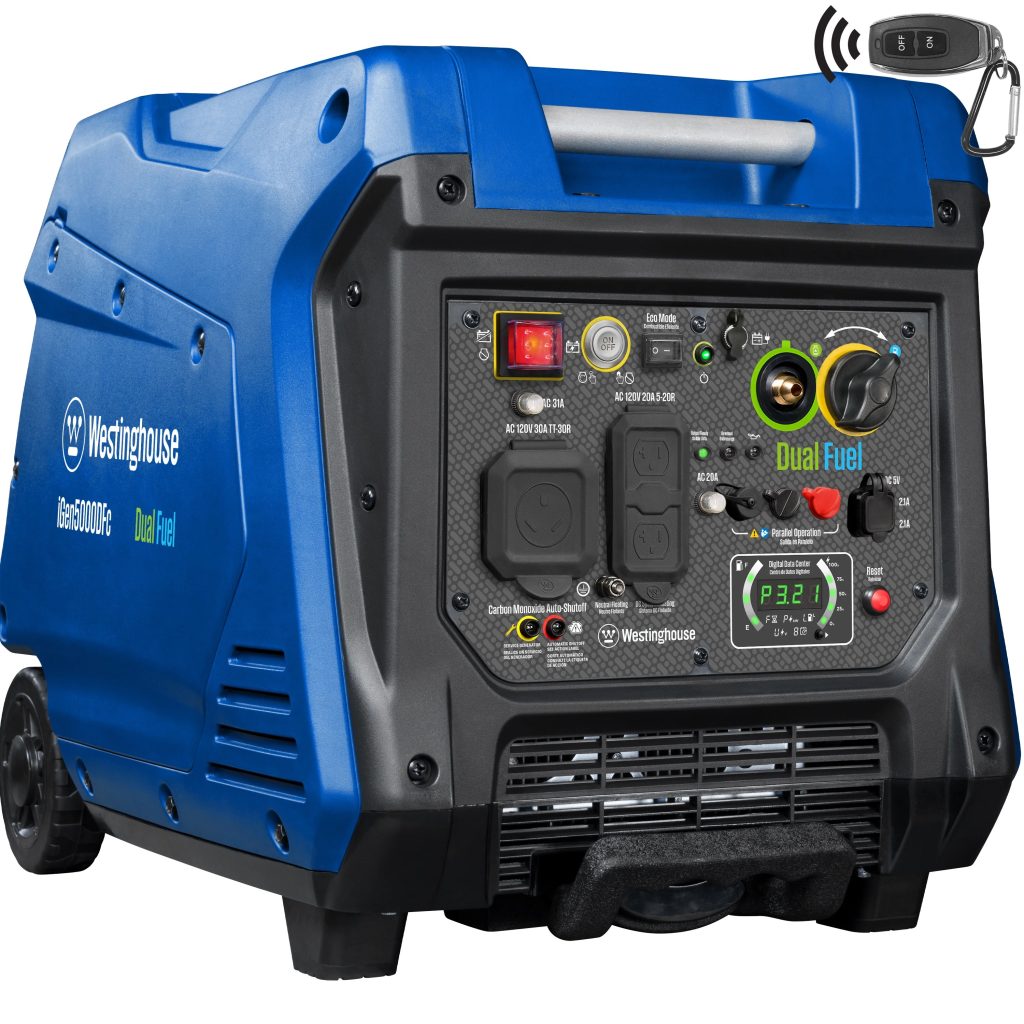
1. Westinghouse iGen5000DFc: Best Overall
Why I chose it and who it’s for
This is the generator I’d point most households to. It makes 3,900 running watts on gas and 3,500 on propane, which covers a fridge, a gas furnace blower, lights and phones with room to spare.
It starts three ways: a remote key fob, a push button and a pull cord. At 52 dBA it’s also the quietest of the larger picks. Westinghouse has replaced the iGen4500DFc with this model on its own site, so if you see the older name on a listing, this is the newer version with more output. It’s best for homes that don’t need 240V.
Key specs
- Gasoline: 5,000 peak and 3,900 running watts
- Propane: 4,500 peak and 3,500 running watts
- Runtime (Westinghouse): up to 18 hours on a 3.4 gallon tank and 22 hours on propane, both at 25% load
- Outlets: one TT-30R RV outlet, one 5-20R duplex, two USB
- Start: remote key fob, electric and recoil
- Safety: CO sensor with automatic shutdown, low oil shutdown
- Noise: 52 dBA
- Weight: 105.8 lb
- Warranty: 3 years
Pros and cons
Pros
- Strong output for its size on both fuels
- Remote start means you don’t walk outside in a storm to start it
- Quiet enough for close neighbors
Cons
- No 240V outlet, so it can’t feed a 240V well pump
- Not CARB compliant, so not sold in California
- Over 100 lb, so it rolls rather than carries
Performance analysis
At a quarter load, about 975 watts, Westinghouse rates it at 22 hours on propane. That’s a day of fridge, lights and phones on one standard 20 lb tank. Load it up with the furnace and a microwave and the hours drop, so plan on a tank a day in a cold outage.
The TT-30R outlet carries 30 amps at 120V, which makes it the right outlet for a heavy cord to a 120V inlet box or an RV. Ask your electrician what your panel setup needs before you buy for that job.
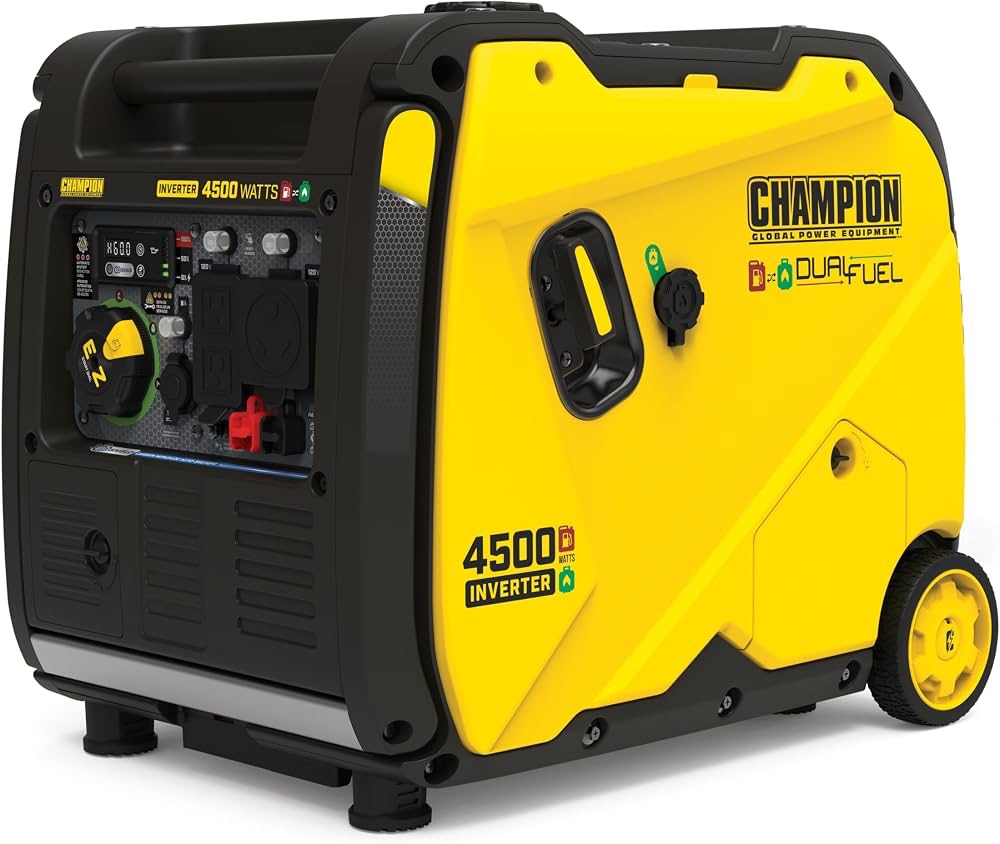
2. Champion 4500W Electric Start Dual Fuel Inverter: Best Value
Why I chose it and who it’s for
Champion’s 4500 watt electric start model does most of what the Westinghouse does for less money. It makes 3,500 running watts on gas and 3,150 on propane, starts with a push button and comes with the propane hose.
Champion’s CO Shield shuts the engine off if carbon monoxide builds up around the unit, and the Intelligauge readout shows voltage, frequency and run hours. It’s best for households that want fridge, furnace and lights covered without paying for extras.
Key specs
- Gasoline: 4,500 starting and 3,500 running watts
- Propane: 4,500 starting and 3,150 running watts
- Runtime (Champion): up to 14 hours on a 2.3 gallon tank and 21 hours on a 20 lb tank, both at 25% load
- Outlets: one TT-30R, one 5-20R duplex, one 12V DC
- Start: electric and recoil
- Safety: CO Shield auto shutoff, low oil shutoff
- Noise: 61 dBA at 23 ft
- Weight: 99.2 lb
- Warranty: 3 years
Pros and cons
Pros
- Same 4,500 starting watts on propane as on gas
- Push button start with a pull cord as a backup
- Parallel kit ready if you add a second unit later
Cons
- Louder than the Westinghouse
- Smaller gas tank means more refills on gasoline
- No remote start
Performance analysis
The detail I like is that its starting watts stay at 4,500 on propane. Start-up surge is what trips small generators when a fridge or furnace motor kicks on, so holding that number on propane matters more than the small drop in running watts.
Its 2.3 gallon tank is the trade-off. On gasoline you’ll refill about twice a day in a long outage, so I’d run this one on propane and keep gas as the backup fuel.
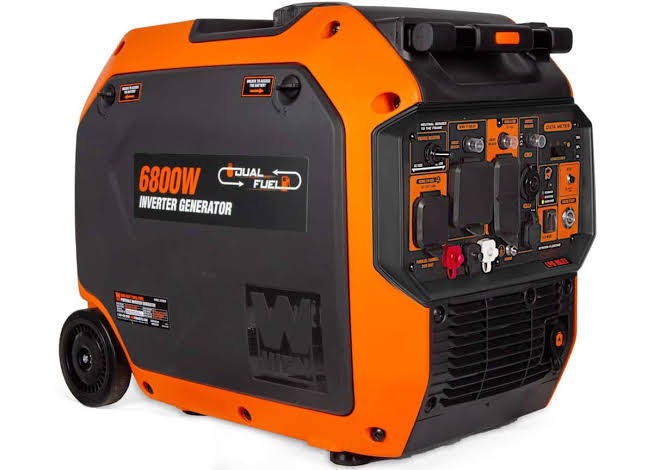
3. WEN DF680iX: Best for a Transfer Switch
Why I chose it and who it’s for
If your well pump, furnace or other key circuits are hardwired, you need a generator that can feed a transfer switch or an interlock. The DF680iX does that with a 120/240V L14-30R twist lock outlet, which is uncommon on a portable inverter.
It makes 5,100 running watts on gas and 4,500 on propane, and WEN’s Watchdog sensor shuts it down if carbon monoxide rises. It’s best for homes on a well and anyone planning a proper panel hookup.
Key specs
- Gasoline: 6,800 surge and 5,100 rated watts
- Propane: 6,000 surge and 4,500 rated watts
- Runtime (WEN): up to 6.1 hours on a 2.9 gallon tank and 9 hours on a 20 lb tank, both at half load
- Outlets: one L14-30R 120/240V, two 5-20R, one TT-30R, one 12V DC, two USB
- Neutral: bonded on 240V, per WEN
- Start: electric and recoil
- Safety: Watchdog CO shutdown sensor, fuel shutoff
- Noise: 64 dB at quarter load
- Warranty: 3 years
Pros and cons
Pros
- Real 240V output in a portable inverter
- More running watts than the 4,500 watt class
- Every common outlet type on one panel
Cons
- Small gas tank for its output
- Needs an electrician to get the most from it
- Bonded neutral may not suit every transfer switch setup
Performance analysis
WEN rates it at 9 hours on a 20 lb tank at half load, about 2,550 watts. That covers a 240V well pump, the fridge and lights through a long night. Running around the clock you’d go through two to three tanks a day, so keep several filled before storm season.
WEN lists the 240V side as bonded neutral. Some transfer switch setups want a bonded neutral generator and some want a floating one, depending on how the switch handles the neutral. Your electrician will know which you need, so show them this spec before you buy.
4. Westinghouse iGen12000DFc: Best Whole-Home
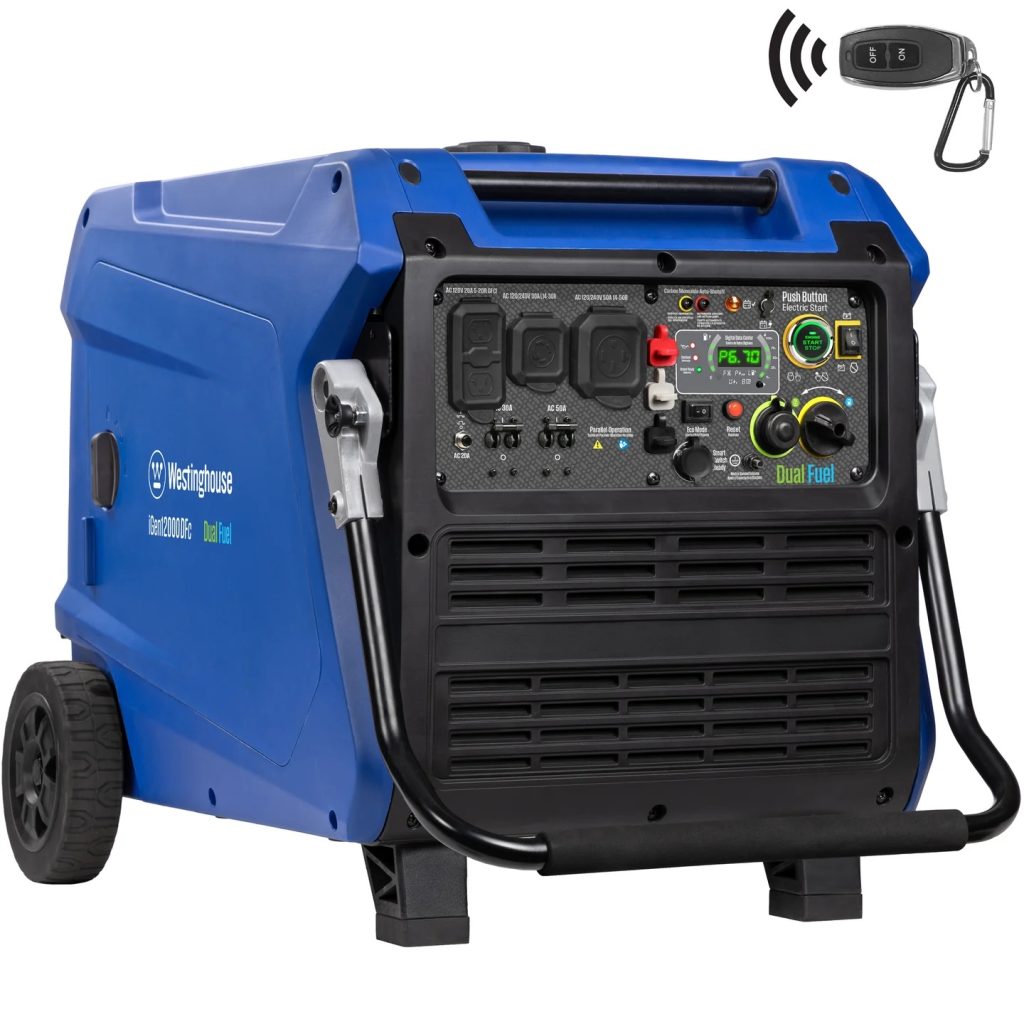
Why I chose it and who it’s for
When you want most of the house running, this is the one. It makes 9,000 running watts on gas and 8,100 on propane, enough for a well pump, a furnace, the fridge, a freezer and the kitchen at once.
It has both a 30 amp L14-30R and a 50 amp 14-50R outlet at 120/240V, and Westinghouse lists both as transfer switch or interlock ready. It’s best for larger homes and anyone who wants a single generator to cover the whole panel’s essentials.
Key specs
- Gasoline: 12,000 peak and 9,000 running watts
- Propane: 11,000 peak and 8,100 running watts
- Runtime (Westinghouse): 19 hours at 25% load and 11 at 50% on a 7.9 gallon tank; 9 hours at 25% and 5 at 50% on a 20 lb tank
- Outlets: one L14-30R, one 14-50R, one GFCI 5-20R duplex
- Neutral: bonded
- Start: remote key fob, electric and recoil
- Safety: CO sensor with automatic shutdown, low oil shutdown
- Noise: as low as 64 dBA
- Weight: 189 lb
Pros and cons
Pros
- Runs most of a house through a transfer switch
- 50 amp outlet for larger interlock setups
- Quiet for its output
Cons
- A 20 lb tank lasts 5 to 9 hours, so propane means a larger tank
- 189 lb, so it lives on its wheels
- Not CARB compliant, so not sold in California
Performance analysis
Its propane numbers deserve a close look. Per the iGen12000DFc spec sheet, a 20 lb tank lasts 9 hours at a quarter load and 5 at half load. For a long outage on propane, ask your propane dealer about a 100 lb cylinder, or run it on gas and keep propane as the backup.
On gas, 19 hours at a quarter load from the 7.9 gallon tank is excellent. That’s an overnight run with the fridge, furnace and lights on without a refill.
5. Champion 2500W Dual Fuel Inverter: Best Lightweight
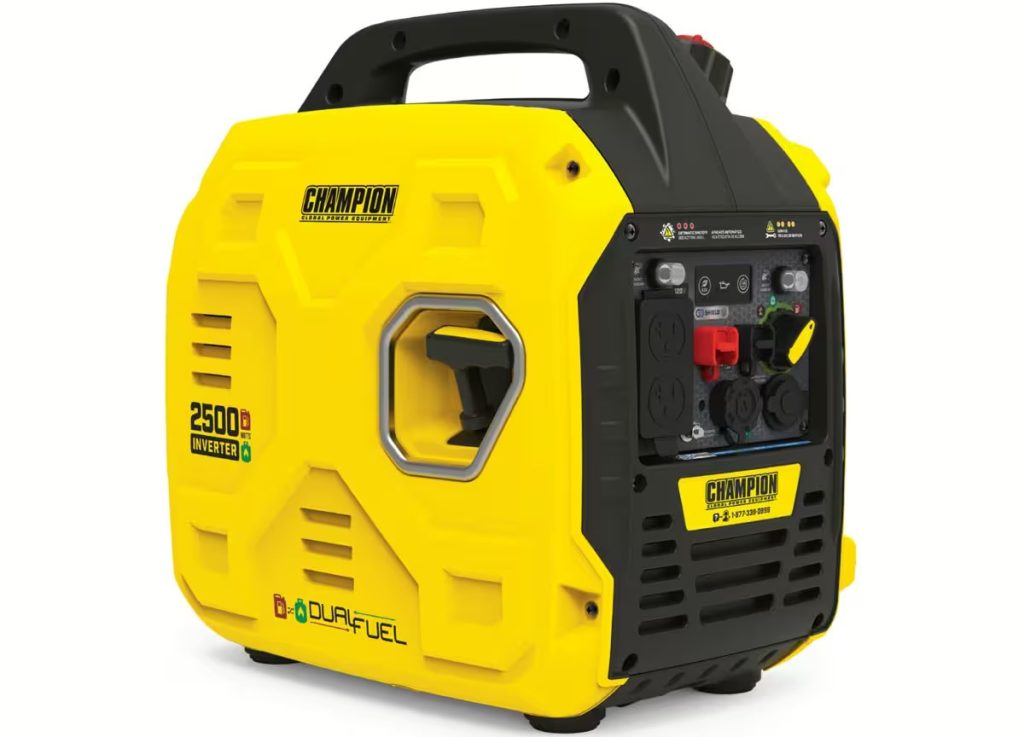
Why I chose it and who it’s for
Not every outage needs a big machine. At 43.2 lb, Champion’s 2500 watt dual fuel inverter is light enough to carry, quiet at 53 dBA, and runs up to 25 hours on a 20 lb tank at a quarter load.
It makes 1,850 running watts on gas and 1,665 on propane. That handles a modern fridge, lights, phones, a CPAP and a TV, but not the fridge, a furnace and a microwave all at once. It’s best for apartments, small homes and anyone who wants a light unit they can move without help.
Key specs
- Gasoline: 2,500 starting and 1,850 running watts
- Propane: 2,500 starting and 1,665 running watts
- Runtime (Champion): up to 11.5 hours on a 1.05 gallon tank and 25 hours on a 20 lb tank, both at 25% load
- Outlets: one 5-20R duplex, one 12V DC
- Start: recoil
- Safety: CO Shield auto shutoff, low oil shutoff
- Noise: 53 dBA at 23 ft
- Weight: 43.2 lb
- Warranty: 3 years
Pros and cons
Pros
- Light enough for one person to carry
- Longest propane runtime here at a quarter load
- Parallel ready, so two can share a load
Cons
- Pull start only
- No RV or 240V outlet
- A fridge start-up surge can be close to its limit
Performance analysis
Fridges are the question with any small generator. A modern fridge draws a few hundred watts running, but generator sizing charts list up to 2,200 extra watts for the moment its compressor starts. On paper that’s more than its 2,500 starting watts, but a newer, efficient fridge usually needs far less. Check the label, start the fridge before anything else, and if it trips the generator, step up to a 4,500 watt model.
Propane suits this one well. Twenty five hours at a quarter load means one 20 lb tank covers a full day of a cycling fridge, lights and a CPAP.
6. EcoFlow Smart Generator 3000 (Dual Fuel): Best With a Power Station
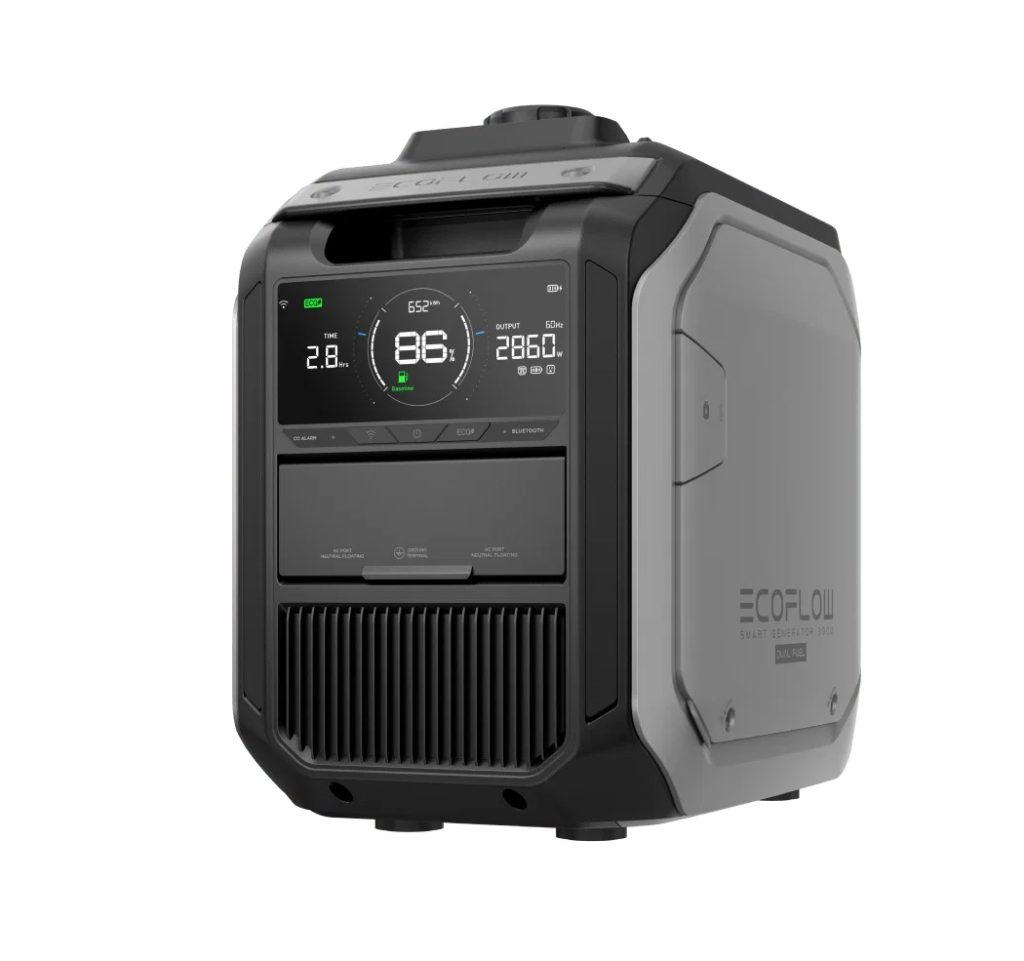
Why I chose it and who it’s for
If you already own an EcoFlow DELTA 3 Plus, this generator turns it into a small standby system. When the battery drops to a level you set, the generator starts itself, recharges it and shuts down when it’s full.
On its own it makes 2,000 running watts on gas and 1,800 on LPG through two AC outlets, and its alerts, including carbon monoxide, trigger an automatic shutdown. It’s best for anyone who bought a power station for quiet nights and wants it topped up automatically.
Key specs
- Gasoline: 2,000 rated and 3,000 peak watts
- Propane: 1,800 rated and 3,000 peak watts
- Runtime (EcoFlow): about 9 hours at 1/4 load and 3.3 at full load on a 4 L tank; up to 11 hours at full load on a 20 lb tank
- Outlets: two AC outlets
- Start: pull cord, button, app, or automatic with a DELTA 3 or DELTA 3 Plus
- Safety: CO alerts with automatic shutdown, low oil and overload alerts
- Noise: 69 dB at 23 ft, full load
- Weight: about 48 lb
Pros and cons
Pros
- Starts and stops itself to keep a DELTA 3 Plus charged
- App monitoring from inside the house
- About 48 lb, easy to move
Cons
- Auto start only works with certain EcoFlow stations
- Less output on its own than the 4,500 watt class
- Not available in California
Performance analysis
The point of this pairing is that the battery does the overnight work in silence and the generator runs in short bursts to refill it. If you’re weighing a station first, my portable power station guide covers the DELTA 3 Plus and what it runs.
EcoFlow rates it at up to 11 hours at full load on a 20 lb tank, which is strong for a 1,800 watt propane rating. EcoFlow puts that at about 20 kWh per tank, enough to refill a 1,024 Wh DELTA 3 Plus many times over.
What Can It Power?
Tap the appliances you want to keep running, pick your fuel and how long the outage might last. The tool adds up running and start-up watts, checks all six generators on gas or propane, flags anything that needs 240V or a transfer switch, and works out how much fuel the outage will take.
Appliance figures come from a utility’s generator sizing guide and are on the high side for newer models; your appliance’s label has the exact numbers. Runtimes are estimates scaled from each maker’s own runtime figure, so cold, altitude and heavy loads can shorten them.
How to Choose a Dual Fuel Inverter Generator
Why an inverter, and why two fuels
An inverter generator turns its engine’s power into clean, steady current, under 3% distortion on the Westinghouse spec sheets, so it’s safe for a furnace control board, a smart fridge and laptops. The engine also slows down when the load is light, which saves fuel and noise on long nights.
Dual fuel gives you a second supply when the first runs short. Gas pumps need power too, so stations near you may be closed, and gasoline goes stale in storage unless you add stabilizer. Propane keeps in its tank for years, and swapping a 20 lb tank is cleaner than pouring gas in the dark.
Running watts, starting watts and the propane penalty
Add up the running watts of everything you want on at once. Then add the extra starting watts of the biggest motor, usually the fridge, a sump pump or a well pump. Generator sizing charts put a fridge at about 700 running watts and 2,200 extra for the second its compressor starts.
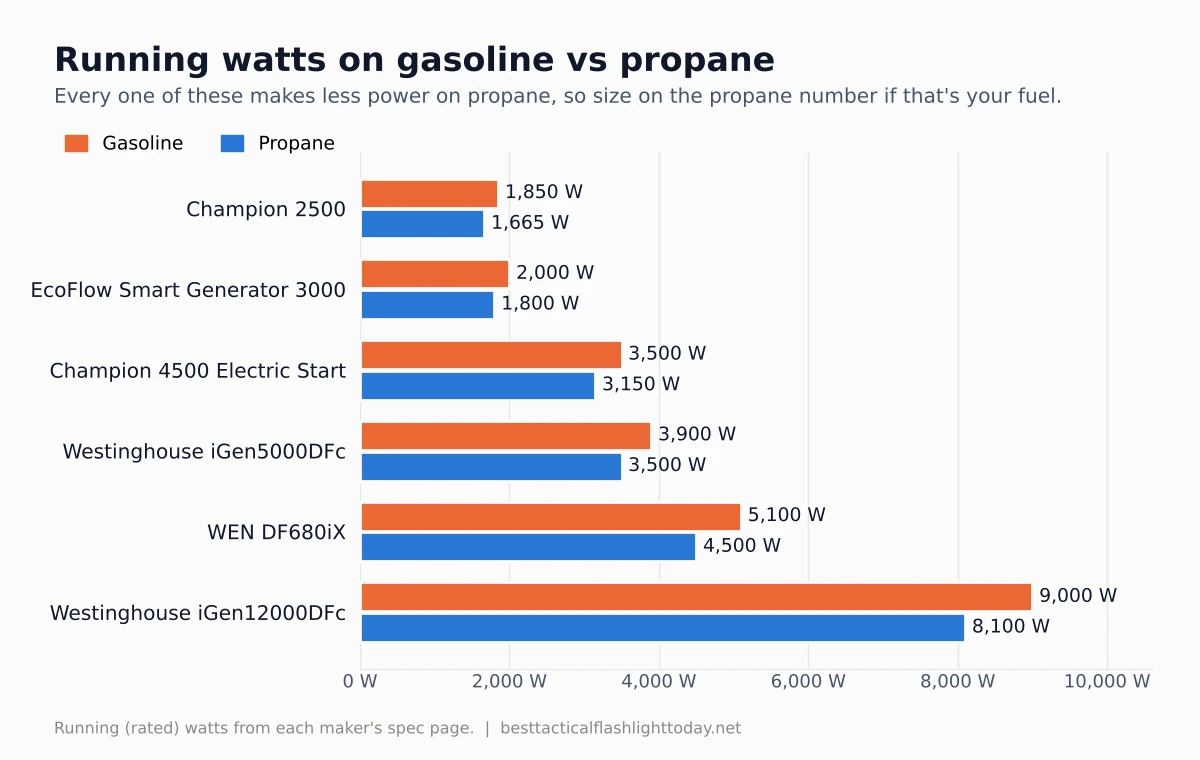
Then check the propane figure, because every one of these loses output on propane. The Westinghouse iGen5000DFc goes from 3,900 running watts to 3,500, and the Champion 2500 from 1,850 to 1,665. If you plan to run on propane, size the generator on its propane number.
How much fuel an outage takes
Maker runtimes are measured at a quarter or half load, so read them carefully. At a quarter load, the Champion 4500 runs up to 21 hours on a 20 lb tank. The big Westinghouse runs only 9, because a quarter of its output is already more than 2,000 watts.
For a 3 day outage running around the clock, most homes on a mid-size generator need three to five 20 lb tanks, or 10 to 15 gallons of stabilized gas. If you don’t know how long outages tend to last where you live, my power outages by state page shows the average hours customers go without power each year.
Heat is the load that empties tanks fastest. An electric space heater alone takes about 1,500 watts, so for a cold outage an indoor propane heater warms one room on far less fuel and leaves the generator for the fridge and furnace blower.
120V, 240V and hooking up to the house
Anything with a plug can run on extension cords from the generator. A gas furnace blower, a well pump and an electric water heater are usually hardwired, though, and many well pumps run on 240V. For those you need a 240V outlet like the L14-30R and a transfer switch or interlock installed by a licensed electrician.
A transfer switch is a small panel that moves chosen circuits to the generator. An interlock is a plate on your main panel that stops the main breaker and the generator breaker from being on together. Both keep power from flowing back into the utility lines, where it can kill a line worker. Never plug a generator into a dryer outlet with a double male cord.
Where the generator goes
The CPSC’s generator safety alert is clear: run it outdoors only, at least 20 feet from doors, windows and vents, and never in a garage, basement or shed, even with the door open. Point the exhaust away from the house.
Treat the generator’s own CO shutoff as a backup only. Put battery CO alarms, or plug-in alarms with battery backup, inside the house, and test them monthly. Let a hot engine cool before you pour in gas, and keep a rechargeable headlamp with the generator, since you’ll usually be starting and refueling it in the dark.
Pairing a generator with a power station
A power station and a generator work well together. The station runs the fridge, router and CPAP quietly overnight, and the generator runs a few hours in the day to recharge it and handle bigger loads. The EcoFlow pick automates this, but any of these generators can charge a station through its AC charger. For the rest of the plan, my power outage emergency kit guide covers what to stock alongside it.
Two add-ons worth buying
Frequently Asked Questions
Is a dual fuel inverter generator worth it?
For outages, yes. You get clean power that’s safe for electronics, lower noise and fuel use at light loads, and a second fuel when gas runs short. Propane also stores for years without going stale, which suits a generator that may sit unused between storms.
How long will a dual fuel inverter generator run on a 20 lb propane tank?
It depends on size and load. At a quarter load, makers rate the Champion 2500 at up to 25 hours, the Westinghouse iGen5000DFc at 22 hours and the Champion 4500 at 21 hours. The big Westinghouse iGen12000DFc gets 9 hours at a quarter load and 5 at half load, because it burns far more fuel.
Can a dual fuel inverter generator power a whole house?
A large one can run most of a house’s essentials. The Westinghouse iGen12000DFc makes 9,000 running watts on gas, enough for a well pump, furnace, fridge, freezer and kitchen loads through a transfer switch. Central air and electric heat usually need a standby generator.
Is it better to run a generator on gas or propane?
Gas gives slightly more power and is easier to find before a storm. Propane stores for years, burns cleaner and is easy to swap, but every generator here makes less output on it. A sensible plan is to run on propane and keep a few gallons of stabilized gas as the backup.
The Bottom Line
For most homes, the Westinghouse iGen5000DFc is the one to buy. It has enough output for the essentials on either fuel, starts from a key fob and stays quiet.
Pick the Champion 4500W Electric Start Dual Fuel Inverter to save money, the WEN DF680iX for a well pump or transfer switch, and the Westinghouse iGen12000DFc to run most of a house. The Champion 2500W Dual Fuel Inverter is the light option for a fridge and small loads, and the EcoFlow Smart Generator 3000 (Dual Fuel) belongs with an EcoFlow DELTA 3 Plus.
Whichever you choose, keep it 20 feet from the house and put battery CO alarms inside. Then run your appliances through the What Can It Power? tool above to see how much fuel to keep on hand.
