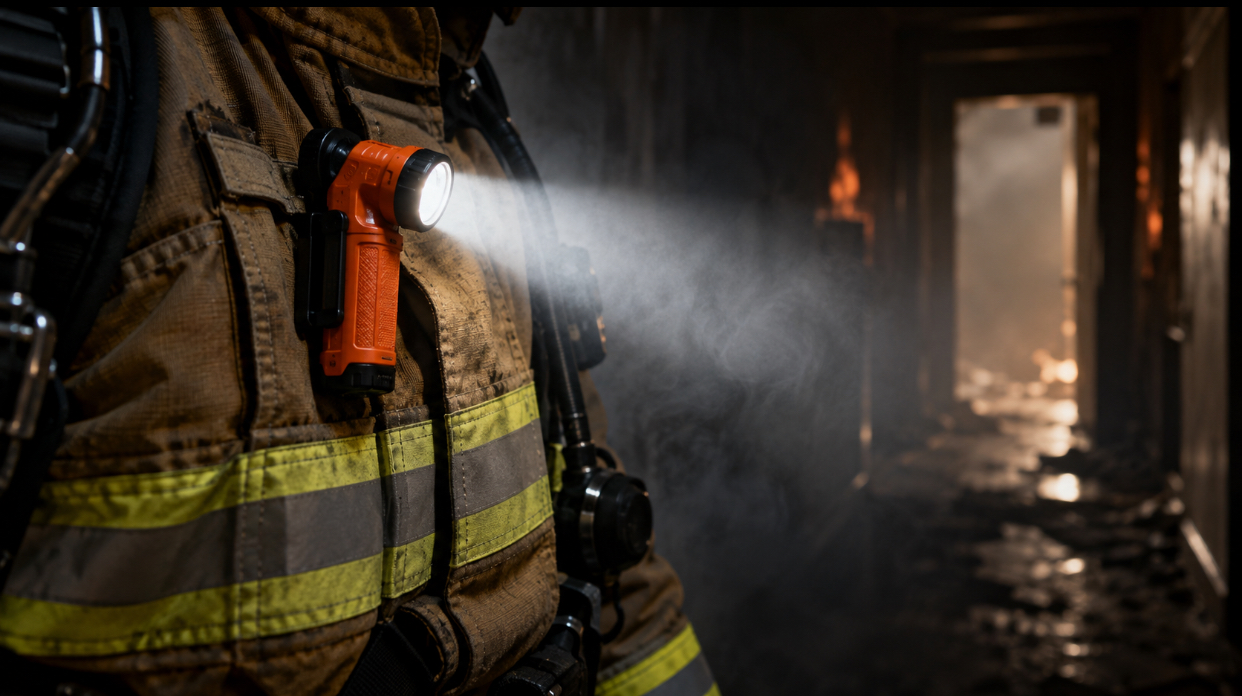
The best firefighter flashlight for most people is the Streamlight Survivor X. It clips to your turnout coat, it’s rated for hazardous atmospheres, and its tight 50,000 candela beam is built to push through smoke instead of bouncing back at you.
But one light isn’t the answer. Almost every experienced firefighter carries two: a right-angle light on the coat and a second light for the helmet or for searching. If you only buy one, buy the coat light. If you’re buying two, this guide tells you which pair makes sense for the way you work.
I’ve been writing about flashlights since 2014, and fire service lights are their own category. A 2,000 lumen tactical light that looks great in a driveway can be close to useless in a smoke-filled hallway. Lumens matter less here than beam shape, heat resistance, glove-friendly switches and a body that won’t spark in a gas leak.
Below you’ll find eight lights that cover every role, from interior attack to volunteer budgets to the box light that lives on the rig. Each one is a current model you can still buy, with specs checked against the manufacturer.
Quick Picks
Comparison Chart
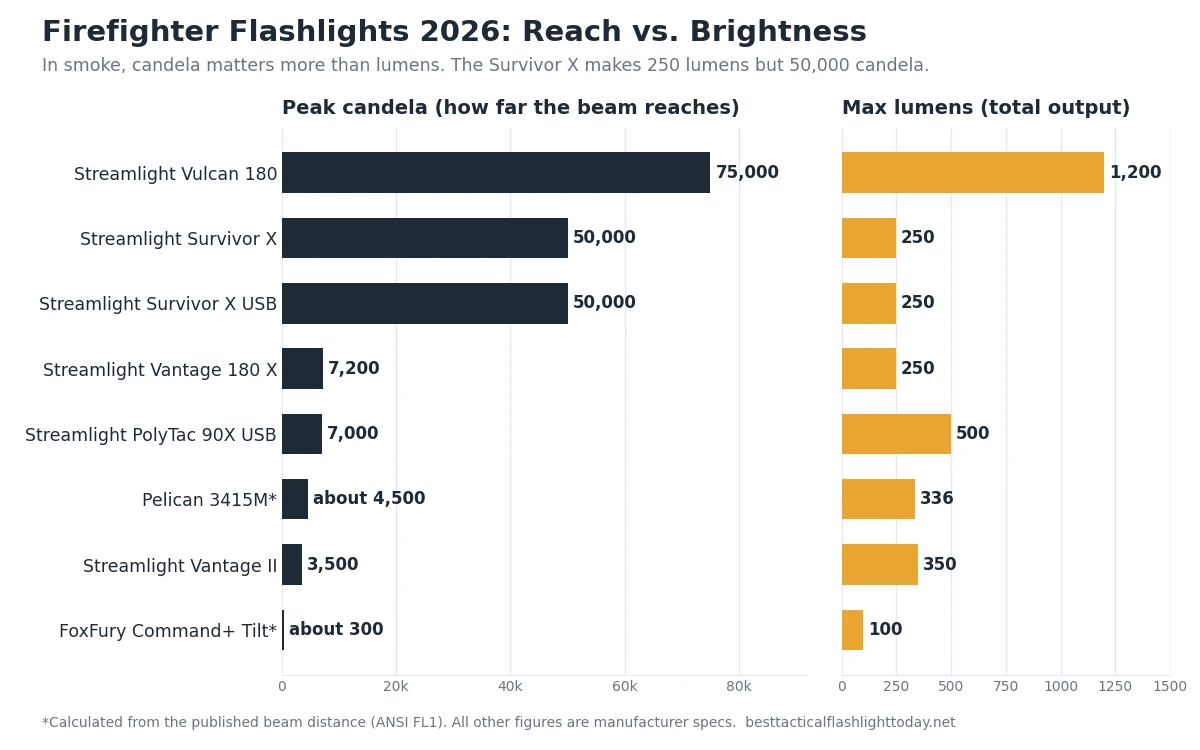
The Vulcan 180 throws the hardest beam, while the Survivor X packs the most candela into a coat light.
*Calculated from the published beam distance using the ANSI FL1 standard.
The Two-Light Setup Most Firefighters Carry
The coat light comes first. A right-angle light clipped high on your turnout coat points wherever your chest points, so it works while both hands are on a hose line or a victim. It also marks your position for the crew behind you and for a RIT team if things go bad. That’s why you’ll see it on almost every coat in the station.
The weakness is aim. Clipped to your chest, it lights what’s in front of your torso and nothing else. When you’re crawling a hallway on a primary search, your chest is pointed at the floor.
That’s where the second light earns its spot. Some firefighters run a helmet light, which follows your eyes and leaves your hands free. Others carry a box light like the Vulcan 180 on a shoulder strap, which you can aim under a bed, down a stairwell or across a big room. Truck companies and search crews tend to favor the box light. Engine crews often lean toward the helmet light.
Here’s the simple version:
- One light only: a C1D1 right-angle coat light (Survivor X or Pelican 3415M).
- Engine company: coat light plus a helmet light (Vantage II or FoxFury).
- Truck or search: coat light plus a box light (Vulcan 180).
- Tight budget or off duty: Survivor X USB or PolyTac 90X USB.
If your department issues a box light on the rig, spend your own money on the coat light and a helmet light.
1. Streamlight Survivor X: Best Overall
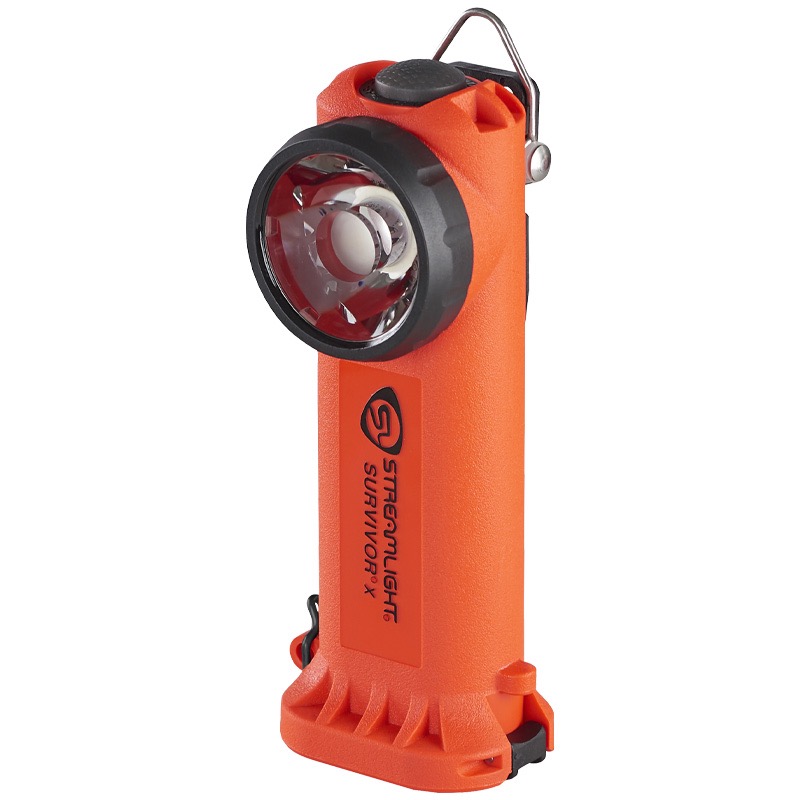
Why I chose it: The original Survivor has been the default coat light for decades, and the X version fixes its biggest weakness, which was output. It’s the light I’d point any structural firefighter toward first, career or volunteer.
Best for: interior attack crews who want one proven, intrinsically safe light on the coat.
Key specs
- High: 250 lumens, 50,000 candela, 447 m beam
- Low: 60 lumens, 14,000 candela, 237 m beam
- Runtime: 3.75 hours on high (rechargeable), 5 hours (alkaline), 15 hours on low
- Power: Li-ion pack (charged up to 1,000 times) or 3 AA with the carrier
- Rating: Class I, Division 1; meets the NFPA 1971 500°F heat test
- Build: high-impact nylon, IP67, 2 m drop rated, about 12.2 oz
Pros
- That 50,000 candela beam is the strongest in its class for a coat light
- Big rubber dome switch works through heavy structural gloves
- Rechargeable and alkaline versions share the same output
- Serialized body, which helps when lights get mixed up after a fire
Cons
- Won’t fit the older Survivor chargers, so a station upgrade means new cradles
- At about 12 oz, it’s noticeably heavier than the 9.6 oz Pelican 3415M
Performance analysis
The number that matters here is candela, not lumens. The Survivor X puts out only 250 lumens, but it focuses them into a 50,000 candela hotspot. In smoke, a wide beam lights up the particles right in front of you and creates glare. A tight beam punches deeper before it scatters. That’s why a 250 lumen Survivor X will usually show you more of a smoky room than a 1,000 lumen floody tactical light.
The clip is the other reason this design has lasted. It grips the coat hard, and the D-ring lets the light hang forward on a strap when you want it lower. The orange and yellow bodies are easy to spot if it ends up on the floor.
The one decision you’ll need to make is power. The rechargeable model lives in a 12V cradle on the rig, so it’s always topped up. The alkaline model is cheaper to run if you’re not on the rig every day, and AA batteries are easy to find anywhere. Both carry the same C1D1 rating.
2. Streamlight Survivor X USB: Best for Volunteers
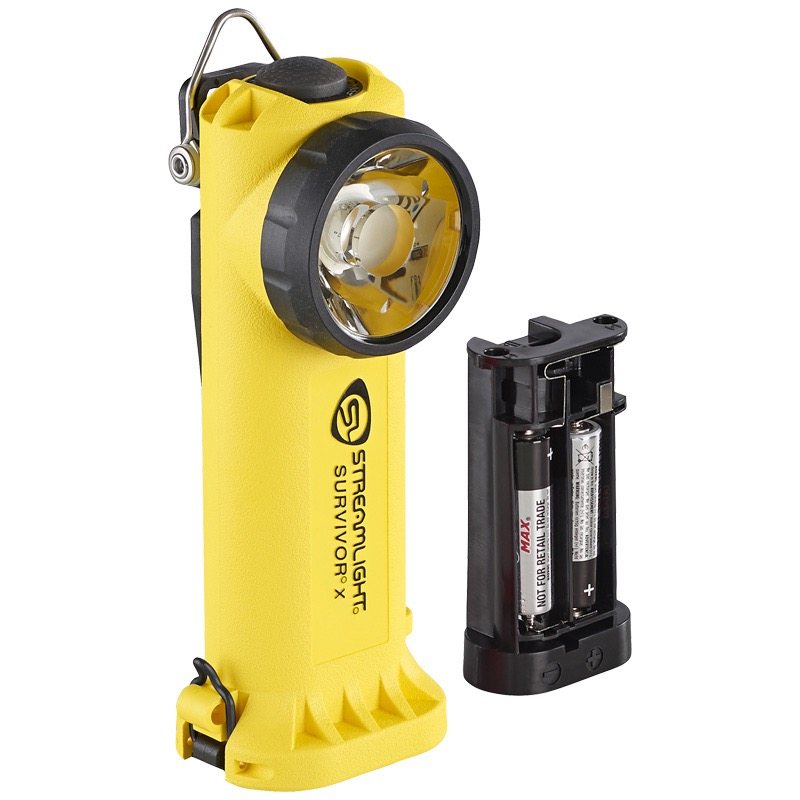
Why I chose it: Volunteers don’t always have a charging cradle waiting on the rig. The USB version keeps the Survivor X beam and body but charges from a phone charger, a truck USB port or a power bank, and it still takes AA batteries when the pack runs flat.
Best for: volunteer and combination department members who keep their gear at home or in a personal vehicle.
Key specs
- High: 250 lumens, 447 m beam, 4 hours
- Low: 60 lumens, 15 hours; flash mode for signaling
- Power: Streamlight SL-B26 USB rechargeable pack (up to 500 charges) or 3 AA
- Rating: Class I, Division 2
- Build: high-impact nylon, IP67, same clip and D-ring as the Survivor X
Pros
- No cradle needed, which makes it the easiest Survivor to own outside a career station
- Dual-fuel design means you’re never stuck with a dead light
- Same smoke-cutting beam as the standard Survivor X
- One of the best-selling right-angle lights on Amazon right now
Cons
- Division 2 rating instead of Division 1
- The SL-B26 pack is rated for fewer charge cycles than the Survivor X pack
Performance analysis
The beam is the same story as the standard Survivor X: modest lumens, a very tight and deep hotspot, and a low mode that runs long enough for an extended overhaul.
The part most buyers miss is the safety rating, and it’s the only real reason to pick one Survivor X over the other. Class I, Division 1 means the light is safe where flammable gas or vapor can be present during normal conditions. Division 2 covers places where that gas only shows up when something has failed, like a leak or a ruptured line. For a firefighter walking into a gas leak call, that “something has failed” scenario is the whole job. If your department has a Division 1 policy, or you run a lot of hazmat calls, buy the standard Survivor X.
For everyone else, especially volunteers whose light rides around in a gear bag between calls, the USB version is the more practical choice. Being able to top it off from any USB cable matters more day to day than a rating you may never test.
3. Pelican 3415M: Best Streamlight Alternative
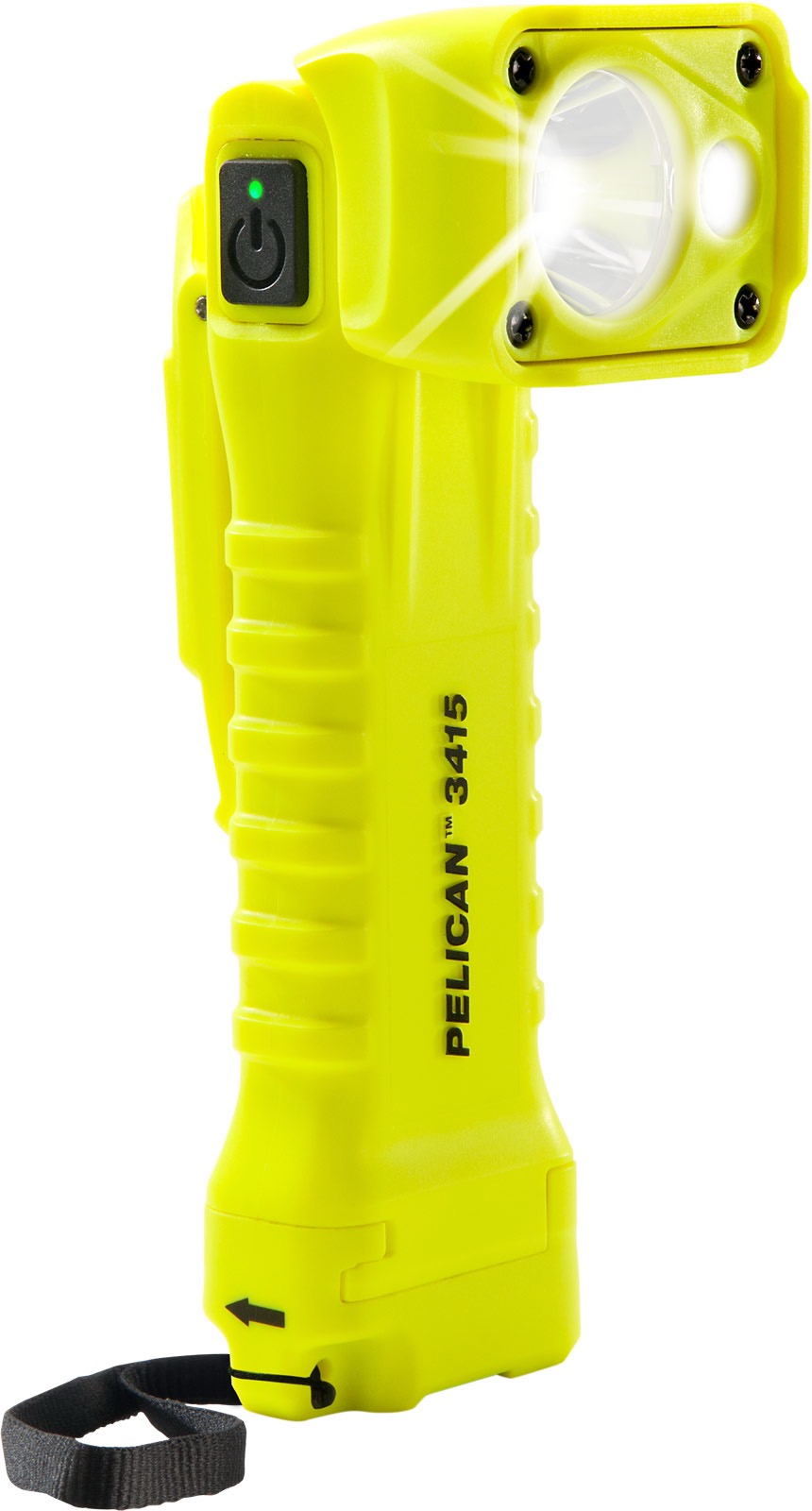
Why I chose it: It’s the only right-angle light here with two separate LEDs in one head: a spot for distance and a flood for close work. It also carries a broader hazardous location rating than any Streamlight on this list.
Best for: firefighters who want Division 1 protection and a wider beam option, and anyone who wants their light to stick to a steel surface.
Key specs
- Spot and flood together: 336 lumens, 133 m beam, 6 hours
- Spot only: 186 lumens, 135 m beam, 14 hours
- Flood only: 177 lumens, 37 m beam, 15 hours
- Power: 3 AA (included)
- Rating: Class I, II and III, Division 1
- Build: articulating head, clip with built-in magnet, 7.44 in long, 9.6 oz with batteries
Pros
- Division 1 across gas, dust and fiber hazards, not just gas
- Flood mode gives you useful spill light for packaging a patient or working a tool
- Magnet holds it on apparatus, a car door or a steel beam for hands-free light
- Lighter than the Survivor X and runs on easy-to-find AA batteries
Cons
- Far less throw than the Survivor X; its spot beam is roughly a tenth as intense
- Pelican doesn’t list an NFPA heat rating for it, so check your department’s spec
Performance analysis
The 3415M is a different philosophy from the Survivor X. Streamlight goes all in on one deep beam. Pelican gives you choice. With both LEDs on, you get a bright center with a wide halo, which is easier on the eyes in a clean room or at a car wreck at night. Switch to flood only and you’ve got soft, even light for close work at the dash or the patient.
The trade is reach. Based on its 135 m beam rating, the spot works out to roughly 4,500 candela, compared with 50,000 for the Survivor X. In heavy smoke, that gap is real. That’s why I see the Pelican as the better pick for EMS-heavy departments, rescue work and industrial fire brigades, and the Survivor X as the better pick for crews doing a lot of interior attack.
The magnetic clip is a quiet win. Stick it to the side of the engine during a night pump operation and you’ve got a work light where you need it.
4. Streamlight Vantage II: Best Helmet Light
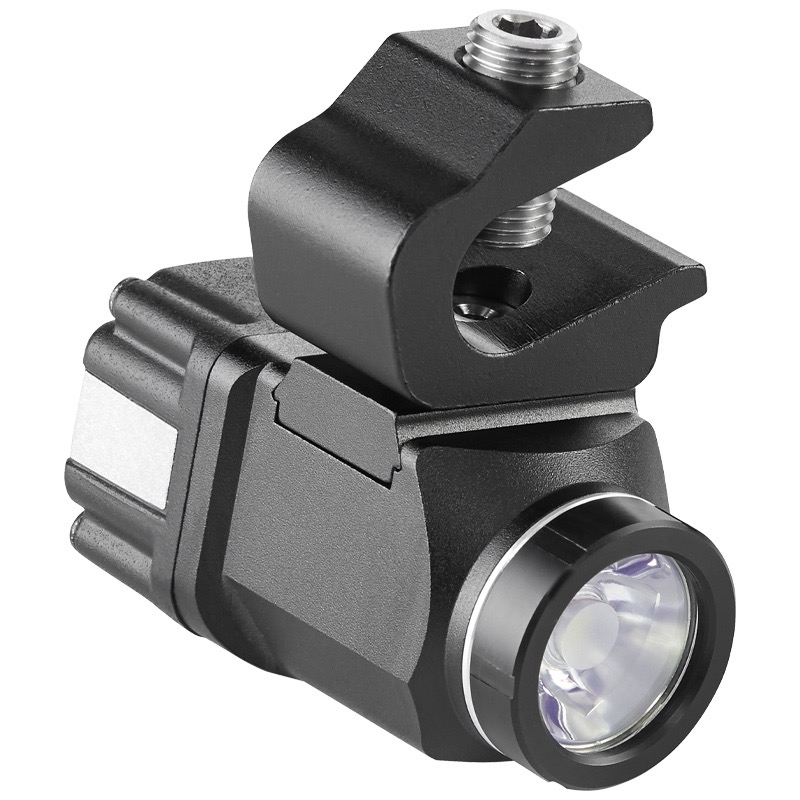
Why I chose it: It’s small, bright and nearly impossible to snag, and the blue taillight solves a real problem on the fireground: being seen from behind in smoke. With over a thousand ratings averaging 4.8 stars, it’s also the most trusted helmet light you can buy online.
Best for: engine company firefighters who want hands-free light that goes where their eyes go.
Key specs
- High: 350 lumens, 3,500 candela, 118 m beam, 2.25 hours
- Low: 135 lumens, 80 m beam, 5 hours
- Power: 1 CR123A lithium
- Build: 6000-series aluminum, BOROFLOAT glass lens, IPX7, about 3 oz
- Mount: swivel clamp above or below the brim of traditional and modern helmets (MSA Cairns version available)
- Extras: blue rear safety LED (steady, flashing or off), “safe off” lockout
Pros
- Weighs about as much as a deck of cards, so you won’t feel it on the helmet
- Low profile won’t hang up on wires or a dropped ceiling grid
- Big rear button is easy to find with gloves on
- Blue taillight lets the crew behind you track your position
Cons
- One CR123A means short runtime on high, so carry a spare
- 3,500 candela is far less throw than a coat light; it’s a navigation light, not a search light
Performance analysis
The Vantage II uses a TIR optic, which gives it a smooth hotspot with plenty of spill. That’s the right beam for a helmet. You want enough reach to read a hallway and enough spread to see your hands and your footing without moving your head.
The weak point is runtime. At 2.25 hours on high, one CR123A won’t last through a long overhaul. Most firefighters keep it on low for general work and switch to high only when they need it. One tip from Streamlight is worth repeating: don’t run its rechargeable SL-B9 battery in firefighting use. Stick with standard CR123A lithium cells.
The swivel clamp lets you set the beam angle once and forget it. Mount it under the brim if you want it out of the way, or on top if you want the beam to clear your face shield.
5. Streamlight Vantage 180 X: Best Helmet and Coat Hybrid
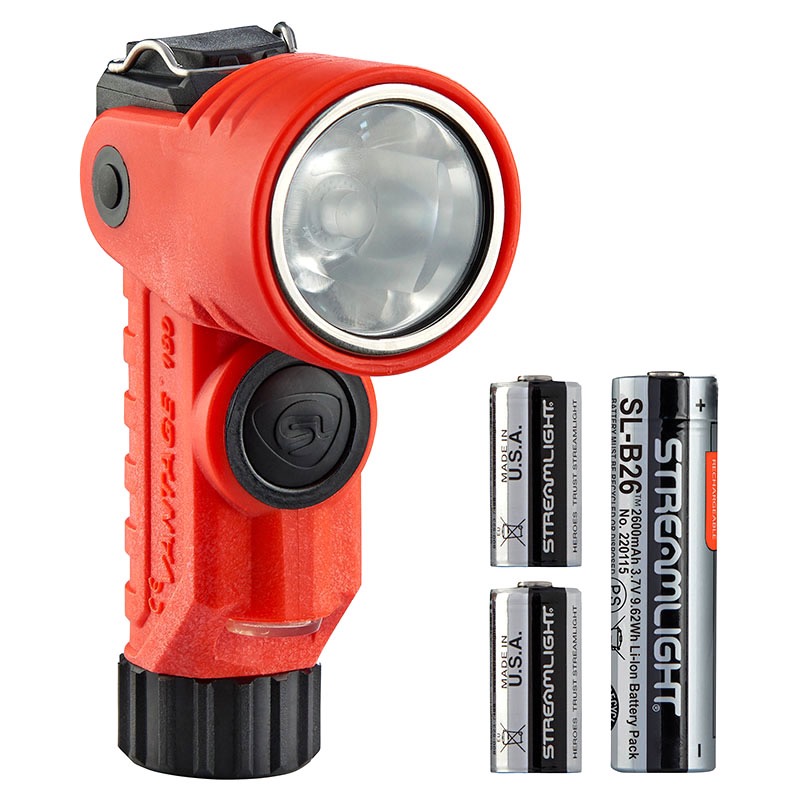
Why I chose it: Streamlight calls it three lights in one, and that’s accurate. It mounts on the helmet, clips to the coat as a right-angle light, and comes off in seconds to use as a handheld. If you can only carry one light and can’t decide between helmet and coat, this is the compromise.
Best for: firefighters who want one light that does several jobs, and anyone who splits time between fire and rescue calls.
Key specs
- High: 250 lumens, 7,200 candela, 170 m beam, 4 hours (CR123A) or 5 hours (USB pack)
- Low: 100 lumens, 2,650 candela, 103 m beam, 12 to 15 hours
- Power: 2 CR123A or one Streamlight SL-B26 USB pack (USB model)
- Head: rotates 180 degrees; rear LED switches from blue taillight to white downlight
- Build: nylon polymer, IPX7, meets the NFPA 1971 500°F heat test, about 5.5 oz
- Mount: quick-release helmet bracket plus stainless steel clip
Pros
- Genuinely works as a helmet light, coat light or handheld
- Rotating head gives you a forward spot and a light at your feet at the same time
- Twice the candela of the Vantage II, with longer runtime
- Multi-fuel design on the USB version
Cons
- Bulkier on the helmet than the Vantage II
- The rear light changes function as the head rotates, which takes some getting used to
Performance analysis
The clever part is the rotating head. Pointed straight, it’s a normal forward beam with a blue taillight behind it, which is what you want on a helmet. Turn the head 90 degrees for coat carry and the rear blue LED becomes a white floodlight aimed downward, so you can see the stairs and the hose line at your feet while the main beam lights the way ahead.
With 7,200 candela, it has more reach than any other helmet light here. It still isn’t a Survivor X, but it’s enough to read a room through light smoke.
The downside is that a jack of all trades carries a bit more bulk. On the helmet it sits higher and heavier than a Vantage II. Firefighters who already own a good coat light usually get more from the slimmer Vantage II. Firefighters starting from zero often get more from this one.
6. FoxFury Command+ Tilt: Best Low-Profile Flood
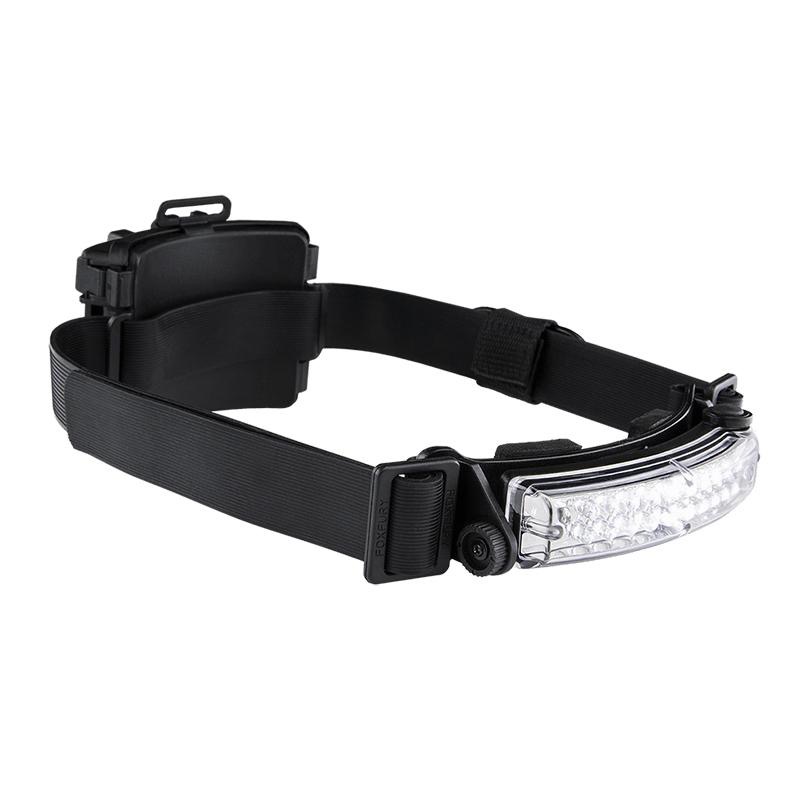
Why I chose it: Every other helmet light here is built around a beam you aim. The Command+ Tilt is built around a wide wash of light for the work right in front of you. Add a red rear beacon visible from more than a mile away and you have a light that’s very good at a different job.
Best for: extrication, EMS, wildland and overhaul, where you need to see your hands and the area around them more than a distant wall.
Key specs
- Output: 100 lumens high, 75 medium, 32 low
- Runtime: 5 hours high, 6 hours medium, 14 hours low
- Beam: 35 m, 38 degree beam angle
- Power: 4 AA in a rear battery pack (rechargeable version: 420-T09R)
- Build: meets the NFPA 1971 500°F heat test with the silicone strap, IPX7, 3 m drop rated
- Extras: tilting head, flashing red rear LED, silicone and elastic straps included
Pros
- Even, glare-free flood that’s easy on the eyes up close
- The battery pack sits at the back, which balances the weight on the helmet
- Red rear marker is one of the most visible safety lights on any helmet light
- Runs on AA batteries you can buy anywhere
Cons
- Only 100 lumens and very little throw, so it’s no help seeing through smoke
- At 8.4 to 9.8 oz with batteries, it’s the heaviest helmet light here
Performance analysis
Think of the Command+ Tilt as a work light, not a flashlight. Its 38 degree beam spreads light across your whole field of view at arm’s length, which is exactly what you want when you’re cutting a door off a car or packaging a patient. A tight beam makes that kind of work harder because you keep moving your head to chase the hotspot.
The split design matters too. The light head stays small at the front of the helmet while the battery pack rides at the back, so the helmet doesn’t pull forward on your neck over a long shift. That makes it a good fit for wildland crews working long shifts.
For interior structural firefighting in smoke, it’s the wrong tool, and FoxFury doesn’t pretend otherwise. Pair it with a Survivor X on the coat and the two lights cover each other’s weak spots. If you like the idea of green light for better contrast in smoke, FoxFury also sells a white and green version (420-T06).
7. Streamlight Vulcan 180: Best Box Light
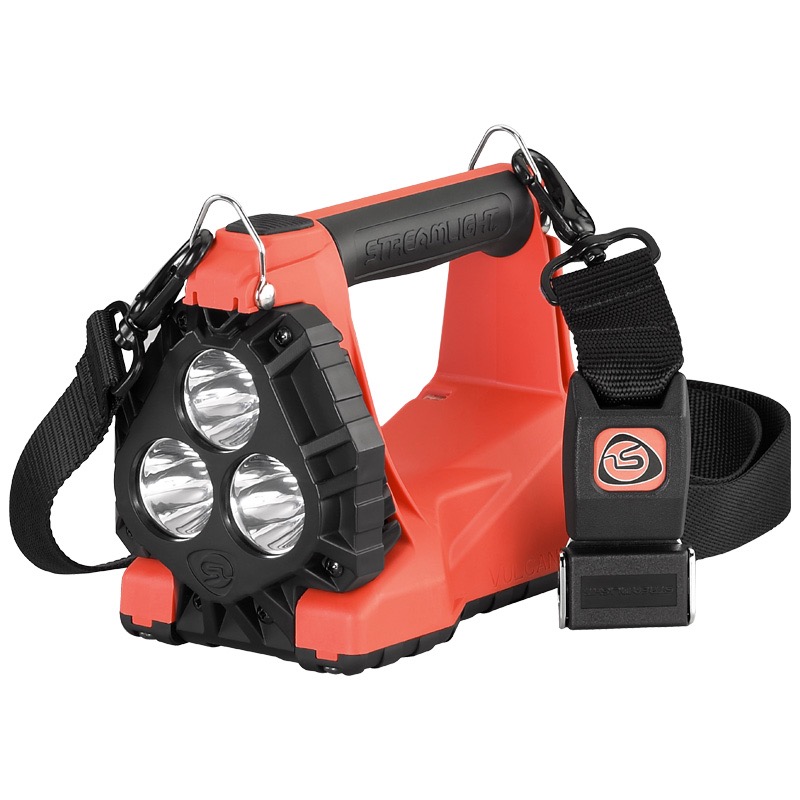
Why I chose it: If you do searches, this is the light. At 75,000 candela it throws harder than anything else here, and the tilting head lets you aim it without twisting your wrist. It’s the modern version of the box light that has ridden on fire apparatus for generations.
Best for: truck companies, search crews, and anyone who needs to light a whole room or scene rather than a path.
Key specs
- High: 1,200 lumens, 75,000 candela, 548 m beam, 7.25 hours
- Low: 350 lumens, 19 hours
- Power: built-in rechargeable Li-ion
- Rating: Class I, Division 2; charging rack meets NFPA 1900 when mounted in any position
- Build: nylon body with an aluminum head inside a nylon shell, three LEDs, two blue taillights, about 2.5 lb
- Charging: standard system (AC and 12V DC) or vehicle mount system (12V DC direct wire)
Pros
- Most throw on this list by a wide margin
- 180 degree head aims down a stairwell or under furniture while you hold the handle level
- Flat base lets it stand on its own as scene light
- Blue taillights can be set to steady, flashing or off
Cons
- At about 2.5 lb, it’s a real weight on a shoulder strap over a long search
- Division 2, not Division 1
Performance analysis
The Vulcan 180 fills a role no coat light can. Your coat light marks you and lights your path. A box light lets you actually sweep a room. You hold it low, under the smoke layer, and push that beam across the floor, where visibility is usually best.
The tilting head is the upgrade over the classic Fire Vulcan. Instead of bending your wrist to point a fixed head down a stairwell, you tilt the head and keep the handle where it’s comfortable. It locks forward when you want a straight beam.
Most firefighters won’t buy this one personally, since departments usually supply box lights on the rig. But if your rig doesn’t carry one, or you run a small volunteer company, it’s the single biggest upgrade you can make to your search capability. Get the vehicle mount system if it will live on the apparatus, so it’s charged every time you pull it off.
8. Streamlight PolyTac 90X USB: Best Backup Light
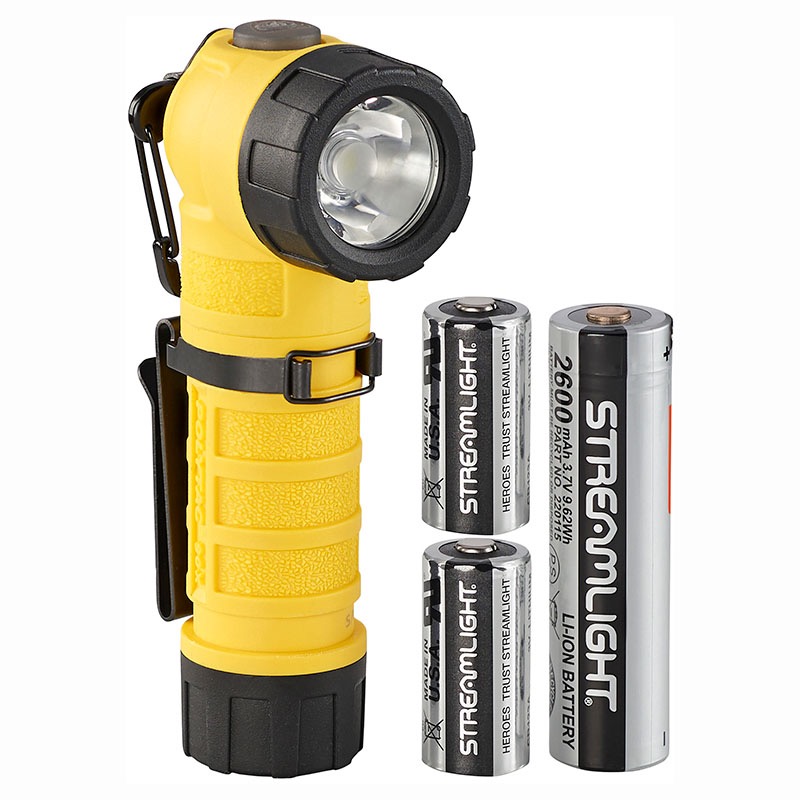
Why I chose it: Every firefighter needs a light that isn’t on the coat: one for the station at 3 a.m., the personal vehicle, the off-duty bag or a spare in a pocket of the turnout pants. The PolyTac 90X USB is a pocket-size right-angle light with real output, in a polymer body that comes in orange or yellow.
Best for: a backup or off-duty light, EMS crews, and firefighters who want a compact right-angle light on a budget.
Key specs
- High: 500 lumens, 7,000 candela, 167 m beam, 3.75 hours (USB pack) or 2.5 hours (CR123A)
- Low: 85 lumens, 64 m beam, 19 hours (USB pack) or 12 hours (CR123A)
- Power: Streamlight SL-B26 USB pack or 2 CR123A
- Build: nylon polymer, IPX7, 2 m drop rated, 4.43 in long, about 4.8 oz
- Carry: integrated carabiner D-ring plus pocket clip
Pros
- Small and light enough to carry every day, on or off duty
- Highest lumen output of any right-angle light here
- Charge indicator in the switch flashes red when the battery is low
- Polymer body doesn’t conduct electricity or get as cold as aluminum
Cons
- No hazardous location rating, so it shouldn’t be your interior coat light
- The USB pack charges through micro-USB, not USB-C
Performance analysis
The PolyTac 90X USB is a good example of why lumens alone don’t tell you much. It has twice the lumens of a Survivor X but about one-seventh the candela. Its beam is wider and brighter up close, which makes it great for checking a car interior or lighting a patient during a medical call. In smoke, the Survivor X will still show you more.
The carabiner D-ring and the clip make it easy to hang from a radio strap or a loop on your gear. It’s also one of the few compact lights that works well as a backup on the fireground, as long as you understand its limits.
I’d buy the orange or yellow version over black. A bright body is much easier to find in a gear bag or on a dark floor.
Buying Guide: What to Look For in a Firefighter Flashlight
Candela matters more than lumens
Lumens measure the total light a flashlight puts out. Candela measures how concentrated the beam is. For seeing through smoke, candela is the number to compare. A wide, high-lumen beam lights up the smoke particles right in front of you and sends glare back into your eyes. A tight, high-candela beam drills further before it scatters. If you want the full explanation, read my guide to candela vs lumens.
My rule of thumb is at least 20,000 candela in a coat light you’ll use for interior work. The Survivor X and Vulcan 180 clear that easily. Helmet and backup lights can get by with less because they do a different job.
Hazardous location rating
You’ll see ratings like “Class I, Division 1” (C1D1) on fire service lights. Class I means flammable gases and vapors, Class II means combustible dust, and Class III means fibers. Division 1 means those hazards can be present during normal conditions. Division 2 means they’re only expected when something fails, like a leak. OSHA uses these same classes in its hazardous location rules.
A rated light is built so it can’t create a spark or a surface hot enough to ignite that atmosphere. For a coat light that may go into a gas leak or a vehicle fire, Division 1 is the safer choice. Outside North America, look for ATEX or IECEx ratings instead.
Heat resistance
Look for a light that meets the 500°F heat test in NFPA 1971, the standard for structural firefighting gear. The Survivor X, Vantage 180 X and FoxFury Command+ all list it. A typical aluminum tactical light isn’t tested to that standard, so there’s no guarantee its lens and seals will survive a hot interior.
Battery type
Each battery type has a place on the fireground:
-
- Rechargeable cradle (Survivor X, Vulcan 180): best for career stations, since the light is always charged when you pull it off the rig.
- USB rechargeable (Survivor X USB, PolyTac 90X USB): best for volunteers who can charge anywhere.
- AA alkaline: cheap and available everywhere, but they lose a lot of capacity in the cold and can leak if left sitting for months.
- CR123A lithium: light, strong in cold weather and good for about 10 years in storage, which makes them ideal spares.
A dual-fuel light that takes both a rechargeable pack and disposables is the safest bet, because a dead pack never means a dead light. For off duty lights that run on standard batteries, see our best AA flashlight picks.
Switch and controls
Picture working the switch in structural gloves with wet hands. Big rubber dome switches and large rear buttons win here. Lights with tiny side buttons or tap-to-change modes are a frustration on the fireground.
Mounting and color
A coat light should clip high on the chest where the SCBA shoulder strap won’t block it. A helmet light should clear your face shield or goggles and should be easy to pop off with one gloved hand. Pick orange or yellow when you can. A bright body is easier to find after you set it down, and it helps a crew member spot you.
Mistakes to Avoid
Shopping by lumens. The brightest number on the box is rarely the best light in smoke. Compare candela and beam distance instead.
Using a tactical light as your coat light. A black aluminum light built for a pistol or a nightstand isn’t rated for hazardous atmospheres and isn’t tested for fireground heat. Keep those for off-duty use, or see my picks for the best pistol lights if that’s what you need.
Mixing up Survivor chargers. The Survivor X won’t charge in the older Survivor cradles. If your station still runs the old chargers, budget for new ones or go with the USB version.
Running the wrong battery. Streamlight warns against using its SL-B9 rechargeable in the Vantage II, or its SL-B9 and SL-B34 packs in the Vantage 180 X, during firefighting. Use the batteries each light is rated for.
Skipping the cleanup. After a working fire, wipe your light down with mild soap and water and check the O-ring seal. Soot left on your gear is something you don’t want to carry home.
Carrying only one light. Batteries die and clips break. A second light, even a small backup like the PolyTac 90X USB, is cheap insurance.
FAQ
What flashlight do most firefighters use?
The most common setup is a Streamlight Survivor series right-angle light clipped to the turnout coat, often paired with a helmet light like the Streamlight Vantage II. Many departments also carry a box light such as the Vulcan 180 on each rig for search and scene work.
Why do firefighters use right-angle flashlights?
A right-angle head lets the light clip flat to the chest while the beam points forward. That keeps both hands free for the hose line or a tool, and it marks your position for the rest of the crew. A regular straight flashlight clipped to the coat would point at the sky or the floor.
Is green light better than white light in smoke?
Some makers, including FoxFury, offer white and green LED models and say green helps with contrast and depth perception. White light is still the standard for interior firefighting, and the bigger factor in smoke is beam shape. A tight, high-candela white beam will usually show you more than any color of wide beam.
How many lumens do you need to see through smoke?
Fewer than most people think. The Survivor X, built specifically for smoke, puts out only 250 lumens. What makes it work is its 50,000 candela beam. Focus on candela and a tight beam rather than chasing a high lumen number.
The Bottom Line
If you’re buying one light, get the Streamlight Survivor X. It has the deepest beam of any coat light here, a Division 1 rating and decades of fire service trust behind the design. Volunteers who charge at home should go with the Streamlight Survivor X USB instead.
For your second light, pick based on how you work. Engine crews do well with the Streamlight Vantage II on the helmet. Search and truck crews get more from the Streamlight Vulcan 180. If you want one light that does both helmet and coat duty, the Streamlight Vantage 180 X is the smart compromise.
Whatever you choose, buy a light rated for the fireground and carry a spare. The light on your coat is one of the few pieces of gear you’ll use on nearly every call.
