
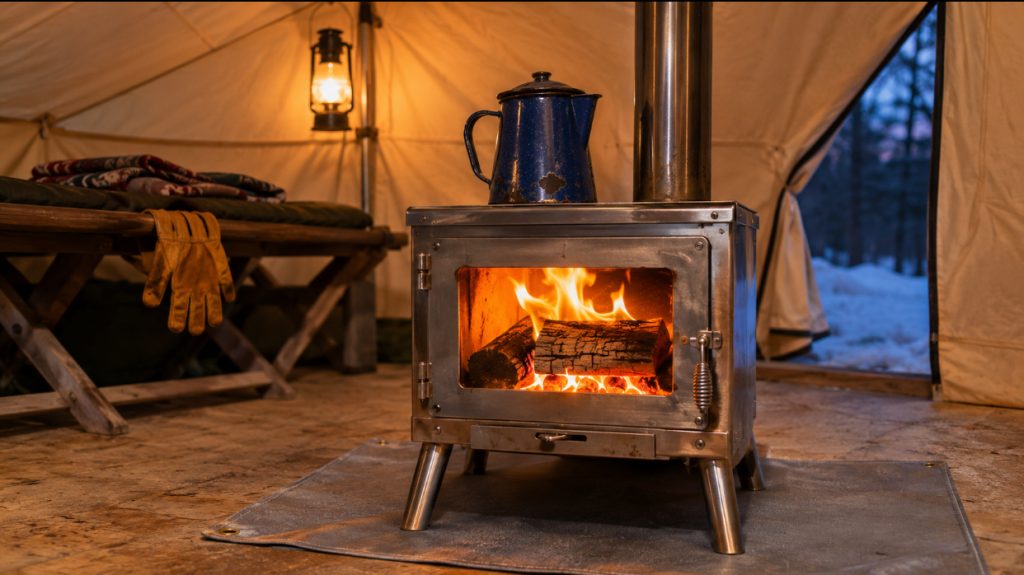
Every November somebody comes back from elk camp with the same story. The thermometer zip-tied to the tent pole read 12 degrees the first night. By morning their boots had frozen into the shape of their feet, the water jug had a lid of ice on it, and they spent the last hour before daylight curled in a sleeping bag with frost on the drawstring, waiting for somebody else to be brave enough to get up first. Meanwhile the camp down the creek had a little steel stove ticking away in their wall tent, and those guys were sitting around in their shirtsleeves playing cards.
That’s what a tent wood stove does. A steel box about the size of a carry-on bag, a pipe out through the roof and an armload of split wood turn a canvas tent into a cabin. Wet gloves and socks are dry by morning. The coffee water on top is already steaming when you climb out of the bag. And the tent stops being the place you dread walking back to after dark.
Here’s what I’d set up. For most bell tents, big tipis and smaller wall tents, the Winnerwell Nomad View 1G Medium is the stove I’d hand you. It’s all stainless, the legs and pipe nest inside it for the drive, and there’s glass on the door and the side so you can watch the fire without opening anything. If that’s more than you want to spend, the OneTigris Tiger Roar gets you a stainless box and a big glass door for a good bit less. Hunting out of a 12 x 14 wall tent? Step up to the Winnerwell Nomad View 1G Large or the old elk camp standby, the Camp Chef Alpine Heavy Duty Cylinder Stove, which swallows logs up to about 22 inches long. And if the stove has to ride in your backpack, the POMOLY Ti 0.6 folds flat and weighs under six pounds with its pipe.
Further down there’s a night planner. Pick your tent and how cold it’s going to get, and it picks the stove that fits, marks roughly when you’ll be getting up to feed it, and counts how many bundles of firewood to throw in the truck.
Quick Picks: The Best Tent Wood Stoves
If you just want the short answer:
- Winnerwell Nomad View 1G Medium: best tent wood stove for bell tents, tipis and small wall tents.
- OneTigris Tiger Roar: best value stainless stove with a glass door.
- VEVOR 304 Stainless Tent Wood Stove: best budget tent wood stove for a first hot tent, a hunting blind or an ice shack.
- Winnerwell Nomad View 1G Large: best for 12 x 14 and 14 x 16 wall tents.
- Camp Chef Alpine Heavy Duty Cylinder Stove: best for hunting camps and outfitter wall tents.
- POMOLY Ti 0.6: best ultralight stove for backpacking and small hot tents.
Which Stove, and How Much Wood? Try the Night Planner
Wood stoves don’t come with a BTU rating the way propane heaters do, so first-timers mostly guess at the size. Pick your tent, the coldest night you expect and how long you want heat, and it picks the stove from this list that fits, lays out the night with a mark every time you’ll need to add wood, and counts the firewood. It also checks whether the pipe that comes with the stove is tall enough for your tent.
Tent Wood Stoves Compared
Weight and firebox size are where these stoves really differ. A bigger firebox runs longer between loads, so you sleep longer between trips to the woodpile, but you carry every ounce of it from the truck. Here’s how the six line up:
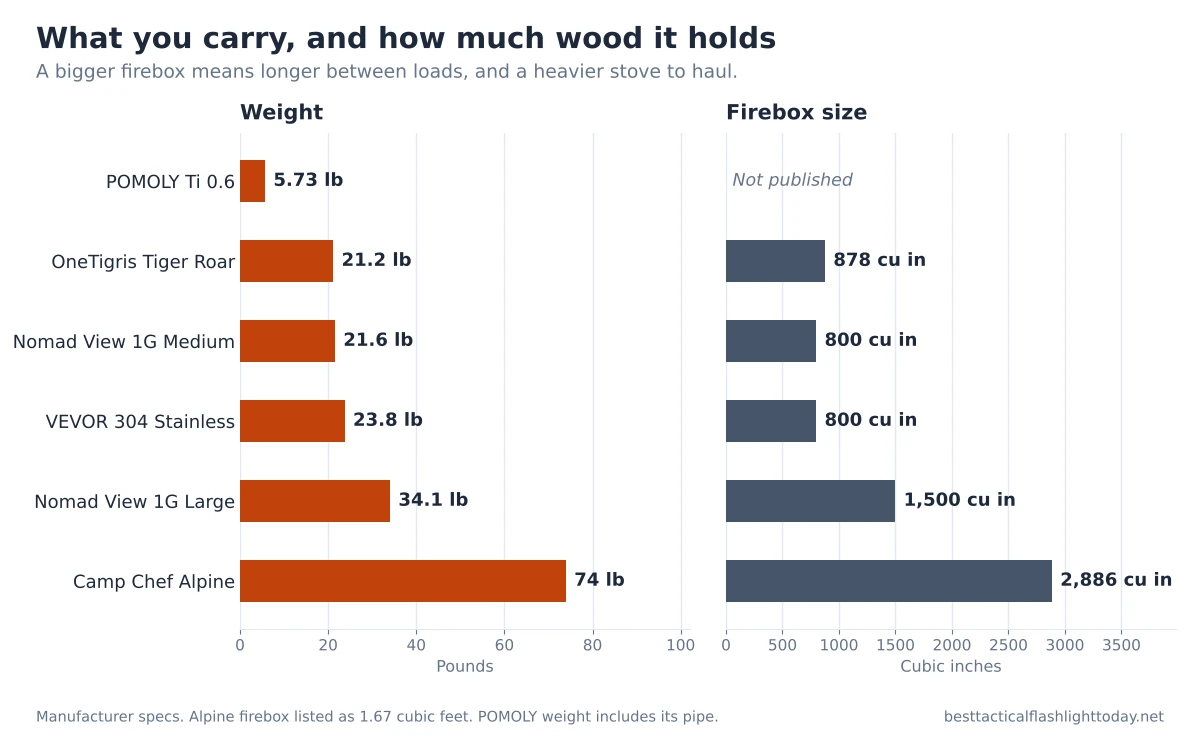
The Alpine’s firebox is more than three times the size of the Nomad Medium’s, and it weighs a bit more than three times as much. That’s an easy trade when the stove rides in a pickup and stays put for a week, and a bad one when you’re hauling it up a trail on a sled. POMOLY doesn’t list a firebox volume for the Ti 0.6, so it only gets a weight bar.
1. Winnerwell Nomad View 1G Medium: Best overall
Why I chose it and who it’s for
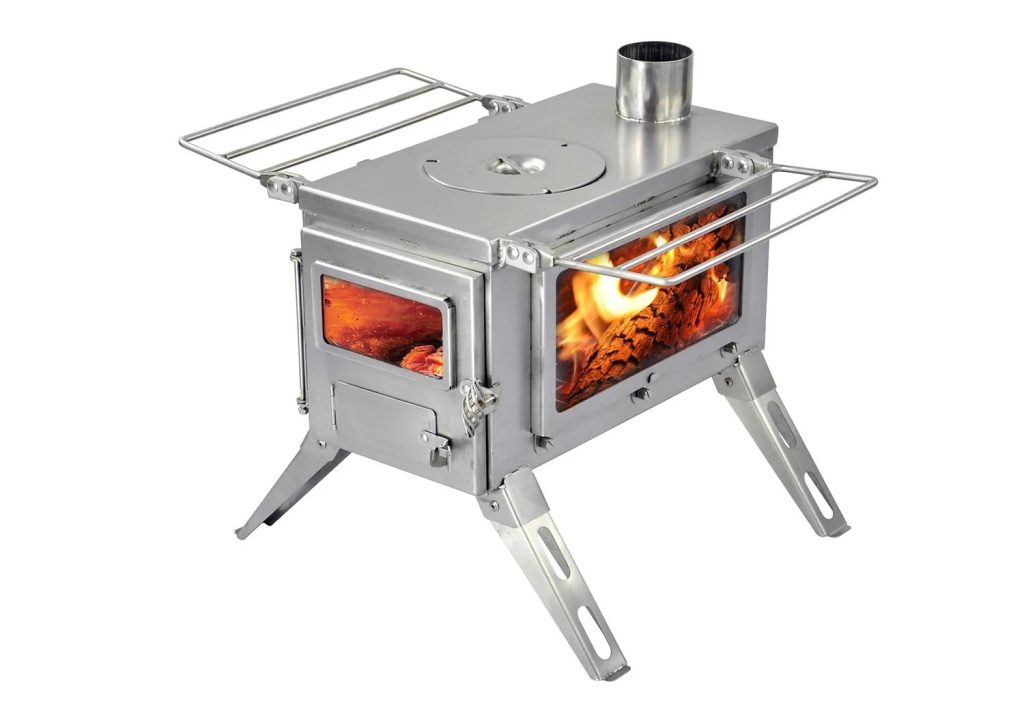
The Nomad View 1G Medium is the stove I’d put in most hot tents. It’s sized for the shelters most people actually own, like a 13 foot bell tent, a big tipi or a 10 x 12 wall tent. The firebox holds 800 cubic inches of wood, and the whole stove is 304 stainless, so it won’t rust out after a wet season sitting in the garage.
The View version puts glass on the door and on the side, so you can see when the fire is getting low without opening the door, which is when smoke and sparks get out into the tent. On a cold night, that orange glow through the side window is half the reason people fall for hot tenting in the first place.
Key specs
- Firebox: 800 cubic inches
- Stove body: 15 x 7.9 x 8.3 inches
- Weight: 21.6 lb
- Pipe: 2.5 inch diameter, 14.4 inch sections
- Height with pipe: 90.7 inches
- Material: 304 stainless steel
- In the box: Chimney pipe, airflow controller, spark arrestor, ash scraper, grate
Pros
- Glass on the door and the side
- Stainless steel all the way through
- Legs and pipe nest inside for travel
- Damper and spark arrestor included
- A water tank and pipe oven made to fit it
Cons
- Costs more than the other steel stoves here
- Pipe comes up short in tall bell tents
- Wood has to be cut short to fit the 15 inch body
In real use
Plan on adding wood every two to three hours with seasoned hardwood. That’s normal for an 800 cubic inch firebox. Split your wood to about wrist thickness, fill the box, and turn the airflow controller down once the fire is going well. That gets you the longest stretch between loads.
The thing to check before your first trip is the pipe height. With every section in place, the stove stands 90.7 inches to the top of the spark arrestor. A lot of 13 foot bell tents peak higher than that, and the pipe should clear the ridge by at least 6 inches, so you may need one or two extra 2.5 inch sections. Winnerwell sells them in 14 inch lengths.
The stainless turns gold and blue after the first few fires. That’s just the steel taking on a patina, and it doesn’t hurt anything. Do those first burns outside, not in the tent. Add the Winnerwell water tank to the side and you’ve got hot water for coffee and dishes all day, and a battery lantern hung from the ridge does the rest.
2. OneTigris Tiger Roar: Best value
Why I chose it and who it’s for
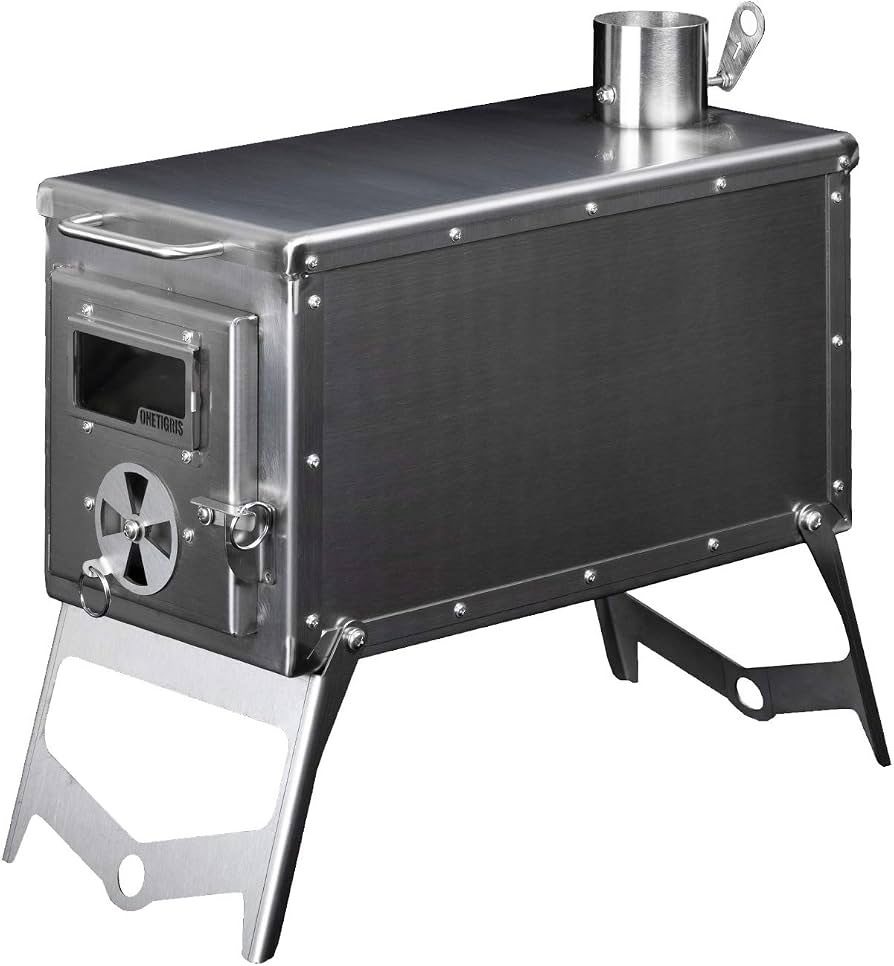
OneTigris built the Tiger Roar for car campers and hunters who want a stainless stove with a big fire window, without paying for the premium name. The body is 304 stainless, the firebox is a little bigger than the Nomad Medium’s at 878 cubic inches, and most of the door is glass.
Everything rides inside the stove body: seven pipe sections, two 45 degree elbows, two 90 degree elbows, leather gloves and a spare piece of glass. The elbows are what you need if your tent’s stove jack sits in the side wall instead of the roof.
Key specs
- Firebox: 878 cubic inches
- Size: 17.3 x 8.5 x 10.6 inches
- Weight: 21.2 lb
- Height with pipe: 81.6 inches
- Material: 304 stainless body, 201 stainless pipe
- In the box: Seven pipe sections, two 45 degree and two 90 degree elbows, gloves, spare glass, ash scraper
Pros
- Big glass door
- Elbows for side-wall stove jacks
- Spare glass in the box
- Everything packs inside the stove
Cons
- No spark arrestor in the box
- Shortest pipe here, 81.6 inches total
- Pipe is 201 stainless, a step below the 304 body
In real use
This little box has more heat than most small tents need. One owner ran it in a tent on a night just above freezing and got the inside up to 109°F. So learn to run it with small loads and the air turned down, and save the big loads for the really cold nights.
The short pipe is what you plan around. At 81.6 inches total, it suits low tipis and small hot tents, but most bell tents and wall tents need extra sections. Order a spark arrestor sized to fit its pipe at the same time, since one doesn’t come with it, and don’t burn it in a tent until that’s on.
OneTigris tells owners to run a CO detector and never leave the tent with the stove burning, and that’s good advice for every stove on this list. A battery carbon monoxide detector costs less than a tank of gas and is the one piece of hot tent gear I’d never leave home without.
3. VEVOR 304 Stainless Tent Wood Stove: Best budget
Why I chose it and who it’s for
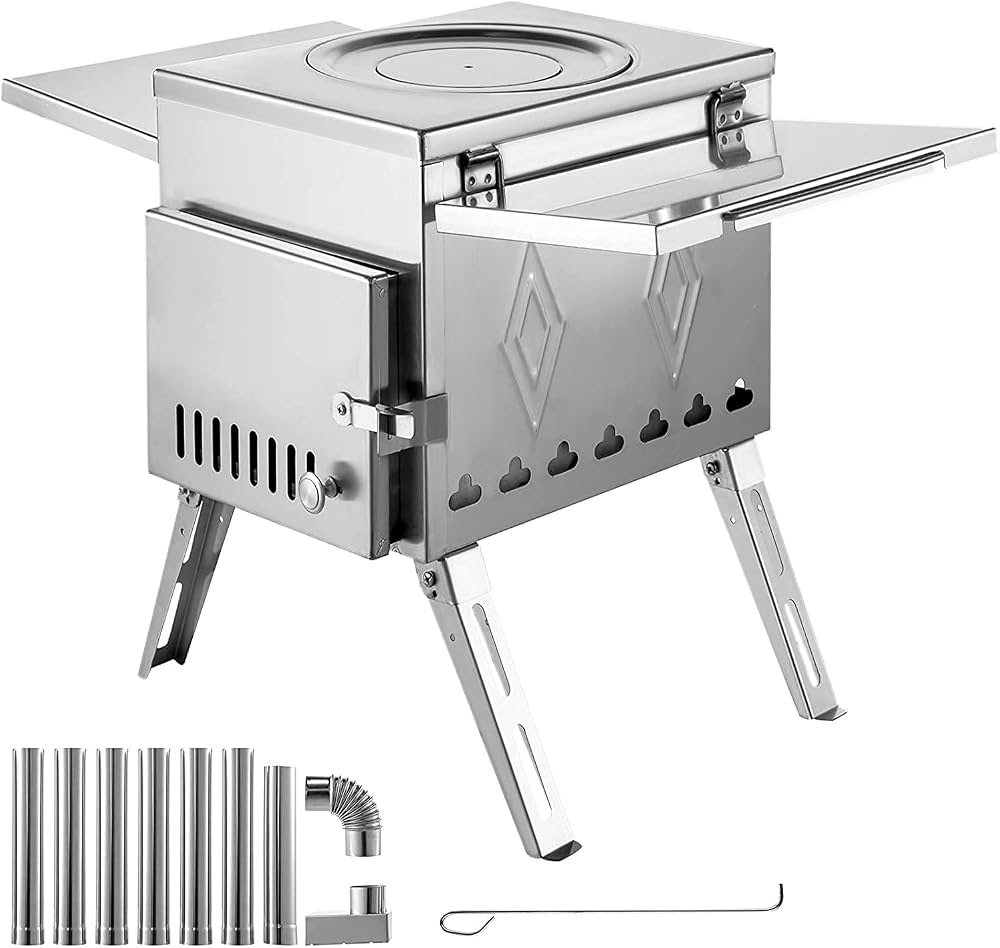
VEVOR’s stainless tent stove has become the go-to first stove for a lot of people trying hot tenting. It has the same 800 cubic inch firebox as the Nomad Medium, a 304 stainless body, folding legs and nine pipe sections that take it to 90.6 inches total, for a fraction of what the big names cost.
This is the stove I’d point you to if you’re still finding out whether hot tenting is for you, or you’re setting up an ice fishing shack, a hunting blind or a cabin in the woods on a budget. It’s heavy for a camp stove at 23.8 pounds, so it belongs in the truck, not your backpack.
Key specs
- Firebox: 800 cubic inches
- Stove size: 18.3 x 15 x 14.17 inches
- Weight: 23.8 lb
- Pipe: 3 inch diameter, nine sections
- Height with pipe: 90.6 inches
- Material: 304 stainless steel
- In the box: Pipe sections, chimney seat, drawer damper, ash scraper
Pros
- Costs far less than the name brands
- Stainless steel body
- 3 inch pipe draws well
- Folding legs
Cons
- No spark arrestor included
- Rougher fit and finish
- Legs feel light under a heavy pot
In real use
Owners who run it in hot tents say it keeps them warm and needs feeding about every two hours on a normal night, which is about what you’d expect from an 800 cubic inch box. One keeps it in an 8 x 8 shack in the woods and says it heats the place fine, and several point out that the stainless is heavier gauge than on a lot of cheap stoves.
It isn’t as tidy as a Winnerwell. A few owners mention smoke slipping out around the door at first, which a length of wood stove door gasket fixes for a few dollars, and the legs are on the light side for a big pot of water.
Two things before it goes in a tent. Burn it hot outside a couple of times to cook off any coatings and oils from the factory, and put a spark arrestor for 3 inch pipe in the same order, because it doesn’t come with one.
4. Winnerwell Nomad View 1G Large: Best for wall tents
Why I chose it and who it’s for
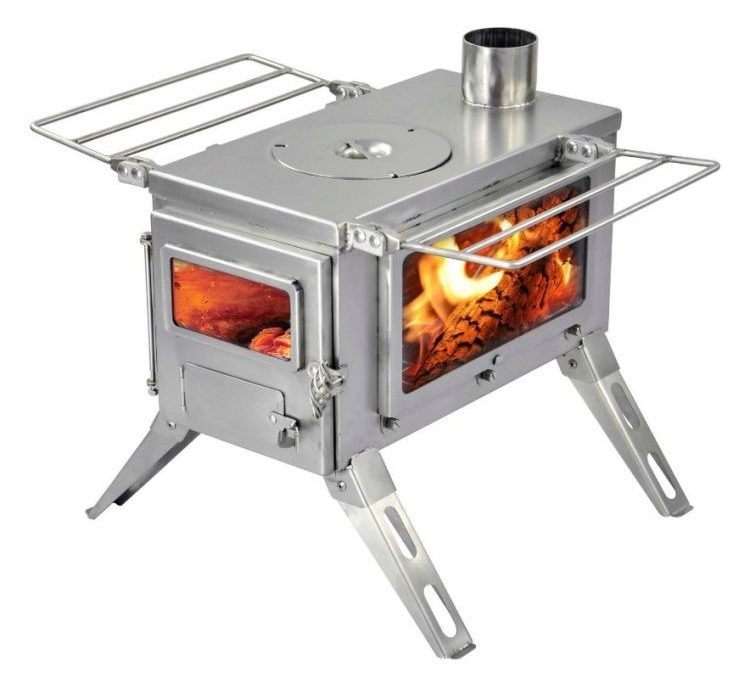
Once you’re living in a 12 x 14 or 14 x 16 wall tent, a medium stove has to be fed constantly to keep up on a single digit night. The Nomad View 1G Large nearly doubles the firebox to 1,500 cubic inches and steps up to 3.5 inch pipe, which pulls harder and handles a bigger fire.
It’s the same stainless build as the Medium, with glass on the door and side, nesting legs and folding side shelves. With all its pipe it stands 107.9 inches tall, so in most wall tents one extra section gets the top past the ridge.
Key specs
- Firebox: 1,500 cubic inches
- Stove body: 18.1 x 9.8 x 9.8 inches
- Weight: 34.1 lb
- Pipe: 3.5 inch diameter, 16.9 inch sections
- Height with pipe: 107.9 inches
- Material: 304 stainless steel
- In the box: Chimney pipe, airflow controller, spark arrestor, ash scraper, grate
Pros
- Big firebox means fewer loads a night
- Tall enough for most wall tents
- Stainless with two windows
- Spark arrestor included
Cons
- Too much stove for a small tipi
- The most expensive pick here
- 3.5 inch pipe needs a stove jack that fits it
In real use
The bigger box is what you notice at 2 a.m. It holds close to twice the wood of the Medium, so a full load of hardwood with the air turned down carries you a lot further into the night before somebody has to crawl out and feed it.
Check your stove jack before you order. A 3.5 inch pipe needs a jack sized for it, and some tents built around smaller stoves won’t take it without a bigger jack sewn in. Winnerwell makes a 3.5 inch pipe oven and a large water tank for this stove, and in a hunting camp the water tank earns its keep.
It’s 34 pounds, so it rides in the truck or on a sled. In a wall tent, set it on a fireproof stove mat near the door end so the pipe runs straight up through the roof jack, and keep cots and gear bags back at least a couple of feet.
5. Camp Chef Alpine Heavy Duty Cylinder Stove: Best for hunting camp
Why I chose it and who it’s for
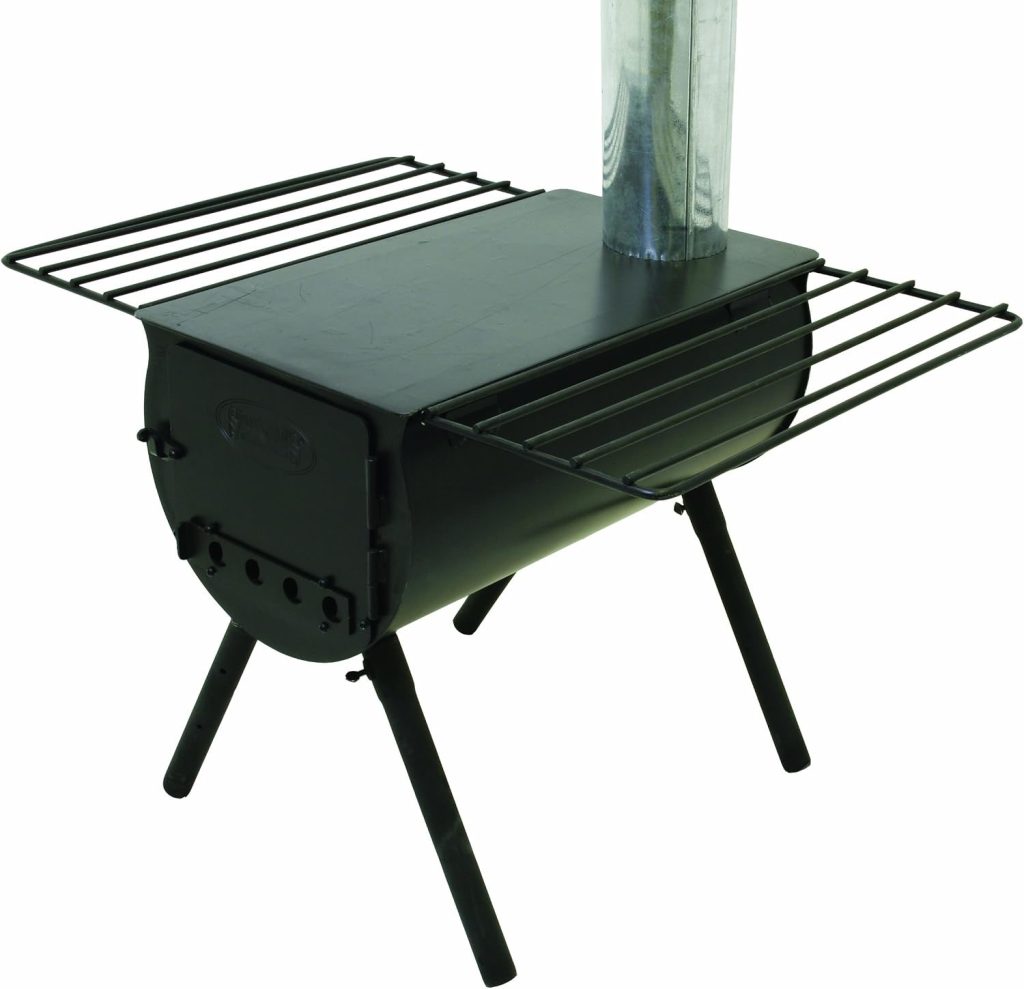
The Alpine has been a fixture in elk and deer camps for years. It’s a heavy steel barrel stove made from 10 and 12 gauge steel, it weighs 74 pounds, and Camp Chef recommends it for tents from 10 x 12 up to 14 x 16.
Everything packs inside the barrel: the five-piece nesting pipe, the damper, the spark arrestor, the log grate, two shelves that double as drying racks, and the removable legs. The firebox holds 1.67 cubic feet and takes logs up to about 22 inches long, so you aren’t cutting firewood into short pieces after a day on the mountain.
Key specs
- Firebox: 1.67 cubic feet
- Size: 20 x 24 x 22.5 inches
- Weight: 74 lb
- Pipe: 5 inch diameter, 10 feet, nesting
- Construction: 10 and 12 gauge steel
- In the box: Damper, wire spark arrestor, log grate, two wire shelves, adjustable legs, water tank brackets
Pros
- Huge firebox for long burns
- Takes logs up to about 22 inches
- Flat top cooks for the whole camp
- Adjustable legs for uneven ground
Cons
- 74 pounds
- No window to watch the fire
- Pipe widens as it goes up, which makes side-wall elbows hard to fit
In real use
Camp Chef’s manual says to keep the firebox at least 3 feet from the tent walls, with a 3 foot area around it clear of anything that can burn. That’s easy in a 12 x 14 wall tent and close to impossible in most tipis, so keep this one for wall tents.
The manual also says the pipe should stand at least 6 inches above the ridge, and the 10 feet of pipe covers that in most wall tents. The sections taper so they nest for travel, which means the pipe gets wider as it goes up. One owner who wanted to vent out the side wall found that the wider sections wouldn’t take standard 45 degree elbows, so plan on a roof jack.
Run it too hot and the steel can warp, so turn down the door air when it starts glowing. Clean all the ash out before you store it for the summer, since ash pulls in moisture and rusts the firebox. Keep a rechargeable headlamp by your cot for the 2 a.m. wood runs.
6. POMOLY Ti 0.6: Best ultralight
Why I chose it and who it’s for
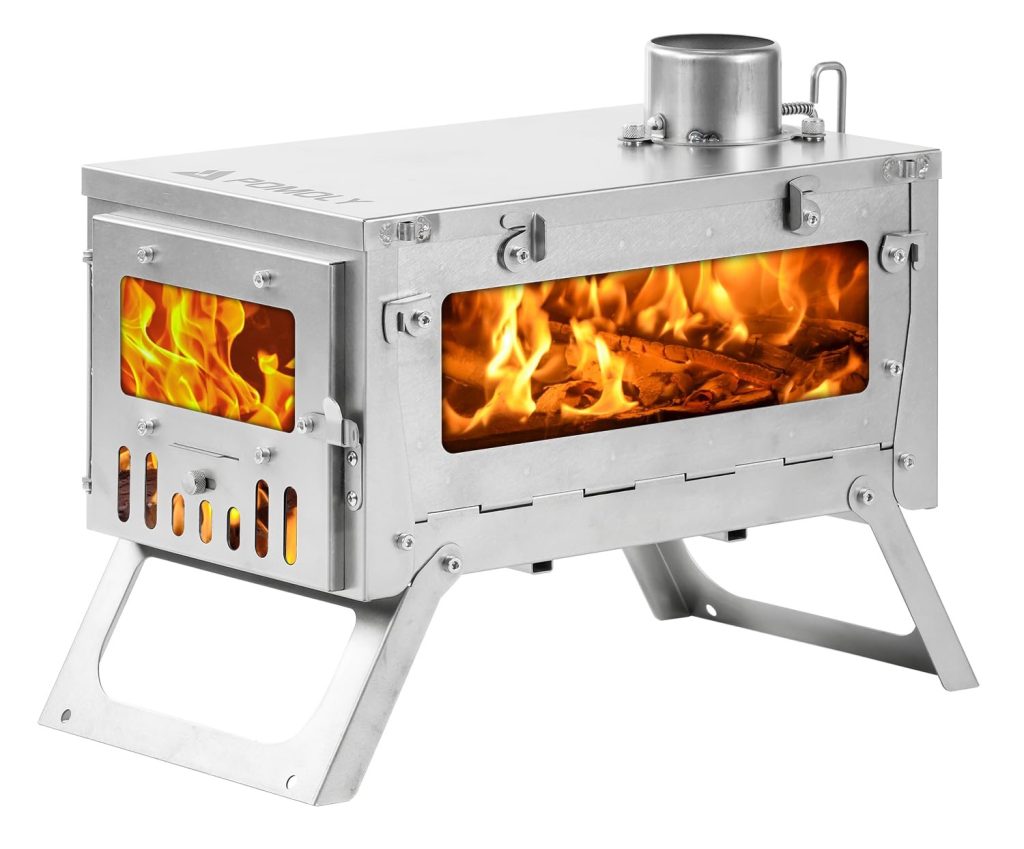
If your hot tent goes into the backcountry on your back, steel is out. The POMOLY Ti 0.6 is built from 0.6 mm titanium with ribs pressed in to stiffen it, it folds flat, and it weighs 5.73 pounds with its 9.84 foot titanium pipe, spark arrestor, damper and gloves.
It’s a stove for one or two person hot tents and small tipis, the kind of shelter you’d carry in for a late season backcountry hunt. Two glass windows are a nice surprise on a stove this light.
Key specs
- Material: 0.6 mm titanium
- Weight: 5.73 lb with accessories
- Set-up size: 15.4 x 11.6 x 8.7 inches
- Pipe: 9.84 foot roll-up titanium
- Windows: Two, glass
- In the box: Spark arrestor, damper base, cut-resistant gloves, carry bag
Pros
- Under 6 pounds with pipe
- Long 9.84 foot pipe
- Two glass windows
- Folds flat
Cons
- Small firebox burns through wood fast
- Roll-up pipe takes practice
- Titanium warps slightly with heat
In real use
Titanium throws heat fast and loses it fast. The tent warms up quickly once the fire gets going, and it cools off quickly once the fire dies, so loads go faster than in a steel stove. Cut your wood short to fit the box and keep a small pile within reach of your bag. One owner paired it with a POMOLY hot tent and kept the inside around 80 degrees.
The roll-up pipe is fiddly the first time. Unroll it on a table at home and take it slow, because a sharp crease weakens it. Owners say it forms up easily once it has been burned in. A little warping in the panels after a few fires is normal for titanium and doesn’t affect how it works.
Thin pipe catches the wind, so guy it out with cord on breezy nights. Pack a survival flashlight or a headlamp with spare batteries, since stove chores in a dark tent go a lot smoother when you can see the door latch.
How to Choose a Tent Wood Stove
Match the stove to the tent
The right hot tent stove starts with the tent you have and how cold it gets where you camp. Small tipis and one or two person hot tents need very little heat, and a big steel box will cook you out of them. A titanium stove or a compact box like the Tiger Roar fits better. Bell tents, four person tipis and 10 x 12 wall tents are right in the sweet spot for an 800 cubic inch stove like the Nomad View Medium. Wall tents 12 x 14 and up, especially in single digits or below zero, need a bigger firebox like the Nomad View Large or the Alpine. The night planner above runs those numbers for your tent.
Stainless steel, painted steel or titanium
Stainless steel stoves like the Winnerwells, the Tiger Roar and the VEVOR hold up to years of wet seasons without rusting, and they keep their shape well under heat. Painted steel stoves like the Alpine are tough and cheap for their size, but they’re heavy and they rust if you store them dirty. Titanium is the lightest by far and heats a small tent fast, but it warps a little, the thin pipe needs gentle handling, and the small firebox needs feeding more often.
Firebox size and how often you’ll feed it
Firebox volume is what decides how long you sleep between loads. An 800 cubic inch firebox full of seasoned hardwood goes about two to three hours before it needs more. A 1,500 cubic inch firebox goes noticeably longer, and a little titanium stove goes less. Hardwood like oak and maple burns longer than pine or spruce, and dry wood matters more than anything. Wet wood smokes, builds creosote in the pipe and throws a fraction of the heat.
Pipe height, pipe size and the stove jack
The top of the pipe should sit at least 6 inches above the tent’s ridge. Pipe that’s too short draws poorly, and sparks come out right at roof level. Measure your tent’s peak before you buy and compare it to the stove’s height with all its pipe. Then check the pipe diameter against your stove jack, especially with 3.5 inch and 5 inch pipe, which need a jack sized for them. If your jack is in the side wall, you’ll need elbows, and the Tiger Roar is the only stove here that comes with them.
Spark arrestor, damper and glass
A spark arrestor is a screen cap on top of the pipe that keeps embers from landing on your tent roof. Never burn without one. The Winnerwells, the Alpine and the POMOLY include one, and for the Tiger Roar and the VEVOR you’ll want to add a spark arrestor. A damper or airflow controller lets you slow the fire down for a longer burn, and every stove here has one. Glass on the door looks great, but it’s also practical, because you can check the fire without opening the door and letting smoke out.
Using a Wood Stove in a Tent Safely
Carbon monoxide
A tent wood stove only works safely because the pipe carries the smoke and carbon monoxide outside. When something goes wrong, like a downdraft on a windy night, a door left cracked or a smoldering fire with the air shut down too far, some of it can come back into the tent. The CDC has investigated camping deaths where people brought a propane stove or a charcoal grill inside a tent for warmth, and it says fuel-burning heaters, stoves, lanterns and grills should never be used inside a tent or other enclosed shelter. A vented wood stove with a proper pipe is a different setup, but the risk doesn’t go to zero, so hang a battery carbon monoxide detector inside the tent at about head height where you sleep.
Never bring a propane camp stove or a grill into the tent to warm it up. Cook on the wood stove or outside on a propane camping stove.
Clearances and a fire mat
Set the stove on a fireproof stove mat that reaches about 18 inches in front of the door and 6 inches past the sides and back, so a dropped ember lands on something that won’t burn. Keep at least 2 feet clear around a small stove, and 3 feet around a big barrel stove like the Alpine, with no cots, sleeping bags, gear or tent wall inside that circle. Wear leather gloves when you feed it, and keep a bucket of water or snow by the door.
Sleeping with the stove going
Plenty of people do it. Even a big stove needs feeding every few hours, though, and a fire choked way down to last all night smolders, makes more smoke and creosote, and is exactly when carbon monoxide becomes a concern. A lot of experienced hot tent campers let the fire burn down at bedtime, sleep in a bag rated for the night, and relight in the morning with kindling laid out the night before. If you keep it going, run the CO alarm, keep the spark arrestor clean, and keep a headlamp where you can find it in the dark.
Fire restrictions
Check the rules for the forest you’re headed to before you load the stove. Restrictions vary from forest to forest. On Colorado’s San Juan National Forest, Stage 1 restrictions still allow a fully enclosed stove with at least 5 feet of chimney and a spark arrestor with mesh no bigger than a quarter inch, but Stage 2 bans wood burning stoves outright. Some other forests ban wood stoves at Stage 1. Late season and winter trips usually have no restrictions at all, but early fall hunts in a dry year often do.
Tent Wood Stove FAQ
Is it safe to sleep with a wood stove in a tent?
It can be, with the right setup: a stove jack made for a hot stove, pipe that clears the ridge by at least 6 inches, a spark arrestor, a fire mat, clear space around the stove and a battery carbon monoxide detector inside the tent. The riskiest moments are a smoldering fire with the air shut way down and a downdraft on a windy night. Many hot tent campers let the stove burn down at bedtime and relight it in the morning instead.
How much firewood do I need for one night?
It depends on the tent, the cold and how long you burn, but plan on roughly 15 to 30 pounds of hardwood for an evening and morning fire in a bell tent or small wall tent, and 50 pounds or more to run a big wall tent all night in serious cold. That’s one or two campground bundles for an evening and morning fire, and three or more for an all-nighter. Softwood burns faster, so bring more of it. The night planner above works it out for your tent.
Can I put a wood stove in any tent?
No. You need a tent with a stove jack, a fire-resistant ring or panel the pipe passes through, and a fabric that tolerates a hot stove nearby, which usually means canvas or a tent sold as a hot tent. A regular nylon backpacking or family tent will melt or burn. If your tent has a jack, check that the pipe diameter fits it.
Do I need a CO detector with a tent wood stove?
Yes. A vented wood stove sends most of its carbon monoxide out the pipe, but a downdraft, a leaky door or a smoldering fire can push it back into the tent, and you can’t smell it. A small battery CO alarm hung near where you sleep costs very little and is the best insurance you can buy for a hot tent.
The Bottom Line
For most bell tents, tipis and small wall tents, the Winnerwell Nomad View 1G Medium is the tent wood stove to get. It’s stainless, it packs small, it comes with the spark arrestor, and the glass makes the whole tent feel like a cabin. If you want a glass door for less money, the OneTigris Tiger Roar is a strong stove that just needs a spark arrestor added, and the VEVOR 304 Stainless Tent Wood Stove gets a first hot tent going on a tight budget.
Living in a 12 x 14 wall tent all season? The Winnerwell Nomad View 1G Large keeps you sleeping longer between loads, and the Camp Chef Alpine Heavy Duty Cylinder Stove has warmed hunting camps for years. And if the stove has to go in your pack, the POMOLY Ti 0.6 is the one to carry. Whichever you pick, run your tent through the night planner above, bring a CO alarm, and pack more dry wood than you think you’ll need.
