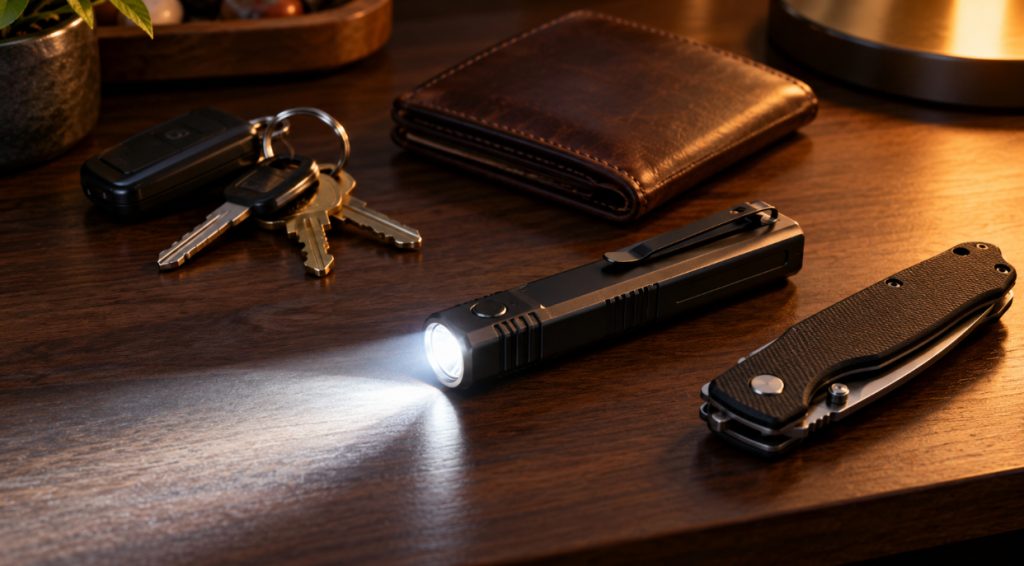
The best EDC flashlight is the one still in your pocket at 9 p.m. when the parking garage lights are out. Size, weight and the way a light rides in your pocket decide that long before lumens do.
Flat lights changed this category. Olight, Nitecore and Streamlight now build lights shaped like a phone or a folding knife that slide in next to your keys, and some of them outshine tactical lights twice their size. Tube lights still win when you want a battery you can swap at a gas station. I picked seven lights across both camps, from a 52 gram tube that hides in a coin pocket to a 6,500 lumen slab. If you walk or run after work, check when your drive home goes dark after the November time change.
Stuck between two of them? The head-to-head comparer further down draws any two at the same scale, next to a credit card, and lines up their output, throw, weight and battery. For something smaller than any of these, my best mini flashlight guide covers keychain lights.
James’s Top Picks
Quick Comparison
How I Picked These Lights
Carry came first. Every pick had to ride in a front pocket all day without you thinking about it, so I capped length at about 140 mm and passed on anything built around a 21700 cell. That ruled out lights like the Nitecore P20iX, which belongs on a duty belt more than in your jeans.
Next came pocket behavior. A lockout, a deep carry clip or a switch that’s hard to bump is what separates a good EDC light from one that turns on against your leg. Output came last, and I weighed the 50 to 500 lumen modes you’ll use every day above the turbo number on the box.
Every pick comes from a brand that publishes its own output and runtime figures and backs its lights in the US. Wurkkos is the least known name here, and the TS10 earned its place as a light shaped by flashlight enthusiasts and refined over two versions.
1. Olight ArkPro: Best Overall
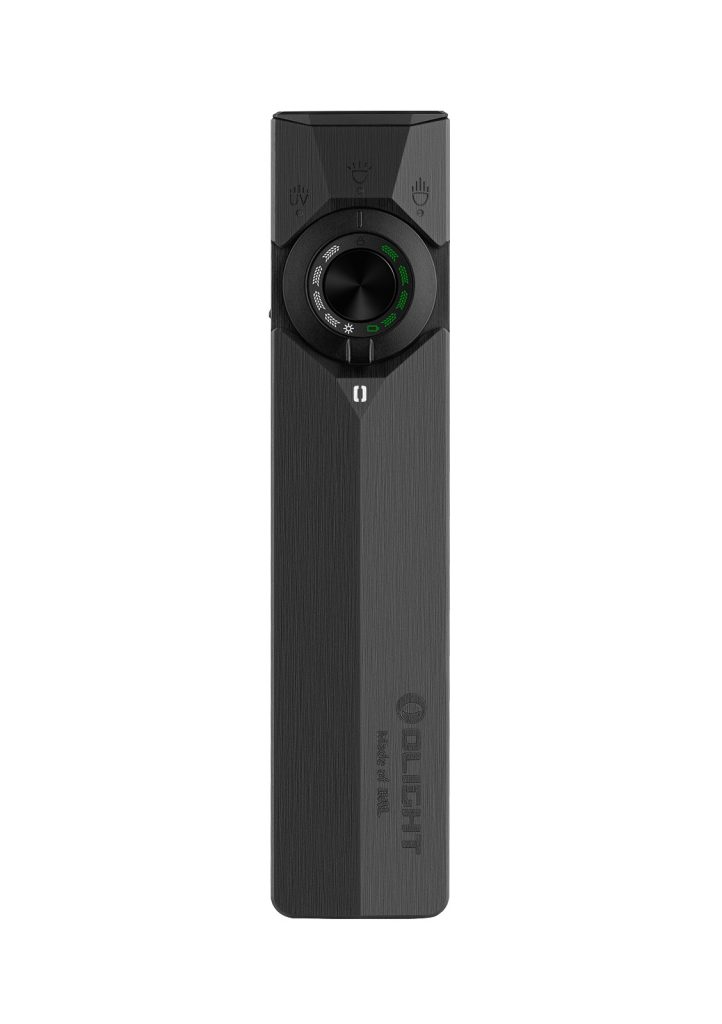
Why I chose it: The ArkPro is the light I’d recommend to most people who want one EDC flashlight and don’t want to think about it again. It replaces the Arkfeld Pro, and the changes fix what held that light back. You now get a separate floodlight and spotlight, a bigger battery and a USB-C port beside the magnetic charger. It’s best for anyone who reaches for a light every day and likes having UV and a laser pointer in the same body. If UV is the main reason you’re shopping, my best UV flashlight guide covers dedicated 365nm lights that do that job better.
Key specs
- Output: 1,500 lumen flood, 800 lumen spotlight, down to a 1 lumen moonlight
- Throw: 205 meters on the spotlight
- Extras: 365 nm UV light and a green laser that can run alongside the white light
- Battery: built-in 2,000 mAh, charged by USB-C or Olight’s magnetic cable
- Runtime: 520 lumen flood for about 2.5 hours, moonlight for up to 14 days
- Build: unibody aluminum, IPX7, 124 x 27 x 16 mm, 115 g
Pros
- Flood and spot beams you choose between, instead of one compromise beam
- Lockout mode for pocket carry
- Charges from any USB-C cable when the magnetic one is at home
Cons
- The built-in battery can’t be swapped in the field
- Many buyers will rarely use the laser or UV
- At 115 g it’s more than twice the weight of the Baton 4
Performance analysis: The Pure Flood is the mode you’ll live in. It spreads 520 lumens evenly across a room or a driveway without a hotspot, and holds that level for over two hours. The spotlight takes over when you need reach, sending 800 lumens out to 205 meters, about twice the throw of the Arkfeld Pro. Turbo on either beam is a short burst; Olight rates the 1,500 lumen flood for 4 minutes before it settles at 520.
If you already own an Arkfeld Pro, the upgrade is mainly worth it for the spotlight and USB-C. If you’re buying new, skip the older model. The ArkPro Ultra adds 200 lumens and a tougher alloy, which few people will notice day to day. My best rechargeable flashlight guide covers more lights with built-in batteries.
2. Streamlight Wedge: Best Simple Pocket Light
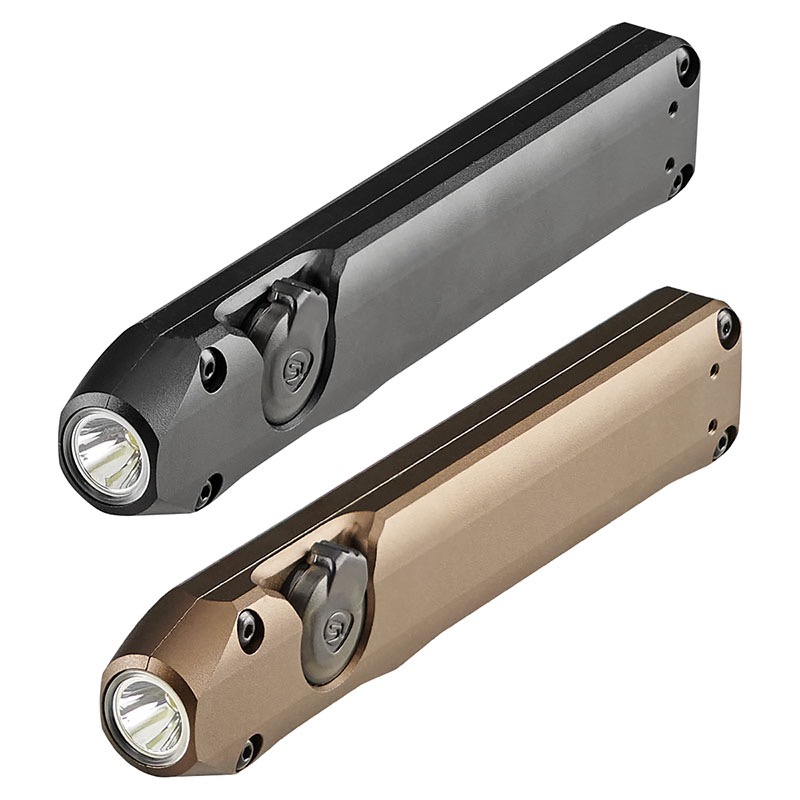
Why I chose it: Some people want a flashlight that works like a light switch, and the Wedge is that light. Push the thumb switch forward for 300 lumens. Push past that and it jumps to 1,000 lumens for as long as you hold it, up to 35 seconds. There are no modes to cycle and nothing to learn. It’s best for anyone tired of fiddly interfaces, and it makes a good gift for someone who isn’t a flashlight person.
Key specs
- Output: 300 lumens constant, 1,000 lumen THRO burst for up to 35 seconds
- Throw: 69 meters constant, 110 meters on THRO
- Runtime: 3 hours at 300 lumens
- Battery: built-in lithium polymer, USB-C charging in about 3 hours
- Build: anodized aluminum, IPX7, 1 meter impact tested, 5.46 in long, 3.3 oz
Pros
- About as simple as a flashlight gets
- Deep carry clip that mounts on either side
- Output stays steady through the runtime instead of fading
Cons
- Only one constant brightness, with no low mode for a dark bedroom
- Long for a flat light, so it can ride up in some pockets when you sit
- The polycarbonate lens scratches more easily than glass
Performance analysis: Three hundred lumens is a well judged number for a one-mode light. It’s bright enough for a row of parked cars or an engine bay and soft enough to use indoors without squinting.
If the length bothers you, the Wedge XT is 108 mm long and swaps the side switch for a tail button with 500 and 50 lumen modes, plus a five-tap lockout. It gives up the THRO burst, so it throws 87 meters instead of 110. Pick the original for simplicity and the XT for a smaller pocket footprint and a real low mode.
3. Nitecore EDC29: Most Powerful Flat Light
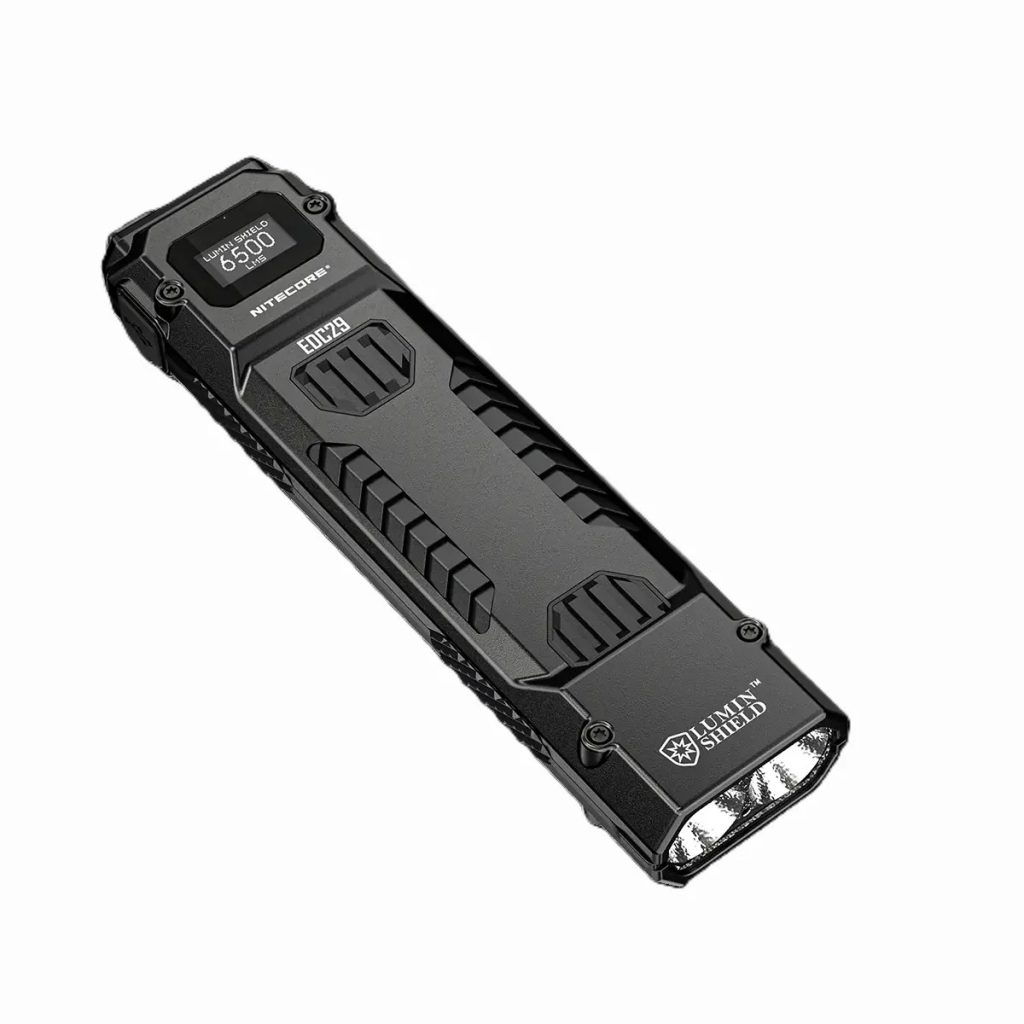
Why I chose it: The EDC29 is for people who want the most light a pocket can hold. Nitecore built it around two UHi 20 MAX LEDs that put out 6,500 lumens in a wide LUMIN SHIELD flood, or 3,000 lumens in a focused SEARCH beam that reaches 400 meters. That’s more output than many full-size tactical lights, from a flat body about 17 mm thick. It’s best for security work and rural property, and for anyone who wants a flat light that doubles as a defensive tool.
Key specs
- Output: 6,500 lumen LUMIN SHIELD, 3,000 lumen SEARCH, regular modes of 1,200 / 400 / 100 / 15 lumens
- Throw: 400 meters, 40,230 candela
- Runtime: up to 61 hours at 15 lumens
- Battery: built-in 2,500 mAh, USB-C charging in about 1 hour 15 minutes
- Display: OLED showing output level, remaining runtime and battery voltage
- Build: stainless steel shell with PVD titanium coating, IP54, 1 meter impact rated, 133.5 mm, 160 g
Pros
- More burst output than any other light here by a wide margin
- Rapid Lock slider locks it out instantly, with no menus
- Charges from empty in about 75 minutes
Cons
- Gets hot quickly on its top modes
- IP54 means rain is fine but a dunk isn’t
- The clip isn’t deep carry, so part of the light shows above the pocket
Performance analysis: The two burst modes are timed, so treat them as tools rather than settings. Hold the paddle switch and you get SEARCH or LUMIN SHIELD for about 10 seconds at a time before the light drops back to protect itself. For walking around, the 400 lumen mode is the one to use; it’s rated for 3 hours.
Lock it every time it goes in your pocket. The Rapid Lock slider on the side makes that a habit instead of a chore, and you only want one accidental 6,500 lumen activation against your leg. Nitecore lists the full ratings on its EDC29 product page. If 160 grams is too heavy, the EDC27 UHi drops to 122 grams and 3,100 lumens with the same flat design and display. For a light chosen mainly for defense, see my best self defense flashlight guide.
4. Olight Baton 4: Best Compact EDC Flashlight
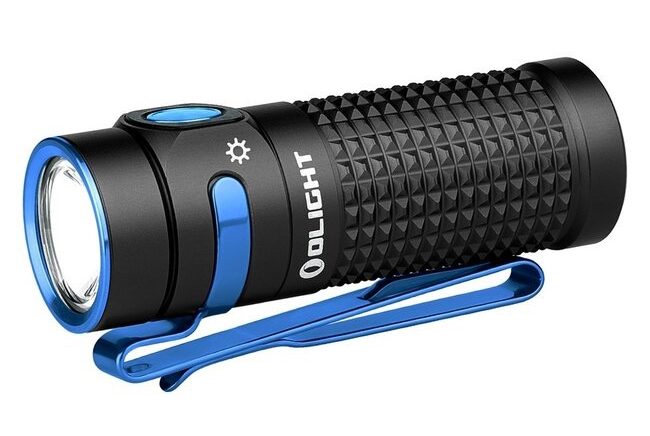
Why I chose it: The Baton 4 is shorter than your index finger and still puts out 1,300 lumens. At 63 mm long and 52.5 grams it disappears in a coin pocket, and the magnetic tail cap sticks to a car door or a breaker box when you need both hands. It’s best for people who find flat lights too long, and for anyone who wants a capable light they’ll never leave at home.
Key specs
- Output: 1,300 lumen turbo, then 600, 60, 12 and 0.5 lumen moonlight
- Throw: 170 meters
- Runtime: 60 lumens for 8 hours, 12 lumens for 35 hours, moonlight for 30 days
- Battery: Olight’s customized 650 mAh 16340 cell, charged in the light by magnetic cable
- Build: aluminum, IPX8, 1.5 meter impact rated, 63 x 21 mm, 52.5 g
Pros
- Smallest and lightest light on this list
- A 0.5 lumen moonlight that won’t wreck your night vision
- Magnetic tail cap for hands-free work
Cons
- Turbo steps down after about 90 seconds
- Charges only with Olight’s magnetic cable
- A generic 16340 isn’t a sure fit, so buy Olight’s spare cell
Performance analysis: A 650 mAh cell is the trade for this size. Olight rates turbo at 1,300 lumens for 90 seconds before it steps to 600, and most daily use will happen at the 60 lumen medium, which runs 8 hours.
If you want the same feel with far more runtime, the Baton 4 Pro moves to a 3,500 mAh 18650, adds a tail switch and USB-C, and rates 155 hours at 15 lumens. It’s 111 mm long and 114 grams, so it carries more like a small tactical light. My best 18650 flashlight guide has more lights in that size class.
5. SureFire Stiletto Pro II: Best Premium
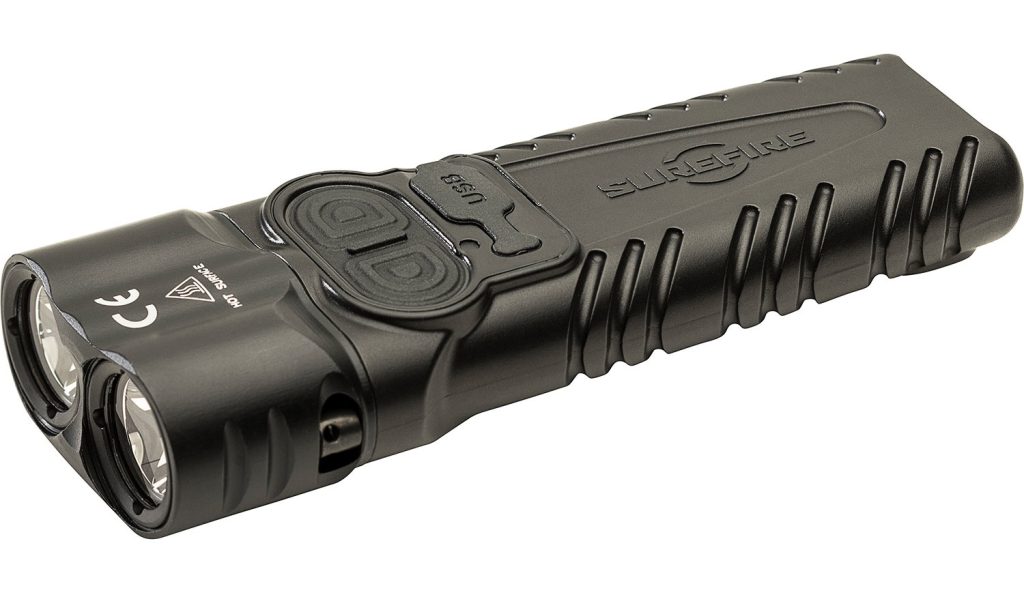
Why I chose it: The Stiletto Pro II is the flat light for people who want reach. SureFire gave it two reflectors side by side, and together they push 35,000 candela out to 375 meters, close to the EDC29’s throw from a body 20 grams lighter. It’s machined in the USA from hard-anodized aluminum and carries SureFire’s reputation for duty gear. It’s best for law enforcement and for anyone who’d rather buy one light for the next decade.
Key specs
- Output: 1,500 / 500 / 25 lumens, plus strobe from the tail switch
- Throw: 375 meters, 35,000 candela
- Runtime: 1 hour on high, 1.5 hours on medium, 23.5 hours on low
- Battery: integrated lithium polymer, USB-C charging
- Switches: top primary switch plus a tactical tail switch, both programmable
- Build: Mil-Spec hard-anodized aluminum, IPX7, 4.87 in long, 5.0 oz
Pros
- Second-longest throw here, behind only the EDC29
- Tail switch gives instant high without hunting for a mode
- Reversible clip carries bezel up or bezel down
Cons
- The most expensive light on this list by a wide margin
- One hour on high is short for the price
- No moonlight mode below 25 lumens
Performance analysis: The hybrid beam is the reason to buy this over the original Stiletto Pro. It keeps a bright center for distance with enough spill around it to see your footing. The jump from 5,100 candela on the older model to 35,000 is the difference between lighting your yard and lighting the tree line past it.
For daily use the 500 lumen medium is plenty, but SureFire rates it for only 1.5 hours, so plan on charging more often than you would with the ArkPro. The tail switch can be reprogrammed to high only if you don’t want the strobe. If reach is what you care about most, my best throw flashlight guide covers lights that go much farther in bigger bodies.
6. Wurkkos TS10 V2: Best Budget
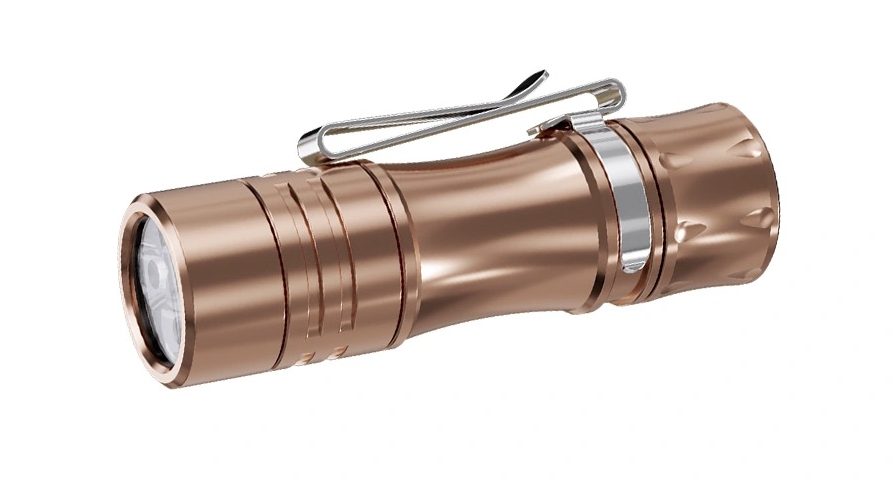
Why I chose it: The TS10 V2 costs the least of anything here and is a favorite among flashlight enthusiasts. It runs Anduril 2, an open source interface that lets you set the ramp, the brightness ceiling and the thermal limit yourself. Three 90 CRI LEDs render colors naturally, and three RGB aux LEDs glow when the light is off so you can find it in the dark. It’s best for people who like to set up their gear their own way, and for anyone who wants a capable EDC light without spending much.
Key specs
- Output: up to 1,400 lumens, ramping down to 1 lumen
- Throw: 130 meters, 4,150 candela
- Battery: one 14500 lithium-ion cell, sold with a 900 mAh cell in the battery kit
- Charging: none on the light, so you need a 14500 charger
- Interface: Anduril 2 with lockout, smooth ramping and stepped modes
- Build: aluminum, IP68, 71.5 x 21 mm, 32 g without the cell
Pros
- Fully adjustable interface
- High CRI light shows true colors
- Small enough for a coin pocket
Cons
- A regular AA fits but won’t turn it on
- Turbo is a short burst that settles to a few hundred lumens
- Anduril takes some learning before it feels natural
Performance analysis: Turbo is the headline, not the working mode. The TS10 hits its peak for a short burst, then steps down hard to keep the head from overheating, which is normal for a light this small. Lower the Simple mode ceiling and it becomes a predictable light you can hand to anyone.
One warning matters more than any spec here. A 14500 is the same size as an AA, so label your cells and never assume an AA from a drawer will run it. My best budget flashlight guide has more lights that don’t cost much.
7. Streamlight ProTac 1L-1AA: Best Swappable Battery
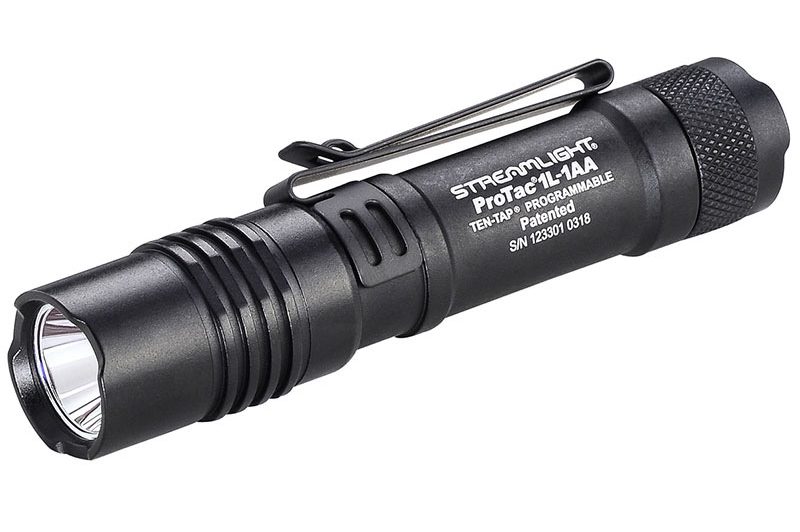
Why I chose it: Every other light on this list depends on a charger or a specific cell. The ProTac 1L-1AA runs on a CR123A for 350 lumens or on a plain AA from any gas station for 150. If the battery dies on a trip, you’re one store visit from working light again. It’s best for travelers, and for anyone who keeps a light in a car or a desk drawer where it might sit for months.
Key specs
- Output on CR123A: 350 lumens high, 40 lumens low, plus strobe
- Output on AA: 150 lumens high, 40 lumens low
- Throw: 160 meters on CR123A, 105 meters on AA
- Runtime on CR123A: 1.5 hours on high, 14 hours on low
- Programs: TEN-TAP choice of high/strobe/low, high only, or low/high
- Build: aluminum, tempered glass lens, IPX7, 2 meter impact tested, 4.25 in long, 2.5 oz with a CR123A
Pros
- Runs on two of the easiest batteries to buy
- Comes with one CR123A and one AA in the box
- Tail switch works as momentary or click-on
Cons
- No built-in charging
- 350 lumens is the lowest peak here
- Strobe sits in the default mode order until you reprogram it
Performance analysis: On a CR123A this is a punchy little light with real throw for its size, and 14 hours on low covers a long night. On an alkaline AA it drops to 150 lumens and 1 hour 20 minutes on high, which is enough to get you home. A lithium AA stretches high past 4 hours, so that’s the cell to keep in a glove box. Set TEN-TAP to low/high if you mostly use it up close.
If CR123As are new to you, my CR123A rechargeable guide explains how disposable and rechargeable cells differ. My best AA flashlight guide covers more lights that run on AA.
Compare Any Two EDC Flashlights
Most people end up choosing between two lights, not seven. Pick any two below and the comparer draws them at the same scale beside a credit card, then lines up their output, throw, weight and battery so the tradeoff is easy to see. I also added three lights people often weigh against these picks: the Streamlight Wedge XT, the Nitecore EDC27 UHi and the older Olight Arkfeld Pro.
The shortest picks are the Olight Baton 4 at 63 mm and the Wurkkos TS10 V2 at 71.5 mm. The longest are the Streamlight Wedge at 139 mm and the Nitecore EDC29 at 133.5 mm. The EDC29 is the heaviest at 160 grams, and the Baton 4 is the lightest at 52.5 grams.
How much each pick weighs in your pocket
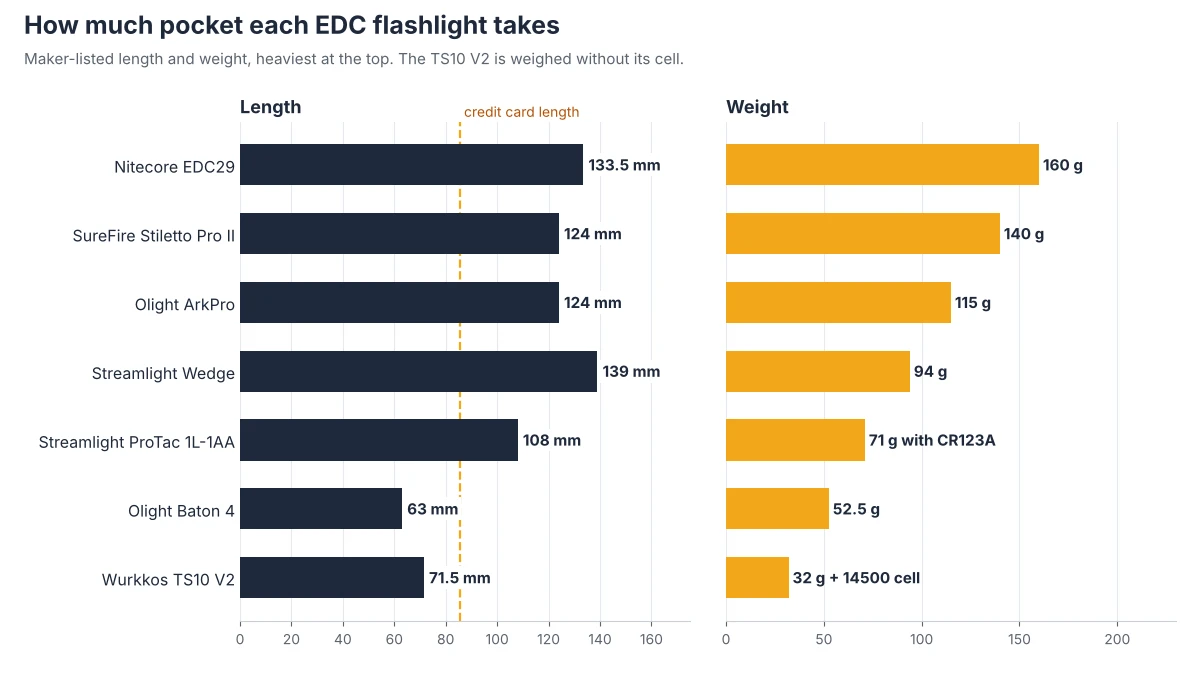
The gap is bigger than spec sheets make it feel. The EDC29 weighs about three times as much as the Baton 4, and you notice that by the end of a day in light pants.
What to Look For in an Everyday Carry Flashlight
Flat or round
Flat lights spread their battery out instead of stacking it, so they ride against your leg like a phone or a folding knife. They’re the most comfortable to carry and usually charge through a built-in port. Round lights can roll off a table, but they’re shorter for the same output and often take a removable cell. If you carry in a front jeans pocket, try a flat light first. In a coin pocket, a bag or a jacket, a short tube like the Baton 4 often works better.
Built-in battery or one you can swap
Most rechargeable EDC flashlights now charge over USB-C, so one cable covers your phone and your light. A built-in battery keeps a flat light thin and sealed, and USB-C means any phone cable tops it up. The catch is that the battery’s life is the light’s life. Lithium cells slowly lose capacity over hundreds of charge cycles, and when a sealed pack wears out, the light usually goes with it. A removable 14500, 16340 or AA lets you carry a spare and replace a tired cell cheaply. Choose built-in for convenience and removable for the long haul.
The lumens you’ll actually use
The number on the box is a burst. Small lights can’t shed heat fast, so they step down from turbo within seconds or minutes. Daily use happens between about 50 and 500 lumens: the low end for a dark bedroom or a car interior, the high end for a parking lot or a yard. Check runtime at those levels before you compare peak output. My candela vs lumens guide explains why throw matters as much as brightness outdoors.
A lockout you’ll actually use
A light that switches on in your pocket drains its battery, and a high output light can get uncomfortably hot against your leg. Look for a lockout that’s quick enough to use every time. The EDC29’s Rapid Lock slider and the ArkPro’s lockout mode are the easy kind, and Anduril locks the TS10 with a few quick clicks. Lights without one, like the original Wedge, rely on a switch that’s hard to bump.
The clip decides whether you carry it
A deep carry clip lets the light sit below the pocket line so it doesn’t snag or print. The Wedge’s clip is one of the best here and moves to either side for left-hand carry. The EDC29’s clip leaves part of the light showing. A two-way clip, like the one on the TS10, lets you clip the light to a hat brim and use it as a makeshift headlamp.
FAQ
What is the best EDC flashlight?
For most people it’s the Olight ArkPro. It’s flat enough to forget in a pocket and gives you a floodlight and a 205 meter spotlight in one body. If you want something simpler, the Streamlight Wedge is the easiest light here to use.
How many lumens should an EDC flashlight have?
Look for at least 300 lumens you can run for an hour or more, plus a low mode under 50 lumens for indoor use. A burst of 1,000 lumens or more helps when you’re scanning a yard, but on a pocket light it only lasts seconds to minutes.
Is the Olight ArkPro better than the Arkfeld Pro?
Yes, for most buyers. The ArkPro adds a separate spotlight that throws 205 meters, about double the Arkfeld Pro’s 102. It also brings 200 more lumens, a larger 2,000 mAh battery and USB-C charging next to the magnetic cable. The Arkfeld Pro is slightly shorter and lighter, so it’s only worth buying if you find it well discounted.
Can you take an EDC flashlight on a plane?
Yes. A flashlight with its battery installed can travel in your carry-on. Spare lithium cells, including 14500, 16340 and CR123A batteries, must stay in your carry-on and never go in checked bags, under the FAA’s lithium battery rules. Protect their terminals from short circuits, and lock the light out before you pack it.
Bottom Line
If you buy one EDC flashlight, make it the Olight ArkPro. It’s the most complete light here and it carries like a phone. Choose the Streamlight Wedge if you want something anyone can use without instructions, or the Nitecore EDC29 for the most output a pocket can hold.
For the smallest footprint, the Olight Baton 4 is hard to beat at 52.5 grams. The SureFire Stiletto Pro II is the one to buy once and keep. The Wurkkos TS10 V2 gives tinkerers the most for the least, and the Streamlight ProTac 1L-1AA keeps working on batteries sold everywhere.
