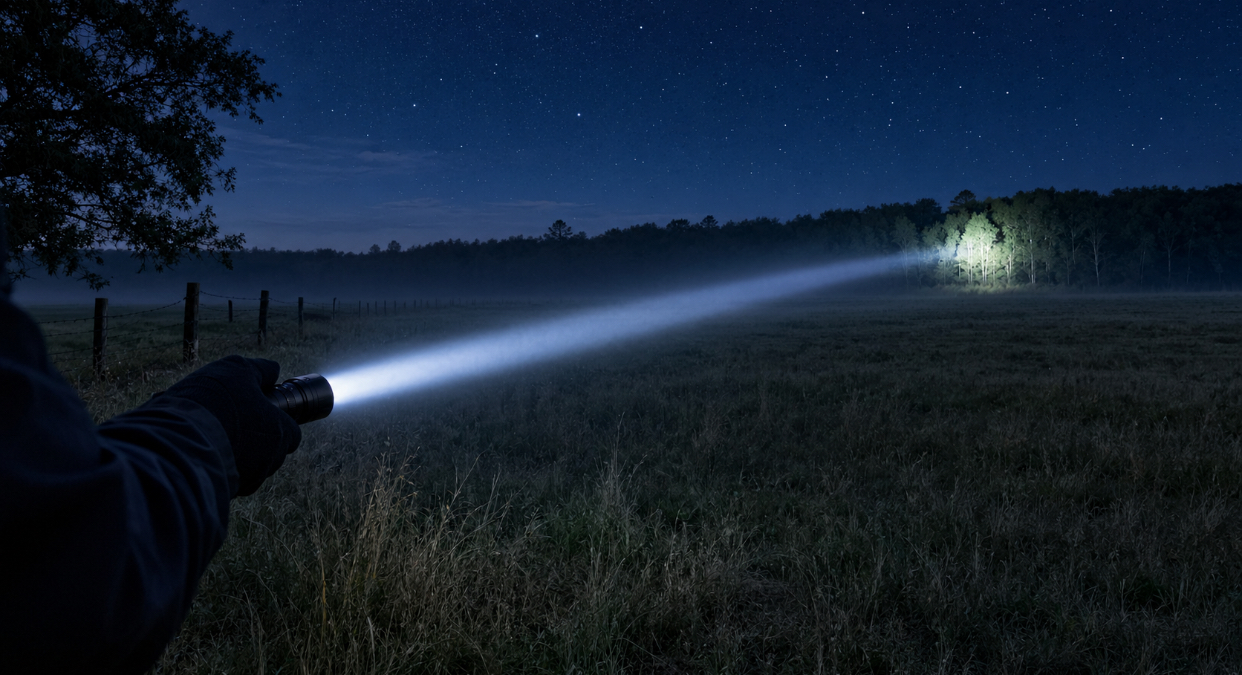
Most “long range” flashlights sold today are blinding at your feet and useless at 200 yards. A real thrower works the other way around. It squeezes its light into a tight hotspot so you can pick out a coyote at the far fence line or the reflector on a boat ramp from the middle of the lake.
I’ve been separating real throwers from spec sheet fiction on this site since 2014, and the number that tells you the truth is candela, not lumens. Every light below is rated by its maker under the ANSI FL1 standard and sold on Amazon. The range runs from a 3.5 inch pocket light all the way up to a 2,500 meter searchlight.
If you just want the farthest throw flashlight you can carry on a belt, go straight to the Nitecore P30i or the Fenix TK30R. Not sure how much reach you actually need? The throw calculator further down turns any candela rating into a realistic seeing distance.
Quick Picks: The Best Throw Flashlights
Throw Flashlights Compared
Sorted by rated throw, these are the manufacturer ANSI FL1 figures for all seven lights.
The 7 Best Throw Flashlights, Reviewed
1. Nitecore P30i (Best Overall)
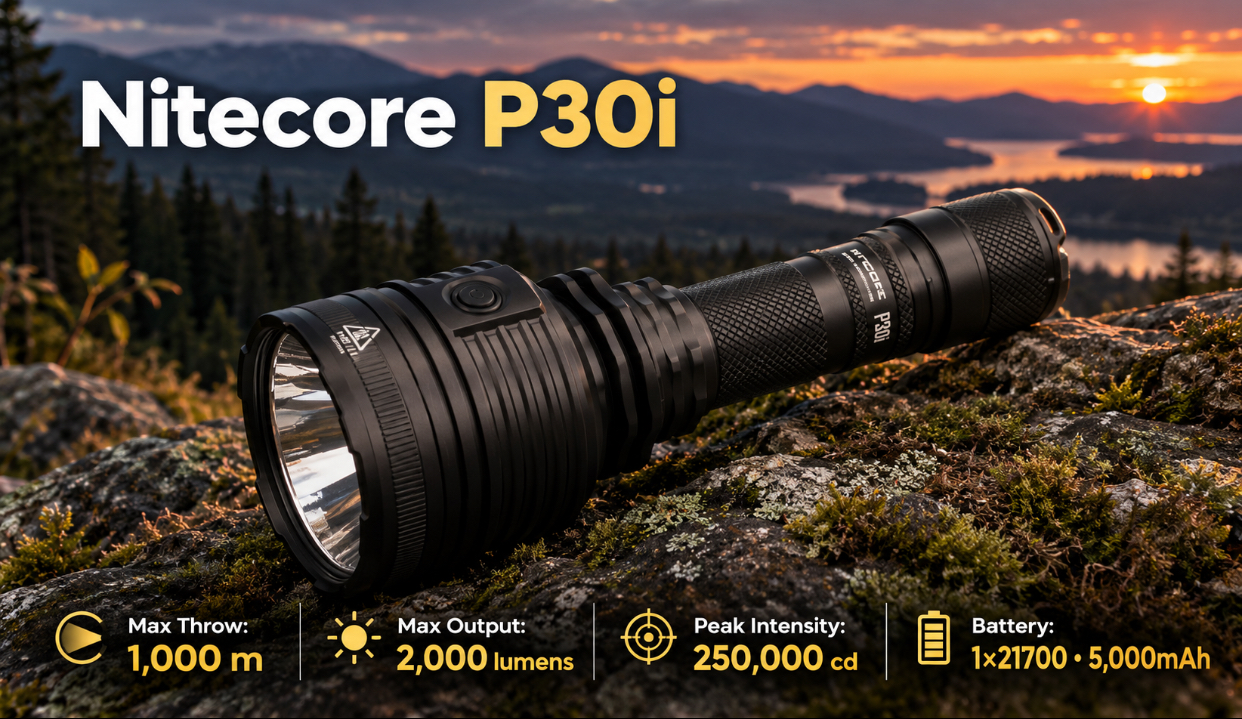
Why I chose it: The P30i is the shortest path to a genuine 1 kilometer beam without stepping up to a searchlight. Nitecore rates it at 250,000 candela, and the ANSI math on that number lands on exactly 1,000 meters, so the spec sheet isn’t padded. It’s a dedicated long range light and doesn’t pretend to be anything else.
Who it’s best for: Property owners and search volunteers who want maximum reach from a light that still fits a holster.
Key specs:
- LED: CREE XHP35 HI
- Max output: 2,000 lumens
- Peak intensity: 250,000 cd
- Rated throw: 1,000 m (1,093 yd)
- Battery: Nitecore NL2150HPi 21700, 5,000 mAh (included), plus a CR123A magazine
- Charging: USB-C port on the light
- Size and weight: 6.99 in long, 65 mm head, 255.5 g (9.01 oz)
- Rugged: IP68 to 2 m, 1 m impact rating
- In the box: RSW2i remote pressure switch, holster, clip
Pros:
- A real 1,000 meter beam in a 7 inch light
- Remote pressure switch included for long gun mounting
- Accepts CR123A primaries when your rechargeable is dead
- Five brightness levels plus strobe and beacon
Cons:
- Full output needs Nitecore’s own high drain i-series cell
- Very little side light for close work
Performance analysis: The XHP35 HI is a small domeless emitter, and small emitters throw. That’s how the P30i reaches 1,000 meters on 2,000 lumens when plenty of 5,000 lumen lights stall out under 400. The beam is a hot, round center with a thin ring of spill, which is exactly what you want for scanning a tree line and exactly what you don’t want for walking a dark trail at your feet.
Nitecore’s runtime chart lists Turbo at about 30 minutes before the cell is spent, with the light stepping itself down as it heats. High at 1,000 lumens runs about an hour and a half, and Mid at 385 lumens runs about four hours. Mid is where I’d leave it for long patrols, since it still reaches well past most handheld lights.
One thing to know before you buy: Nitecore says the P30i only hits full power on its i-series 21700 rated above 15 amps. A generic 21700 won’t cut it. The included CR123A magazine is your backup, and the USB-C port doubles as the jack for the remote switch when you mount it on a rifle or shotgun.
2. Acebeam L19 2.0 (Best for Hunting)
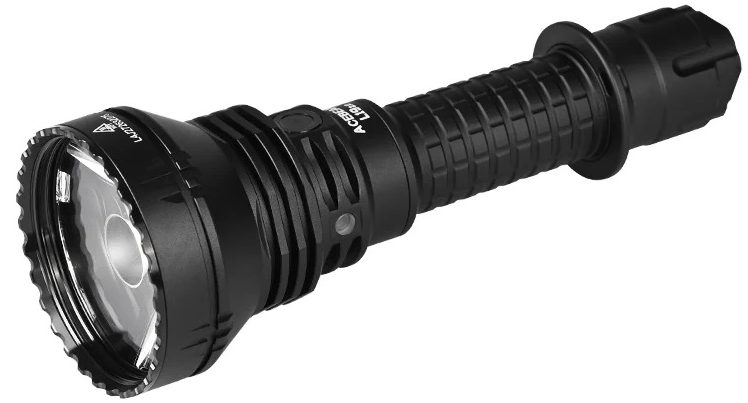
Why I chose it: The L19 2.0 out-throws the P30i on paper, at 293,222 candela against 250,000, and it does it through a 55 mm TIR optic instead of a big reflector. Acebeam also sells it with a green LED, and that’s the version I’d point most night hunters toward.
Who it’s best for: Hog and predator hunters, plus anyone who wants the most reach from a single 21700 light that mounts to a rifle.
Key specs:
- LED: Luminus SFT40 HI (white), with a 55 mm TIR lens
- Max output: 2,200 lumens
- Peak intensity: 293,222 cd
- Rated throw: 1,083 m (1,184 yd); the green version is rated to 1,520 m
- Battery: Acebeam 21700, 5,100 mAh with its own USB-C port (included)
- Size and weight: 163.8 mm (6.4 in), 284.3 g (10 oz)
- Rugged: IP68
- Mounting: works with Acebeam’s mount and remote switch accessories
Pros:
- Most candela of any LED light here under a pound
- Green version for hunters who want less spook and better night vision
- Strong 1,200 lumen High mode that still throws 769 m
Cons:
- No charging port on the light; you charge the battery itself
- Heavier than the P30i
- Narrow beam, so you’ll want a second light for close work
Performance analysis: A TIR optic is a molded lens that bends nearly all of the LED’s light into one narrow cone. Pair it with the SFT40, one of the most popular throw LEDs right now, and you get a beam that reaches past a kilometer from a head only 55 mm wide.
The High mode is the one hunters will live in. Acebeam rates it at 1,200 lumens, 147,840 cd and 769 meters for about 1 hour 38 minutes. That’s longer reach than most people’s Turbo, and it holds steady long enough to glass a field properly.
The green version is where the L19 2.0 earns this slot. Green light is easier on your own night vision, and many hunters find animals stay calmer under it than under white. Acebeam rates the green model at 577,600 cd and 1,520 meters, which is LEP territory from an LED light. Check your state’s rules on lights and hunting before you head out, which I cover in the buying guide below.
3. Fenix TK30R (Best LEP)
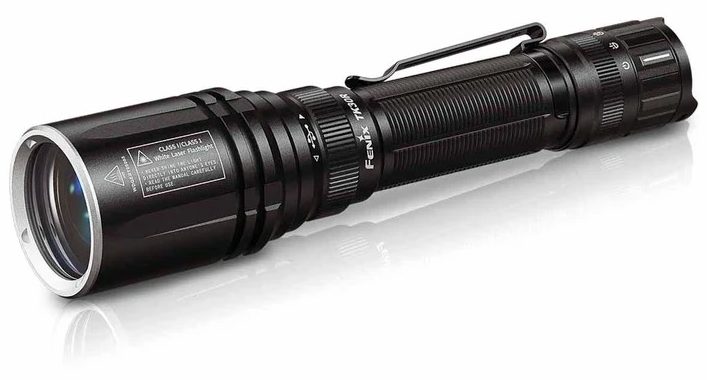
Why I chose it: The TK30R puts 600,000 candela and a 1,500 meter beam into a 250 gram light with built in USB-C charging. It’s the easiest way into LEP, short for laser excited phosphor, from a brand with real customer support in the US.
Who it’s best for: Search teams and ranchers who need to identify something at extreme distance and already carry a separate everyday light.
Key specs:
- Light source: 10 W white laser module (LEP), Class 1 laser per Fenix
- Max output: 500 lumens
- Peak intensity: 600,000 cd
- Rated throw: 1,500 m (1,640 yd)
- Battery: Fenix ARB-L21-6000 21700, 6,000 mAh (included)
- Charging: hidden USB-C port, about 4 hours on a 15 W adapter
- Size and weight: 7.24 in long, 250 g (8.82 oz)
- Rugged: IP68, 1.5 m drop rating
- Controls: rotary tail cap with lockout, Low and High, plus instant strobe
Pros:
- Longest reach of any light here under a pound
- Almost no spill, so the light lands only where you aim it
- Rotary tail cap with a real lockout position
Cons:
- Useless for close range work
- Only two brightness levels
- Can’t be switched on while it’s charging
Performance analysis: An LEP light fires a blue laser at a tiny phosphor target, which glows white from a spot far smaller than any LED die. The smaller the source, the tighter the optics can focus it. That’s why the TK30R reaches 1,500 meters on 500 lumens, a quarter of the P30i’s output.
High runs about 3.5 hours at 500 lumens. Low drops to 100 lumens and still reaches 600 meters for almost 9 hours. Fenix notes that High eases off gradually as the light heats up, so expect the beam to soften a little on long runs.
The tradeoff is the beam itself. An LEP beam is a pencil of light with almost nothing around it, so shining it at your feet shows you a bright dot and not much else. Carry it alongside a floody EDC light and use the TK30R only for distance.
4. Nitecore MH25 Pro (Best for Everyday Duty)
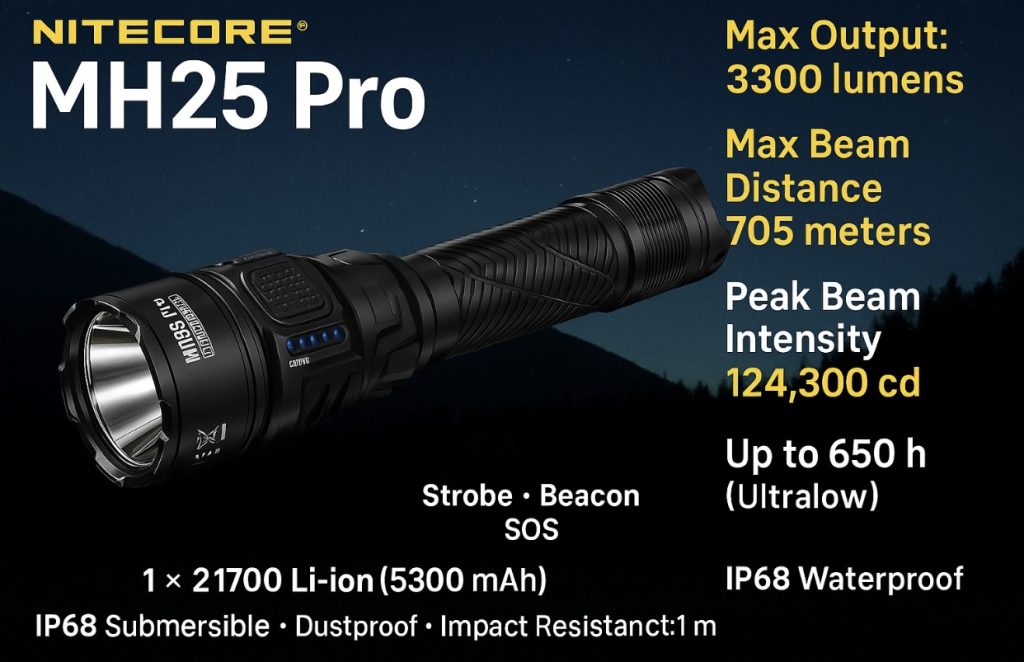
Why I chose it: Not everyone needs a kilometer. The MH25 Pro reaches 705 meters with 3,300 lumens behind it, so you get usable spill for walking and a hotspot that still reaches across a big pasture. It’s the most versatile light on this list.
Who it’s best for: Security work and farm chores, or anyone who wants one light that handles both distance and close range.
Key specs:
- LED: NiteLab UHi 40 with a smooth reflector
- Max output: 3,300 lumens
- Peak intensity: 124,300 cd
- Rated throw: 705 m (771 yd)
- Battery: Nitecore NL2153HP 21700, 5,300 mAh (included)
- Charging: USB-C port on the light
- Size and weight: 153.6 mm (6.05 in), 40 mm head, 130 g (4.59 oz) without battery
- Rugged: IP68
- Controls: tactical tail switch plus mode button, Daily and Tactical user modes
Pros:
- Most usable spill of the handheld picks
- Slim 40 mm head fits standard duty holsters
- Up to 650 hours on its lowest mode
Cons:
- About 70 percent of the P30i’s reach
- Turbo steps down quickly, like every light this size
Performance analysis: The MH25 Pro is a hybrid. Its smooth reflector gives a defined hotspot, but at 3,300 lumens there’s plenty of light spilling around it. That spill is what makes it practical for walking a fence line or searching a yard, where a pure thrower would leave you squinting at the edges.
The two user modes matter more than they sound. Daily mode gives you five brightness levels plus beacon and SOS. Tactical mode trims that back to the brightness levels and strobe, so you can’t cycle into beacon or SOS by accident. If the light lives on a duty belt, Tactical is the setting you want.
At 705 meters it gives up real distance to the P30i and L19 2.0. But it’s slimmer and far easier to use for everything else you do after dark, which is why it earns a place here.
5. Acebeam E10 2.0 (Best Pocket Thrower)
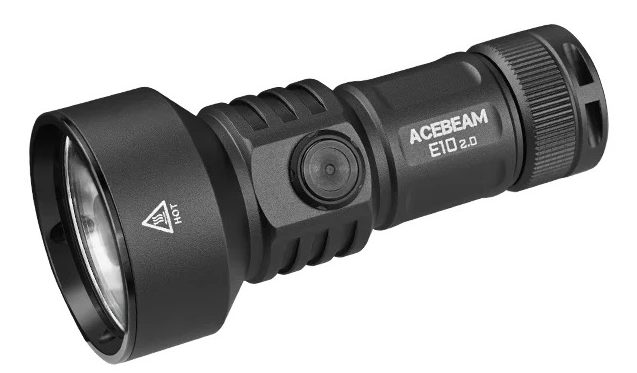
Why I chose it: The E10 2.0 is 3.47 inches long and rated to throw 715 meters, which is farther than the MH25 Pro on about a third of the lumens. If you want to understand why candela matters more than lumens, this light is the whole argument in your hand.
Who it’s best for: Hikers and everyday carriers who want real reach without a belt holster.
Key specs:
- LED: CREE XP-LR with a TIR optic
- Max output: 1,200 lumens
- Peak intensity: 127,806 cd
- Rated throw: 715 m (782 yd)
- Battery: 16340 Li-ion with a built in USB-C port (included)
- Size and weight: 88 mm (3.47 in) long, 40 mm head, 106.5 g (3.76 oz)
- Rugged: IP68, 1.5 m drop rating
- Extras: magnetic tail cap
Pros:
- Longest throw on this list per inch of flashlight
- Magnetic tail sticks to a truck fender or a steel post
Cons:
- The small 16340 cell gives short runtimes on the top modes
- The 40 mm head is wide for a jeans pocket
- Turbo is a short burst, not a mode to leave on
Performance analysis: The trick is the optic. The XP-LR is a small, intense LED, and Acebeam’s TIR lens shapes nearly all of its output into a narrow spot. The result is a beam that looks like it came from a much bigger light, at least for the first stretch of Turbo.
That stretch is the catch. A 16340 cell simply doesn’t hold much energy, so the E10 2.0 steps down from 1,200 lumens fast and spends most of its working life on its lower modes. Think of Turbo as the button you press to check what’s at the far end of the field, then drop back down.
For most people this is the light that’s actually with them when something moves out past the porch light. If you want the smallest possible option, see my best mini flashlight picks too.
6. Sofirn IF22A (Best Budget Thrower)
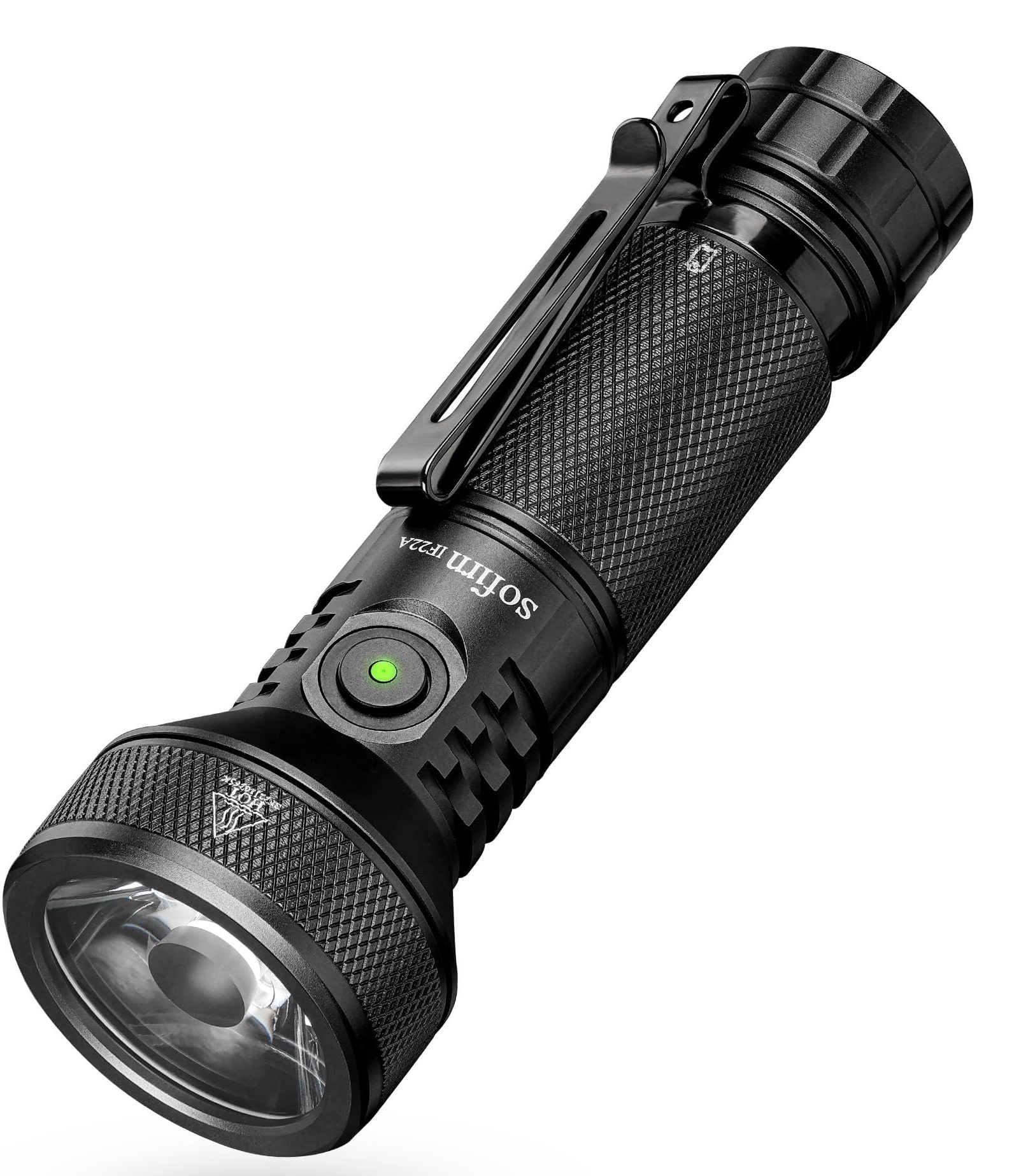
Why I chose it: The IF22A gives you roughly 690 meters of rated reach, a 21700 battery and USB-C charging for a price that undercuts every other light here by a wide margin. It’s the light I’d hand to someone curious about throwers who doesn’t want to spend big to find out.
Who it’s best for: First time thrower buyers and anyone who wants a long range truck or barn light on a budget.
Key specs:
- LED: Luminus SFT-40 with a 5 degree TIR optic
- Max output: 2,100 lumens
- Peak intensity: about 108,000 cd
- Rated throw: about 690 m (755 yd)
- Battery: 21700, 5,000 mAh (included), with an 18650 adapter tube
- Charging: USB-C, and it can charge your phone as a power bank
- Rugged: IPX8 to 2 m
- Controls: single side switch with ramping or stepped modes
Pros:
- Huge reach for the money
- Doubles as a power bank
- Runs 18650 cells too with the included adapter
Cons:
- No tactical tail switch
- Real world output settles well below the 2,100 lumen headline after the first minute
Performance analysis: The IF22A uses the same LED as the Acebeam L19 2.0’s white version, the SFT-40, behind a tight 5 degree TIR optic. That combination is why a budget light lands in the same throw class as the Nitecore MH25 Pro.
The beam has almost no spill, so it behaves like a mini spotlight. That’s great for picking out eyes at the edge of a field and less great for walking. The single side switch handles everything, and you can pick smooth ramping or fixed steps, which is a nice touch at this price.
The honest tradeoff is sustained output. Like most budget lights, the IF22A’s 2,100 lumen Turbo is a short burst before heat pulls it down. It still throws a long way after it settles, it just won’t hold the number on the box. More picks at this price live in my best budget flashlight guide.
7. Acebeam K75 2.0 (Maximum Throw)
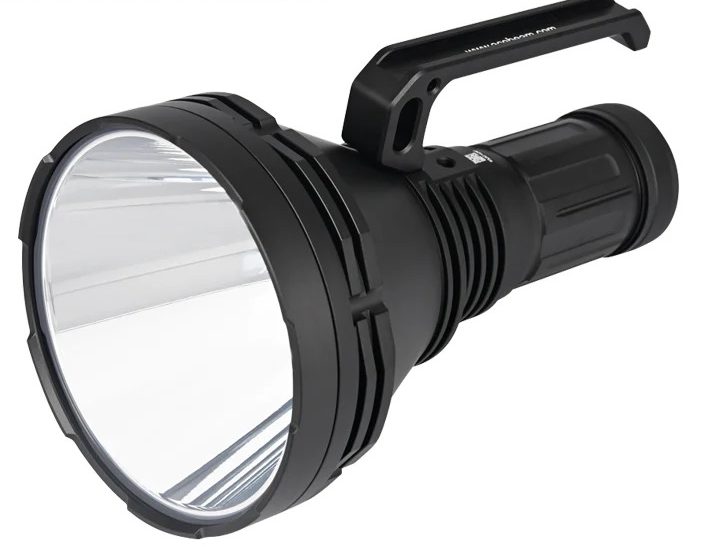
Why I chose it: When a kilometer isn’t enough, the K75 2.0 is rated to 2,500 meters, about 1.55 miles. Its 1,562,500 candela is more than six times the P30i, and it still comes from a handheld light with a carry handle instead of a vehicle mounted spotlight.
Who it’s best for: Search and rescue teams and big open properties, where a kilometer of reach still isn’t enough.
Key specs:
- LED: Luminus SBT-90.2
- Max output: 6,300 lumens
- Peak intensity: 1,562,500 cd
- Rated throw: 2,500 m (2,734 yd)
- Battery: 4 x 18650 high drain cells rated for at least 10 A
- Modes: Power mode for full output, Eco mode at 3,000 lumens and 1,649 m
- Size and weight: 218 mm long, 126 mm head, about 844 g without batteries
- Rugged: IP68
Pros:
- Longest LED throw on this list by a wide margin
- Eco mode trades some reach for longer runtimes
- Lights a whole hillside instead of a single dot on it
Cons:
- Big and heavy, closer to a lantern than a flashlight
- Needs four matched high drain 18650s and a separate charger
- Overkill for nearly everyone who isn’t searching for something
Performance analysis: The SBT-90.2 is a large, very bright LED, and the K75 2.0 needs a head over 5 inches wide to focus it. That’s how it gets both huge lumens and huge candela, something smaller lights can only pick one of.
Acebeam rates Turbo at 6,300 lumens for about 1 hour 45 minutes, with the output stepping down along the way. Eco mode caps the light at 3,000 lumens and still reaches 1,649 meters, which still beats every other light on this list at full power.
The practical issue is the battery setup. Acebeam calls for four high drain 18650 cells, and some listings ship without them, so check the bundle before you order. Mine would be the kit with cells and a 4 bay charger, because mismatched cells in a four cell light is asking for trouble. If you’re new to these cells, my 18650 flashlight guide covers the basics.
How Far Can You Actually See With a Throw Flashlight?
A rated throw of 1,000 meters doesn’t mean you can identify a deer at 1,000 meters. Under the ANSI FL1 standard, beam distance is the point where the light on a target has fallen to 0.25 lux, which Pelican’s ANSI FL1 summary compares to a full moon on a clear night in an open field. At that distance you can tell something is there. Picking out what it is takes more light.
The math behind the rating is simple. Rated throw in meters equals two times the square root of the candela figure. That’s why the Nitecore P30i’s 250,000 cd works out to exactly 1,000 meters.
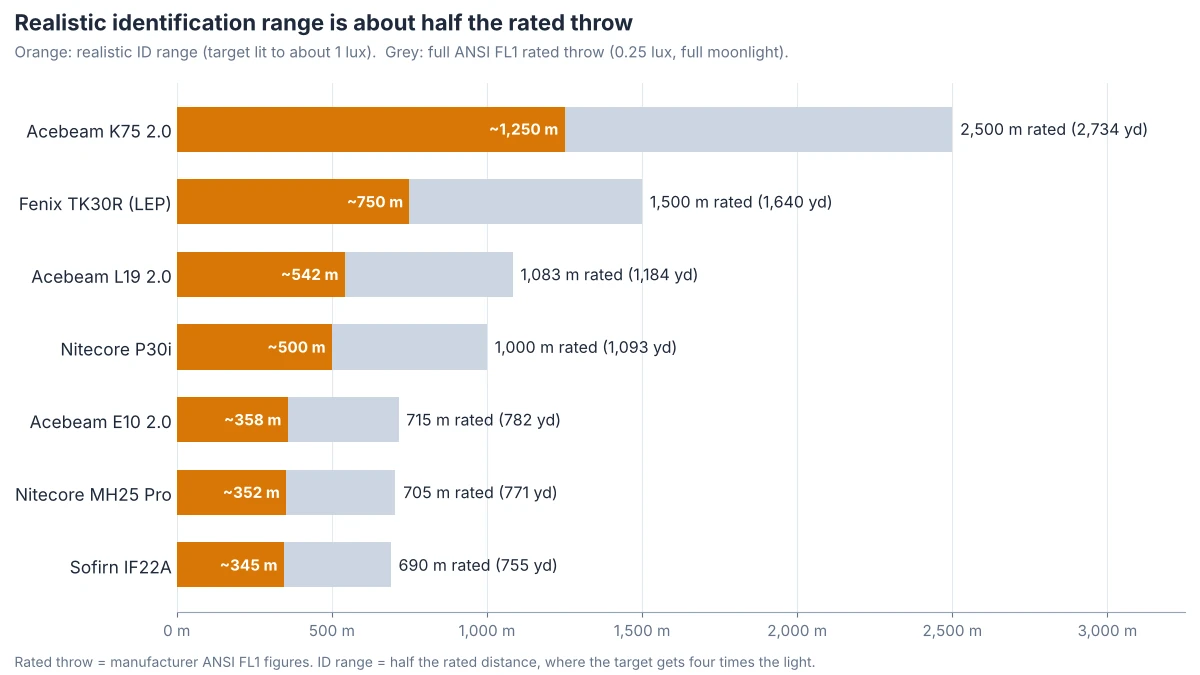
Light on a target falls with the square of distance, so halving the distance gives you four times the light. At half the rated throw, your target gets about 1 lux, four times a full moon. That’s roughly where most people can start picking out detail. Treat half the box number as your realistic identification range, and expect less in humid or dusty air.
Which Throw Flashlight Fits Your Distance?
Start with the farthest thing you actually need to identify, then double it. That’s the rated throw to shop for.
If you mostly need to see what’s moving at the edge of a backyard or a small farm, roughly 300 meters or less, the Acebeam E10 2.0, Nitecore MH25 Pro and Sofirn IF22A all cover it. Each one puts about 1 lux on a target at around 350 meters.
Open pasture, a long tree line or hunting from a stand usually means 400 to 550 meters. That’s Nitecore P30i and Acebeam L19 2.0 territory, and the green version of the L19 2.0 stretches it further.
Past that, you’re spotting across a lake or a big ranch. The Fenix TK30R gives you around 750 meters of identification range from a light under a pound, and the Acebeam K75 2.0 pushes past 1,200 meters if you can carry its weight.
Buying Guide: What to Look For in a Long Range Flashlight
Candela first, lumens second
Lumens tell you how much light leaves the flashlight. Candela tells you how concentrated it is in the brightest part of the beam, and that’s what decides reach. A 1,200 lumen pocket light like the Acebeam E10 2.0 out-throws the 3,300 lumen MH25 Pro because its light is packed tighter. If a listing shows lumens but hides candela or ANSI beam distance, skip it. My candela vs lumens guide goes deeper on this.
Be wary of Amazon listings claiming 50,000 or 100,000 lumens from a light the size of a soda can. Real lights at that level exist, but they’re big, fan cooled searchlights, and I compare them in my brightest flashlight guide.
Head size and optics
For a given LED, a wider head means a tighter beam. That’s basic optics, and it’s a big part of why the 126 mm K75 2.0 reaches more than three times as far as the 40 mm MH25 Pro. A deep smooth reflector or a narrow TIR lens both work well for throw. TIR optics like the ones on the L19 2.0, E10 2.0 and IF22A can match a bigger reflector’s reach from a smaller head, at the cost of almost no spill.
Skip the cheap zoom flashlights that promise both flood and throw from one sliding lens. That kind of lens wastes a lot of light, and few of those lights publish honest candela figures.
LEP lights take this as far as it goes. Their light source is so small that a modest head produces a pencil beam reaching well past a kilometer, like the Fenix TK30R.
The LED behind it
Small, intense LEDs throw farther than big, bright ones of the same output. Names you’ll see on serious throwers include the Luminus SFT40 (L19 2.0 and IF22A) and the CREE XHP35 HI (P30i). The giant Luminus SBT-90.2 in the K75 2.0 is the exception, and it needs a huge head to make its size pay off.
You still need some spill
A pure thrower shows you a bright circle and leaves everything around it dark. That’s fine from a tree stand or a truck bed, and it’s frustrating on a trail. If you’ll be walking with the light, a hybrid like the MH25 Pro is easier to live with. Otherwise, plan on carrying a second, floodier light for close range work. That’s also why I’d never make a pure thrower anyone’s only flashlight. It’s a tool for distance, and the light you reach for to find your keys should be a different one.
Battery and charging
Most serious throwers now run a single 21700 cell, and every handheld pick here includes one. Pay attention to the fine print, though. The P30i needs Nitecore’s own high drain cell, the L19 2.0 charges through the battery instead of the light, and the K75 2.0 wants four high drain 18650s plus a separate charger. Built in USB-C charging on the light itself, like the TK30R, MH25 Pro and IF22A have, is the easiest setup to live with. And if you already own a charger and a drawer of 21700 cells, a light that takes standard cells costs less to keep running than one tied to a proprietary battery.
Look past the Turbo number
ANSI runtime is measured from 30 seconds after you switch on, and every high output light steps down as it heats. Turbo is a burst for checking something far away. The mode you’ll actually use is usually High or Medium, so compare those reach figures before you buy. The L19 2.0 at 769 meters on High is a good example of a light that stays useful after Turbo ends. The P30i’s High mode is rated at 130,500 cd, which still works out to about 720 meters, and the TK30R’s Low mode reaches 600 meters for almost 9 hours.
Fog, rain and beam color
Water droplets bounce light straight back at you, so any powerful beam turns into a glowing wall in heavy fog. Hold the light away from your face, low at your hip or out to the side, so less of that glare lands in your eyes. A neutral white beam also tends to look less washed out in mist than a very cool blue white one. And an LEP’s tiny beam makes less glare near you than a wide LED beam does.
Mounting and remote switches
If the light is going on a rifle, a shotgun or a truck rail, check which mounts and pressure switches its maker sells. The Nitecore P30i ships with its RSW2i remote switch, which plugs into the USB-C port. The Acebeam L19 2.0 works with Acebeam’s mount and remote switch accessories, and Fenix sells remote pressure switches and rail mounts that fit the TK30R. A remote switch lets you run the light from your support hand without breaking your grip. Mounting a light to a gun doesn’t change your state’s hunting rules, so the section below still applies.
Lockout and controls
A thrower riding in a pack or a truck door pocket needs a reliable lockout. A 2,000 lumen light that switches on by accident heats up fast and drains its cell before you need it. The TK30R’s rotary tail cap has a lockout position you can feel without looking. Others, including the K75 2.0, use an electronic lockout set from the switch, so learn the sequence from the manual before the light goes in your bag. With gloves on, a big tail switch is easier to find than a small side button.
Hunting with a light: check your state’s rules
A throw flashlight is a natural fit for hunting, but the law gets specific. New Mexico, for example, makes it unlawful to cast a spotlight or other artificial light into fields or woods where big game may be while you have a firearm, with exemptions for landowners on their own land and permit holders. Many states have similar rules for deer and other big game, while predator and hog hunting at night is often treated differently. Read your state wildlife agency’s current regulations before you take any of these lights hunting.
Frequently Asked Questions
What is the farthest throw flashlight you can buy?
On this list, the Acebeam K75 2.0 throws farthest at a rated 2,500 meters. For a light you can carry on a belt, the Fenix TK30R reaches 1,500 meters at just 250 grams. Large LEP searchlights from specialist brands go farther still, but they’re heavy and mostly sold outside Amazon.
How many candela do I need for a throw flashlight?
About 100,000 cd gets you a rated 632 meters, which is plenty for most yards, trails and small farms. Around 250,000 cd reaches a full kilometer, a good target for hunters and large properties. Above 500,000 cd you’re into LEP and searchlight territory.
Is an LEP flashlight better than an LED for throw?
For pure distance from a small light, yes. An LEP like the Fenix TK30R reaches 1,500 meters on 500 lumens. The tradeoff is a very narrow beam with almost no spill, so an LED thrower like the Nitecore P30i is easier to use when you also need to see what’s around you.
How far can a 1,000 meter flashlight really let you see?
You can spot that something is there at around 1,000 meters on a clear night. To actually identify it, plan on about half the rated distance, roughly 500 meters, and less in humid or hazy air.
Bottom Line
For most people, the Nitecore P30i is the throw flashlight to buy. It reaches a real kilometer and still fits a holster. Hunters who want more reach, or a green beam, should look hard at the Acebeam L19 2.0.
If distance is the only thing that matters, the Fenix TK30R gets you 1,500 meters from a light under a pound, and the Acebeam K75 2.0 takes you to 2,500 meters if you can live with its size. For everyday carry, the Nitecore MH25 Pro and the pocket sized Acebeam E10 2.0 are easier companions, and the Sofirn IF22A is the smart way to try a thrower without spending much.
Whichever you pick, look at candela before lumens and plan on identifying things at about half the number on the box.
