
A medical penlight has a smaller job than a tactical light, but a pickier one. It has to come on gently in someone’s eye and show skin, throats and wounds in their real color, then survive a wipe down after every patient.
Plenty of “medical” penlights miss. Some start on their brightest setting. Others use a cold, bluish LED that makes a pale patient look grey.
I’ve been sorting good lights from bad ones since 2014, and these six are the ones I’d hand a nurse, an EMT or a physician. If you want the short answer, get the Nitecore MT06MD.
Quick Picks
Medical Penlights Compared
1. Nitecore MT06MD: Best Overall
Why I chose it
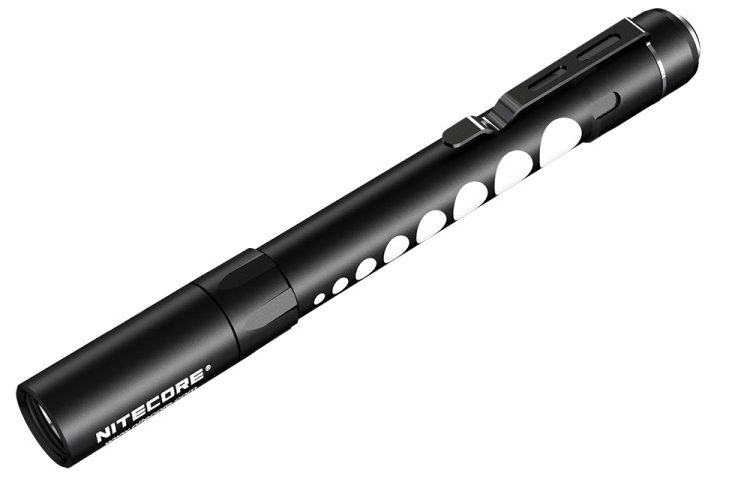
The MT06MD turns on at 4 lumens every time, so a patient’s first look is a soft glow, not a flash. A half press takes you to 45 lumens, then 180 for the back of a throat or a wound in a dim room. It’s the best fit for floor nurses, ED staff and anyone who wants one light for pupils and everything else.
Key specs
- Output: 4, 45 and 180 lumens, always starting on low
- Runtime: 35 hours on low, 5 hours 15 minutes on mid, 45 minutes on high
- LED: Nichia 219B, CRI above 90, 5000K, rated RG0
- Battery: 2x AAA, alkaline or NiMH
- Build: aluminum, IPX8 to 2 meters, rated for alcohol sterilization
- Weight: 22 g
Pros
- Low-first switch removes the most common penlight mistake
- Accurate color for skin, mucosa and wound beds
- Survives being wiped and dunked
Cons
- Order the pupil gauge version, because the plain black one has no markings
- 5000K is neutral, so it isn’t as warm as the Weltool M6-Dr
Performance analysis
The low mode is the one you’ll live in. At 4 lumens it constricts a pupil without making the patient squint away, and it runs 35 hours on one set of batteries. High steps down after five minutes, which won’t matter for an exam. The tail switch works fine with gloves.
2. Weltool M6-Dr: Best for Pupil Checks
Why I chose it
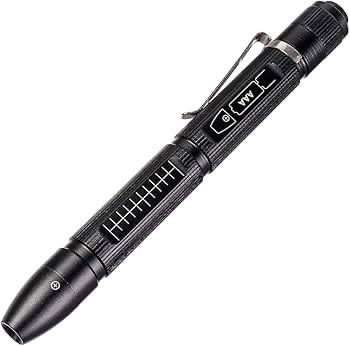
The M6-Dr has one output, 4.5 lumens, and that’s the point. There’s no high setting for a tired hand to click into at 3 a.m. The 3000K beam looks like an old incandescent bulb and is easy on a patient’s eyes. It suits neuro checks, eye clinics and nurses who mostly use a penlight on pupils.
Key specs
- Output: 4.5 lumens, single mode
- Runtime: about 10 hours
- LED: warm white, 3000K, CRI 85
- Beam: even 30 degree flood through an optical glass lens
- Battery: 2x AAA, alkaline or NiMH
- Build: 6061 aluminum, IP65, tail switch
Pros
- No high mode to hit a patient with by mistake
- Warm, even circle of light with no hotspot, so the iris is lit edge to edge
Cons
- No pupil gauge on the barrel
- Too dim for a throat or a wound in a dark room
Performance analysis
At 20 cm it lights a circle about 35 cm across with no bright center, so the pupil edge is easy to read. IP65 handles a wipe down, but don’t soak it. If you also check throats, pair it with a brighter light or choose the MT06MD.
3. Lumintop IYP365 Nichia: Best Value High-CRI
Why I chose it
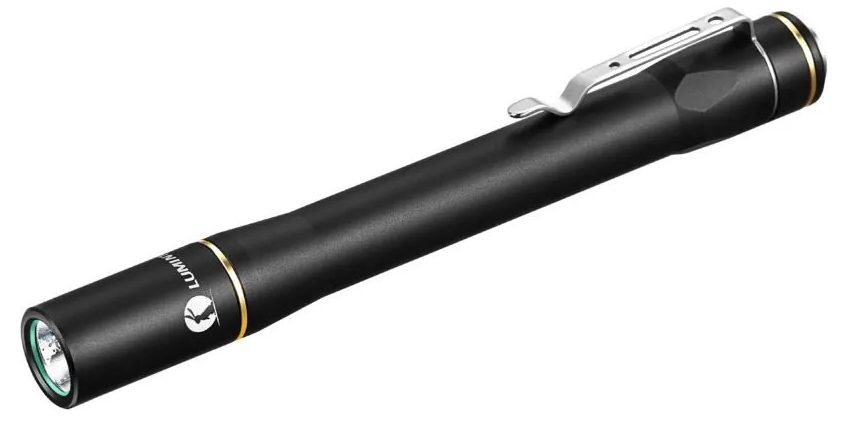
The Nichia IYP365 has the best color rendering here, CRI 93, and costs noticeably less than the Nitecore. Its 1.5 lumen low is the gentlest in this guide, and 125 lumens covers any exam. It’s a strong pick for students and clinicians who want true color on a budget.
Key specs
- Output: 1.5, 25 and 125 lumens
- LED: Nichia 219CT, CRI 93
- Battery: 2x AAA
- Build: aluminum, IP68 submersible to 2 meters
- Controls: tail switch, or twist the head to change modes
Pros
- Best color rendering in the lineup
- Very low 1.5 lumen mode for dark rooms
- IP68, so a full soak won’t hurt it
- Two ways to change modes, at the tail or by twisting the head
Cons
- Doesn’t start on low, and depending on the batch it opens on medium or your last mode
- No pupil gauge
Performance analysis
Its weakness is the startup. At 25 lumens, medium is fine for a throat but harsh for a first look at a pupil. Turn it on pointed at your palm, click down to low, and the beam matches lights that cost more.
4. Weltool M6-BL: Best for EMS
Why I chose it
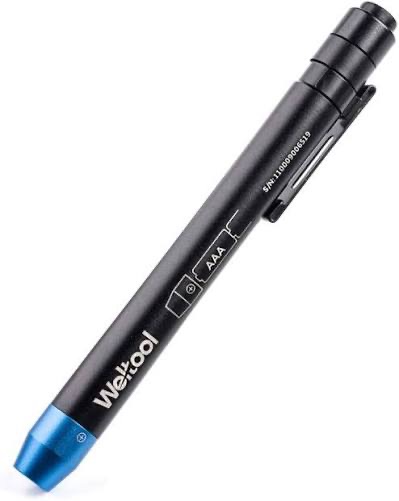
The M6-BL gives you two light sources. The warm 3000K LED runs at 6 lumens for pupils, and the 12 lumen xenon bulb renders tissue color about as naturally as any light can. Add a pupil gauge and a push-button switch that stays on, and it’s built for medics and ED doctors.
Key specs
- Output: 6 lumens LED, 12 lumens xenon
- LED: warm white, 3000K, CRI 85
- Battery: 2x AAA
- Pupil gauge: yes
- Build: aluminum with pocket clip
Pros
- Xenon option for the most natural color on skin and mucosa
- Gauge and steady-on switch in one tool
Cons
- A xenon bulb uses more power and can burn out, unlike an LED
- Heavier, more industrial feel than a slim pen
- Neither source is bright enough for scene lighting
Performance analysis
The beam has a defined center with a soft halo, which makes pupil reaction easy to read. Use the LED for most checks and the xenon for judging color, like a wound bed or a pale, clammy patient. On a dark scene you’ll still want a real flashlight.
5. RISEMART 2-Pack: Best Budget Reusable
Why I chose it
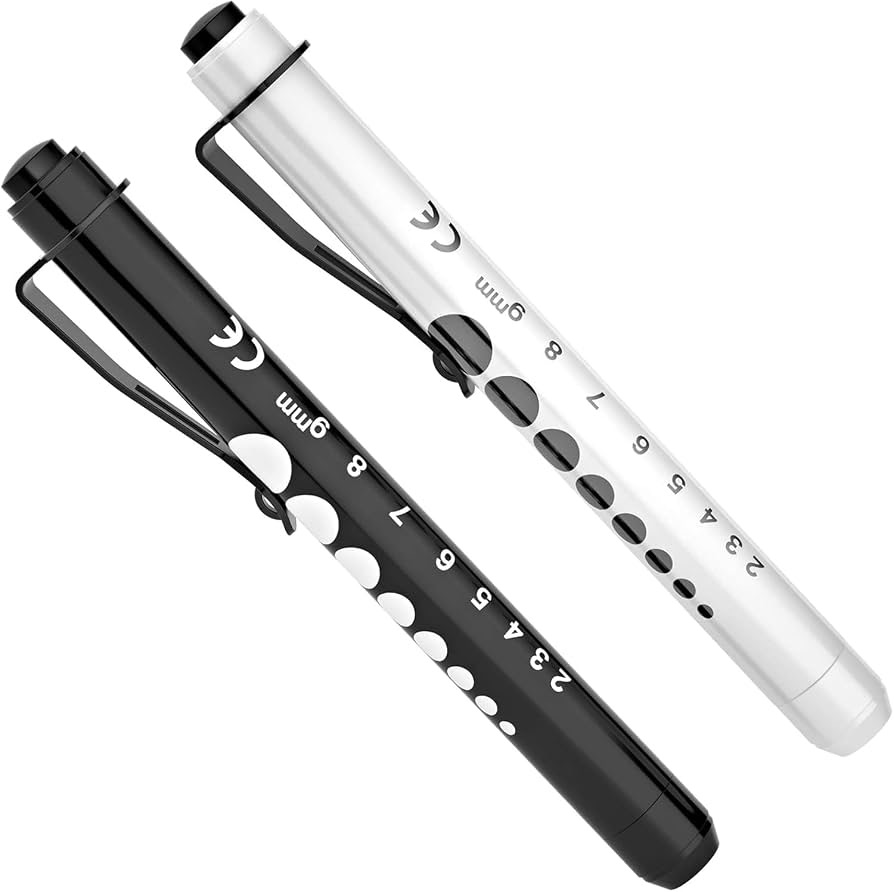
Penlights get borrowed, left in patient rooms and lost in laundry bins, so plenty of nurses want a decent light they won’t mourn. RISEMART’s set gives you two anodized aluminum lights, each with a pupil gauge and 5 cm ruler. It suits nursing students building a first kit.
Key specs
- Quantity: 2 lights
- Markings: pupil gauge and 5 cm ruler
- Battery: 2x AAA each
- Build: anodized aluminum with a pocket clip
- Light: white LED, with some sets adding a warm head
Pros
- Reusable metal build for very little money
- Ruler is handy for measuring wounds and rashes
Cons
- RISEMART publishes no lumen, CRI or runtime figures
- The standard white beam is cool, so it won’t render color like the Nichia lights
Performance analysis
It’s a sound pupil and throat light. What you give up is color accuracy, because a cool white LED pushes skin toward grey. Sets vary, so check the listing, and if a warm head is included, use it for pupils.
6. Primacare DL-9224 6-Pack: Best Disposable
Why I chose it
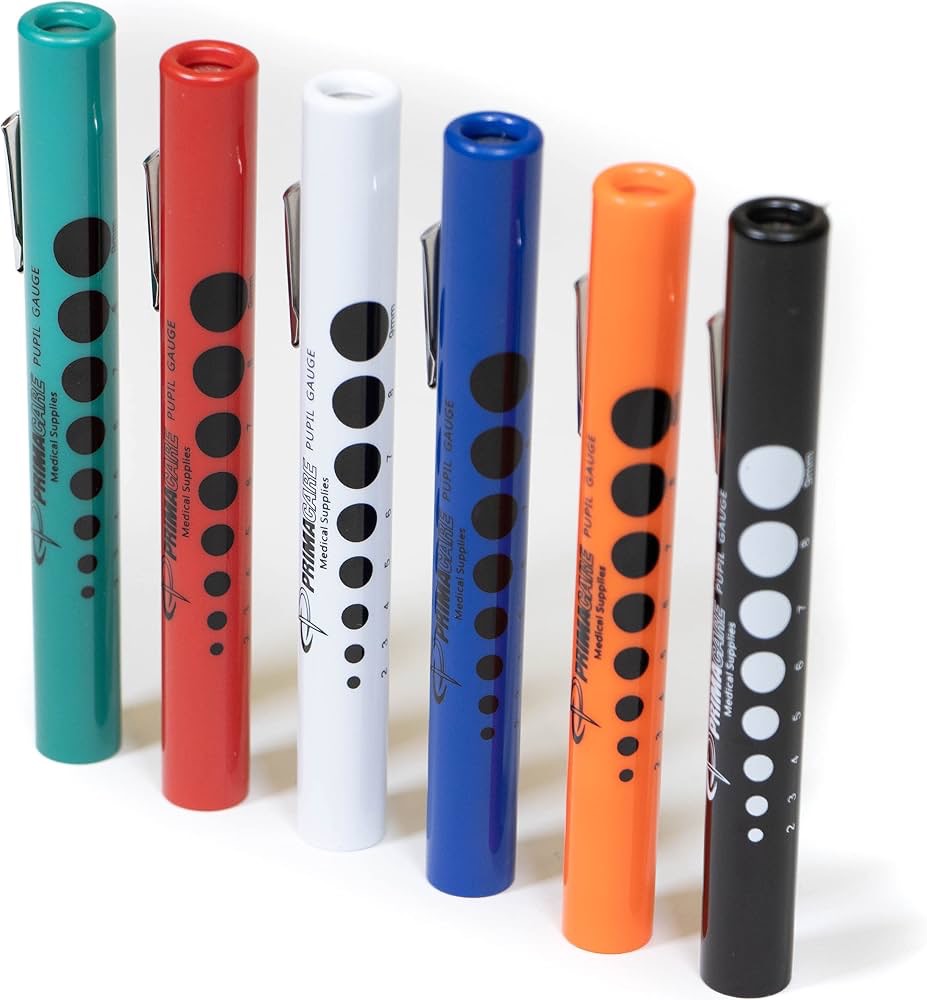
In an isolation room, a light that stays with the patient beats cleaning your own after every visit. The Primacare six-pack gives you lightweight plastic penlights with a printed pupil gauge, switched on by pressing the clip. They suit isolation rooms, school nurses, students and first aid kits.
Key specs
- Quantity: 6 penlights in assorted colors
- Size: about 5 inches long and 1/2 inch wide
- Beam: sealed, pre-focused with a pinpoint lens
- Switch: press the pocket clip
- Pupil gauge: yes
Pros
- Single-patient use takes cleaning out of the equation
- Colors make it easy to tell whose light is whose
- Last far longer than the word “disposable” suggests
Cons
- Dimmer than the reusable lights here, so the pupil reaction is harder to see in a bright room
- You have to hold the clip down the whole time
- No published output or color figures
Performance analysis
For a quick pupil check in a dim room, these do the job. Under bright overhead lights, a weak beam makes a subtle difference between the eyes hard to spot during a swinging flashlight test. Keep a reusable light for routine pupil exams.
How Bright Should a Medical Penlight Be?
There’s no single lumen number that separates a safe penlight from a dangerous one, so be wary of any guide that hands you one. What matters is how the light starts and how you use it.
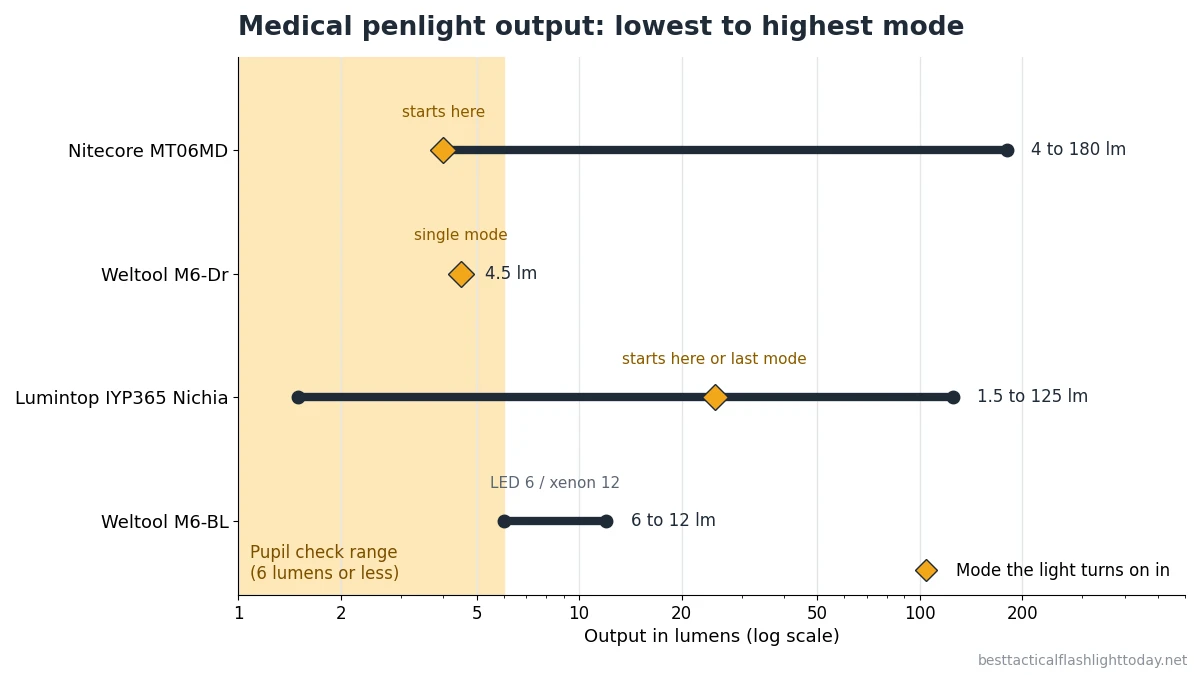
Start low. A pupil responds to a few lumens. Every light here with published specs runs at 6 lumens or less, and the best ones start there. Save higher modes for throats and wounds.
Look for an RG0 rating. RG0 is the exempt group under the IEC 62471 photobiological safety standard, the lowest risk class a light source can get. Nitecore lists the MT06MD as RG0 on its official product page, which is one more reason it’s my top pick.
Technique matters more than output. Dim the room, have the patient look at something far away, and shine the light in from slightly off center for two to three seconds per eye. The University of Utah Moran Eye Center’s pupil assessment guide lays out the full sequence, including the swinging flashlight test.
Too dim is a problem too. A weak beam under bright ward lighting can hide a sluggish or uneven response, which is exactly what the swinging flashlight test looks for.
What to Look For in a Medical Penlight
CRI and color temperature
CRI tells you how faithfully a light shows colors, and anything above 85 is good for clinical work. Color temperature tells you how warm or cool the light looks. Around 3000K reads warm and soft, 5000K reads neutral, and the bluish 6000K and up of many cheap penlights flattens skin tones. For judging pallor, cyanosis or a wound bed, high CRI matters most.
A switch that starts on low
Check the mode order before you buy. A light that opens on low, like the MT06MD, or has a single low mode, like the M6-Dr, protects the patient from a flash. Lights with mode memory or a medium start need a careful hand every time.
Pupil gauge
A printed gauge lets you record pupil size in millimeters without carrying a separate card.
Disposable or reusable
Disposables make sense where a light should stay with one patient. A reusable light needs a body that tolerates your facility’s wipes, so look for sealed aluminum and an IPX rating. Clean it between patients the way your infection control policy says.
Batteries
Every reusable light here runs on AAA cells. NiMH rechargeables work in the MT06MD and the M6-Dr. For more on how AAA lights compare, see our guide to the best AAA flashlights.
Need a penlight for everyday carry instead?
For a pen-sized light for the house or a job site, see our guide to the best penlights.
Medical Penlight FAQ
How many lumens should a medical penlight have?
For pupils, a few lumens is enough. The lowest modes of the lights here run from 1.5 to 6 lumens. For throats, ears and wounds, 25 to 50 lumens helps. A low first mode matters more than the maximum number on the box.
Should a medical penlight be warm or white?
Warm to neutral, with high CRI. A 3000K to 5000K light with CRI above 85 shows skin and tissue close to their true color. A cool blue-white beam can make a patient look paler or greyer than they really are.
What do nurses use penlights for?
Mostly pupil size and reaction during neuro checks, plus looking into the mouth and throat, checking skin and wounds, and finding a vein or a dropped cap in a dark room.
Can I use a regular flashlight to check pupils?
You can, but most EDC flashlights start too bright, use a tight hotspot and render color poorly. A medical penlight with a low first mode and an even beam gives a clearer read and a more comfortable patient.
The Bottom Line
For most clinicians, the Nitecore MT06MD is the best medical penlight. It starts on low every time, shows color accurately and has the output to handle a throat or a wound. If pupils are most of your work, the Weltool M6-Dr‘s single warm mode is the hardest light to misuse.
The Lumintop IYP365 Nichia gives you the best color for less, as long as you remember it doesn’t start on low. Medics should look at the Weltool M6-BL. For spares and student kits, the RISEMART 2-pack is fine, and the Primacare six-pack belongs in isolation rooms.
Whichever you choose, start low and dim the room before you check a pupil.
