
Open most “best 18650 flashlight” lists and you’ll spot a problem pretty fast. Half the lights on them don’t run on an 18650 at all. You get 21700 lights, sealed battery packs, and big four-cell monsters that happen to use 18650s inside a handle the size of a soda can.
This list works differently. Every light below runs on a single 18650 cell, and I checked each one’s battery requirements before it made the cut. I also looked past the headline lumen number to what each light actually holds after 30 seconds and after ten minutes, because that’s the brightness you’ll live with once the turbo rush is over.
Already own one of these and just need to know if a spare battery will fit? Jump to the fit checker further down. It answers that for every light on this page.
Quick Comparison
How I Picked These Lights
I started with one hard rule. The light has to run on one 18650, either a standard cell or the maker’s own version of one. No 21700 lights, no built-in packs and no multi-cell search lights. That rule alone knocks out a surprising number of the lights other guides recommend.
From there, I only considered brands that publish ANSI FL1 ratings and stand behind them with a real warranty. Then I compared each claim against measured output. A light rated for 2,000 lumens that holds 1,900 at the 30-second mark is honest. A light rated for 10,000 lumens on a single cell is not, and none of those made it in.
Last, I looked at the stuff that matters a year after you buy: whether you can grab a spare battery off the shelf, whether the light takes CR123A cells in a pinch, and how it handles heat when you leave turbo on.
1. Fenix PD35R ACE: Best Overall
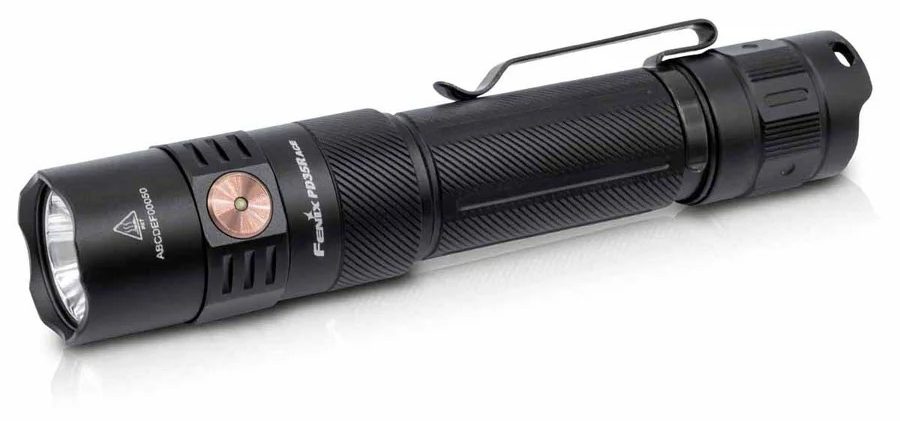
Why I chose it: The PD35R ACE does more things well than any other 18650 light I’d recommend right now. It’s bright, it throws far, it charges over USB-C, and it takes almost any 18650 you put in it. What sets it apart is the ACE system. A small SET button under the charging collar lets you pick one of three mode sets: turbo only, a simple three-level set, or the full five levels plus SOS. You can even switch strobe off entirely.
Who it’s best for: Anyone who wants one light for the truck, the nightstand and the belt, and doesn’t want to choose between a tactical light and a general purpose one.
Key specs:
- Max output: 2,000 lumens (about 1,940 measured at 30 seconds)
- Beam: 33,872 candela, 380 meters
- Battery: Fenix ARB-L18-4000 18650 included, or two CR123A
- Charging: USB-C under a screw-down collar
- Size: 5.1 in (130 mm), 5.1 oz with battery
- Water rating: IP68 to 2 meters, 1.5 meter drop rated
- Switches: tactical tail switch plus a side mode switch
Pros:
- Turbo-only mode turns it into a dedicated defensive light in one click
- Takes button-top, flat-top and protected cells, plus CR123A backups
- Regulated driver keeps output steady instead of slowly dimming
- Charge port is fully covered, not hidden behind a rubber flap
Cons:
- The SET button is small and hard to press with gloves on
- Charging takes a bit over three hours
- The battery level indicator only works with Fenix cells
Performance analysis: The numbers back up the spec sheet. Turbo holds above 1,000 lumens for close to two minutes before heat management steps in, and the head stays hand-friendly the whole time. Measured throw actually lands a touch past Fenix’s 380 meter claim. If you run it on two CR123A cells, Fenix caps turbo at 1,000 lumens (half the rated output), which is still plenty for a backup.
One thing I like that rarely gets mentioned is the mode memory. It remembers turbo too, so if you set it up as a defensive light, it comes on at full output every time. Pair it with my guide on using a flashlight for self defense if that’s your main reason for buying.
2. Nextorch TA30D: Brightest Pick and Best for Duty
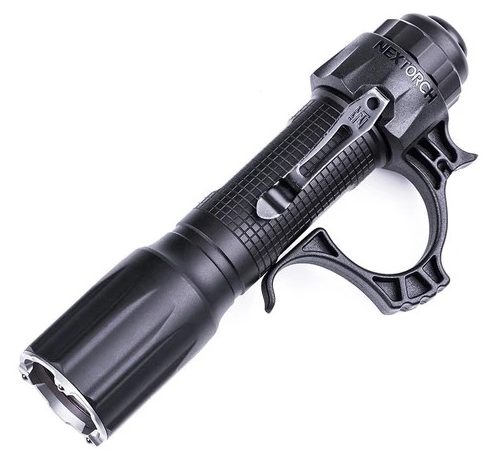
Why I chose it: The TA30D is the brightest single-18650 light on this list and the freshest, announced in January 2026. It’s built around a rotary selector ring with five positions: TAC, LOCK, and three steady output levels. In TAC mode, the tail switch fires full output on a tap and strobe on a deep press. There’s no menu to remember and no clicks to count when your hands are shaking.
Who it’s best for: Patrol officers, security staff, and anyone who wants a light that does one job with zero confusion. It’s also the pick if “brightest 18650 flashlight” is the first thing you typed into Google.
Key specs:
- Max output: 2,200 lumens (about 1,875 measured at 30 seconds)
- Beam: 42,025 candela, 410 meters
- Battery: 3,400 mAh 18650 with USB-C on the cell, plus an included CR123A adapter
- Size: 5.4 in (137 mm), 3.6 oz without battery
- Water rating: IPX8 to 3 meters, 3 meter impact rated
- Extras: tactical grip ring, ceramic window breaker in the bezel
Pros:
- Highest candela here, so it reaches the farthest
- Rotary ring makes lockout and mode changes something you can do by feel
- Tail switch indicator ring shows battery level at a glance
- Pocket clip is captured by the tailcap, so it won’t slide off
Cons:
- The light itself has no charging port; you charge the battery
- Only three steady brightness levels
- Uses PWM on its steady modes, which some people can pick up on camera
- Cool, low CRI beam that flattens colors
Performance analysis: Measured output falls about 15 percent short of 2,200 lumens, which is within the normal range for a first reading and still the highest output on this page. Full blast lasts roughly a minute before it steps down. That’s typical for this size and it isn’t gaming the rating. Throw is where it shines. The calculated reach actually beat Nextorch’s 410 meter claim, so if you need to light up a fence line or the far end of a parking lot, this is the one. For even more reach, see my best throw flashlights. And if it doesn’t have to run on a single 18650, my brightest flashlight guide goes all the way up to 200,000 lumens.
3. Fenix LD30R: Best for Everyday Carry
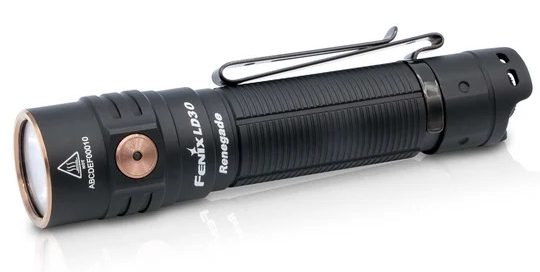
Why I chose it: The LD30R is the light I’d hand to someone who has never owned a “real” flashlight. The tail switch turns it on and off. The side switch changes brightness. That’s the whole manual. It still puts out serious light, carries comfortably in a front pocket, and charges through a USB-C port on the head.
Who it’s best for: Daily carry, dog walks, camping, and anyone who uses a light several times a day and wants it to just work. If you’re comparing pocket lights in general, my best EDC flashlights guide covers smaller options too.
Key specs:
- Max output: 1,700 lumens (about 1,820 measured at 30 seconds)
- Beam: 18,037 candela, 267 meters
- Battery: Fenix ARB-L18-3400 18650 included, or two CR123A
- Charging: USB-C on the head
- Size: 5.1 in (130 mm), 4.7 oz with battery
- Water rating: IP68
- Lowest mode: 1 lumen for about 750 hours
Pros:
- Beats its own lumen rating
- High mode holds close to 700 lumens for well over two hours
- Dead simple two-switch interface
- Moonlight-style 1 lumen mode for tents and dark hallways
Cons:
- No lockout mode, so carry it in the holster or a dedicated pocket
- No shortcut to turbo; you click up through the levels
- Short flat-top cells don’t make good contact
- Slight green tint in the center of the beam
Performance analysis: This is where the LD30R earns its spot. Turbo holds near full output for almost three minutes before it eases down, which is longer than most lights this size. Then it settles around 670 lumens and stays there. High mode is the real story, though. It runs flat at roughly 700 lumens for over two hours without getting uncomfortably warm. That’s genuinely useful light, not ten seconds of showing off.
4. ThruNite TN12 Pro: Best Value Tactical Light
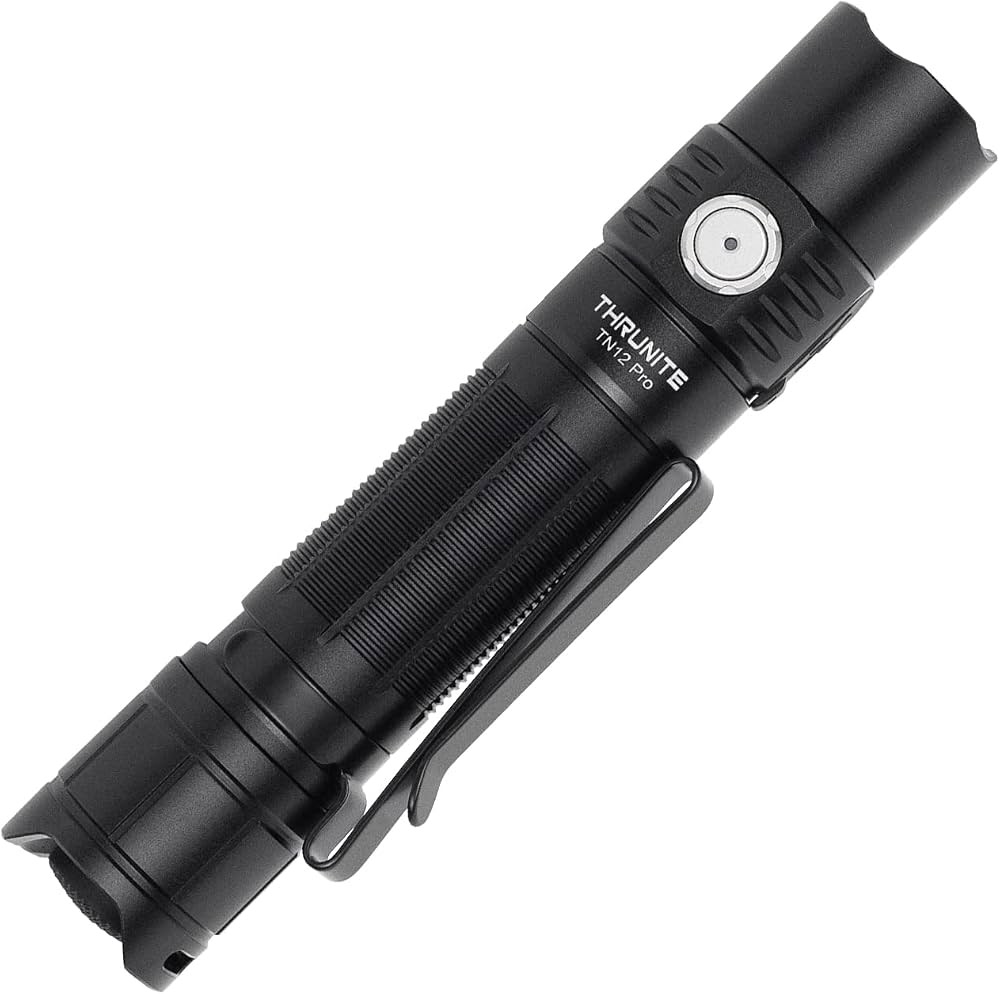
Why I chose it: The TN12 Pro gives you a true dual-switch tactical layout for a lot less than the Fenix and Nextorch lights. A half press on the tail switch gives momentary turbo, a full click locks it on, and the side switch handles everything else, including a moonlight mode. It ships with a protected 3,400 mAh cell, a holster and a USB-C cable, so there’s nothing else to buy.
Who it’s best for: Budget-minded buyers who want instant turbo from a tail switch and a beam that reaches out.
Key specs:
- Max output: 1,900 lumens (about 1,380 measured at 30 seconds)
- Beam: 36,000 candela, 380 meters
- Battery: ThruNite 3,400 mAh protected button-top 18650 (70.5 mm long)
- Charging: USB-C on the head
- Size: 5.2 in (131.5 mm), 5.1 oz with battery
- Water rating: IPX8, 1.5 meter drop rated
Pros:
- Measured throw slightly beat the 36,000 candela rating
- Electronic lockout, plus a “double lockout” using the tail switch
- Complete kit right out of the box
- Tail stands steadily for room lighting
Cons:
- Unregulated driver, so brightness fades as the battery drains
- PWM in low, medium and high (invisible to the eye, but it can show on camera)
- Rear threads aren’t anodized, so no mechanical lockout
- The rubber charge port cover can peel open in a pocket
Performance analysis: Here’s the tradeoff for the lower price. The TN12 Pro uses a direct drive driver instead of a regulated one. It starts strong, then falls off. By the ten minute mark on turbo, output sits around 360 lumens. Runtime is solid though, and both high and turbo outlasted ThruNite’s own runtime claims. Just know that the included cell is 5.5 mm longer than a standard 18650. A standard cell will work, but it rattles. The fit checker below covers this.
5. Fenix PD32R: Simplest 18650 Flashlight to Use
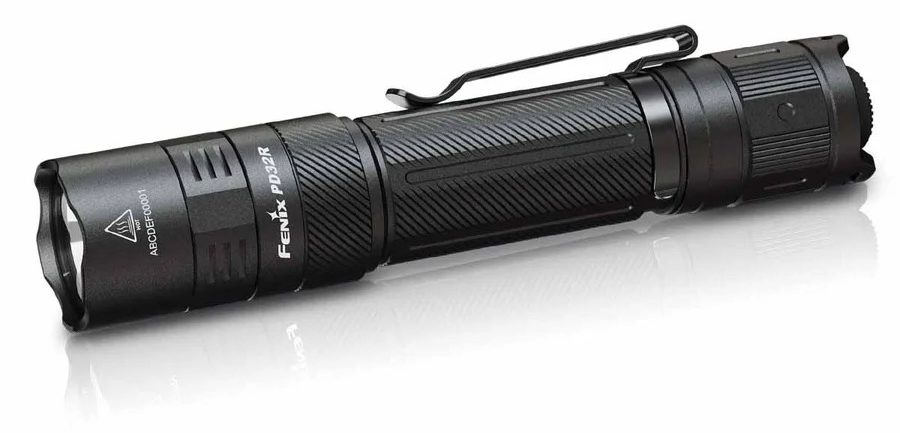
Why I chose it: The PD32R has exactly one switch, and that’s the point. Press halfway for momentary light, press fully to click on, tap to change brightness, and hold for strobe. There’s nothing on the side of the light to bump in a pocket or confuse a family member who grabs it during a power outage.
Who it’s best for: Home emergency kits, glove boxes, and anyone buying a light for someone who doesn’t care about flashlights. It also suits preppers who want CR123A backup.
Key specs:
- Max output: 1,400 lumens (about 1,480 measured at 30 seconds)
- Beam: 29,588 candela, 344 meters
- Battery: Fenix ARB-L18-3400 18650 included, or two CR123A
- Charging: USB-C under a retractable shroud, about two hours
- Size: 5.3 in (135 mm), 4.8 oz with battery
- Water rating: IP68 to 2 meters, 2 meter drop rated
Pros:
- Beats its lumen and throw ratings
- Fast charging for a single 18650 light
- Charge port fully sealed under a metal shroud
- Holds around 600 lumens for over an hour on turbo
Cons:
- The silent tail switch has an odd, soft feel
- Battery indicator sits under the shroud, so you have to open it to check
- No moonlight mode; the lowest level is 20 lumens
- Flat-top cells won’t fit
Performance analysis: The PD32R is rated conservatively, which I always like to see. It came in above spec on output and throw, then settled into a flat, regulated level that holds for over an hour. On CR123A cells, Fenix limits it to 800 lumens. That’s a fine backup plan, and it’s why this light lives in a lot of emergency bins. If you’re stocking up for outages, my power outages by state data shows how often and how long the lights tend to go out where you live.
6. Wurkkos FC12C: Best Budget Pick
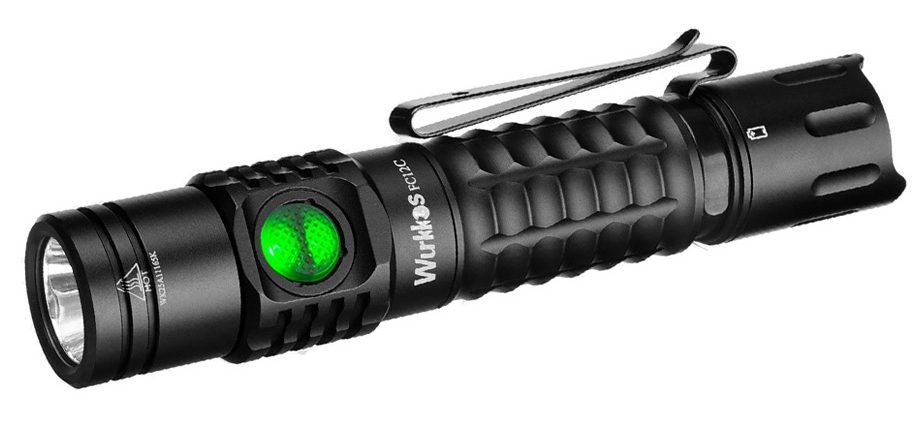
Why I chose it: The FC12C used to be the kind of light you’d find only on enthusiast forums. Now it’s an easy recommendation for anyone on a budget. It has a regulated driver, which most cheap lights skip, plus dual switches, USB-C charging and a 3,000 mAh cell in the box. It’s cheap enough that buying two or three for the car, the shop and the kitchen drawer actually makes sense.
Who it’s best for: First-time 18650 buyers and anyone who wants several good lights instead of one expensive one. For more lights in this price range, see my best budget flashlights.
Key specs:
- Max output: 1,600 lumens rated (about 1,170 measured at 30 seconds)
- Beam: 27,575 candela, 332 meters
- Battery: Wurkkos 3,000 mAh button-top 18650 included
- Charging: USB-C on the head
- Size: 5.4 in (136 mm), 4.6 oz with battery
- Water rating: IP68, 1 meter drop rated
- Modes: smooth ramping plus a separate tactical mode
Pros:
- Regulated output at a budget price
- Takes nearly any 18650, including flat-tops and long protected cells
- Throw matches the rating
- Solid machining with no sharp edges
Cons:
- Falls well short of its 1,600 lumen claim
- Slow charging that keeps trickling after it shows full
- Two mode groups make the interface busier than it needs to be
- Shorter, more basic warranty than the big brands
Performance analysis: Ignore the 1,600 lumen claim. This light makes about 1,200 at turn-on and steps down within two minutes. What matters is what happens next. It settles around 550 lumens and holds that for over an hour and a half, which beats plenty of lights that cost twice as much. Medium runs over ten hours. For a light at this price, that’s the number that counts.
Rated vs Real: What These Lights Actually Hold
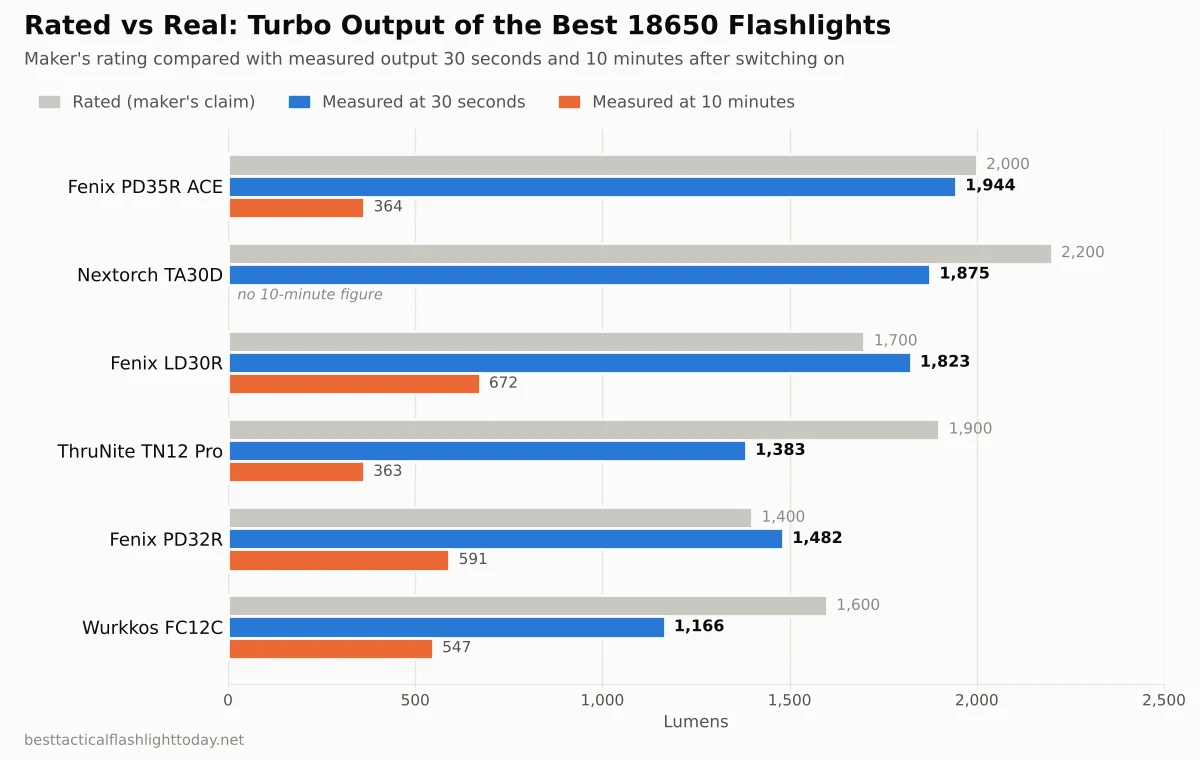
Every flashlight brand rates turbo at the instant you click it on. Real use looks different. Within a minute or two, heat forces almost every compact light to step down. The chart above shows the rated number, the output 30 seconds in (the point the ANSI FL1 standard uses), and where each light sits after ten minutes.
Two lights stand out. The LD30R and PD32R both came in above their ratings and still hold roughly 590 to 670 lumens at the ten minute mark. The FC12C and TN12 Pro both land about 27 percent under their claims, but they behave very differently after that. The FC12C’s regulated driver holds it steady once it settles, while the TN12 Pro keeps fading, which is what you’d expect from an unregulated driver. If the difference between lumens and throw is fuzzy, my candela vs lumens guide explains it in plain terms.
Will a Spare 18650 Fit Your Light?
This is the question nobody else answers. 18650 cells aren’t all the same size. A bare flat-top cell is about 65 mm long, while a protected cell with a built-in USB port can run past 70 mm. Some lights won’t make contact with a short cell. Others won’t close with a long one. Pick your light and the battery you’re thinking about below.
How to Choose the Best 18650 Flashlight
Standard cell or proprietary cell
Most 18650 lights take an off-the-shelf cell. Some don’t. ThruNite’s TN12 Pro cell is longer than standard, and some brands go further with custom contacts that only work in their own lights. If you want to carry spares or swap batteries between lights, stick with a light that takes a standard cell, like the PD35R ACE or FC12C.
Button top vs flat top
A button-top cell has a small raised nub on the positive end. A flat-top cell doesn’t. Lights with a reverse polarity ring at the head need that nub to make contact, so a flat-top cell just won’t turn them on. Among the picks here, the PD32R won’t work with flat-tops, and the LD30R struggles with short ones. When in doubt, buy button-top cells. They work in more lights.
Protected vs unprotected
A protected cell has a small circuit that cuts power if the battery is overcharged, over-discharged or shorted. It adds a few millimeters of length. Most modern lights have their own low voltage protection, but a protected cell is still the safer choice for a light that rides in a pocket or a kid’s backpack. Just check that it fits.
Sustained output beats turbo lumens
A 2,000 lumen turbo that lasts 60 seconds matters less than what the light holds for the next hour. Look for a light with a regulated (constant current) driver. It keeps brightness flat as the battery drains, then drops at the very end. Unregulated lights start bright and fade steadily.
Throw or flood
Lumens tell you how much light comes out. Candela tells you how far it reaches. For room clearing and close work, a wider beam helps. For trails, fields and parking lots, look for 25,000 candela or more. Every light on this list clears that bar except the LD30R, which trades some reach for a wider, friendlier beam.
Where the charging port lives
Most lights here charge through a USB-C port on the light. The TA30D puts the port on the battery instead, so the light itself has one less opening to seal. That’s tougher, but it means a generic spare cell has to be charged in an external charger.
CR123A backup
CR123A cells store well for years, which makes them great for emergency kits. The PD35R ACE, LD30R, PD32R and TA30D all run on two of them. Expect lower output, since makers cap turbo to protect the cells. If you’d rather recharge, my guide to rechargeable CR123A batteries covers safe options.
Lockout for pocket carry
A light that switches on in your pocket can get hot and drain its battery. Look for electronic lockout, a lockout position like the TA30D’s ring, or at least anodized tail threads so a quarter turn of the tailcap breaks the circuit.
Ignore impossible numbers
Real 18650 cells top out around 3,500 to 4,000 mAh in 2026. Any 18650 sold as 6,000 or 9,900 mAh is lying, and the same goes for single-cell lights claiming 10,000 lumens or more. Those listings are where most of the bad reviews in this category come from.
18650 vs 21700: Which Should You Buy?
A 21700 cell is 21 mm wide and 70 mm long, compared with 18 mm by 65 mm for an 18650. That extra size buys capacity, usually 4,000 to 5,000 mAh, and lets a light run brighter for longer. Flashlight makers have shifted a lot of new models to 21700 for exactly that reason.
So why buy an 18650 light in 2026? Size and fit. An 18650 light is slimmer in the pocket and lighter on the belt. The cells are everywhere, they’re cheap, and plenty of lights, headlamps and gadgets share them, so one stack of spares covers everything.That includes UV lights like the Sofirn SF16, my top pick in the black light flashlight guide. And many 18650 lights take CR123A backups, which far fewer 21700 lights do.
My take: if you want the most runtime and don’t mind a thicker light, look at a 21700. If you want something that disappears into a pocket and shares batteries with gear you already own, an 18650 is still the smarter buy. For truly tiny lights, my best mini flashlight guide covers smaller cells.
Battery Care, Storage and Flying With Spares
Lithium-ion cells are safe when you treat them right. Store spares at around half charge if they’ll sit for months, and keep them out of hot cars in summer. Don’t charge them below freezing. Toss any cell with a torn wrapper or a dented end, because a torn wrapper can short against a metal tube.
Carry spares in a plastic battery case, never loose in a pocket with keys or coins. If you’re flying, the FAA requires that spare lithium-ion batteries go in carry-on bags only, with the terminals protected from short circuits. A battery case or the original packaging does the job. A light with its battery installed is treated as a device, but it’s smart to lock it out so it can’t switch on in your bag.
For prepping, think in pairs: one light ready to go and at least one charged spare cell. If you keep CR123A lights in an emergency kit, check the dates once a year. My best survival flashlight guide covers what else belongs in that kit.
Want a bigger 21700 cell or a light that charges in a wall dock? My guide to the best rechargeable flashlights covers both.
FAQ
Can I use any 18650 battery in my flashlight?
Not always. 18650 cells vary by a few millimeters in length depending on whether they have a button top, a protection circuit or a built-in USB port. Some lights need a button top to make contact, and some won’t close with a long protected cell. Check the manual, or use the fit checker above for the lights on this page.
Is 21700 better than 18650?
For raw capacity, yes. A 21700 cell typically holds 4,000 to 5,000 mAh compared with roughly 3,000 to 4,000 mAh for an 18650. But an 18650 light is slimmer, lighter and more likely to accept CR123A backups, which matters for everyday carry and emergency kits.
How long does an 18650 battery last in a flashlight?
It depends on the brightness level. On turbo, most lights in this guide run two to three hours total because they step down to protect themselves. On medium, you’re looking at roughly six to fifteen hours, and on the lowest modes, days to weeks. A quality cell also lasts for a few hundred charge cycles before capacity drops noticeably.
Can you take 18650 batteries on a plane?
Yes, but only in your carry-on. The FAA bans spare lithium-ion batteries from checked bags and requires that the terminals be protected, such as in a battery case. A battery installed in the flashlight follows the rules for devices, and keeping the light in your cabin bag is the simplest choice.
Bottom Line
If you want one light that does it all, get the Fenix PD35R ACE. It’s bright, takes nearly any 18650, runs on CR123A in a pinch, and lets you set it up exactly the way you’ll use it. If you need maximum reach for work or duty, the Nextorch TA30D is the brightest single-18650 light here. For everyday pocket carry, the Fenix LD30R is the easiest to live with.
On a tighter budget, the ThruNite TN12 Pro gives you a real tactical setup for less, and the Wurkkos FC12C is the one to buy in multiples. And if the light is for someone who just wants it to work, hand them the Fenix PD32R.
Whichever you pick, buy a spare battery that fits. The fit checker above will tell you which one.
