
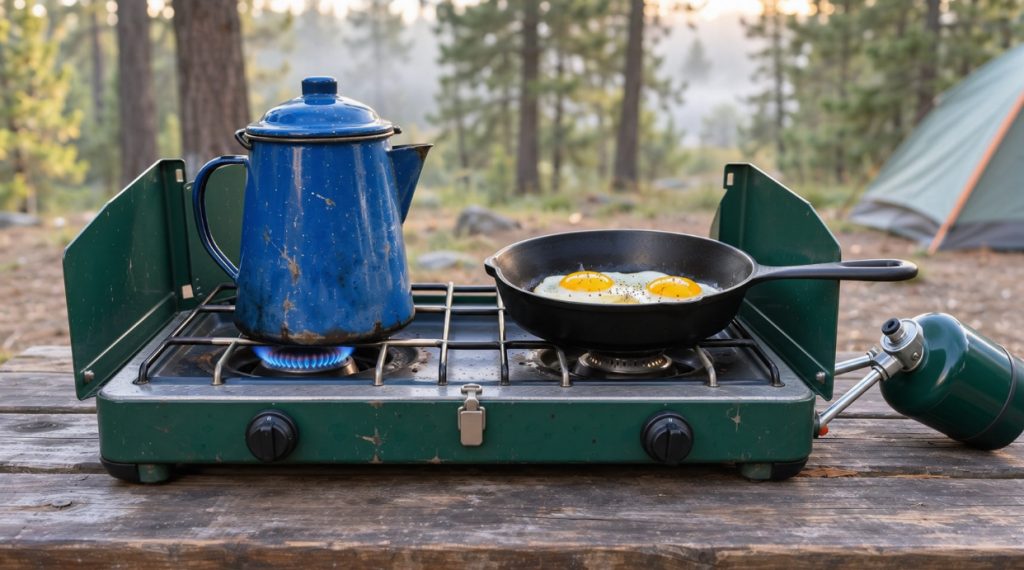
The first morning of a camping trip always goes the same way. It’s 38 degrees, everybody else is still zipped into their sleeping bags, and you’re out at the picnic table in a puffy jacket trying to get coffee going before the mutiny starts. You click the igniter three times, get a lazy little flame that leans sideways every time the wind blows, and stand there watching a pot of water that refuses to boil. Somebody yells from the tent asking about breakfast. Breakfast is a long way off.
A good propane camping stove fixes that whole scene. It lights on the first click, holds its flame when the breeze comes off the lake, and has room for the coffee pot and the bacon pan side by side. That same stove also happens to be the best backup kitchen you can own. When an ice storm takes the power out for three days, you set it up on the back porch and start cooking your way through the freezer while the neighbors eat cold cereal.
Here’s what I’d buy. The Coleman Cascade 3-in-1 is the one I’d hand most families, because the cast iron grill and griddle plates in the box turn it into a full breakfast station. If your trips run cold and windy, the Camp Chef Everest 2X has a lot more heat per burner and a tall windscreen to keep it there. One or two people can get by on the little Coleman Cascade 18, which runs about two and a half hours on a single green cylinder. And if you’re feeding a crowd or want a stove that cooks for days off the grill tank during an outage, the Camp Chef Explorer 2-Burner stands on its own legs and hooks straight to a 20 lb tank.
Further down there’s a fuel planner that counts exactly how many cylinders to pack for your trip or your outage, so you’re not the one driving 40 minutes to a gas station on day two.
Quick Picks: The Best Propane Camping Stoves
If you just want the short answer:
- Coleman Cascade 3-in-1: best propane camping stove for most families and car campers.
- Camp Chef Everest 2X: best for cold weather, wind and high altitude.
- Coleman Cascade Classic: best two-burner if you want something simple and lighter.
- Coleman Cascade 18: best single burner for solo campers and couples.
- Gas One GS-3400P: best cheap backup stove for an outage kit.
- Camp Chef Explorer 2-Burner: best for groups of six or more and long power outages.
How Much Propane Do You Need? Try the Fuel Planner
Pick camping or a power outage, tell it how many people you’re feeding and for how long, and it picks the stove from this list that fits and counts the propane down to the last cylinder. It always adds one spare, because the cylinder runs dry right when the pasta water starts to boil.
Propane Camping Stoves Compared
Burner ratings also tell you how fast a stove drinks propane. A pound of propane holds about 21,600 BTU (the EIA lists 91,452 BTU per gallon, and a gallon weighs about 4.2 pounds), so I ran the numbers for every stove here on a green 1 lb cylinder and a 20 lb tank, with every burner wide open:
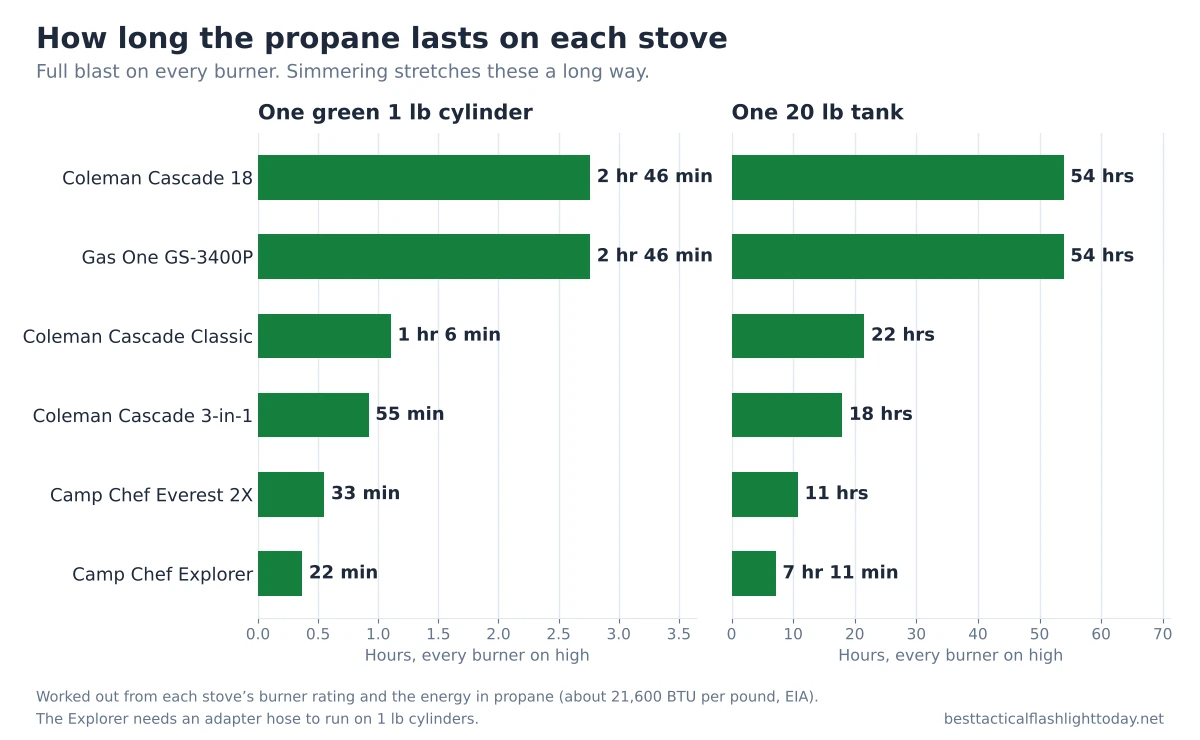
Nobody cooks with both burners on high for an hour straight, so real trips stretch further than this. The gap still matters, though. The Everest 2X can empty a green cylinder in about half an hour flat out, while a 20 lb tank keeps the same stove going for around 11 hours. If you cook for more than two people for more than a weekend, a tank and a hose will save you money and a trash bag full of empties.
1. Coleman Cascade 3-in-1: Best overall
Why I chose it and who it’s for
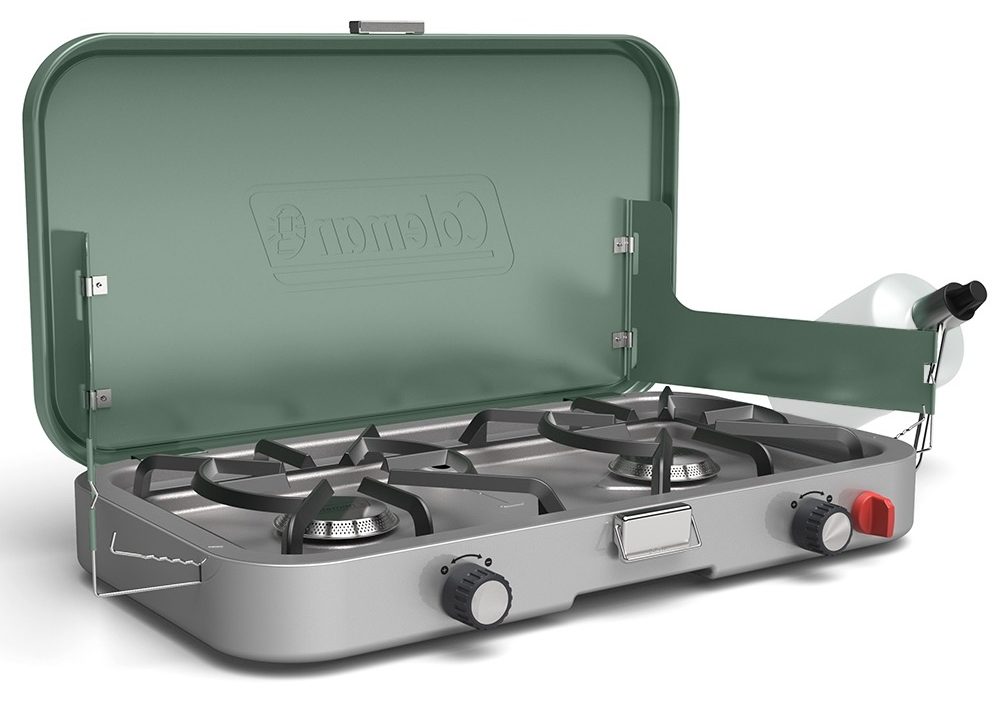
This is the stove for the family that wants a real camp breakfast: pancakes, eggs and bacon all coming off the stove at the same time. The two 12,000 BTU burners boil water quickly, and the knobs turn down far enough to simmer a pot of chili without scorching the bottom.
The cast iron plates are what set it apart. Swap the grate for the griddle and you’ve got a flat top for pancakes and grilled cheese, or drop in the grill plate for burgers and peppers. It’s the one I’d send camping with most families, and the one I’d set up on the porch when the power goes out.
Key specs
- Burners: Two, 12,000 BTU each (24,000 total)
- Fuel: 1 lb propane cylinder, up to about 1 hour on high
- Ignition: Twist-to-light rotary igniter
- Pan fit: A 12 inch and a 10 inch pan side by side
- Weight: 14 lb 12.8 oz for the stove alone
- Folded size: 22 x 13.2 x 3.7 inches
- In the box: Cast iron grill and griddle plates, wind guards, a carry case for the plates
Pros
- Grill and griddle plates come with it
- Fine simmer control on both burners
- Aluminized cooktop wipes clean
- Plenty of room for two real pans
Cons
- Close to 26 pounds once the cast iron is packed
- Short wind guards
- A 1 lb cylinder lasts about an hour on high
In real use
On a cold, still morning at about 35°F and 4,400 feet, it boils a liter of water in around 7 and a half minutes, which is quick for a Coleman. It keeps cooking in genuinely nasty weather too. Down around 15°F with a 15 to 20 mph wind, the igniter on one burner may give up after a night outside, but a lighter gets it going and the eggs and sausage still come out fine.
The wind guards are the weak spot. They’re low and sit about an inch off the burners, so on a gusty day, turn the back of the stove into the wind or park a cooler beside it as a wall. The cast iron needs seasoning like any skillet. Rub it with a high smoke point oil and bake it at 450 to 500°F for about an hour before the first trip, and by the second morning the eggs slide right off.
For outages, this is the most kitchen-like stove of the bunch. Hook it to a 20 lb tank with an adapter hose and it’ll run for days, the same tank that feeds an indoor propane heater through a hose or a dual fuel generator.
2. Camp Chef Everest 2X: Best for wind and cold
Why I chose it and who it’s for
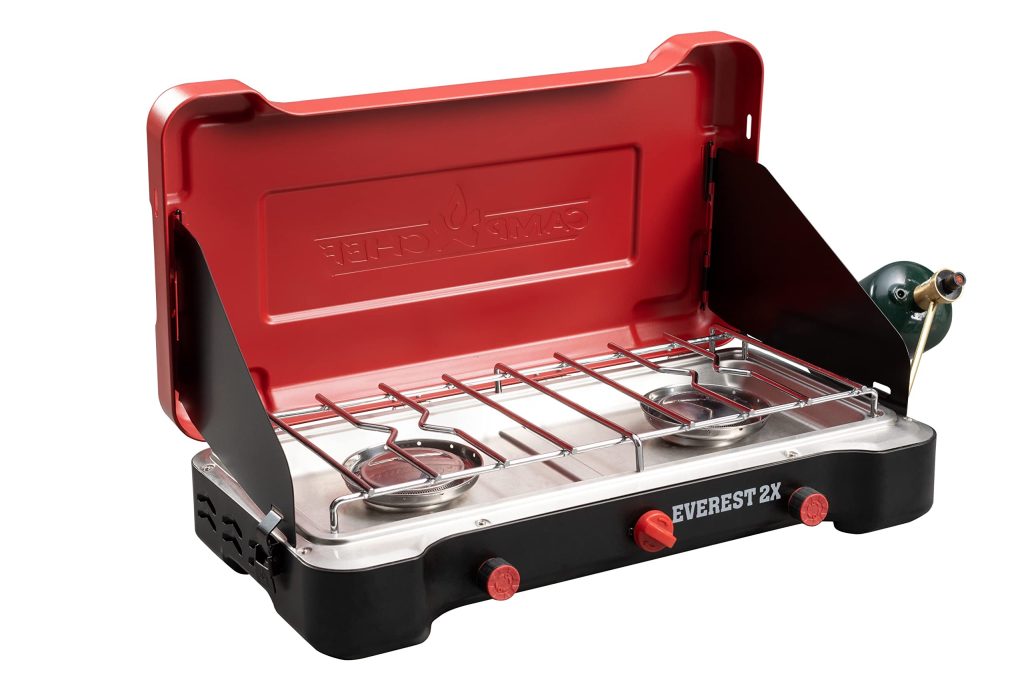
Camp Chef built this one for the trips where everything is working against you: wind coming off the water, frost on the table, and a big pot that needs to boil before the kids lose it. Each burner puts out 20,000 BTU, the most of any tabletop stove here, and the lid and side panels stand up into a windscreen on three sides.
It’s the stove I’d take to deer camp, on fall trips to the mountains, or anywhere the morning starts below freezing. If you’ve ever babysat a sputtering flame with your hands cupped around it, you’ll get why this one is worth the extra bulk.
Key specs
- Burners: Two, 20,000 BTU each (40,000 total)
- Fuel: 1 lb propane cylinder, or a 20 lb tank with an adapter hose
- 1 lb cylinder on high: About 30 minutes with both burners open
- Ignition: Matchless igniter
- Wind protection: Tall windscreen on three sides
- Weight: 12 lb
Pros
- The fastest boil on this list
- Simmers far better than you’d expect for this much heat
- Windscreen protects three sides
- Mostly metal build with solid latches
Cons
- Empties a 1 lb cylinder fast on high
- About 24 inches wide, which fills a small camp table
- Costs more than the Colemans
In real use
The first thing you notice is the speed. Big pots of pasta water come to a boil in a few minutes, even up high, and the burners sit down low behind the windscreen so a stiff breeze doesn’t push the flame off the pot.
The low end is better than you’d guess. Powerful stoves usually have two settings, off and blowtorch, but the Everest turns down far enough to simmer rice without welding it to the pot. All that heat comes at a price in fuel, though. Wide open, it drains a green cylinder in about half an hour, so on anything longer than a weekend I’d run it off a 20 lb tank.
It’s also a big stove. It fits on a picnic table or a tailgate fine, but on a narrow folding camp table the burners end up hanging close to the edge. Carry a lighter as well. Every push-button igniter gets finicky when it’s wet or very cold, no matter who makes it.
3. Coleman Cascade Classic: Best value two-burner
Why I chose it and who it’s for
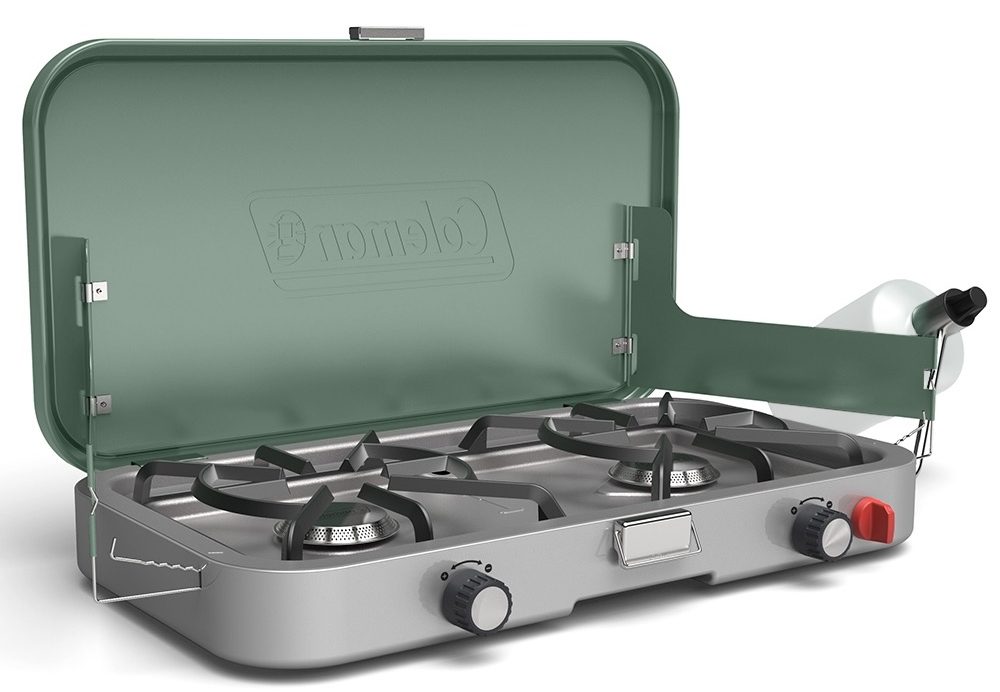
If you want a dependable two-burner and don’t need the cast iron, this is the one. It’s the Coleman layout a lot of us grew up camping with, two burners in a fold-up case with wind guards, now with twist-to-light ignition so you aren’t digging through the tote for matches.
It’s almost three pounds lighter than the 3-in-1 on its own, and more than a dozen pounds lighter once you count the 3-in-1’s plates. For weekend car camping and as a garage stove for outages, it does everything most people need.
Key specs
- Burners: Two, 10,000 BTU each (20,000 total)
- Fuel: 1 lb propane cylinder, up to about 1 hour on high
- Ignition: Twist-to-light rotary igniter
- Pan fit: A 12 inch and a 10 inch pan, burners 11 inches apart
- Weight: 11 lb 14.4 oz
- Folded size: 21 x 13 x 3.6 inches
Pros
- Simple, with very little to go wrong
- Light for a two-burner
- Removable chrome grate and aluminized cooktop clean easily
- Folds flat for the trunk
Cons
- Igniter can take a few clicks in wind
- Two 12 inch pans crowd each other
- Less heat than the 3-in-1
In real use
Ten thousand BTU per burner is plenty for coffee, oatmeal, a pot of chili or a skillet of fajitas. It brings water to a boil a little slower than the 3-in-1, which you’ll only notice when everyone is standing around holding plates.
The burners sit 11 inches apart, center to center, so a 12 inch skillet next to a 10 inch pot fits fine, but two big 12 inch pans will bump rims. The igniter sometimes needs a few clicks in a breeze, so keep a lighter tucked in the case.
This is a great stove to keep on a garage shelf next to the power outage emergency kit. It’s small and simple, with nothing fancy on it to break, and two burners mean you can heat soup and boil water for coffee at the same time while the lights are out.
4. Coleman Cascade 18: Best single burner
Why I chose it and who it’s for
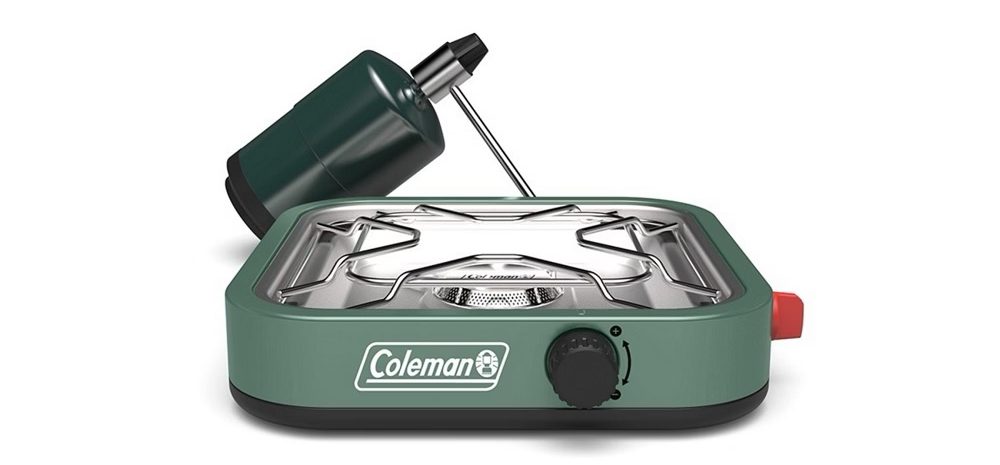
For solo campers, couples, or anyone who mostly boils water and cooks one-pot dinners, a two-burner is extra weight you don’t need. The Cascade 18 is one 8,000 BTU burner on a steady base with a grate that holds a 12 inch pan.
It’s also the thriftiest stove here. Coleman rates it at up to two and a half hours on high from one 1 lb cylinder, more than double what the two-burners get, so a couple can get through a long weekend on two cylinders without trying hard.
Key specs
- Burners: One, 8,000 BTU
- Fuel: 1 lb propane cylinder, up to 2.5 hours on high
- Ignition: Twist-to-light rotary igniter
- Pan fit: One 12 inch pot or pan
- Weight: About 6 lb
- Size: 15 x 10 x 6.5 inches
Pros
- Sips fuel
- Takes a full 12 inch pan
- Grate flips over for storage, with a spot for the regulator
- Optional grill and griddle plate available
Cons
- No carry case or handle
- Grate could be steadier under a heavy pot
- One burner means cooking in shifts
In real use
Breakfast for two is easy: water for coffee first, then eggs and potatoes in the same pan. The knob has a nice low end for simmering, and 8,000 BTU is enough to boil a pot of pasta water without much waiting around.
Set it on a level spot before you load it up. The grate holds a 12 inch pan, but a tall, full stockpot is better on a two-burner. With no case and no handle, it rides best in a milk crate or a tote with the cylinder next to it.
It also makes a handy third burner. On group trips I like a two-burner for the main meal and one of these off to the side for coffee water, so nobody has to wait for a burner to free up.
5. Gas One GS-3400P: Best budget backup
Why I chose it and who it’s for
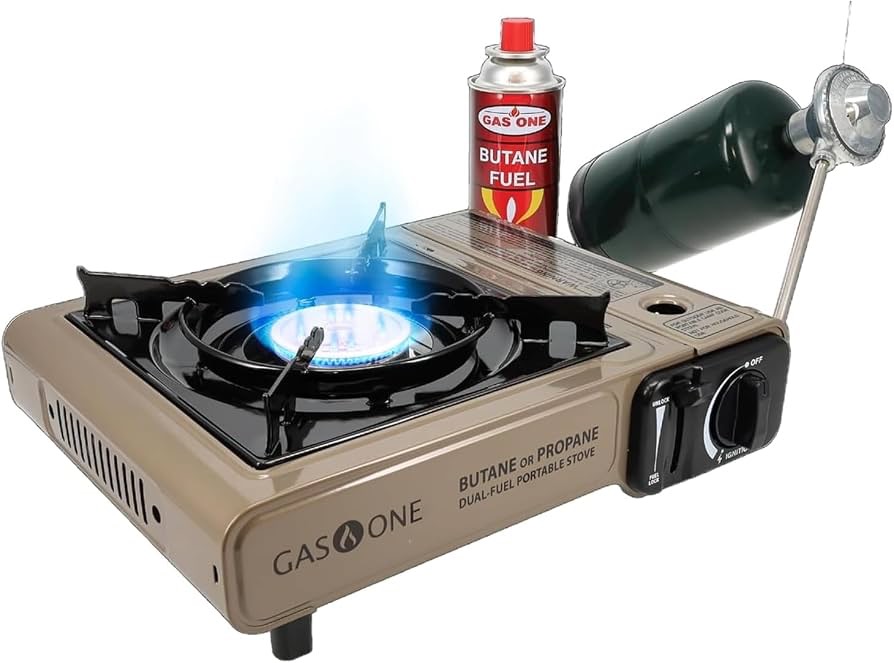
This is the stove I’d put in every outage kit and every car trunk. It costs a fraction of the others, weighs about three pounds, and runs on either a 1 lb propane cylinder or a slim 8 oz butane can. If you run out of one fuel, you can grab the other.
It packs into a carry case that latches shut, with the propane adapter riding in a side pocket of the stove, so nothing goes missing between uses.
Key specs
- Burners: One, 8,000 BTU
- Fuel: 1 lb propane cylinder (adapter included) or 8 oz butane can
- 1 lb cylinder on high: About 2.75 hours, worked out from its rating
- Ignition: Built-in igniter in the control knob
- Weight: 3 lb 4.8 oz
- Packed size: 13.5 x 11 x 4.45 inches in its case
Pros
- The cheapest way to a reliable backup burner
- Two fuel options
- Lights on the first click
- Light and compact in its case
Cons
- No wind guard at all
- The lowest setting can blow out
- Butane quits near freezing
In real use
A liter of water boils in about eight and a half minutes, right in the middle for a single burner. High is steady and strong. The lowest setting can flicker out on you, so simmer things like rice or risotto on medium low instead.
There’s no wind guard, so on a breezy day, set it behind the car or rig up a foil windscreen. In winter, screw on the propane adapter and leave the butane at home. Butane stops boiling at about 31°F, so a can that works fine in July barely gets a flame going on a January porch.
For an outage kit, pair it with a few cylinders and a battery lantern, since cooking in the dark is how people end up knocking pots over. It isn’t a stove for feeding six, but it keeps coffee and soup going for a couple of people for days.
6. Camp Chef Explorer 2-Burner: Best for big families and long outages
Why I chose it and who it’s for
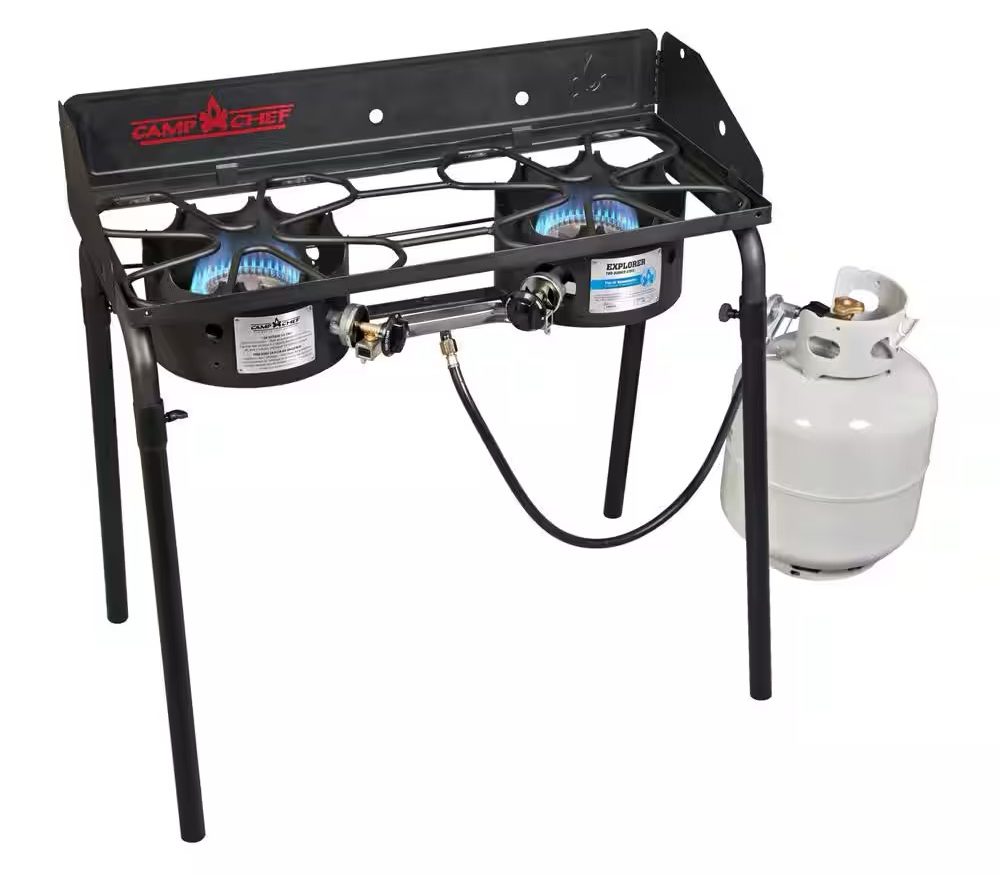
Once you’re feeding six or more, or the power has been out for days, tabletop stoves start to feel small. The Explorer stands on its own four legs at about 31 inches, puts out 30,000 BTU from each cast aluminum burner, and comes with a 3 foot hose and regulator for a regular 20 lb grill tank.
That hose is the big deal. A full tank runs both burners on high for about seven hours, and a lot longer at normal cooking heat, which works out to several days of meals for a family. No pile of empty green cylinders, no running out halfway through dinner.
Key specs
- Burners: Two, 30,000 BTU each (60,000 total)
- Fuel: 20 lb propane tank, 3 foot hose and regulator included
- 20 lb tank on high: About 7 hours with both burners open
- Cooking surface: 448 square inches
- Legs: Removable, about 31 inch cooking height
- Ignition: None, light it with a long lighter
- Weight: Over 30 lb
Pros
- Huge heat for big stockpots
- Freestanding, no table needed
- Runs for days on a grill tank
- Removable three-sided windscreen
Cons
- Heavy and bulky to haul
- No igniter
- Thirsty, even for its size
- Lowest setting still runs fairly hot
In real use
It boils a liter of water in about seven minutes, and it’ll bring a big stockpot of corn or chili to a boil while a tabletop stove is still warming up. The flip side is fuel: it takes around 3.2 ounces of propane just to boil that liter, more than anything else here. On a 20 lb tank, that’s fine. On green cylinders, it would be miserable.
Simmering is better than you’d think for a stove this big, and rice comes out soft, though the lowest setting still lets a bit of flame jump now and then. Keep a stirring spoon handy for anything that likes to stick.
For outages, set it up in the driveway or on a patio well away from the house, with the tank on the ground beside it. It’s a lot of stove to pack for a weekend, so think base camp, hunting camp, family reunions and the week after an ice storm. Bring a long lighter and a rechargeable headlamp so you can see what’s in the pot after dark.
How to Choose a Propane Camping Stove
One burner or two
One burner covers one or two people who mostly boil water and cook one-pot meals. Once you’re cooking for three or more, or you want coffee and breakfast going at the same time, get a two-burner. Big groups of six or more are where a freestanding stove like the Explorer earns its space.
BTU and simmer control
BTU is how much heat a burner puts out per hour. More heat boils water faster and fights wind better, but it also burns propane faster. Ten to twelve thousand BTU per burner is the sweet spot for most car camping. Just as important is how low the knob goes. A stove that can’t simmer will scorch beans and oatmeal no matter how much heat it has up top.
Wind protection
Wind steals more heat than cold does. A breeze bends the flame away from the pot and stretch your boil time a long way. Look for wind guards on at least two sides, and taller is better. On stoves with short guards or none, set the stove with its back to the wind and use the car, a cooler or a foil screen as a wall. Never wrap a screen all the way around a stove sitting on a 1 lb cylinder, because it can trap heat around the fuel.
Propane vs butane in the cold
Propane boils at about minus 44°F, so it keeps making vapor on just about any winter morning you’d camp in. Butane stops boiling at about 31°F, which is why butane stoves go weak right when you want hot coffee most. Propane does slow down as a cylinder gets cold, especially when you run it hard, so keep spares in the car or a tent vestibule overnight and swap a frosty one for a warmer one. Never heat a cylinder with a flame or a heater. If you want real heat inside a canvas hot tent on those trips, that is a job for a tent wood stove vented through the roof, never a propane stove.
1 lb cylinders or a 20 lb tank
Green 1 lb cylinders are easy to find and easy to pack, and they’re perfect for weekends and small groups. They’re also the most expensive way to buy propane, and they pile up fast. For longer trips, bigger groups or an outage, a 20 lb tank is far cheaper per meal and lasts a long time. Most tabletop stoves need an adapter hose to connect to one, sold separately, and the Explorer comes with its own. Check the hose with soapy water the first time you hook it up; bubbles mean a leak.
Using a camp stove when the power goes out
A propane camping stove is one of the best things you can have in an outage, as long as it stays outside. The CDC is blunt about it: never use a portable camping stove inside a home, tent or camper. Its power outage safety page also warns that carbon monoxide has no smell or color and can build up in a home, garage or camper. Cook on a porch, patio or driveway, away from doors, windows and vents, and put a battery carbon monoxide detector inside near the door you use.
Plan your cooking around what spoils first. A closed fridge keeps food safe for about 4 hours, and a full freezer for about 48. So cook the fridge food on day one, then work through the freezer, and save the canned and dry food for later. If you’re not sure how long outages tend to run where you live, our power outages by state page shows the averages.
Keeping it running
Before each season, look at the rubber O ring where the cylinder or hose screws in. If it’s cracked or missing, the connection can leak. Wipe grease off the cooktop after each trip so it doesn’t go rancid in storage, and store the stove with the cylinder off. Empty 1 lb cylinders go home with you; they don’t belong in the fire ring or the campground trash.
Propane Camping Stove FAQ
Can you use a propane camping stove indoors?
No. A propane camping stove makes carbon monoxide, and the CDC says never to use one inside a home, tent or camper, even with a window cracked. Cook outdoors, away from doors, windows and vents, and keep a working carbon monoxide detector inside. If you need heat indoors during an outage, use a heater that’s rated for indoor use instead.
How long does a 1 lb propane cylinder last on a camping stove?
On high, about an hour on a typical two-burner with both burners going, and two and a half to three hours on an 8,000 BTU single burner. A very hot stove like the Everest 2X can drain one in about 30 minutes wide open. Real cooking mixes high and low, so for planning, figure about one cylinder per day for a family of four cooking two hot meals, and more in the cold.
Can I hook a camping stove up to a 20 lb propane tank?
Yes. Most tabletop stoves made for 1 lb cylinders can run off a 20 lb tank with an adapter hose made for that stove, and freestanding stoves like the Camp Chef Explorer come with a hose and regulator for a 20 lb tank already. Check every connection with soapy water before lighting, and keep the tank upright on the ground.
Is propane or butane better for a camping stove?
Propane is better for most camping and for outages, because it keeps working well below freezing and the cylinders are sold almost everywhere. Butane stoves are compact and burn clean, but butane stops boiling at about 31°F, so they struggle on cold mornings. A dual fuel stove like the Gas One GS-3400P gives you both: butane for summer and propane when it’s cold.
The Bottom Line
For most families, the Coleman Cascade 3-in-1 is the propane camping stove to get. It cooks a full breakfast on its grill and griddle, simmers well and doubles as a porch kitchen when the power goes out. Camp in the wind and cold? The Camp Chef Everest 2X has the heat to keep up. Want a simpler, lighter two-burner? Go with the Coleman Cascade Classic.
Cooking for one or two, grab the Coleman Cascade 18, and toss a Gas One GS-3400P in the outage kit as a backup that runs on whatever fuel you have. If you’re feeding a crowd or riding out a long outage, the Camp Chef Explorer 2-Burner on a 20 lb tank will keep the pots going for days. Run your trip through the fuel planner above before you leave, and pack one spare cylinder more than you think you need.
