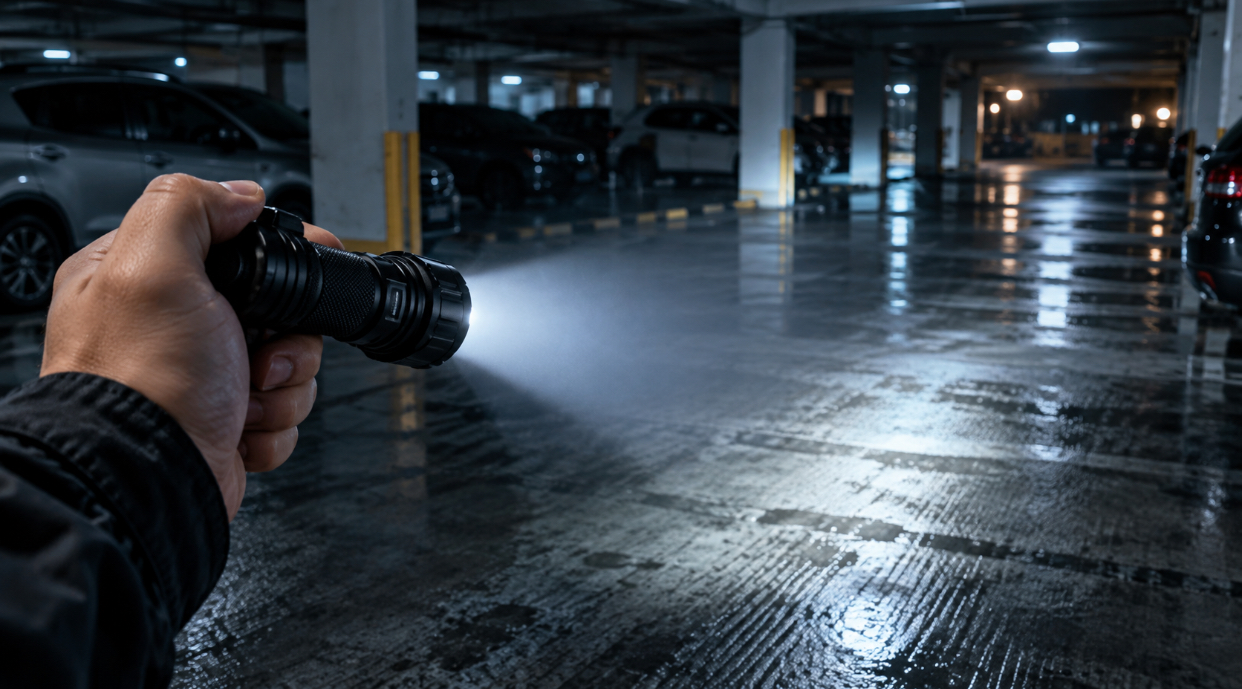
A flashlight won’t win a fight for you. What it can do is buy you two or three seconds, and in a parking garage at night that’s often enough. A hard beam in someone’s eyes makes them flinch and lose track of your hands. That’s your window to leave.
Plenty of lights sold for self defense can’t deliver that window. Some bury strobe three clicks deep. Others print a huge lumen number on the box, then spread the light so wide the center barely stings. The six lights below each have a tail switch you can work under stress and a beam with real intensity behind it.
If you just want the answer, the Olight Warrior 3S is my top pick. If you want strobe without any setup, get the Fenix PD36 TAC.
Quick Picks: The Best Self Defense Flashlights
Self Defense Flashlights Compared
Output and intensity figures are the manufacturers’ published ANSI ratings.
1. Olight Warrior 3S: Best Overall
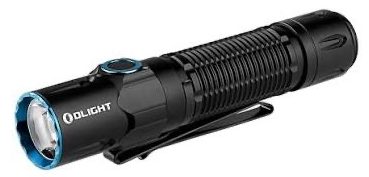
Why I chose it: The Warrior 3S puts out 23,000 candela, the most concentrated beam on this list. Add a two stage tail switch and a real lockout, and it’s the most complete package here. It’s best for people who want one light for daily chores that still holds up if a night goes wrong.
Key specs
- Output: 2,300 lumens Turbo, 800 High, 200 Medium, 15 Low, plus strobe
- Peak intensity: 23,000 candela, 300 m beam
- Battery: Olight 5,000 mAh 21700, magnetic charging
- Length: about 5.5 inches
- Extras: proximity sensor, lockout, holster
Pros
- Highest peak intensity in this group
- Light press for momentary, full press to lock on
- Lockout covers both switches for bag carry
Cons
- Tail strobe needs a one time setting change
- Turbo steps down after 2.5 minutes
- Proprietary battery and cable
Performance analysis
Press the tail halfway and the light stays on only while you hold it. Press it fully and it locks on. That lets you check a dark doorway and go dark again without fumbling. Out of the box the tail gives full output, not strobe, so hold the tail switch and click the side switch once to move strobe onto it. A triple press of the side switch from off also reaches strobe.
Turbo holds 2,300 lumens for 2.5 minutes, then drops to 800 for well over two hours. The proximity sensor dims the light if something blocks the lens, like a pocket lining. If it ever dims when you don’t want it to, double press the side switch within five seconds.
2. Fenix PD36 TAC: Best Instant Strobe
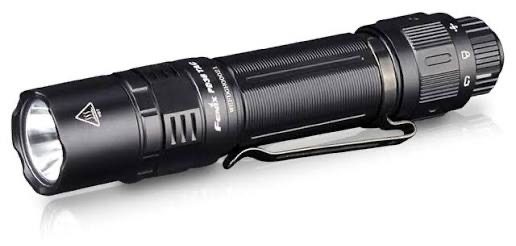
Why I chose it: Most lights make you program strobe or click through modes to find it. On the PD36 TAC, you hold the tail switch for under a second and you’re in strobe, straight from the factory. A twist ring on the tail selects Tactical mode, Duty mode or lockout. It’s best for anyone who wants a light that does the right thing with zero practice.
Key specs
- Output: 3,000 lumens Turbo (Duty mode), 2,000 High and strobe (Tactical mode)
- Peak intensity: 18,700 candela Turbo, 12,600 in Tactical mode
- Battery: Fenix 5,000 mAh 21700 with a USB C port on the cell
- Water and impact: IP68, 1 m impact resistant
- Length: about 5.5 inches
Pros
- Strobe in 0.8 seconds with factory settings
- Mechanical lockout you can feel
- Tactical mode leaves only High and strobe
Cons
- 3,000 lumen Turbo only in Duty mode
- No charging port on the light itself
- Flat top 21700 cells won’t fit
Performance analysis
Set the ring to Tactical and the light knows two things: tap for 2,000 lumens, hold for strobe. Duty mode adds five levels from 30 to 3,000 lumens, and strobe stays behind the same short hold.
Losing Turbo in Tactical mode isn’t a real loss. At 12,600 candela, Tactical High still throws a harsh hotspot at confrontation distance. The lockout is mechanical, too. Turn the ring to the middle and the tail switch simply can’t fire in a glovebox or backpack.
3. SureFire E2D Defender Ultra: Best Strike Bezel
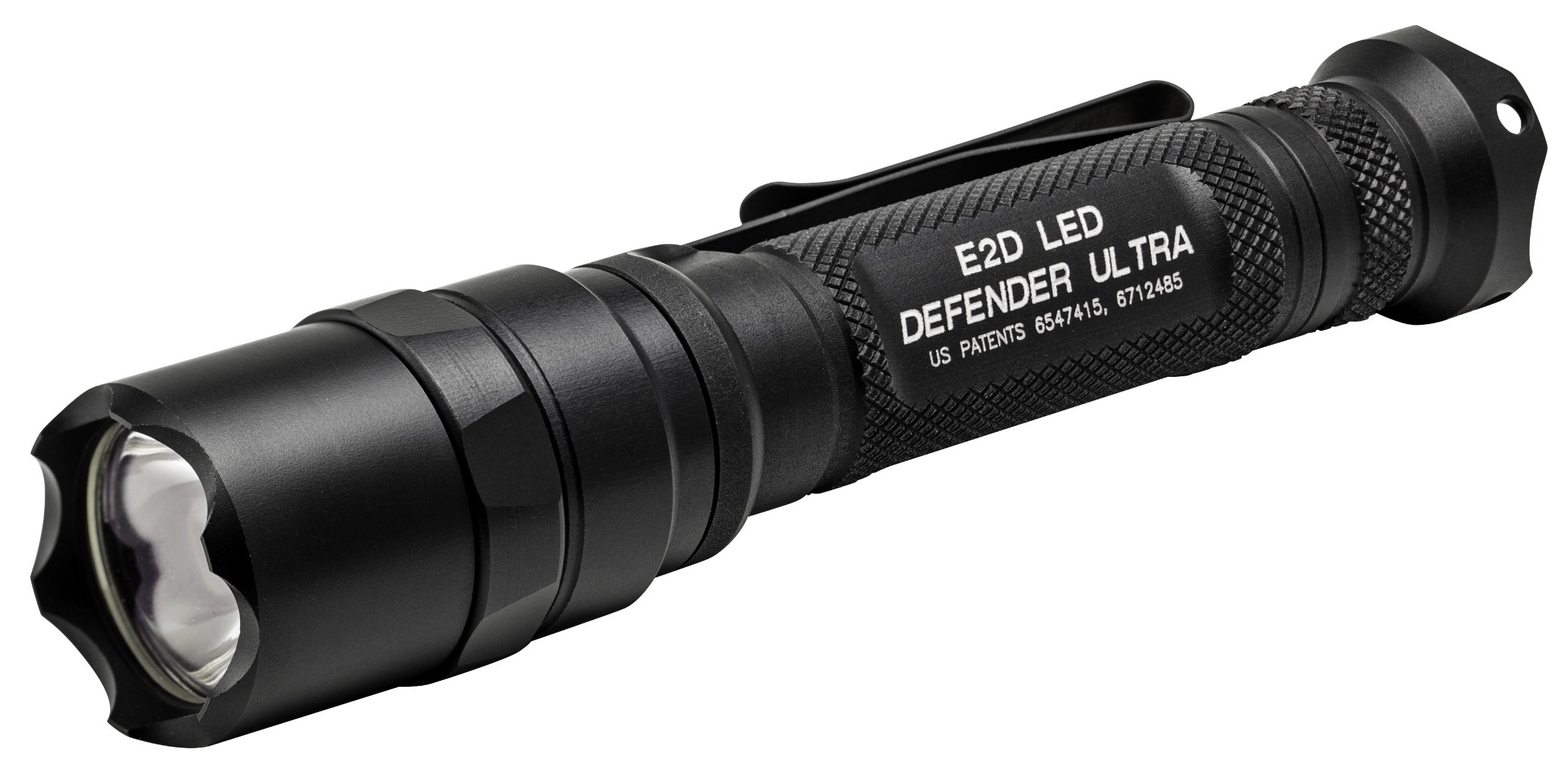
Why I chose it: The E2D Defender Ultra pairs a two output click switch with a crenellated Strike Bezel and a scalloped tailcap. There’s nothing to program. It’s best for people who train with a light and have thought through the legal side of carrying a toothed bezel.
Key specs
- Output: 1,000 lumens High, 5 lumens Low
- Peak intensity: 10,600 candela, 200 m beam
- Runtime: 2.75 hours High, 63 hours Low
- Battery: 2 x CR123A (included); IPX7
- Length and weight: 5.6 inches, 4.2 oz
Pros
- 1,000 lumens with one click, every time
- Bezel and tail machined into the body
- CR123A cells store for years
Cons
- No strobe
- Not rechargeable out of the box
- Bezel teeth chew up pockets and can look aggressive to police or a jury
Performance analysis
Click the tail for 1,000 lumens. Turn it off and click again within two seconds for 5 lumens. Some retailer listings claim a strobe mode, but SureFire describes it as dual output, High and Low only. If you want strobe, pick the PD36 TAC or the P20iX.
At 10,600 candela the beam isn’t the most intense here, but 1,000 lumens through that TIR lens is still a serious deterrent at three feet. The bezel is the reason to buy this light and the reason to think twice. If you’d only ever use a light to blind and run, you don’t need the teeth.
4. Nitecore P20iX: Brightest
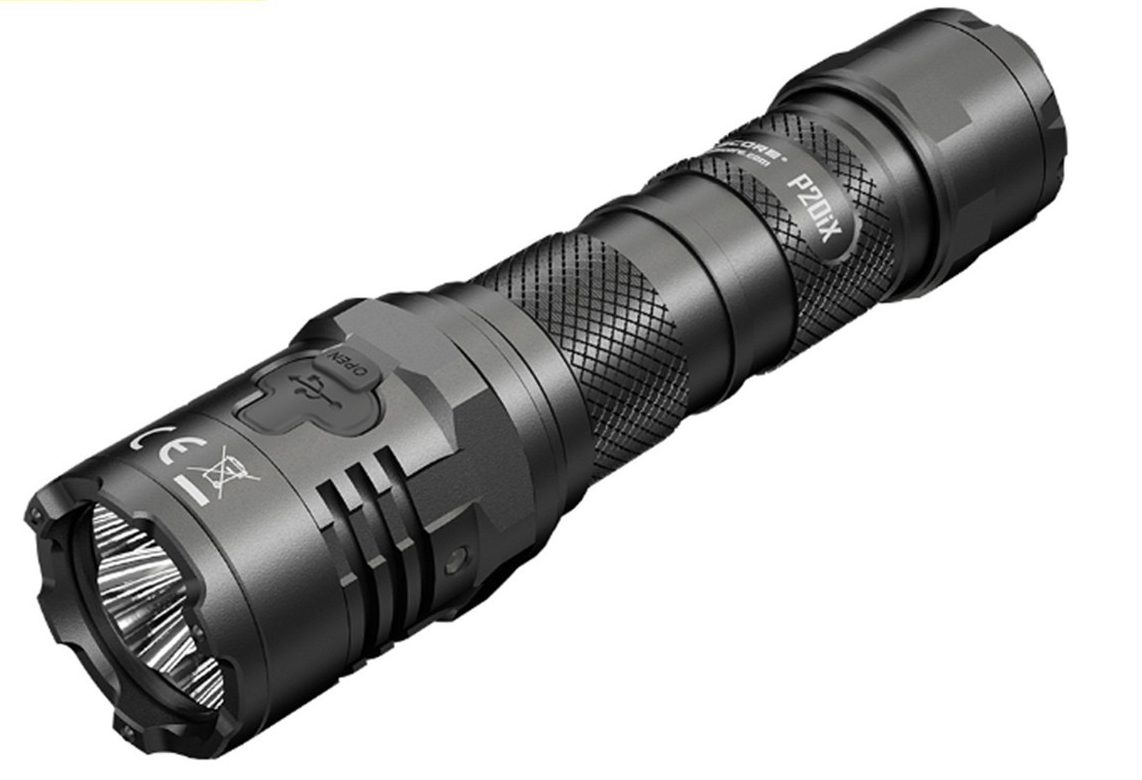
Why I chose it: Four LEDs push 4,000 lumens out of a body just over 5.5 inches long. The more useful feature is the STROBE READY button, a flat switch beside the tail button that fires strobe from off. The bezel hides three ceramic glass breaking beads in hardened steel. It’s best for home defense and car carry.
Key specs
- Output: 4,000 lumens Turbo, plus five lower levels down to 2 lumens
- Peak intensity: 12,200 candela, 221 m beam
- Battery: Nitecore NL2150HPi 21700 (included) or 2 x CR123A
- Charging and water: USB C on the light; IP68 to 2 m
- Length and weight: 5.57 inches, 4.09 oz
Pros
- Dedicated strobe button, no programming
- Strobe shifts frequency at random
- Runs on CR123A cells as a backup
Cons
- Wide beam, less candela per lumen than the Olight or Fenix
- Can’t run while charging
- Spares for its i series cell come from Nitecore
Performance analysis
The P20iX makes almost twice the lumens of the Warrior 3S, yet its peak intensity is about half. Four LEDs behind a wide optic make a big, even flood. Indoors that’s an advantage, because it fills a hallway and still overwhelms eyes at a few feet.
The STROBE READY switch is the easiest strobe access here. With the light off, press the flat button and you’re in strobe, at a frequency Nitecore says shifts at random. The bezel is smoother than the SureFire’s teeth, so it’s kinder to pockets and looks like an ordinary flashlight.
5. Olight Warrior Mini 3: Best for Pocket or Purse
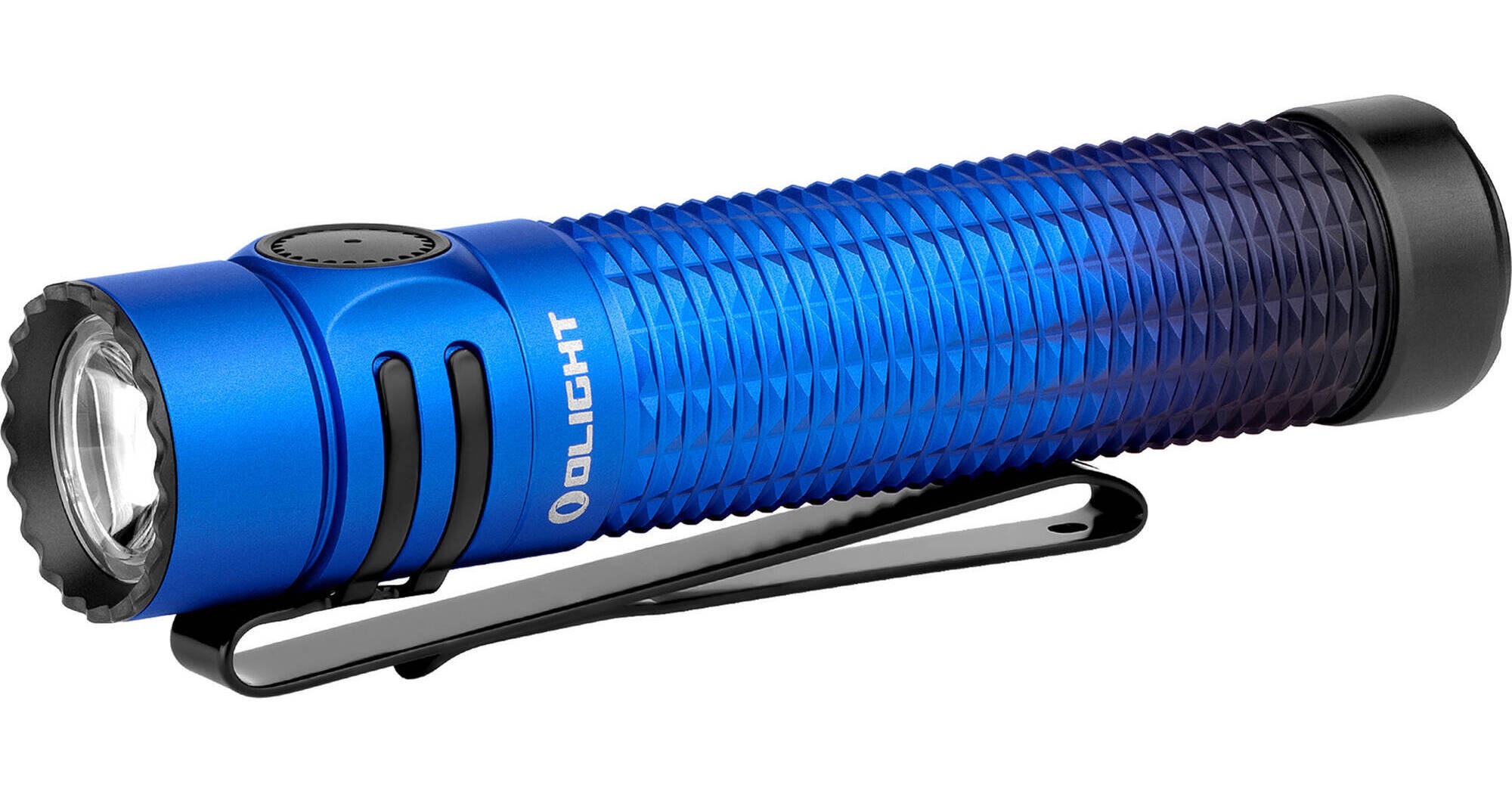
Why I chose it: A self defense light only works if it’s on you, and plenty of people won’t carry a 5.5 inch light every day. The Warrior Mini 3 is 4.37 inches long and keeps a real tactical tail switch. It also puts out 14,400 candela, more than the 4,000 lumen Nitecore. It’s best for pocket or purse carry.
Key specs
- Output: 1,750 lumens Turbo, 500 High, lower levels down to 0.5, plus strobe
- Peak intensity: 14,400 candela, 240 m beam
- Battery: Olight 3,500 mAh 18650, magnetic charging
- Water: IPX8
- Length and weight: 4.37 inches, 4.3 oz
Pros
- Shortest light here with a tactical tail switch
- Tail can be set to Turbo and strobe
- Proximity sensor won’t dim it once it’s on and aimed
Cons
- Turbo steps down after about 2 minutes
- Ships with the tail set to Turbo and Medium
- Proprietary battery and charger
Performance analysis
It disappears in a front pocket, and the stippled body gives sweaty hands something to grip. Olight ships the tail set to Turbo and Medium, so on day one hold the tail switch and click the side switch once to swap Medium for strobe.
The proximity sensor is smarter than the one on the Warrior Mini 2. It only cuts output if the light turns on to a high mode while blocked, like inside a pocket. Turbo lasts about two minutes, then 500 lumens runs for over three hours. If you want something even smaller, my best mini flashlight roundup has options.
6. Streamlight ProTac 2L-X: Best Budget
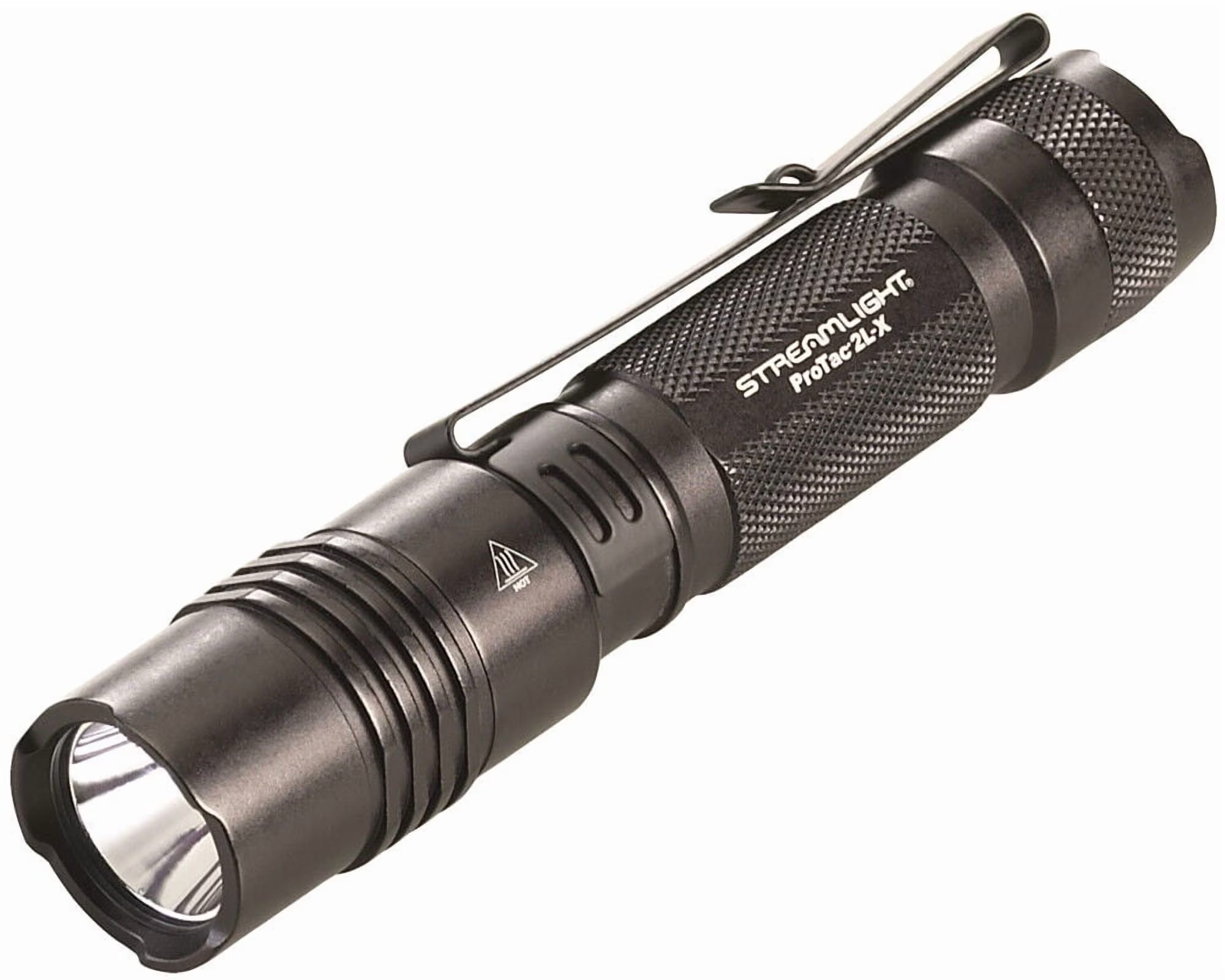
Why I chose it: The ProTac 2L-X proves you don’t need thousands of lumens. It’s a 500 lumen light from a company that builds lights for law enforcement, with strobe behind a quick double tap of the tail. It runs on two CR123A cells or a Streamlight rechargeable pack. It’s best as a first defensive light or a spare for the car or nightstand.
Key specs
- Output: 500 lumens High, 40 Low, plus strobe
- Peak intensity: 6,800 candela, 165 m beam
- Runtime: 2.75 hours High on CR123A, 3.25 hours on the rechargeable pack
- Water and impact: IPX7, 2 m impact tested
- Length and weight: 5.14 inches, 3.9 oz with CR123A cells
Pros
- Strobe from the tail with factory settings
- TEN-TAP can set it to High only
- Holster included, anti roll head
Cons
- Lowest output and intensity here
- Strobe double tap must land within 0.4 seconds
- No strike bezel
Performance analysis
Tap and hold the tail for momentary High, or press until it clicks to lock it on. A fast double tap gives strobe, and a triple tap gives Low. Practice the double tap until it’s automatic. If you’d rather not think about it, TEN-TAP can set the light to High only.
The CR123A option is the real value. A 2L-X left in a car or drawer for a year is ready when you need it, which you can’t say for a rechargeable that quietly ran down.
Lumens vs Candela: The Number That Actually Matters
Lumens measure how much light a flashlight makes in total. Candela measures how much lands in the brightest part of the beam. You’re aiming that hotspot at someone’s eyes, so candela is the better guide to how hard a light hits.
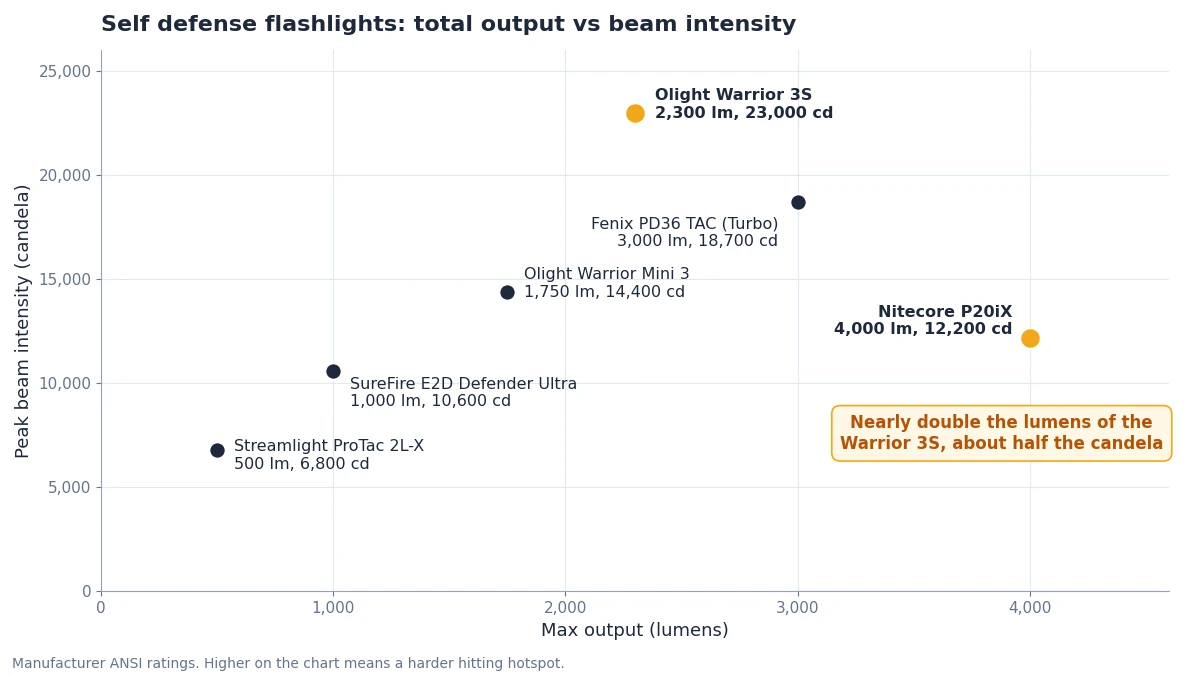
Compare the Nitecore P20iX and the Olight Warrior 3S. The Nitecore makes 4,000 lumens, the most here, according to Nitecore’s own spec sheet, but peaks at 12,200 candela. The Warrior 3S makes 2,300 lumens and hits 23,000 candela. My candela vs lumens guide explains why in more detail.
The practical rule: for a light you carry in public, favor candela. For a nightstand light that needs to fill a room, a wide flood is fine.
How to Choose a Self Defense Flashlight
Start with the tail switch
The switch matters more than the spec sheet. You want a tail switch you can press with your thumb while gripping the light like an ice pick or a hammer, with momentary on: press for light, let go for dark. All six picks here have their main switch at the tail. If you carry a handgun, a handheld doesn’t replace a weapon mounted light, which my best pistol lights guide covers.
Check how you reach strobe
“Has strobe” and “has instant strobe” are different claims. The Nitecore has a dedicated button, the Fenix needs a short hold, and the Streamlight wants a fast double tap. Both Olights need a one time setting change, and the SureFire has no strobe at all. Strobe can disorient the other person, but it also makes it harder for you to track them, so plenty of trainers prefer a steady beam.
Think candela first
Look for at least 10,000 candela in a light you carry. Indoors at arm’s length, even the 500 lumen ProTac 2L-X is more than a dark adapted eye can handle. Also check how long Turbo lasts, since small lights step down fast to stay cool.
Be careful with strike bezels
A toothed bezel gives you a striking edge if the light is your only option. It also changes how the light looks to police, a prosecutor or a jury. A plain flashlight reads as a tool, while sharp crenellations can read as a weapon you chose to carry. Laws on weapons and use of force vary by state and city, so check yours. If you plan to blind and leave, a mild bezel like the Nitecore’s is the safer choice. My guide on how to use a tactical flashlight for self defense covers grips and tactics.
Match the battery and the carry
Rechargeable 18650 and 21700 lights are cheaper to run daily. For a light that sits in a car or drawer for months, CR123A cells hold their charge for years, and my CR123A rechargeable guide covers the rechargeable versions. Decide where the light lives before you buy. The Warrior Mini 3 suits a front pocket, and a purse or backpack calls for a lockout like the Warrior 3S and PD36 TAC have. A nightstand or car can handle the bigger P20iX.
FAQ
How many lumens do you need for a self defense flashlight?
For close range use, 500 lumens is enough to overwhelm eyes adjusted to the dark. For outdoor carry, look for 1,000 lumens or more with at least 10,000 candela, so the beam still hits hard at parking lot distances.
Is it legal to carry a flashlight for self defense?
In most of the US, an ordinary flashlight is legal to carry almost anywhere. Striking someone with any object is still a use of force, judged under your state’s self defense laws. A toothed bezel can draw more scrutiny.
Can I bring a tactical flashlight on a plane?
Usually, yes. The TSA allows flashlights in carry on and checked bags, though the officer at the checkpoint has the final say. Lights with sharp strike bezels are the most likely to get pulled aside, and spare lithium cells belong in your carry on.
Are stun gun flashlights better for self defense?
They’re a different tool. A stun gun flashlight adds an electric shock, and the light is usually an afterthought; one popular SABRE combo lists a 120 lumen LED. Stun guns are also restricted or banned in some states and cities. A quality flashlight works every day and goes almost anywhere.
The Bottom Line
For most people, the Olight Warrior 3S is the best self defense flashlight right now. It has the most intense beam in this group and a tail switch that works under stress. Move strobe onto the tail the day it arrives.
Want strobe with zero setup? Get the Fenix PD36 TAC. Pick the Olight Warrior Mini 3 for pocket carry, the Nitecore P20iX for a nightstand or car, the SureFire E2D Defender Ultra if you want the bezel, and the Streamlight ProTac 2L-X as a first light that stores for years. Whichever you choose, carry it daily and practice with it at night.
