
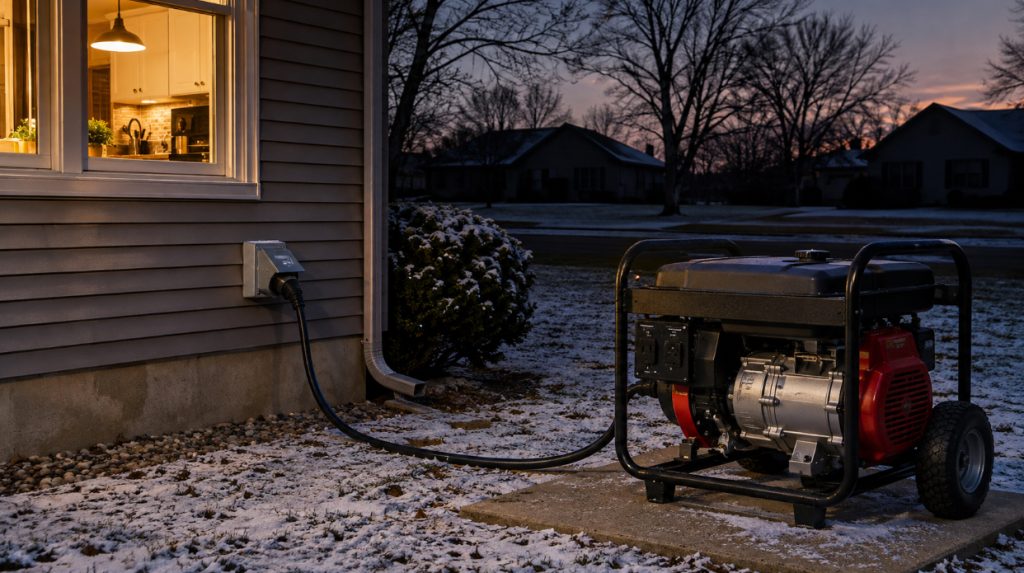
The first time the power stays out overnight, most people find out their house runs on more than outlets. The furnace blower is hardwired. So is the well pump, and the sump pump can’t wait until morning. A portable generator for home backup can run all of that, as long as it’s big enough and wired in properly.
The generators in this guide are the open-frame kind that sit on wheels outside the garage and feed the house through an inlet box. They’re louder than the quiet inverters I cover in my dual fuel inverter generator guide, but they give you far more watts for the money. That’s what it takes to keep a fridge, a furnace and a well pump going through a long outage.
Every pick here shuts itself off when carbon monoxide builds up, and each one fits a different kind of house. Further down, the Breaker Panel Planner lets you flip on the circuits you’d want running and tells you which generator, which hookup and how much fuel you’d need.
Quick Picks
Portable Home Generators Compared
How I Picked These Generators
A generator that runs outside your bedroom window at 3 a.m. has to look after itself. Every one of these has a carbon monoxide sensor that shuts the engine off if CO starts building up, and I wouldn’t own a portable without one. Each also has a 240-volt outlet, so it can feed the house through an inlet box and run the loads that matter most in a long outage, like a well pump.
Houses need very different amounts of power. A small place on gas heat gets by on far less than a farmhouse on a deep well, and a home with a natural gas line can skip fuel runs altogether. These five run from a 30-amp setup that keeps the furnace and fridge going up to a V-twin big enough for most of a house.
1. Westinghouse WGen9500DFc EFI: Best Overall
Why I chose it and who it’s for
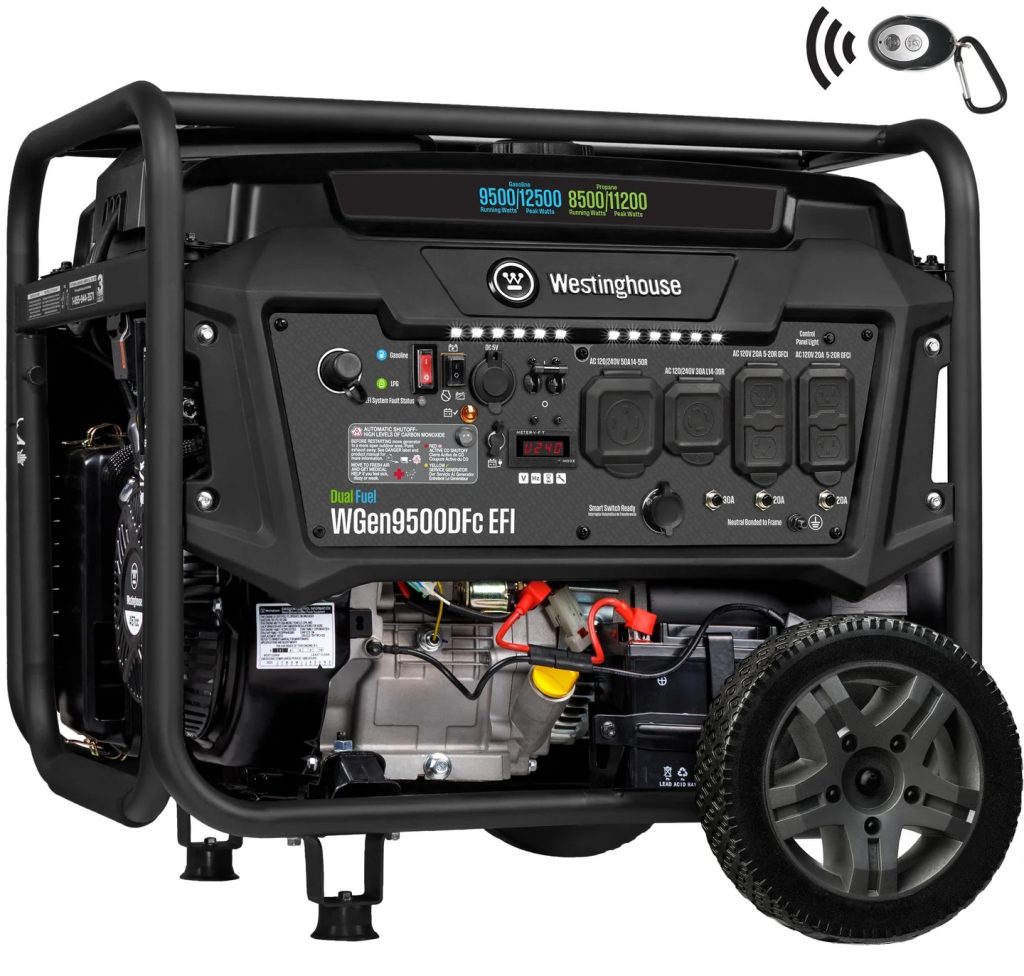
The Westinghouse WGen9500DFc EFI is the newer, fuel-injected version of Westinghouse’s long-running WGen9500DFc. The output is the same, but electronic fuel injection replaces the carburetor, so there’s no choke to fiddle with and no gummed-up carburetor after a summer of sitting. It’s also CARB compliant, which matters if you live in California, where most big open-frame generators can’t be sold.
It’s the one I’d put in front of most houses. It has enough power for a fridge, freezer, furnace blower, sump pump and lights with room left over, and both a 30-amp and a 50-amp outlet, so it works with either kind of inlet.
Key specs
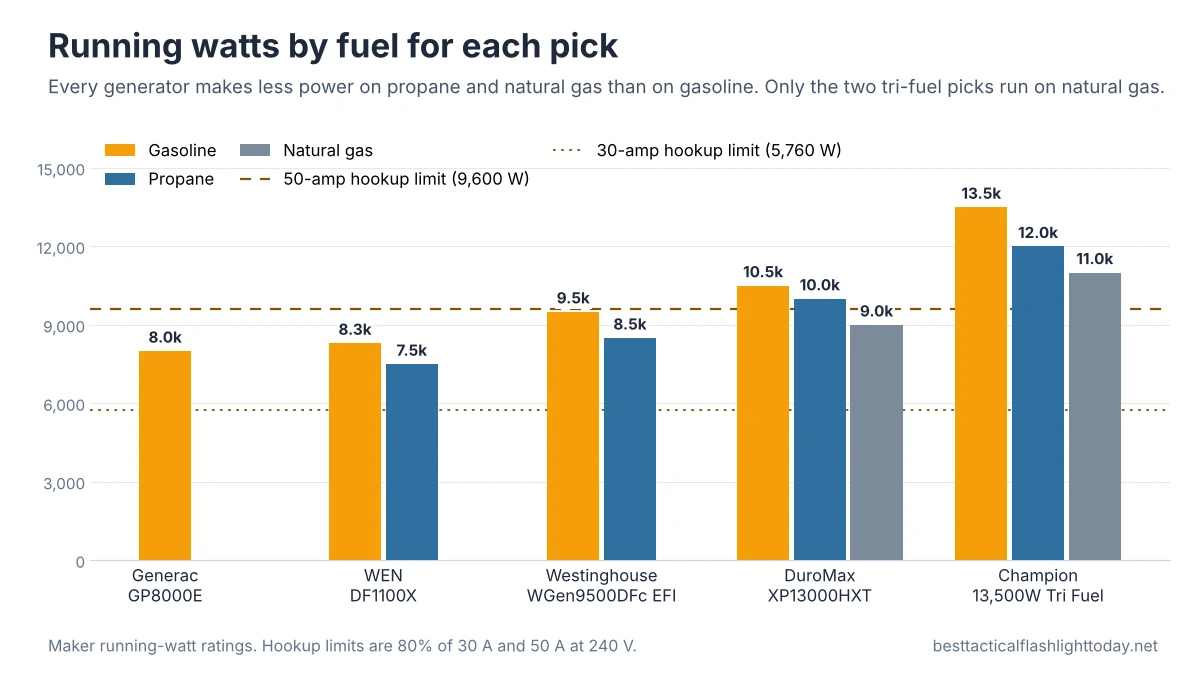
- Running watts: 9,500 on gasoline, 8,500 on propane
- Peak watts: 12,500 on gasoline, 11,200 on propane
- Outlets: two 120V GFCI duplex (5-20R), a 30A L14-30R and a 50A 14-50R, both 120/240V
- Engine: 457cc OHV with electronic fuel injection
- Fuel tank: 6.6 gallons, up to 10 hours at half load or 15 at quarter load
- Starting: electric, key fob remote and recoil
- Noise: 74 dBA
- Weight: 221 lb
- Safety: CO sensor with automatic shutoff, low-oil shutdown
- Warranty: 3 years residential; CARB compliant
Pros and cons
Pros
- Fuel injection starts easily and needs less upkeep
- Sold in California as well as the other 49 states
- Remote start from the kitchen window
Cons
- It costs more than the carbureted version
- Heavy at 221 lb, so plan a flat path to its spot
- Propane runs it about 10% weaker
Performance analysis
The jump from 8 to 10 hours at half load on the same 6.6 gallon tank is the part I’d notice in a real outage. It’s two more hours between refills, and over a five-day outage that’s a few fewer trips to a gas station that may not have power either.
In a winter storm, the remote start lets you start it from inside, let it warm up, then go out and plug in. The digital readout also shows voltage, frequency and lifetime hours, so oil changes are easy to track.
Westinghouse lists the neutral as bonded. That’s the usual setup for a portable, but tell your electrician so they can match it to your transfer switch or interlock.
2. WEN DF1100X: Best Value
Why I chose it and who it’s for
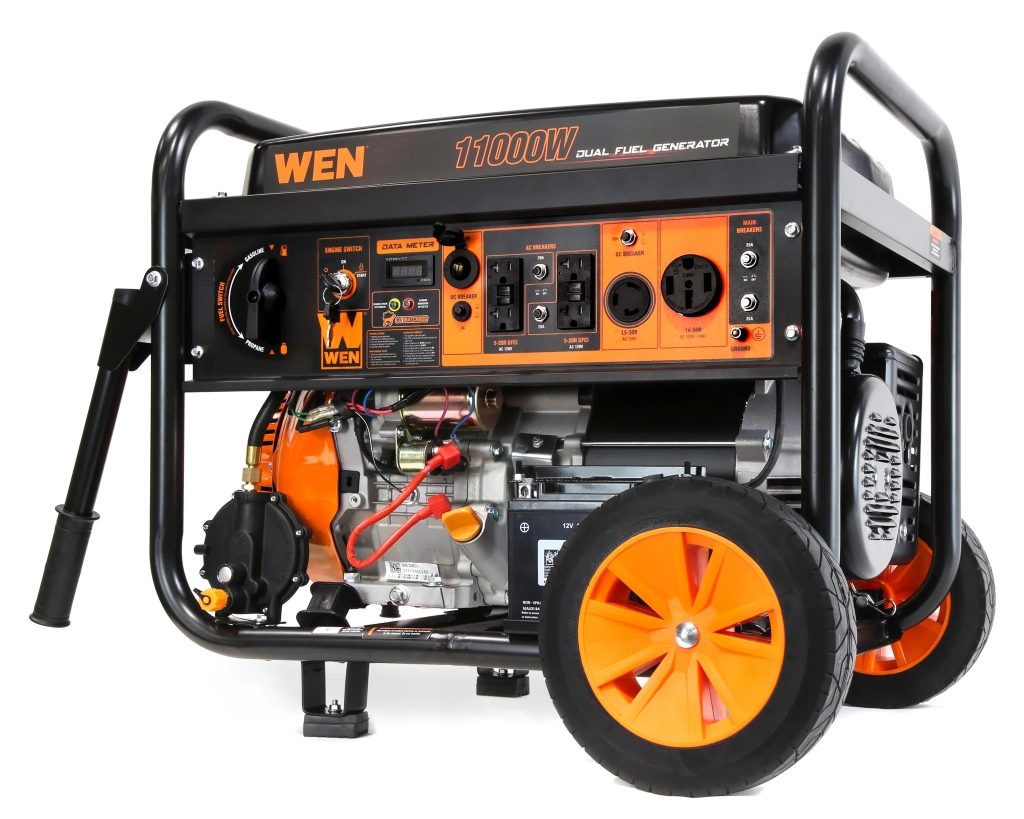
The WEN DF1100X gives you a 50-amp outlet, dual fuel and a CO shutdown sensor for less than most generators this size. WEN calls the sensor CO Watchdog. It shuts the engine off when carbon monoxide gets too high, then blinks a red light for five minutes so you know why it stopped.
It’s the pick for a house that needs the essentials covered without paying for features it won’t use. Just plan on a 50-amp inlet for it, since that’s its only 240-volt outlet.
Key specs
- Running watts: 8,300 on gasoline, 7,500 on propane
- Surge watts: 11,000 on gasoline, 9,500 on propane
- Outlets: four 120V GFCI (5-20R), a 120V 30A L5-30R, a 120/240V 50A outlet and a 12V DC socket
- Engine: 457cc OHV
- Fuel tank: 6.6 gallons, up to 8.5 hours at half load
- Propane: about 3 hours at half load on a 20 lb tank
- Starting: electric key start
- Weight: 213.8 lb with the wheel kit
- Safety: CO Watchdog automatic shutoff
- Warranty: 2 years
Pros and cons
Pros
- An affordable way into a 50-amp, dual fuel generator
- Wheel kit and propane hose included
- The CO sensor tells you when it caused a shutdown
Cons
- No 30-amp 240V twist-lock outlet
- Shorter warranty than the others
- No remote start
Performance analysis
The outlet panel is the thing to plan around. Its only 240-volt outlet is the 50-amp one, and the 30-amp twist-lock is 120 volts only. If you already have a 30-amp L14-30 inlet, either have it changed to a 50-amp inlet or pick one of the other generators. Don’t solve it with an adapter.
WEN’s own propane figure is about 3 hours at half load on a 20 lb tank. That’s realistic for any generator this size, so stock several tanks if propane is your main fuel.
3. DuroMax XP13000HXT: Best Tri-Fuel
Why I chose it and who it’s for
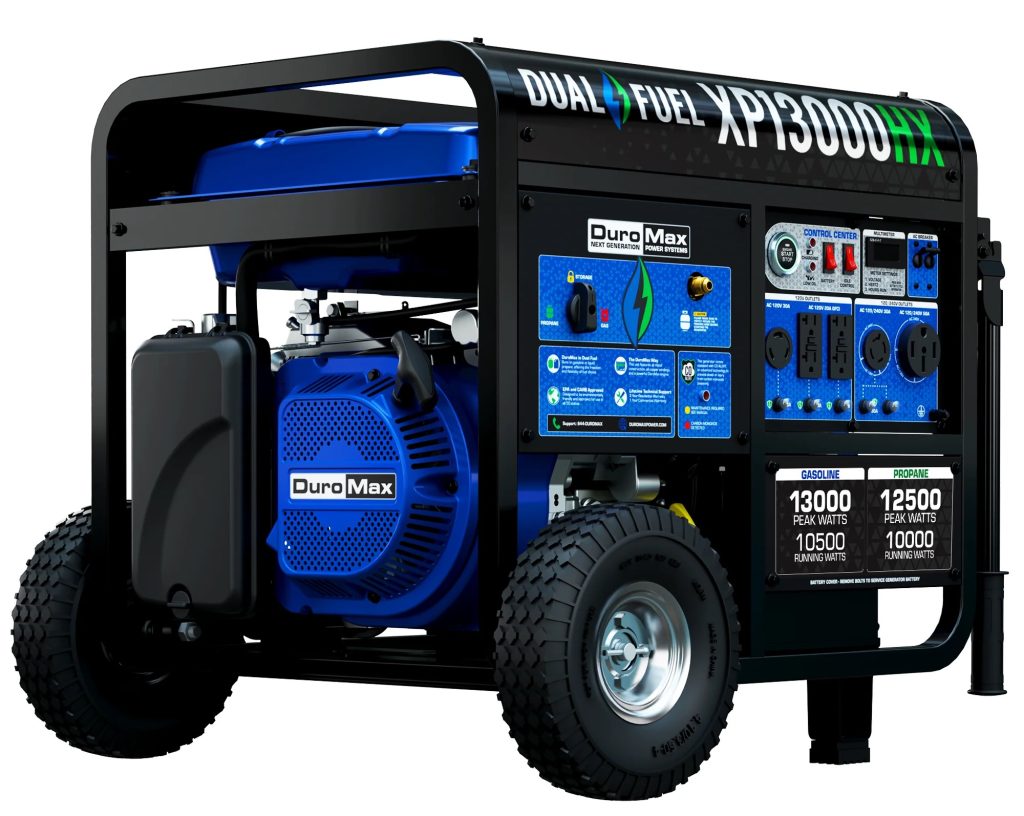
The DuroMax XP13000HXT runs on gasoline, propane or natural gas. If your house has a gas line, that changes the whole outage. A plumber adds a shutoff and a quick-connect fitting, you plug in the included 15-foot hose, and it runs as long as the gas keeps flowing with no fuel trips at all.
If you’ve been looking at Harbor Freight’s big Predator tri-fuel, this is the one to weigh against it. The power is close, and DuroMax backs it with a 5-year warranty.
Key specs
- Running watts: 10,500 on gasoline, 10,000 on propane, 9,000 on natural gas
- Starting watts: 13,000 on gasoline, 12,500 on propane, 11,250 on natural gas
- Outlets: four 120V GFCI (5-20R), a 120V L5-30R, a 120/240V L14-30R and a 120/240V 50A 14-50R
- Engine: 500cc
- Fuel tank: 8.3 gallons, up to 8.5 hours at half load or 17 at quarter load
- Starting: push button, remote and recoil
- Noise: 74 dB
- Weight: 240 lb
- Included: 15-foot natural gas hose and propane hose with regulator
- Safety: CO sensor with automatic shutdown; warranty 5 years
Pros and cons
Pros
- No refueling on natural gas
- Both 30-amp and 50-amp 240V outlets
- The longest warranty in this guide
Cons
- Not sold in California
- Output drops about 14% on natural gas
- Large and heavy to move
Performance analysis
Natural gas costs you about 1,500 watts compared with gasoline, which still leaves 9,000 running watts. That’s plenty for a fridge, freezer, furnace, sump pump and a 1 hp well pump at the same time.
Ask the plumber to check your gas meter before you count on it. The furnace, water heater and generator all pull from the same meter, and an undersized meter or line can starve the generator when everything runs at once.
Keep a few cans of gas anyway, since a gas utility can shut off lines during a flood.
4. Champion 13,500W Tri Fuel: Most Power
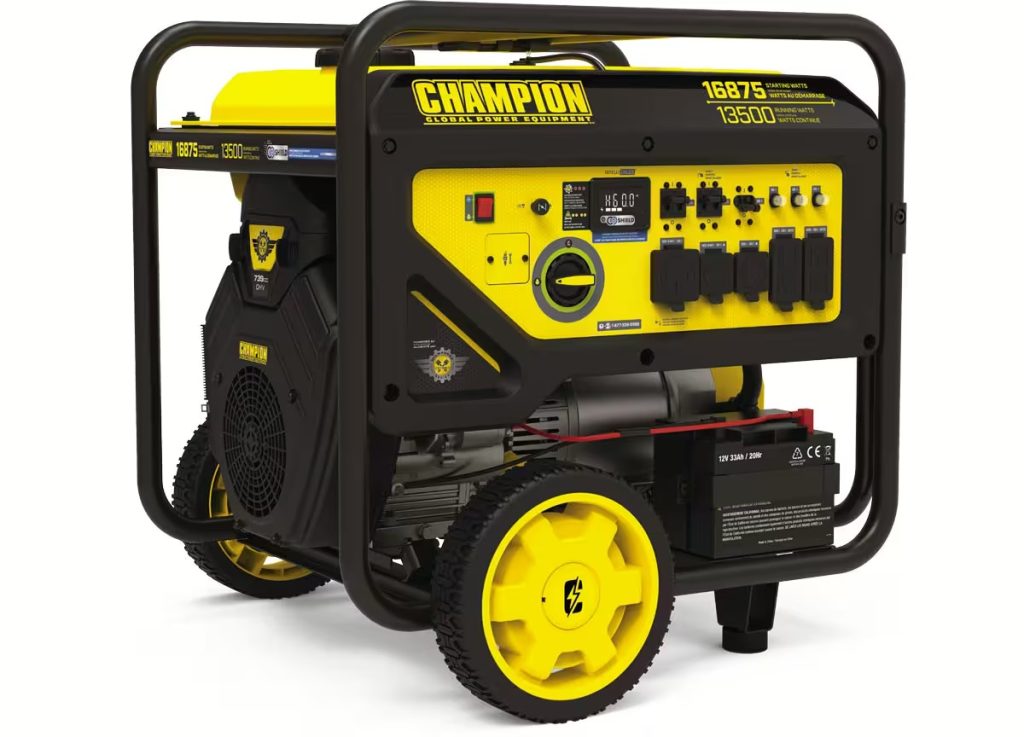
Why I chose it and who it’s for
The Champion 13,500W Tri Fuel is one of Champion’s newest home backup tri-fuels, model 201241. Its V-twin engine makes 16,875 starting and 13,500 running watts on gasoline, and still 11,000 running watts on natural gas, the most of any pick here.
It’s the one for big houses, homes with a deep well pump, or anyone who wants to run the microwave and coffee maker without turning other things off first.
Key specs
- Running watts: 13,500 on gasoline, 12,000 on propane, 11,000 on natural gas
- Starting watts: 16,875 on gasoline, 15,000 on propane, 13,750 on natural gas
- Outlets: two 120V GFCI duplex (5-20R), a 120V L5-30R, a 120/240V L14-30R and a 120/240V 50A 14-50R
- Engine: 739cc V-twin
- Fuel tank: 11 gallons, about 8 hours at half load
- Propane: about 3 hours at half load on a 20 lb tank
- Starting: electric start with included battery
- Noise: 79 dBA at 23 feet
- Weight: 361 lb
- Safety: CO Shield automatic shutoff; warranty 3 years
Pros and cons
Pros
- The most power in this guide on every fuel
- V-twin handles big motor starts well
- Runs off a gas line like the DuroMax
Cons
- 361 lb takes two people or a flat path
- Burns more fuel at light loads
- Rated louder than the other picks
Performance analysis
The hookup limits what reaches the house. A 50-amp inlet tops out around 9,600 watts of steady load, so most of the extra power goes to headroom for big motor starts, like a 1 hp well pump kicking on while the fridge compressor runs.
The trade-off is fuel. A big engine burns a lot even when it’s lightly loaded, so if your list is only essentials, a smaller pick will stretch your fuel much further. The planner below shows the difference.
5. Generac GP8000E: Best for a 30-Amp Hookup
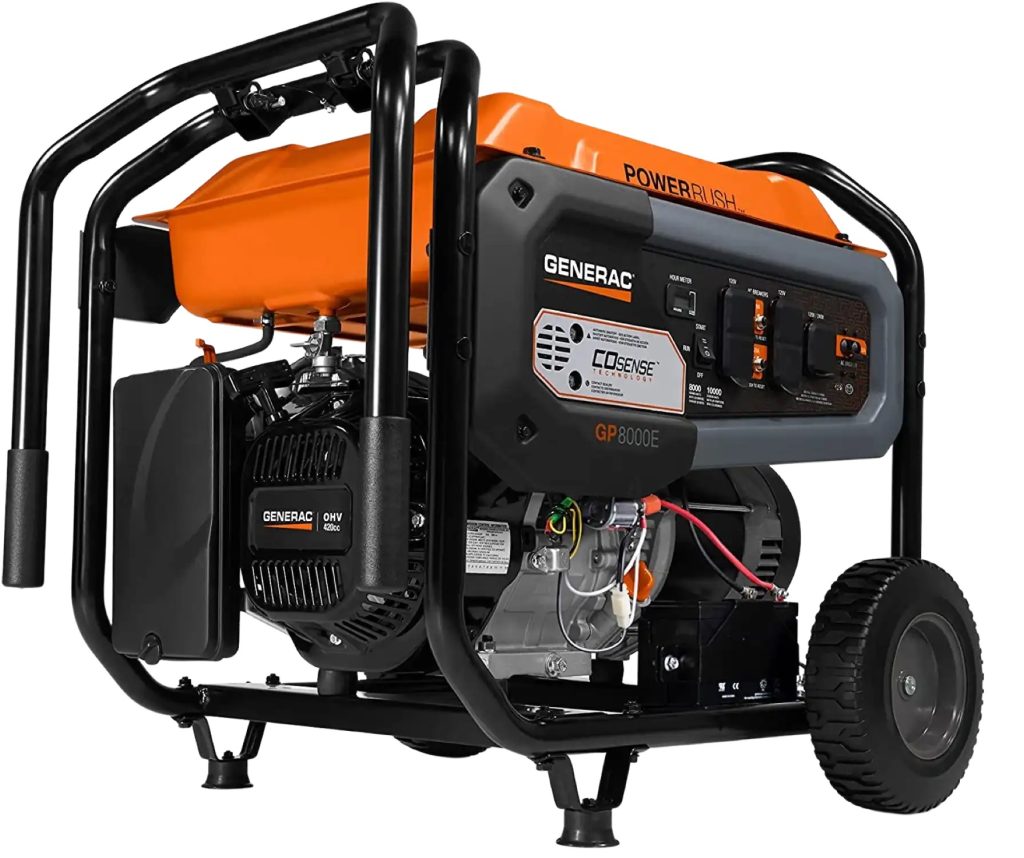
Why I chose it and who it’s for
Plenty of homes start with a 30-amp inlet and an interlock, and the Generac GP8000E is sized for exactly that. It’s gas only, with a 30-amp L14-30R twist-lock for 240 volts, and Generac’s COsense shuts it off if carbon monoxide builds up.
It suits a smaller house with gas heat that needs the furnace blower, fridge and lights, or anyone who wants a brand with service shops in most towns.
Key specs
- Running watts: 8,000; starting watts: 10,000
- Fuel: gasoline only
- Outlets: two 120V GFCI duplex (5-20R) and a 120/240V 30A L14-30R
- Engine: 420cc OHV
- Fuel tank: 7.9 gallons, up to 11 hours at half load
- Starting: electric with PowerRush, which adds extra starting power for motors
- Weight: about 200 lb
- Safety: COsense automatic shutdown, low-oil shutdown, hour meter
- Warranty: 3 years residential
Pros and cons
Pros
- The longest half-load runtime here
- Built for the common 30-amp hookup
- Generac dealers and service are everywhere
Cons
- No propane or natural gas
- No 50-amp outlet
- No remote start
Performance analysis
The 30-amp outlet caps how much it can send into the house at about 7,200 watts, and you’d want to stay near 5,700 for steady running. That’s a good match for its 8,000-watt rating, so you’re paying for the power you can actually use through that hookup.
PowerRush is Generac’s name for extra starting power, which helps when a fridge compressor or sump pump kicks on. The 7.9-gallon tank and the long rated runtime make it the easiest of these to leave running overnight.
Generac builds a California version and a 49-state version, so make sure you get the one that’s legal where you live.
Breaker Panel Planner
Flip on the circuits you’d want running in an outage. The planner adds up running watts, counts the startup kick from your biggest motor, and tells you whether a 30-amp or 50-amp hookup fits. It also shows which of these five generators carries the load on your fuel, and how much fuel to keep for a three, five or seven day outage.
The watt figures are typical for each appliance. If something on your list is older or bigger, the nameplate inside the door or on the motor will have its exact numbers.
How to Choose a Portable Generator for Home Backup
Running watts first, then the biggest motor
Add up the running watts of everything you want on at the same time. Then add the extra startup watts of the single biggest motor on your list. You only count that one motor, because motors need the surge for just a second or two, and if you start them one at a time, they don’t all hit the generator together. That’s the number to match against the generator’s starting watts.
Then leave room. I’d aim for 50 to 75% of the rating on a normal day, which leaves headroom when the fridge and the sump pump kick on together.
30-amp or 50-amp hookup
The hookup decides how much of a generator’s power reaches your panel. A 30-amp inlet carries up to 7,200 watts at 240 volts, and it’s wise to keep steady loads below about 5,700. A 50-amp inlet carries up to 12,000, so about 9,600 steady. If your running total sits under 5,700 watts, a 30-amp inlet and cord will do. Above that, go 50-amp.
Match the outlet too. A 30-amp hookup uses an L14-30 cord, and a 50-amp hookup uses a 14-50 or CS6365 cord. The WEN has no 240-volt 30-amp outlet and the Generac has no 50-amp outlet, so choose the generator and the inlet together.
Transfer switch, interlock or extension cords
Never plug a generator into a wall outlet with a double-ended cord. Power runs back out through your meter into the lines, which can kill a lineworker and start fires when the grid comes back. Generac explains why back-feeding a panel is dangerous and against electrical code.
The safe ways in are an interlock kit, which is a sliding plate on your panel that stops the main breaker and the generator breaker being on together, or a manual transfer switch with its own small set of circuits. Both feed from an inlet box outside. An electrician installs either one, usually with a permit. Extension cords are fine for plug-in appliances, but they can’t reach hardwired loads like a furnace, well pump or ceiling lights.
Gasoline, propane or natural gas
Gasoline gives the most power and is easy to find before a storm, but it goes stale in a few months without stabilizer, and stations need power to pump it. Propane stores for years and is clean to handle, but every generator makes about 10% less on it, and a 20 lb tank goes fast. Natural gas costs the most power but never needs a refill as long as the utility keeps it flowing.
A dual fuel generator gives you a backup fuel when one runs out. A tri-fuel only makes sense if you have a gas line and a plumber to add the connection.
CO shutoff and where the generator sits
Carbon monoxide from portable generators kills about 100 people a year in the U.S., according to the Consumer Product Safety Commission. It advises running a generator outside only, at least 20 feet from the house, and looking for one with a CO shutoff feature. That’s why every pick here has one.
Never run it in the garage, even with the door open. Point the exhaust away from doors and windows, and put battery CO alarms on every floor. The ones in my power outage emergency kit guide keep working when the power is out.
Fuel for a long outage
Most of these burn somewhere between half a gallon and a bit over a gallon of gas an hour at half load. Run one 12 hours a day and a five-day outage takes 30 to 60 gallons. That’s a lot of cans, so check how long outages typically last in your state and plan for the high end if you get hurricanes or ice storms.
You don’t need to run it around the clock. Run the fridge and freezer a few hours in the morning and evening, keep their doors shut in between, and turn the generator off at night if nothing on your list needs it.
Portable, inverter or standby
An open-frame portable like these is the most power for the money. A dual fuel inverter generator is far quieter and safer for electronics, but most top out around 4,000 to 5,000 running watts. A permanently installed standby generator starts itself and runs the whole house, at several times the cost. For a bedroom CPAP and phones alone, a portable power station runs silently indoors.
Frequently Asked Questions
What size portable generator do I need to run a house?
For the essentials, meaning a fridge, freezer, furnace blower, sump pump, lights and Wi-Fi, most homes need about 3,500 to 5,500 running watts and a generator rated around 8,000. Add a well pump or window AC and you’re closer to 9,500 to 10,500. The Breaker Panel Planner above works out your exact number.
Can a portable generator power a whole house?
Most of one, if you skip the big electric loads. A 50-amp hookup carries up to about 9,600 watts of steady load, which covers lights, the fridge and freezer, a gas furnace, a well pump and the kitchen. Central AC, an electric water heater and electric heat usually need a standby generator.
Do I need a transfer switch for a portable generator?
You need a transfer switch or an interlock kit to power anything hardwired, like the furnace, well pump or ceiling lights. Extension cords work for plug-in appliances. Never plug the generator into a wall outlet, which back-feeds the grid and is dangerous for lineworkers.
How long can a portable generator run continuously?
As long as it has fuel and oil. On gasoline, these run about 8 to 11 hours at half load per tank, and on natural gas a tri-fuel runs until the gas stops. Shut it down to refuel and check the oil every 8 hours or so.
The Bottom Line
For most homes, the Westinghouse WGen9500DFc EFI is the portable generator to buy. It’s fuel-injected, sold in all 50 states, has both 30-amp and 50-amp outlets, and covers the essentials on gas or propane with room to spare.
On a tighter budget, the WEN DF1100X does the job if you wire a 50-amp inlet. With a gas line, the DuroMax XP13000HXT never needs refueling. For a big house or a deep well, the Champion 13,500W Tri Fuel has the most power, and for a 30-amp hookup on gasoline, the Generac GP8000E is the right size.
Run your circuits through the planner above, then have an electrician install the inlet and interlock before the next storm. Keep battery CO alarms on every floor, a flashlight for power outages by the panel, and grab the free Lights Out kit for the rest of the plan.
