
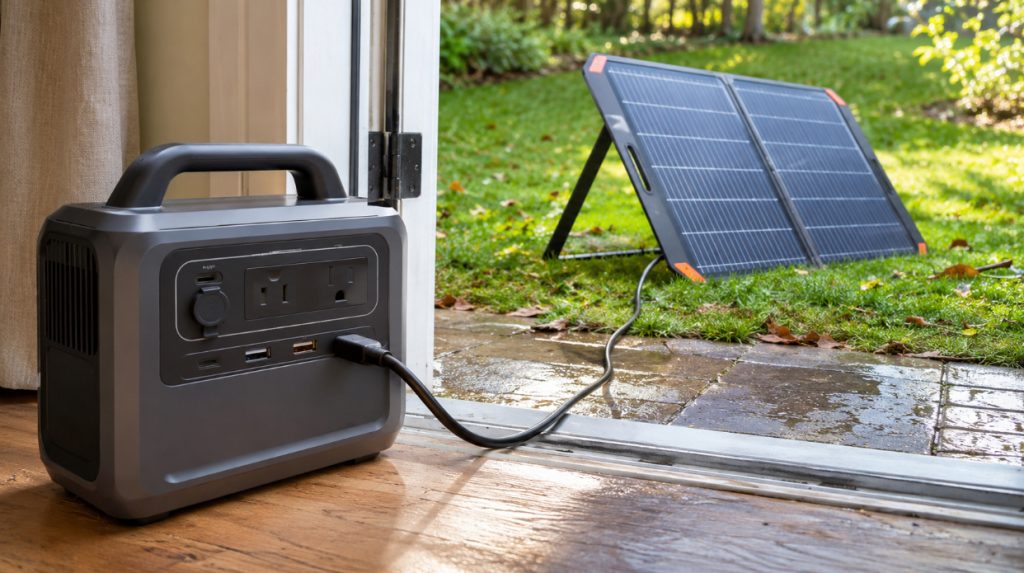
The storm rolls through around four in the afternoon. The lights blink twice, the fridge shudders to a stop, and the whole house goes quiet in that way you only notice when it happens. You’ve got a power station charged and waiting in the hall closet, and it does exactly what you bought it for. The fridge stays cold, the phones charge, the router keeps the kids on their tablets. By the next morning, though, the screen reads 14%, the neighbor two doors down is yanking the cord on his generator, and the line at the one open gas station wraps around the block. Meanwhile the sun is up and beating down on your driveway like nothing happened.
That’s where a solar generator earns its keep. It’s a power station and a folding solar panel sold as a kit, so when the battery runs low you prop the panel up in the yard and let the sun fill it back up. There’s no fuel to find, nothing to run outside in the rain, and no exhaust anywhere near an open window. One thing to know going in: a panel never makes what’s printed on the box, and what it does make depends a lot on where you live and which month the lights go out. A 220 watt panel in Arizona in June puts back about 1,230 watt-hours on an average day. That same panel in Washington in December manages about 300.
Here’s what I’d buy. The EcoFlow Delta 3 Classic with its 220 W panel suits most homes, with enough battery for the fridge overnight and a panel that keeps the small stuff going for as long as the outage lasts. If a full-size fridge is the whole reason you’re shopping, the Anker SOLIX C2000 Gen 2 with a 400 W panel doubles both the battery and the panel. And if all you need is a CPAP and the phones, the little Jackery 300 v2 kit fits on a closet shelf. Below the reviews there’s a planner that takes your state and the month, adds up what you want to run, and shows whether the sun keeps up.
Quick Picks: The Best Solar Generators in 2026
Solar Generators Compared
1. EcoFlow Delta 3 Classic + 220W Solar Panel: Best Overall
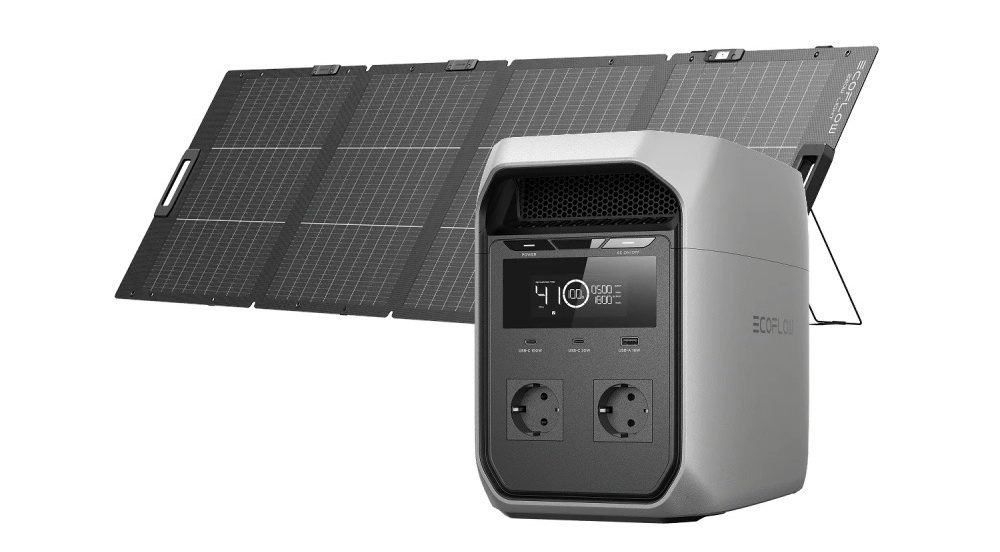
Why I chose it: The Delta 3 Classic gets the basics right for an ordinary house or apartment. The station holds 1,024 Wh on a LiFePO4 battery, puts out 1,800 W with 3,600 W of surge for a fridge compressor, and takes over in about 10 ms when the grid drops, so a CPAP or a desktop never notices. The panel that comes with it is EcoFlow’s 220 W bifacial model, which picks up extra light on its back side off a bright patio or snow. The station takes up to 500 W of solar, so there’s room to add a second panel later. It’s the kit for anyone who wants the fridge covered overnight and the small stuff covered for as long as the outage runs.
Key specs
- Battery: 1,024 Wh, LiFePO4
- Output: 1,800 W, 3,600 W surge
- Switchover: about 10 ms
- Wall recharge: about 45 minutes to 80%, about an hour to full
- Solar input: up to 500 W
- Panel: 220 W front and 175 W rear rating, IP68, 15.4 lb, stand adjusts from 30 to 60 degrees
- Station weight: 26.7 lb
Pros
- Fast switchover for a CPAP or computer
- The bifacial panel has a built-in angle guide
- Room on the solar input for a second panel
Cons
- One panel covers the small stuff, not a full fridge, through most of the year
- Won’t charge below 32°F, so it has to live indoors in winter
Performance analysis: In an average July in Texas, the 220 W panel puts back about 990 Wh a day. That runs a router, two phones and a few LED lamps around the clock with some left over, and it slows the drain when the fridge is plugged in too. In an Ohio December it’s closer to 330 Wh, which covers the phones and a few lamps while the battery carries the router. The station’s screen shows how many watts are coming in, so you can move the panel around the yard and watch the number climb. Keep the station inside at night. A second 220 W panel nearly doubles what you get back each day.
2. Anker SOLIX C2000 Gen 2 + 400W Solar Panel: Best for Keeping the Fridge Running
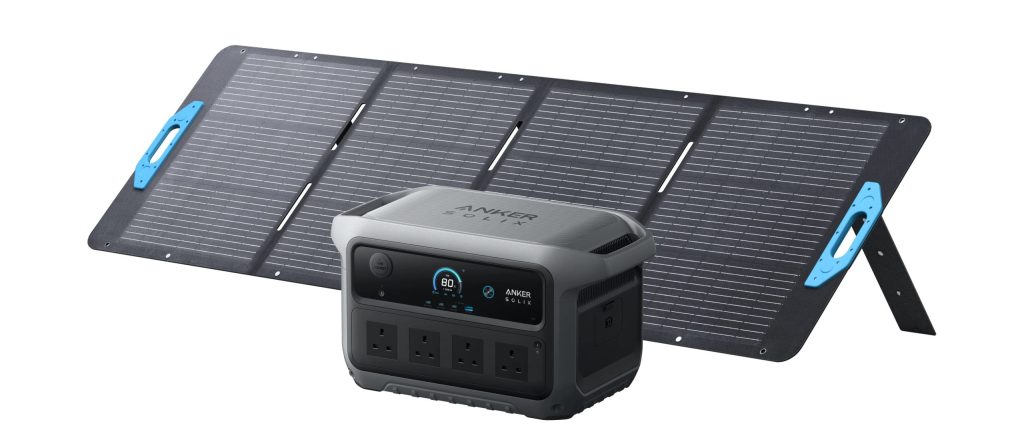
Why I chose it: A full-size fridge uses somewhere around 1,300 Wh a day once the compressor cycling is averaged out. That’s more than a 1 kWh station holds, and more than a single 220 W panel can put back on most days. The C2000 Gen 2 doubles both sides of that math, with a 2,048 Wh LiFePO4 battery and a 400 W panel in the box. It puts out 2,400 W (4,000 W peak), switches over in 10 ms, and has a 20 amp outlet and an RV-style TT-30 outlet alongside the regular ones. It’s the kit for anyone whose real fear in an outage is a freezer full of food going bad.
Key specs
- Battery: 2,048 Wh, LiFePO4, 4,000 cycles to 80%
- Output: 2,400 W, 4,000 W peak
- Switchover: 10 ms
- Wall recharge: about 88 minutes to full at 1,800 W
- Solar input: up to 800 W, 11 to 60 V, one XT-60 port
- Expansion: up to 4 kWh with Anker’s BP2000 battery
- Panel: 400 W, IP67, stand sets at 30, 40, 50 or 80 degrees, MC4 connectors
- Station weight: 41.7 lb
Pros
- Big enough to carry a fridge for more than a day on the battery alone
- Quiet, rated at 30 dB under 1,000 W
- Room for a second 400 W panel and an extra battery
Cons
- Heavy enough that it should stay in one spot
- The 400 W panel is large to set up and store
- Charging stops below 32°F and above 104°F
Performance analysis: Through most of the South from spring to early fall, this is where solar starts to carry a fridge. In an average Georgia July the 400 W panel adds about 1,600 Wh a day, enough to cover a fridge with a little to spare, while the 2 kWh battery bridges the nights and the cloudy days. Farther north and in winter it won’t keep up, but it stretches a fridge from a little over a day on the battery alone to two or three days. Watch the temperature limits. Anker lists a charging range of 32 to 104°F, so in July keep the station in the shade or just inside the door with the cable running out to the panel. Plug the fridge straight into the station rather than through a power strip.
3. Jackery Solar Generator 1500 v2: Easiest to Set Up
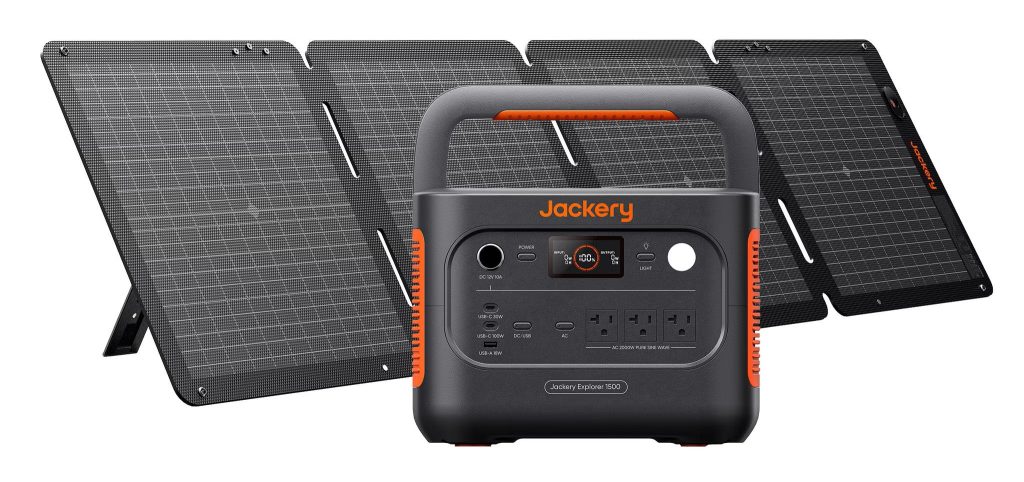
Why I chose it: If you’ve never used a solar panel before, this is the kit with the fewest ways to get it wrong. The Explorer 1500 v2 comes with two SolarSaga 100W Air panels, and they plug into the station with Jackery’s own cables, one panel to each of the two solar ports. There’s nothing to wire in series and no adapters to buy. The station holds 1,536 Wh on LiFePO4 cells rated for 6,000 cycles, puts out 2,000 W with a 4,000 W surge, and weighs about 32 lb. The panels fold small and are light enough to set out and bring in every day. It’s best for older owners and anyone who wants solar without learning the jargon.
Key specs
- Battery: 1,536 Wh, LiFePO4, 6,000 cycles to 70%
- Output: 2,000 W, 4,000 W surge
- Switchover: within 20 ms
- Wall recharge: about 1.5 hours
- Solar input: up to 400 W, 200 W per port, 16 to 60 V
- Panels: two SolarSaga 100W Air with Jackery DC8020 plugs
- Station weight: about 32 lb
Pros
- Panels plug straight in, no matching or adapters
- Light panels you can carry with one hand
- Highest cycle rating in this lineup
Cons
- Third-party panels need an adapter for Jackery’s plug
- 200 W of panels is modest for a battery this size
- Slower switchover than the EcoFlow and Anker picks
Performance analysis: Jackery’s own figure is about 10 hours of strong sun to fill the station from the two panels, which means it won’t refill in one day outside summer. Think of the solar as a way to stretch the battery. Run the fridge off the battery overnight and let the panels cover the daytime load. If you want more solar later, the station takes up to four of the same panels. Test the switchover with your CPAP or computer before you count on it, since 20 ms is fine for most electronics but not all.
4. EcoFlow Delta Pro 3 + Two 400W Solar Panels: Best Whole-Home Kit
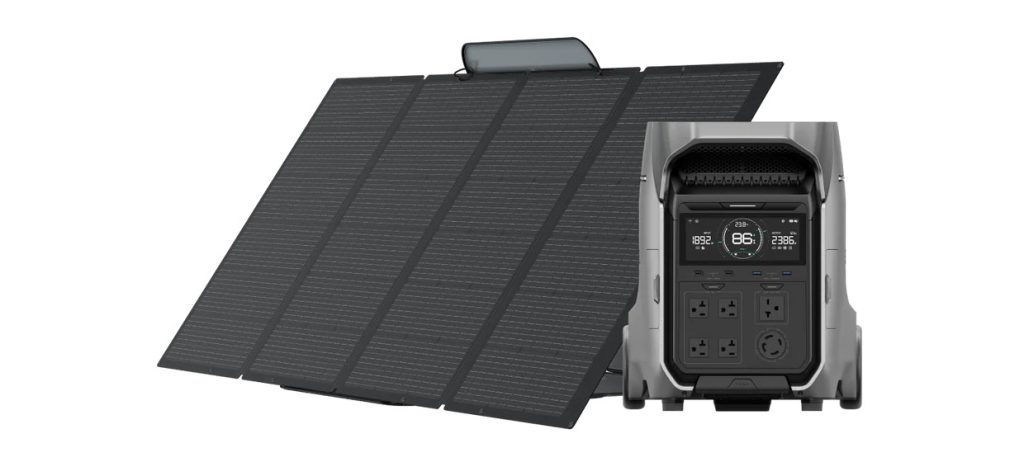
Why I chose it: The Delta Pro 3 is the only kit here that can run the parts of a house that don’t plug into an outlet. It puts out 4,000 W at 120 or 240 volts, so through a transfer switch or EcoFlow’s Smart Home Panel 2 it can feed a well pump or the blower on a gas furnace. The battery holds 4,096 Wh and grows to 12 kWh with two extra batteries. Two 400 W panels come with it, and the station takes up to 2,600 W of solar across two ports, so you can keep adding panels for a long time. It’s the kit for rural homes and anyone who loses power for days at a stretch.
Key specs
- Battery: 4,096 Wh, LiFePO4, 4,000 cycles to 80%
- Output: 4,000 W at 120/240 V, 8,000 W surge
- Outlets: four 20 A, a TT-30, a 6-20 and an L14-30
- Switchover: 10 ms
- Solar input: 2,600 W total, a 30 to 150 V port up to 1,600 W and an 11 to 60 V port up to 1,000 W
- Expansion: up to 12 kWh with two extra batteries
- Panels: two 400 W, IP68, 35.3 lb each
- Station weight: 113.5 lb, on wheels
Pros
- Runs 240 V loads like a well pump
- Solar input you won’t outgrow
- Five-year warranty
Cons
- Running house circuits needs an electrician and a transfer switch or EcoFlow’s panel
- Two 400 W panels take real room to set out
- Far more than an apartment needs
Performance analysis: With both panels out, an average Florida September (peak hurricane season) puts back about 3,130 Wh a day. That’s enough to cover a fridge, a freezer, fans, lights and the Wi-Fi without touching the battery much. In a New York January the same panels add about 1,720 Wh, enough to cover the fridge and the Wi-Fi, which leaves the battery free for the furnace blower at night. Budget for the transfer switch or EcoFlow’s panel and an electrician up front. If you already run a generator through an interlock kit and inlet box, ask the electrician whether the station’s L14-30 outlet can feed that same inlet.
5. Jackery Solar Generator 300 v2: Best Budget Kit
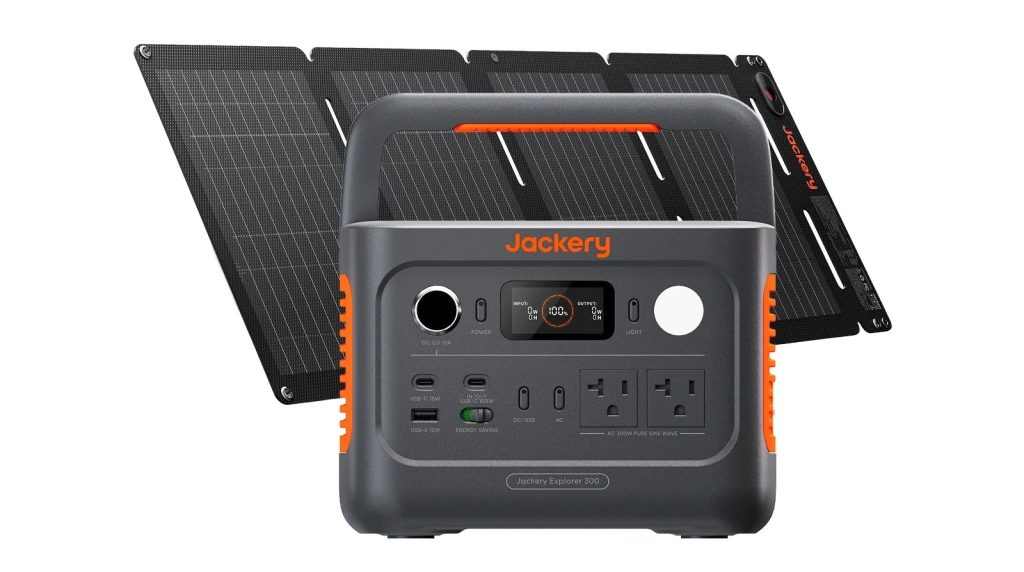
Why I chose it: Plenty of people don’t need a fridge in an outage. They need the CPAP to run tonight and the phones to stay charged, and a 30 pound power station is overkill for that. The Explorer 300 v2 weighs 8.3 lb, holds 288 Wh on LiFePO4 cells, and switches over within 20 ms with a CPAP plugged in. The SolarSaga 40 Air panel in this kit folds down small. It’s the kit for apartments, CPAP users and anyone who wants something light to grab and go.
Key specs
- Battery: 288 Wh, LiFePO4, 4,000 cycles to 70%
- Output: 300 W, 600 W surge
- Switchover: within 20 ms
- Wall recharge: about 76 minutes
- Solar input: up to 100 W
- Panel: SolarSaga 40 Air
- Station weight: 8.3 lb
Pros
- Light enough to carry with one hand
- Covers a CPAP without a heater for a night or more
- Cheapest real solar kit from a known brand
Cons
- Too small to start a fridge
- The 40 W panel fills it slowly
- Room for only one more small panel
Performance analysis: The 40 W panel adds about 170 Wh on an average June day in North Carolina, which is about a night of CPAP use without the heated humidifier, or plenty to keep two phones charged. Jackery puts a full charge from that panel at about 9.5 hours of ideal sun. The station takes up to 100 W of solar, so a 100 W panel is the upgrade if you want it to refill in a single day. For more nights on a CPAP, my CPAP battery backup guide sizes a battery to your machine.
6. EcoFlow 220W Bifacial Portable Solar Panel: Best Panel to Add
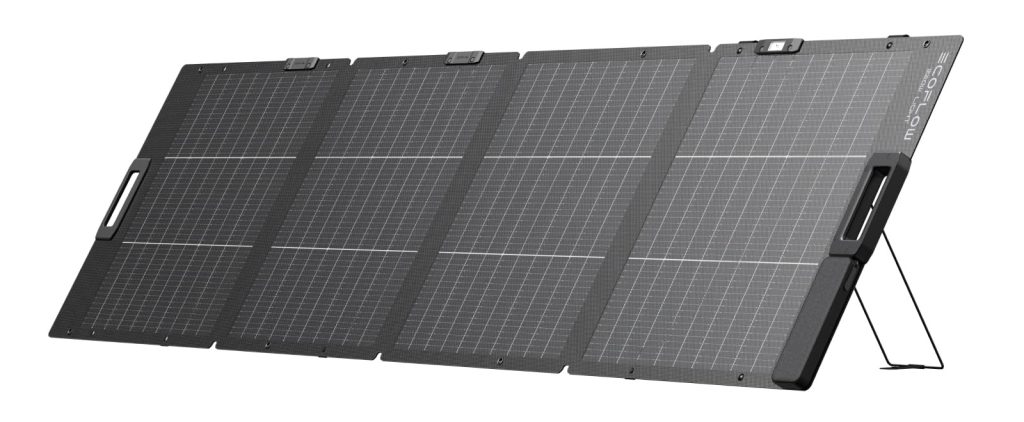
Why I chose it: If you already own a power station, you may only need the panel. This is the same 220 W bifacial panel that comes with the Delta 3 Classic. Its N-type cells are rated at 25% efficiency, the back side is rated for another 175 W of light bounced up off the ground, and it’s sealed to IP68. A kickstand case holds it anywhere from 30 to 60 degrees with a little sun-angle guide built in. It comes with an XT60i cable and has standard MC4 connectors, so it plugs into EcoFlow stations directly and into many other brands with the right cable. It’s the pick for anyone with a power station like the ones in my power station guide.
Key specs
- Rating: 220 W front, 175 W rear
- Cells: N-type, 25% efficiency
- Open-circuit voltage: 21.5 V
- Sealing: IP68
- Stand: 30 to 60 degrees with an angle guide
- Connectors: MC4, with an XT60i cable included
- Weight: 15.4 lb, folds to about 24 by 23 inches
Pros
- Low enough voltage for almost any station’s solar port
- Back side adds a little over light-colored ground or snow
- Folds into its own case
Cons
- Jackery stations need an adapter for their DC8020 plug
- Rear rating assumes bright reflected light you won’t always get
Performance analysis: Don’t count on the rear rating. The back side only adds much when it faces something bright, like a white patio, light gravel or fresh snow, so think of it as a small bonus. On its own the panel adds about 320 Wh on an average Michigan December day and well over double that in summer. Check your station’s solar input range before you buy. At 21.5 V the panel suits any port that starts at 12 V or so, which covers most of them.
Will a Solar Generator Keep Up Where You Live?
Pick your state and the month of the outage, then tap what you want to keep running. The planner uses NASA‘s long-term average sunshine for your state, takes off a quarter for the losses every real panel has, and runs your list through the first three days of an outage. It also shows every month of the year, so you can see how a July storm compares with a January ice storm.
How Much a Solar Panel Really Makes
A panel’s watt rating comes from a lab test with perfect light on a cool panel. In a real yard it’s warmer, the sun moves, the angle is a little off and the station loses some power converting it. Expect about three quarters of the rating while the sun is strong. A 200 W panel making 150 W at midday is doing its job.
The other half of the math is how many hours of strong sun you get. Solar people count it in full-sun hours, the number of hours a day would take at full strength to deliver that day’s sunshine. Multiply your panel’s rating by the full-sun hours and by about 0.75, and you have a good guess at the watt-hours you’ll get back that day. The chart shows how much that number swings across the year.
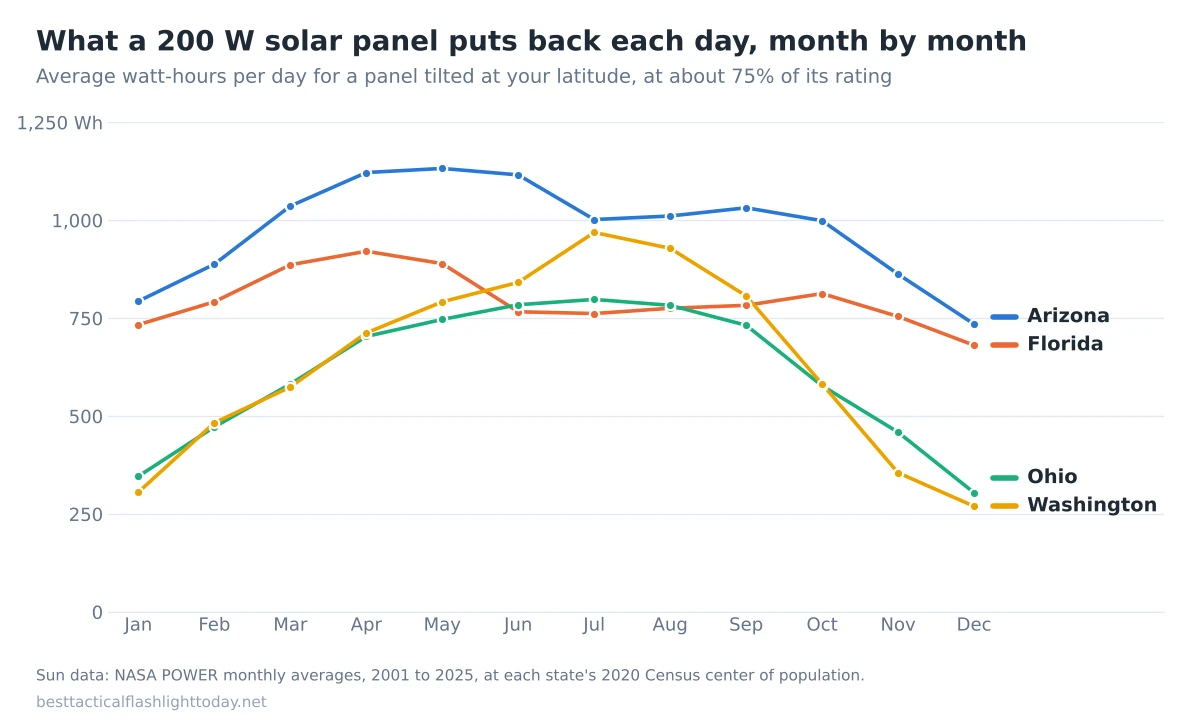
The swing is bigger the farther north you live. Florida even dips in summer, when afternoon thunderstorms roll through most days, and a Washington July outshines a Florida one. Come December, though, the Washington panel makes a little over a third of what the Arizona one does. Across the states, the middle value is about 5.5 full-sun hours a day in July and about 3.0 in December. That’s why one 220 W panel refills an empty Delta 3 Classic in about a day of average July sun but needs about two days in December. Plug your own state into the planner above for the real numbers.
Using a Solar Generator in a Summer Outage
Summer outages come with long days and plenty of sun, which is when a solar generator shines. A thunderstorm, a heat wave or a hurricane can knock the power out for days, and those are the months when a panel can keep a fridge and fans running without much help from the battery.
Heat is the thing to manage. Solar cells lose output as they get hot, so prop the panel up where air moves behind it, not flat on a hot roof or deck. Keep the station itself out of the sun. Most stop charging somewhere around 104 to 113°F, and a black box sitting on a sunny driveway gets there fast. Run the cable through a cracked door or window so the station stays inside where it’s cooler.
Air conditioning is the hard one. A small window unit draws around 500 W while it runs, which drains a 2 kWh battery in an afternoon. Fans are the better bet. A box fan uses about a tenth of that, and a few of them plus a cold fridge make a hot outage a lot more bearable. For hurricane country, set the panels out the morning after the storm passes, once the wind has dropped, and bring them in before the next band comes through.
Using a Solar Generator in a Winter Outage
Winter is harder on solar in every way. The days are short, the sun sits low, and snow covers anything left flat. Tilt the panel steeper to face the low sun, somewhere around 50 or 60 degrees in the northern states, and brush it off after every snowfall. A bifacial panel sitting over fresh snow picks up a little extra from the back.
The battery has its own winter rule. Lithium cells, LiFePO4 included, shouldn’t be charged below freezing, and most stations, including the EcoFlow and Anker kits here, won’t charge below 32°F. Keep the station inside, even in an unheated house, and run only the panel and its cable outdoors.
Cold also pushes a panel’s voltage up. A panel’s open-circuit voltage is measured at a mild temperature, and on a bitter morning it climbs above that. If you wire several panels together in series, leave some room between their total voltage and the top of your station’s solar input range, because going over can damage the station. Kits sold as a set, like the ones above, are already matched. For heat, skip the battery entirely. An electric heater drains even a big station in a few hours, while an indoor propane heater keeps one room warm without touching it.
What to Look for in a Solar Generator
Battery size first
Battery capacity, counted in watt-hours, decides how long you last through the night and through cloudy days. Add up what you want to run in a day. Phones, Wi-Fi and lights fit in about 600 Wh. A full-size fridge adds roughly 1,300 Wh more. Then pick a battery that covers at least one full day of that list, because solar can’t help at 2 a.m.
Enough panel to matter
The panel decides whether the battery comes back. As a rough guide, you need about one watt of panel for every watt-hour you use per day, divided by your full-sun hours and by 0.75. A 1,300 Wh fridge in a 5 hour summer location needs about 350 W of panel. In 2.5 hours of winter sun it needs around 700 W. That’s why bigger kits come with bigger panels.
The station’s solar input
Every station has a limit on how many watts of solar it takes and over what voltage range. A small station with a low limit stays slow no matter how many panels you buy. Look for room above the panel in the box so you can add one later, and check the voltage range before mixing brands.
Connectors
EcoFlow and Anker panels use standard MC4 plugs and XT-60 style cables. Jackery uses its own DC8020 plug. You can mix brands with the right adapter cable, but buying the panel and station from the same maker is simpler.
Switchover time
If the station sits plugged into the wall with a CPAP or computer plugged into it, the switchover time decides whether that device notices the outage. Under 10 ms is ideal, and 20 ms suits most electronics. Test yours before you rely on it.
Weight and where it lives
Under 30 lb, you can carry the station from room to room. Past 40 lb it lives in one spot, so put it near the fridge or the panel where it’ll do the most good. The panels need a sunny patch of yard or deck with no shade from about 10 a.m. to 3 p.m.
Solar Generator or Gas Generator?
A gas generator makes more power for less money and runs as long as you have fuel. It also has to stay outdoors, far from windows, and it needs fuel when the gas stations are closed. A solar generator runs in the kitchen with no fumes and no noise, and it refuels itself whenever the sun is out, but it can’t match a generator on big loads. Many prepared homes keep both: the solar generator for nights, quiet and the small stuff, and a dual fuel inverter generator for long outages and heavy loads. If you run any fuel-burning gear, keep a carbon monoxide detector on every floor.
For the lights, see my battery lantern and emergency flashlight picks, both of which charge happily from a solar generator. My power outage emergency kit checklist covers the rest, and the power outages by state map shows how often your area loses power.
Solar Generator FAQ
Can a solar generator run a refrigerator?
Yes. Any of the kits here except the Jackery 300 v2 can start and run a typical full-size fridge from the battery. A fridge uses roughly 1,300 Wh a day, so a 1 kWh battery carries it for most of a day and a 2 kWh battery for a little over a day. Whether the panels keep up on top of that depends on your panel size, your state and the month.
How long does a solar generator take to charge?
Divide the battery’s watt-hours by the panel’s watts times 0.75, and you get the full-sun hours it takes. A 1,024 Wh station with a 220 W panel needs about 6 full-sun hours, which is about one day of average July sun across the states and about two in December. From a wall outlet, the stations here refill in about one to two hours.
Can a solar generator power a whole house?
Not the way a standby generator does. A big kit like the Delta Pro 3 can run chosen circuits, such as the fridge, well pump, furnace blower, lights and outlets, through a transfer switch an electrician installs. Central air, an electric range and an electric water heater use far more than any portable kit can supply for long.
Do solar generators work on cloudy days and in winter?
They work, just slowly. Under heavy clouds a panel might make a tenth to a third of its usual output, and a December day in the northern states gives about a third of the sunshine of a July one. Size the battery to carry you through a few gray days, and treat the panel as the thing that keeps it from running dry.
The Bottom Line
For most homes, the EcoFlow Delta 3 Classic + 220W Solar Panel is the one to buy. It covers a fridge overnight, keeps the small stuff going on sun alone, and has room for a second panel. If the fridge and freezer are the whole point, go with the Anker SOLIX C2000 Gen 2 + 400W Solar Panel. The Jackery Solar Generator 1500 v2 is the easiest to set up, the EcoFlow Delta Pro 3 + Two 400W Solar Panels runs real house circuits, and the Jackery Solar Generator 300 v2 handles a CPAP and the phones. Already own a power station? The EcoFlow 220W Bifacial Portable Solar Panel turns it into a solar generator.
Before you buy, run your own state and your worst outage month through the planner above. It takes a minute, and it tells you whether you need a bigger battery, more panel or a shorter list. Then set the panel out once on a sunny weekend so you know where it goes and what it makes before the day you need it.
