
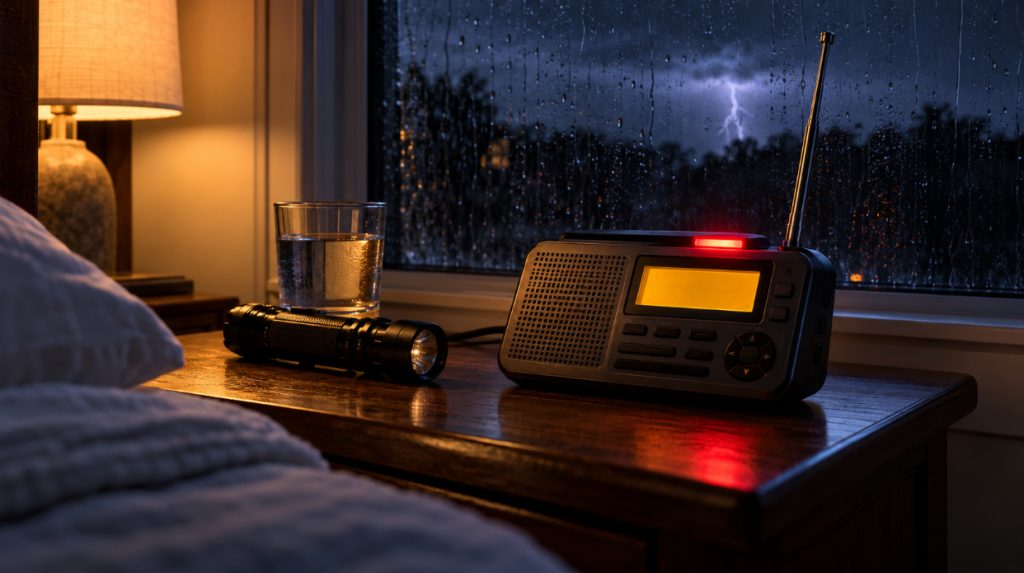
Tornado warnings have a habit of arriving at 2 AM. Your phone may catch one, as long as it’s charged and the nearest cell tower still has power. A weather alert radio sits on the shelf saying nothing for weeks, then switches itself on the moment the National Weather Service issues a warning for your county.
The good ones keep working on AA batteries when the power drops and let you choose which alerts are worth waking up for. Some can also set off a strobe or a pillow shaker for anyone who won’t hear a siren.
Plenty of radios print NOAA on the box. Only a handful can be told which county you live in, and that’s the feature that decides whether a radio stays plugged in after its third false alarm at night. These five are the ones I’d buy, and further down there’s a free setup wizard that gives you your county code, your station’s frequency and the exact settings for the radio you choose.
Quick Picks
Weather Alert Radios Compared
How I Picked These Radios
I started with one requirement: county coding, which goes by the name SAME. A radio without it goes off for every warning on its station, and one station can cover five or six counties. That rules out most of what’s sold as an emergency radio, including the crank radios in my hand crank radio guide, with one exception I’ll get to.
Next came battery backup, because storms knock the power out at the same moment they’re sending warnings. Every tabletop pick here keeps running on AA batteries when the mains go. I also wanted Public Alert certification and an external alert jack, since those separate a radio built for warnings from a clock radio with a weather button.
The fifth pick is that exception. The Midland ER310PRO has no SAME, but it’s the radio I’d want when the power has been out for days or I’m away from home, so it earns a spot as the portable partner to a tabletop radio.
1. Midland WR400: Best Overall
Why I chose it and who it’s for
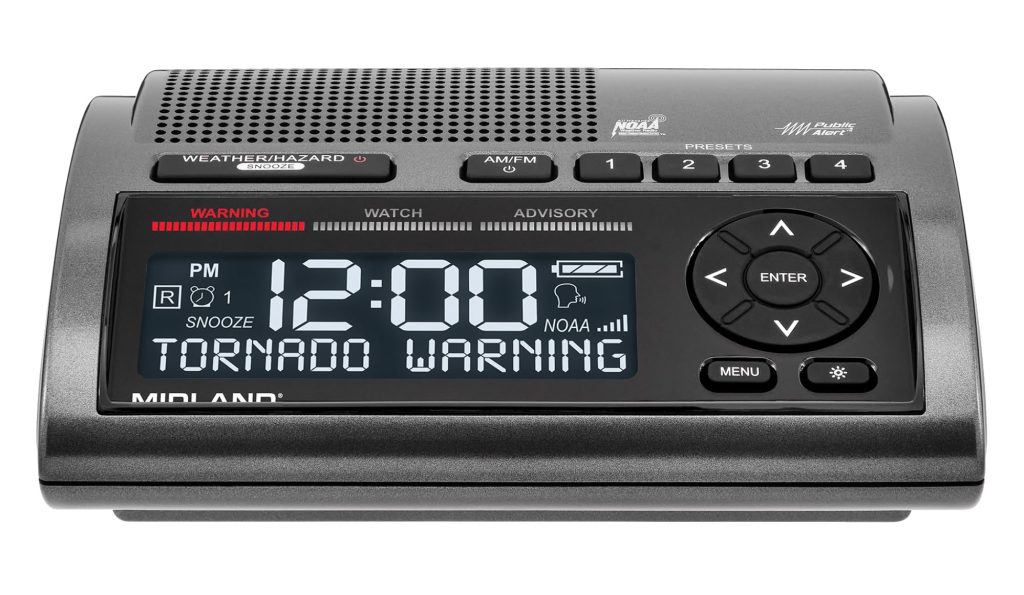
The Midland WR400 is Midland’s top tabletop weather radio and the one I’d put in most homes. It does everything the cheaper WR120B does, then adds AM and FM radio, a second alarm, a USB port for a phone and a fourth backup battery.
It suits a kitchen, a living room or a home office, anywhere the radio sits in plain view and can earn its spot the rest of the year as an everyday radio and clock.
Key specs
- Weather: all 7 NOAA channels, SAME with up to 25 counties (Single, Multiple or Any)
- Alert modes: voice, tone or display only, with red, orange and yellow lights for warnings, watches and advisories
- Alert tone: about 85 dB
- Radio: AM and FM, dual alarm clock
- Jacks: external antenna, external alert (strobe and pillow shaker), headphone
- Charging out: USB-A port
- Backup: 4 AA batteries
- Public Alert certified
Pros and cons
Pros
- AM and FM make it a radio you use every day, so you notice if it stops working
- USB port can top up a phone
- Takes Midland’s strobe and pillow shaker
Cons
- The display tilts back at about 45 degrees, so it’s hard to read lying down
- No volume control on the alert tone
- Some owners hear a faint hum through the speaker on AC power
Performance analysis
When a warning arrives for a county you’ve saved, the WR400 sounds its tone and then plays the forecaster’s message. The colored lights do a lot of the work after that. One look tells you whether it’s an advisory you can ignore until morning or a warning that needs you up and moving.
The weekly test is silent out of the box. The yellow light comes on afterward instead, which is a quick way to confirm the radio is still hearing its station. You can switch the test on in the event settings if you’d rather hear it.
Keep the AA batteries for alerts during an outage. A couple of hours of FM on battery power takes a visible bite out of them, so I’d do my listening on a crank radio and leave the WR400 on standby until the lights come back.
2. Midland WR120B: Best Value
Why I chose it and who it’s for
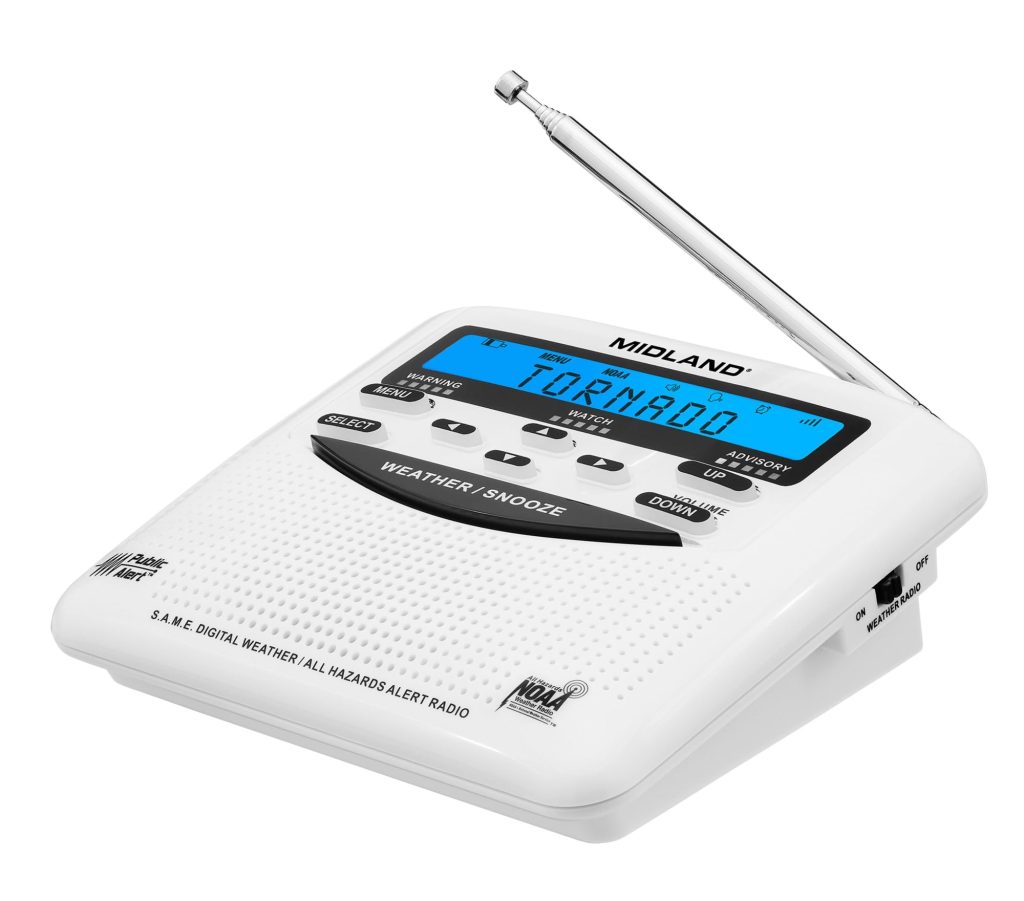
The Midland WR120B is the plain, reliable weather alert radio most people need. It waits in silence and sounds when the Weather Service issues something for your county, and it costs a good deal less than the WR400.
It has no AM or FM, which suits a bedroom, a rental, a parent’s house or a second floor. It’s also the one to buy in pairs, so there’s a radio near every place people sleep.
Key specs
- Weather: all 7 NOAA channels, SAME with up to 25 counties (Single or Multiple)
- Alert modes: voice (8 seconds of tone, then the broadcast), tone (up to 3 minutes) or display only
- Siren: rated at 90 dB
- Lights: red, orange and yellow for warning, watch and advisory
- Jacks: external alert, external antenna
- Backup: 3 AA batteries, about 75 hours of standby or 5 hours of active use
- Extras: alarm clock, English, Spanish and French menus
- Public Alert certified
Pros and cons
Pros
- Louder rated siren than the WR400
- Battery life is spelled out: about 75 hours of standby
- Small enough for a nightstand
Cons
- No AM or FM radio
- Three AAs cover about three days of standby, not a week
- No USB port for charging a phone
Performance analysis
Midland rates the three AAs at about 75 hours of standby, which is roughly three days with the power off. For a longer outage, put fresh batteries in on day three or plug it into a portable power station, which it barely touches.
Setup is a menu walk. Choose Single for one county, or Multiple if you want neighboring counties too. In Multiple mode the radio offers the nearby counties for you, which saves looking up codes.
Set the alert type to Tone in a bedroom where someone sleeps heavily. Tone keeps sounding for up to three minutes or until you press a button, while Voice plays a short burst and then the message.
3. Midland WR120B + Strobe and Pillow Shaker: Best for Hard of Hearing and Heavy Sleepers
Why I chose it and who it’s for
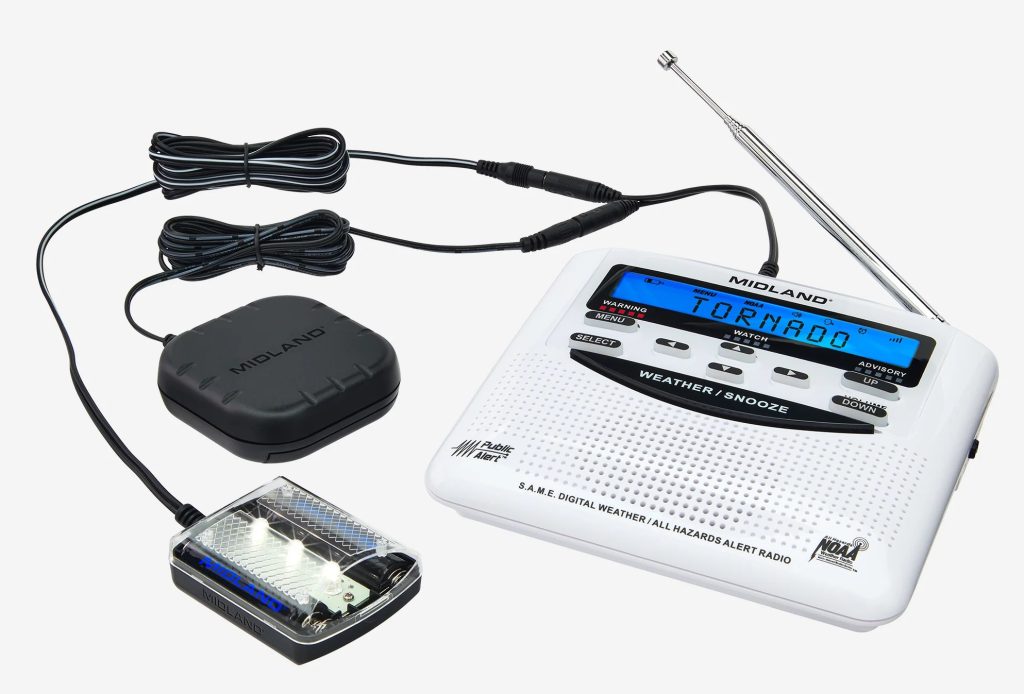
A siren does nothing for someone who can’t hear it. Midland makes a strobe light (the STR180) and a pillow shaker (the SHKR100) that plug into the External Alert jack on the back of its radios, and it sells them with the WR120B as one bundle, the Midland WR120B with strobe and pillow shaker.
It’s the setup I’d choose for a deaf or hard of hearing household member, anyone who sleeps with earplugs, or a teenager who sleeps through alarm clocks. If you already own a WR120, WR300 or WR400, buy the add-on kit on its own instead.
Key specs
- Radio: Midland WR120B, with all the specs above
- Strobe: STR180, flashes when an alert comes in
- Pillow shaker: SHKR100, vibrates under the pillow, with a pillow clip
- Hookup: a Y cable runs both from the radio’s 3.5 mm External Alert jack
- The add-on kit comes with the Y cable, pillow clip and four AA batteries
- Kit works with the Midland WR120, WR300 and WR400
Pros and cons
Pros
- Wakes people a siren can’t
- The strobe can sit anywhere it’s seen from bed or the couch
- The kit adds on to a radio you already own
Cons
- More cords on the nightstand
- The shaker only works if it stays under the pillow
- The strobe and shaker run on their own AA batteries
Performance analysis
The strobe and the shaker go off whenever the radio’s alarm does, so the event settings matter even more here. Turn off the alerts you don’t need, or the shaker will wake you for a wind advisory at 3 AM.
Set the radio up first and watch it through one weekly test before you plug the accessories in. That way you know the radio is receiving before you rely on the strobe.
The Weather Service lists the same Midland setup on its page about weather radios for people with hearing loss, which also explains how these alert jacks work.
4. Sangean CL-100: Best Clock Radio
Why I chose it and who it’s for
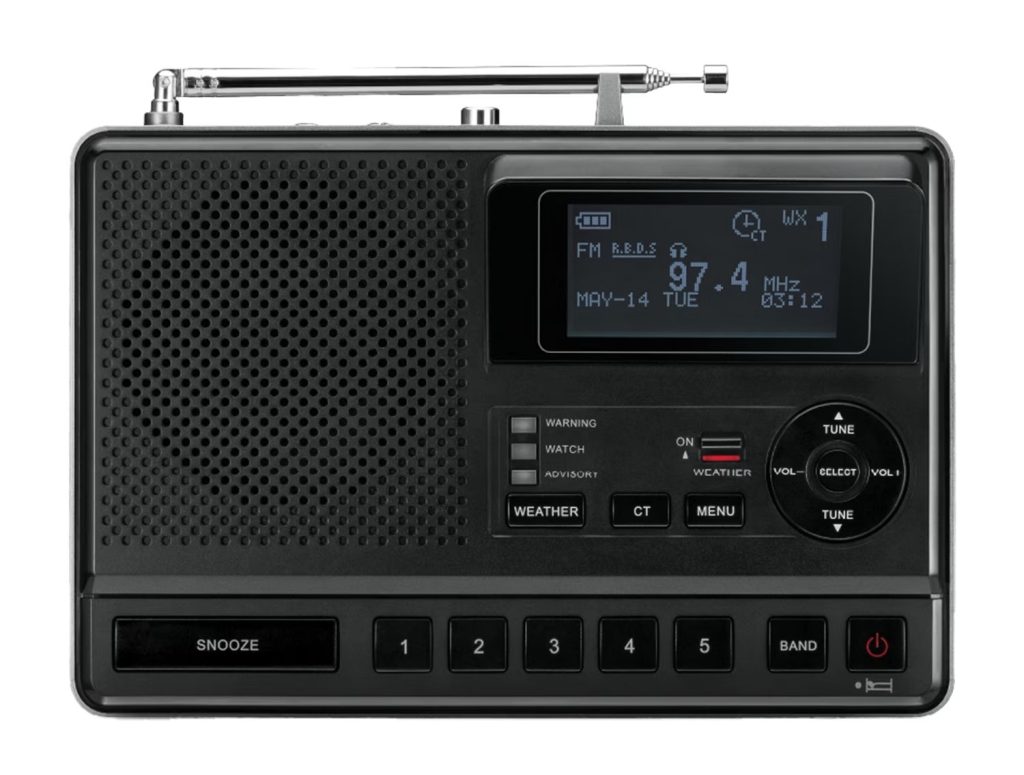
The Sangean CL-100 is a proper AM/FM clock radio from Sangean with SAME alerts built in. Its graphic display has a wide viewing angle and adjustable brightness, so it reads well from the pillow, which is the WR400’s weak spot.
Pick it if the radio is replacing a bedside clock. It wakes you to the radio or a gentle buzzer on normal days, and sounds for your county’s warnings on the bad ones.
Key specs
- Weather: all 7 NOAA channels, SAME with up to 25 county codes
- Alert lights: Warning, Watch and Advisory, with alerts you can switch off by type
- Radio: AM and FM with RBDS station names, 5 presets per band
- Display: 128 x 64 graphic LCD with dimmer and contrast control
- Alarms: two daily alarms, wake to radio or buzzer, snooze, sleep timer from 15 to 120 minutes
- Jacks: alert output, separate AM and FM/weather antenna jacks, aux input
- Backup: 4 AA batteries; stores the last 20 alert messages
- Public Alert certified
Pros and cons
Pros
- The best display here for a nightstand
- Separate antenna jacks help in weak-signal areas
- Keeps a log of the last 20 alerts
Cons
- No USB port for charging a phone
- Harder to find in stock than the Midlands
- Old AA batteries left in too long can leak into the compartment
Performance analysis
The alert log is more useful than it sounds. If the radio went off overnight and you slept through the message, you can scroll back and see what it was.
For a weak signal, the separate FM and weather antenna jack lets you run a window antenna without giving up AM reception.
Change the AA batteries once a year. They only work when the power’s out, so it’s easy to forget them until they’ve leaked.
5. Midland ER310PRO: Best Portable for Outages
Why I chose it and who it’s for
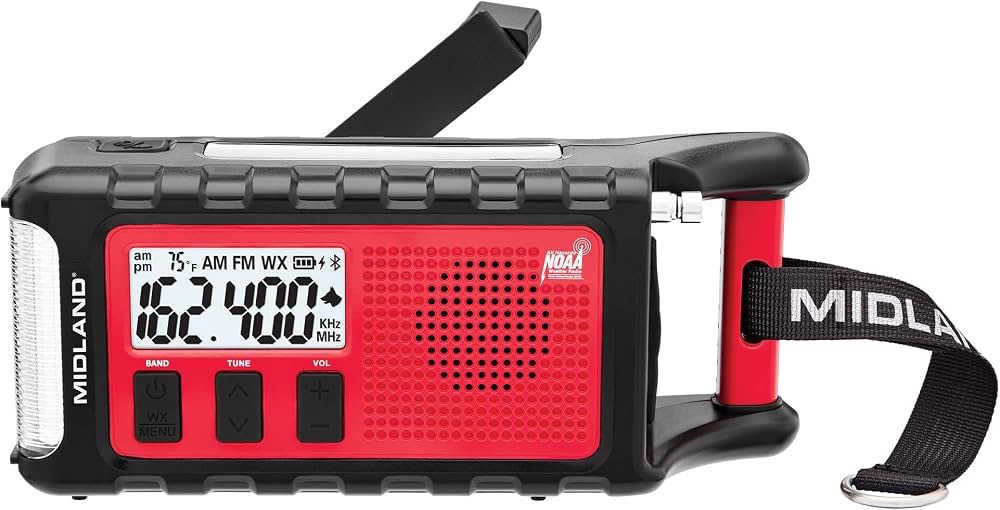
A tabletop radio lives plugged in at home. When the power has been out for days, or you’re in a car, a camper or a shelter, the Midland ER310PRO is the radio I’d reach for. It’s Midland’s newest crank radio, with a 10,000 mAh battery that also charges phones.
It has a NOAA alert mode but no SAME, so it sounds for every warning on the station you tune. That’s fine on the road and a fair trade in a long outage. At home I’d pair it with one of the SAME radios above rather than use it alone.
Key specs
- Bands: AM, FM and all 7 NOAA weather channels, plus Bluetooth audio
- Weather alert: stays on standby and switches itself on for any NOAA alert (no SAME)
- Battery: 10,000 mAh lithium-ion, rated up to 200 hours of radio
- Charging: USB-C, solar panel and hand crank (1 minute gives about 10 to 20 minutes of playback)
- Phone charging: USB-A at 5 V, 2.1 A
- Light: LED flashlight with high, low and SOS, plus a reading light
- Size and weight: 8.1 x 3.4 x 2.8 in, 1.3 lb
Pros and cons
Pros
- Runs for days without mains power
- Doubles as a power bank
- Goes anywhere
Cons
- No SAME, so expect alerts for neighboring counties
- No AA backup
- No water resistance rating
Performance analysis
Charge it full over USB-C before storm season and keep it on a sunny windowsill. The crank and solar panel are for topping up, not filling an empty battery.
Setting the alert takes a few seconds. Tune the weather band to your station, hold the Alert button until the icon shows, and leave it on standby. The wizard below gives you the right channel.
I cover it in more depth, along with five other crank radios, in my guide to hand crank radios.
Weather Radio Setup Wizard
Pick your state and county to get your SAME code and the NOAA station that covers you, then answer four quick questions. The wizard picks the radio that suits your home and writes out the settings for it, with your code and channel already filled in. You can copy the steps or print them and keep them with the radio.
If NOAA lists your station as degraded or out of service, the wizard points you to a working one nearby. Station status changes from week to week, so check again before storm season.
What to Look For in a Weather Alert Radio
SAME county coding
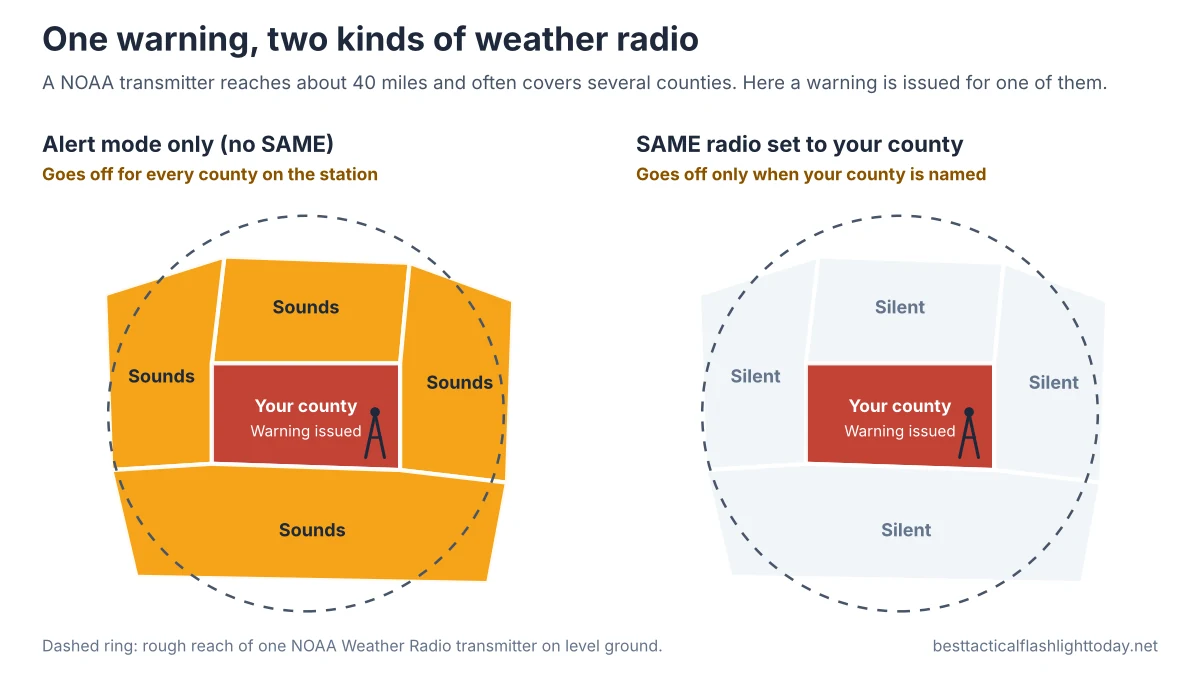
SAME stands for Specific Area Message Encoding. Every warning the Weather Service sends carries a code for each county it covers, and a SAME radio compares those codes with the ones you’ve saved. If yours is on the list, it sounds. If it isn’t, the radio stays quiet.
That matters because a single NOAA transmitter reaches roughly 40 miles on level ground and usually covers several counties. A radio without SAME goes off for every warning on its station, including a flood warning two counties over. After a few of those at night, most people unplug it, and an unplugged radio protects nobody.
Alert mode versus a weather band
A weather band only means the radio can play the NOAA broadcast when you tune in. An alert mode keeps the radio on standby and switches it on when a warning goes out. All five picks here have an alert mode. Plenty of cheap crank radios only have the band, which I explain in my hand crank radio guide.
Public Alert certification
The Public Alert logo means the radio meets a performance standard the Consumer Technology Association wrote for alert receivers. The National Weather Service suggests looking for that logo when you choose a radio, since it doesn’t recommend brands. All four tabletop picks here carry it.
Battery backup that keeps the alerts coming
A weather radio is most needed during the storms that cut the power, so it has to keep running without the wall outlet. Every tabletop pick here takes AA batteries for that. Use alkaline cells, put a reminder in your calendar to change them each year, and check how long outages typically last in your state before you decide whether three days of standby is enough.
An alert jack for strobes and pillow shakers
A jack on the back marked External Alert lets the radio fire a strobe light or a bed shaker when it sounds. The Weather Service calls this optional on home radios, so plenty skip it. The WR120B, WR400 and CL-100 all have one, which means you can add a strobe later without buying a new radio.
Where to put it
Reception decides everything. Put the radio near a window with the antenna fully up, on the same floor where people sleep. Basements and metal buildings block the signal, so if the radio has to live in one, use the external antenna jack and test it there first.
Then watch for the weekly test. Many offices send it on a Wednesday late morning, and your local office’s page lists the exact time. On a Midland, the yellow light comes on afterward. If you never see it, move the radio or try another channel before you trust it with a tornado warning.
Phone alerts or a weather radio?
Keep the emergency alerts on your phone switched on. They’re free and they work. They also only carry the most dangerous warnings, such as tornado and flash flood warnings, so a standard severe thunderstorm warning usually won’t reach your phone, and a long outage can take the nearest cell tower down with it. A weather radio hears every warning for your county straight from the NOAA transmitter, which is why it belongs in a power outage emergency kit alongside the phone.
Frequently Asked Questions
Do I need a weather alert radio if my phone gets emergency alerts?
It’s worth having both. Phones only receive the most dangerous warnings, and they depend on cell towers that can go down in a long outage. A weather alert radio picks up every warning the Weather Service broadcasts for your county, runs on backup batteries, and only needs a signal from the nearest NOAA transmitter.
What does SAME mean on a weather radio?
SAME stands for Specific Area Message Encoding. You enter your county’s six-digit code, and the radio only sounds for warnings that include it. The radios in this guide hold up to 25 codes, and the setup wizard above gives you yours.
Do weather alert radios work when the power goes out?
Yes, as long as the backup batteries are in. The Midland WR120B runs about 75 hours on standby with three AA batteries, and the WR400 and Sangean CL-100 take four. For outages that last longer, a crank radio like the Midland ER310PRO keeps going on its own battery, solar panel and crank.
Why does my weather radio go off for other counties?
Either it doesn’t have SAME, or it’s set to receive every location instead of yours. On a Midland, go to SET LOCATION, choose SINGLE and pick your county. If it still sounds for alerts you don’t need, switch those off under SET EVENTS.
The Bottom Line
For most homes, the Midland WR400 is the weather alert radio to buy. It wakes you for your county’s warnings, plays AM and FM the rest of the time, and keeps going on four AA batteries when the power drops.
If you only want the alerts, the Midland WR120B does the job for less. Get the strobe and pillow shaker bundle for anyone who won’t hear a siren, and the Sangean CL-100 if it’s replacing a bedside clock. For outages that run on for days, keep an Midland ER310PRO alongside whichever one you choose.
Then run through the setup wizard above, enter your county code and watch for the weekly test light. Keep a flashlight for power outages and a battery lantern near the radio, and grab the free Lights Out kit for the rest of the plan.
