
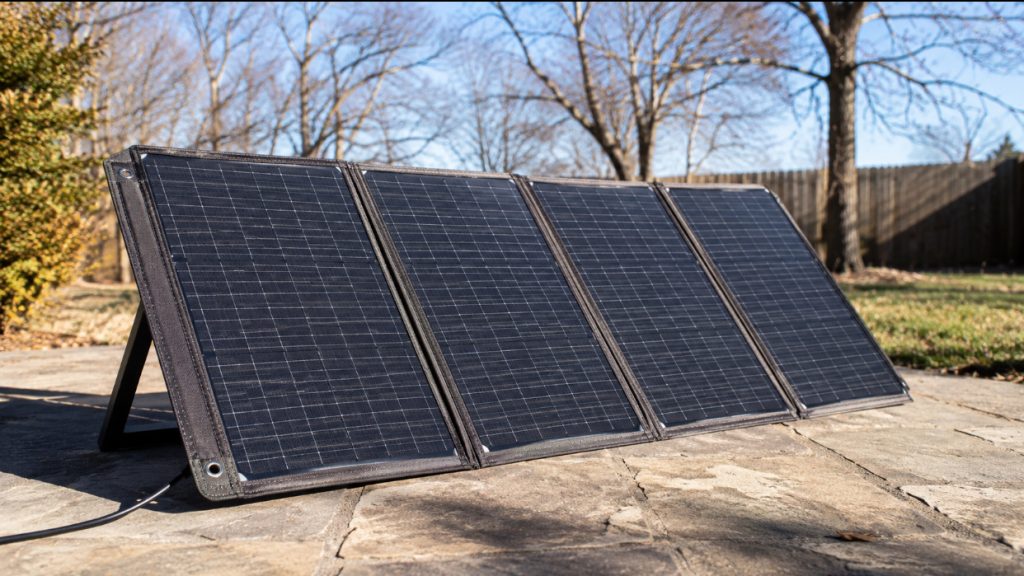
The box says 200 watts. So you unfold the panel on the lawn one bright December morning, plug it into the power station and watch the little screen settle on 61. You wiggle the cable. You wipe the glass with your sleeve. Still 61. Nothing is broken. The winter sun just doesn’t put in a full shift, and how short that shift runs depends almost entirely on where you live.
That shift has a name, peak sun hours, and it’s the number every solar estimate is built on. Type your ZIP code into the peak sun hours calculator below and you’ll get it for every month of the year. Then it keeps going. It shows how many watt-hours your panel will really make, what angle to prop it at, and what happens when the sky turns gray for a week.
How to Use the Peak Sun Hours Calculator
Start with a ZIP code or a city name, or tap the location button and let your phone fill it in. The big number at the top is your peak sun hours for the month, and the bars lay out the whole year. Tap any bar to switch months.
Next, pick the size of your panel. The calculator turns sun hours into watt-hours a day, then into things you can picture, like phone charges and hours of fridge time.
The sun dial is the fun part. Grab the top of the little panel and drag it. The numbers move with your finger, so you can see what a steeper angle is worth in January and why a nearly flat panel wins in June.
The cloudy-week check runs your panel against 25 years of daily weather for your area. It shows what a gray day does to your output and how much battery it takes to ride out a dim stretch. Below that, the refill planner works out how many days of sun your power station needs to go from empty to full.
Peak Sun Hours Map by Month
The map at the bottom of the calculator shades the whole country by peak sun hours. Drag the slider or hit play and it runs through all 12 months, so you can watch the Southwest stay bright while the Great Lakes and the Northwest go dim for winter. Tap anywhere on the map and the calculator loads that spot.
What Are Peak Sun Hours?
A peak sun hour is one hour of sunlight at full strength, which the solar industry sets at 1,000 watts landing on every square meter. Real sunlight almost never holds that level. It’s thin at breakfast, strong around lunch and fading again by supper. So we add up all the light that lands in a day and ask how many hours of full-strength sun would deliver the same amount. If the answer is 4, your spot got 4 peak sun hours that day.
Solar panels are rated at that same full strength. A 200 watt panel only makes 200 watts when 1,000 watts per square meter are hitting it. That’s why peak sun hours are so handy. Multiply the panel’s rating by the day’s peak sun hours and you have the day’s energy.
You’ll see the same number written as kWh/m²/day, or called solar insolation or solar irradiance. One kilowatt-hour per square meter per day equals one peak sun hour, so 4.5 kWh/m²/day and 4.5 peak sun hours mean the same thing.
How to Calculate Peak Sun Hours
If you already have a solar map figure in kWh/m²/day, you’re done. That number is your peak sun hours. If all you have is a day of readings in watts per square meter, add up the watt-hours for the day and divide by 1,000. A day that lands 4,500 watt-hours on a square meter of ground is a 4.5 peak sun hour day. Most of us will never own the meter for that, so it’s easier to look the number up.
Peak Sun Hours vs Daylight Hours
These two get mixed up all the time. Daylight hours, or sunlight hours, count the time between sunrise and sunset. Peak sun hours count how much energy showed up. Chicago gets a little over 9 hours of daylight in the middle of December and only about 1.5 peak sun hours on flat ground, because the sun stays low and the sky is often gray. Anchorage has more than 19 hours of daylight in June and still collects fewer peak sun hours than Phoenix does. So don’t judge a spot by how long the sun is up. Go by its peak sun hours.
How to Calculate Watt-Hours From Peak Sun Hours
The math fits on a sticky note.
The 0.75 is a haircut for real life. Panels run hot, cables lose a little, the charge controller takes its cut and nobody keeps the glass spotless. Three quarters of the rating is a fair planning number for a clean panel pointed the right way.
How Much Does a 200 Watt Solar Panel Produce?
Take Denver in December. A panel propped at a steep winter angle gets about 5.2 peak sun hours on a normal day. Run the math and 200 watts makes about 770 watt-hours. That keeps a router and a couple of phones going around the clock with room to spare, or runs a fridge for a bit more than half a day. The same panel makes about 250 watt-hours on a December day in Seattle and close to 900 in Phoenix.
How Much Does a 100 Watt Solar Panel Produce in Winter?
On a normal December day a 100 watt panel makes roughly 120 watt-hours in Seattle, 220 in Chicago, 250 in New York, 310 in Atlanta and 450 in Phoenix. That covers the phones and a good part of a day of Wi-Fi in most of the country, and not much more. A 400 watt panel makes four times those figures. The calculator works it out for any size you type in.
Average Peak Sun Hours by State
These are peak sun hours a day for a south-facing panel fixed at the best year-round angle, averaged across every ZIP code in the state. Each row gives December, July and the yearly average.
Which State Has the Most Peak Sun Hours?
Arizona gets the most peak sun hours of any state, about 6.5 a day over the year, with New Mexico and Nevada right behind at 6.4 and 6.3. Alaska gets the fewest at 3.2, and Washington is the lowest of the lower 48 at 4.2. December is where the states really pull apart. Arizona still collects 5.1 peak sun hours a day while Oregon drops to 1.8 and Washington to 1.5.
A state average can hide a lot. Coastal Washington and the dry side of the Cascades are different worlds, and so are Buffalo and Long Island. Use the calculator for your own ZIP code before you size anything.
Peak Sun Hours in Winter: December at a Glance
Here’s what a 200 watt portable panel makes in 25 cities, propped at its best December angle. The first figure is a normal December day. The second is a gray day, the kind that comes around about one day in ten.
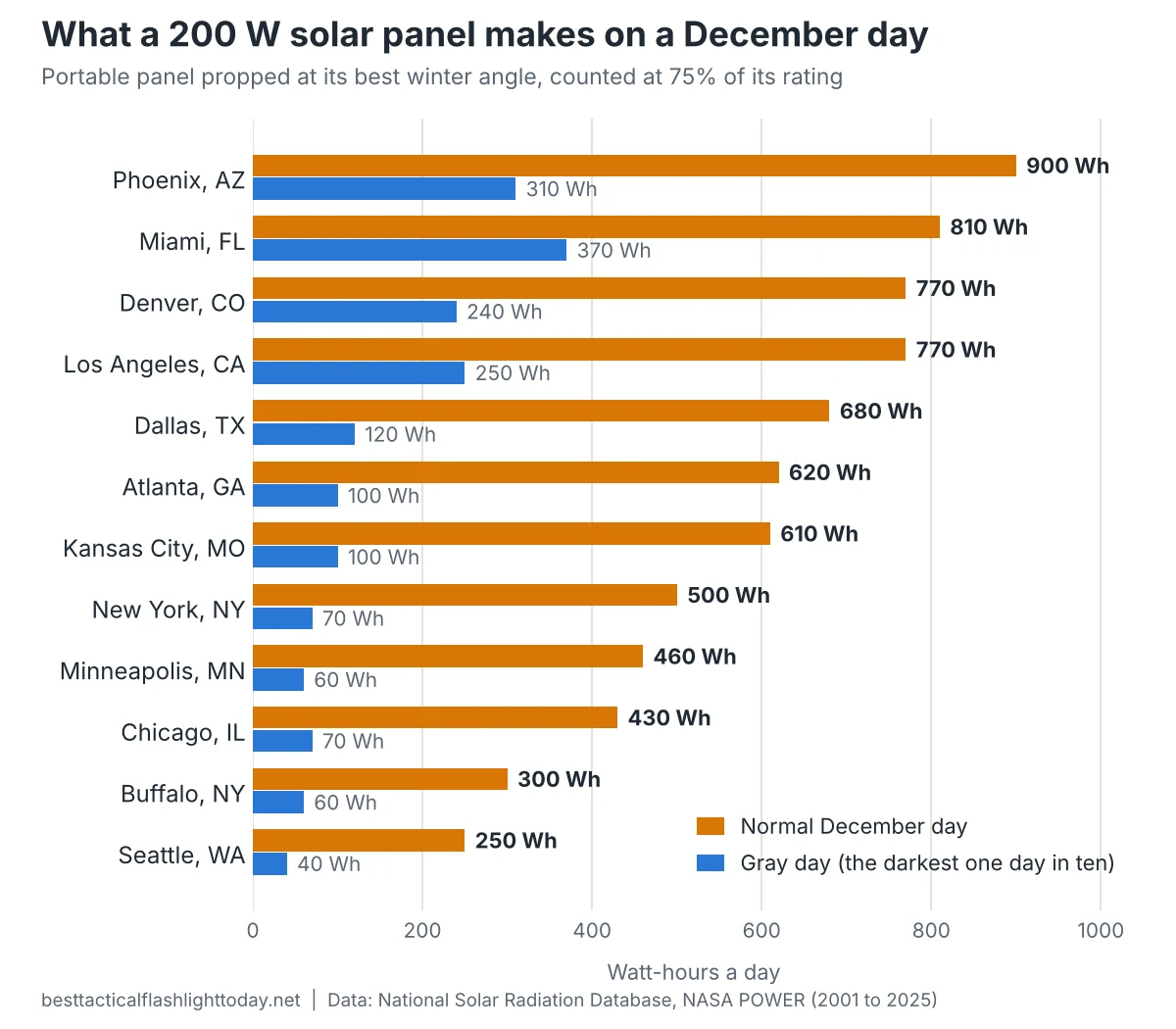
In Chicago a 200 watt panel makes about 430 watt-hours on a normal December day and about 70 on a gray one. In New York it’s about 500 and 70. Phoenix barely notices winter, with about 900 watt-hours on a normal day and 310 on a gray one. Seattle sits at the other end, at about 250 and 40.
Solar Panel Output in Winter vs Summer
Winter works against a panel from every side. The days are shorter. The sun rides lower, so its light passes through more air on the way down. And across much of the country the clouds settle in for the season. Put together, a fixed panel in New York, Michigan or Minnesota collects only a third to 40 percent as much in December as it does in July. In the Sun Belt the gap is much smaller. Arizona’s December is still worth more than three quarters of its July.
Winter does have one thing going for it. Panels like the cold. A solar cell makes a little more voltage at 20°F than it does at 90°F, so on a clear, bitter January noon a panel can beat its summer wattage for an hour or two. There just aren’t many of those hours.
Do Solar Panels Work on Cloudy Days?
They do, at a fraction of normal. Under heavy overcast a panel typically makes 10 to 25 percent of what it makes under a clear sky. The cloudy-week check in the calculator puts local numbers on that. In New York, one December day in ten is dark enough to cut a 200 watt panel from about 500 watt-hours to about 70.
One gray day is easy to ride out. The runs are what drain a battery. Atlanta, Houston, Dallas and Minneapolis all see a couple of dull days back to back in a typical December, and about one year in ten that stretches to 4 in a row. That’s why the calculator sizes your battery against the dimmest week of the month. Sizing it against an average day leaves you short the first time the weather turns.
What About Snow on Solar Panels?
A panel under snow makes nothing, so brush it off. A soft broom does the job without scratching the glass. Once the panel is clear, snow on the ground actually helps a little, because it bounces extra light up onto a tilted panel. A steep winter angle also sheds the next snowfall faster.
Best Solar Panel Angle for Winter and Summer
The old rule says to tilt a panel at your latitude, 15 degrees steeper in winter and 15 degrees flatter in summer. It’s a decent start. The numbers behind this calculator say winter wants steeper than that.
Most folding panels have a kickstand that tops out around 60 degrees, and that’s fine. Being 10 or 15 degrees off the perfect angle only costs a few percent. What really costs you is leaving a panel flat on the ground in winter. In Chicago a flat panel collects about 51 percent of what a properly propped one does in December.
Point the panel due south if you can. Southeast or southwest gives up about 5 percent over a year on a fixed panel, and more than that in the dead of winter when the sun’s arc is short. The sun dial shows the best angle for your ZIP code month by month, and the best single angle if you’d rather set it once and leave it.
How Many Peak Sun Hours Do You Need?
For rooftop solar, installers like to see 4 or more peak sun hours a day on a yearly average. With a tilted panel every state but Alaska clears that.
For backup power the better question is what you get in your worst month. Add up what you want to run in watt-hours a day, then divide by your panel’s watts and by 0.75. A router and two phones use about 400 watt-hours a day. With a 200 watt panel that takes about 2.7 peak sun hours. A normal December day delivers that across the South, the Plains and the Southwest. It comes up a little short around the Great Lakes and in Idaho, and well short in the Pacific Northwest.
A fridge is another story. It goes through about 1,300 watt-hours a day, which works out to nearly 9 peak sun hours from a single 200 watt panel. No ZIP code in the country gets that in December, so a fridge needs more panel, more battery or both. My solar generator guide matches complete kits to that job, and the portable power station guide covers the battery side. If you’re still choosing a brand, EcoFlow vs Jackery vs Anker compares how fast each one refills from solar.
How Long Does It Take to Charge a Power Station With Solar?
Divide the battery’s watt-hours by what your panel makes in a day. A 1,000 watt-hour station behind a 200 watt panel refills in a little over a day of normal December sun in Denver, about two days in New York and about four in Seattle. In June all three get it done in a day or close to it.
Two limits get in the way. Every station caps how many solar watts it will accept, so check that number before you buy a second panel. And lithium batteries won’t take a charge when they’re frozen. EcoFlow, for one, lists a charging range of 32 to 113°F, and other brands publish similar limits. On a morning that starts at 15°F, leave the station inside where it’s warm and run the cable out through a door or window to the panel.
Running a CPAP through an outage is its own math, since the load comes at night. My CPAP battery backup guide works out how many nights you get from each battery size.
Where the Numbers Come From
The sun hours come from the National Solar Radiation Database, the federal data set behind the government’s own PVWatts solar calculator. This page covers the 50 states, Washington DC, Puerto Rico and the U.S. Virgin Islands, 41,169 ZIP codes in all.
The gray-day and cloudy-week figures come from 25 years of daily satellite records, 2001 through 2025, published by NASA POWER. The tilted-panel math was checked against PVWatts at 150 locations around the country, and at normal kickstand angles it lands within about 3 percent. Watt-hour figures count a panel at 75 percent of its rating.
Peak Sun Hours FAQ
What is a good number of peak sun hours?
Most of the country gets between 4 and 6 peak sun hours a day on a yearly average with a tilted panel. Anything over 4 is plenty for solar to make sense. Above 5.5 is excellent, and that’s what you get across the Southwest, plus Florida and Texas.
How many peak sun hours do you get in winter?
It swings from about 1.5 a day in Washington state to about 5.1 in Arizona in December, for a fixed south-facing panel. Most northern states land between 2 and 3, and most southern states between 3 and 4.5. Propping the panel steeper for winter adds roughly 10 to 20 percent to those figures.
How do I find the peak sun hours for my ZIP code?
Type it into the calculator at the top of this page. You’ll get peak sun hours for all 12 months on flat ground, on a fixed panel and on a panel you re-aim each month, plus the watt-hours a panel of any size makes there.
Do solar panels need direct sunlight?
No. They work on scattered light too, which is why they still produce under clouds. They just make far less of it, usually 10 to 25 percent of a clear day’s output under heavy overcast. Shade is worse than cloud. A shadow across even one corner of a folding panel can drop its output by half or more, so keep it clear of trees, railings and your own shadow.
The Bottom Line
The rating on the box is what a panel does in perfect light. Your ZIP code decides the rest. Look it up, check the cloudy week as well as the average, and size your battery for December. If the numbers say you need more panel, my solar generator guide is the place to go next. And while you’re getting ready for storm season, the free Lights Out kit has a one-page outage plan you can tape inside a kitchen cabinet.
