
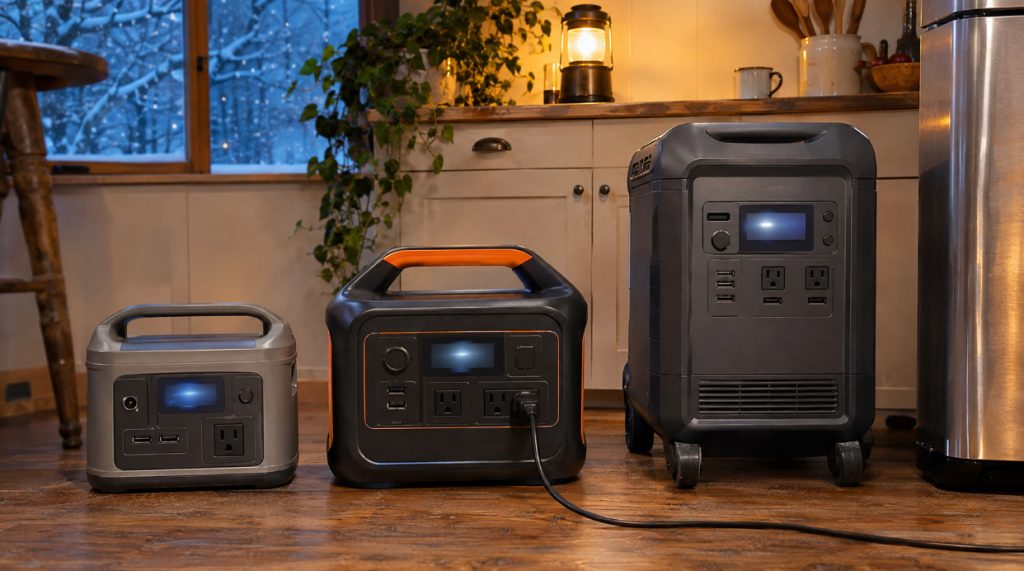
Walk into any big box store in the fall and you’ll find them stacked by the front doors like snow shovels: a gray EcoFlow, a Jackery with its orange handle, a dark Anker SOLIX, each one wearing a sale tag. I get asked about EcoFlow vs Jackery more than about any other piece of gear on this site, usually by somebody who just sat through two days without power, pouring melted ice out of a cooler and swearing it won’t happen again.
I’ll give you my answer before the details. The brand matters less than the size, and each brand wins a different size. In the 1 kWh class I’d buy the EcoFlow DELTA 3 Plus. At 2 kWh, Jackery’s HomePower 2000 Plus v2 is the one I’d want for a long winter outage, because it can grow to 12 kWh. For a whole house on 240 volts, nothing here comes close to the Anker SOLIX F3800 Plus.
Below, I put the three brands head to head size for size, using their current models only. Every matchup answers the questions that matter when the lights go out: how long it runs a fridge, how fast it refills from the wall and from winter sun, and how quickly it takes over when the grid drops. Further down there’s a matcher that picks the right box from each brand for what you need to keep running.
Quick Picks: Which Brand Wins at Each Size
EcoFlow vs Jackery vs Anker: The Short Answer
All three brands build good LiFePO4 power stations now, so you’re choosing strengths, not dodging lemons. Here’s where each one comes out ahead:
EcoFlow: best for the most solar input at 1 kWh and 3 kWh, fast wall charging and a big family of add-ons, including a dual-fuel Smart Generator that starts itself when the DELTA 3 Plus runs low.
Jackery: best for light, simple stations and the most expandable 2 kWh system, the HomePower 2000 Plus v2.
Anker SOLIX: best for the fastest-charging 1 kWh station and true 240-volt whole-home backup with the F3800 Plus.
If you’d rather see my top picks across every brand, including a couple from outside these three, my portable power station guide ranks them for home backup.
How the Three Brands Compare
If you’ve read an older EcoFlow vs Jackery comparison that says EcoFlow wins because Jackery still uses NMC batteries, that was true of Jackery’s older Explorer models. Every station in this guide, from all three brands, runs on LiFePO4 cells, the long-lived chemistry you want in something that sits in a closet for years.
The fine print on cycle ratings is where they really differ. Jackery and EcoFlow’s Gen4 quote cycles down to 70% of the original capacity, while the DELTA 3 Plus and Anker’s C2000 Gen 2 quote down to 80%. A 4,000-cycle rating to 80% is the tougher promise, even though the bigger number looks better on the box. For a backup station that cycles a few dozen times a year, any of them will outlast the furniture.
1 kWh: EcoFlow DELTA 3 Plus vs Jackery Explorer 1000 v2 vs Anker SOLIX C1000 Gen 2
This is the size most people should start with. One of these runs a full-size fridge through the night and most of the next day, keeps the router and phones going, and still fits in a coat closet.
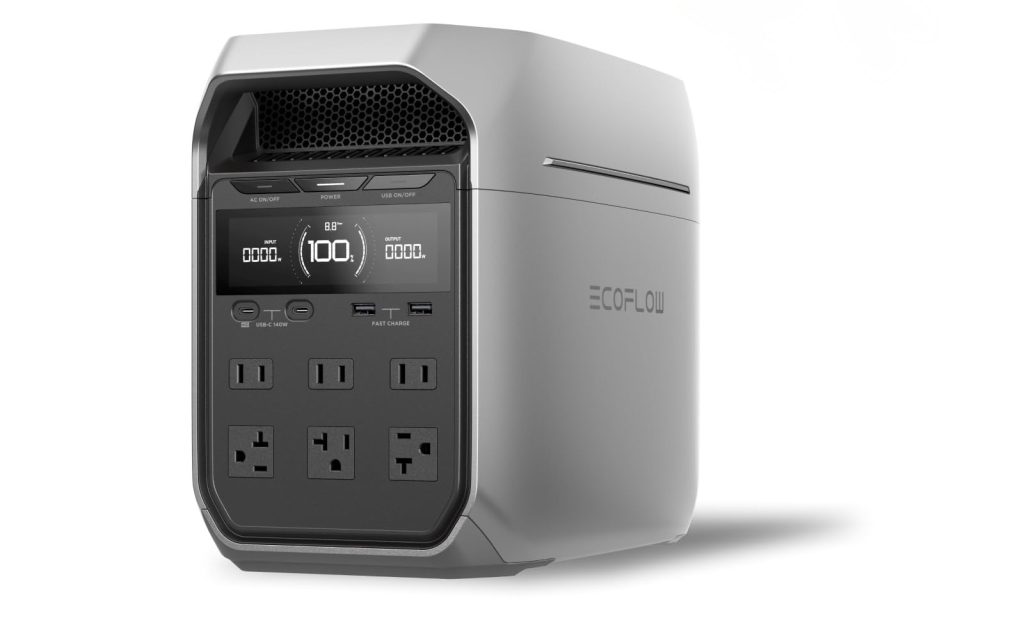
EcoFlow DELTA 3 Plus: Best 1 kWh for Most Homes
Why I chose it and who it’s for
This is the one I’d hand a family that wants one box in the hall closet for the fridge and the router. It holds 1,024 Wh, puts out 1,800 W, and goes from empty to full on a wall outlet in 56 minutes. What sets it apart is the solar side. Two inputs take 1,000 W between them, more than double the Jackery, so even a short December day can fill it if you own the panels.
It’s also the only 1 kWh station here you can grow. Add an EcoFlow extra battery later and it reaches about 5 kWh, which turns a one-night box into a multi-day setup without starting over.
Key specs
- Capacity: 1,024 Wh, LiFePO4
- Output: 1,800 W (3,600 W surge)
- Wall recharge: empty to full in 56 minutes
- Solar input: 1,000 W across two ports
- UPS switchover: under 10 ms
- Battery life: 4,000 cycles to 80%
- Weight: 27.6 lb
- Expansion: up to about 5 kWh with an extra battery
- Warranty: 5 years
Pros and cons
Pros
- The most solar input in the 1 kWh class by a wide margin
- Can grow later with an extra battery
- Works with EcoFlow’s dual-fuel Smart Generator, which starts and stops itself
Cons
- Heaviest of the three 1 kWh picks, by about 3 pounds
- 1,800 W covers a microwave or a coffee maker, but not both at once
- The useful settings live in the app, so set it up before the storm, not during it
In real use
Plug a full-size fridge into it and figure on about 14 hours. That comes from a typical fridge using around 1.5 kWh a day and about 85% of the battery reaching your outlets after the inverter takes its cut. Keep the door shut and you’ll stretch it toward a full day.
The under-10 ms switchover is the quiet feature that earns its keep. Leave the router and modem plugged through it all year, and the next time the power blinks, the Wi-Fi never notices.
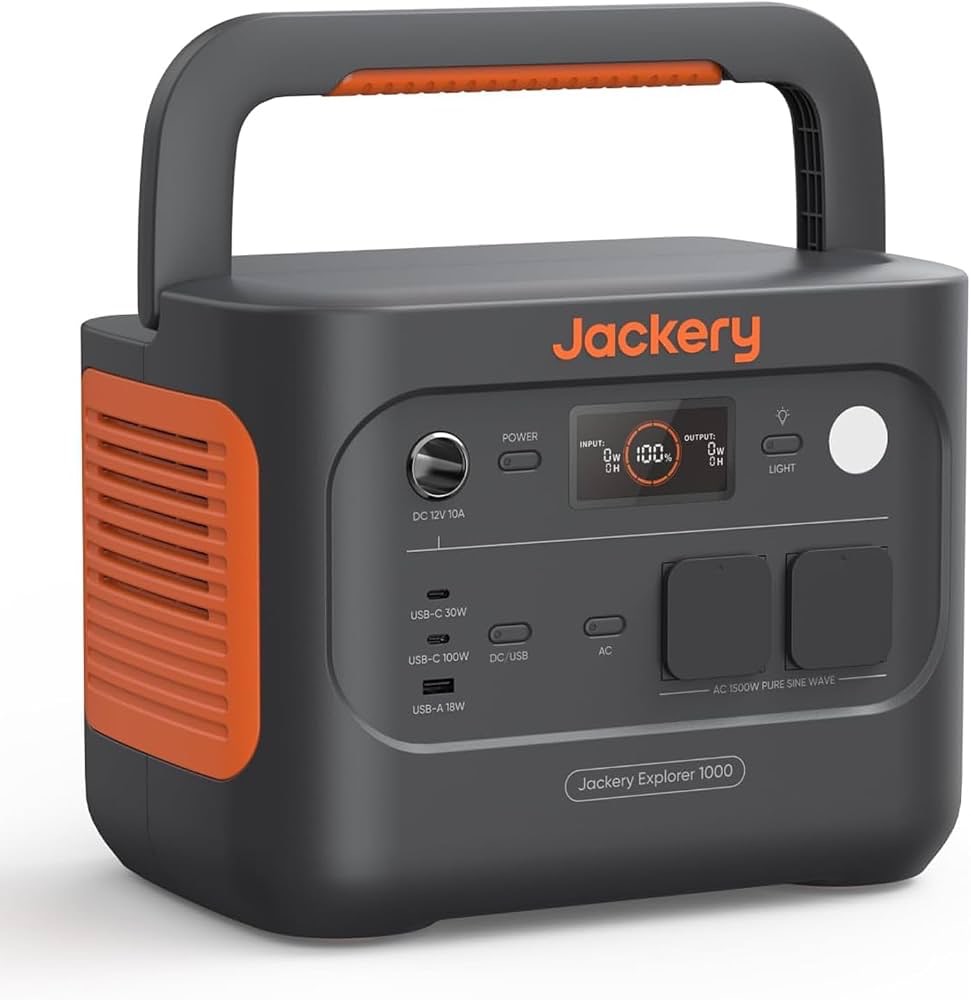
Jackery Explorer 1000 v2: Lightest 1 kWh
Why I chose it and who it’s for
Jackery built its name on this size, and the Explorer 1000 v2 is the one I’d pick for anybody who has to lift it. At 23.8 pounds it’s the lightest 1 kWh station here, it holds a little more than the other two at 1,070 Wh, and it works with nothing more than the buttons on the front.
It’s best for renters, campers and older folks who want something they can carry from the closet to the kitchen without help.
Key specs
- Capacity: 1,070 Wh, LiFePO4
- Output: 1,500 W (3,000 W surge)
- Wall recharge: about 1.6 hours, or about 50 minutes in emergency charge mode
- Solar input: 400 W
- UPS switchover: under 20 ms
- Battery life: 4,000 cycles to 70%
- Weight: 23.8 lb
- Expansion: none
- Warranty: 3 years, plus 2 more when bought direct from Jackery
Pros and cons
Pros
- Lightest 1 kWh unit in this comparison
- The most capacity of the three, by a hair
- Dead simple to run, with or without the app
Cons
- 400 W of solar input is the lowest here
- Slower UPS switchover than the EcoFlow and the Anker
- Three AC outlets, so a power strip comes in handy
In real use
Expect about 14 to 15 hours on a typical fridge, nearly the same as the other two. Where it falls behind is refilling from the sun in winter. With 400 W of panels on a short December day, it gets back roughly 70% of a charge, while the EcoFlow and the Anker can fill all the way.
Like every station in this guide, it won’t charge below freezing. Jackery lists 32°F as the bottom of its charging range, so keep it indoors in winter and bring it back inside if you’ve been running it in the garage.
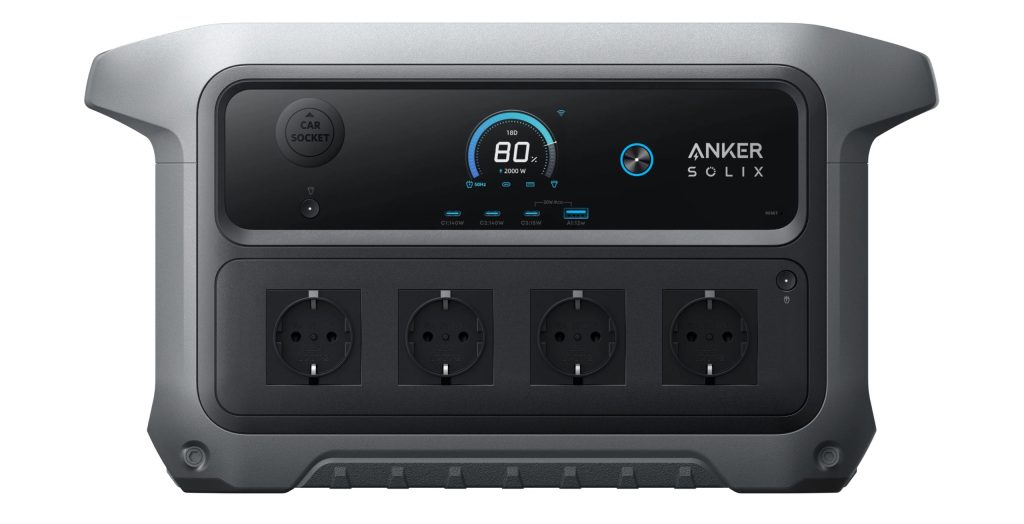
Anker SOLIX C1000 Gen 2: Fastest to Recharge
Why I chose it and who it’s for
Anker’s C1000 Gen 2 holds the record for the fastest-recharging 1 kWh portable power station, going from empty to full in 49 minutes at 1,600 W once you switch on UltraFast charging in the app. It also puts out 2,000 W, the most of the three, and switches over in 10 ms.
It’s best for people who live with rolling blackouts, where the grid comes back for an hour and then drops again. An hour of grid power is a full tank with this one.
Key specs
- Capacity: 1,024 Wh, LiFePO4
- Output: 2,000 W (3,000 W peak)
- Wall recharge: 49 minutes with UltraFast on
- Solar input: 600 W
- UPS switchover: 10 ms
- Battery life: 4,000 cycles
- Weight: 24.9 lb
- Expansion: none
- Warranty: 5 years
Pros and cons
Pros
- Fastest wall refill in the 1 kWh class
- Most output at this size, enough for a microwave or a small space heater
- Light enough to carry with one hand
Cons
- No expansion port, so 1,024 Wh is as big as it gets
- UltraFast slows way down when the battery is cold
- 600 W of solar input sits between the other two
In real use
Read the cold-weather note before you count on that 49 minutes. Anker says UltraFast only kicks in when the battery is above 68°F, and charging between 32°F and 68°F is much slower. In a heated house that’s no problem. In a cold garage during an ice storm, it is.
Fridge runtime lands around 14 hours, same as the DELTA 3 Plus. The difference shows up on the second day, when the grid flickers back for 45 minutes and this one is the only 1 kWh unit that’s nearly full again by the time it drops.
Who wins at 1 kWh: the EcoFlow DELTA 3 Plus for most homes, because it takes the most solar and can grow. Pick the Anker SOLIX C1000 Gen 2 if your grid comes and goes, and the Jackery Explorer 1000 v2 if weight matters more than anything else.
2 kWh: Jackery HomePower 2000 Plus v2 vs Anker SOLIX C2000 Gen 2 vs EcoFlow DELTA 3 Max
Double the battery and a fridge makes it through a full day and night with room left for the freezer, the router and a lamp. This is the size I’d want for a winter storm that knocks the lines down for more than a day.
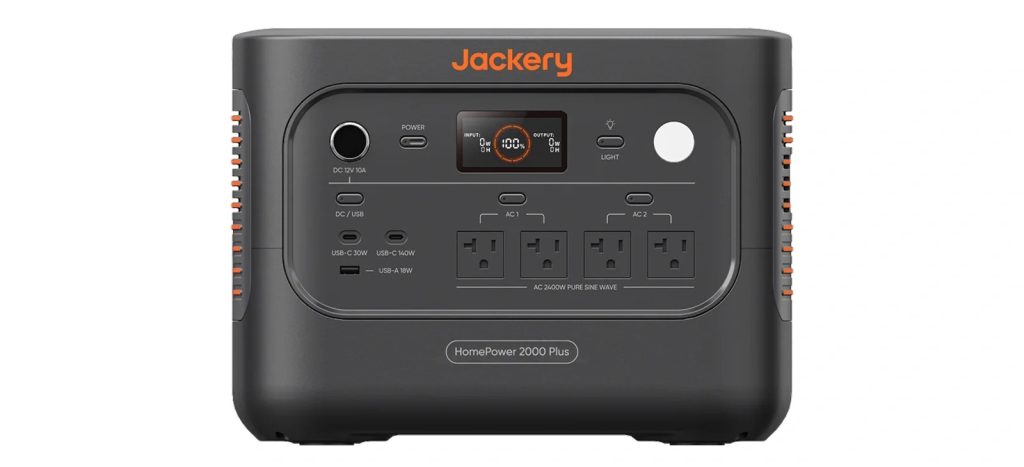
Jackery HomePower 2000 Plus v2: Best 2 kWh for Long Outages
Why I chose it and who it’s for
This Jackery home unit is the one I’d buy for a house that loses power for days at a time. It starts at 2,048 Wh and 2,400 W, and it takes up to five Battery Pack 2000 Plus v2 units to reach about 12 kWh. You can start with one box and add packs as the budget allows.
The feature I like most is Priority Routing. You choose which outlets matter and set a battery level, and when the charge drops to it, the station cuts the extras on its own so the fridge and the router keep running. It’s best for families who want to start small and grow into whole-home backup.
Key specs
- Capacity: 2,048 Wh, LiFePO4, expandable to about 12 kWh
- Output: 2,400 W
- Solar input: 800 W
- UPS switchover: 10 ms
- Battery life: 6,000 cycles to 70%
- Weight: about 41.5 lb, 21 lb lighter than the model it replaces
- Extras: 140 W USB-C, 30 dB quiet mode
- Warranty: 3 years, plus 2 more when bought direct from Jackery
Pros and cons
Pros
- Grows to 12 kWh, the most of any 2 kWh station here
- Priority Routing keeps the essentials on as the battery drains
- Rated for 6,000 cycles
Cons
- Only the v2 battery pack fits, so older 2000 Plus packs won’t work with it
- Fewer long-term owner reports than Jackery’s older Explorer line
- 800 W of solar input refills about three quarters of it on a December day
In real use
On its own it runs a typical fridge for about 28 hours. Add one battery pack and you’re past two days, which covers most of the multi-day outages I hear about after ice storms. That’s where this unit pulls ahead of the other two, since neither can reach that size.
Set Priority Routing before you need it. Put the fridge and the router on the protected side, set the threshold around 30%, and let the station decide when the TV goes dark.
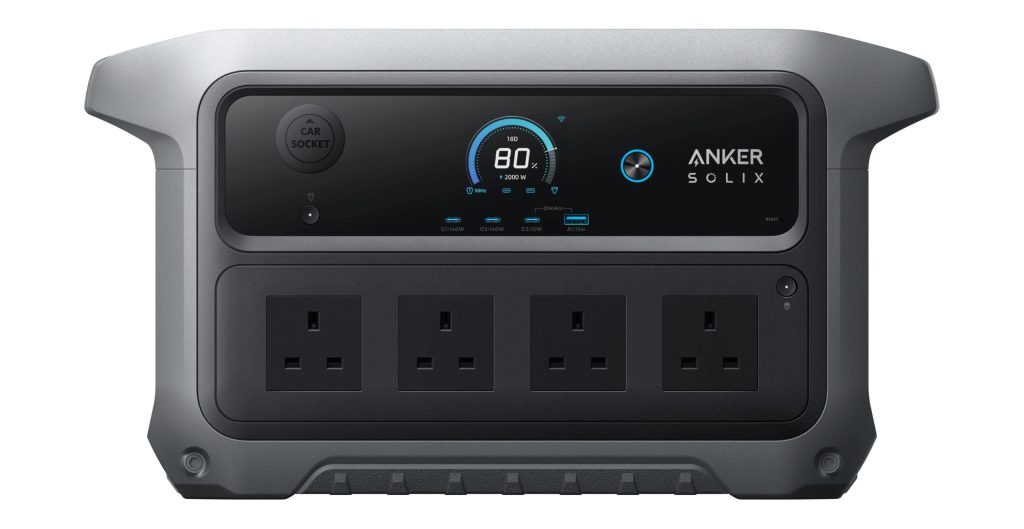
Anker SOLIX C2000 Gen 2: Best Value 2 kWh
Why I chose it and who it’s for
Anker’s C2000 Gen 2 is the quick one in this tier. It fills from the wall in 88 minutes, reaches 80% in 45, and takes 800 W of solar. It puts out 2,400 W with a 4,000 W peak and has a TT-30 outlet, so it plugs straight into a travel trailer.
Anker rates its idle draw at just 9 W, which matters more than it sounds when the station sits on for days running a fridge. It’s best for anyone who wants a fast, capable 2 kWh unit and doesn’t need to grow past 4 kWh.
Key specs
- Capacity: 2,048 Wh, LiFePO4, expandable to about 4 kWh
- Output: 2,400 W (4,000 W peak)
- Wall recharge: 88 minutes, 80% in 45 minutes
- Solar input: 800 W
- UPS switchover: 10 ms
- Battery life: 4,000 cycles to 80%
- Weight: 41.7 lb
- Warranty: 5 years
Pros and cons
Pros
- Fastest wall refill of the 2 kWh picks
- TT-30 outlet for RVs and trailers
- Low idle draw stretches every charge
Cons
- Expansion stops at about 4 kWh
- Anker’s 32-hour fridge figure is a best case
- Heavy enough that you’ll want to keep it near where it’s used
In real use
Anker says it runs a fridge for up to 32 hours. My math for a typical full-size fridge comes out closer to 28, and the gap is normal. Makers test with fridges that aren’t opened all day, and yours will be.
If all you need through a long outage is the fridge, the router and a CPAP, look at the Anker SOLIX S2000 too. It holds 2,010 Wh, Anker rates it for up to 35 hours of fridge backup and 10,000 cycles to 60%, and it weighs 35.7 pounds. The catch is 1,500 W of output and 400 W of solar, so it’s an essentials box, not a do-everything one.
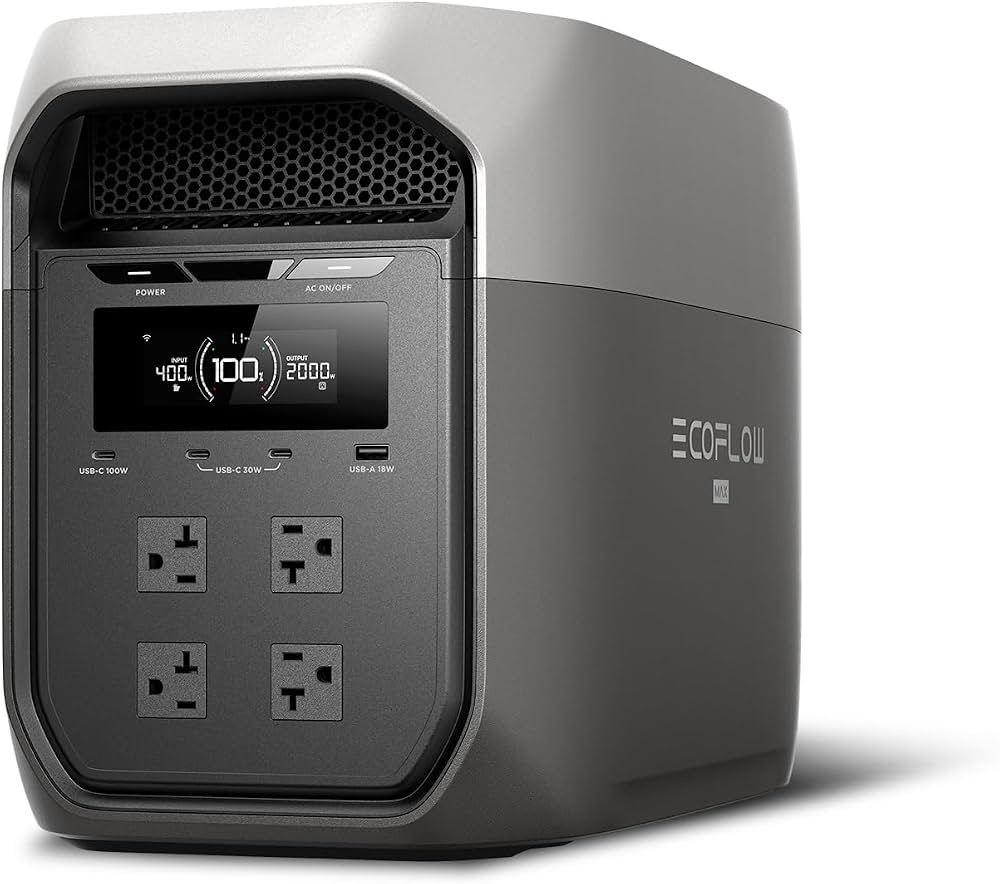
EcoFlow DELTA 3 Max: Best for Grid and Generator Recharging
Why I chose it and who it’s for
EcoFlow’s 2 kWh DELTA refills fast from a wall or a generator, reaching 80% in 68 minutes, and it puts out 2,400 W with a 4,800 W surge for hard-starting compressors. It switches over in 10 ms and runs quietly under light loads.
It’s best for homes that plan to recharge from a generator or from the grid between outages, not from the sun.
Key specs
- Capacity: 2,048 Wh, LiFePO4
- Output: 2,400 W (4,800 W surge)
- Wall recharge: 0 to 80% in 68 minutes
- Solar input: 500 W
- UPS switchover: 10 ms
- Weight: 44.8 lb
- Expansion: none
- Warranty: 3 years, plus 2 more after app registration
Pros and cons
Pros
- 4,800 W surge rating for fridges with hard-starting compressors
- Fast refill from a wall or generator
- Quiet enough for a bedroom
Cons
- 500 W of solar input is low for a 2 kWh battery
- No expansion port (the pricier Max Plus has one)
- Heaviest of the three
In real use
The solar number is what holds it back. On a December day with panels maxed out, it refills less than half its battery, while the Jackery and the Anker manage about three quarters. If you’ll lean on the sun during an outage, pick one of those.
Paired with a small inverter generator, though, it’s a strong team. Run the generator for an hour to bring it back to 80%, shut the generator off, and let the battery carry the house quietly through the night.
Who wins at 2 kWh: the Jackery HomePower 2000 Plus v2 for long outages, because it grows to 12 kWh. The Anker SOLIX C2000 Gen 2 is the better value if 4 kWh is plenty, and the EcoFlow DELTA 3 Max makes sense only if you’ll recharge from a generator.
3 to 4 kWh: EcoFlow DELTA 3000 Gen4 vs Jackery HomePower 3000 vs Anker SOLIX F3800 Plus
At this size you’re backing up most of a house: the fridge, a chest freezer, the furnace blower, a sump pump and a microwave. The EcoFlow and the Jackery are a true head-to-head at 3,072 Wh and 3,600 W. The Anker is bigger, heavier and built for 240 volts.
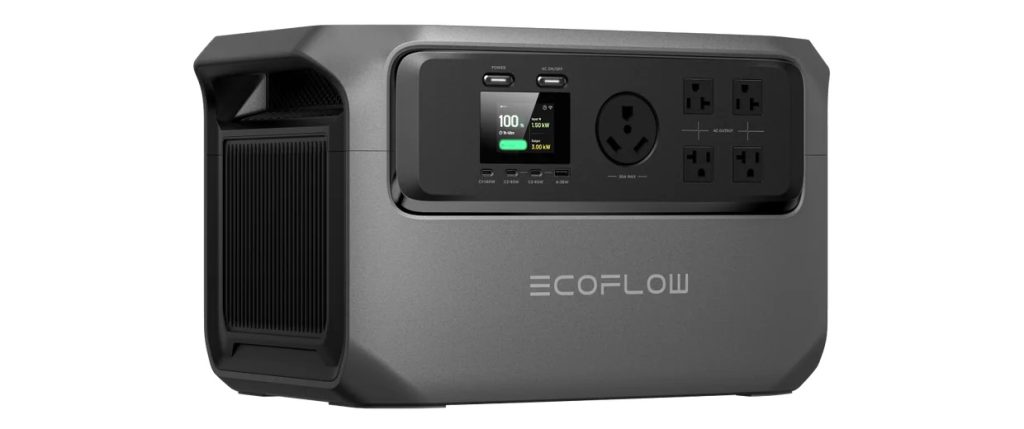
EcoFlow DELTA 3000 Gen4: Lightest 3 kWh
Why I chose it and who it’s for
The DELTA 3000 Gen4 is the 3 kWh model in EcoFlow’s DELTA Gen4 series, and it’s the one I’d look at first. It keeps the 3,072 Wh and 3,600 W of the DELTA 3 Ultra but weighs 57.3 pounds, about 20% less, and it takes 1,000 W of solar on one input.
It also adds three features aimed squarely at outages. Fridge Runtime Boost stretches runtime on a single fridge or freezer, Emergency Power Mode holds back enough charge to top up a phone after the display reads zero, and Storm Guard uses National Weather Service alerts to fill the battery before bad weather arrives. It’s best for anyone who wants the lightest 3 kWh station they can carry.
Key specs
- Capacity: 3,072 Wh, LiFePO4
- Output: 3,600 W (7,200 W surge)
- Wall recharge: about 2 hours at 1,800 W
- Solar input: 1,000 W
- UPS switchover: under 10 ms
- Battery life: 6,000 cycles to 70%
- Standby draw: 3 W
- Weight: 57.3 lb, two handles, no wheels
- Expansion: none (the 3800 Gen4 adds a battery port)
- Warranty: 3 years, plus 2 more after app registration
Pros and cons
Pros
- Lightest 3 kWh, 3,600 W station on the market, per EcoFlow
- Fastest switchover of the 3 kWh picks
- Emergency Power Mode keeps a phone charge in reserve
Cons
- Stock tends to run short right before winter storms, so buy it well before you need it
- No battery port on this model
- No wheels, and 57 pounds is still a two-hand carry
In real use
EcoFlow’s spec sheet claims up to 58 hours on a fridge, but the fine print says that was an empty fridge with the door shut. With food in it and a family opening the door, figure on about 42 hours, which is still nearly two full days.
The low 3 W standby draw matters for a backup unit too. Leave it on in a closet with nothing plugged in and it loses very little, so it’s close to full when the storm hits.
Jackery HomePower 3000: Best 3 kWh for Cold Weather
Why I chose it and who it’s for
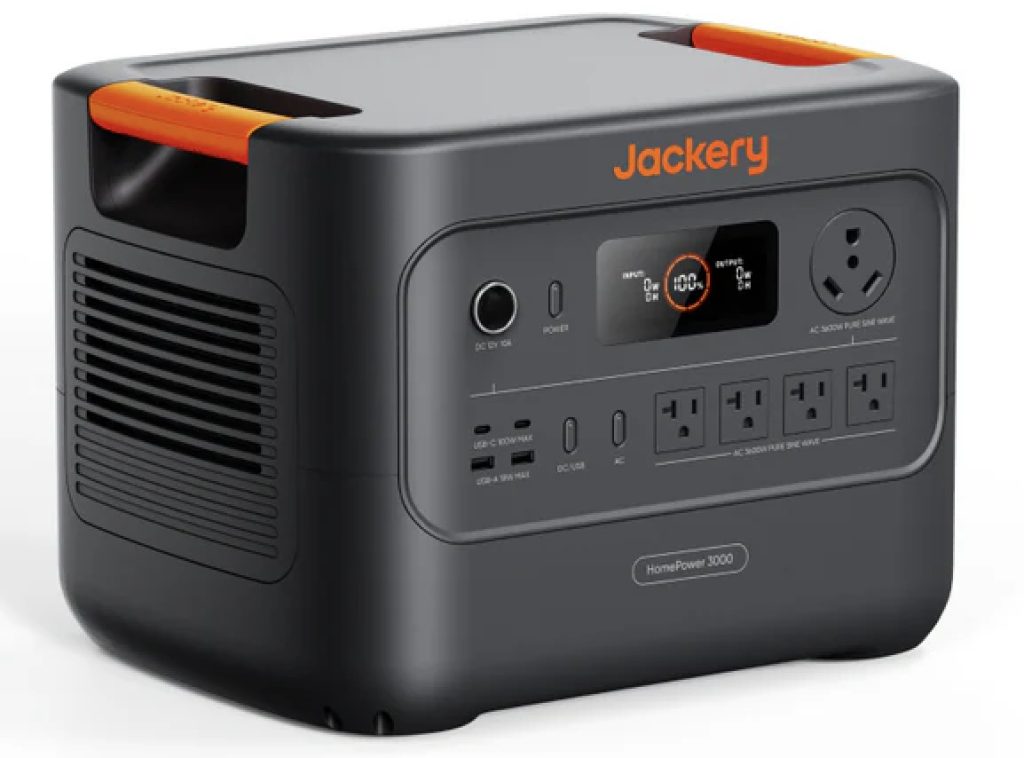
Jackery’s HomePower 3000 matches the Gen4 on the numbers that count, 3,072 Wh and 3,600 W with a 7,200 W surge, and it takes 1,000 W of solar. It has a 30-amp TT-30 outlet for an RV, and it fills from the wall in about 2.2 hours.
It’s also built for cold sheds and porches. Jackery rates it to keep running down to 5°F, with output limited to 2,000 W below 14°F. It’s best for anyone who keeps a 3 kWh station in a cold garage, on a porch or in an RV.
Key specs
- Capacity: 3,072 Wh, LiFePO4
- Output: 3,600 W (7,200 W surge)
- Wall recharge: about 2.2 hours
- Solar input: 1,000 W
- UPS switchover: 20 ms or less
- Battery life: 4,000 cycles to 70%
- Weight: 59.5 lb
- Expansion: none
- Warranty: 3 years, plus 2 more when bought direct from Jackery
Pros and cons
Pros
- Keeps running down to 5°F
- TT-30 outlet for an RV
- Jackery rates it to keep 95% of its charge after a year in storage
Cons
- Slower switchover than the Gen4
- No battery port, so 3,072 Wh is the ceiling
- The heaviest 3 kWh unit, at 59.5 pounds
In real use
Runtime matches the Gen4 in my math, about 42 hours on a typical fridge. The 20 ms switchover is fine for a fridge, lights and most electronics, though I’d put a desktop computer on the EcoFlow if it has to ride through without a reboot.
Keep in mind that running in the cold and charging in the cold are different. It runs down to 5°F, but like every station here, it won’t take a charge below 32°F, so bring it inside to refill.
Anker SOLIX F3800 Plus: Best for Whole-Home 240V Backup
Why I chose it and who it’s for
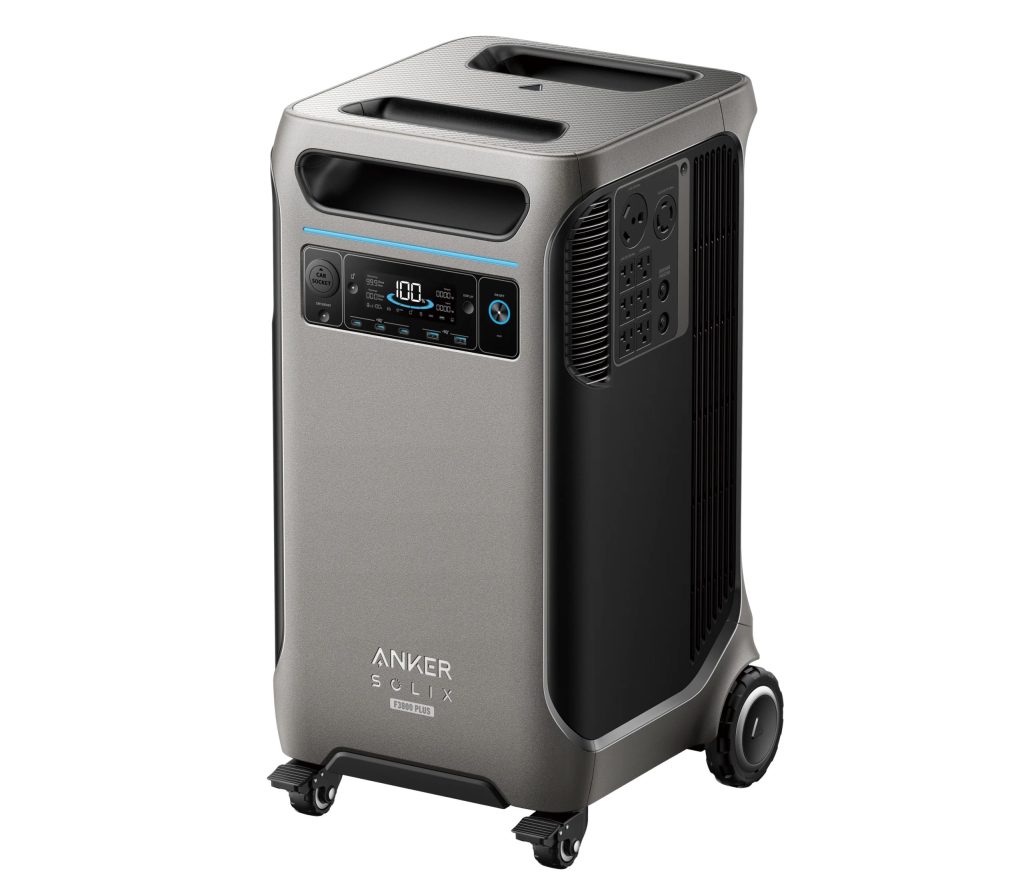
The F3800 Plus is a different animal. It holds 3,840 Wh, puts out 6,000 W at either 120 or 240 volts, and rolls on wheels because it weighs 136.7 pounds. It has an L14-30 outlet that feeds a transfer switch or an interlock kit, plus a TT-30 for an RV.
It takes up to 3,200 W of solar through two high-voltage inputs and grows to 26.9 kWh with BP3800 batteries. It’s best for houses with a well pump, a 240-volt pump or appliance, or anyone who wants to back up real circuits instead of running extension cords.
Key specs
- Capacity: 3,840 Wh, LiFePO4, expandable to 26.9 kWh
- Output: 6,000 W at 120V or 240V
- Outlets: L14-30 and TT-30, plus standard 120V outlets
- Solar input: 3,200 W across two 165V inputs
- UPS switchover: 20 ms on the three left-side outlets
- Battery life: 3,000+ cycles to 80%
- Weight: 136.7 lb, on wheels
- Warranty: 5 years
Pros and cons
Pros
- The only station here with 240-volt output
- Huge solar input, enough for a full refill even in December
- Grows past 26 kWh for true whole-home backup
Cons
- Heavy and big, so it lives in one spot
- UPS only covers three outlets
- Costs far more than the other picks
In real use
A well pump is the reason most people end up here. Every other station in this guide tops out at 120 volts, and most deep well pumps need 240. Wire the F3800 Plus to a transfer switch and the pump, the fridge and the furnace blower all come back on with one switch.
On a typical fridge alone it would run more than two days, about 52 hours by my math. Spread across real household circuits it goes faster, which is where the 3,200 W of solar input earns its place. With enough panels it can refill completely on a short December day.
Who wins at 3 to 4 kWh: the Anker SOLIX F3800 Plus if you need 240 volts or a well pump. Otherwise, the EcoFlow DELTA 3000 Gen4 is the lighter, quicker-switching box, and the Jackery HomePower 3000 is the one for cold garages, porches and RVs.
Anker vs EcoFlow: Which Is Better?
These two are the closest rivals, so it’s worth putting them side by side at each size.
At 1 kWh, the Anker C1000 Gen 2 refills faster from the wall and puts out more power, while the EcoFlow DELTA 3 Plus takes far more solar and can add a battery. If you’ll rely on the grid coming back, go Anker. If you’ll rely on panels, go EcoFlow.
At 2 kWh, Anker wins outright. The C2000 Gen 2 takes 800 W of solar to the DELTA 3 Max’s 500 W, charges faster, and can expand to about 4 kWh, which the Max can’t.
At the top end they split by purpose. The EcoFlow DELTA 3000 Gen4 is the lighter, quicker-switching 3 kWh station for a home that runs on extension cords. The Anker F3800 Plus is the one for a home that wants 240 volts and a transfer switch. Both brands put 10 ms switchover on most of their models, and both back their stations for 5 years once you count EcoFlow’s registration extension.
Outage Brand Matcher
Pick what has to stay on, how long you expect to be in the dark and how you’ll recharge. The matcher finds the smallest station from each brand that handles the job, shows how much of the outage it covers, and picks the best fit.
How to Choose the Right Power Station for an Outage
Size it by your fridge, not by the box
A closed fridge keeps food safe for about 4 hours without power, according to FoodSafety.gov, so anything longer than an evening means the fridge needs power. Most full-size fridges use about 1.1 to 1.9 kWh a day, which you can check on the yellow EnergyGuide label. Here’s roughly how long each size runs a typical fridge that uses 1.5 kWh a day, after about 15% is lost in the inverter:
The makers’ own fridge numbers run higher because they test with fridges that stay shut. EcoFlow’s 58-hour claim for the DELTA 3000 Gen4, for example, comes from an empty fridge with nobody opening the door. Plan with the lower numbers and you won’t come up short.
Check the solar input for December, not June
A panel makes far less in December, and that’s when most of us lose power to ice and snow. The chart below shows how much of each battery a full solar setup can put back on a December day with 2.5 peak sun hours, typical for the northern half of the country.
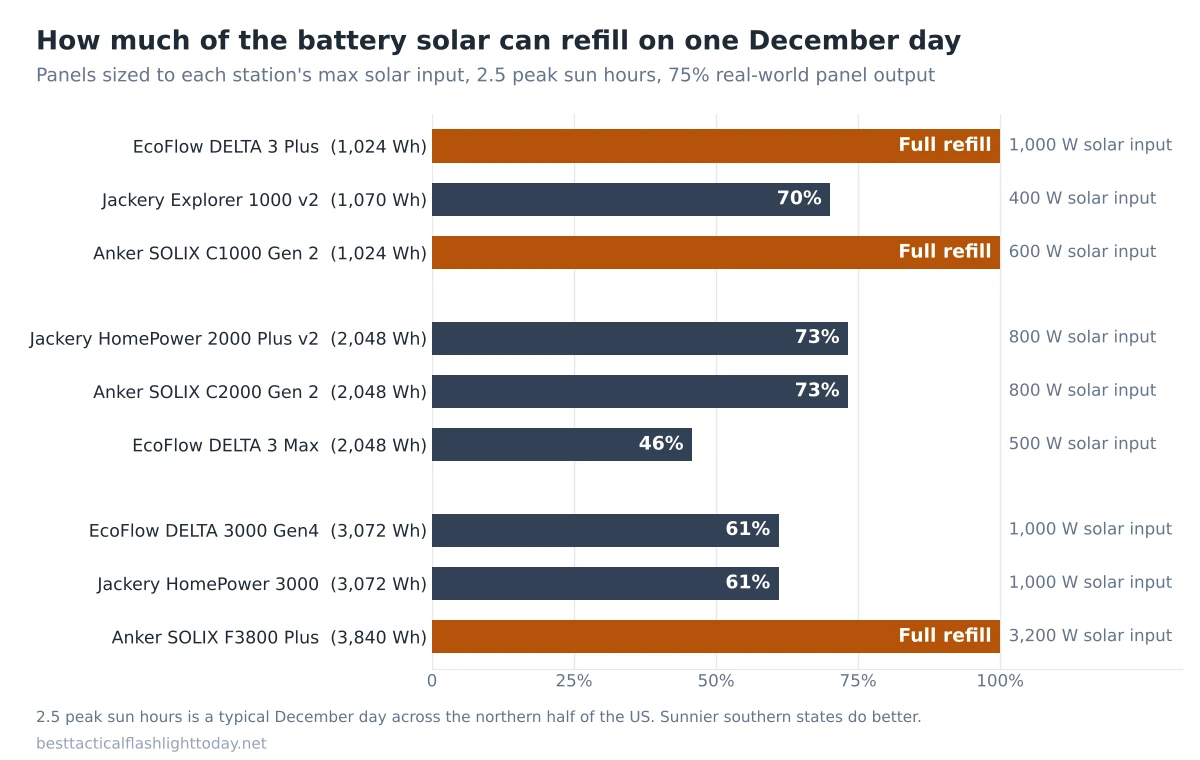
The stations with high solar input, the DELTA 3 Plus, the C1000 Gen 2 and the F3800 Plus, can fill all the way. The DELTA 3 Max can’t even get halfway. If solar is part of your plan, my solar generator guide pairs panels with stations, and the input limit on the station matters as much as the panels you buy.
Look for 10 ms switchover if you run a CPAP or router
Every station here works as a basic UPS. Plug your gear into it, plug it into the wall, and it takes over when the power fails. EcoFlow and most of Anker’s models switch in 10 ms, while Jackery’s Explorer 1000 v2 and HomePower 3000 and Anker’s F3800 Plus take up to 20 ms. Both are fast enough for a fridge, a router and most CPAP machines. If you’re sizing one for a CPAP, my CPAP battery backup guide has the night-by-night math.
Keep it above freezing to charge
Every station in this guide stops charging below 32°F. They’ll still run in a cold garage, but they won’t take a charge from the wall or the sun until they warm up. Store yours inside the house in winter. If you rely on Anker’s UltraFast charging, the battery needs to be above 68°F for full speed.
Plan for expansion and 240 volts
A station you can grow saves you from buying twice. The DELTA 3 Plus reaches about 5 kWh, the C2000 Gen 2 about 4 kWh, the HomePower 2000 Plus v2 12 kWh and the F3800 Plus 26.9 kWh. If you have a well pump or want to feed real house circuits, only the F3800 Plus does 240 volts, and it pairs with a transfer switch or interlock kit. For bigger loads on a budget, a dual fuel inverter generator charging a smaller station is another good route.
Think about who has to carry it
The 1 kWh units all weigh 24 to 28 pounds, the 2 kWh units about 42 to 45, and the 3 kWh units 57 to 60. Past that you’re on wheels. Put the station where it’ll be used, usually next to the fridge, and you’ll only carry it once.
Not sure how often your area loses power? My power outages by state page shows how many hours a year the average home goes dark where you live, and the power outage emergency kit covers the lights, radio and water to keep beside the station.
Frequently Asked Questions
Which is better, EcoFlow or Jackery?
It depends on the size. EcoFlow is better at 1 kWh and 3 kWh, with more solar input and faster switchover on the DELTA 3 Plus and the DELTA 3000 Gen4. Jackery is better at 2 kWh, where the HomePower 2000 Plus v2 grows to 12 kWh and has Priority Routing, and it makes the lightest 1 kWh unit in the Explorer 1000 v2.
Is Anker SOLIX better than EcoFlow?
At 2 kWh, yes. The Anker C2000 Gen 2 takes more solar, charges faster and expands further than the EcoFlow DELTA 3 Max. At 1 kWh it’s a split: Anker’s C1000 Gen 2 refills fastest, while EcoFlow’s DELTA 3 Plus takes more solar and can grow. For 240-volt whole-home backup, Anker’s F3800 Plus has no match from EcoFlow at this size.
Do EcoFlow, Jackery and Anker all use LiFePO4 batteries now?
Yes. Every station in this comparison uses LiFePO4 cells. Older Jackery Explorer models used NMC batteries, which is where that old claim comes from, but the current lineups from all three brands are LiFePO4.
Can you use one brand’s solar panels with another brand’s power station?
Usually, yes. Check that the panel’s open-circuit voltage stays under the station’s input limit, which is 60 V for most of the stations here and 165 V for the F3800 Plus, and get an adapter for the plug, since Jackery uses a different connector than the XT60 style EcoFlow and Anker use. Extra panel wattage isn’t a problem, since the station only takes as much as it’s rated for. Voltage is the number that can do damage.
The Bottom Line
Don’t pick a brand, pick a size, then take the brand that wins it. For most homes that’s the EcoFlow DELTA 3 Plus at 1 kWh, the Jackery HomePower 2000 Plus v2 at 2 kWh, and the Anker SOLIX F3800 Plus if you need 240 volts. If your grid keeps flickering back on, the Anker SOLIX C1000 Gen 2 refills faster than anything else its size. And if you want the EcoFlow DELTA 3000 Gen4 for the coldest months, buy it in the fall so it’s charged and in the house before the first ice storm.
