
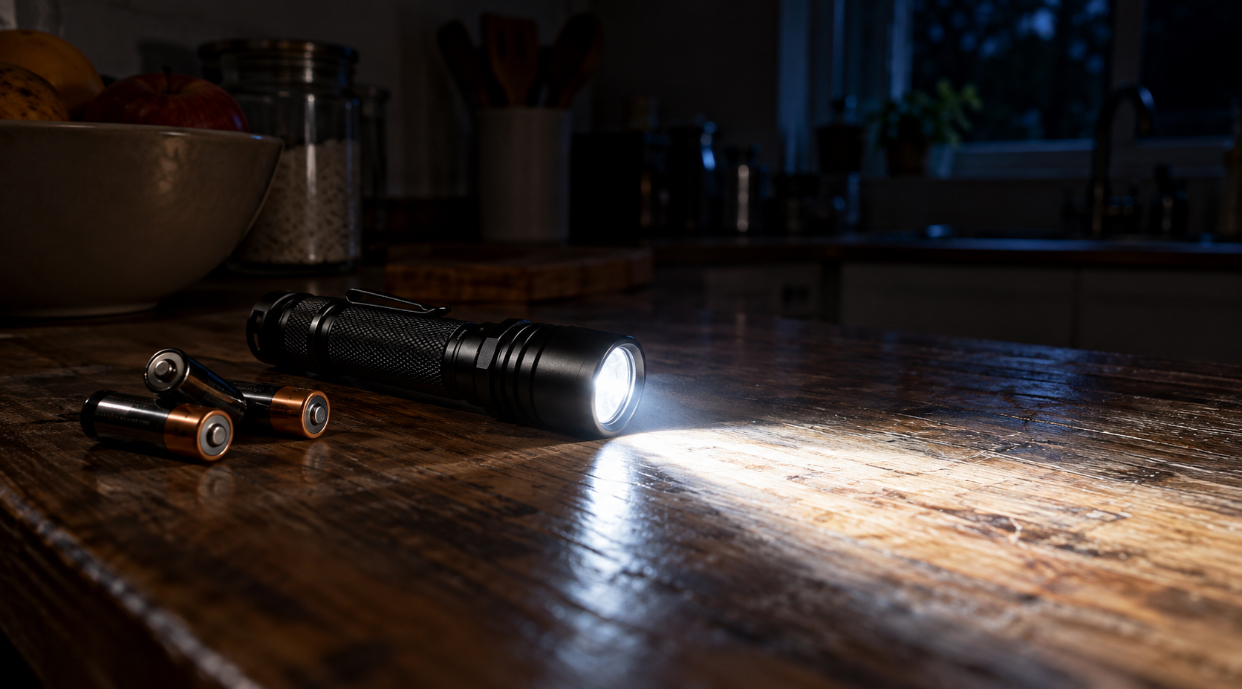
Almost every kitchen drawer in America has a few AA batteries rolling around in it. That’s the whole case for an AA flashlight. When the power’s been out for two days and your rechargeable lights are dead, the light that runs on whatever’s in the remote control is the one still working.
The old knock on AA lights was that they’re dim. That hasn’t been true for a while. Some of the lights below run on a plain AA and also take a lithium 14500 cell, which pushes them past 900 lumens from something the size of a lipstick tube. Others are built to sit in a kitchen drawer for five years and still turn on the first time you click them.
I’ve been covering flashlights since 2014, and I’ve narrowed this list to seven AA lights that earn their spot. Some ride in a pocket, and a couple are built for the night the grid goes down. Each one has a clear job, and I’ll tell you which job it’s best at.
Quick Picks: The Best AA Flashlights
AA Flashlight Comparison Chart
Here’s how the seven stack up side by side. Where a light takes two power sources, the first output figure is its best case and the figure in brackets is on plain AA.
1. Fenix E12 V2.0: Best Overall Pocket AA
Why I chose it
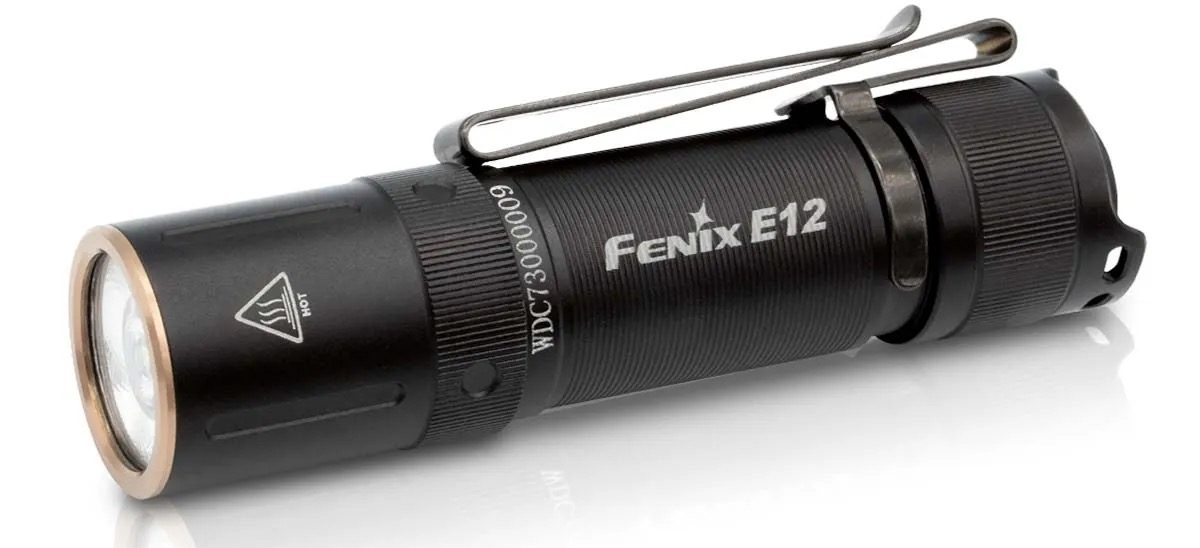
The E12 V2.0 is the light I’d hand to someone who’s never thought about flashlights and doesn’t want to start. It’s 3.07 inches long, which is barely more than the AA inside it, and it has a single tail switch with three levels. There’s no strobe hiding in the switch and nothing to learn. It’s best for anyone who wants a light that lives in a pocket or a purse and simply works.
Key specs
- Output: 160 / 30 / 5 lumens
- Runtime: 1 hour on high, 13 hours on medium, 70 hours on low (alkaline)
- Beam distance: 68 m (223 ft)
- Battery: 1x AA alkaline or NiMH; lithium AA usable; not 14500 compatible
- Water and impact: IP68 to 2 m, 1 m drop rated
- Weight: 1.76 oz with battery
Pros & Cons
Pros
- Tiny for an AA light, with a two way clip that also fits a hat brim
- No standby drain, so a battery left inside isn’t slowly being eaten
- Wide, even beam that’s comfortable for close work
Cons
- Won’t take a 14500, so 160 lumens is the ceiling
- Cool white tint isn’t flattering for reading or cooking
Performance analysis
Sixty eight meters of throw won’t light up the far end of a field, and it isn’t meant to. What the E12 does well is close and medium range: finding the keyhole on the porch or walking the dog down a dark street. The ultra thin optic spreads light wide, so you see the whole sidewalk instead of a tight dot.
The 70 hour low mode is the number that matters most. On 5 lumens, one battery gets you through several nights of a blackout if you’re only using it to move between rooms. When the cell runs down, the E12 steps to a lower level instead of cutting out, so it never leaves you in the dark without warning.
2. Streamlight ProTac 1L-1AA: Best Tactical AA
Why I chose it
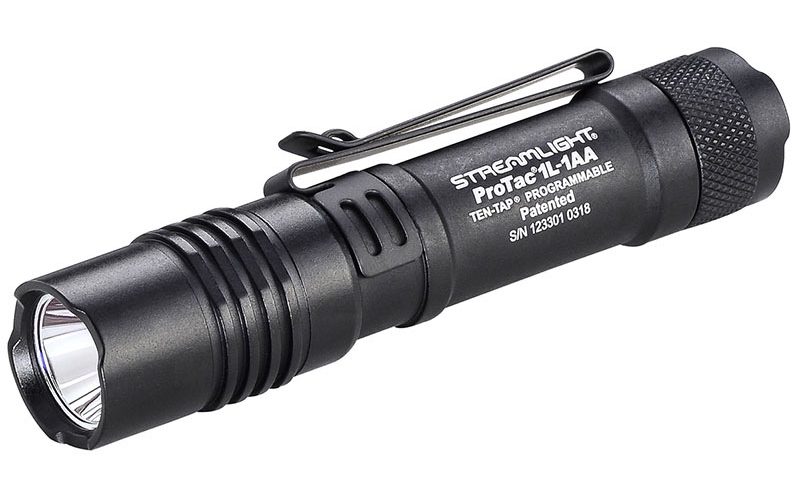
This is the one light on the list that’s built for a bad night, not just a dark one. It runs on a single AA or a CR123A, and both come in the box. Run it on the CR123A day to day and you get 350 lumens. Then if you’re ever stuck with nothing but a pack of AAs from a gas station, it keeps working. It’s best for people who carry a light for self defense or security work, and for anyone who wants their EDC light to double as a backup to a weapon light.
Key specs
- Output: 350 lumens on CR123A, 150 lumens on AA, 40 lumen low
- Runtime on AA high: 1 hour 20 minutes (alkaline), 4.25 hours (lithium)
- Beam distance: 160 m on CR123A, 105 m on AA
- Switch: push button tail with momentary on and TEN-TAP programming
- Water and impact: IPX7 to 1 m, 2 m drop tested
- Length: 4.25 inches
Pros & Cons
Pros
- Dual fuel, with both batteries included
- Momentary tail switch you can work under stress
- A high only program, so the light always comes on bright
Cons
- Only 150 lumens on an AA, well behind the other dual fuel lights here
- Popular enough to be counterfeited, so buy from Streamlight or where Amazon is the seller
Performance analysis
The tail switch is the reason this light is here. Press it partway and the light stays on only while you hold it. Click it fully and it stays on. That’s how a defensive light should behave, because you can check a doorway and kill the light again without fumbling.
Set it to high only through TEN-TAP and it can’t surprise you by starting on low. On a CR123A, 6,400 candela gives a tight, punchy hotspot that’s bright enough to make anyone in its path stop and squint.
The AA numbers tell the real story for this article. On alkaline, high lasts 1 hour 20 minutes. Swap in a lithium AA and that jumps to 4.25 hours, according to Streamlight’s own published figures. That gap is why I keep lithium AAs in any light I might need in an emergency. More on that in the battery chart below.
3. Acebeam TAC 2AA: Brightest AA Flashlight
Why I chose it
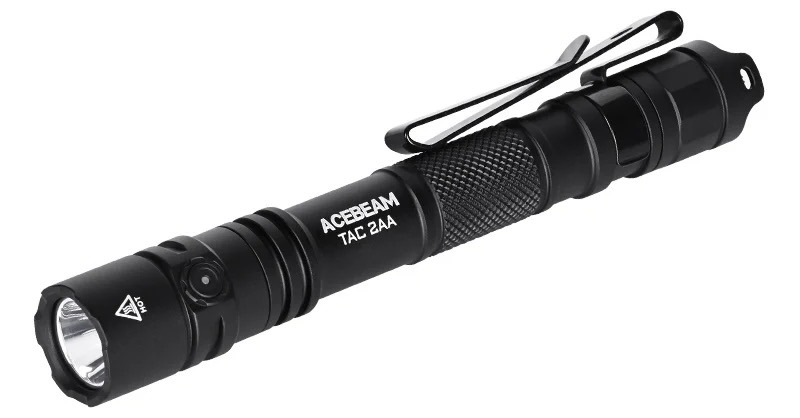
For years the advice on 2AA lights was to skip them, because they were too big for a pocket and too weak to matter. The TAC 2AA ends that argument. On its included rechargeable cell it hits 1,600 lumens, and on two NiMH AAs it still puts out 630. That’s double what a good single AA light makes on the same batteries. It’s best for anyone who wants real brightness without giving up the option to run on store bought batteries.
Key specs
- Output: 1,600 lumens on the included cell, 630 lumens on 2x NiMH AA
- Beam distance: 181 m (a throwier SFT-25R version reaches 304 m at 1,400 lumens)
- Battery: included Acebeam 14100P with USB-C, or 2x AA alkaline or NiMH
- Switches: tactical tail switch plus a metal side switch with a battery indicator
- Water and impact: IP68 to 2 m, 1.5 m drop rated
- Size: 5.9 inches, 3.73 oz
Pros & Cons
Pros
- The brightest AA compatible light I’d recommend, by a wide margin
- Separate tactical and daily modes, so you choose what the tail switch does first
- Battery indicator in the side switch tells you when it’s time to swap
Cons
- No charging port on the light itself; you pull the cell out to charge it
- At 5.9 inches, it rides in a pocket like a marker, not a lipstick
Performance analysis
The 1,600 lumen turbo is a burst. Acebeam rates it for about a minute before it settles down to 600 lumens, which is still bright and holds for close to two hours. Treat turbo as the button you press to see across a parking lot, not as the mode you walk the dog on.
The NiMH figures are what make this light worth recommending in an AA roundup. High mode holds 390 lumens for 158 minutes on a pair of rechargeable AAs, and the 35 lumen low runs a full day. Moonlight mode gets close to 100 hours. Acebeam does say not to mix random half used AAs, so keep a matched pair together.
Choose the standard version for a wide, useful beam. Pick the SFT-25R version if you want throw for searching a yard or a tree line.
4. Lumintop Tool AA 3.0: Best Budget AA
Why I chose it
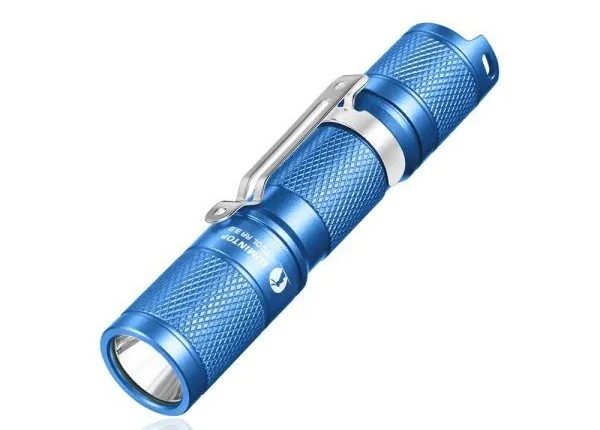
The Tool AA 3.0 costs less than a takeout dinner and does two jobs. On a regular AA it’s a capable 300 lumen pocket light. Drop in a 14500 lithium ion cell and it jumps to 900 lumens from a body only 3.5 inches long. It’s best for budget buyers, and for anyone curious about 14500 cells who wants to try them without spending much.
Key specs
- Output: 900 lumens on 14500, 300 lumens on AA
- Runtime on AA: about 1 hour on turbo, 3 hours on high, 12 hours on medium
- Beam distance: 138 m (rated)
- Battery: 1x AA alkaline or NiMH, or a button top 14500
- Water rating: IPX8
- Size: 3.5 inches, about 1.8 oz with a NiMH AA
Pros & Cons
Pros
- Best output per dollar of anything on this list
- Runs well on plain AAs, not just lithium ion
- Smooth reflector gives a tighter, longer beam than most tiny lights
Cons
- The lighted tail switch slowly drains a 14500 when it’s off, so unscrew the tail for storage
- Strobe hides behind six quick taps, which can catch you out
Performance analysis
The 900 lumen figure is real, but it’s a sprint. On a 14500, output drops noticeably within the first few minutes as the cell’s voltage sags, because the driver doesn’t hold it steady. That’s normal for lights this size and this cheap. Expect a bright burst, then a few hundred lumens for the long haul.
On AA it behaves better than you’d expect. It holds close to its 300 lumen rating at turn on and keeps the 150 lumen high going for around three hours on NiMH. The tint runs cool and slightly blue, so colors look a bit flat. For finding things and lighting a path, that won’t matter.
One warning that applies to every dual fuel light: the Tool AA needs a button top 14500. Flat top cells won’t make contact, so check before you order spares.
5. Fenix LD22 V2.0: Best for Power Outages
Why I chose it
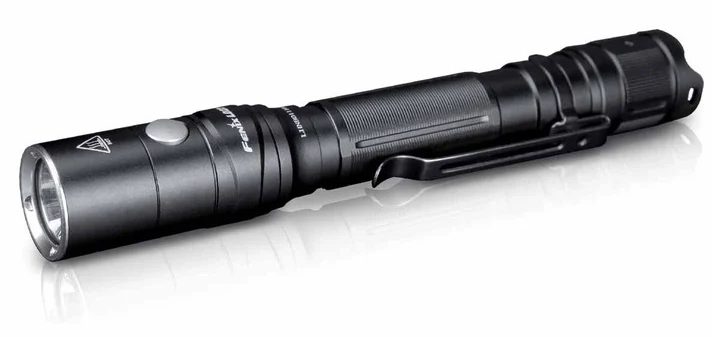
When the grid goes down, the light you want isn’t the brightest one. It’s the one that lasts. The LD22 V2.0 has an eco mode that runs 190 hours on two AAs, which is about eight days of continuous light. It also ships with a rechargeable pack and two alkalines, so on day one of an outage you already have two power sources in hand. It’s best for families building an emergency kit and anyone who wants one light that covers both daily use and the long haul.
Key specs
- Output: 800 lumens on the included pack, 350 lumens on 2x AA
- Runtime on AA: 1 hour 15 minutes on high, 5 hours 50 minutes on medium, 19 hours 45 minutes on low, 190 hours on eco
- Beam distance: 214 m on the pack
- Battery: included Fenix USB-C pack, or 2x AA alkaline or NiMH
- Switches: tactical tail switch plus a side switch for brightness
- Water rating: IP68 to 2 m
Pros & Cons
Pros
- Eco and low modes stretch two AAs across days, not hours
- Tail switch for on and off, side switch for brightness, so anyone in the house can run it
- Comes with a belt holster as well as a pocket clip
Cons
- Turbo only works on the rechargeable pack, not on AAs
- The light itself has no charging port; the pack charges separately
Performance analysis
Think of the LD22 V2.0 as two lights. On the included pack it’s a slim 800 lumen EDC light with real reach. On AAs it becomes a slow and steady emergency light, topping out at 350 lumens but able to run for days on its lower modes. Fenix’s spec page is clear that turbo is locked out on AAs, so don’t expect 800 lumens from the spare batteries in your kit.
The 30 lumen low mode is the one you’ll use most in an outage. It’s plenty to cook dinner or get down the hallway, and it lasts almost 20 hours on alkalines. Stand the light on its tail and bounce it off a white ceiling and it’ll light a small room.
The two switch layout matters more than it sounds. In a blackout, kids and older relatives will grab whatever light is closest. Click on, press the side to change brightness. Nobody needs instructions.
6. Mini Maglite Pro: Best Glovebox Light
Why I chose it
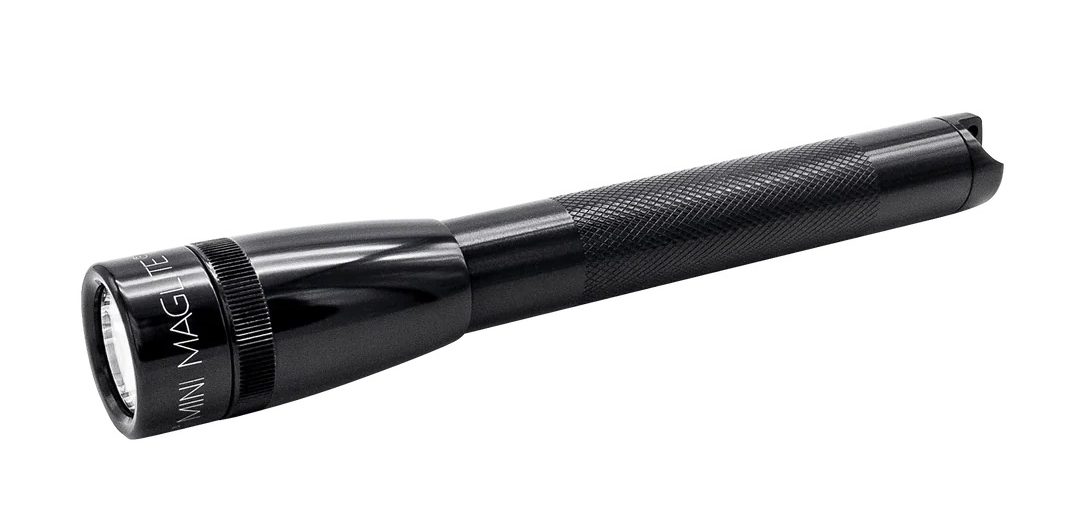
Everyone knows how a Mini Maglite works, and that’s exactly the point. You twist the head to turn it on, and you keep twisting to go from spot to flood. There’s no button to wear out and nothing to explain to a teenager borrowing your car. The current Pro version swaps the old bulb for a 332 lumen LED, and it’s still made in the USA. It’s best for a glovebox or a kitchen drawer, where it may sit for years before anyone needs it.
Key specs
- Output: 332 lumens on high, plus an eco mode at about 25% power
- Runtime: 2 hours 30 minutes on high, 13 hours on eco
- Beam distance: 172 m
- Battery: 2x AA alkaline (included)
- Water and impact: IPX4 water resistant, 1 m drop rated
- Size: 6.6 inches, 4.15 oz with batteries
Pros & Cons
Pros
- Adjustable focus from a tight spot to a broad flood
- Simple twist operation that anyone can use
- Made in the USA, with a long track record behind the design
Cons
- IPX4 means splash resistant only, so don’t drop it in a lake
- Older stock on Amazon is rated lower (226 to 272 lumens), so check the listing
Performance analysis
The focusing head is the Maglite’s real advantage over the other lights here. Twist it one way and you get a tight spot that reaches past the end of a driveway. Twist it back and the beam opens wide enough to change a tire by. Fixed beam lights make you pick one or the other.
At 6.6 inches it’s a little long for a pocket, but it fits a door pocket or a glovebox easily. The eco mode drops output to about a quarter, which is what you want when the batteries need to last.
The weak spot is water. IPX4 handles rain, not submersion. If your light might end up in a creek or a flooded basement, pick one of the IP68 lights above instead, like the Fenix E12 V2.0 or the Fenix LD22 V2.0.
7. Coast HX5: Best Focusing Beam
Why I chose it
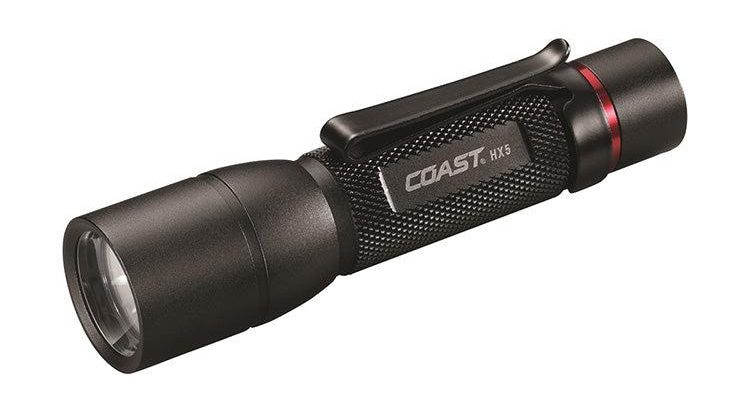
The HX5 does what the Mini Maglite Pro does, but in a pocket size body with a clip. Slide the head forward and back and the beam shifts from a wide flood to a focused spot, with no ugly dark ring in between. It’s best for tradespeople and DIYers who switch between close work and looking down a crawlspace, and for anyone who wants a focusing light they can actually clip in a pocket.
Key specs
- Output: 410 lumens
- Beam distance: 130 m
- Runtime: 3 hours (rated)
- Battery: 1x AA alkaline (included), NiMH or 14500
- Focus: slide focus from flood to spot
- Clip: two way, works on a hat brim
Pros & Cons
Pros
- Clean flood to spot transition with no halos
- Takes alkaline, NiMH or 14500, so you’re never stuck
- Coast backs it with a lifetime warranty against defects
Cons
- Coast lists it as weatherproof but doesn’t publish an IP rating
- Coast doesn’t publish low mode runtimes, so it’s harder to plan around for a long outage
Performance analysis
Coast’s focusing optic is the best thing about this light. On full flood it throws a broad, even circle that’s great for working under a sink. Push the head out and the light gathers into a spot that reaches about 130 meters. The transition is smooth, which isn’t true of the cheap zoom lights that flood Amazon.
The 410 lumen rating and 3 hour runtime are both tested to the ANSI FL1 standard, so they’re comparable to the other numbers in this article. On paper, that puts the HX5 well above the Fenix E12 V2.0.
It isn’t a light for heavy rain or water work. For that, the E12 or the Fenix LD22 V2.0 is the safer bet. For dry jobs where you’re constantly changing what you’re looking at, nothing else here is as flexible.
Same Light, Different AA: Why Battery Choice Matters
The battery you put in matters almost as much as the light you buy. Here’s the Streamlight ProTac 1L-1AA running the exact same modes on two kinds of AA, using Streamlight’s published runtimes.
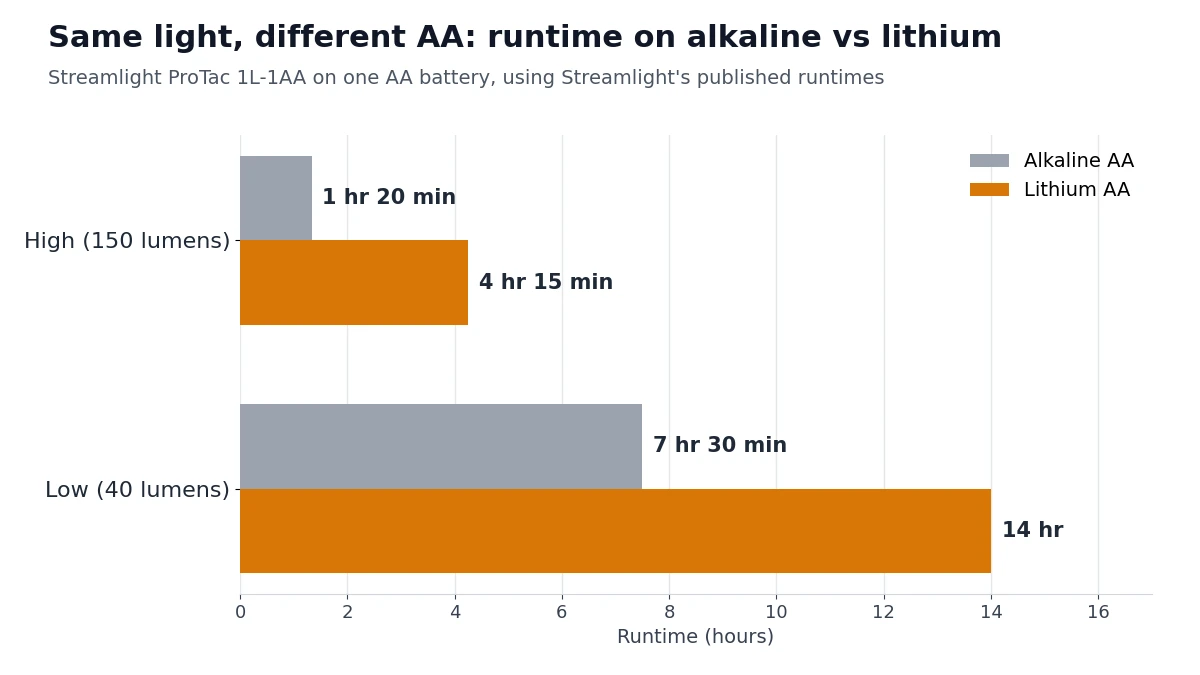
On high, a lithium AA runs 3.2 times longer than alkaline, because alkaline cells lose capacity fast under heavy draw. On low, lithium still nearly doubles your runtime.
Buying Guide: How to Choose an AA Flashlight
One AA or two?
A single AA light usually runs 3 to 4 inches long and disappears in a pocket. Two AAs double the energy, which buys you either more brightness or longer runtime, at the cost of a light that’s closer to six inches long. If you’ll carry it every day, go with one AA. If it’s going in a kit or a car, two AAs is the better deal.
You’ll notice there’s no 4xAA light on this list. Most of the popular ones from Fenix, Nitecore and ThruNite have been discontinued, and modern 2AA lights with a rechargeable pack now match them on output.
Dual fuel and 14500 batteries
A 14500 is a lithium ion cell the same size as an AA, but it runs at about 3.7 volts instead of 1.5. In a light built for it, that extra voltage is where numbers like 900 lumens come from. In a light that isn’t built for it, a 14500 can fry the driver in seconds.
The rule is simple: only use a 14500 if the manufacturer lists it as compatible. On this list, that means the Lumintop Tool AA 3.0 and the Coast HX5. The Fenix E12 V2.0 and the Mini Maglite Pro are AA only. The Acebeam and the Fenix LD22 use their own included packs, so stick with those rather than swapping in a random cell. If you’d rather skip loose cells altogether and charge the light itself, see my rechargeable flashlight picks.
Alkaline, NiMH or lithium AA?
Alkaline AAs are cheap and everywhere, but they’re the most likely to leak and corrode the inside of a flashlight that sits unused for a year. NiMH rechargeables like Eneloops are the best choice for a light you use every day. They hold their charge well in storage and handle high output modes better than alkaline.
For emergency kits and cars, lithium AAs are worth the extra money. Energizer rates its Ultimate Lithium AAs to work from minus 40 to 140 degrees Fahrenheit and to hold power in storage for up to 20 years. You saw what they do for runtime in the chart above.
Switch type
A tail switch with a momentary press is the fastest to use under stress, which is why tactical lights have one. Side switches are easier for changing brightness once the light is on. Twist switches, like the Maglite’s, have fewer parts to fail but take two hands. Pick the one that matches how you’ll actually use the light.
Water rating
IPX4 means splash resistant, so rain is fine but a dunk isn’t. IPX7 and IPX8 mean the light survives being submerged, usually to 1 or 2 meters for 30 minutes. IP68 adds dust protection on top of that. For a prepping or outdoor light, I wouldn’t go below IPX7. My survival flashlights roundup ranks six lights by what they run on when the grid is down, including one that takes any pair of AAs.
Lumens aren’t everything
A light’s lumen number tells you how much total light it makes. It doesn’t tell you how far that light reaches or how it’s spread. If you want the full picture, our candela vs lumens guide explains how to read a spec sheet without getting fooled. And if you’re building a kit for blackouts specifically, see our best flashlight for power outages roundup.
AA Flashlight FAQ
Can I put a 14500 battery in any AA flashlight?
No. A 14500 runs at about 3.7 volts, more than double a standard AA, and it can destroy a light that isn’t designed for it. Check the manufacturer’s compatible battery list first. Lights like the Lumintop Tool AA 3.0 accept both, while the Fenix E12 V2.0 is AA only.
Are lithium or alkaline AA batteries better for flashlights?
Lithium AAs are the better choice for emergency and car kits, mainly because they don’t leak and they keep working in freezing weather. In Streamlight’s own figures, a lithium AA runs the ProTac 1L-1AA on high more than three times longer than an alkaline. For daily use, rechargeable NiMH cells are the most economical.
What is the brightest AA flashlight?
Of the lights I’d recommend, the Acebeam TAC 2AA is the brightest at 1,600 lumens on its included rechargeable cell and 630 lumens on two NiMH AAs. For a single AA light, the Lumintop Tool AA 3.0 reaches 900 lumens on a 14500 and about 300 on a regular AA.
How long does an AA flashlight last on one battery?
It depends almost entirely on the brightness mode. On high, most single AA lights run about 1 to 3 hours. On low, the same battery can last 20 to 70 hours, and the Fenix LD22 V2.0‘s eco mode runs about 190 hours on two AAs.
The Bottom Line
If you want one AA light and don’t want to think about it, get the Fenix E12 V2.0. It’s small enough to carry every day and simple enough for anyone in the house to use.
If brightness matters most, the Acebeam TAC 2AA is the clear pick, with the Lumintop Tool AA 3.0 as the budget way into the same dual fuel idea. For a kit that has to last through a long outage, put the Fenix LD22 V2.0 in it with a pack of lithium AAs. If you carry for protection, the Streamlight ProTac 1L-1AA is the one I trust with a CR123A in it and an AA as backup.
Whichever you choose, put lithium AAs in any light that sits in a drawer or a car. It’s the cheapest upgrade you can make to a flashlight. For more pocket options beyond AA, see our best EDC flashlights guide.
