A 3,000-lumen flashlight can lose a distance contest to a 650-lumen weapon light. That surprises a lot of buyers, and it explains why so many people end up disappointed by a light they picked for the biggest number on the box.
Lumens tell you how much light comes out. Candela tells you how hard that light is pushed in one direction. You need both to know what a flashlight will actually do, and once you see how they work together, spec sheets stop reading like marketing and start being useful.
Below, you’ll learn what each number means, how beam distance is worked out, a quick ratio that reveals a beam’s shape in seconds, and how real lights compare side by side.
What Are Lumens?What Is Candela?How Beam Distance Is CalculatedThe 568-Lumen Light That Outthrows 80,000 LumensThe Candela-to-Lumen RatioWhich One Matters More?Beam Profile: Hotspot and SpillReal Flashlights ComparedThe Most Common Buying MistakeFAQ
What Are Lumens?
Lumens measure the total amount of visible light a flashlight puts out, in every direction combined. The number says nothing about beam shape or reach. It’s simply the total.
Think of a garden hose. Lumens are how much water flows through it. Whether that water leaves as a wide spray or a tight jet depends on the nozzle, and a 1,000-lumen light produces the same total output whether its beam is pencil thin or as wide as a floodlight.
In practice, output levels break down like this:
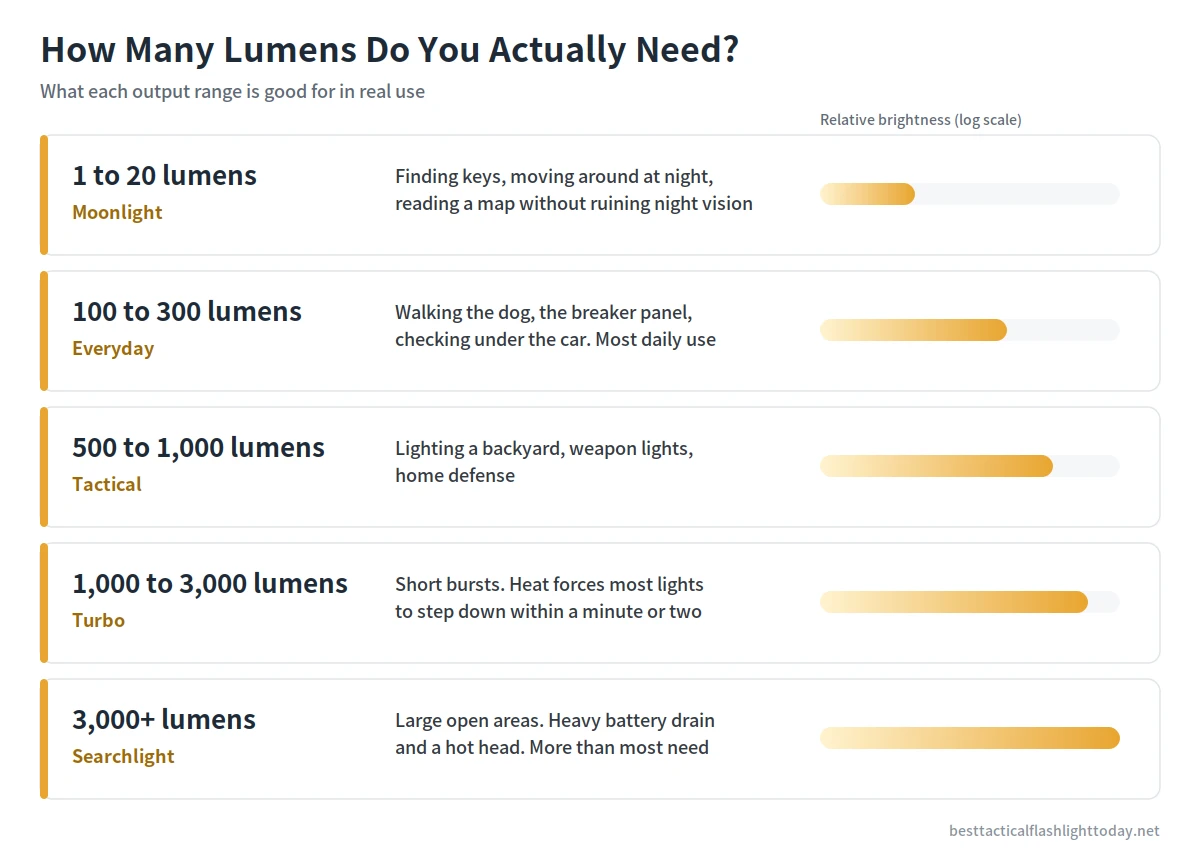
1 to 20 lumens is moonlight territory. It’s enough to find your keys on the nightstand or move through the house at 2 AM without wrecking your night vision. Most people ignore these modes until they try them.
100 to 300 lumens is the everyday range. Walking the dog, checking the breaker panel, looking under the car. This band covers most of what people actually do with a flashlight.
500 to 1,000 lumens is where tactical lights live. It lights up a backyard, and up close it’s bright enough to make someone squint and turn away. Most weapon lights, including the picks in our best pistol lights guide, sit in or near this band.
1,000 to 3,000 lumens is turbo territory. It looks impressive, but very few lights can hold it for long. Heat builds fast, so the light steps itself down (called thermal stepdown), often within a minute or two.
3,000 lumens and up is searchlight output. It’s great for big open areas, but batteries drain quickly and the head gets hot. It’s more than most people need day to day.
Lumens tell you how bright your immediate surroundings will look. They can’t tell you whether you’ll see something 200 meters down the road. That’s candela’s job.
What Is Candela?
Candela measures the intensity of light in a single direction, specifically at the brightest point of the beam. Spec sheets list it as “peak beam intensity” or simply “cd.”
Back to the hose. If lumens are the volume of water, candela is the pressure at the center of the stream. High candela means the light is packed into a tighter beam that carries farther. Low candela means it’s spread wide, which helps up close but fades quickly with distance.
That’s why two lights with the same lumen rating can behave nothing alike.
High-Candela Lights (Throwers)
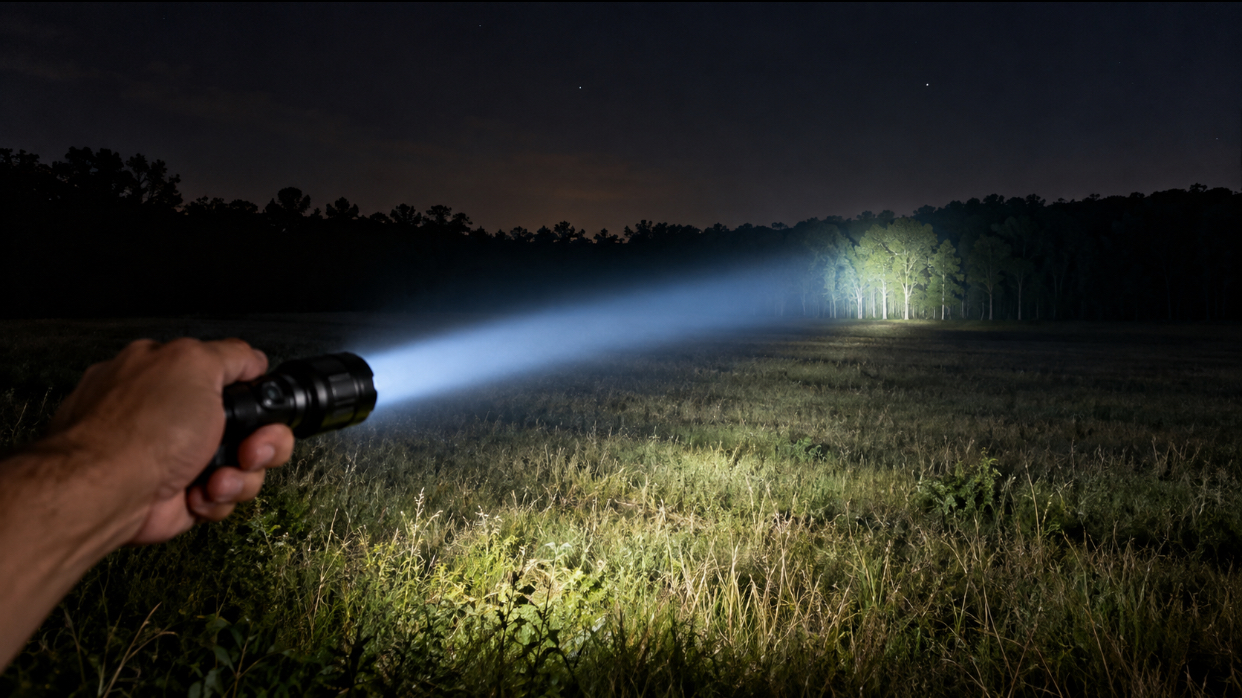
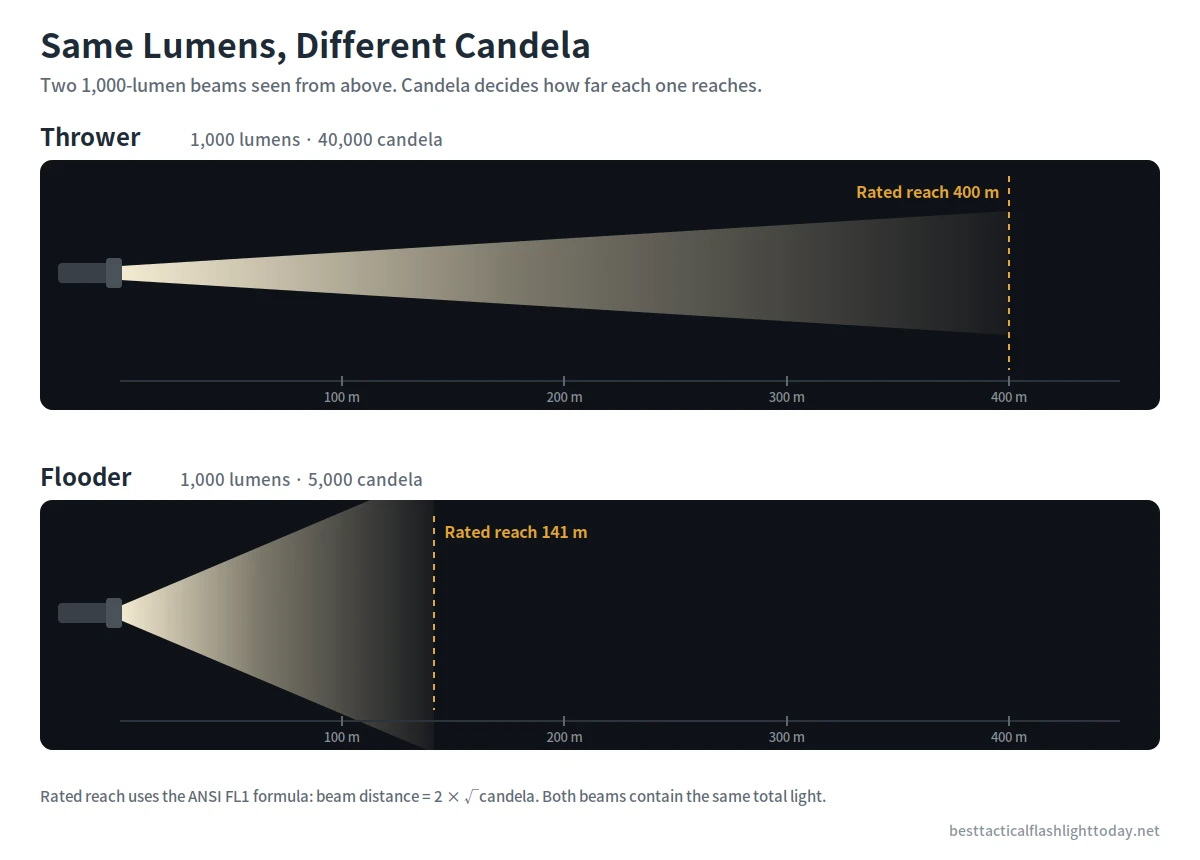
A thrower puts a bright, concentrated spot far downrange. Aim one across a dark field and you can pick out a fence line a few hundred meters away. The trade is peripheral light, since anything well off to the side of the hotspot stays dim.
Throwers suit search work, property checks, security patrols and open terrain: anywhere you need to identify something far away.
Low-Candela Lights (Flooders)
A flooder spreads its output into a wide, even wash. Up close it’s excellent. You see the path, the ground at your feet and everything in your peripheral vision at once.
Point it across a parking lot, though, and the beam thins out to almost nothing. Flooders are the better pick for trails, camp chores, car repairs and blackouts. For outage-ready picks, see our best flashlight for power outages guide.
How Beam Distance Is Calculated
The beam distance printed on the box isn’t a separate measurement. Under the ANSI FL1 standard that reputable brands follow, it comes straight from candela:
A light with 10,000 candela works out to 2 × 100 = 200 meters. At 40,000 candela, it’s 2 × 200 = 400 meters.
That distance is where the beam drops to 0.25 lux, about the brightness of a full moon. You can detect something there, but you can’t really identify it. For recognizing a face or reading a sign, figure on roughly half the listed distance.
One more rule worth remembering: doubling beam distance takes four times the candela. Going from 200 to 400 meters means jumping from 10,000 to 40,000 candela, which is why long-range lights need big reflectors and big batteries.
The 568-Lumen Light That Outthrows 80,000 Lumens
If you want proof that lumens and reach are two separate things, compare these two lights.
The Weltool W4 Pro is an LEP (laser excited phosphor) flashlight that puts out 568 lumens. The Acebeam X75 puts out 80,000 lumens, enough to light up a sports field.
The W4 Pro has well under 1% of the X75’s lumens, yet its beam reaches about three times as far. Roughly 3.4 kilometers against 1.15.
It manages that by squeezing almost all of its output into a beam about 1.8 degrees wide, which produces nearly 2.9 million candela. The X75 does the opposite. It floods a huge area up close, and that light thins out as the distance grows.
Would you want the W4 Pro as your only flashlight? No. Its beam is so narrow that anything outside the center stays dark. But as a demonstration of why lumens alone don’t predict reach, nothing beats it.
The Candela-to-Lumen Ratio
Here’s a quick way to read a beam’s shape straight off the spec sheet. Divide peak candela by lumens.
A high ratio means more of the light is packed into the hotspot. A low ratio means more of it goes into spill. Because it ignores raw output, the ratio lets you compare a slim EDC light and a big searchlight on equal terms.
The clearest example comes from a single product line. SureFire’s X300 Ultra and X300T Turbo share the same body, but one is tuned for a balanced beam and the other for reach.
Nitecore EDC27
The X300T makes 35% fewer lumens than the X300 Ultra, yet it has nearly six times the candela. Run both through the formula above and the Turbo reaches about 514 meters to the Ultra’s 213. Same body, completely different job.
Use these ranges as a rough guide:
When you’re stuck between two lights, run the division. It takes seconds and tells you more about the beam than the marketing copy will.
Candela vs Lumens: Which One Matters More?
Neither, on its own. It depends on what you’re lighting.
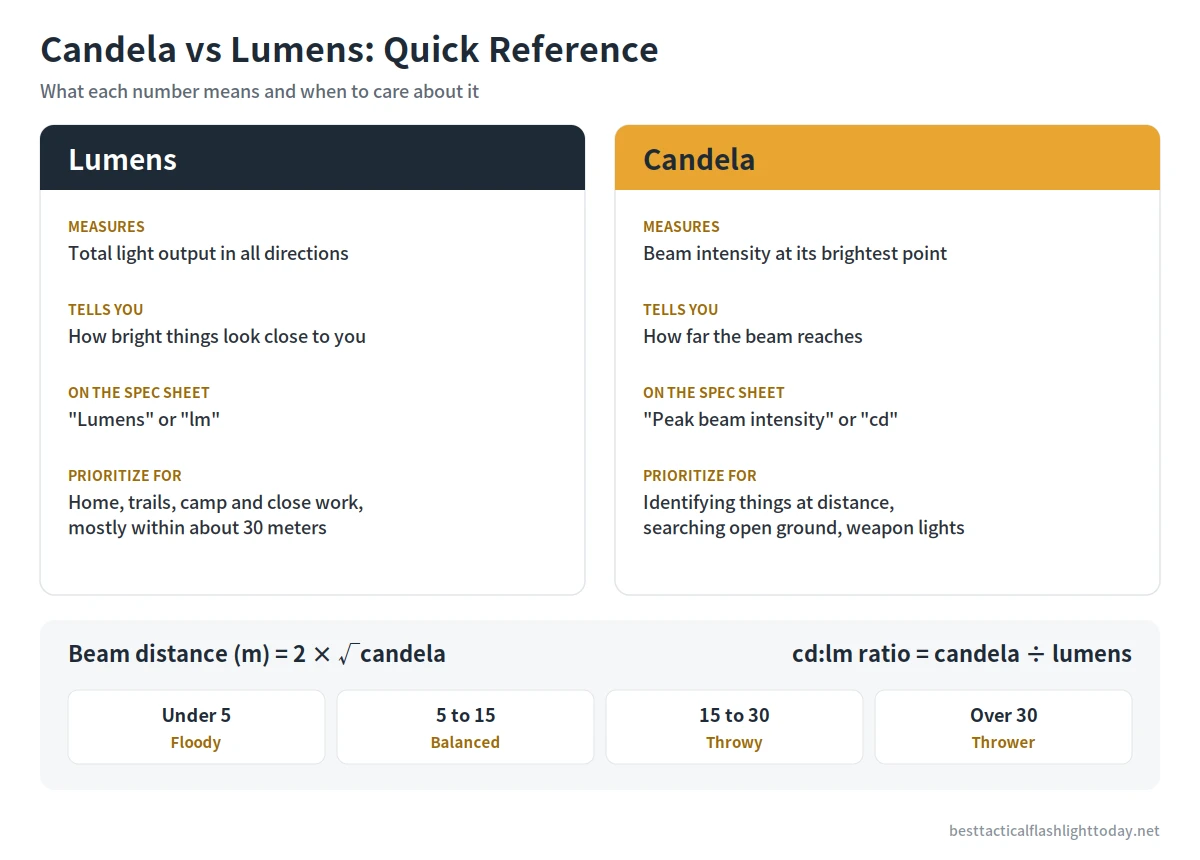
Lumens matter more when most of your use is within about 30 meters: around the house, on a trail, in a tent or under a hood. Wide, even light beats reach in all of those places.
Candela matters more when you need to identify something far away, search open ground or water, or cut through fog, rain or smoke.This is why firefighters choose lights like the Streamlight Survivor X, which makes only 250 lumens but 50,000 candela. See our guide to the best firefighter flashlight
For defensive and weapon lights, candela usually wins, since positive identification at distance is the whole job. That’s why many of the lights in our best pistol lights guide put candela ahead of raw lumens. Indoors, a balanced beam still works best, because too much output bouncing off white walls can wash out your own vision.
For one do-everything light, look for a ratio of about 8 to 15. That gives you enough reach to be useful at distance and enough spill for comfortable close work. Our best EDC flashlights picks are a good place to start.
Beam Profile: Hotspot and Spill
Lumens and candela are numbers. The beam profile is how they show up on the wall: a bright center hotspot surrounded by softer spill.
Some lights have a tight hotspot with almost no spill. They reach far, but walking a trail with one feels like looking through a tube. Others have no visible hotspot at all, just a soft, even wash like a lantern. Pleasant up close, useless at range.
The best all-rounders pair a defined hotspot with generous spill. You aim the hotspot at whatever you care about while the spill keeps you aware of everything around it.
The reflector or optic does most of the shaping. A deep, smooth reflector pushes light into a tight hotspot, while a shallow or textured one (often called orange peel) softens the beam and blends the hotspot into the spill. Reflector size matters too, which is why dedicated throwers have big heads. The emitter plays a part as well. A small LED makes a tighter hotspot, and the tiny light source in LEP lights is a big reason they throw so far.
If reach is your priority, see our best throw flashlight picks.
Real Flashlights Compared
These numbers make the most sense side by side. All figures are manufacturer ratings, sorted by candela.
Nitecore EDC27
*SureFire doesn’t publish a beam distance for the X300T, so this one is calculated from its candela with the ANSI formula.
Look at the two lights rated at 3,000 lumens. The Fenix PD36R ACE reaches 415 meters, nearly twice the Nitecore EDC27’s 220, because it has more than three times the candela. Then look at the X300T. At just 650 lumens, it out-reaches both of them.
The ratio column tells the same story. The EDC27 at 4.1 is a flood light built for close work. The X300T at over 100 is all about the hotspot. The Fenix and the TLR-1 HL-X sit in the balanced middle, which is why they work so well as general-purpose lights.
The Most Common Buying Mistake
It usually goes like this. Someone buys the light with the biggest lumen number they can afford, takes it camping, and points it across the site at their car. The beam fades into a dim glow long before it gets there.
Nothing is wrong with the light. It’s just the wrong light for that job. A flooder built for wide, close coverage was never going to reach across a campsite, and a 1,000-lumen thrower would have done it with ease.
Before you buy, answer one question: do you need to see far away, or do you need to see everything around you?
- Far away: prioritize candela and beam distance.
- Everything around you: prioritize lumens and a wide beam.
- Both: look for a balanced beam with a cd:lm ratio of about 8 to 15.
If budget is the limit, our best budget flashlight guide covers picks that don’t cut corners on the specs that matter.
Candela vs Lumens FAQ
Is higher lumens always better?
No. More lumens means more total light, but if it’s spread wide you get a bright patch that doesn’t reach far. A 650-lumen thrower like the SureFire X300T reaches farther than many 3,000-lumen EDC lights. Match the beam to the job.
How many candela do I need for a tactical flashlight?
For indoor home defense, 5,000 candela or more is enough. If you need to identify someone across a yard or parking lot, look for 20,000 candela or more, which gives a rated beam of about 280 meters and a practical identification range of roughly 140. Duty and rural use benefit from 40,000 and up.
Can a flashlight have both high lumens and high candela?
Yes, but it takes a bigger head and a powerful LED. The Acebeam L35 V2.0 is a good example at 5,000 lumens and 105,625 candela. You pay for it in size, weight and heat, so don’t expect that combination from a keychain light.
What is a good beam distance for everyday carry?
For most people, 150 to 250 meters covers daily needs. That works out to roughly 5,600 to 15,600 candela. More reach is nice, but you’ll rarely use it outside open terrain.
Does the listed beam distance mean I can see clearly that far?
Not quite. The rated distance is where the beam drops to 0.25 lux, about full-moon brightness. You can detect something there, but clear identification happens at around half that distance. A light rated for 400 meters lets you identify things at roughly 200.
What does the candela-to-lumen ratio tell me?
It shows how a light distributes its output. Under 5 is floody, 5 to 15 is balanced, 15 to 30 is throwy, and over 30 is a dedicated thrower with a tight, intense hotspot. Divide candela by lumens on any spec sheet and you’ll know the beam type before you buy.
The Bottom Line
Don’t buy a flashlight on lumens alone. Check the candela and the beam distance, and run the ratio if you want to know the beam’s shape.
Need reach? Prioritize candela. Need wide coverage up close? Prioritize lumens. Not sure? A balanced beam with a ratio of about 10 to 15 handles most real-world situations well, and it’s the safest pick for a single do-everything light.
