
A penlight does one job better than anything else in your pocket. It puts a clean beam into tight spots like a breaker panel or the gap behind a dashboard, and its slim body doesn’t block your view while it does it. A stubby EDC light is great for walking to the car at night, but its fat head gets in the way the moment you lean into an engine bay.
This guide is for people who use a penlight to get work done or carry one every day: mechanics, electricians, home inspectors, and anyone who wants useful light without the bulk. I picked six lights that each win at something specific. They run from a 100 lumen AAA classic to an 850 lumen light that still clips to a shirt pocket.
If you need a penlight for pupil checks or patient exams, you want a different kind of light. My best medical penlights guide covers those.
Quick Picks: The Best Penlights in 2026
Penlight Comparison Chart
1. COAST HP3R: Best Overall
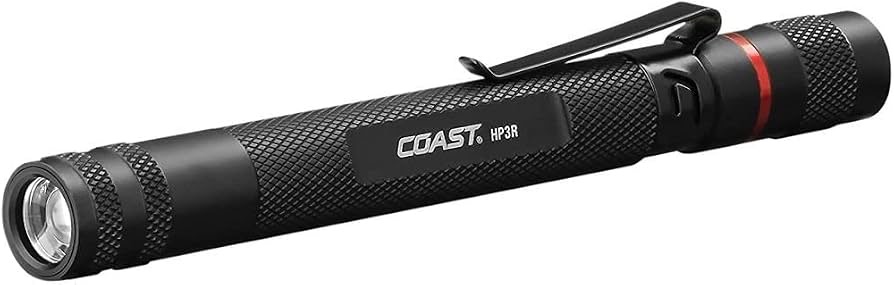
Why I chose it: The HP3R is the penlight I’d hand to someone who isn’t sure what they need yet. Twisting the head slides the beam from a wide flood that fills an engine bay to a tight spot that reaches 89 meters. It’s best for mechanics, inspectors and EDC carriers who want one penlight that handles close work and distance.
Key specs
- Output: 500 / 185 / 26 lumens
- Beam distance: 89 m on high
- Runtime: 1.5 h high, 3.75 h medium, 12 h low
- Power: COAST ZX320 rechargeable cell (USB-C) or 2x AAA
- Size: 5.89 in long, 1.83 oz, IP54
Pros
- Twist focus covers close work and distance in one light
- Keeps running on AAAs when the rechargeable cell is flat
- Rubber bite caps come in the box for hands-free work
Cons
- IP54 handles rain and splashes, not a drop in a bucket
- Older 245 and 385 lumen versions are still listed, so check for 500 lumens and USB-C before you buy
Performance analysis: Treat the AAAs as a backup. Alkaline cells can’t feed it the way the ZX320 can, so expect noticeably less light on them. The cell charges through a USB-C port under the tail cap, or outside the light on its own built-in port, and Coast backs the HP3R with a lifetime warranty.
2. Streamlight Stylus Pro: Best AAA Classic
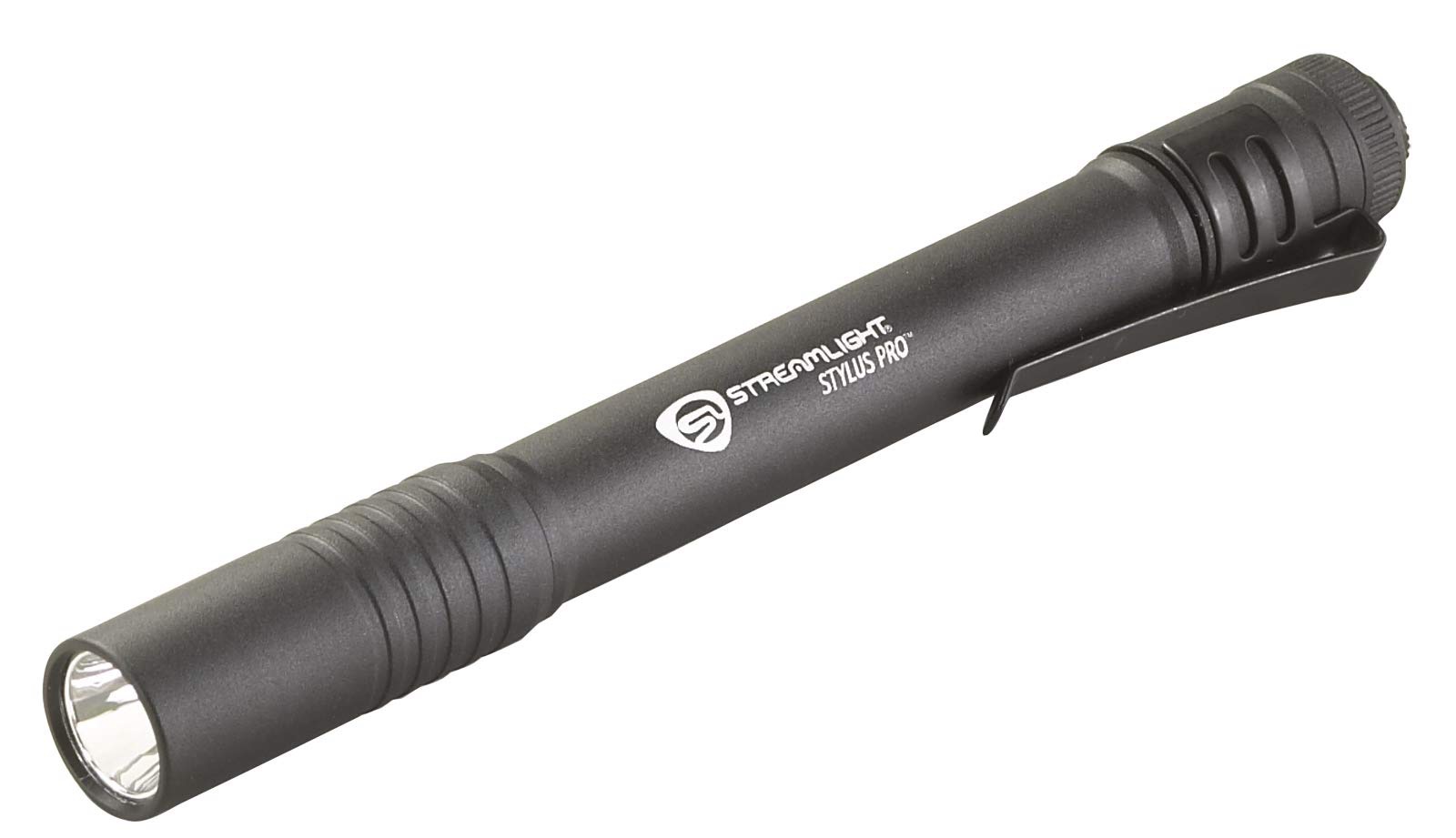
Why I chose it: The Stylus Pro has ridden in work shirts for years because you press the tail button and it works, on two AAAs you can buy at any gas station. It’s best for anyone who never wants to think about a charging cable.
Key specs
- Output: 100 lumens (single mode)
- Beam distance: 62 m
- Runtime: 8 h
- Power: 2x AAA alkaline (included)
- Size: 5.3 in long, 1.64 oz, IPX4, 1 m impact tested
Pros
- Nothing to charge, and spare batteries are everywhere
- Tail switch gives momentary or constant on
- Flashes a strobe to warn you when the batteries are getting low
Cons
- Only one brightness level
- IPX4 means splash resistant, nothing more
Performance analysis: 100 lumens is the right amount of light for work inside arm’s reach. It’s enough to read a VIN plate or check a fuse, and it won’t glare back at you off a white appliance panel the way a 500 lumen light can. Some retailer pages still list 48 lumens, which was the older version, so don’t let that number put you off.
3. Milwaukee 2010R: Best for the Trades
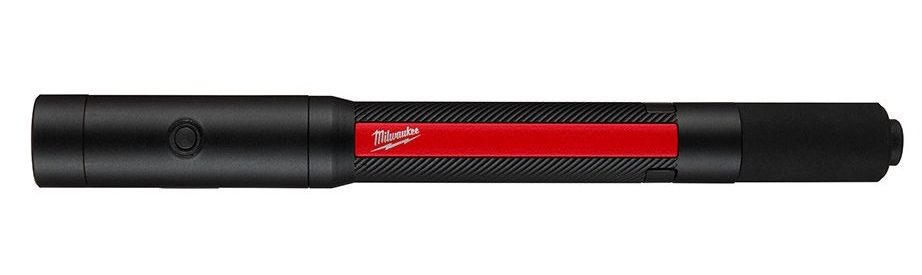
Why I chose it: The built-in laser pointer is what sets it apart. When you’re showing an apprentice which terminal is scorched or pointing out a crack to a homeowner, a laser dot ends the back and forth fast. It’s best for electricians, HVAC techs, plumbers and inspectors.
Key specs
- Output: 250 / 50 lumens
- Runtime: 2 h high, 8 h low
- Power: built-in battery, USB-C charging, three-color battery indicator
- Durability: IP54, 2 m drop rating
- Extras: laser pointer, rubber bite zone, removable metal clip
Pros
- Laser pointer makes it easy to show someone exactly what you mean
- Bite zone frees both hands
- Low mode lasts a full 8 hour shift
Cons
- Built-in battery, so there’s no AAA backup when it runs flat
- 2 year warranty, shorter than the lifetime coverage on the Coast and Streamlight lights
Performance analysis: 50 lumens is plenty for panel and under-sink work, and 250 lumens covers an attic or crawl space. A momentary-on press lets you flash light into a box without clicking it on and off. Some sellers list it as IP67, but Milwaukee’s spec page rates it IP54, so go by the manufacturer.
4. NEXTORCH K30: Brightest Penlight
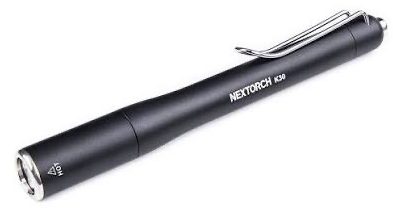
Why I chose it: Most penlights top out around 100 to 250 lumens. The K30 hits 850 on its rechargeable cell and still fits a shirt pocket. It’s best for security staff, patrol officers and EDC carriers who want real reach without carrying a bigger light.
Key specs
- Output on the 10880 cell: 850 / 160 / 20 lumens
- Output on 2x AAA: 400 / 110 / 20 lumens
- Runtime: about 1 h high, 12 h low on either power source
- Beam distance: 95 m
- Size and build: 5.63 in long, aluminum, IPX7
Pros
- Brightest light on this list by a wide margin
- Runs on AAAs, and still makes 400 lumens on them
- IPX7 is the best water rating here
Cons
- A full press of the tail switch fires the strobe, which can catch you off guard during close work
- Rated for drops of about 1 m, half the Milwaukee’s 2 m rating
Performance analysis: That 850 lumen figure is a starting number, not something a pen-size body can hold for long, so treat high as a burst for checking a yard or a parking lot. The 160 lumen medium is where the K30 earns its keep day to day.
5. Streamlight Stylus Reach: Best Flexible Inspection Light
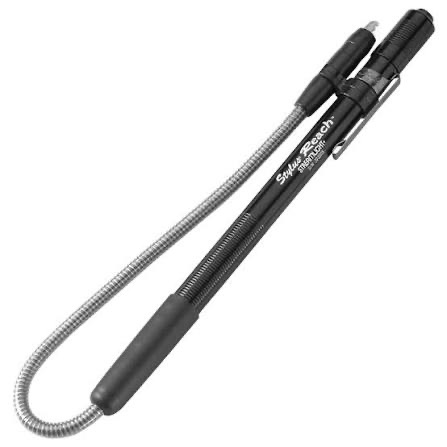
Why I chose it: A straight penlight can only shine where you can point it. The Stylus Reach puts its LED on the end of a 7 inch bendable cable, so you can curl it behind a pipe or into a wall cavity and leave it aimed while you work. It’s best for plumbers, mechanics, gunsmiths and anyone who spends time looking into places their head won’t fit.
Key specs
- Output: 11 lumens, 140 candela
- Runtime: 24 h
- Power: 3x AAAA (included)
- Reach: 7 in flexible cable, 14 in total
- Build: aluminum body, IPX4
Pros
- The cable holds its shape, so the light stays aimed hands-free
- 24 hour runtime means the batteries last for months of occasional use
- An 18 inch cable version (Stylus Reach 18) and an intrinsically safe version are also made
Cons
- 11 lumens is for inspection only, not for lighting a room or a path
- AAAA batteries are harder to find than AAAs
Performance analysis: Don’t judge this light by its lumen number. At the end of a 7 inch cable the LED sits a couple of inches from what you’re looking at, and at that distance 11 lumens is plenty.
6. Olight O’Pen Glow: Best Pen with a Light
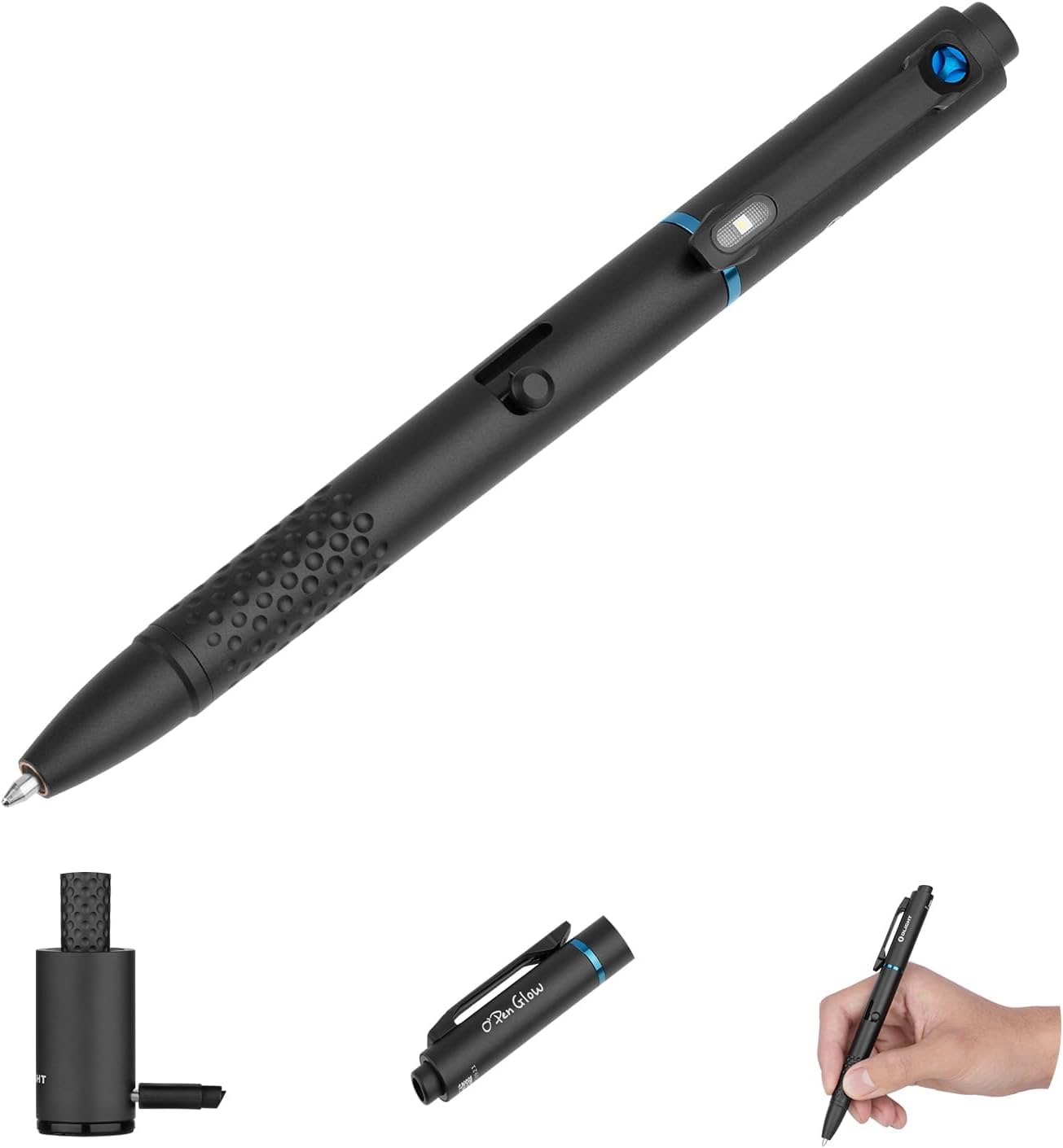
Why I chose it: The O’Pen Glow is an actual pen, with a bolt-action ballpoint, a light built into the clip and a green laser pointer. It’s best for anyone who writes notes in dim rooms and wants one tool in the pocket instead of two.
Key specs
- Output: 120 / 60 / 20 / 5 lumens, plus a 0.2 lumen glow at the pen tip
- Runtime: 14 min at 120 lumens, then 21 min at 60; 5 h on the 5 lumen mode
- Power: built-in rechargeable battery, USB charging dock included
- Extras: green laser pointer, detachable clip light
- Size: 6.1 in long, 1.34 oz, IPX4
Pros
- Writes like a normal pen, so it never feels like extra carry
- The tip glow lets you see the page without lighting up the whole room
- Laser pointer is handy for presentations and pointing out shelf locations
Cons
- Short runtime on the higher modes because the battery is tiny
- A laser pointer makes it a poor choice to hand to kids
Performance analysis: Think of this as a pen that also lights, not a flashlight that also writes. The 20 lumen mode is the one you’ll use most, for reading labels or finding a keyhole, and it runs nearly two hours. If you need sustained light for real work, pair it with the Stylus Pro or the HP3R.
How Bright Should a Penlight Be?
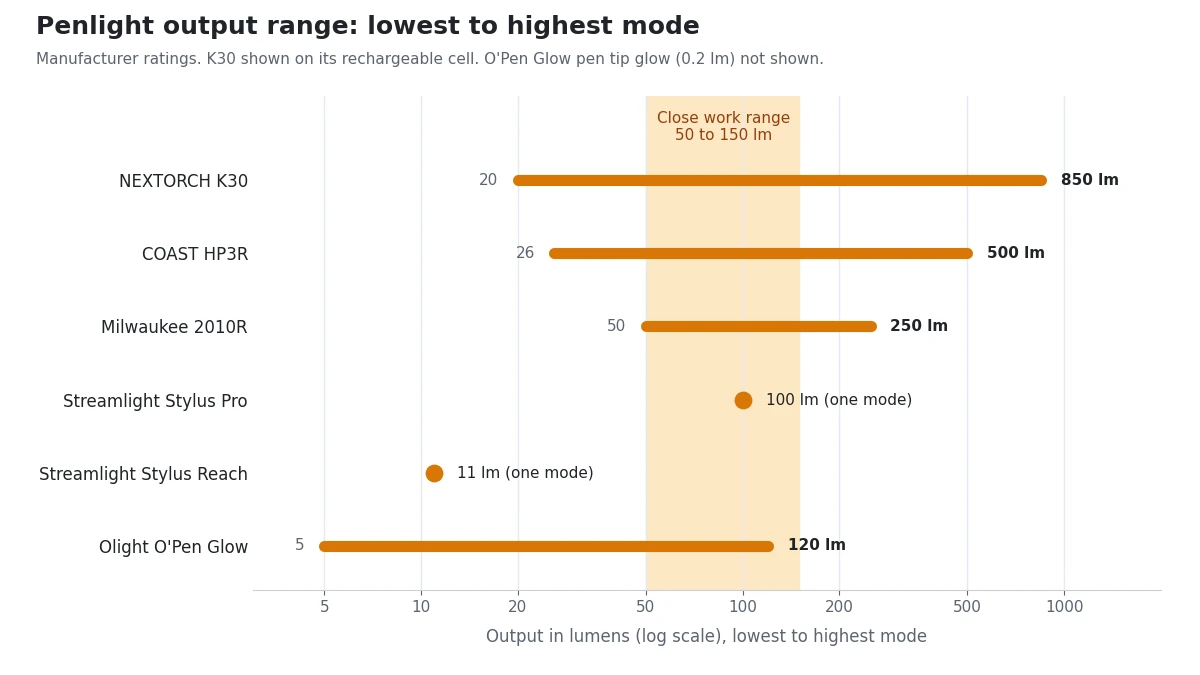
For close work, 50 to 150 lumens is the useful range. Inside arm’s reach, extra light mostly bounces off shiny metal and white panels and makes details harder to see. Higher output earns its place when you’re looking across a yard, into a dark attic or under a car from a few feet away.
The chart below shows the lowest and highest mode of each light on this list. The Stylus Pro sits at a single 100 lumen point, while the K30 covers everything from 20 to 850.
Two things the number on the box won’t tell you:
- High modes step down. A pen-size body can’t shed heat fast enough to hold its top output, so the K30’s 850 and the HP3R’s 500 are short bursts. Runtime ratings under the ANSI FL1 standard count until output falls to 10% of where it started, which means a “1 hour” rating on high is not an hour at full brightness.
- Lumens and reach are different numbers. Lumens tell you how much light comes out. Candela tells you how far it carries. My candela vs lumens guide explains why a 100 lumen spot can outreach a 300 lumen flood.
Buying Guide: What to Look For in a Penlight
Power source. AAA lights like the Stylus Pro never need a cable, and spare batteries are sold everywhere. Built-in batteries, as on the Milwaukee and the O’Pen Glow, are convenient right up until they run flat with no backup. Dual power lights like the HP3R and the K30 give you both, so they’re the safest pick if you only want to own one penlight.
Charging port in dirty work. Grease and drywall dust can pack into an open USB port and stop it charging. If you work in grime, look for a port that’s covered or hidden under the tail cap, as on the HP3R, or skip charging entirely with an AAA light.
Beam type. A flood beam lights the whole area in front of you, which is what you want for close work. A spot beam reaches farther but leaves the edges dark. Twist focus gives you both in one light.
Switch and clip. A tail switch with momentary-on lets you flash light into a panel without clicking through modes. The clip should grip a shirt pocket hard enough to stay put when you lean over an engine.
Water and drop ratings. IPX4 covers rain and splashes, IP54 adds protection against dust, and IPX7 survives a dunk. A 1 to 2 meter drop rating covers the usual fall from your hand onto concrete.
Need a Penlight for Patient Exams?
Then skip the lights above. Pupil checks call for low, steady output, a warm beam with accurate color, and ideally a printed pupil gauge on the barrel. A 500 lumen work light is the wrong tool to point at someone’s eyes. My best medical penlights guide covers six lights built for nurses, EMTs and doctors.
Penlight FAQ
How many lumens should a penlight have?
For close work like reading labels, checking fuses or looking under a sink, 50 to 150 lumens is enough. Go for 250 lumens or more only if you also need to light up a yard or an attic.
Is a rechargeable penlight better than one that takes AAA batteries?
A rechargeable is cheaper to run if you use your penlight every day. AAA lights are better for gloveboxes, emergency kits and dirty job sites where a charging port can clog. A dual power penlight like the COAST HP3R or NEXTORCH K30 gives you both.
What’s the difference between a penlight and a flashlight?
A penlight is a flashlight with a slim, pen-shaped body, usually around half an inch across. That shape lets it reach into gaps a regular flashlight’s head can’t, and it clips into a shirt pocket like a pen.
What batteries do penlights use?
Most take two AAAs. Very slim models like the Stylus Reach use AAAA cells, and many newer penlights have a built-in rechargeable battery. Dual power lights ship with a small rechargeable lithium cell and accept two AAAs as a backup.
The Bottom Line
If you want one penlight that does nearly everything, get the COAST HP3R. If you’d rather never charge anything, the Streamlight Stylus Pro is still the simplest penlight worth carrying. Tradespeople should look hard at the Milwaukee 2010R for its laser and bite zone, and the NEXTORCH K30 is the pick when brightness matters most. Keep the Stylus Reach in your toolbox for the jobs a straight light can’t reach, and if you’d rather carry one tool than two, the O’Pen Glow writes and lights. Pair any of them with a main light from my best EDC flashlights guide and you’re covered.
