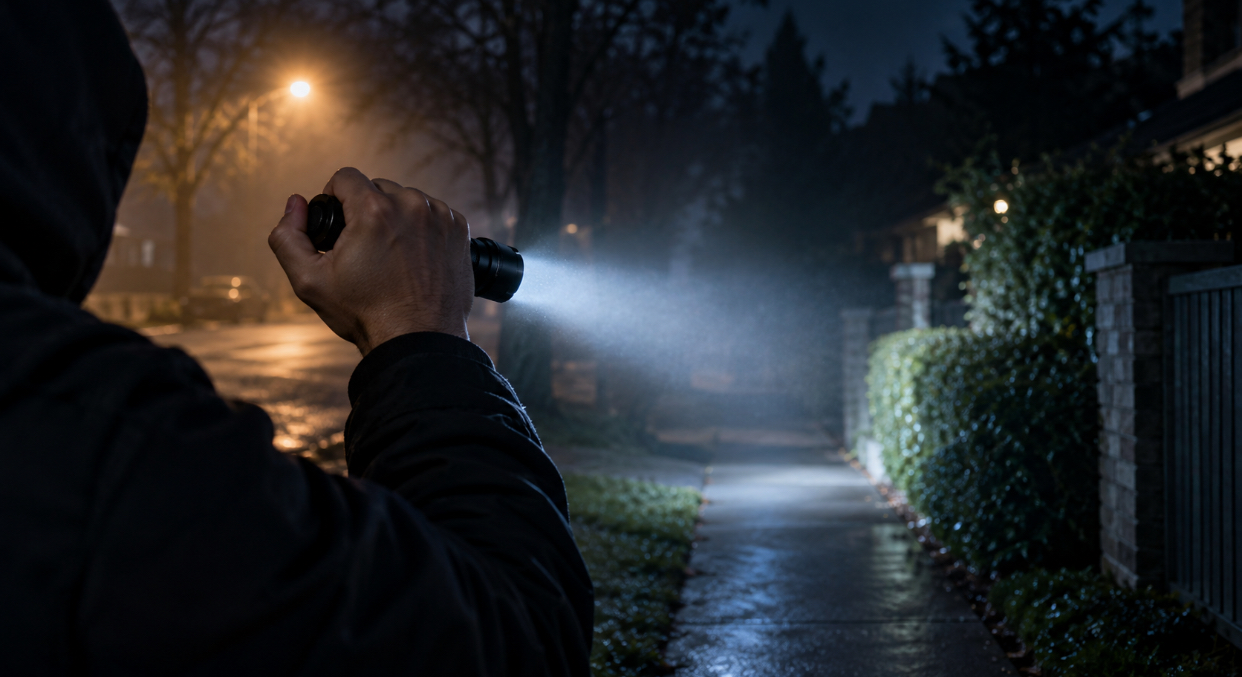
Most people picture using a flashlight as a weapon the wrong way round. They think of the hard aluminum body first and the beam second. In a real confrontation, the beam does most of the work and the body is the backup.
I’ve carried a tactical light every day for well over a decade, and the honest answer to “can a flashlight be used as a weapon?” is yes, with two conditions. You have to use it in the right order, and you have to stay inside what the law allows. Get either one wrong and a tool that should have bought you time ends up costing you.
Quick answer: a flashlight is legal to carry almost anywhere in the US, and using one in self defense is judged like any other use of force. Light the person from a distance, warn them, and put the beam in their eyes if they keep coming. Then leave. Strike only if they close the gap anyway, and only until you can get away.
Is a Flashlight Legally a Weapon?
A plain flashlight isn’t a weapon until someone uses it as one. That’s how most US criminal law treats ordinary objects.
Texas spells it out clearly. Its Penal Code defines a deadly weapon in two ways. The first is anything made or adapted to cause death or serious injury. The second is anything that, in the way it’s used or meant to be used, is capable of causing death or serious injury. Lawyers call these weapons by design and weapons by use. Other states word it differently, but judging an everyday object by how it was used runs through US criminal law.
A standard tactical flashlight sits in the second group. Carrying it is no different from carrying a pen. It only becomes a weapon in the legal sense when you swing it at someone, and at that point the question is whether you were justified.
Where strike bezels change things
A light with sharp, toothed crenellations around the lens is harder to call a plain tool. To a prosecutor or a jury, those teeth can look like they were added to hurt people, which pushes the light toward the “by design” side.
My view sits in the middle. A mild, rounded bezel protects the lens when you set the light face down and still adds bite to a strike. Sharp, pointed teeth add little that a plain bezel doesn’t, and they’re the first thing anyone will ask you about after an incident.
Carrying one
In most places a flashlight isn’t regulated at all. Courthouses, schools, airports and other screened buildings are the exception, since security staff can treat an aggressive bezel light as a weapon. Use of force laws vary by state and city, so check yours, and treat this section as general information rather than legal advice.
The Sequence: See, Warn, Blind, Leave
Most violent encounters never involve a weapon at all. A Justice Department report covering nearly a decade of crime survey data found that about 26% of violent crimes involved an armed offender. That leaves roughly three in four where the other person had nothing but their hands, which is exactly the kind of situation a flashlight handles well.
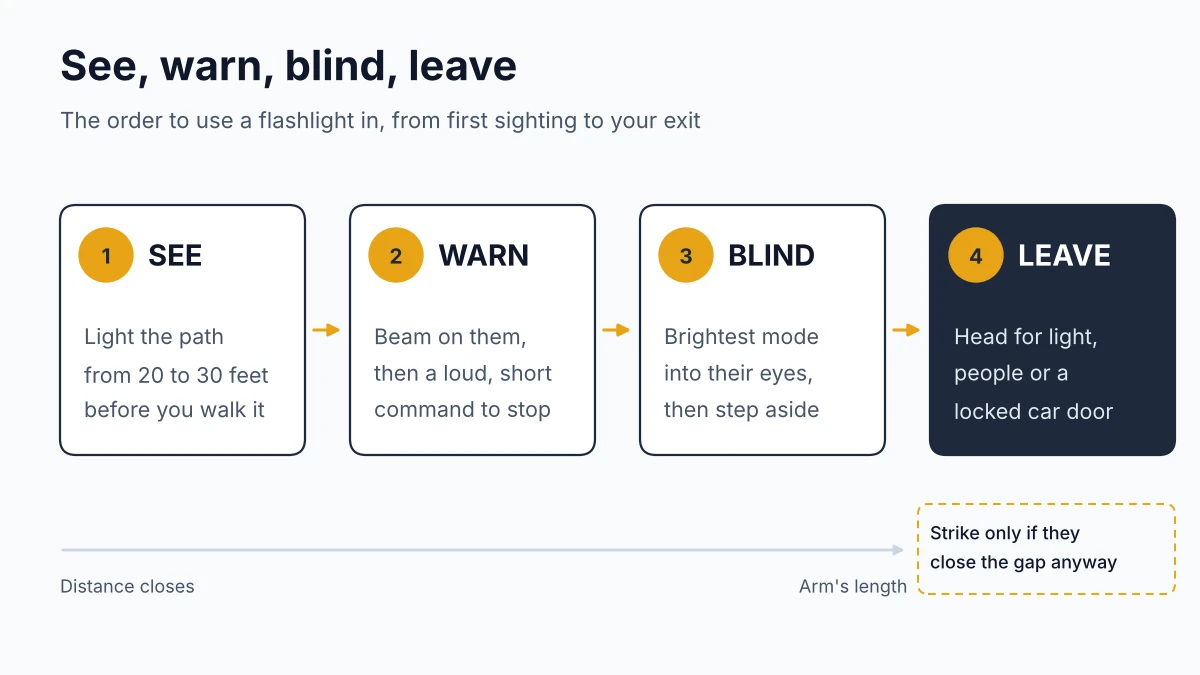
- See. Light up the path before you walk it. A parking lot, a stairwell or the side of your house at night all have spots where someone can wait unseen. Sweeping them from 20 or 30 feet takes away the surprise, and someone looking for an easy target often moves on once a bright beam lands on them.
- Warn. If a person approaches and something feels off, keep the light on them and speak up. A short, loud command like “Stop, stay back” gives them a clear chance to walk away. It also gives any witness a clear picture of who was trying to avoid trouble.
- Blind. If they keep closing in after that, put the brightest mode straight into their eyes. Eyes adjusted to the dark get a moment of near blindness, and almost everyone turns their head or throws up a hand. Take a big step to the side as you do it, so you’re no longer where they last saw you.
- Leave. That moment is your exit, not an opening to fight. Move toward light, people or a locked car door, and keep the beam on them while you go if you can.
Contact isn’t on this list. If you start the sequence early, most situations end at step three or sooner.
Grips That Keep the Light On
How you hold the light decides what you can do with it. You want one grip that keeps your thumb on the switch and works for striking without any change of hands.
The reverse grip
Hold the light in your fist with the head sticking out below your little finger and your thumb resting on the tail switch. Raise your hand to about cheek height and the beam lines up with your eyes, so it points wherever you look. From here, one press of the thumb lights up a face, and the bezel is already in place for a hammer fist strike.
This is the grip to train first, and it’s why a tail switch matters. A side switch is hard to find with your thumb here, especially with cold or shaking hands.
The forward grip
This is how most people pick up a flashlight, with the head out past the thumb like a hammer handle. On a tail switch light, though, your thumb can’t reach the button without shifting your hand, so move to the reverse grip the moment something feels wrong.
You can see both grips in motion, along with four handgun techniques, in the grip explorer further down.
When the Flashlight Becomes an Impact Tool
If someone ignores the warning, shrugs off the beam and grabs for you, the light becomes something to hit with. Think of it as a hard extension of your fist, the same idea as a kubotan or yawara stick.
From the reverse grip, the strike is a hammer fist. Bring the bezel straight down or across, like pounding a table. Your free hand stays up in front of you to fend off grabs and judge the distance. Hit whatever is reaching for you, then step away. You’re after a gap big enough to run through, not a knockout.
Be realistic about what this achieves. A 5 inch aluminum light can hurt, but an attacker full of adrenaline often won’t stop after one hit. It changes the fight far more often than it ends it.
The legal line moves fast here. Force has to match the threat, and it has to stop when the threat stops. Hitting someone who has backed off, fallen or started running turns you from the defender into the attacker in the eyes of the law. If you’ve made space, use it to go.
Does Strobe Actually Work?
Strobe is the most oversold feature in defensive lights. It has a use, but it’s narrower than the marketing suggests.
A fast flash makes it hard for someone to judge your distance or track your movement, and it’s very unpleasant to look at. At 15 feet or more, it can make an approaching person hesitate.
The problem shows up at arm’s length. Strobe flickers on your target too, so you lose a clear view of their hands, which is the thing you most need to watch. It also bounces off nearby walls and back into your own eyes. Up close, a steady beam on maximum blinds just as well and lets you keep seeing.
Access matters more than the mode itself. If strobe sits three clicks deep in a menu, you won’t reach it under stress. The lights worth carrying put strobe on the tail switch or a quick double press, and many let you switch it off completely. If yours can’t reach strobe instantly, set it to open on its brightest steady mode instead.
What Makes a Light Good for This
Any flashlight beats an empty hand, but a few features separate a light you can defend yourself with from one that just finds your keys.
Two lights from my roundup show the range. The Olight Warrior 3S has the most intense beam of my picks at 23,000 candela, with a two stage tail switch that sits right under the thumb. The Streamlight ProTac 2L-X is gentler on paper, but it runs on CR123A cells and its tail switch is dead simple, which makes it a good glovebox or nightstand light.
My best self defense flashlight guide compares six picks on beam intensity and strobe access.
Using a Flashlight With a Handgun
If you carry a gun, the flashlight is how you identify what you’re looking at before you decide anything. You can’t legally draw on a shape in the dark, and as the numbers above show, most encounters don’t justify a firearm at all. The see, warn, blind, leave sequence still comes first.
When drawing is justified, four handheld techniques let you run a light and a pistol together: Harries, cigar, neck index and FBI. The explorer below shows each one next to the two grips from earlier, with where the beam goes and the trade off of each.
At home, think twice before searching. Lighting a room from a safe spot and calling 911 is usually smarter than clearing hallways alone. If a handgun is part of your home plan, a mounted light frees both hands, and my best pistol lights guide covers the options.
How to Practice
Reading about flashlight self defense techniques won’t help in the moment. A few minutes a week with your own light will.
Draw and light
Start with the light where you normally carry it. On a “go” from a phone timer, draw it into the reverse grip and put the beam on a spot on the wall at face height. Do ten a day. Within a couple of weeks it’ll take you about a second, and you’ll find out whether your pocket or holster gets in the way.
Command and step
Stand facing a door frame or a mirror. Light it, say your command out loud, then drop the beam to eye height and take a big step to the side. Saying the words out loud feels awkward at first, and that’s the point. You want them to come out on their own when it counts.
Strike a pad
Tape a folded towel or a cheap kick pad to a wall or post. From the reverse grip, practice hammer fist strikes with your free hand up, then step back and away after each pair. Afterward, check that the lens and switch still work.
After It’s Over
Once you’re safe, call 911 even if nobody was hurt. Tell them someone came at you and you got away. The first report often shapes how an incident is seen, and a person who took a beam to the face may well call it in first.
Keep your statement short and stick to facts. Point out any witnesses or cameras nearby. If you struck someone, it’s reasonable to tell officers you’ll give a full statement once you’ve spoken to a lawyer.
FAQ
Can a flashlight be considered a deadly weapon?
Yes, depending on how it’s used. Under laws like Texas’s, an ordinary object becomes a deadly weapon when it’s used in a way capable of causing death or serious injury. Simply carrying a flashlight doesn’t make it one.
Is it legal to carry a tactical flashlight?
In most of the US, yes, and almost anywhere. Screened buildings like courthouses and schools may turn away lights with sharp strike bezels.
Can you bring a tactical flashlight on a plane?
Usually, yes. The TSA allows flashlights in carry on and checked bags, though the officer at the checkpoint has the final say. Sharp bezels draw the most attention, and spare lithium batteries belong in your carry on.
Is a flashlight better than pepper spray for self defense?
They do different jobs. Pepper spray is made for one purpose and can stop someone without contact, but some states and cities restrict it and it can’t go in your carry on. A flashlight goes almost everywhere, and you’ll use it every day for ordinary things. Plenty of people carry both.
The Bottom Line
A flashlight makes a good weapon mostly because you rarely have to use it as one. Light the person early, speak up, put the beam in their eyes and leave. Keep strikes as the backup for when someone closes the gap anyway, and stop the moment you can get away.
Pick a light with a tail switch and a strong beam, carry it every day and practice the draw until it’s automatic. If you’re still choosing one, start with my best self defense flashlight picks.
