
Open the pantry in most houses during an ice storm and you’ll find the real emergency food supply. There’s a can of chili that moved in with the last owners, half a sleeve of saltines, a bag of rice nobody remembers buying and a jar of peanut butter with a valley carved down the middle. That holds up fine on a dark Saturday night. By day three, with the freezer weeping onto the kitchen floor and the road out glazed over and strung with power lines, it starts to look like the bottom of a duffel bag.
Short on time? Skip to my picks
So folks go shopping for a bucket, and every bucket has a big number on the front. That number is servings, and a serving can be a cup of oatmeal or a scoop of drink mix. One popular 14-day bucket counts 150 servings, and 56 of them are drink mix and powdered milk. A best-selling 30-day pail comes in versions that look nearly the same, and one of them hands you about 530 fewer calories a day than the other.
The picks below are sized up by the number that keeps you on your feet, calories per day, and by what each one needs to get from the bag to your belly: a pot of boiling water, a splash of cold, or nothing at all. You’ll also find a planner that adds up real days for your own household, plus the stuff the labels skip, like the 15 gallons of water one pail drinks before you do.
Quick Picks: The Best Emergency Food Supply
- Mountain House Classic Bucket: best for picky eaters, small households and a first bucket.
- ReadyWise 14-Day Emergency Food Bucket: best for one person for two weeks, or a family of four for a long weekend.
- Peak Refuel MAX Bucket: best for hard workers, hunters and campers who will eat it and replace it.
- Augason Farms 30-Day QSS Pail: best for a month of food for one person at the lowest cost per calorie of any bucket here.
- Datrex 3600 Emergency Food Bar: best for cars, go-bags and the drawer at work.
- MRE Star Full Meal Case with Heaters: best for hot meals with the power out and no stove or fuel.
Emergency Food Supplies Compared
Real days assume one adult eating 2,000 calories a day. The MRE Star case counts 12 meals at about 1,200 calories each.
Feed Planner: How Many Days Will Your Food Really Last?
Tell the planner who eats at your table and what’s on your shelf. It counts calories instead of servings, then shows how many days you’re covered, the water to set aside, how many days you can eat with no stove, and what a hot garage does to the shelf life.
Here’s the short version for a single adult. Each bar is one package of each pick, divided by 2,000 calories a day.

1. Mountain House Classic Bucket: Best Tasting
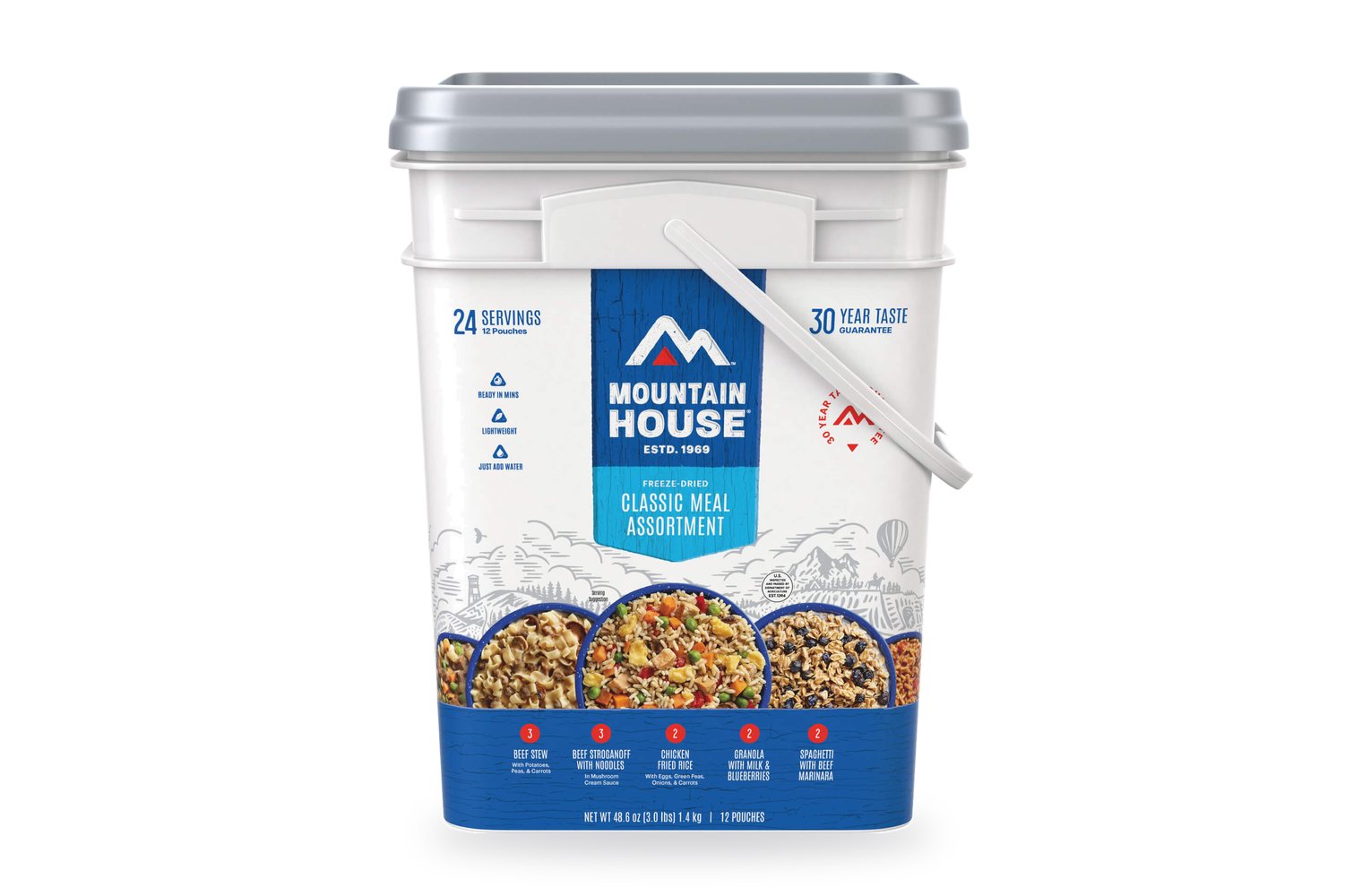
Why I chose it: Morale is a real thing on day four of a blackout, and nothing lifts it like a hot meal that tastes like somebody cooked it. Mountain House has been the benchmark for freeze-dried food for decades, and this bucket holds their greatest hits: Beef Stew, Beef Stroganoff, Classic Spaghetti, Chicken Fried Rice and Granola with Milk and Blueberries. You tear the top, pour water in the pouch, seal it and wait about ten minutes. No pot, no dishes.
The part that sold me for outages is that it doesn’t need hot water. Mountain House says cold water works too and just takes about twice as long, so a dead stove doesn’t mean a dead supper.
Key specs
- Pouches: 12, labeled as 24 servings
- Total calories: about 6,100
- Real days, 1 adult: about 3
- Water per pouch: 1 to 2 cups
- Ready in: about 10 minutes hot
- Shelf life: 30-year taste guarantee
- Bucket: 5.7 lb, about 12 x 10 x 12 in
Pros
- Tastes like real food, even to kids
- Cooks in the pouch, so there’s no pot to scrub
- Cold water works when the stove can’t
- Small and light enough for a closet shelf
Cons
- Only about three days of food for one adult
- Some meals run over 1,000 mg of sodium a serving
- Costs the most per calorie of the buckets here
In real use: A two-serving pouch makes a fair supper for one hungry adult, so think of this bucket as twelve meals. Stack it on top of a bigger, plainer bucket and the family gets one meal a day they look forward to.
2. ReadyWise 14-Day Emergency Food Bucket: Best Two-Week Supply
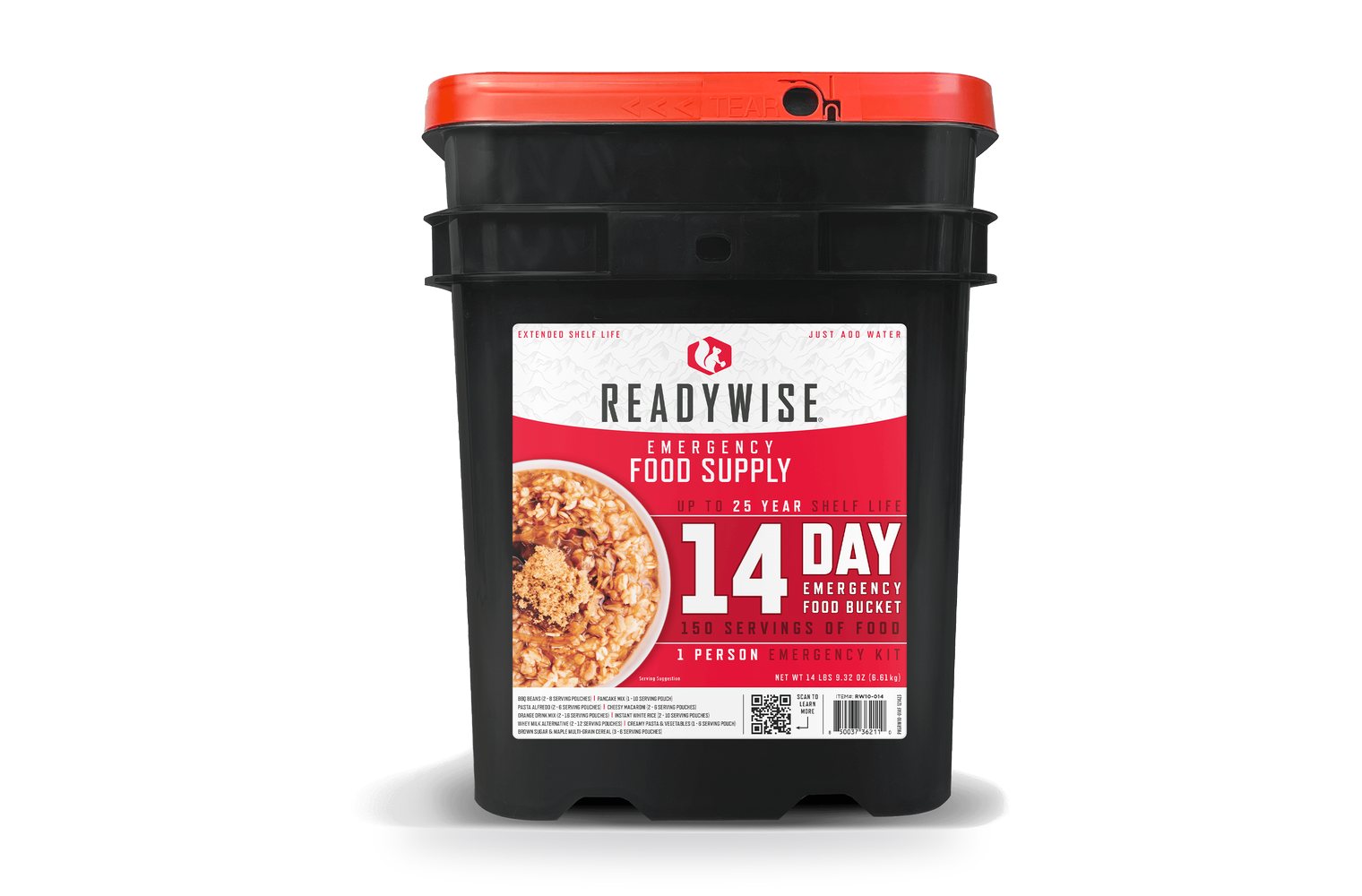
Why I chose it: ReadyWise is the bucket people keep searching for this winter, and for a two-week stash it makes sense. This one packs 150 servings and 25,580 calories into a stackable bucket with a carry handle. ReadyWise rates it at 1,800 calories a day for 14 days, which works out to a little under 13 days for an adult eating 2,000.
Know what the servings are, though. Of the 150, 56 are orange drink mix and whey milk powder, and the rest is cereal, pancake mix, rice, beans and pasta dishes. That’s why the calorie count matters more than the number on the lid.
Key specs
- Servings: 150, in 6-serving pouches
- Total calories: 25,580
- Label: 1,800 calories a day for 14 days
- Real days, 1 adult: about 12.8
- Water to prepare: about 100 cups
- Prep: boil water in a pot, stir in, stand 12 to 15 min
- Shelf life: up to 25 years
Pros
- A lot of food in one bucket
- Long shelf life for a set-and-forget closet
- Stacks neatly with a second bucket
- Built-in handle makes it easy to grab and go
Cons
- Needs a pot and a burner for most meals
- 1,800 calories a day runs short for hard workers
- Plainer flavor than Mountain House
In real use: Each pouch holds six servings, so you’ll boil water in a pot, stir the mix in, cover it and let it stand. ReadyWise figures about 100 cups of water for the whole bucket. That means a working camp stove and fuel. Cook on the porch or in the open garage door, never in the kitchen with the windows shut. Servings are small, so add peanut butter or a can of tuna for anybody doing heavy work.
3. Peak Refuel MAX Bucket: Best High-Protein
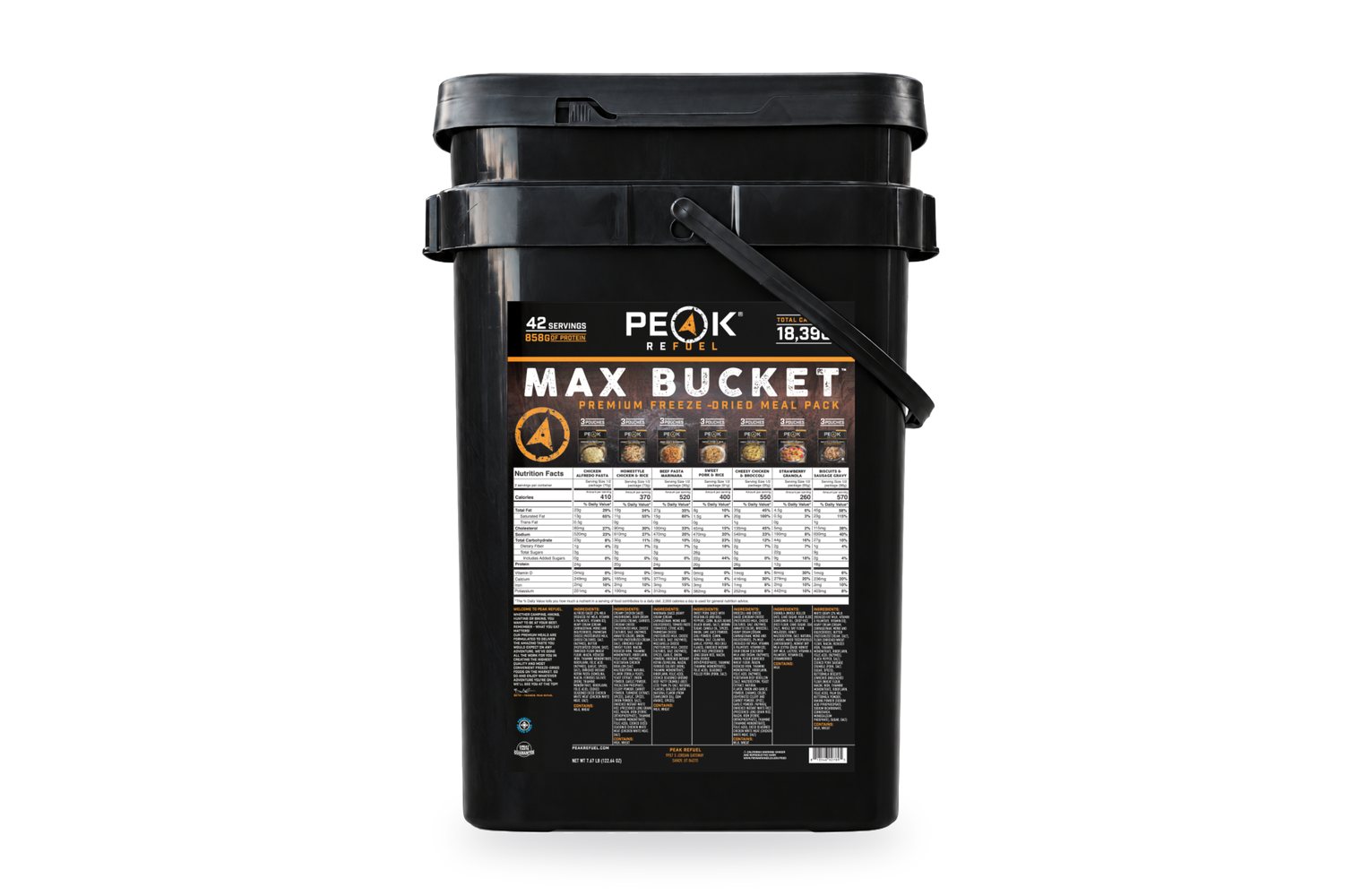
Why I chose it: When the ice storm drops a pine across your driveway, somebody is going to spend a day on a chainsaw, and oatmeal won’t carry them. Peak Refuel uses real meat with no TVP filler, and the new MAX Bucket averages about 40 grams of protein a pouch. Its 21 pouches add up to 18,390 calories and 858 grams of protein.
The menu reads like hunting camp: Chicken Alfredo Pasta, Homestyle Chicken and Rice, Beef Pasta Marinara, Sweet Pork and Rice, Cheesy Chicken and Broccoli, Strawberry Granola and Biscuits and Sausage Gravy, three of each.
Key specs
- Pouches: 21, labeled as 42 servings
- Total calories: 18,390
- Total protein: 858 g
- Real days, 1 adult: about 9
- Prep: hot water in the pouch
- Shelf life: 5 years
- Bucket: 9 gallons with a hinged lid
Pros
- More calories and protein per pouch than most buckets
- Real meat that eats like a meal, not a side dish
- Cooks in the pouch with no cleanup
- Doubles as camping and hunting food
Cons
- Five-year shelf life, so plan to rotate it
- Costs more per day of food than the big buckets
- The 9-gallon bucket takes real closet space
In real use: Treat this as the working bucket and feed the person doing the heavy lifting from it. Since it keeps about five years, it shines in a house that camps or hunts. Take a few pouches on every trip and replace them.
4. Augason Farms 30-Day QSS Pail: Best Value
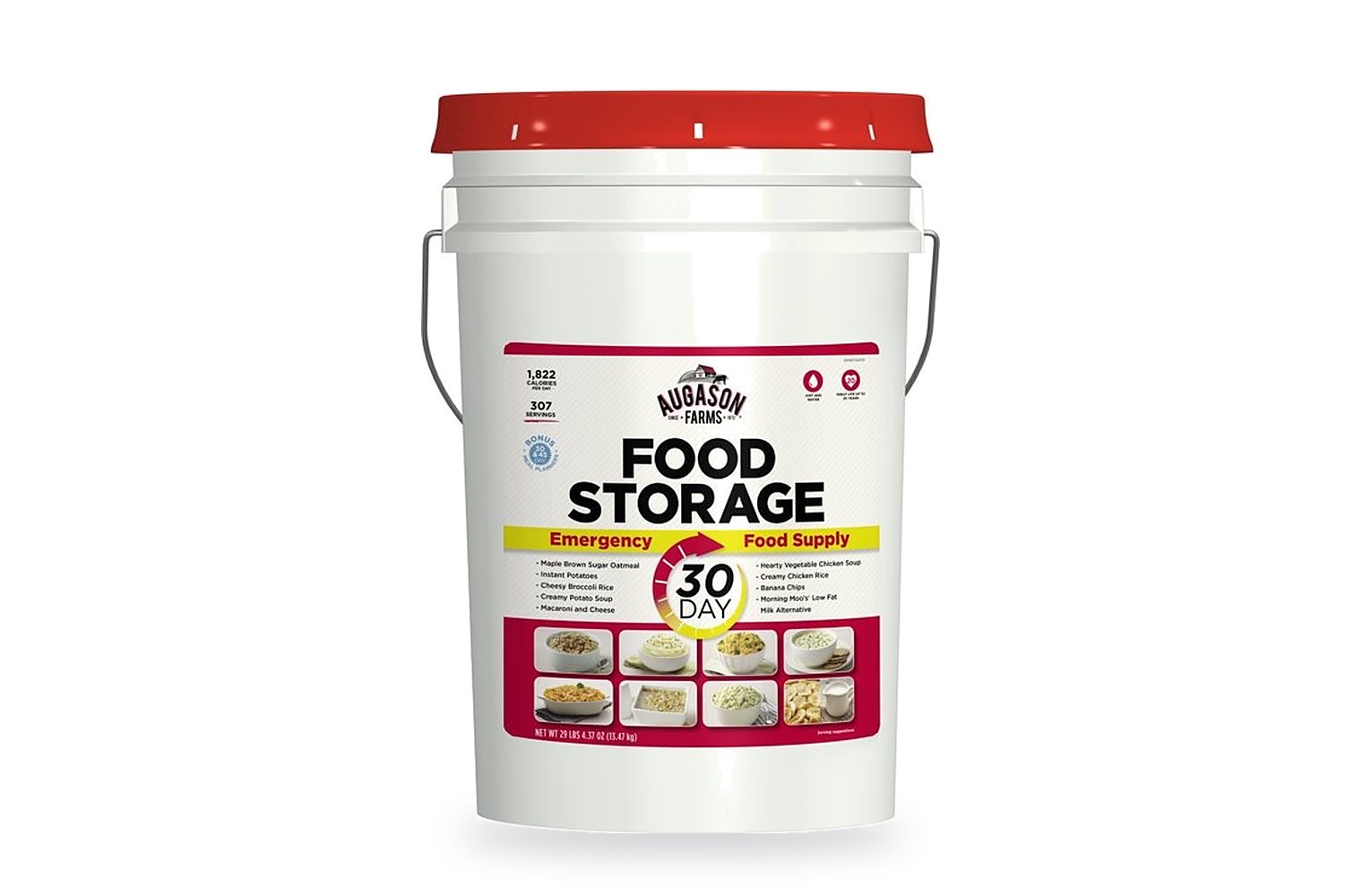
Why I chose it: If you want a month of food in one pail, this is the one, as long as you get the right version. The 307-serving pail is rated at 1,822 calories a day for one person for 30 days, which adds up to about 54,700 calories. It also comes with a 30-day and a 45-day meal planner, so you know what to cook each day without doing math by lantern light.
Watch the label. Augason sells other 30-day pails that look almost the same and list 1,290 or 1,236 calories a day. Look for 307 servings and 1,822 calories a day on the front of the pail before you buy.
Key specs
- Servings: 307
- Total calories: about 54,700
- Per day: 1,822 calories
- Real days, 1 adult: about 27
- Water to prepare: about 15 gallons for the pail
- Prep: add water and cook 12 to 15 minutes
- Shelf life: up to 25 years, shorter on some items
- Pail: 8.5 gallons with a handle
Pros
- The most calories of any pick here
- Lowest cost per calorie of the buckets
- Meal planner takes the guesswork out
- One pail covers a family of four for about a week
Cons
- Nearly every meal needs a pot, a burner and fuel
- Soups, rice and potato dishes get repetitive
- Drinks about 15 gallons of water on top of your drinking water
In real use: This is pantry food in a pail, and it cooks like pantry food. You’ll simmer the soups and rice in a pot, so pair it with a camp stove, a stack of propane canisters and a case of water. The pail makes a decent stool while you stir.
5. Datrex 3600 Emergency Food Bar: Best for Car and Go-Bag
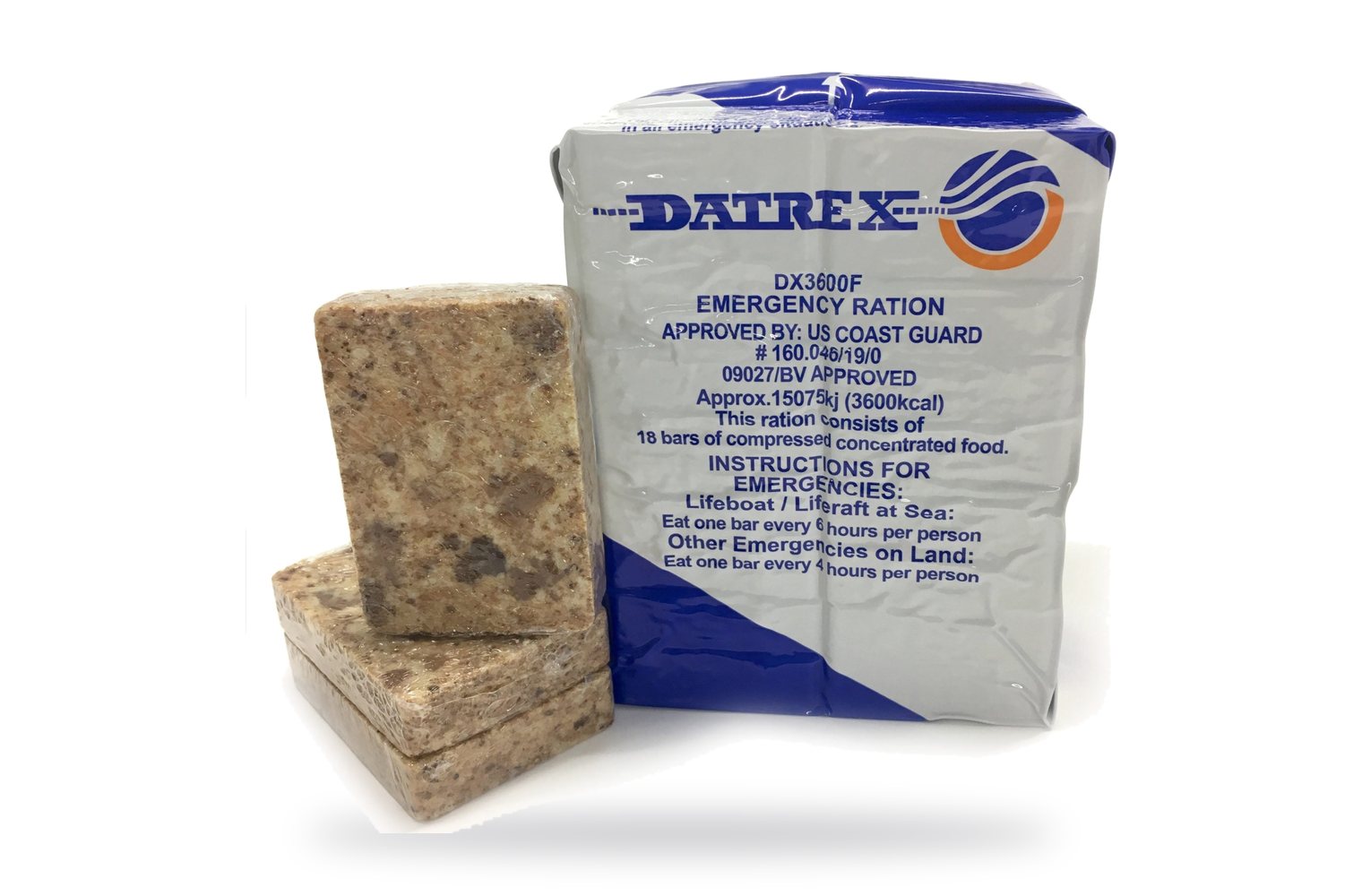
Why I chose it: A car trunk in July can bake regular food in a week. Datrex bars are lifeboat rations approved by the U.S. Coast Guard and rated for storage from -22 to 149°F, so they live in the trunk, the go-bag and the drawer at work without complaint. Each foil pack holds 18 bars of 200 calories, and they taste like a crumbly coconut shortbread cookie.
They need no water or cooking and are made to not make you thirsty, which matters when your water is a few bottles rolling around the back seat.
Key specs
- Bars: 18 x 200 calories
- Total calories: 3,600
- Real days, 1 adult: about 1.8
- Prep: none
- Storage range: -22 to 149°F
- Shelf life: 5 years
- Approval: U.S. Coast Guard
Pros
- Survives a hot car better than any food here
- Eat it anywhere, even while walking
- Small enough for a glovebox or backpack
- Cheap enough to put one in every car
Cons
- Less than two days of food for one adult
- Dry and bland by day two
- A bridge to real food, not a menu
In real use: Put one pack in each car with a few bottles of water, a blanket and a light, and you’ve covered the most likely emergency most of us will face, which is a long night stuck on a closed highway. The bars also work as the food in a home 72-hour kit. My car emergency kit guide covers the rest of the trunk.
6. MRE Star Full Meal Case with Heaters: Best for Power Outages
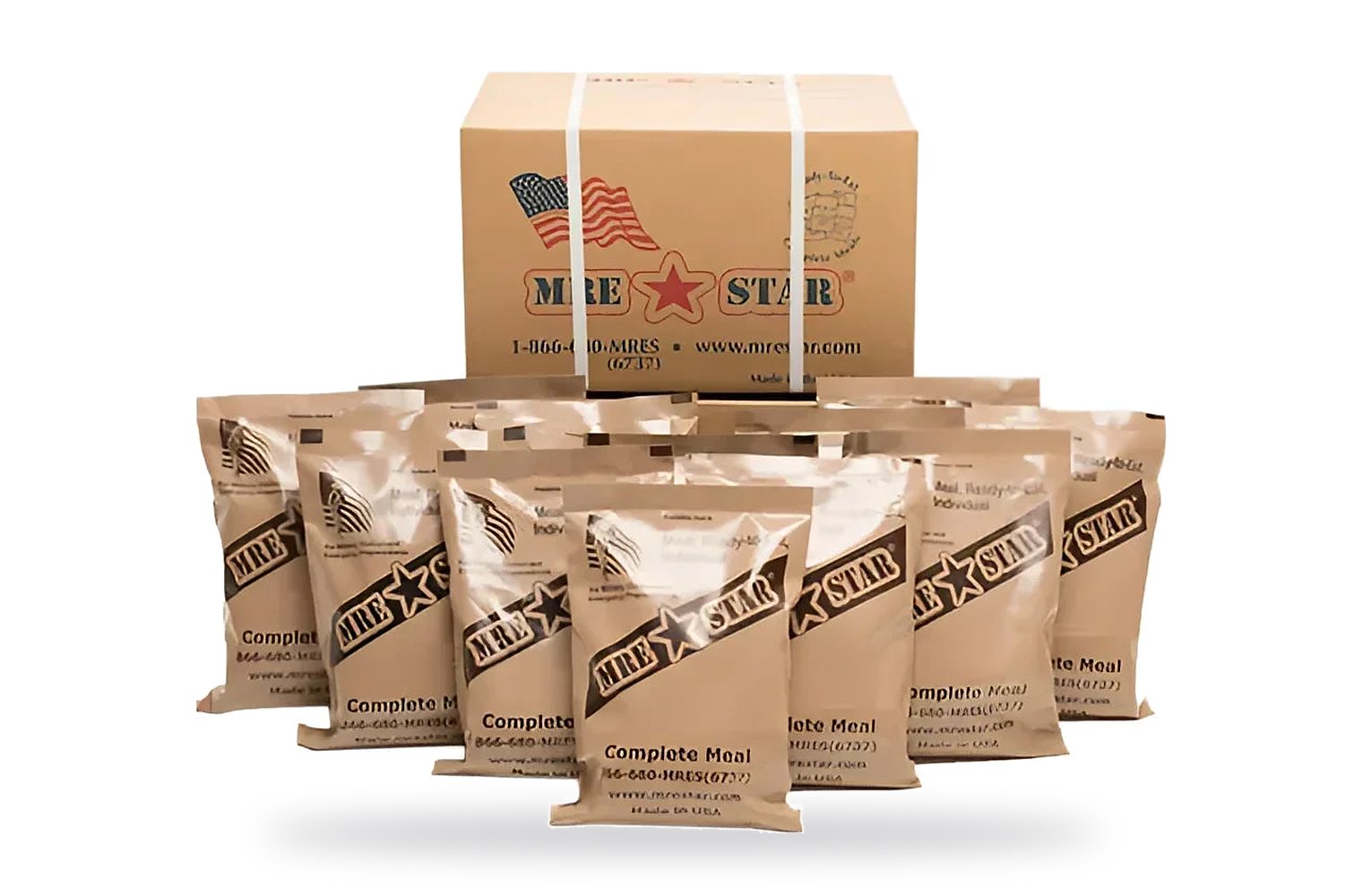
Why I chose it: MRE Star meals are fully cooked, military-style rations that average about 1,200 calories each, and every bag in this case comes with a flameless ration heater. You splash a little water on the heater, slide the entree in next to it, and about 12 minutes later supper is hot with the stove still cold. There’s no fuel to burn and no water to rehydrate the food.
The case holds two each of six entrees. Every bag has an 8-ounce entree with sides and a snack, plus an accessory pack with a spoon, coffee, creamer, sugar, salt, pepper and a wet nap, so one bag is a full meal for one person.
Key specs
- Meals: 12, two each of 6 entrees
- Calories per meal: 1,100 to 1,300
- Real days, 1 adult: about 7
- Prep: none, eat cold or heat with the included heater
- Shelf life: 3 to 5 years, cool and dry
- Case weight: about 17 lb
Pros
- Hot meals with no stove, fuel or water to rehydrate
- Big calories in every bag
- Kids think the heater is a science project
- Every bag is a complete meal, sides included
Cons
- Heavy and bulky for the calories
- Shortest shelf life here in a hot house
- Lots of packaging to deal with
In real use: Keep a case for the stretch of an outage when the camp stove fuel runs low or the weather won’t let you cook outside. The heater gives off steam and a little hydrogen, so heat meals near an open window, never in a closed closet or a car. Store the case in the coolest room you’ve got and write the date you bought it on the box in marker.
Servings vs Calories: How the Label Fools You
A serving on a food bucket is whatever the company decided it should be, and that ranges from a full entree to a cup of drink mix. In the ReadyWise 14-Day bucket, 56 of the 150 servings are drink mix and milk powder, so the big number on the lid sounds like a lot more food than it is.
The honest number is calories per person per day. Most adults need around 2,000, more if they’re out working in the cold. Here’s what a “day” on the label really holds for four popular kits:

Any bucket works if you know its real number. A 1,290-calorie day is fine for a small adult sitting tight and short for a big guy clearing branches. Divide total calories by 2,000, or let the planner above do it for your whole house.
Freeze-Dried vs MREs vs Food Bars
Freeze-dried food is the backbone of most long term food storage. It’s light, keeps for decades in a cool closet, and tastes the best, but it needs water and usually heat. MRE meals are the opposite trade. They’re fully cooked, come with their own heater and need no water to rehydrate, but they weigh more per calorie and keep only a few years in a warm house. Emergency food bars are the smallest and toughest of the three and the least fun to eat, which is why they belong in the car and the go-bag. Most families do best with freeze-dried buckets as the main supply, a case of MREs for days with no stove and a pack of bars in every car.
How Much Emergency Food Do You Need Per Person?
Plan on 2,000 calories per adult per day, about 2,600 for someone doing hard physical work, and less for small children. Ready.gov asks every household to keep at least a several-day supply. I’d go further. Ice storms and hurricanes routinely leave roads blocked and stores dark for a week or more, so two weeks of food is a comfortable target, with the first few days covered by what’s already in the pantry.
For a family of four, two weeks works out to roughly 100,000 calories, about two Augason pails or four ReadyWise buckets.
What Goes in a 72-Hour Emergency Food Kit?
A 72-hour kit should hold about 6,000 calories per adult in food that needs little or no cooking. Two Datrex packs per person cover it in a backpack. At home, a Mountain House bucket gets one adult through about three days with real meals, and a few MREs make a good grab-and-go option if you have to leave in a hurry.
Eating Through a Power Outage Without a Stove
Eat in the right order and your emergency food lasts days longer. Start with the fridge, since the USDA says a refrigerator keeps food safe for only about 4 hours without power. A full freezer holds for about 48 hours with the door shut, so the freezer comes next. Then work through the pantry, and open the buckets last.
When it’s time for the buckets, most of them need boiling water. A propane camping stove on the porch handles that fine, and it should never run indoors, where it can fill the house with carbon monoxide. If you’re stuck inside, reach for the no cook emergency food first: MREs, ration bars, Mountain House pouches made with cold water, and pantry staples like peanut butter, tuna, crackers, canned fruit and trail mix.
My power outage emergency kit guide covers the lights, radio and power that go with the food.
Don’t Forget the Water
Plan on a gallon of drinking water per person per day, and then add the water your food drinks. Freeze-dried pouches take 1 to 2 cups each, and the Augason pail needs about 15 gallons to cook through the whole month. For a family of four over two weeks, that can mean more than 70 gallons once cooking is counted.
Store water next to the food, and keep a filter or purification tablets for refilling from a bathtub or rain barrel. MREs and ration bars are the only picks here that need no water to prepare.
Does Emergency Food Really Last 25 Years?
A 25 year emergency food supply is real, but only on paper unless you store it right. Those long shelf life claims assume a cool, dry, dark spot. Heat is what ages stored food, and a garage or attic that hits 100°F in August eats years off a bucket. The military’s own spec for MREs is three years at 80°F and only six months at 100°F, and freeze-dried food slows down the same way in the heat, just more gently.
Keep buckets in an interior closet, under a bed or in a basement, and write the purchase date on every lid. Eat the shorter-lived Peak Refuel and MREs on camping trips and replace them. Datrex is built to sit in a hot car.
Kids, Pets and Food Allergies
Kids eat less than adults, roughly 1,000 to 1,400 calories for little ones and adult amounts for teenagers, but they’re pickier. Make a taste test night out of a few pouches now, while there’s still a grocery store down the road. Ready.gov also suggests ready-to-feed formula for babies, since it needs no water.
Pets need the same number of days of their regular food plus their own water, and a sudden switch to new food upsets a dog’s stomach fast. For allergies, read every pouch. The Mountain House bucket contains milk, wheat and egg, though its Beef Stew is gluten-free. Datrex bars are coconut flavored. Buckets mix many meals together, so one allergy can rule out several pouches inside.
Buying Guide: What to Look For in an Emergency Food Supply
Calories per day, not servings. Divide total calories by 2,000 per adult. Anything under about 1,800 a day needs extra food on the side for working adults.
How it cooks. In-pouch meals need hot water. Pot meals need a burner, fuel and cleanup, and a month of them can drink 15 gallons of water. MREs and bars need nothing. Match the food to the stove, fuel and water you really have.
Shelf life and storage. Long claims need cool storage. If your only spot is a hot garage, buy shorter-life food you’ll rotate, or stick to bars.
Food your family eats. The best survival food is whatever people will eat when they’re tired, cold and worried. Taste a few pouches before you buy a year’s worth.
Packaging. Thick Mylar pouches inside a sealed bucket keep out light, air and mice. Stackable buckets save closet space.
Frequently Asked Questions
How much emergency food do I need per person?
Plan on about 2,000 calories per adult per day and at least two weeks of food if you live where ice storms or hurricanes cut roads. That’s about 28,000 calories per adult. Count calories, not servings, because a serving on a bucket can be a cup of drink mix.
How long does emergency food really last?
Freeze-dried buckets are rated for 25 to 30 years in cool, dry storage. Peak Refuel rates its meals for 5 years, Datrex bars for 5 years, and MREs for about 3 years at 80°F. Heat shortens all of them, so keep food out of hot garages and attics.
What’s the best emergency food that doesn’t need cooking?
MREs with flameless heaters give you hot meals with no stove, and emergency food bars need nothing at all. Mountain House pouches also work with cold water if you give them about twice as long. Peanut butter, tuna pouches, crackers and canned fruit fill in the gaps.
Is freeze-dried food better than MREs?
For long-term home storage, yes. Freeze-dried food is lighter, keeps much longer and tastes better. MREs win when you have no stove or water to spare, since they’re fully cooked and heat themselves. A mix of both covers the most situations.
The Bottom Line
For most households, the Augason Farms 30-Day QSS Pail is the backbone of a good emergency food supply, with a month of real calories for one person in a single pail. If you want food you’ll look forward to, start with the Mountain House Classic Bucket. For a two-week stash that’s easy to stack, get the ReadyWise 14-Day Emergency Food Bucket, and feed your hardest workers from the Peak Refuel MAX Bucket.
Then cover the gaps. A case of MRE Star Full Meal Case with Heaters keeps hot meals coming when the stove fuel runs out, and a Datrex 3600 Emergency Food Bar in every car takes care of the night you’re stuck on the highway. Run your household through the planner above, set the water next to the food, and write the date on every lid.
Keep reading