
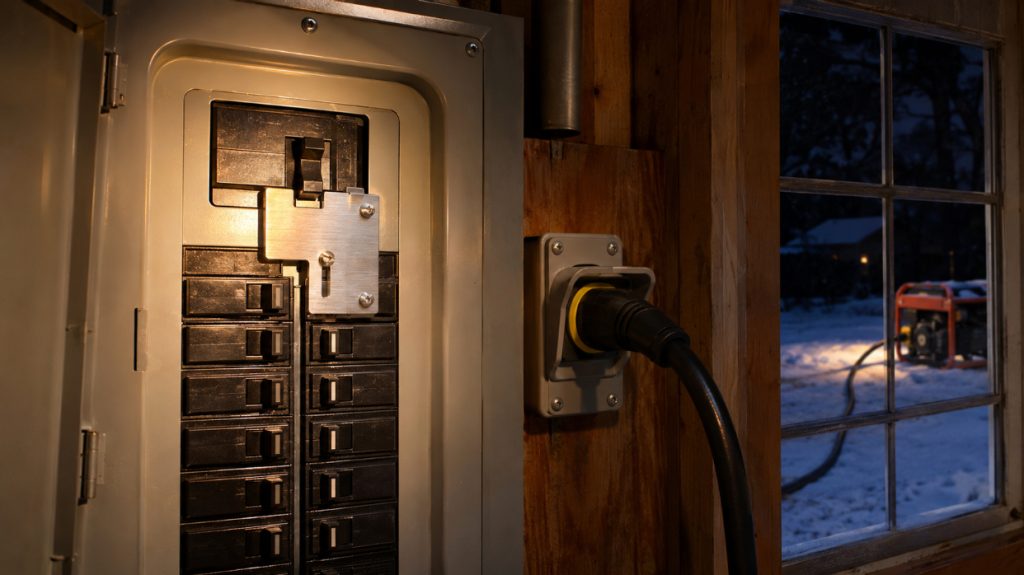
A generator in the driveway only gets you halfway through an outage. The other half is getting its power into the house without a mess of extension cords running under the door, and without feeding electricity back out onto the utility line where a lineman might be working.
A generator interlock kit is the cheapest proper way to do that. It’s a small steel or aluminum plate that bolts onto the cover of your breaker panel and makes it physically impossible to have the main breaker and the generator breaker on at the same time. With one installed, a single cord from the generator to an inlet box on the outside wall can power any circuit in the panel.
The catch is fit. There’s no universal interlock. Each kit is made for one panel brand, one range of main breaker sizes and one gap between the main and the breaker below it. Further down, the Interlock Kit Finder walks you through your own panel and then builds the rest of the hookup with you.
Our Top Picks at a Glance
Generator Interlock Kits Compared
How a Generator Interlock Kit Works
Inside your panel, the big main breaker at the top connects the house to the utility. An interlock adds a second path: a two-pole breaker near the main gets fed from the generator through an inlet box on the outside wall. That breaker is called the backfeed breaker or generator breaker.
The interlock plate sits over both handles. When the main is on, the plate blocks the generator breaker from being switched on. To run on the generator, you switch the main off, slide the plate over, and only then can the generator breaker go on. The two sources can never touch.
That’s the whole point of the plate. The CPSC warns that powering house wiring by plugging a generator into a wall outlet puts utility workers and your neighbors at risk of electrocution, because the transformer steps the generator’s power back up to thousands of volts on the line. The plate makes that mistake impossible, even for someone half asleep at 3 a.m. with a flashlight in their teeth.
Once the generator breaker is on, every circuit in the panel can draw from the generator. You choose what runs by flipping breakers on and off, which is a big advantage over a transfer switch that’s wired to a handful of preselected circuits. The tradeoff is that nothing stops you from overloading the generator except your own attention, which is why the switch-over steps further down matter.
1. GenInterlock SD-200A: Best Overall
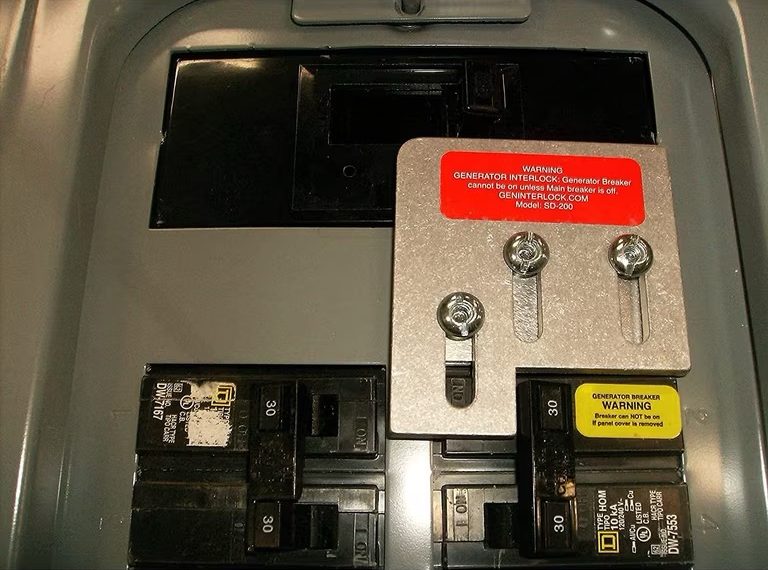
Why I Chose It and Who It’s Best For
Square D’s two panel lines, QO and Homeline, share the same breaker layout at 150 and 200 amps, so one plate can serve both. The GenInterlock SD-200A fits both, which is why it’s my first pick and the one I’d point most people toward.
GenInterlock is one of the original interlock makers. Its kits are made in the USA and MET listed, which means an independent lab tested them for safety. That listing is what an electrical inspector looks for, and it’s the main reason I’d take this kit over a cheaper copy with the same shape.
Key Specs
- Fits: Square D QO and Homeline panels with a 150 or 200 amp main, indoor or outdoor
- Main breaker: single handle, horizontal throw
- Gap: 1-3/8 in. from the main breaker to the first branch breaker
- Generator breaker: two-pole, in the top right spaces under the main
- Listing: MET listed
- Made in: USA
- Warranty: 2-year limited
Pros and Cons
Pros
- One kit covers both Square D lines
- MET listing that inspectors recognize
- GenInterlock makes versions for main-on-bottom and meter-main Square D panels too
Cons
- The generator breaker isn’t included
- Only fits the 1-3/8 in. gap, so measure first
- Main-on-bottom panels need a different GenInterlock version
Performance Analysis
The 1-3/8 in. gap is the measurement that decides whether this kit fits. You can measure it with the panel door open and the cover left on, from the edge of the main breaker to the edge of the first breaker on the right side. If yours is different, GenInterlock has other Square D versions, including one for panels with the main on the bottom and one for Homeline meter mains.
The generator breaker goes in the two spaces on the top right, directly under the main. If those spaces are already used, an electrician will move that circuit down the panel. It’s a common job and part of every interlock install, so don’t let it put you off.
A backfed breaker has to be held down with something besides its own clip, so it can’t be pulled out of the panel while it’s live. GenInterlock sells screw-down retainers for Square D breakers that do this job better than a strap.
2. EXCELFU Eaton BR Interlock Kit: Best for Eaton Panels
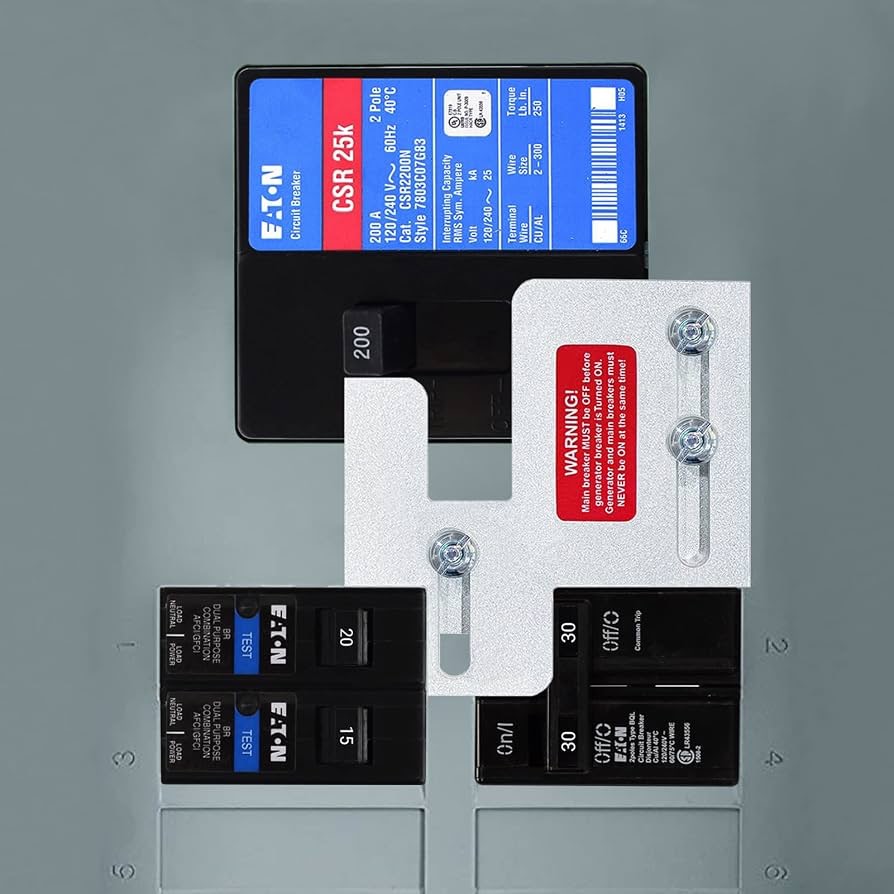
Why I Chose It and Who It’s Best For
For an Eaton or Cutler-Hammer BR panel, the EXCELFU Eaton BR Interlock Kit is the kit I’d buy. Everything you need to mount it comes in the box.
That includes two breaker retaining straps and the full set of warning labels, two things some kits leave out. For a BR panel owner who wants one order and done, this is the one.
Key Specs
- Fits: Eaton and Cutler-Hammer BR series panels with a 150 or 200 amp main
- Gap: 1-1/4 to 1-7/16 in. between the main and branch breaker
- Main breaker: horizontal throw
- In the box: top and bottom interlock plates, three shoulder screws, three hex nuts, a generator start-up label, five reminder labels, two breaker retaining straps and a 3/16 in. drill bit
- Install: mounts with shoulder screws through holes drilled in the panel cover
Pros and Cons
Pros
- Wide gap range fits more BR panels
- Breaker retaining straps included
- Labels for the panel and start-up steps included
Cons
- No UL or MET listing
- Straps are less solid than a screw-down bracket
- Doesn’t fit CH panels
Performance Analysis
BR and CH are both Eaton lines, but they’re not interchangeable. BR breakers are 1 in. wide with black handles. CH breakers are 3/4 in. wide with tan handles, and they need a CH kit. One look at the breakers tells you which line you have.
The 1-1/4 to 1-7/16 in. gap range is wider than most kits allow, so it covers almost every 150 and 200 amp BR panel.
This kit doesn’t carry a UL or MET listing. Some inspectors insist on a listed part for a permitted job, and for those, GenInterlock makes a listed BR kit.
3. XMK Siemens and Murray Interlock Kit: Best Budget
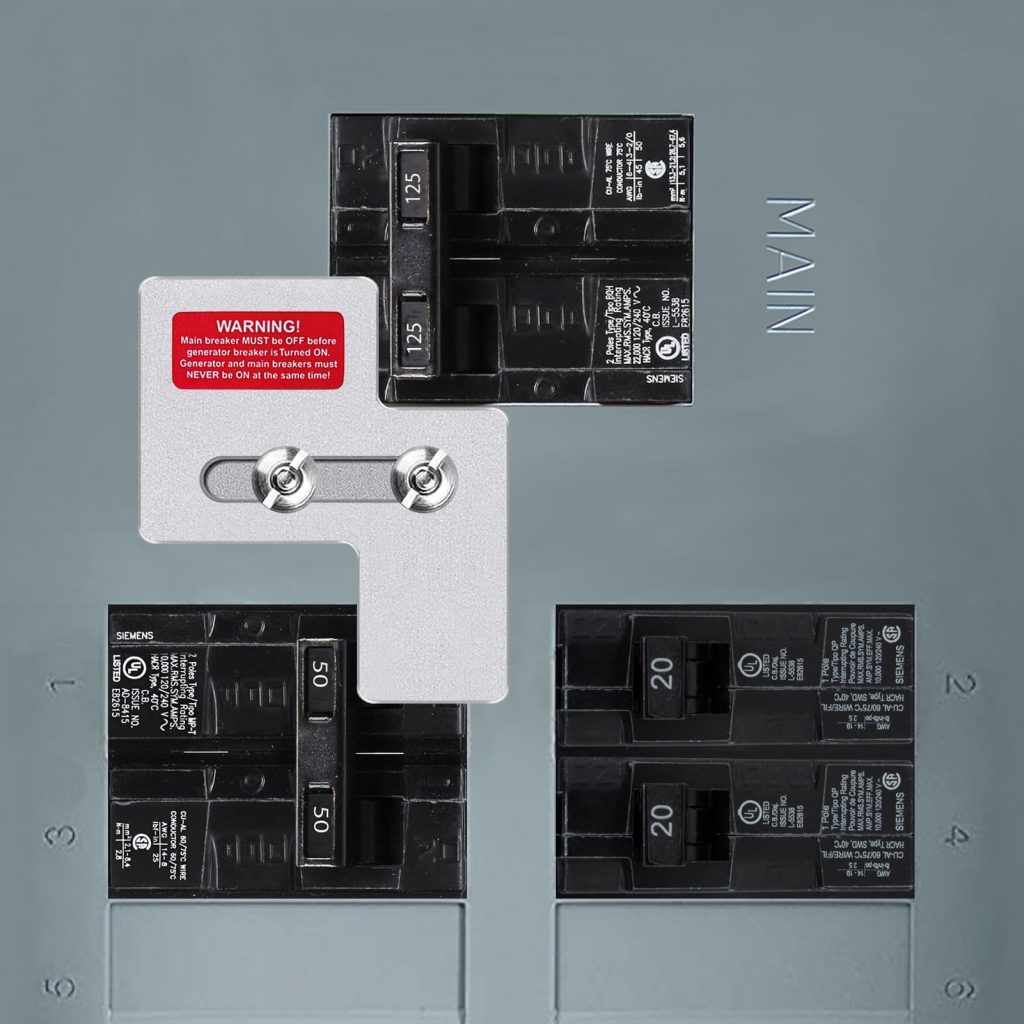
Why I Chose It and Who It’s Best For
The XMK Siemens and Murray Interlock Kit is the low-cost way into an interlock for a Siemens or Murray panel. Kits for those two brands are usually the same part, and this one is listed for both at 150 and 200 amps.
It’s for someone who wants a working, safe hookup for the least money and is happy to have an electrician check the fit. The plate itself is simple, which is fine. Its whole job is to block a breaker handle.
Key Specs
- Fits: Siemens and Murray panels with a 150 or 200 amp main
- Gap: 7/8 to 1-1/4 in. between the main and branch breaker
- In the box: interlock plate, mounting hardware, drill bit and warning labels
- Install: drilled into the panel cover
Pros and Cons
Pros
- Low cost for a full plate and hardware set
- One plate covers both Siemens and Murray
- Mounting hardware and drill bit included
Cons
- No independent safety listing
- Tighter gap range than the Eaton kit
- No breaker retainer included
Performance Analysis
The gap on Siemens and Murray panels runs tighter than on Square D, and this kit’s 7/8 to 1-1/4 in. range reflects that. If yours measures outside it, the panel is an older or less common style and needs a different kit.
There’s no retainer in the box, so you’ll want one that fits your breaker brand. It’s a small part, and code requires it.
Older ITE and Gould panels often share the Siemens layout, so this kit is worth a look for those as well.
4. Westinghouse WLock G: Best for GE Panels
Why I Chose It and Who It’s Best For
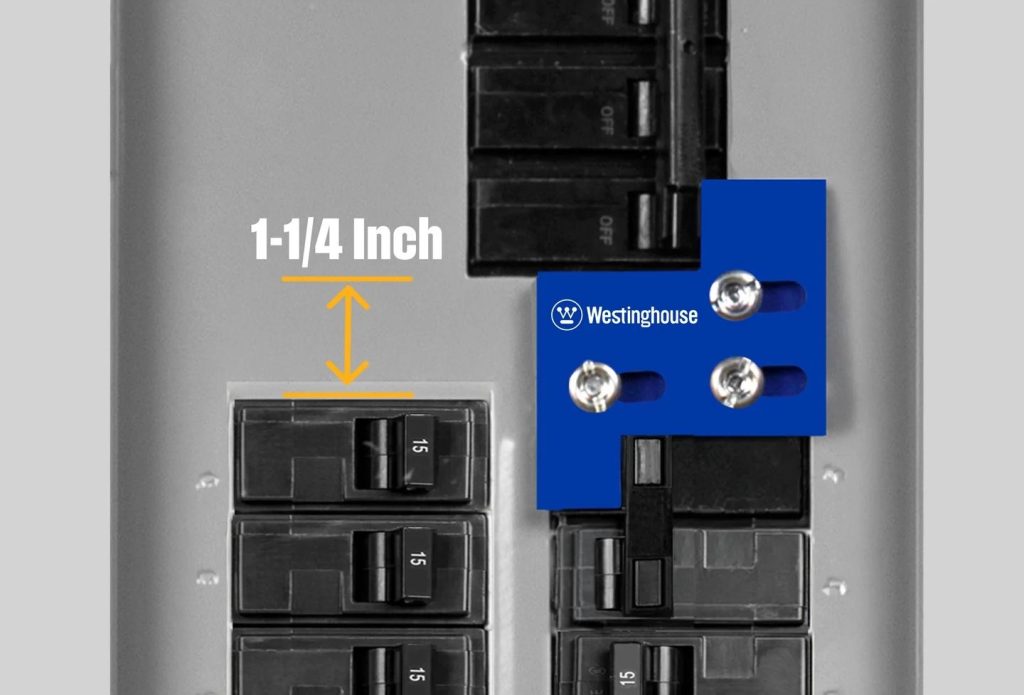
There are fewer interlock kits for GE panels than for Square D or Eaton, so a new one from a big name is welcome. The Westinghouse WLock G comes from the same Westinghouse whose generators I recommend in my home generator guide, and it’s made for GE 150 and 200 amp panels with the main breaker sitting 1-1/4 in. above the first branch breaker.
It’s the kit for a GE owner who’d rather buy a known brand than a no-name plate. It’s part of a new WLock line that also covers Square D QO and Eaton BR panels.
Key Specs
- Fits: GE panels with a 150 or 200 amp main and a 1-1/4 in. gap between the main and first branch breaker
- Generator hookup: works with generators using 30 amp or 50 amp connections
- In the box: interlock bracket, drill template, mounting nuts and bolts, a 3/16 in. drill bit, thread sealant and two zip ties
- Build: corrosion-resistant metal
- Install: professional installation recommended for code compliance
Pros and Cons
Pros
- Known brand with US support
- Drill template takes the guesswork out of the holes
- Thread sealant keeps the bolts from backing out
Cons
- Only fits the 1-1/4 in. gap style of GE panel
- No separate breaker retaining bracket
- Vertical-main GE panels need a different kit
Performance Analysis
GE made two styles of panel. On some, the main breaker sits horizontally above the branch breakers. On others, the main is vertical and the gap is much wider, around 2-1/4 in. This kit is for the first kind. If your main breaker handle moves up and down, look for a GE vertical-main kit instead.
The drill template is the part I like most. Getting the holes in the right place is the only fiddly part of mounting any interlock, and the template sets them for you.
There’s no separate retaining bracket in the box, so the generator breaker will need one. If you have a Square D QO panel and like the Westinghouse name, the Westinghouse WLock QO fits QO panels with a 150 to 225 amp main.
5. GenInterlock SD-100A: Best for 100 Amp Panels
Why I Chose It and Who It’s Best For
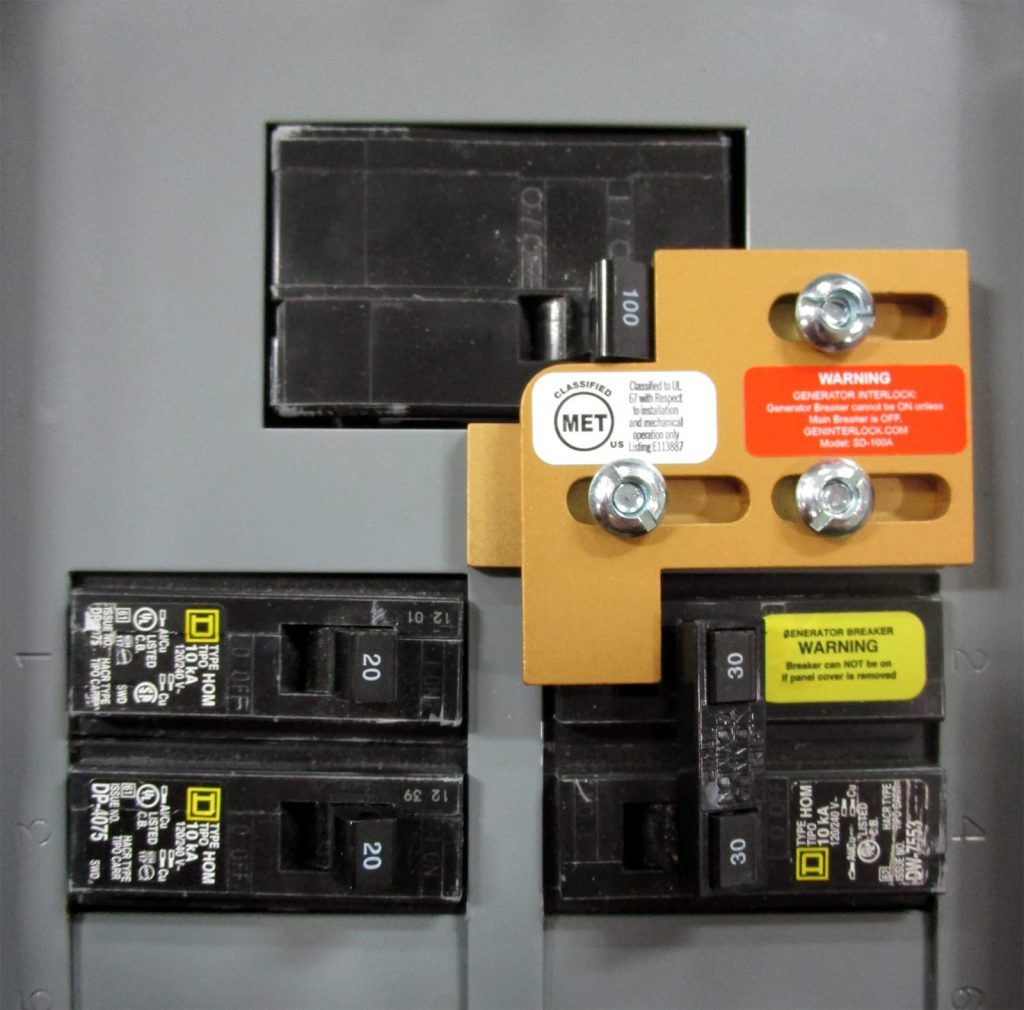
A lot of older and smaller homes still run on a 100 or 125 amp panel, and most interlock kits on the market are made for 150 and 200 amps. The GenInterlock SD-100A covers those panels for Square D, with the same MET listing and US manufacturing as my top pick.
It’s for the owner of a smaller Square D panel that the usual 150 and 200 amp kits won’t fit.
Key Specs
- Fits: Square D QO and Homeline panels with a 100 or 125 amp main
- Location: indoor or outdoor panels
- Listing: MET listed
- Made in: USA
Pros and Cons
Pros
- Made for panel sizes most kits skip
- MET listed
- Fits both Square D lines
Cons
- Square D only
- Small panels have fewer spare spaces for the generator breaker
- Doesn’t fit 150 or 200 amp panels
Performance Analysis
The real limit on a 100 amp panel is space. The generator breaker needs two spaces right next to the main, and small panels are often full. An electrician can usually make room with tandem breakers, if the panel is rated for them.
A 100 amp panel also pairs naturally with a 30 amp generator hookup. A 30 amp inlet carries up to about 7,200 watts, which covers the essentials in a smaller house.
For an indoor Eaton BR panel with a 100 or 125 amp main, the Westinghouse WLock E is the Westinghouse equivalent.
6. Square D HOMCGK2C: Best Factory Kit
Why I Chose It and Who It’s Best For
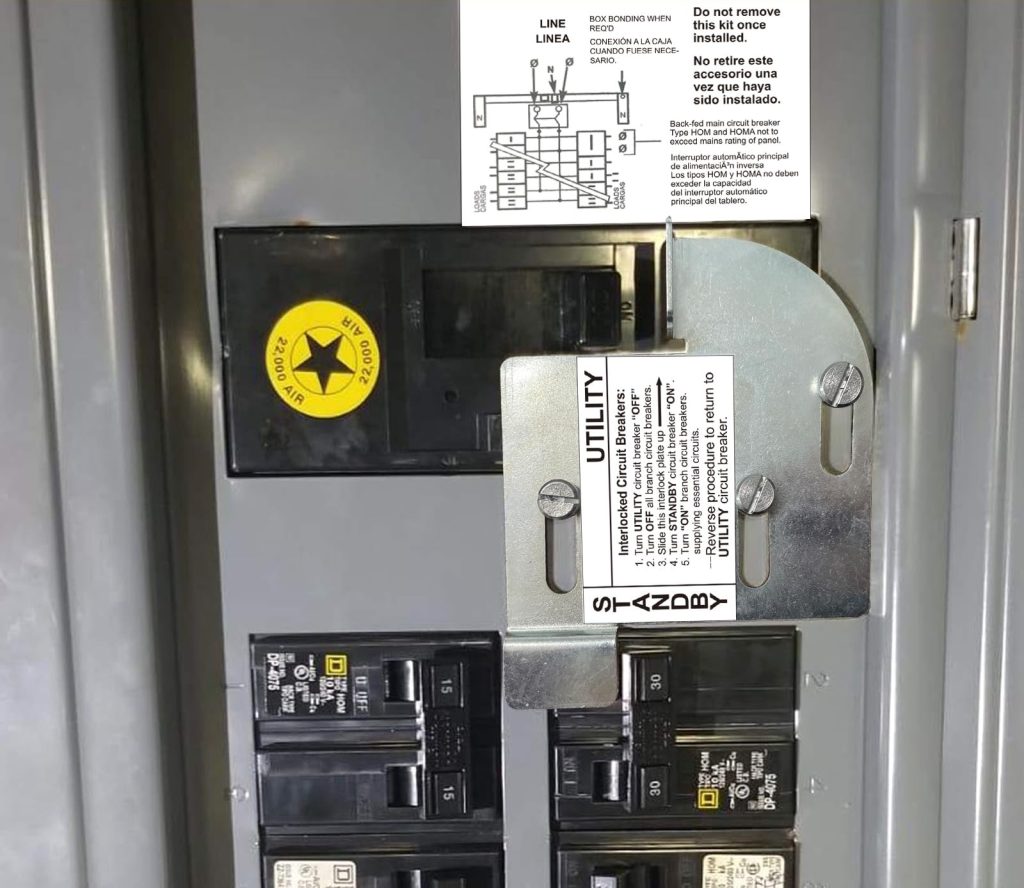
The Square D HOMCGK2C is Square D’s own interlock, made by Schneider Electric for indoor Homeline panels with a main breaker from 150 to 225 amps. It’s UL listed, and because it comes from the panel maker, there’s no question about the fit.
It’s for the Homeline owner who wants the manufacturer’s part, or whose inspector has asked for one.
Key Specs
- Fits: indoor Homeline main breaker panels from 150 to 225 amps (QOM2 frame main breaker)
- In the box: interlock bracket, retaining bracket and hardware
- Listing: UL listed
- Maker: Schneider Electric (Square D)
Pros and Cons
Pros
- Factory fit and UL listing
- Includes a screw-down retaining bracket
- Covers 225 amp panels, which aftermarket kits often don’t
Cons
- Indoor panels only
- Homeline only
- Often costs more than aftermarket kits
Performance Analysis
The retaining bracket is the reason I’d pay a little more for this kit. It screws down over the generator breaker, which is a sturdier hold than the straps in most aftermarket kits.
It’s for indoor panels only. Square D sells a separate outdoor Homeline kit, the HOMRBGK2C, for panels mounted outside. For QO panels, the factory version is the Square D QOCGK2C.
Interlock Kit Finder
Answer a few questions about your panel and the finder shows the kit that fits, how to measure the gap, and the hookup parts that match your generator. At the end, it walks through the switch-over in the order you’d do it in a real outage.
How to Choose a Generator Interlock Kit
Panel brand and series
Open the panel door and look for the label on the inside. It names the maker and usually the series, like Square D Homeline or Eaton BR. If the label is gone, the breakers tell you. Square D QO breakers have a small window that shows red when they trip, and Homeline breakers don’t. Eaton BR breakers are 1 in. wide with black handles, and CH breakers are 3/4 in. wide and tan.
Main breaker size
The main breaker has its rating printed on the handle, usually 100, 125, 150 or 200. Most kits cover 150 and 200 amps together. 100, 125 and 225 amp panels need their own kits.
The gap
Measure from the edge of the main breaker to the edge of the first branch breaker where the generator breaker will go. Every kit lists a gap, or a gap range, and this number decides the fit more than anything else. Also note whether the main handle moves side to side or up and down.
Safety listing
UL, ETL or MET listing means an independent lab tested the kit. Many inspectors want to see a listed part on a permitted job. An unlisted plate does the same mechanical job, so the listing matters most when an inspection is involved.
A breaker retainer
The National Electrical Code requires a backfed breaker to be held in place by something more than its own clip, so it can’t be pulled loose while it’s live. Some kits include a strap or bracket. If yours doesn’t, buy one made for your breaker brand.
Indoor, outdoor and meter-main panels
Outdoor panels and meter-main panels, where the meter and main share one box, often take a different version of the same kit.
Finishing the Hookup: Breaker, Inlet Box and Cord
The interlock plate is only one part of the job. To actually run the house, you need three more parts, and they all have to match the biggest 240 volt outlet on your generator.
The breaker has to be the same brand and type as the panel. Interlock kit makers say this plainly, and an inspector will check it. A Homeline panel takes a Homeline breaker, a BR panel takes a BR breaker. Size the breaker to the inlet and cord, not to the generator. A 30 amp inlet gets a 30 amp breaker, even if the generator could put out more.
For the inlet and cord, the easiest route is a matched kit. A 30-amp inlet box and cord kit covers most generators up to about 7,500 watts. A 50-amp inlet box and cord kit is for the bigger 50 amp generators. Keep the cord as short as your setup allows, but long enough that the generator sits at least 20 feet from doors, windows and vents. That’s the same 20 foot figure in the CPSC’s generator safety alert, and it matters as much as anything in this guide.
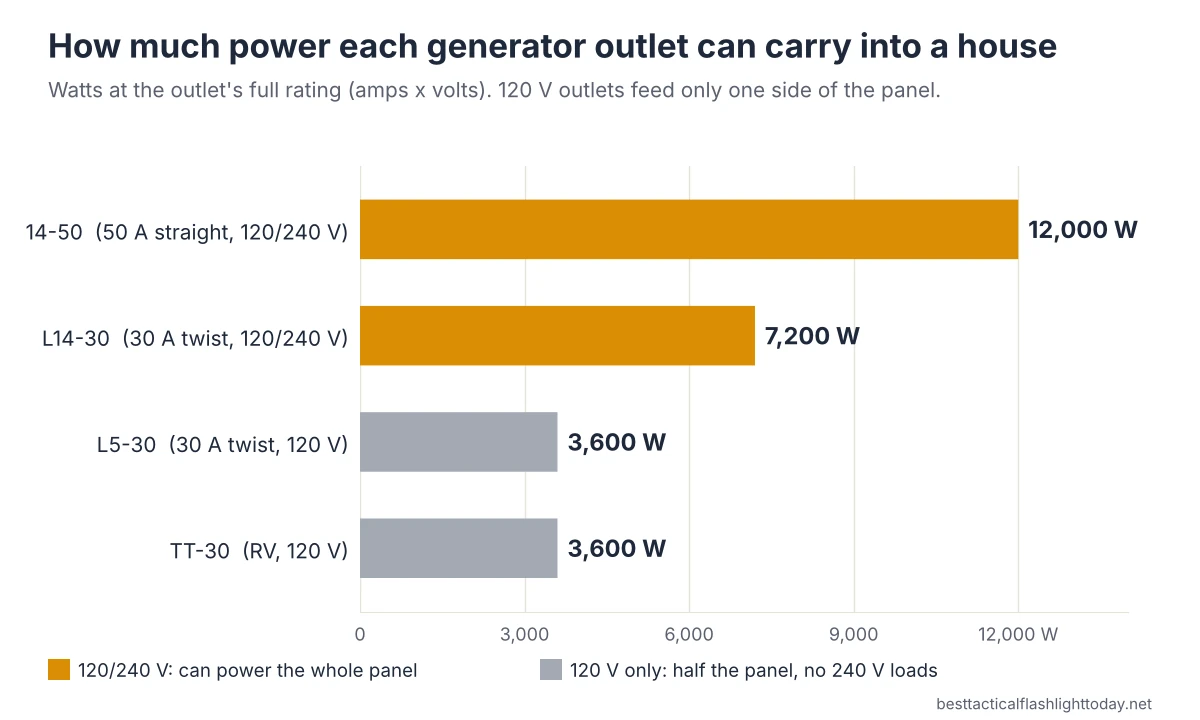
The chart shows how much power each type of generator outlet can carry into the house. The 120 volt outlets top out at 3,600 watts, and only on half the panel.
If your generator’s only 30 amp outlet is an L5-30 or a TT-30, it’s 120 volts only. It can’t power 240 volt loads like a well pump through an interlock, and it shouldn’t be adapted to fit an L14-30 inlet. A generator with a proper 240 volt outlet is the fix. My home generator guide covers which ones have both 30 and 50 amp outlets.
The same hookup works with a large power station that has a 120/240 volt outlet, like the whole-home units in my power station guide. It’s a quiet setup, and the station itself can sit indoors because it makes no exhaust.
Floating vs Bonded Neutral
Ask your electrician about this one before the install. In a house panel, the neutral and ground are bonded together at the main panel. An interlock switches the hot wires but never the neutral, so the generator’s neutral ends up tied to the house neutral.
Most open-frame portable generators ship with their neutral bonded to the frame. Hooked to a house through an interlock, that can create a second neutral-to-ground connection. Many electricians handle it by setting the generator up with a floating neutral when it powers the house. Some generator makers offer a way to do this, and some newer generators with GFCI protection on their 240 volt outlets will trip until it’s sorted out. Your generator’s manual says which kind you have, and it’s worth handing to the electrician on install day.
How to Switch to Generator Power in an Outage
Here’s the order to follow every time. Tape a copy inside the panel door.
- Turn off the large branch breakers, or all of them, so the generator doesn’t start under load.
- Set the generator at least 20 feet from the house, start it, and let it run for a minute.
- Plug the cord into the generator, then into the inlet box.
- Switch the main breaker off.
- Slide the interlock plate over the main.
- Switch the generator breaker on.
- Turn on circuits one at a time, starting with the biggest motor load, like the well pump or furnace, and give each one a few seconds to settle.
When the utility power comes back, you’ll often see the neighbors’ lights first. Reverse the order: turn off the branch breakers, switch the generator breaker off, slide the plate back, switch the main on, then shut down the generator and unplug the cord.
Interlock Kit vs Transfer Switch
A manual transfer switch is a small subpanel wired to a set of preselected circuits, usually six to ten. You flip each circuit from line to generator. It’s simpler to operate and harder to overload, but you can only run the circuits it was wired to, and it costs more to buy and install.
An interlock gives you the whole panel. You can run the dryer one hour and the well pump the next, as long as you stay under what the generator can carry. For most homes with a portable generator, that flexibility at a lower cost is why I’d choose an interlock. A transfer switch makes more sense if someone else in the house will be running the generator and you want fewer ways to get it wrong.
Permits and Installation
Installing an interlock means opening the panel, drilling the cover, adding a breaker and running a wire to an inlet box outside. In most places that needs a permit, and in many it has to be done by a licensed electrician. Even where a homeowner is allowed to do it, the panel’s main lugs stay live with the main breaker off, so it’s not a first electrical project.
The parts are a small share of the cost. Most of what you pay for is an electrician’s time, and an interlock install is a short job compared with a transfer switch. Ask for the inlet box, breaker and retainer to be quoted together so nothing gets left out.
FAQ
Is a generator interlock kit legal and up to code?
Yes, in most of the US, when it’s installed correctly with a listed kit and a matching breaker that’s held down by a retainer. The National Electrical Code allows interlocks as transfer equipment. Local rules vary, so check with your building department, especially about whether a permit and a licensed electrician are required.
Can I install a generator interlock kit myself?
Mounting the plate itself is simple, but the job also means adding a breaker inside a live panel and running a wire to an inlet box. Many areas require a licensed electrician for that, and the main lugs stay energized even with the main off. Most people should hire an electrician and have it inspected.
Is an interlock kit better than a transfer switch?
For most homes with a portable generator, yes. An interlock lets you power any circuit in the panel and costs less to install. A transfer switch limits you to the circuits it was wired to, but it’s harder to overload and simpler for someone unfamiliar with the panel.
What size breaker do I need for a generator interlock?
Match the breaker to the inlet box and cord, not the generator. A 30 amp L14-30 inlet takes a 2-pole 30 amp breaker, and a 50 amp inlet takes a 2-pole 50 amp breaker. It also has to be the same brand and type as your panel.
The Bottom Line
For most homes, the GenInterlock SD-200A is the kit to get. It fits both Square D lines and carries the MET listing inspectors look for. Eaton BR owners should look at the EXCELFU Eaton BR Interlock Kit, Siemens and Murray owners at the XMK Siemens and Murray Interlock Kit, and GE owners at the Westinghouse WLock G. For a small Square D panel, the GenInterlock SD-100A fits where others won’t, and for a Homeline panel where you want the factory part, the Square D HOMCGK2C is the one.
Whatever kit you choose, measure the gap before you order, and plan the inlet box and cord along with it so the electrician can do everything in one visit. If you haven’t picked the generator yet, my home generator guide has a planner that sizes one to the circuits you’d want running.
