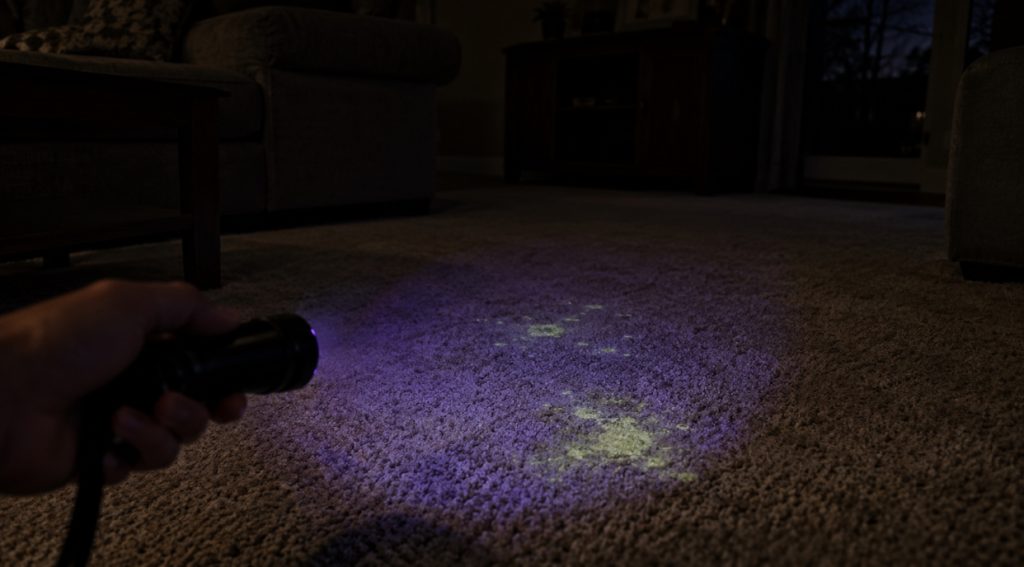
Most black lights sold online are cheap 395nm lights that bathe everything in purple. Point one at a carpet and you see a violet blob, and the faint stain you were hunting for disappears inside it. That’s why so many people buy a UV flashlight, try it once and decide the whole idea doesn’t work.
It does work. You just need the right wavelength, and ideally a filter that blocks the visible glow. A good 365nm light with a filter makes pet stains, scorpions, fluorescent rocks and the security strip in a twenty dollar bill jump out against a dark background instead of hiding under a purple haze.
I picked five UV flashlights from brands that publish real specs, checked every figure against the maker, and built a simulator so you can see what each type of light shows before you buy. Short version: the Sofirn SF16 is the one I’d hand most people. If you want a UV light that also works as your everyday flashlight, get the Olight Arkfeld Pro.
Quick Picks
UV Flashlights Compared
Start with the wavelength and whether the lens has a filter, then compare UV output in milliwatts. Lumens don’t apply here, because lumens measure visible light and good UV is almost invisible.
UV Detection Simulator: What Will Your Light Actually Show?
Pick what you’re hunting for and the kind of UV light you’re thinking about buying. Then drag the beam across the scene. The simulator shows how much of the target glows and how much purple glare gets in the way, and it points you to the light I’d use for that job.
Loading the UV detection simulator. If it doesn’t appear, the 365nm vs 395nm section and the job guide below cover the same ground.
365nm vs 395nm: Why the Number on the Box Matters
UV flashlights are sold by wavelength, measured in nanometers. Visible light starts around 400nm. A 395nm LED sits right on that edge, so a good part of what it puts out is violet light you can see. A 365nm LED sits well below the edge, so almost all of its output is true ultraviolet.
That difference decides what you see. Fluorescent things glow because UV hits them and they give back visible light. With a 395nm light, the glow has to compete with the light’s own purple wash. With a 365nm light, the background stays dark and the glow stands out. More materials react at 365nm too, which is why rockhounds and inspectors won’t use anything else.
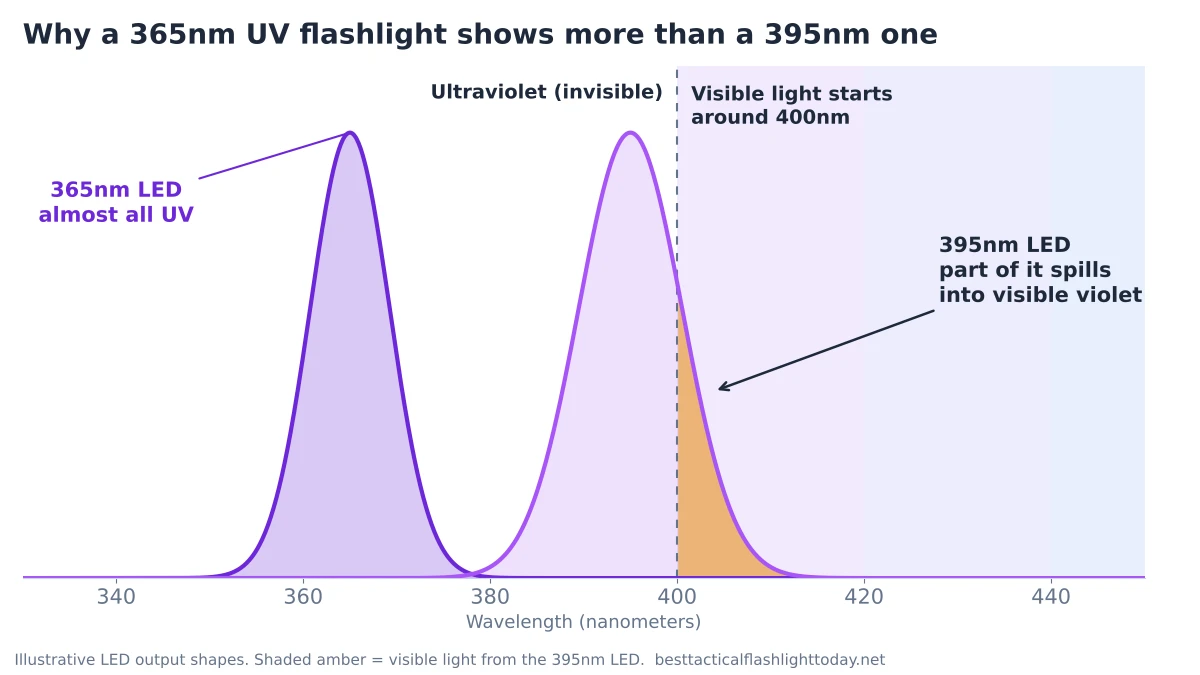
Even a 365nm LED leaks a little visible light, usually a pale blue or greenish glow. That’s what a ZWB2 filter is for. It’s a dark glass lens that passes UV and blocks most of the rest. Three of the five lights here have one, and it’s the single biggest upgrade you can make to a UV light.
So is 395nm useless? No. It still lights up scorpions, highlighter ink and plenty of pet stains on a light carpet, and 395nm lights are cheap. The trouble is the faint stuff. Old stains, a hotel bedspread, the subtle glow in a rock: that’s where 395nm lets you down and filtered 365nm doesn’t.
How I Chose These UV Flashlights
Every pick here uses a 365nm LED, comes from a brand with a real track record in flashlights or UV, and has published specs I could check. I skipped the 100 LED black lights that fill the search results. Most run on AA cells through flimsy battery carriers, use 395nm LEDs with no filter, and print output figures nobody can verify.
I also skipped lights that sell a wavelength they don’t deliver. If a listing shows a bright purple beam in its photos, it isn’t a clean 365nm light, whatever the title says. The same habit of checking claims runs through my best budget flashlight guide, where the Lumen Claim Checker catches impossible brightness numbers.
1. Sofirn SF16: Best Overall
Why I chose it and who it’s for
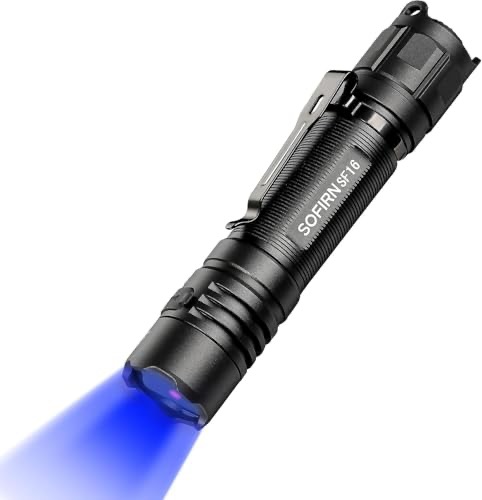
The SF16 is the UV light I’d recommend to almost anyone who asks. It pairs a 365nm Luminus emitter with a ZWB2 filter, so the beam stays dark while stains and minerals light up. Three UV levels let you go soft for close work and strong for a whole room, and Sofirn puts a 3,000mAh 18650 in the box.
It’s best for pet owners, renters checking a new place, hobbyists and anyone who wants one serious UV light without a learning curve.
Key specs
- LED: Luminus SST-08-UV, 365nm
- Filter: ZWB2 visible light filter
- Output: 875 / 440 / 126 mW
- Runtime: 8 h high, 14.5 h medium, 31 h low
- Power: one 18650, 3,000mAh cell included, USB-C charging
- Build: IPX8, 67 g without the battery, mechanical tail switch with mode memory
Pros and cons
Pros
- Filtered 365nm at a sensible size and weight
- Three levels, so close work isn’t blinding
- Comes ready to use with its own cell
Cons
- Changing modes takes a half press on the tail, which takes a minute to learn
- No white light, so it’s a UV tool only
Performance analysis
High is 875 mW, enough to sweep a living room floor from standing height. Medium is the setting I’d use for most stain hunting, and it runs about 14.5 hours. Low at 126 mW is right for checking a bill or a gemstone up close, where a full blast just washes out the detail.
Because it runs on a standard 18650, a spare cell doubles your runtime. If you already own an 18650 flashlight, the cells swap between them. My best 18650 flashlight guide covers lights that share the same battery.
2. uvBeast V3 365nm: Best for Scorpions and Big Areas
Why I chose it and who it’s for
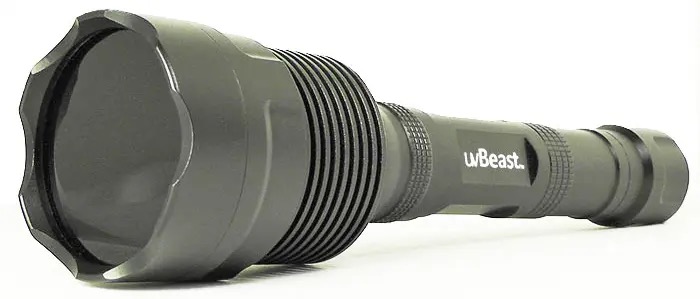
The V3 365nm is built for distance. It runs three 365nm LEDs behind an onboard filter and comes with two 18650 cells, a two bay charger and an extension tube for a third cell. uvBeast rates it at 5,400 µW/cm² of combined UV intensity and says the beam reaches past 60 feet.
It’s best for scorpion hunting in the Southwest, sweeping a yard or a barn, and finding old pet stains across a large carpeted room from standing height.
Key specs
- LEDs: three 365nm LEDs, 1,000 mA each
- Filter: onboard UV filter
- Rated intensity: 5,400 µW/cm² combined (maker’s figure)
- Range: 60 feet plus, per uvBeast
- Power: two 18650 cells and a two bay USB charger included, extension tube for a third cell
- Modes: one
Pros and cons
Pros
- The most reach of any light here
- Filtered 365nm, so the long beam stays clean
- Everything you need is in the box
Cons
- One mode only, so it’s too much for close work
- Charges its cells outside the light, not by USB in the body
- Long and heavy compared to the rest
Performance analysis
This is a sweeping light. Walk a patio at night and scorpions glow blue green from well beyond arm’s length, which is exactly where you want them. On carpet, you can scan a whole room without crawling around on your knees.
The focused beam is the catch. Up close, one strong setting is too intense for checking a bill or reading a small stain. Pair it with a small light like the Lumintop Tool AA UV if you need both.
3. Olight Arkfeld Pro: Best EDC UV Flashlight
Why I chose it and who it’s for
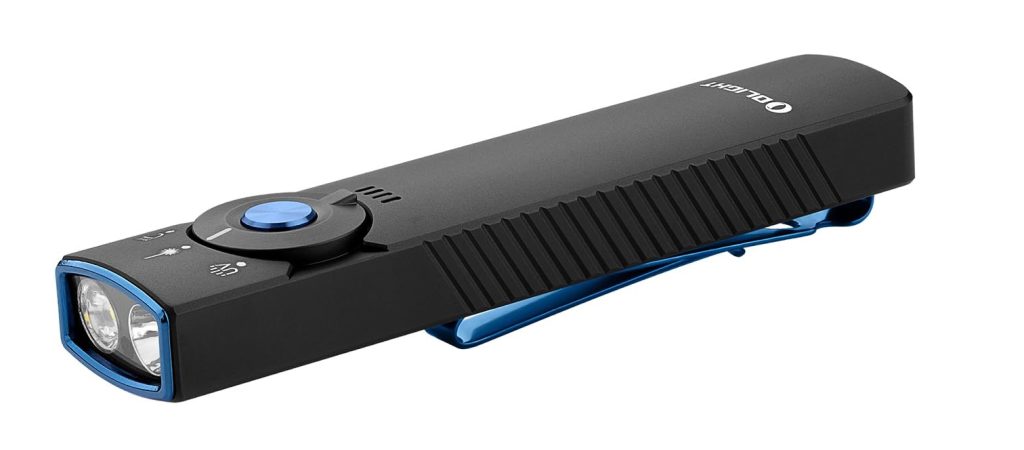
The Arkfeld Pro is a flat everyday carry flashlight with a dial that switches between 1,300 lumens of white light, 365nm UV and a green laser. Most people don’t want a UV light sitting in a drawer. This one rides in your pocket all day, so it’s there when you check a hotel room or a suspicious bill.
It’s best for travelers, inspectors, landlords and anyone who wants UV without carrying a second light. Olight has since released the ArkPro, a slightly larger follow up, but the Arkfeld Pro is still the one most people search for. My EDC flashlight guide covers more lights like it.
Key specs
- UV: 900 to 560 mW typical, 365 to 370nm, up to 5 h 15 min
- White light: up to 1,300 lumens
- Laser: green, Class 3R, 5 mW or less
- Battery: built-in 1,500mAh lithium polymer, magnetic charging
- Build: IPX7, 111 g, 120 x 27 x 16 mm
Pros and cons
Pros
- A real everyday flashlight with UV built in
- 900 mW is strong for a pocket light
- The dial makes switching modes fast and certain
Cons
- Olight doesn’t list a visible light filter on the UV
- The battery can’t be swapped
Performance analysis
As a white light it holds its own against any EDC light its size. As a UV light it sits close to the Sofirn on paper, but without a filter you’ll see a little more visible glow at the edges of the beam.
For a quick hotel check or a look at the back seat of a used car, that doesn’t matter much. For hunting a faint old stain on a patterned rug, a filtered light like the SF16 will show more.
4. Lumintop Tool AA UV: Best Pocket UV Light
Why I chose it and who it’s for
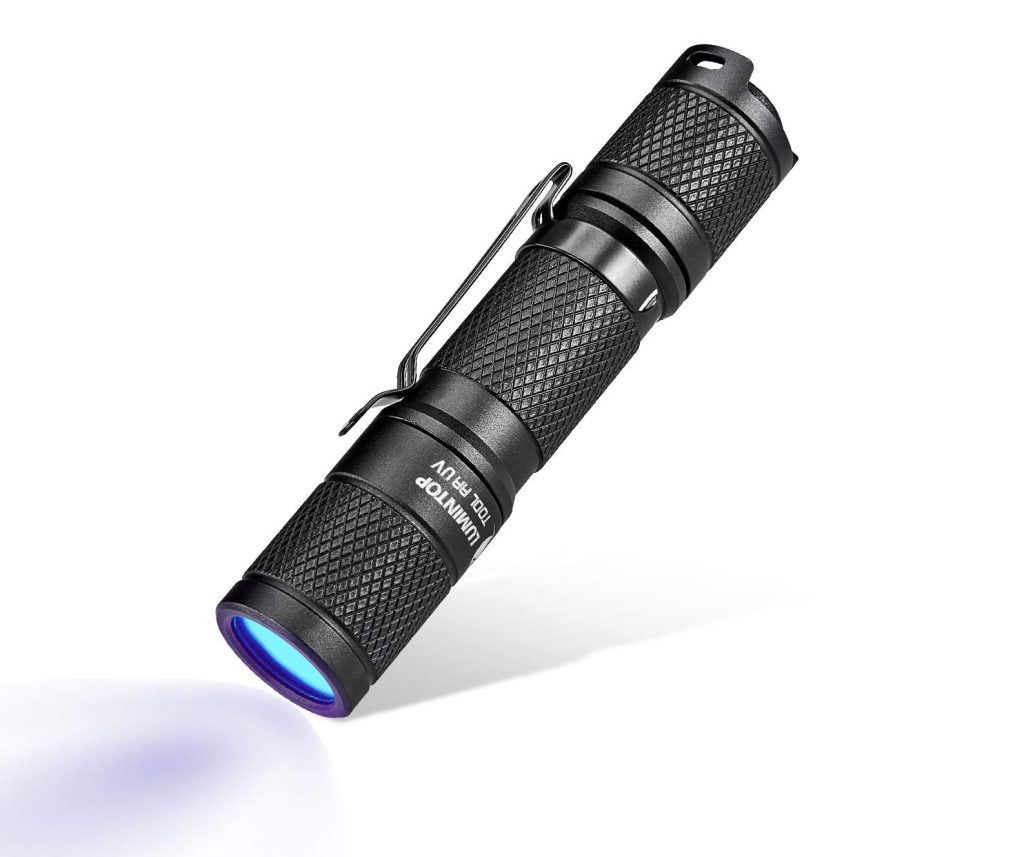
The Tool AA UV is tiny, about the size of your finger, but it runs a 365nm Luminus emitter behind a ZWB2 filter. That makes it one of the cleanest UV beams you can put on a keychain. It runs on a 14500 button top cell, so check whether your kit includes one.
It’s best for close checks: bills, IDs, hotel bedding, a small stain or a rock in your hand.
Key specs
- LED: Luminus SST-10-UV, 365nm
- Filter: ZWB2
- Modes: two, with memory
- Power: one 14500 button top cell
- Build: IP68 to 2 meters, 92 mm long, 24 g without the battery
- Switch: tail clicky or twist the head
Pros and cons
Pros
- Clean, filtered 365nm in a keychain size
- Waterproof to 2 meters, with a tail switch or a twist head
Cons
- Lumintop doesn’t publish UV output or runtimes
- Too small to sweep a room
- The battery may not be included
Performance analysis
This is a close-range light, and at close range it’s excellent. Hold it a few inches from a twenty dollar bill and the security strip glows, which the U.S. Currency Education Program confirms is the green you should see on a real note.
Use a 14500 lithium-ion cell, not a standard alkaline AA, to get the light Lumintop designed it for. My best AA flashlight guide explains how 14500s and AAs differ.
5. Nitecore GEM10UV: Best for Rocks and Gems
Why I chose it and who it’s for
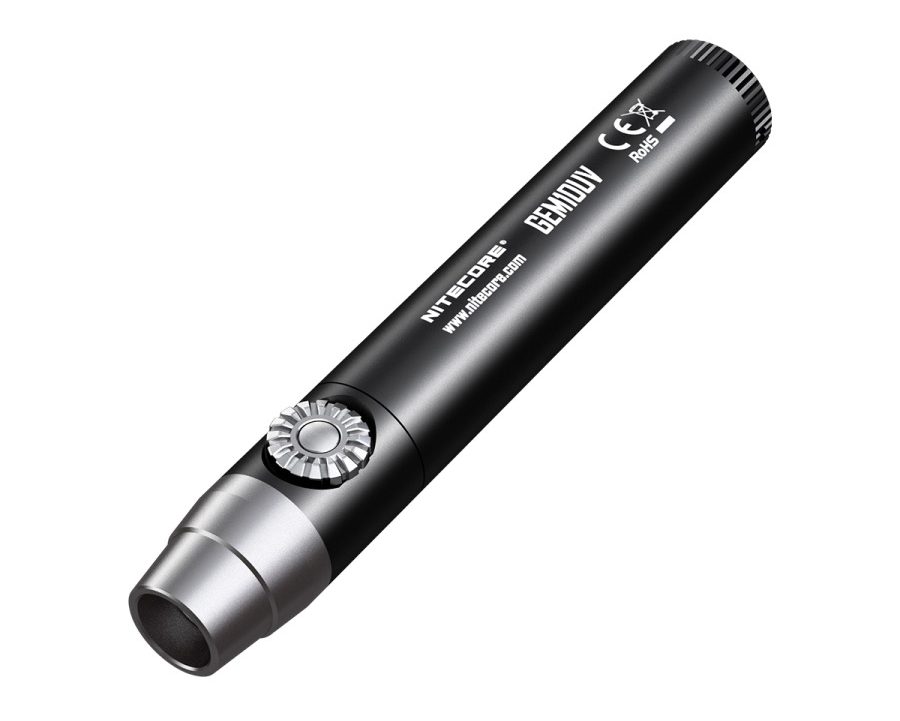
The GEM10UV comes from Nitecore’s gemstone line, built for jewelers checking jade and amber for fillers. It puts out up to 3,000 mW of 365nm UV, by far the most here, and a rotary dial dims it smoothly from a whisper to full power.
It’s best for rockhounds, mineral collectors and anyone examining stones, where fine control over brightness matters more than reach.
Key specs
- UV: 365nm, up to 3,000 mW
- Runtime: up to 500 hours at the lowest setting
- Control: rotary dial with stepless dimming
- Power: one 18650 or two CR123A cells, not included
- Build: IPX8 to 2 meters, 1 m impact resistance, 135 mm, 66.5 g
- Extras: tail stand, built-in measuring scale on the body
Pros and cons
Pros
- The most UV power in this guide, with stepless dimming for close inspection
- Runs on an 18650 or two CR123A cells
Cons
- Nitecore doesn’t list a visible light filter
- Battery sold separately
- 3,000 mW demands real care with your eyes
Performance analysis
Turn the dial low and a fluorescent mineral shows its colors without the glare blowing out the detail. Turn it up and you can light a whole rock pile in the dark. That range is why it suits collectors better than a one mode light.
Treat full power with respect. Never shine it at anyone’s eyes or at shiny tile and glass that can bounce it back, and wear a pair of UV blocking safety glasses for long sessions. Feed it an 18650 cell; my 18650 vs 21700 guide covers safe storage.
Which UV Light for Which Job
Most people buy a UV flashlight for one task. Here’s what each job really needs, and which pick fits it.
Pet urine
Dried urine contains compounds that fluoresce under UV, which is why a black light finds old accidents your nose can’t place. Turn off every light, wait for your eyes to adjust, and hold the light two or three feet above the floor. Filtered 365nm, like the Sofirn SF16, shows faint stains a 395nm light buries in purple. Mark each spot with painter’s tape, then treat it with an enzyme cleaner.
Scorpions
Scorpions glow bright blue green under almost any UV, even 395nm, so here range matters more than purity. The uvBeast V3 365nm lets you check a patio, a woodpile or the base of a wall from a safe distance.
Rocks and minerals
Many fluorescent minerals react to 365nm but barely respond at 395nm, and some need shortwave UV that no flashlight in this guide produces. For longwave work, the Nitecore GEM10UV gives you power and fine control.
Hotel rooms and used cars
Bodily fluids and cleaning residue can fluoresce on sheets, headboards and seats. It’s a quick, discreet check, and a pocket light like the Olight Arkfeld Pro or Lumintop Tool AA UV is the one you’ll actually have with you.
Money, IDs and documents
Most banknotes and many IDs carry features that only show under UV. Close range and a soft beam work best, so use a low mode and hold the light a few inches away.
A/C leaks and UV resin
Mechanics add UV dye to refrigerant and engine fluids so leaks glow under a black light, and UV resin cures under it. Both respond to 365nm, and resin cures faster under it. A focused light like the SF16 on high handles both.
UV Flashlight Buying Guide: What to Look For
Pick 365nm unless you only hunt scorpions
365nm shows more and wastes less of its output on visible light. 395nm is fine for scorpions and bright stains, and it’s cheap, but it’s the reason most people think black lights don’t work.
Look for a ZWB2 filter
A filter is a black glass lens over the LED. It’s the easiest way to tell a serious UV light from a toy. If the product photos show a purple beam lighting up the whole scene, there’s no filter.
Judge output in milliwatts, not lumens
UV output is measured in milliwatts (mW) or microwatts per square centimeter (µW/cm²). A UV flashlight listing that brags about lumens is measuring the wrong thing, usually the visible glare you don’t want. My candela vs lumens guide covers what each brightness number really means.
Match the beam to the job
A wide, soft beam is best for floors and rooms. A tight, focused beam reaches scorpions across a yard but is too harsh for a bill or a gemstone. A light with several levels, like the SF16 or GEM10UV, covers more jobs.
Think about the battery
Built-in batteries are convenient but can’t be swapped. 18650 and 14500 lights let you carry a spare. Skip lights that run six AA cells in a plastic carrier; those carriers are where cheap black lights usually fail.
Is a UV Flashlight Safe?
Used sensibly, yes. The 365nm and 395nm lights here are UVA, the same type found in sunlight. But concentrated UV can hurt your eyes, and the EPA notes that UV exposure raises the risk of certain cataracts. Never shine a UV light in anyone’s eyes, including your own, and watch for reflections off mirrors, windows and glossy tile.
For long sessions, wear UV blocking glasses. Keep strong UV lights away from kids, and don’t use a UV flashlight as a sanitizer. Germ-killing lamps use UVC, a different and far more hazardous band that none of these lights produce.
Frequently Asked Questions
What is the best UV flashlight?
For most people, the Sofirn SF16. It combines a filtered 365nm beam, three output levels and an included 18650 cell. If you want UV in your everyday carry light, the Olight Arkfeld Pro is the better fit.
Which is better, 365nm or 395nm?
365nm, for almost every job. It makes more materials glow and adds far less purple glare, especially with a filter. 395nm is cheaper and works for scorpions and fresh, bright stains, but it misses the faint stuff.
Will a UV flashlight show cat and dog urine?
Yes, dried urine from cats and dogs fluoresces under UV. It shows best in a fully dark room with a filtered 365nm light held a few feet above the floor. Some cleaners and fabrics also glow, so confirm a spot by smell before you scrub.
Is a UV flashlight the same as a black light?
Yes. Black light is the everyday name for UVA light, and a black light flashlight is just a handheld UV light. Most are sold under both names.
The Bottom Line
If you buy one UV flashlight, make it the Sofirn SF16. Filtered 365nm and three output levels cover pet stains, minerals and money with no fuss. For scorpions and big spaces, the uvBeast V3 365nm reaches farther than anything else here. For a light that does UV and everything else, carry the Olight Arkfeld Pro.
Want the smallest clean UV beam you can find? The Lumintop Tool AA UV fits on a keychain. For rocks and gems, the Nitecore GEM10UV gives you the most power and the finest control. Whatever you choose, use it in a fully dark room and keep it out of everyone’s eyes.
