
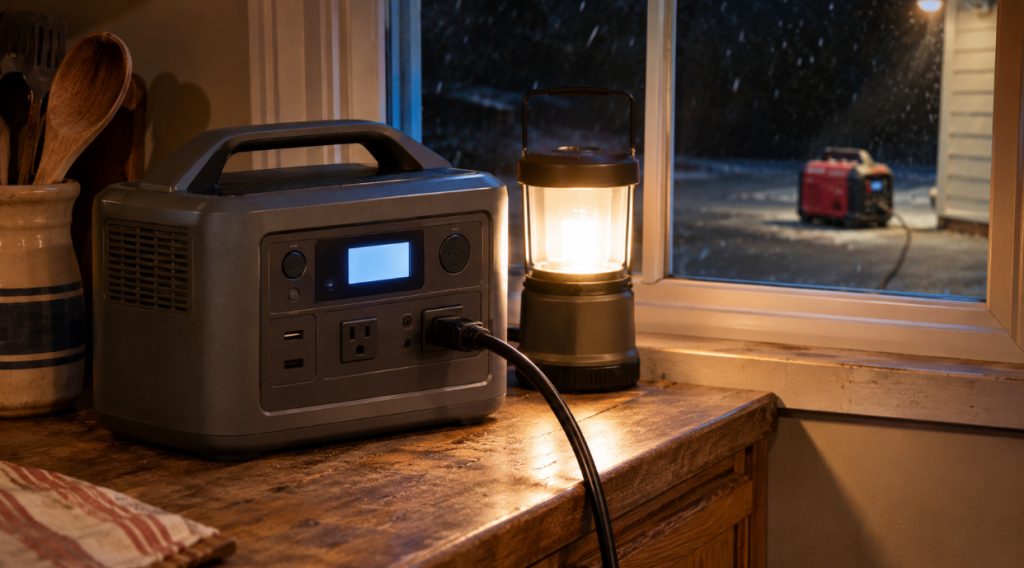
Drive down any street on the third night of an ice storm and you can tell who planned ahead just by listening. One driveway has a generator rumbling away like a pickup somebody forgot to shut off, and around midnight a fellow in a headlamp and house slippers is out there sloshing gas into it from a red can. Two doors down it’s dead quiet. A battery box on the kitchen counter is keeping the fridge cold and the router blinking, and that family is sound asleep under the electric blanket. Come day four, though, the quiet house is out of juice and the generator guy is handing extension cords over the fence.
Short on time? Skip to my picks
That street is the whole power station vs generator question. A portable power station is a big rechargeable battery with outlets on it. It’s silent, it’s safe in the bedroom, and it runs until the battery is empty. A generator burns gasoline or propane, makes a lot more power for the money, and keeps going as long as you feed it. It also has to sit outside, at least 20 feet from the house, and the whole block will hear it.
If your outages usually last a night or two, you live in an apartment, or somebody sleeps with a CPAP, buy the battery. If you’re on a well, need the furnace blower running, or the power stays off for days, buy the generator. If the lines come down every winter on your road, get a little of both. Here’s what I’d buy for each case, and the Outage Planner further down will tell you which camp your house falls in.
Quick Picks: Power Station, Generator or Both
The short list, in plain words:
- EcoFlow Delta 3 Plus: best for overnight outages, apartments and CPAP users
- Westinghouse iGen5000DFc: best for multi-day outages in a house with a yard
- EcoFlow Smart Generator 3000 (Dual Fuel): best for pairing with a Delta 3 Plus so the battery never runs dry
- Anker SOLIX F3800 Plus: best for well pumps, 240-volt circuits and whole-home battery backup
- Jackery Solar Generator 1500 v2: best for recharging from the sun when the outage drags on
- Champion 4500W Dual Fuel Inverter: best for the most generator for the money
Power Station vs Generator: The Short Answer
A power station stores electricity ahead of time. A generator makes it on the spot by burning fuel. Noise, fumes, runtime and cost all follow from that one difference.
Power Station vs Generator Compared

Battery or Gas? Outage Planner
Tap what has to keep running, tell the planner how long your outages last and what kind of home you’re in, and it does the math. You’ll get a straight verdict, an hour-by-hour picture of the outage, the fuel or recharging it takes, how loud it’ll be at the bedroom window, and the gear that fits.
Can a Portable Power Station Replace a Generator?
For a lot of homes, yes. A fridge, a router, a few LED lamps, phones and a CPAP come to roughly 1.7 kWh a day. The EcoFlow Delta 3 Plus keeps that going for about 12 hours, the Bluetti Elite 200 V2 for about a day, and the Anker SOLIX F3800 Plus for about two days. Where a battery falls short is anything that makes heat or turns a big motor for hours.
Can a power station run a furnace?
A gas furnace needs power for the blower and controls, usually 400 to 800 watts while it runs, and it cycles on and off. A 1 kWh station covers a few hours of that and the F3800 Plus covers most of a night. Most furnaces are hardwired, though, so you’ll need an electrician to add a furnace plug, or a generator transfer switch or interlock kit. Either one works for a battery or a generator.
Can a power station run a well pump?
Usually not. A half-horsepower submersible pump draws around 1,000 watts running and two to three times that for a split second at startup, and most deep-well pumps are 240 volts. Nearly every portable station is 120 volts only. The F3800 Plus is the exception, with a 240-volt L14-30 outlet and 6,000 watts behind it. The gas inverters here are 120 volts too, so a 240-volt pump needs an open-frame generator like the Westinghouse WGen9500DFc from my portable generator for home guide.
Sump pumps, space heaters and window AC
A plug-in sump pump is fine on a big station if the surge rating covers its start. A 1,500-watt space heater drains the Delta 3 Plus in about 35 minutes, so for heat, a generator or an indoor propane heater makes more sense. A 5,000 BTU window unit pulls about 450 watts, a couple of hours on a 1 kWh station.
Is a Power Station Safe to Use Indoors?
Yes. There’s no engine and no exhaust, and the LiFePO4 batteries in every station here are the calm, slow-burning kind of lithium. A generator is the opposite. CPSC says about 100 Americans a year die from carbon monoxide from portable generators, and its rule is outside only, 20 feet from the house, never on a porch or in a carport. Cracking the garage door doesn’t make it safe. Every generator here has an automatic CO shutoff, and you still want working carbon monoxide detectors on every floor before you pull a starter cord.
How Loud Is a Generator Compared to a Power Station?
The Delta 3 Plus stays under 30 dB below 600 watts, quieter than most refrigerators. The Westinghouse iGen5000DFc is rated as low as 52 dBA, about like a dishwasher two rooms away, and the Champion 4500 is rated at 61 dBA at 23 feet, closer to two people talking. Those are good numbers for generators, and they still carry through a bedroom window at 2 a.m. If you have an HOA, check its rules before the storm. Some limit generator hours or where one can sit.
Which Is Cheaper: a Power Station or a Generator?
A generator is far cheaper to buy. Running costs flip that around. Champion rates its 4500 at 14 hours at quarter load on 2.25 gallons, about 5.4 kWh per gallon, or roughly 74 cents a kilowatt-hour at about $4 a gallon. Charging a battery from the wall costs about 20 cents a kWh at the national average rate, and solar is free once you own the panels.

The expensive way to run a generator is the way most people do it: all night, to keep a 150-watt fridge cold. In economy mode it still burns around a tenth of a gallon an hour, so that power costs around $2.67 a kWh. Run the same generator hard for an hour to fill a battery and the cost drops by three quarters.
Fuel goes stale, batteries don’t
Plain gasoline starts going bad in a few months, and a gummed-up carburetor is the top reason generators won’t start in an outage. Add stabilizer, rotate your cans and run the generator 15 minutes a month. Propane doesn’t go stale, which is why I’d run a dual fuel generator on propane for backup duty. A LiFePO4 battery just wants a top-up every few months.
Solar Generator vs Gas Generator
A solar generator is a power station sold with folding panels. It wins a long outage only if the sun cooperates, and winter is when it usually doesn’t. A 200-watt panel set covers a solid chunk of a day’s essentials in an Arizona December and far less under Seattle clouds. My peak sun hours calculator tells you what a panel really makes at your ZIP code. If that number is small, gas is your multi-day plan and solar is the bonus. My solar generator guide covers the kits that refill fastest.
What Cold Weather Does to Each One
Most LiFePO4 stations will run the house below freezing but won’t recharge until the battery is above about 32°F, so keep the station inside with you and bring the solar cable in through a cracked window. Generators start fine in the cold with the right oil and a fresh battery. Propane is the one that sulks. It loses pressure as the tank gets colder, so on a below-zero night a small tank can struggle to feed a big engine.
Should You Own Both?
If you lose power for days at a time, yes. The battery runs the house all night without a sound. In the morning you roll the generator out to its spot, plug the station into it, and let it charge at full speed for an hour or so while the fridge runs straight off the generator. Then you shut the engine off and the battery takes over. The EcoFlow Smart Generator 3000 (Dual Fuel) does that by itself with a Delta 3 Plus, and the F3800 Plus takes a 240-volt generator directly.
The Picks in Detail
1. EcoFlow Delta 3 Plus: Best Power Station for Most Outages
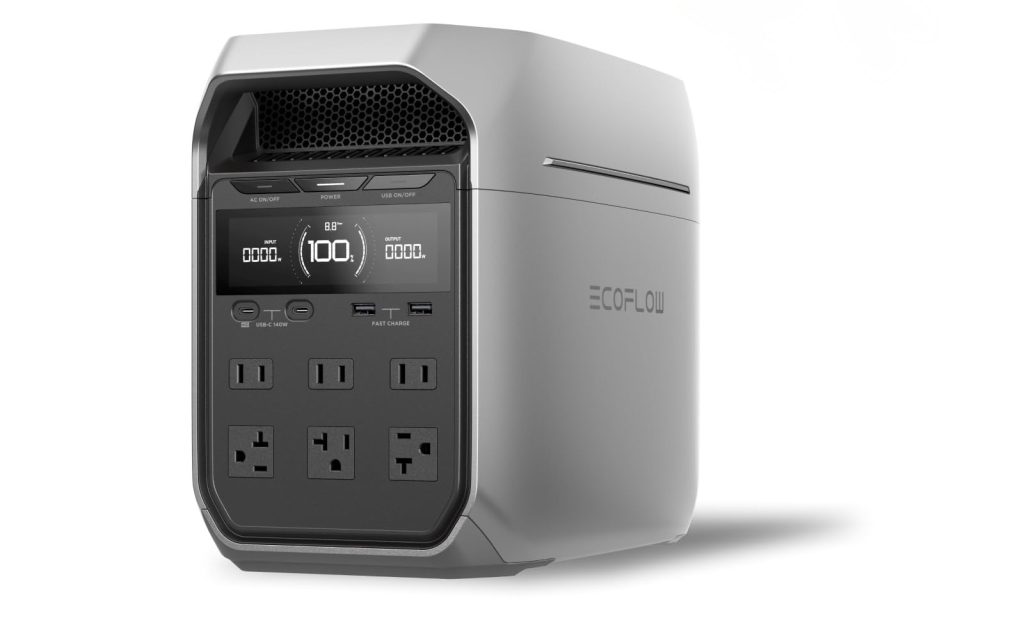
Why I chose it: It’s the top pick in my power station guide, and the battery I’d hand to most people who lose power a few times a year. It holds 1,024 watt-hours, runs 1,800 watts with a 3,600-watt surge that starts a fridge easily, and refills from the wall in 56 minutes, which matters when the power flickers back for an hour between storms. It’s best for apartments, CPAP users and outages that end by lunch the next day.
Key specs
- Capacity: 1,024 Wh LiFePO4, rated 4,000 cycles to 80%
- Output: 1,800 W (3,600 W surge)
- Wall charging: full in 56 minutes; solar up to 1,000 W
- UPS switchover: under 10 ms
- Weight: 27.6 lb; expands to 5 kWh
Pros
- Quiet enough for the bedroom
- Fast charging catches every break in the outage
- Pairs with the Smart Generator 3000
Cons
- About 12 hours of fridge, Wi-Fi and lights alone
- 120 volts only
In real use: Plug in the fridge, router and a lamp before bed and you’ll wake up to a cold fridge with about a third of the battery left. Leave it plugged into the wall in UPS mode and the Wi-Fi won’t even blink when the grid drops.
2. Westinghouse iGen5000DFc: Best Generator for Most Homes
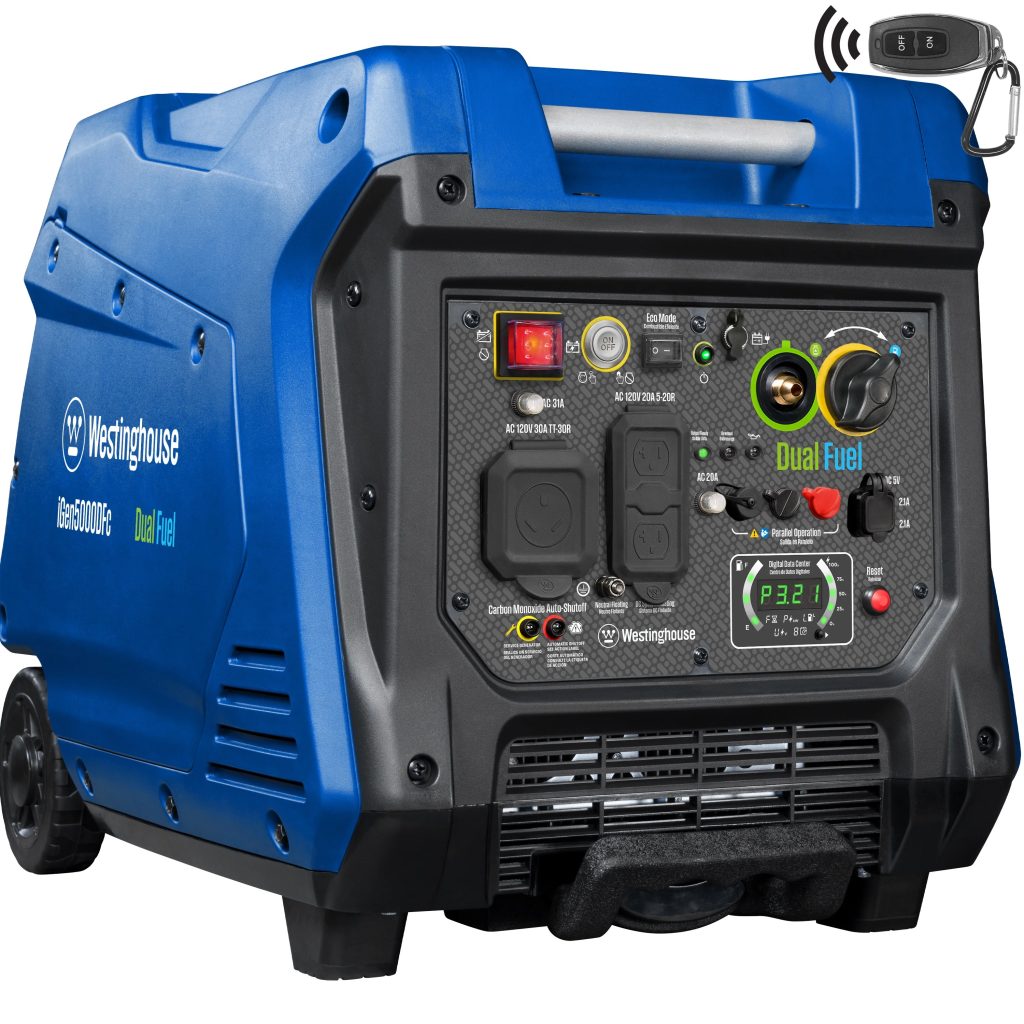
Why I chose it: The top pick in my dual fuel generator guide makes 3,900 running watts on gas and 3,500 on propane, enough for a fridge, freezer, furnace blower, lights and a microwave at once. It’s an inverter, so the power is clean enough for electronics, and its CO sensor shuts it down if exhaust builds up nearby. It’s best for houses that lose power for days.
Key specs
- Output: 3,900 running / 5,000 peak watts on gas; 3,500 / 4,500 on propane
- Runtime at 25% load: up to 18 hours on gas, 22 on propane
- Tank: 3.4 gallons; noise as low as 52 dBA
- Outlets: 120 V duplex, TT-30R, USB
- Safety: CO shutdown, low oil shutdown; remote start
Pros
- Covers most of a house’s 120-volt essentials
- Propane option means no stale gas
- Remote start from indoors
Cons
- 120 volts only, so no 240-volt well pump
- Needs oil changes and monthly runs
In real use: Set it on a level spot 20 feet out with the exhaust pointed away, run your cord or transfer switch cable inside, and press the fob. In economy mode it idles down to a low hum while the fridge cycles. Run it around the clock on propane and you’ll swap tanks about once a day, which is why it pairs so well with a battery.
3. EcoFlow Smart Generator 3000 (Dual Fuel): Best of Both
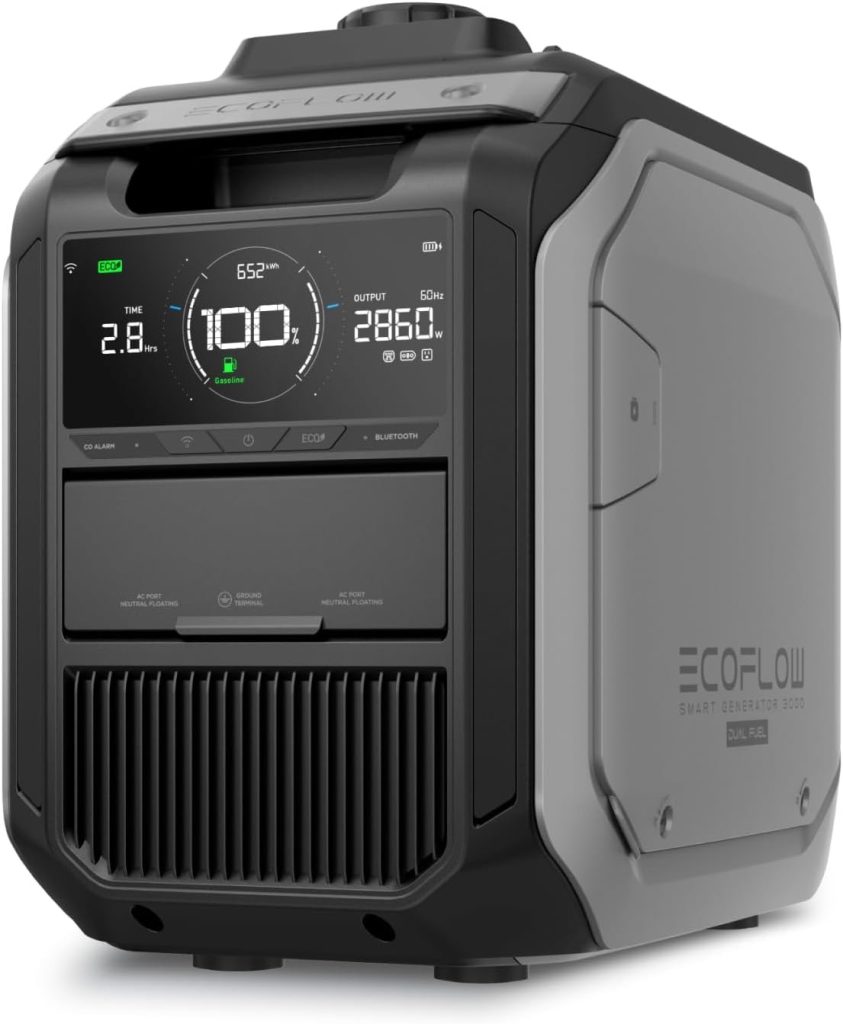
Why I chose it: This generator gives you a battery’s quiet nights and a generator’s endless runtime without babysitting either one. Paired with a Delta 3 Plus or Delta 3, it starts itself when the battery drops to the level you pick and shuts off when it’s full. It’s best for anyone leaning toward the Delta 3 Plus who loses power for days.
Key specs
- Output: 2,000 W on gas, 1,800 W on propane (3,000 W peak with X-Boost)
- Runtime on gas: 3.3 hours at full load, 9 hours at quarter load
- Fuel: small 4-liter gas tank or a standard propane tank
- Start: pull cord, button, app, or automatic
- Weight: 48 lb
Pros
- No 3 a.m. trips outside
- Light enough to carry out of the shed
- Tool-free propane hookup
Cons
- Auto start works only with EcoFlow’s Delta 3 and 3 Plus
- 2,000 W won’t run big loads on its own
In real use: Set the battery to call for the generator at 20% and stop it at 90%. Around dawn you’ll hear it start out back, run for about an hour and quit. That burns less fuel than anything else in this guide, because the engine only runs when it’s working hard.
4. Anker SOLIX F3800 Plus: Best Whole-Home Battery
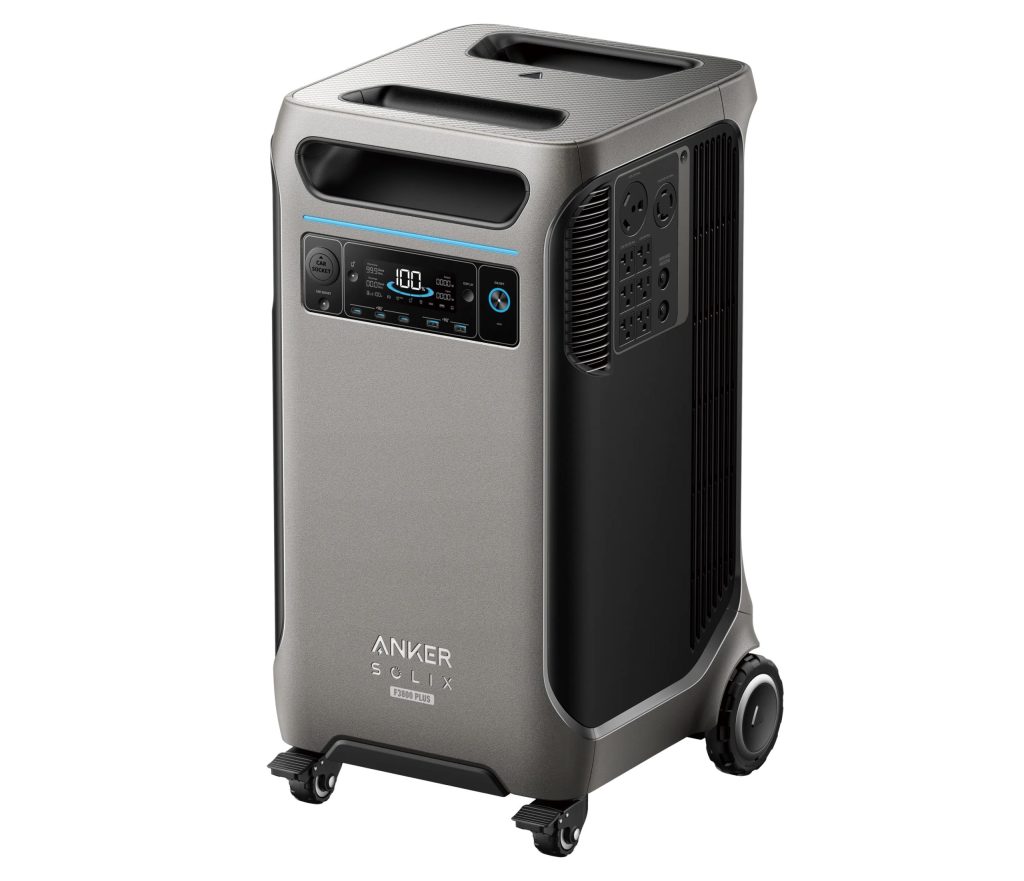
Why I chose it: The one battery here that can stand in for a generator on the big stuff. It holds 3,840 watt-hours, puts out 6,000 watts, and does real 240 volts, so it can run a well pump or a subpanel through a transfer switch. Expansion batteries take it to 26.9 kWh. It’s best for rural homes on a well and anyone who wants whole-home backup without an engine.
Key specs
- Capacity: 3,840 Wh LiFePO4, 3,000+ cycles
- Output: 6,000 W at 120 V and 240 V (L14-30 and 14-50 outlets)
- Solar input: up to 3,200 W
- Generator input: 240 V charging and pass-through with Anker’s adapter
- Weight: 136.7 lb on wheels
Pros
- 240 volts for well pumps
- Grows as your budget allows
- Takes a 240-volt generator for long outages
Cons
- Heavy, it rolls rather than carries
- Costs more than most generators by a wide margin
In real use: Wheel it next to the panel, connect it through a transfer switch, and pick its circuits: fridge, well pump, furnace, bedrooms. One unit gets most families through the first day and night. Let a generator top it up each afternoon and it handles a week.
5. Jackery Solar Generator 1500 v2: Best Solar Generator
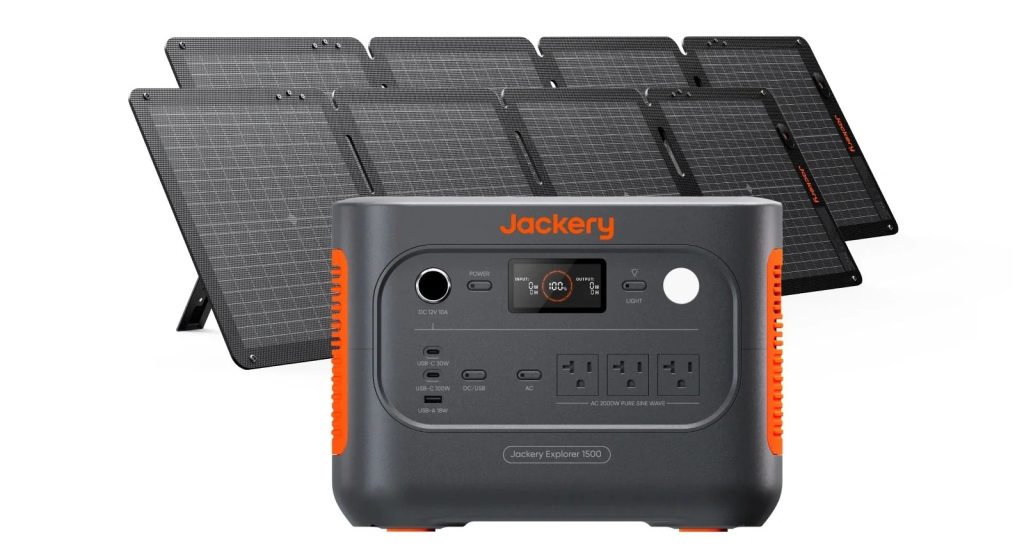
Why I chose it: If you’d rather never store gasoline, this is the simplest way to stretch a battery past the first night. It pairs the Explorer 1500 v2, 1,536 watt-hours and 2,000 watts, with two folding 100-watt panels. It’s best for sunny regions and for renters who can’t keep a generator.
Key specs
- Capacity: 1,536 Wh LiFePO4
- Output: 2,000 W (4,000 W surge), three AC outlets
- Wall charging: about an hour
- Solar input: up to 400 W; two 100 W panels included
- Weight: about 32 lb for the station
Pros
- Light for 1.5 kWh
- Panels included, ready on day one
Cons
- Winter sun refills it slowly up north
- Not expandable, 120 volts only
In real use: Set the panels on the south side of the house, tilted steeply for the low winter sun, and run the cable in through a cracked window so the station stays warm. On a bright December day in a sunny state you’ll win back a good part of the night’s use by mid-afternoon.
6. Champion 4500W Dual Fuel Inverter: Best Value Generator
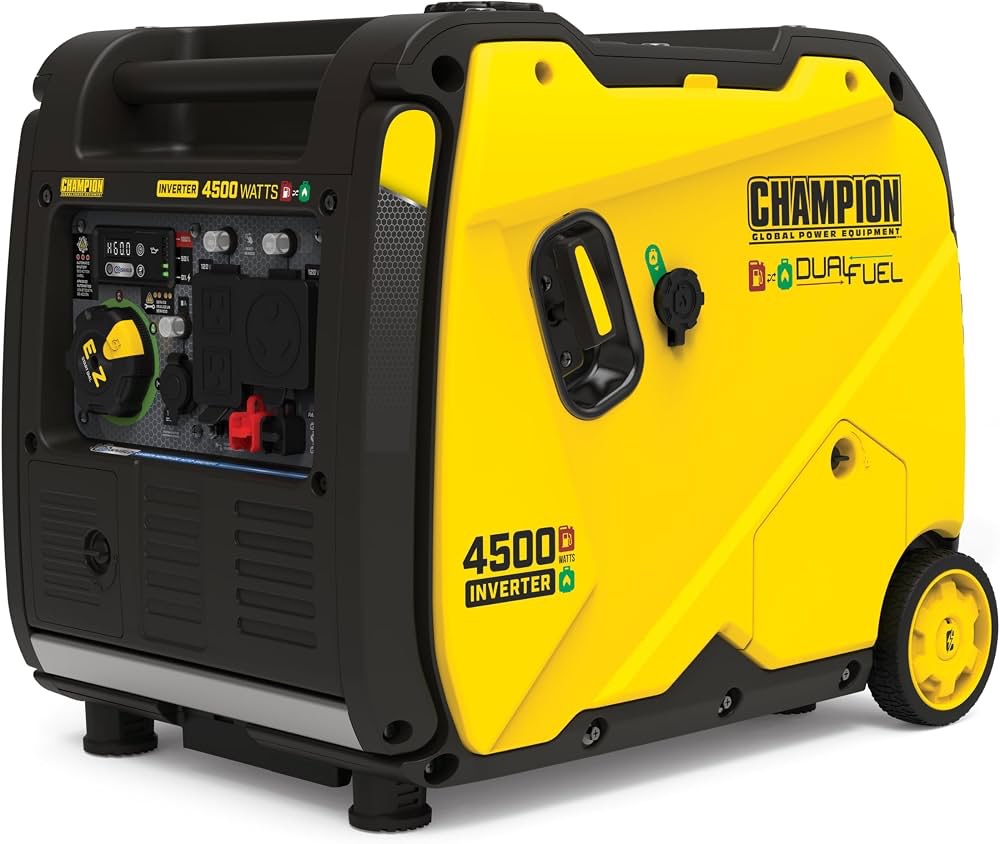
Why I chose it: The Champion 4500 is real backup power without battery money. It makes 3,500 running watts on gas and 3,150 on propane, starts with a button, and has CO Shield, which shuts the engine off if carbon monoxide builds up. It’s best for pairing a dependable, low-cost generator with a small battery for the overnight hours.
Key specs
- Output: 3,500 running / 4,500 starting watts on gas; 3,150 / 4,500 on propane
- Runtime at quarter load: 14 hours on gas (2.25 gal), 21 on propane
- Noise: 61 dBA at 23 feet
- Outlets: 120 V duplex, TT-30R, 12 V
- Weight: 99.2 lb
Pros
- A lot of generator for the money
- Cold Start Technology for winter mornings
- Parallel capable
Cons
- Louder than the Westinghouse
- 120 volts only
In real use: Plug the fridge, freezer and furnace cord into it and it settles into economy mode. Run it morning and evening to recover the fridge and charge a battery, then shut it down for the quiet hours. On propane you skip the stale gas problem entirely.
How to Choose Between a Power Station and a Generator
Plan for your longest outage
Think about the worst outage of the last five years. If it lasted a night, a battery covers it. If it was four days after an ice storm, plan for that. My power outages by state page shows how long outages run where you live.
List what can’t go off
Fridge, freezer, internet, medical gear, furnace blower, sump pump, well pump. Add up the running watts and note anything on 240 volts. That list usually settles it.
Know where it will sit and how it refills
A generator needs a spot 20 feet from the house you can reach in a storm, plus a dry place for fuel. A battery refills from the wall, the sun, a car or a generator. If someone sleeps with a CPAP, quiet bedside power matters most, and my CPAP battery backup guide covers it. Keep the plan with your power outage emergency kit.
Frequently Asked Questions
Can a generator charge a portable power station?
Yes, and it’s the most fuel-efficient way to use a generator in a long outage. Plug the station’s AC charging cable into an inverter generator and it charges like it would from the wall. The EcoFlow Smart Generator 3000 does it automatically with a Delta 3 Plus.
How long will a portable power station run a refrigerator?
A typical fridge uses 1 to 1.5 kWh a day. A 1,024 Wh station has about 870 usable watt-hours, so plan on roughly 14 to 20 hours for the fridge alone, less with other things plugged in.
Why does a power station cost more than a generator with more watts?
You’re paying for stored energy. The battery cells cost far more than a tank of fuel. A generator’s watts are cheap up front, and you pay for them every hour in fuel and upkeep.
Do I need a transfer switch for a power station or a generator?
Only for hardwired things like a furnace, a well pump or whole circuits. Plug-in appliances can run on a heavy extension cord. Never backfeed a wall outlet with a double-ended cord. It can kill a lineman down the street and start a fire in your panel when the grid comes back.
The Bottom Line
For short outages in a small home, buy the EcoFlow Delta 3 Plus and enjoy the quiet. For long ones with a yard, the Westinghouse iGen5000DFc is the generator I’d keep in the shed, and the Champion 4500W Dual Fuel Inverter does the job for less. If you’re on a well and want backup with no engine at all, the Anker SOLIX F3800 Plus carries it. In sun country, the Jackery Solar Generator 1500 v2 keeps refilling itself. And if your road goes dark every winter, pair a Delta 3 Plus with the EcoFlow Smart Generator 3000 (Dual Fuel) and let them take turns. Set it up before the storm and you’ll be the quiet house that still has a cold fridge on day four.
