
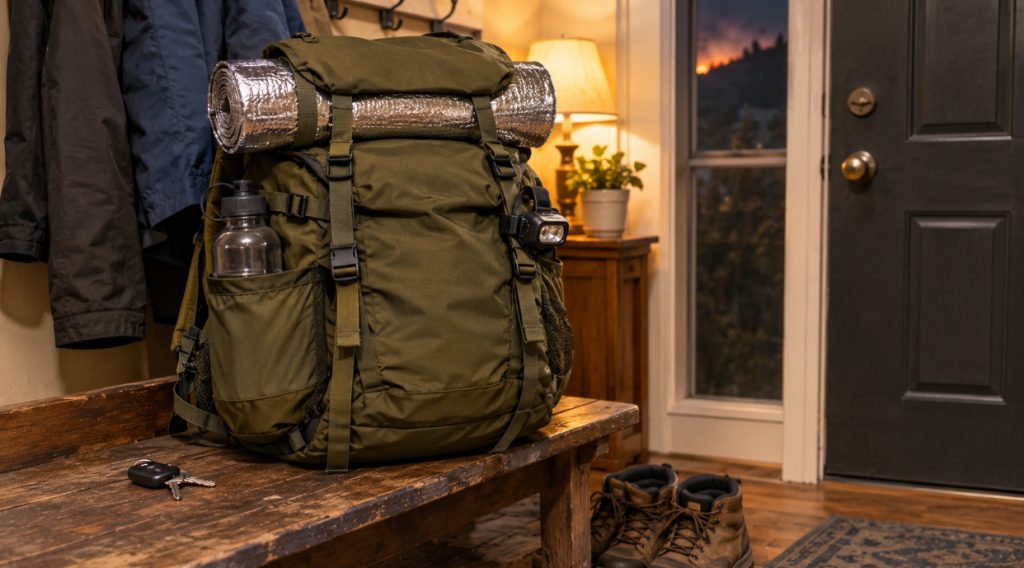
The phone goes off at ten past two in the morning with that awful emergency tone, the one that gets the dog barking before you’re even awake. Evacuation order for your zip code, leave now. Out the bedroom window the ridge behind the subdivision has an orange glow to it that wasn’t there at supper. One person is digging through the junk drawer for the spare car keys, another is standing in the hall closet holding a sleeping bag and a box of granola bars, and nobody can find the charger for Grandma’s phone. That fifteen minutes is the whole reason a bug out bag exists.
Short on time? Skip to my picks
I’ll be straight with you about the kits sold for that night. Most premade bug out bags get you started and leave plenty for you to finish. The popular ones carry one to three liters of water for two people for three days, which is less than one thirsty adult drinks on a hot afternoon. None of them know you take a blood pressure pill, and some arrive with the gear loose in the box and the backpack folded flat on top.
So here’s my short list. The EVERLIT 72 Hour kit is the one I’d hand most families, since it covers food, water, shelter and real bleeding control for two in a pack that holds up. The Uncharted SEVENTY2.0 Pro is the one to buy if you want pro-grade tools in a shell that shrugs off a downpour, and the 5.11 RUSH72 2.0 is the empty pack I’d pick to build your own. Right under the picks there’s a bag builder. Tell it who’s coming, what you’re leaving ahead of and whether you’re driving or walking, and it packs a bag for everybody who can carry one, weighs each bag against what that person can actually carry, and shows exactly what your kit is missing.
Quick Picks: The Best Bug Out Bags
- EVERLIT 72 Hour Bug Out Bag (2-Person): best for most two-person households that want one box covering the basics plus real bleeding control.
- Uncharted SEVENTY2.0 Pro Survival System: best for people who want top-quality tools and a bag that stays dry in a sideways hurricane rain.
- Emergency Zone Urban Survival Bug Out Bag (2-Person): best for apartment and city folks who would rather not look like they are carrying survival gear.
- Ready America 2-Person 3-Day Emergency Backpack: best for a first kit, a teenager’s bag or a second kit for the car.
- 5.11 Tactical RUSH72 2.0 Backpack: best for building your own bug out bag around gear you already trust.
- Osprey Farpoint 55 Travel Pack: best for carrying a heavier bag a long way, and families who want a small daypack for a child.
Bug Out Bags Compared
Look hard at that last box on each kit. Ready.gov plans on a gallon of water per person per day, so two people need about 6 gallons for three days. That’s roughly 23 liters, and the wettest kit here carries 3. Nobody is going to walk out with 50 pounds of water on their back, so the smart plan is a day of water in the bag, a water filter straw and tablets to make more, and jugs in the trunk if you’re driving. The builder below does that math for your family.

Grab-and-Go Bag Builder: Pack a Bag for Everyone
Add the people and pets in your house, pick what you’re most likely to leave ahead of and how you’re getting out, then choose a kit from this list or start from scratch. The builder packs every bag that can be carried, fills it layer by layer and swings a weight gauge for each person, so you can see the moment a kid’s bag gets too heavy. Underneath you get a checklist that marks what the kit already covers, what you add from home and what you still need to buy. Print it and tape it inside the closet door where the bags live.
1. EVERLIT 72 Hour Bug Out Bag (2-Person): Best Overall
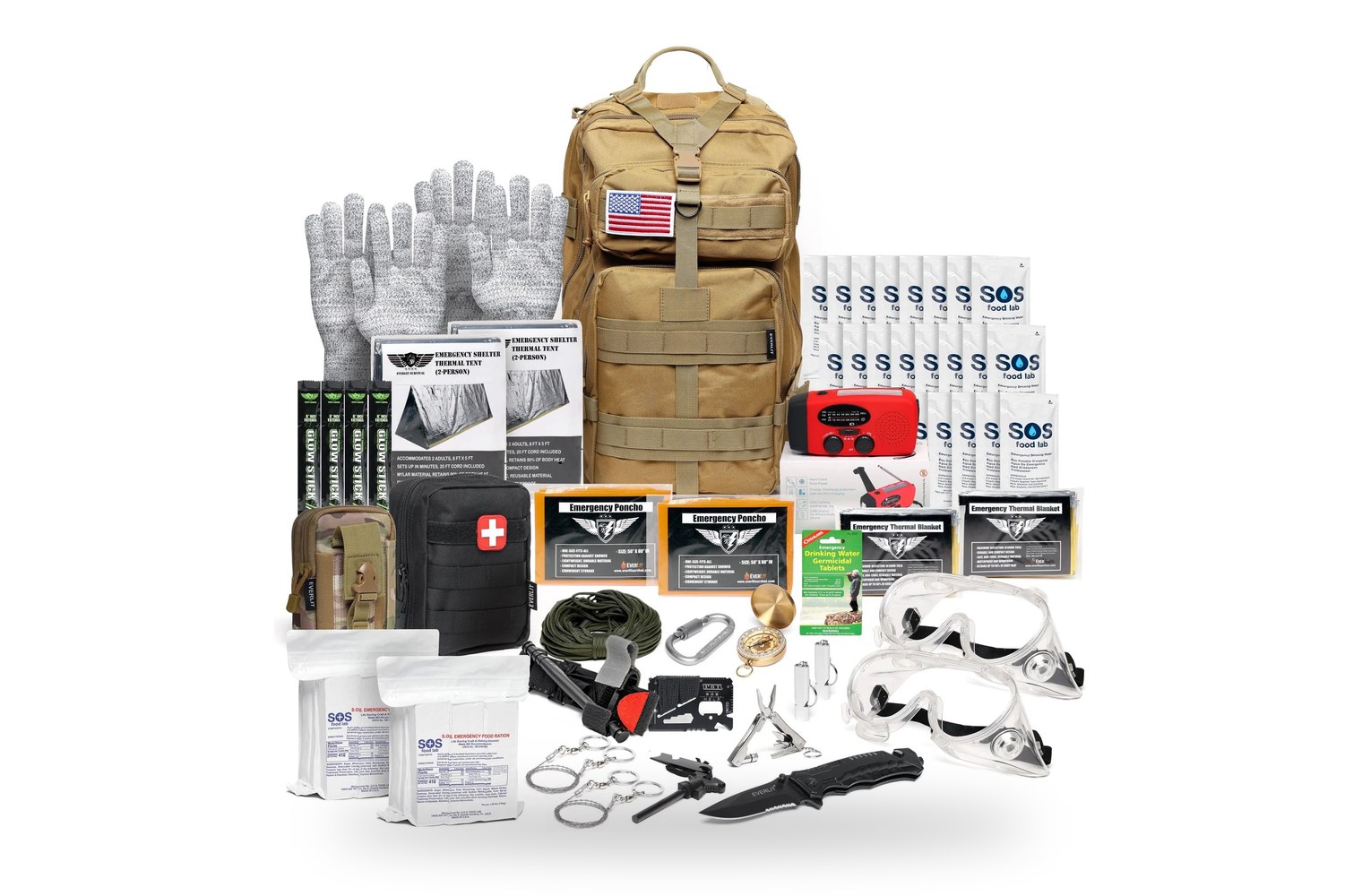
Why I chose it: If a friend asked me to pick one premade bug out bag and be done with it, this is the box I’d send them. EVERLIT calls it the STORM II, and it covers two people for three days. Inside you get two 3,600 calorie food bars, 24 pouches of Coast Guard approved drinking water, a pair of emergency shelters, two ponchos, two mylar blankets and a hand crank radio with a flashlight and a phone charging port built in.
It also has better medical gear than any other kit here: a 200 piece first aid kit and a genuine C-A-T Gen 7 tourniquet, the same one the military carries, with its NSN number listed. Cheap kits toss in a look-alike that can snap when you crank it. With two pairs of cut-resistant gloves and safety goggles on top, it’s ready for broken glass and a car wreck on the way out of town.
Key specs
- Built for: 2 people for 72 hours
- Loaded weight: About 20 lb
- Pack: 17 x 12 x 12 in MOLLE backpack
- Food: 2 bars, 3,600 calories each
- Water: 24 pouches of 125 ml
- Water treatment: 50 purification tablets
- Bleeding control: C-A-T Gen 7 tourniquet
- First aid: 200 piece kit
- Power and light: Crank radio, light, charger
Pros
- A real C-A-T tourniquet, not a knockoff
- Coast Guard approved food and water made in the USA
- Crank radio keeps a phone alive with no outlet
- Gloves and goggles for broken glass and debris
Cons
- The 24 pouches add up to only 3 liters for two people
- No water filter in the box
- No masks for wildfire smoke
- At 20 pounds it’s a lot for a small adult
In real use: Lay everything out on the kitchen table the day it arrives, then practice with the tourniquet on your own arm a few times. You won’t figure it out in the dark with your hands shaking. A free Stop the Bleed class takes about an hour.
Then fill the gaps. Drop in a water filter straw for each person, a box of N95 masks, a headlamp, a week of your prescriptions and a zip bag with copies of your IDs. There’s room for all of it plus a change of clothes. With two adults, the stronger one carries this bag and the other takes a smaller one with the clothes and extra water.
2. Uncharted SEVENTY2.0 Pro Survival System: Best Premium Kit
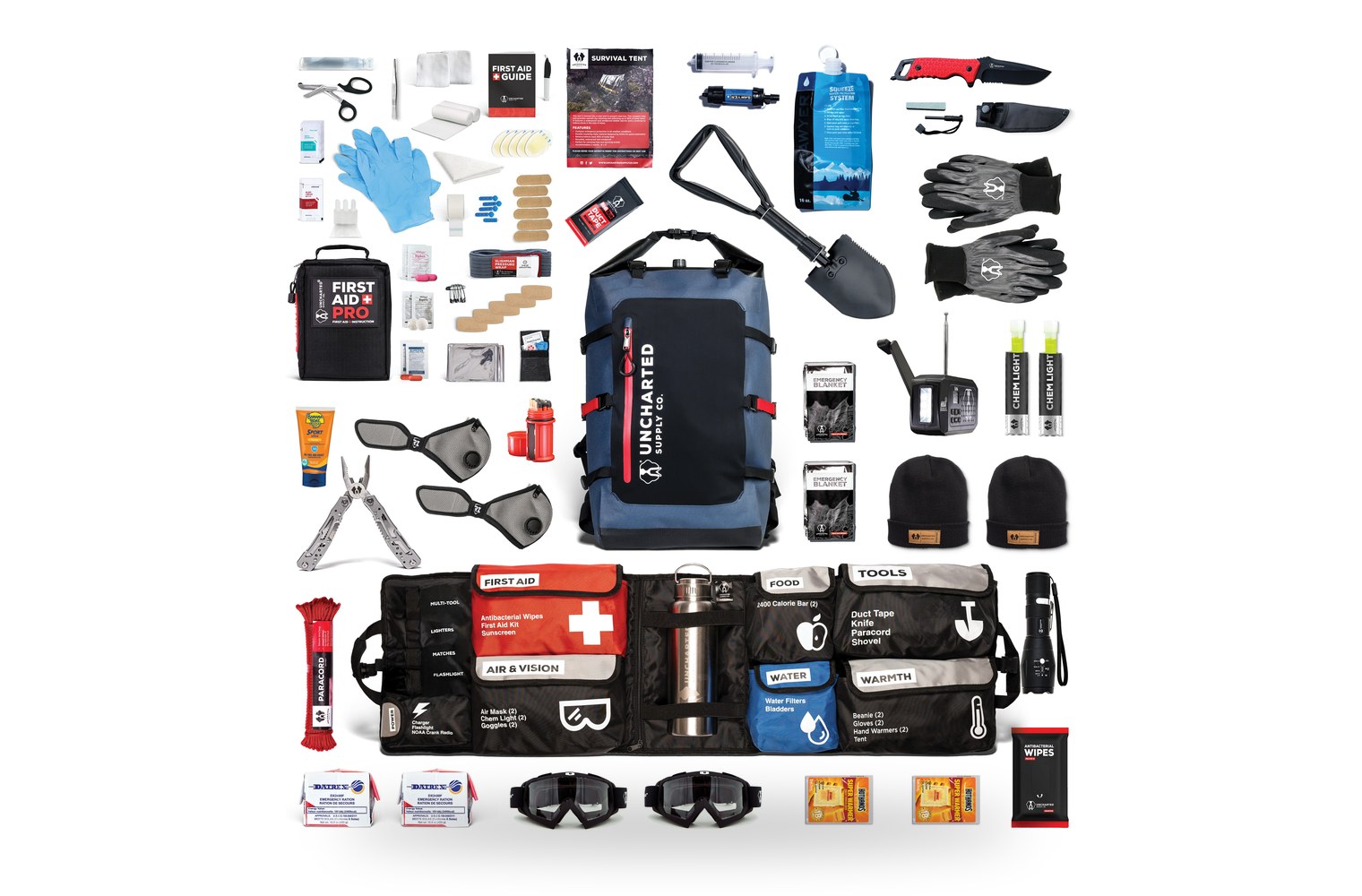
Why I chose it: This kit feels like it came off a rescue truck. The SEVENTY2.0 Pro packs more than 60 pieces of gear for two people into a 36 liter roll-top shell made of 600D dual-coated tarpaulin with welded seams, so a soaking hurricane rain or a wade across a flooded parking lot stays on the outside. Inside is a canvas insert with the survival instructions printed right on it, and its stiff panels double as splints.
The tools are a step up from everything else here: a crank radio that charges a phone, a survival tent, two RZ air filtration masks with goggles for smoke and dust, a shovel and pickax, a real knife, a multitool, insulated waterproof gloves, beanies, hand warmers and a solid first aid kit. Depending on the batch, the water piece is a Sawyer Mini filter or Aquatabs tablets, plus a metal water bottle.
Key specs
- Built for: 2 people for 72 hours
- Loaded weight: About 16 lb
- Pack: 36 liter welded roll-top shell
- Material: 600D dual-coated tarpaulin
- Size: 20 x 13 x 8 in
- Water: Bottle plus filter or tablets
- Air: 2 filtration masks, 2 goggles
- Shelter: Survival tent, 2 mylar blankets
Pros
- Truly waterproof welded shell with a roll top
- Masks and goggles for wildfire smoke and dust
- Cold weather gear most kits skip
- Insert has printed instructions and splint panels
Cons
- Almost no stored water, so you lean on the purifier
- No tourniquet listed
- Costs several times what the budget kits do
In real use: This is the kit I’d want on a hurricane coast or in wildfire country. The roll top seals tight if you fold it at least three times before you clip it. Throw a liter of water in the outside pocket so you aren’t hunting for a creek in the first hour.
Since the shell stays dry, slide your papers, cash and medicine into the top of the insert. Then add a tourniquet, which the first aid kit doesn’t list, and two headlamps so both hands stay free.
3. Emergency Zone Urban Survival Bug Out Bag (2-Person): Best Low-Profile City Kit
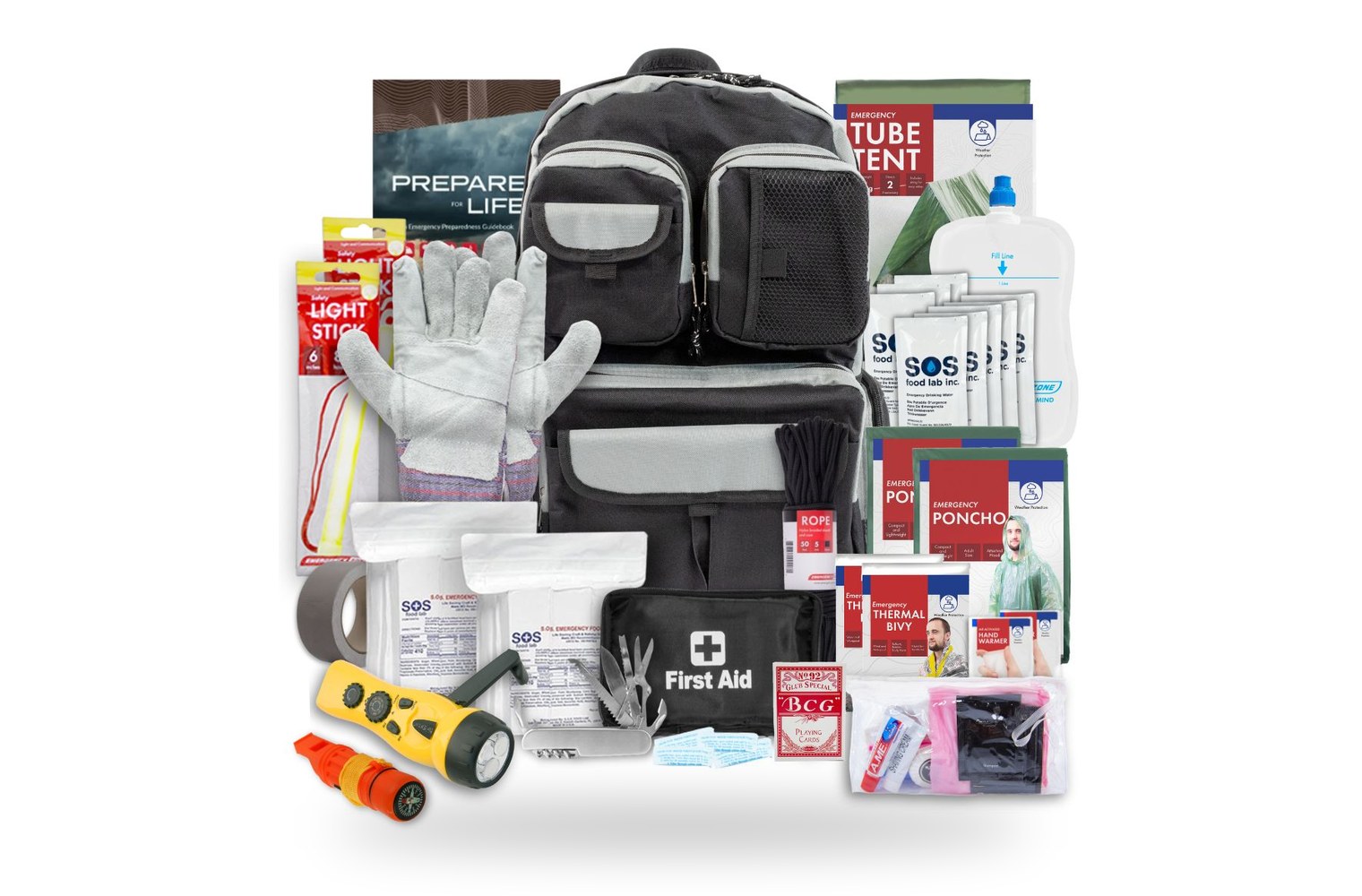
Why I chose it: Not everybody wants to walk out of an apartment building wearing a coyote tan pack covered in straps. Emergency Zone built this kit in a plain black backpack with no labels, and it looks like something a commuter carries to work. It covers two people for three days, or one person for six.
It’s also the most livable kit on the list. You get two reflective sleeping bags, a tube tent, ponchos and hand warmers, plus a proper hygiene kit with toothbrushes, soap, shampoo, toilet paper and feminine pads, which you’ll appreciate by the second night in a school gym. Add two 3,600 calorie bars, a dynamo radio with a built-in flashlight, a 118 piece first aid kit and a folding 1 liter water container with Chlor-Floc purification pouches.
Key specs
- Built for: 2 people for 72 hours, or 1 for 144
- Loaded weight: About 15 lb
- Pack size: 19 x 15 x 10 in, plain black
- Food: 2 bars, 3,600 calories each
- Water: 12 pouches of 4.2 oz
- Shelter: Tube tent, 2 sleeping bags
- First aid: 118 piece kit
- Shelf life: 5 years for food and water
Pros
- Looks like an ordinary backpack
- Real hygiene kit and two sleeping bags
- Folding water container and purification pouches
- Dynamo radio with a built-in flashlight
Cons
- Only about 1.5 liters of stored water
- No masks or goggles
- No tourniquet, and the tools are basic
In real use: This is the bag I’d set by the door of a city apartment or a dorm room. If the building empties out for a fire or a gas leak, you can walk to a shelter or a friend’s couch without looking like you’re headed for the hills.
Spend a little to make it great. Add a water filter straw, two N95 masks, a small LED headlamp and a refillable water bottle, and tuck a power bank and a charging cable in the front pocket, since the kit has no way to charge a phone.
4. Ready America 2-Person 3-Day Emergency Backpack: Best Budget Starter
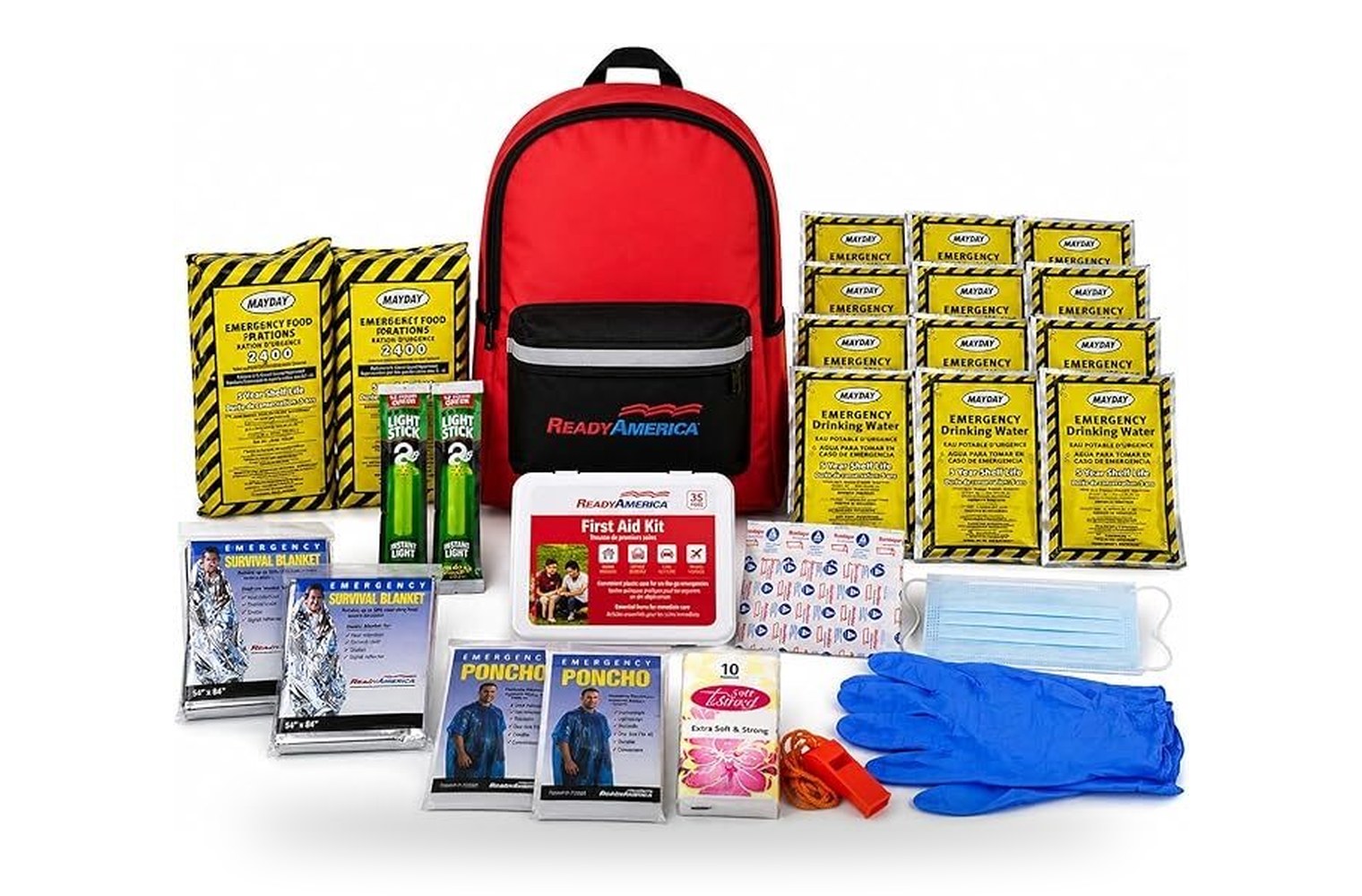
Why I chose it: Ready America has made these little red backpacks for years, and office supply stores and safety catalogs carry them everywhere. The 2-person 3-day kit is the cheapest way to get something real by the door tonight. It weighs about 8 pounds, so a teenager can carry it without complaint and it fits under the seat of a small car.
Inside are two 2,400 calorie food bars and 12 water pouches, both rated for five years, plus a 33 piece first aid kit, two survival blankets, two ponchos, two dust masks, nitrile gloves, light sticks and a whistle. Simple, but it’s the right simple stuff.
Key specs
- Built for: 2 people for 72 hours
- Loaded weight: About 8 lb
- Pack size: 12 x 9.5 x 6 in
- Food: 2 bars, 2,400 calories each
- Water: 12 pouches of 4.225 oz
- First aid: 33 piece kit
- Also inside: Blankets, ponchos, masks, whistle
- Shelf life: 5 years for food and water
Pros
- Light enough for a kid or a teen to carry
- Five year food and water you can forget about
- Small enough for any car
- The easiest kit on the list to buy several of
Cons
- No flashlight or radio, only light sticks
- About 800 calories per person per day
- Small first aid kit and no tools
In real use: Think of this one as a starter kit. The first things to add are a real light and a radio, since light sticks fade by morning. A rechargeable headlamp and a hand crank radio close the biggest gaps for very little weight, and a water filter straw takes care of the water.
It also works as the second kit in the house. Buy the EVERLIT or the Uncharted for the adults, then one of these for each older kid so everybody carries their own water, food and blanket.
5. 5.11 Tactical RUSH72 2.0 Backpack: Best Empty Pack to Build Your Own
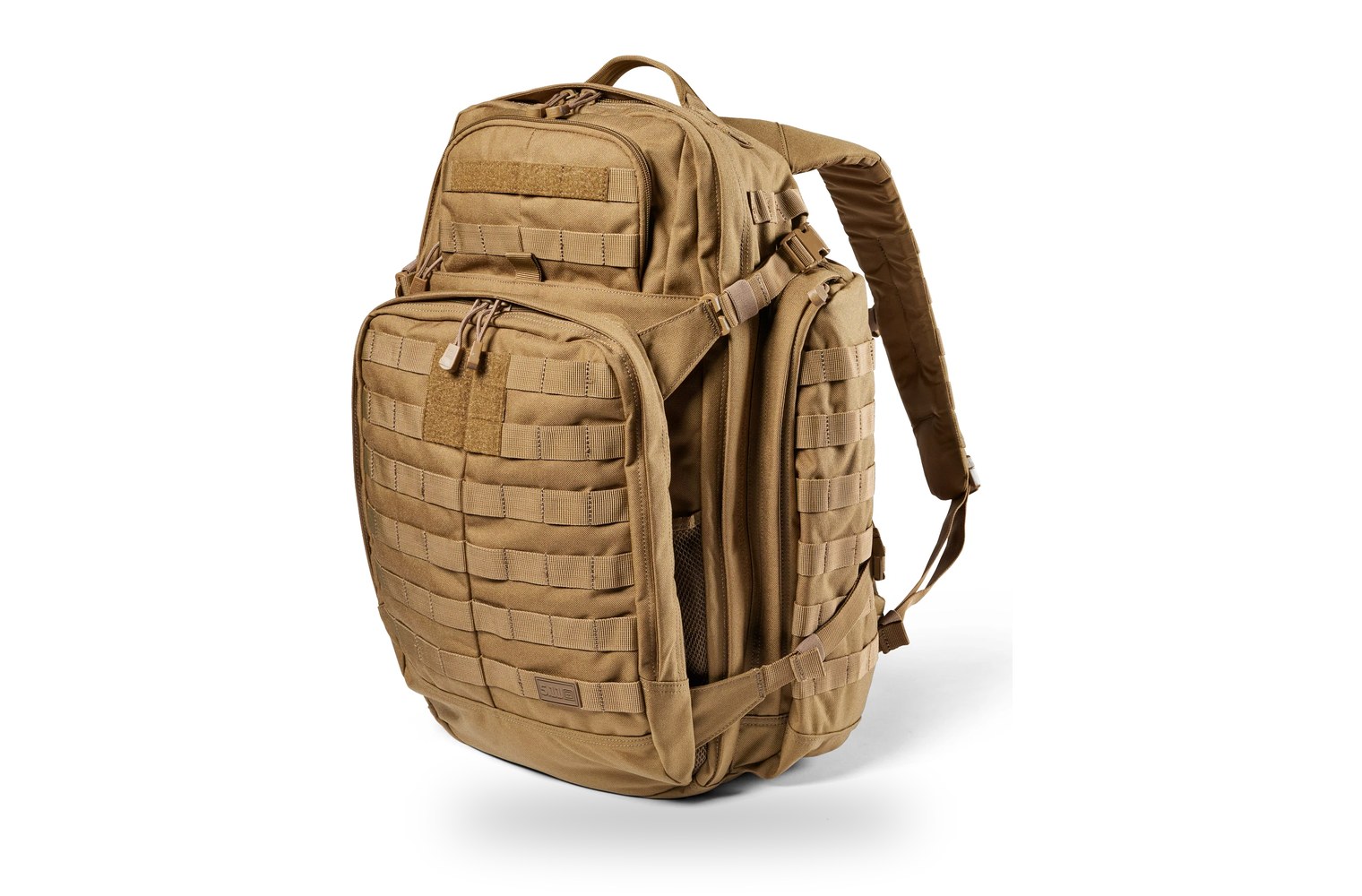
Why I chose it: If you’d rather pack your own bug out bag with gear you already trust, start with a bag that won’t let you down. The RUSH72 2.0 has been a favorite tactical go-bag for years. It holds 55 liters in 1050D nylon, weighs 5.3 pounds empty and has a pocket or a sleeve for just about everything.
There’s a 3 liter hydration pocket, a padded sleeve for a 15 inch laptop, a hidden pocket with a loop panel for a concealed holster, side pockets for bottles and MOLLE webbing across the front and sides for pouches. A reinforced back panel with an aluminum stay and a waist strap keep a full load from sagging.
Key specs
- Capacity: 55 liters
- Material: 1050D nylon
- Empty weight: 5.3 lb
- Size: 23 x 13.5 x 8.5 in
- Hydration: 3 liter bladder pocket
- Support: Aluminum stay, waist strap
- Extras: Hidden pocket, laptop sleeve, MOLLE
Pros
- Built tough enough to take years of abuse
- Room for three days of gear for one adult
- Organization keeps small stuff findable in the dark
- MOLLE takes a med pouch or bottle holder outside
Cons
- Looks unmistakably tactical
- Heavy before you put anything in it
- The waist strap is thin next to a real hiking hip belt
In real use: Pack it from the bottom up. Clothes and the sleeping layer go low, water and food sit tight against your back in the middle, and the first aid kit, headlamp and rain gear go up top. Slide a 3 liter bladder into the back pocket for your water.
Watch the scale as you go, because a 55 liter pack swallows more weight than most people can walk with. If the builder’s gauge goes red, take things out until it doesn’t.
6. Osprey Farpoint 55 Travel Pack: Best Grey-Man Pack for Long Walks
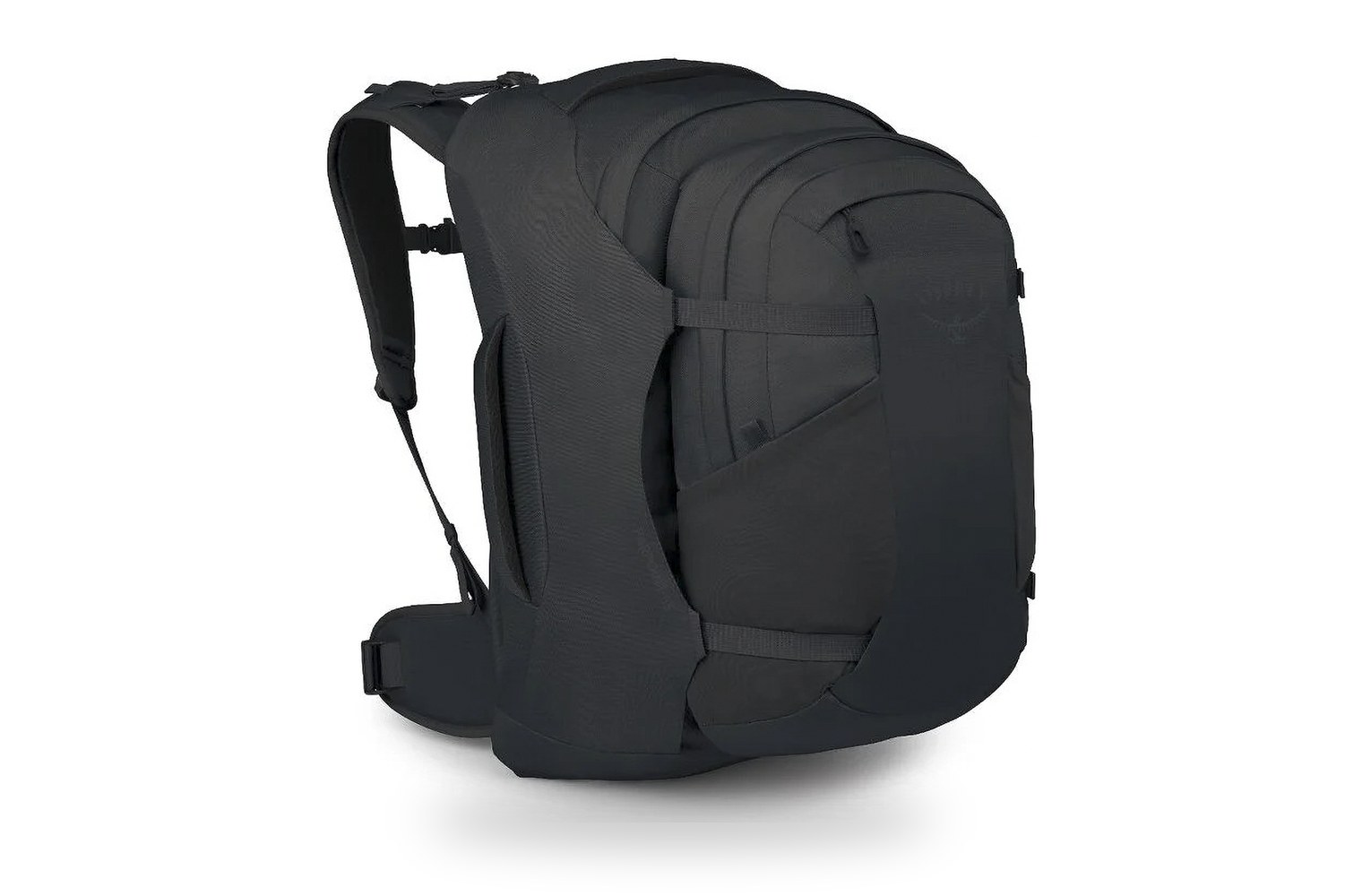
Why I chose it: Here’s the pack I’d choose if I had to walk a long way with a full load. The Farpoint 55 is a travel backpack, so it looks like luggage on a city sidewalk or in an airport. Under that plain shell is a real backpacking suspension with an adjustable torso, a load-lifting frame and a padded hip belt that puts the weight on your hips where it belongs. There’s a women’s fit too, sold as the Fairview 55.
The trick for families is the daypack. The 55 liters are split into a 40 liter main pack and a 15 liter daypack that zips off. Parents carry the big pack, and the daypack becomes the kid’s bag with their own water bottle, snacks, jacket and a stuffed animal. The main pack also opens like a suitcase, so you can see everything at once.
Key specs
- Capacity: 55 liters total
- Main pack: 40 liters
- Daypack: 15 liters, zips off
- Empty weight: About 4 lb 4 oz
- Fit: Adjustable torso, padded hip belt
- Access: Full front panel zipper
- Warranty: Osprey All Mighty Guarantee
Pros
- The most comfortable way to carry a heavy load here
- Looks like travel luggage, not survival gear
- Zip-off daypack is the right size for a kid
- Osprey repairs damage for any reason, for life
Cons
- No MOLLE and no rain cover
- Not as water resistant as the Uncharted shell
- Empty, so you buy every piece yourself
In real use: Set the torso length, load it with 20 pounds and walk the neighborhood for half an hour. You’ll learn more about your bug out bag in that half hour than in a month of reading. Snug the hip belt first, then the shoulder straps, then the load lifters.
Line it with a trash compactor bag so a rainstorm doesn’t soak your sleeping layer, and keep the documents and medicine in a dry bag of their own. With the daypack on a child’s back and the main pack on yours, a family of three can walk out with everything the builder lists.
What Every Premade Bug Out Bag Leaves Out
No company can pack the most important stuff for you, because it’s yours. Every kit on this list still needs a week of prescriptions, spare glasses or contacts, copies of IDs, insurance cards and the house deed in a waterproof pouch, and cash in small bills for the gas station with no power. Add a phone charger cable with a solar power bank, a change of clothes, two pairs of wool socks and the sturdiest shoes you own sitting right next to the bag.
Two other gaps show up in almost every box. The first is water, which I’ve already beaten to death. The second is light. Light sticks and crank flashlights are fine for a while, but a survival flashlight with spare batteries is what you want walking a dark road with a kid by the hand. Write the phone numbers that matter on a card too, since nobody remembers them once the phone dies.
How Heavy Should a Bug Out Bag Be?
REI’s rule of thumb is that a loaded backpacking pack shouldn’t weigh more than about 20 percent of your body weight. For a 170 pound adult that’s 34 pounds. I’d aim lower for a bug out bag, closer to 15 percent, because you may be walking in smoke or rain, in street shoes, after no sleep. Older adults do best at around 10 percent, and so do kids, which works out to about 6 or 7 pounds for a 60 pound child.

Water is what blows the budget. A gallon weighs about 8.3 pounds, so a full three days for one person would be 25 pounds of water before you pack a single granola bar. That’s why the builder plans 2 liters on each back, a filter and tablets for more, and real jugs only when you’re driving. If you’re evacuating by car, toss two water storage containers in the trunk and keep the bags themselves light enough to grab and run if the car gets stuck.
The Bug Out Bag List: What to Pack
Here’s the bug out bag checklist I work from, one category at a time. The builder above turns it into a list sized for your family.
Water
Two liters per person in bottles or a bladder, a water filter straw or squeeze filter for each person, a strip of purification tablets for the viruses a filter won’t stop, and a collapsible bottle for carrying dirty water to filter later.
Food
Ration bars are the backbone because they last five years and don’t make you thirsty. Add food you actually like, such as peanut butter packets, jerky and trail mix, so day two doesn’t feel like a punishment. If you want hot meals, a few freeze-dried pouches from my emergency food supply guide only need boiling water.
Shelter, warmth and clothes
A tube tent or tarp, a mylar sleeping bag for each person, a rain poncho, a warm hat, gloves and one full change of clothes in a zip bag. Wool is the best pick, since it stays warm when it’s wet and won’t melt near a fire the way synthetics can. Cotton stays wet and cold.
Light, power and news
A headlamp for every person who can wear one, a handheld flashlight, lithium AA batteries for both, a power bank and a radio that picks up the NOAA weather band. My NOAA weather radio page lists the station and frequency for your county.
First aid and medicine
A real first aid kit with a tourniquet, a week of every prescription, pain relievers, allergy pills, blister pads and copies of the prescriptions themselves, so a pharmacy in another town can refill them.
Papers, cash and contacts
Copies of driver’s licenses, passports, insurance policies and pet vaccination records in a waterproof pouch, cash in small bills, a paper map of your area with two ways out marked on it, and a contact card in every kid’s bag.
Tools
A good multitool or knife, a fire starter and a lighter, 50 feet of paracord, a roll of duct tape, work gloves, a whistle and a few contractor trash bags. Those bags do the job of a rain cover, a ground sheet and a poncho.
A Bug Out Bag for Kids, Older Parents and Pets
Kids do better with a bag of their own. Give them a small backpack with a water bottle, a jacket, snacks, a headlamp, a whistle clipped to the strap and a card with your name and phone number. Let them pick one comfort item to go in it. A child who’s carrying their own stuffed bear is a child who walks a little farther without asking to be carried. For babies and toddlers, an adult carries diapers, wipes, ready-to-feed formula and a soft carrier, since a stroller is useless on a crowded road shoulder.
Older parents need a lighter bag and a longer medicine list. Pack a week of every pill, spare glasses, hearing aid batteries, a list of their doctors and the charger for any medical device. If they use a CPAP, my CPAP battery backup guide covers running one away from home. Pets need food, a collapsible bowl, a leash, a carrier for cats, a photo of you with the pet and their vaccination records, because pet-friendly shelters often ask for them.
Packing for the Emergency You’re Most Likely to Face
Wildfire
Smoke reaches you long before the fire does. Pack N95 masks for everyone, goggles, long sleeves and pants in wool or cotton rather than synthetics that melt, and a headlamp, since smoke turns noon into dusk. Keep the bag and a full tank of gas ready all season, because wildfire orders come fast.
Hurricane and flood
Rain and floodwater soak anything that isn’t sealed. Pack dry bags or zip bags for clothes, papers and electronics, add rain gear and a spare pair of socks, and stash bug spray. You usually get a day or two of warning, so this is the one where you can top off the water jugs in the car before you go.
Winter storm
In a winter evacuation you’ll fight the cold more than anything else. Add a real insulated layer, a warm hat, mittens, wool socks, hand warmers and a mylar sleeping bag for each person. If there’s a chance you’ll be stuck in the car, pair the bag with my car emergency kit list.
Earthquake
Expect broken glass and dust. Keep sturdy shoes and work gloves right next to the bed, pack dust masks and a whistle, and store a bag in the car or garage in case you can’t get back into the house.
Bug Out Bag vs Go Bag vs Get Home Bag
People use these names interchangeably, but there’s a useful difference. A bug out bag is for leaving home and getting by on your own for about three days. A go bag usually means the same thing, often a lighter version for a quick evacuation to a hotel or a relative’s house. A get home bag lives in the car or at work and holds just enough to walk home if the roads lock up, mainly water, a light, walking shoes and a rain jacket.
Most families need a bug out bag for each adult at home and a get home bag in each car. If you’re planning to stay home when the power goes out, that’s a different kit altogether, and my power outage emergency kit guide covers it.
Where to Keep It and When to Check It
Keep the bags near the door you’d actually leave through, usually the hall closet or the mudroom, not the attic or the back of the garage. Everybody in the house should know where they are. If you park in a garage, a second set in the car saves a trip back inside.
Check them twice a year. I use the weekends the clocks change, since they’re easy to remember. Swap out kids’ clothes they’ve grown out of, update the medicine, test the lights and the radio and check the dates. Ration bars and water pouches usually last five years, lithium batteries much longer, and the cash should probably go up a little each year.
Buying Guide: What to Look For in a Bug Out Bag
Size in liters
For one adult, 35 to 55 liters holds three days of gear. Smaller bags stay lighter on their own, and bigger ones tempt you to overpack. Kids do fine with 10 to 20 liters.
Hip belt and torso fit
A padded hip belt carries most of the weight on your hips instead of your shoulders. If you’ll walk more than a mile or two, it matters more than any pocket. An adjustable torso is a bonus when two people might end up wearing the same pack.
Tactical look or grey man
A tactical pack with MOLLE is tough and easy to customize. A plain pack draws less attention in a crowded shelter or a city street. Neither is wrong, so pick the one that fits where you live.
Water resistance
Only a welded, roll-top shell like the Uncharted truly keeps water out. For any other bag, line it with a trash compactor bag and keep papers and medicine in their own dry bag.
Piece counts
I don’t put much stock in them. A 200 piece kit might be 40 cotton swabs and 40 alcohol wipes. Look for the things that count, such as how much water and how many calories it carries, whether it has a real tourniquet and a real radio, and what the bag weighs fully packed.
Frequently Asked Questions
Are premade bug out bags worth it?
Yes, as a starting point. A good kit like the EVERLIT or the Uncharted gets food, shelter, first aid and a radio by the door today. Plan to add your own medicine, papers, cash, clothes, a light and more water. Building your own on a pack like the 5.11 or the Osprey takes longer, but every piece is one you picked.
How heavy should a bug out bag be?
Aim for about 15 percent of your body weight and stay under 20 percent, which is the limit REI gives for a loaded backpacking pack. Older adults and kids should stay near 10 percent. Water is the heaviest part, so carry a day’s worth and a filter rather than three days of jugs.
What’s the difference between a go bag and a bug out bag?
They’re mostly the same thing: a packed bag for leaving home fast. A go bag is often lighter and meant for a quick trip to a hotel or a relative, while a bug out bag is built to keep you going on your own for about three days. A get home bag is a smaller kit kept in the car or at work.
Where should I keep my bug out bag?
By the door you’d leave through, in a hall closet or mudroom where everybody in the house can find it in the dark. Keep a second, smaller bag in the car, and check both twice a year.
The Bottom Line
For most households, the EVERLIT 72 Hour Bug Out Bag (2-Person) is the bug out bag I’d buy. It covers two people for three days with real bleeding control, a crank radio and gear that holds up, and it leaves room in the pack for the things only you can add. If you want the best build quality and a shell that stays dry in a hurricane, the Uncharted SEVENTY2.0 Pro Survival System is worth the extra money, and the Emergency Zone Urban Survival Bug Out Bag (2-Person) is the one to grab when you’d rather blend in on a city street.
On a tight budget, start with the Ready America 2-Person 3-Day Emergency Backpack and build from there. If you’d rather pack your own, the 5.11 Tactical RUSH72 2.0 Backpack is the tough tactical pick and the Osprey Farpoint 55 Travel Pack is the one I’d want on a long walk with a child by my side. Whatever you choose, add a water filter straw for everybody, a box of N95 masks and a week of medicine, then run your family through the builder so nobody’s bag is too heavy to carry.
Then finish the rest of the plan. Fill some water storage containers for the car, set aside an emergency food supply for the house and check off your power outage emergency kit before the next storm.
Keep reading