
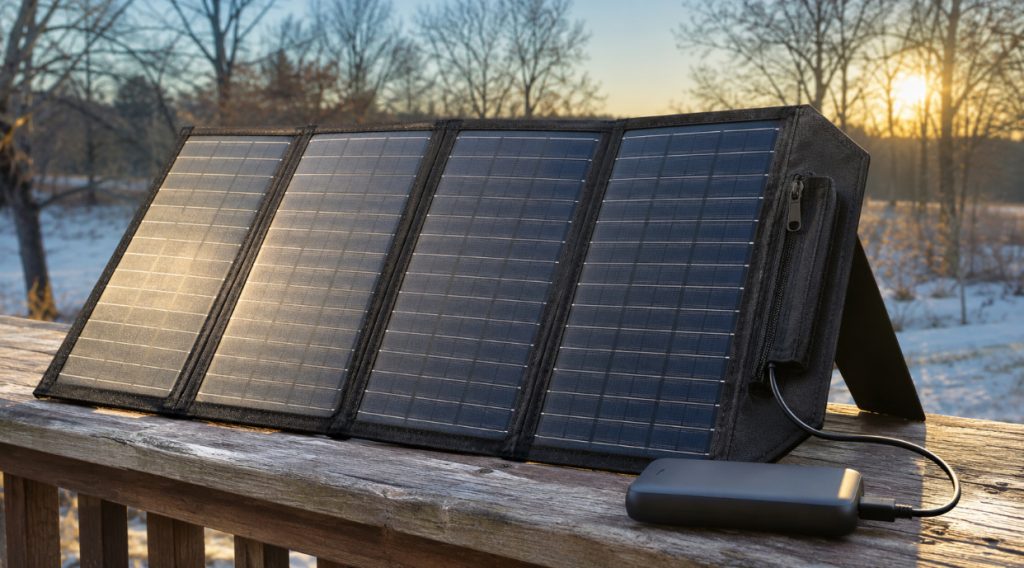
Plenty of junk drawers in America hold the same solar power bank. It has a little panel on the front, a carabiner on one corner, and a box that promised free power from the sun anywhere you go. Then an ice storm takes the lights out for three days, somebody sets it on the dashboard from sunup to sundown, and by suppertime it has earned exactly one of its four blue dots.
Short on time? Skip to my picks
That panel isn’t broken. It’s just small. A strip of cells the size of a playing card can’t collect much more than a watt in perfect sun, and your phone holds around 15 watt-hours. On a short December day you’re waiting weeks for one full charge, and that’s if nobody parks the truck in the shade.
So I came at this guide from the other end. I still cover the classic all-in-one banks and tell you exactly what they’ll do, but the setups that really refill from the sun pair a folding panel about the size of a magazine with a good battery. On a typical December day that combination puts back about two phone charges. Over a long outage, that’s the gap between calling the power company on day four and staring at a dead screen on day two.
Below you’ll find my six picks, a planner that shows how many days of sun each one needs to refill at your ZIP code in December and June, and the habits that squeeze the most out of any panel.
Quick Picks: The Best Solar Power Banks
- BigBlue SolarPowa 28 + Anker Zolo 20K: best for most homes, outage kits and car camping.
- Anker Prime Power Bank (26K, 300W): best for laptops, long outages and air travel.
- BioLite SolarPanel 5+ 2.0: best for backpacking and charging a phone straight from the sun.
- Hiluckey 27000mAh Solar Charger: best one-piece solar power bank for camping.
- BLAVOR 10,000mAh Solar Power Bank: best for pockets, go-bags and keeping a flashlight on the same device.
- Anker SOLIX PS30: best for adding solar to a power bank you already own.
Solar Power Banks Compared
Do Solar Power Banks Actually Work?
They work as power banks. The solar part works too, but only in proportion to how much panel faces the sky, and on most of them that’s a few square inches.
Sunlight carries roughly 1,000 watts per square meter at midday. A good panel turns about a fifth of that into electricity, and a built-in panel on a phone-sized bank covers well under a hundredth of a square meter. That’s how you end up with a watt or so in full sun, less once the case gets hot, and nothing worth mentioning through a window. The four-panel banks that open like a wallet do several times better, because they simply have more surface. A folding panel in the 28 to 30 watt range has around ten times the area again, and that’s where solar starts to feel useful.
The other half of the math is how much sun you get. Solar people measure it in peak sun hours, the number of hours of full-strength sun a day adds up to. Much of the country sees about 3 in December and closer to 6 in June, which is why the same panel refills twice as fast in summer. If you want the number for your town, my peak sun hours calculator has all 12 months for any ZIP code.
Put those together and you get the chart below. These are my estimates for a typical December day with the panel aimed at the sun.

So a solar power bank with one small panel is really a power bank with a slow emergency trickle. Buy it for the battery, and if you want the sun to carry you through a week, feed a battery from a folding panel.
Sun Refill Planner: How Many Days of Sun Will Your Bank Need?
Type in your ZIP code and pick a setup. The planner pulls the average December and June sun for your exact spot, then shows how many days of sun it takes to refill from empty, how many phone charges one sunny day adds, and whether you’d stay ahead of a week-long outage with the way your family actually uses its phones.
Here’s the same idea for a typical spot with about 3 peak sun hours in December and 6 in June. The banks with built-in panels aren’t on it because they’d need weeks and the bars would run clean off the page.

1. BigBlue SolarPowa 28 + Anker Zolo 20K: Best Overall
Why I Chose It
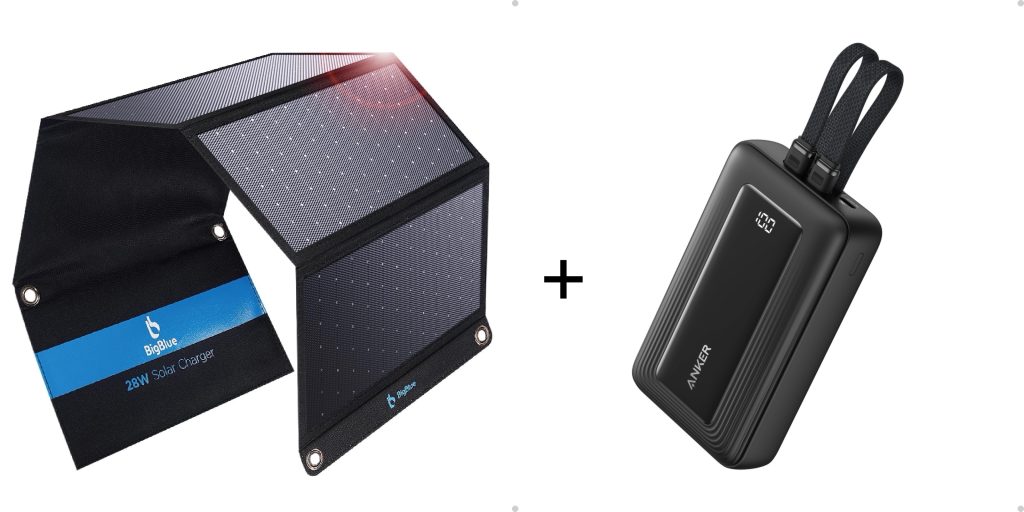
This is the setup I’d hand a friend who asks for a solar power bank and actually wants the sun to do the charging. The BigBlue is a 28-watt folding panel about the size of a closed laptop, and the Zolo is a plain, well-made 20,000mAh Anker bank with a USB-C cable built into its body so the cord can’t wander off.
Lay the panel in the sun, run a cable from one of its USB-C ports into the bank, and the bank fills from the sky at a rate you can actually feel.
Key Specs
- Panel: 28W rated, cells up to 25.4% efficient
- Panel ports: 2 USB-C and 1 USB-A, 5V
- Panel weight: 1.5 lb, IP44
- Bank: 20,000mAh with a 30W USB-C port, USB-A port and built-in USB-C cable
- Bank recharge: up to 20W over USB-C, with a screen showing battery level
- Estimated refill from empty: about 2 days of December sun, 1 in June
Pros
- Puts back about two phone charges on a typical December day
- Panel charges a phone directly while the sun is up
- The bank works fine on its own when the sky stays gray
- The built-in cable means one less thing to lose in a go-bag
Cons
- Two pieces to carry and set up
- The panel is only IP44, so bring it in before the rain does
- Output drops hard in shade or heavy cloud
In real use
Prop the panel facing south, tilted up toward the noon sun, and plug the bank in. Output rises and falls as clouds pass, and a phone plugged straight into a panel tends to stop and restart every time that happens. A power bank soaks up the uneven current without fuss, and your phone stays inside instead of baking on the porch rail. Charge the phone from the bank after dark.
Through an outage week, a careful family can live off this pair as long as the sun shows up every other day or so.
Check the BigBlue Panel on Amazon Check the Anker Zolo on Amazon
2. Anker Prime Power Bank (26K, 300W): Best for Outages and Laptops
Why I Chose It
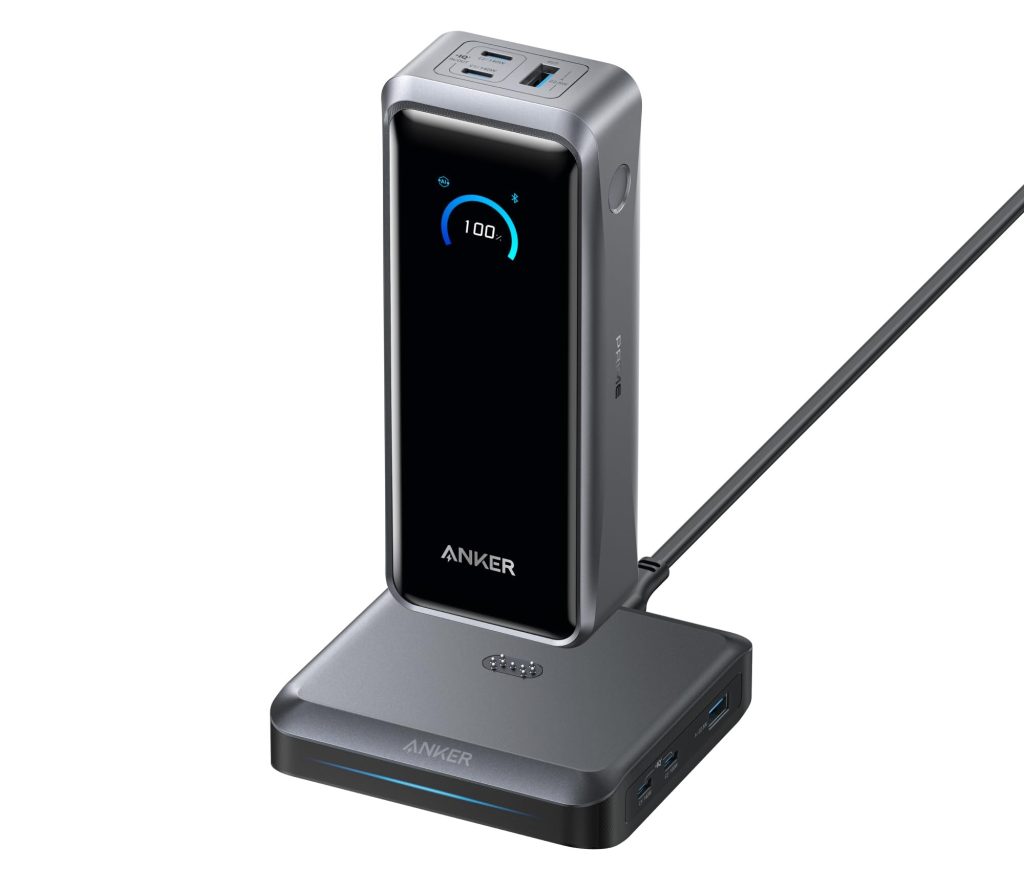
If the outage doesn’t cancel work, this is your bank. Two USB-C ports push up to 140 watts each, enough to run a MacBook Pro at full speed, and the 26,250mAh battery is rated at 99.75 watt-hours, which keeps it just under the airline limit for carry-on batteries.
There’s no panel on it. You pair it with the BigBlue or the Anker SOLIX PS30 and get a laptop-grade setup that refills from the sun in two or three December days.
Key Specs
- Capacity: 26,250mAh (99.75Wh)
- Output: 2 USB-C up to 140W each, USB-A up to 22.5W, 300W total
- Wall recharge: up to 250W using both USB-C ports
- Screen and app show watts going in and out of each port
- Size and weight: 6.3 x 2.5 x 1.5 in, 1.32 lb
Pros
- Runs and charges a laptop at full speed
- Fills from the wall very fast when the power flickers back
- Legal to carry on a plane
- The screen shows exactly how many watts your panel is delivering
Cons
- Pricey next to an ordinary 20K bank
- Too heavy for a jeans pocket
- A USB solar panel only feeds it at panel speed, a small fraction of its wall input
In real use
The screen is the sleeper feature for solar. Plug the panel in, then tilt it a few degrees at a time and watch the input number climb. You’ll find the sweet spot in a minute instead of guessing all afternoon.
From the sun it only takes what the panel gives, which is somewhere around 10 to 20 watts from a 28 or 30 watt panel in good light. Where it earns its keep is the hour the grid comes back, when it soaks up a big charge in a hurry. If your outage plan includes a CPAP or a fridge, step up to a portable power station instead.
3. BioLite SolarPanel 5+ 2.0: Best All-in-One Panel
Why I Chose It
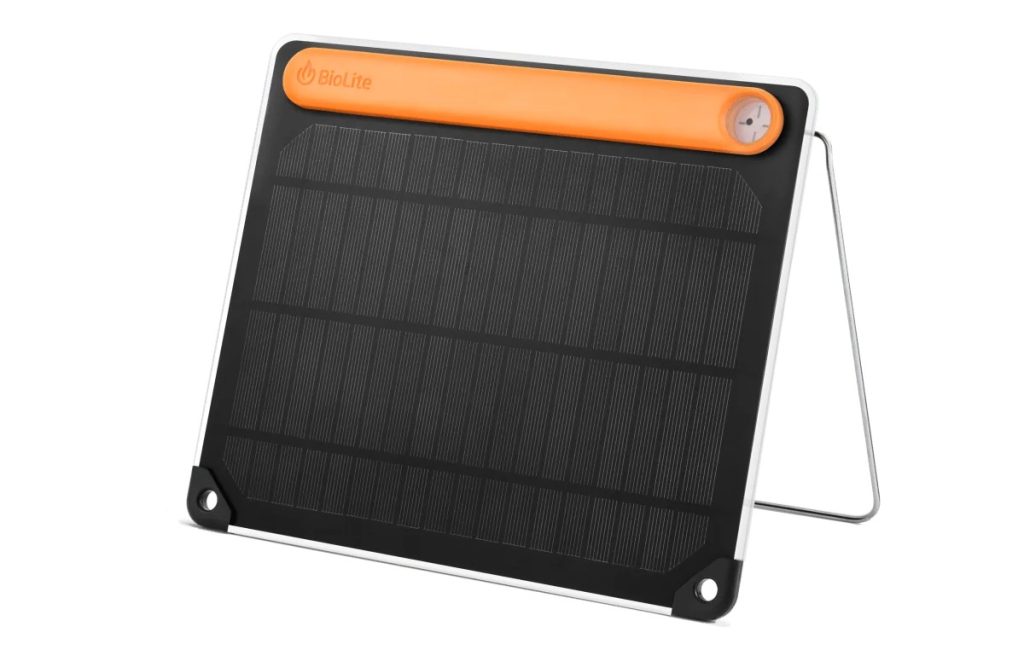
BioLite built this for backpackers who want one flat thing strapped to the pack: a 5-watt panel with a 3,200mAh battery built into its frame. The clever part is the little sundial in the corner. Line up the shadow and you’re pointed straight at the sun, and BioLite says a badly aimed panel can lose up to 30% of its power.
It’s the one solar power bank on this list that can refill its own battery in a day or two of winter sun, because the panel is big compared to the battery behind it.
Key Specs
- Panel: 5W
- Battery: 3,200mAh
- Sundial plus a 360-degree kickstand
- Rating: IPX4 splash resistant
- Weight: 13.8 oz
- Output: USB-A
Pros
- Refills its own battery in about a day and a half of December sun
- Charges a phone directly while the sun is up
- Thin enough to slide into a laptop sleeve
Cons
- Small battery, about two-thirds of a phone charge
- USB-A output only, so bring the right cable
- Owner reviews on battery life are mixed
In real use
Strap it to the top of your pack on the trail, then prop it on the kickstand in camp and nudge it every hour or so to keep the sundial centered.
For a home outage it’s a nice extra, but its battery is too small to be the main plan. Pair it with a bigger bank or the hand crank radio you already keep in the closet.
4. Hiluckey 27000mAh Solar Charger: Best Fold-Out Solar Power Bank
Why I Chose It
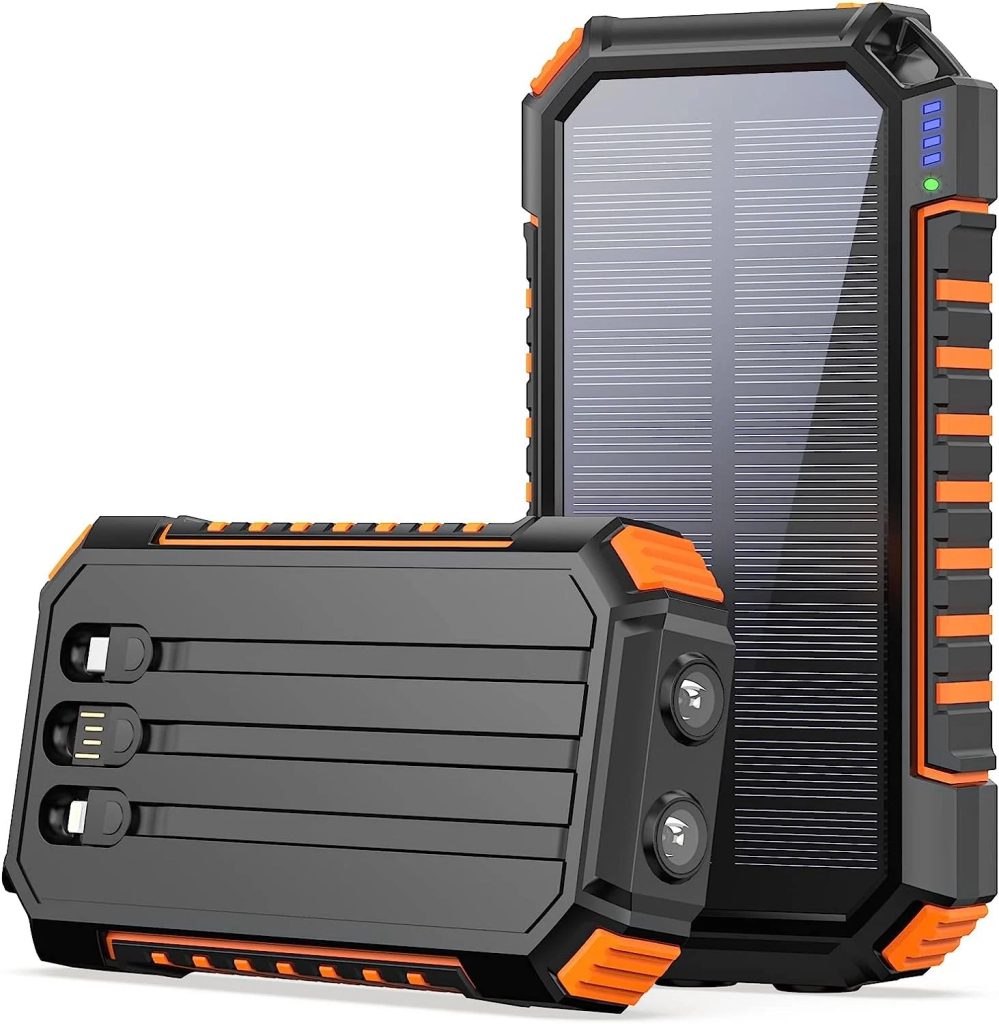
If you want the classic all-in-one solar power bank, get one whose panels fold out. This Hiluckey opens like a wallet into four panels, so it has several times the sun-catching area of a single-panel bank, and it carries a big 27,000mAh battery behind them.
That’s the right balance for this kind of bank. The battery does the real work, and on sunny days the panels slow the drain.
Key Specs
- Battery: 27,000mAh
- Solar: 4 fold-out panels, rated up to 6W in direct sun
- Charging: 22.5W fast charging, USB-C in and out at 18W
- Wall recharge: about 5 hours with a 20W USB-C charger
- Built-in flashlight
Pros
- Big battery, five or so phone charges
- Far more panel than any single-panel bank
- USB-C works both ways
- Flashlight for the tent or the breaker box
Cons
- The 6W rating is a perfect-day number. On a typical December day I’d expect about a seventh of a phone charge
- Bulkier than a plain 20K bank
- No listed water rating, so keep it off wet ground
In real use
Charge it full from the wall before a trip or a storm. Then open the panels on a camp table or porch rail every sunny morning and fold them shut at sunset. Over a long weekend that adds up to a phone charge or so, which is a nice bonus on top of a battery that was already full.
Don’t leave it on a dashboard to charge, since the battery inside hates heat.
5. BLAVOR 10,000mAh Solar Power Bank: Best Pocket Solar Power Bank
Why I Chose It
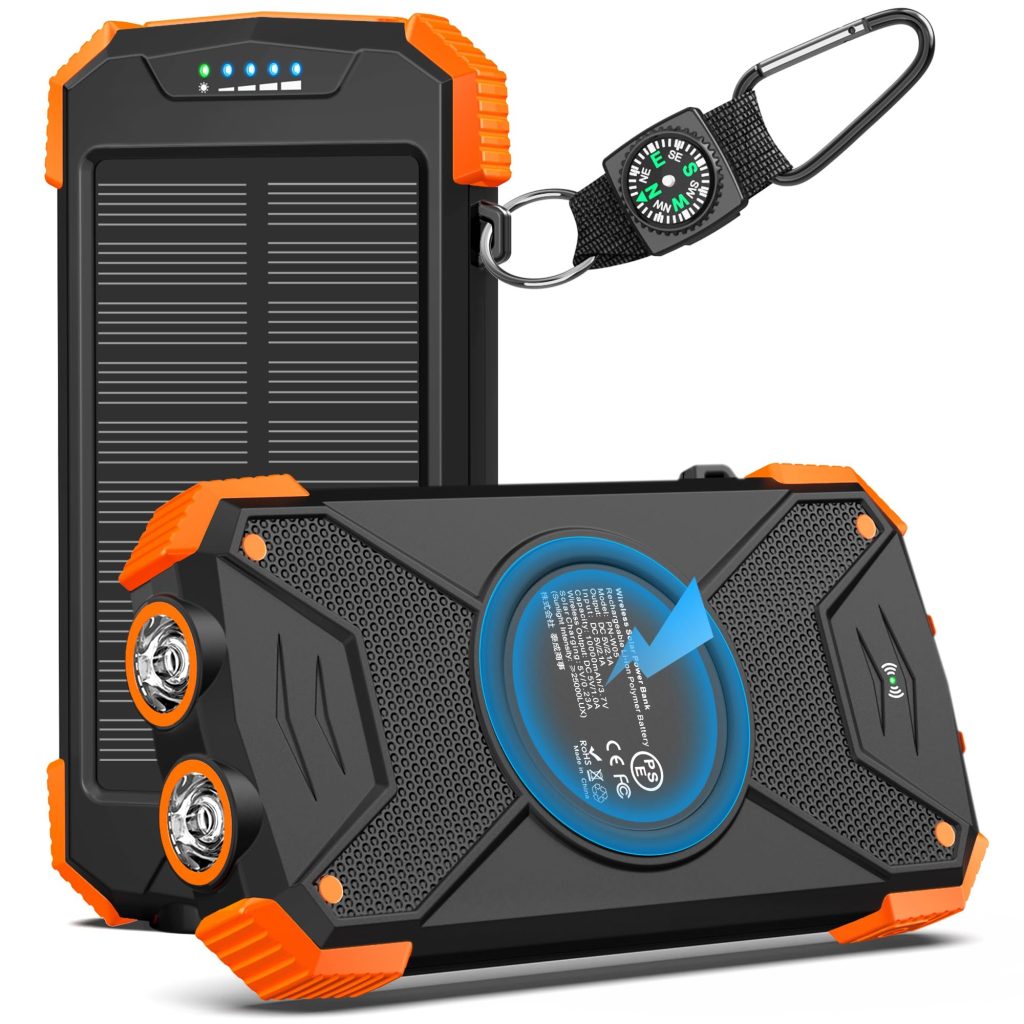
It sits at the top of Amazon’s solar charger best-seller list, and the reasons have little to do with the sun. It’s small, tough and rated IPX5, with two bright flashlights, a wireless pad for phones that support it, a 20W USB-C port that charges a phone quickly, and a compass carabiner on the corner.
The panel on the face is a small strip of cells. Think of it as the thing that keeps a dead bank from staying completely dead after a week outdoors.
Key Specs
- Battery: 10,000mAh
- Output: 20W USB-C, USB-A and Qi wireless charging
- Two built-in flashlights
- Rating: IPX5
- Weight: 9.3 oz, 5.9 x 2.9 x 0.8 in
- Warranty: 3 years
Pros
- Pocket size with a good USB-C port
- IPX5 shell shrugs off rain
- Flashlights right on the bank
- Wireless pad works without a cable
Cons
- Solar adds only a few percent of a phone charge per sunny day
- 10,000mAh is about two phone charges
- Wireless charging is slower than the cable
In real use
Clip it to a go-bag strap or the glovebox door and charge it from the wall every couple of months. Leave it on a sunny windowsill outside the glass, not behind it, and after a week it’ll have bought you a short call and a few texts. That beats nothing, and it’s a lot less than the box suggests.
It also makes a decent little light in a pinch, and you’ll find better flashlights for the drawer in my power outage flashlight guide.
6. Anker SOLIX PS30: Best Panel for the Bank You Own
Why I Chose It
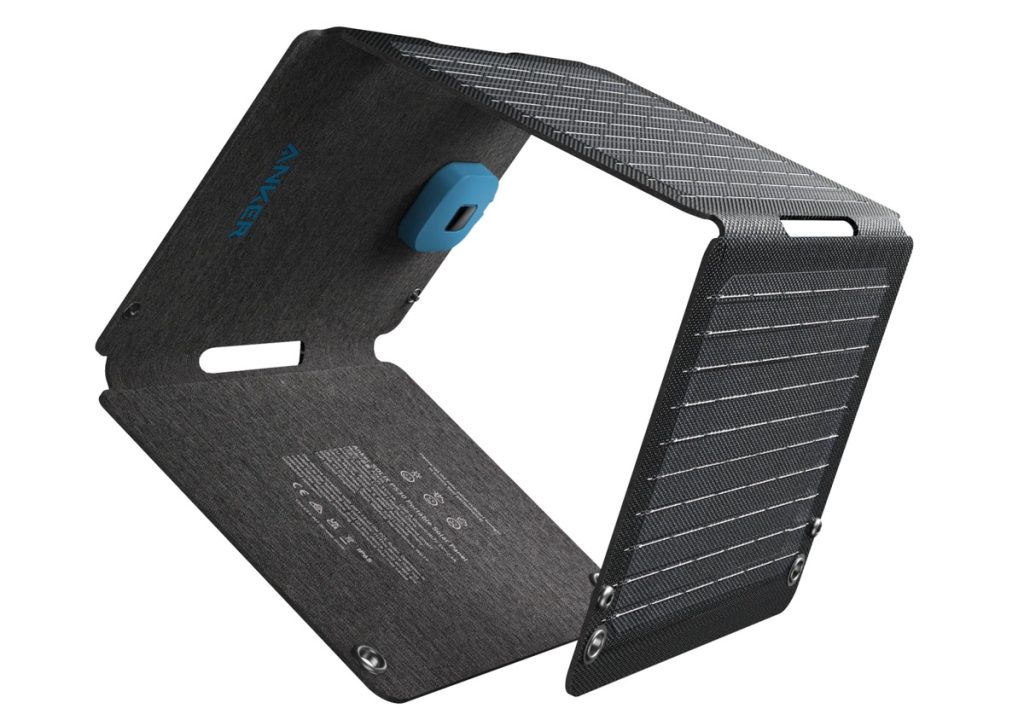
Already own a good power bank? Then all you’re missing is a panel. The PS30 is the small folding panel from Anker’s SOLIX solar line, with a USB-C port and a USB-A port, an IP65 rating, and a kickstand that sets at four angles.
It’s sturdier against weather than the BigBlue and a little heavier.
Key Specs
- Rated power: 30W
- Ports: USB-C (5V, 3A) and USB-A (5V, 2.4A)
- Rating: IP65 dust and water resistant
- Kickstand with 4 angle settings, plus 2 carabiners
- Weight: a little over 2 lb
Pros
- IP65 handles a surprise shower better than most small panels
- Kickstand makes aiming easy
- Works with any USB power bank, Anker or not
Cons
- Owner results vary a lot
- Heavier than the BigBlue
- 5V USB only, so it won’t charge a laptop directly
In real use
Some owners report full charges by evening and others barely move the needle, and that gap nearly always comes down to angle, clouds and time of day. Set it up between about 10 and 2, pointed square at the sun, with nothing shading even one corner, since a shadow across a single cell can drag down the whole panel.
Feed a power bank with it, not your phone, and you’ll get the steady results the good reviews describe.
Best Power Bank for a Power Outage
For an outage, start with the battery and treat solar as the refill. A phone used carefully needs about one full charge a day, so a family of three wants roughly three charges a day, and a 20,000mAh bank covers a little over one day of that. Two charged banks plus a folding panel will get most families through a long outage, with the panel covering what everybody uses on sunny days.
A few habits stretch it further. Turn on low power mode the moment the lights go out, dim the screens, and let the phones charge overnight from the bank instead of topping off in short bursts all day. A hand crank radio carries your weather news without touching the bank at all, and a battery lantern keeps you from burning phone batteries as flashlights.
If you need to run anything bigger than phones and a laptop, like a fridge, a CPAP or a space heater, a power bank is the wrong tool. Look at a solar generator instead, or read my power station vs generator breakdown to pick between battery and gas.
Keeping an Emergency Power Bank Ready
An emergency power bank only helps if it’s charged when the storm hits. Lithium banks lose a little charge every month sitting in a drawer, so put a reminder on your calendar to top them off every three months, and charge everything the day a big storm shows up in the forecast. Store them indoors at room temperature, never in a hot car or an unheated shed. My power outage emergency kit guide covers what else belongs next to them.
What to Look For in a Solar Power Bank
Panel Size Beats the Number on the Box
Solar output comes down to how much panel faces the sun. Fold-out panels beat a single built-in panel, and a separate folding panel beats both by a wide margin. If a listing promises fast solar charging from a panel smaller than a phone, the math isn’t on its side.
Watt-Hours Tell You More Than mAh
Banks are rated in milliamp-hours at the battery’s internal voltage, while your phone charges at USB voltage with some energy lost along the way. Expect about two-thirds of the mAh on the label to reach your phone. A 20,000mAh bank works out to around 74 watt-hours, or about four charges for a typical phone.
USB-C In and Out
A USB-C port that works both ways lets one cable charge the bank and the phone. Look for at least 18 to 20 watts so the bank refills fast from the wall or the car when you get the chance. Most folding panels put out 5 volts, which every USB-C bank accepts.
Water and Dust Ratings
IPX4 shrugs off splashes, IPX5 handles rain, and IP65 adds dust protection. For a panel that spends all day outside, IP65 is the one I’d want. Bring anything rated lower inside before the weather turns.
A Flashlight Is Worth Having
Many solar banks carry a small LED, and in a dark tent or a blacked-out kitchen it’s the feature you’ll use most. It doesn’t replace a real light, though. Keep a proper rechargeable headlamp for the hands-free jobs.
Flying With a Solar Power Bank
Power banks ride in your carry-on only, never checked bags. The FAA limits lithium batteries to 100 watt-hours each, with airline approval needed for up to two between 101 and 160. Some big no-name solar banks around 40,000mAh land over 100Wh, so check the watt-hour rating printed on the case before you pack it.
How to Get the Most Out of Solar Charging
Aim it like you mean it. Point the panel straight at the sun and tilt it up toward the noon sky, then adjust it every hour or two as the sun moves. A sundial like the one on the BioLite SolarPanel 5+ makes this easy, and a strip of tape with a toothpick works almost as well.
Charge between about 10 and 2. Most of the day’s energy arrives in those hours, especially in winter when the sun stays low.
Keep glass out of the way. Window glass cuts a panel’s output badly, so set it outside on a porch rail, a car hood or the ground, not on a sill behind the window.
Shade the battery and sun the panel. Heat slows charging and wears out lithium cells, so with a folding panel let the bank sit in the panel’s shadow on the ground, and with an all-in-one bank bring it in once it’s hot to the touch.
Watch for partial shade. A shadow across one corner can drag down the whole panel, so move it clear of tree limbs, railings and porch posts as the afternoon goes on.
Feed a battery, then the phone. Panels are uneven and phones restart charging every time a cloud passes. Charge the bank in the sun and the phone from the bank.
Frequently Asked Questions
How long does it take to charge a solar power bank in the sun?
It depends on how much panel it has. A bank with one small built-in panel needs two months or more of winter sun to fill from empty, and a four-panel fold-out bank needs five or six weeks. A 28 to 30 watt folding panel refills a 20,000mAh bank in about two days of December sun and one in June. Use the planner above to see the number for your ZIP code.
Are solar power banks worth it?
As power banks, yes, and the panel is a nice emergency backup. As a way to keep a phone running on sun alone, a single-panel bank isn’t enough. If solar charging is the reason you’re buying, get a folding panel and pair it with a good battery.
Can a solar power bank charge through a window or on a cloudy day?
It will register a little, but not much. Glass cuts the output sharply, and heavy cloud can drop it to a small fraction of full sun. Set the panel outside in direct sun between about 10 and 2 for anything worth having.
Can you leave a solar power bank in a hot car?
It’s a bad idea. Heat is hard on lithium batteries and shortens their life, and a closed car in summer gets far hotter than the outside air. Keep the bank inside and put only the panel in the sun.
The Bottom Line
If you want the sun to do real work, buy the BigBlue SolarPowa 28 and the Anker Zolo 20K. That pair puts back about two phone charges on a typical December day and keeps a careful family connected through a long outage. If you need to run a laptop or want one bank that flies, the Anker Prime Power Bank (26K, 300W) is the one to feed from that panel.
For a single all-in-one device, the BioLite SolarPanel 5+ 2.0 is the one that actually refills itself, the Hiluckey 27000mAh Solar Charger brings the biggest battery with the most panel, and the BLAVOR 10,000mAh is the tough little pocket bank with the panel as a backup. Already own a bank? Add the Anker SOLIX PS30 and you’re set.
Whatever you pick, charge it from the wall before the storm, set the panel outside in full sun when it passes, and plug your town into the planner above so you know what the sun will actually give you.
