
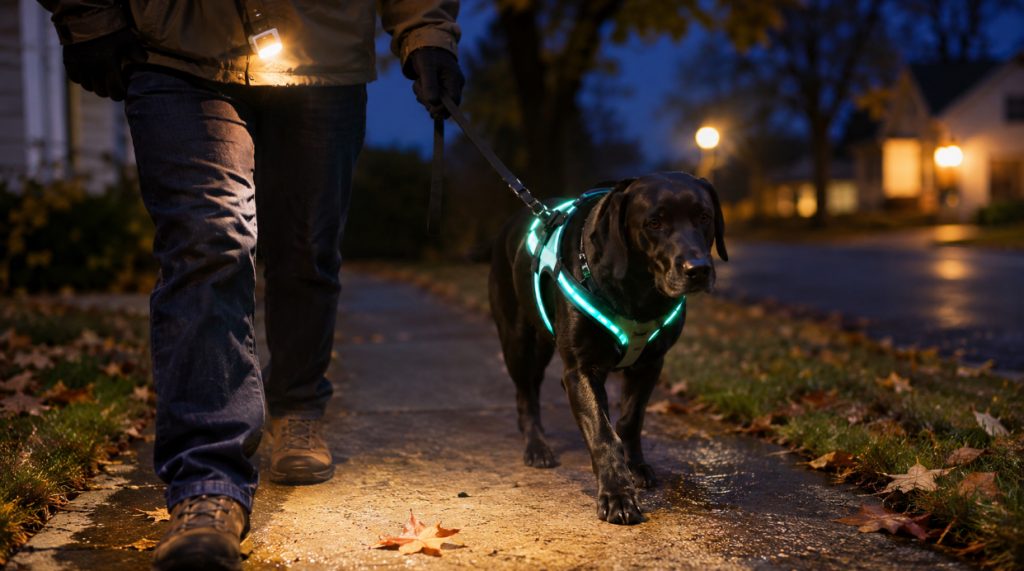
Somewhere around the first week of November, every dog in America gets robbed. The walk that used to happen in warm late afternoon light now happens in the pitch dark, because the clocks fell back and nobody bothered to tell the dog. So out you go at 5:30 with the leash in one hand, a poop bag in the other, and your phone pinched between two fingers like a cigarette, its little flashlight pointing everywhere except where the dog just did his business. Then a pickup rolls around the corner with its brights on. Your black Lab, who is basically a hole in the night with a tail, is standing right on the curb, and the driver has no idea he’s there.
Short on time? Skip to my picks
That moment is why a real flashlight for dog walking matters. NHTSA counted 7,080 pedestrians killed in 2024, and 76% of them died in the dark. The worst stretch of the day ran from 6 p.m. to midnight, which is exactly when the after-dinner walk happens. You don’t need a searchlight to fix that. You need a light that rides on your body so both hands stay free, a beam that lights the sidewalk without blasting drivers in the face, and something on the dog so the guy in the pickup actually sees the dog.
Here’s my short list. The Olight Oclip Pro S clips to your coat and handles most neighborhood walks with a wide flood and a red mode for cleanup. If you’d rather wear your light, the Nitecore NU25 MCT UL weighs 47 grams and has a warm white setting that’s easy on your night vision, and the AVANTO Pro straps to your chest with a red light on the back for traffic coming up behind you. Rural roads and coyote country call for the Fenix E35R. And whatever you carry, put a Noxgear LightHound on the dog. Below the picks, the Night Walk Planner works out how many weeks a year your walk happens in the dark in your town and builds a setup for your route.
Quick Picks: The Best Flashlights for Dog Walking
- Olight Oclip Pro S: best flashlight for dog walking overall, a clip-on light for neighborhood walks.
- Nitecore NU25 MCT UL: best headlamp for dog walking.
- AVANTO Pro Chest Light: best chest light for walking the dog at night on roads.
- Fenix E35R: best flashlight for dog walking on dark rural roads.
- Fenix E03R V2.0: best keychain backup light for dog walkers.
- Noxgear LightHound: best light up dog harness for night walks.
Flashlights for Dog Walking Compared
Your Dog Walk Is in the Dark More Than You Think
Most of us figure the dark walks are a December thing. Run the sun math and it’s a lot longer than that. A 30-minute walk that starts at 6 p.m. in Chicago or Boston ends after dark about 20 weeks a year, close to five months. Atlanta’s evening walk does better at 13 weeks, but its 6:30 morning walk is dark 37 weeks a year, because Atlanta sits far out on the western edge of the Eastern time zone, where the sun comes up late. Seattle, Minneapolis and Miami have the same morning problem.

The jump in early November is the one that catches people. One weekend the 5:30 walk is in daylight, the next it’s in the dark, and drivers haven’t adjusted either. My clocks fall back page digs into what that week does to pedestrian crashes and shows sunset times for your city.
Night Walk Planner: When Does Your Walk Go Dark?
Type in your town, set the times you walk, and tell the planner about your route, your dog’s coat and how cold your winters get. It counts the weeks each walk falls in the dark, shows tonight’s sunset and the minute it’s fully dark, and lays out the light setup that fits: a light for you, one for the dog, and how often you’ll be charging them.
1. Olight Oclip Pro S: Best Overall
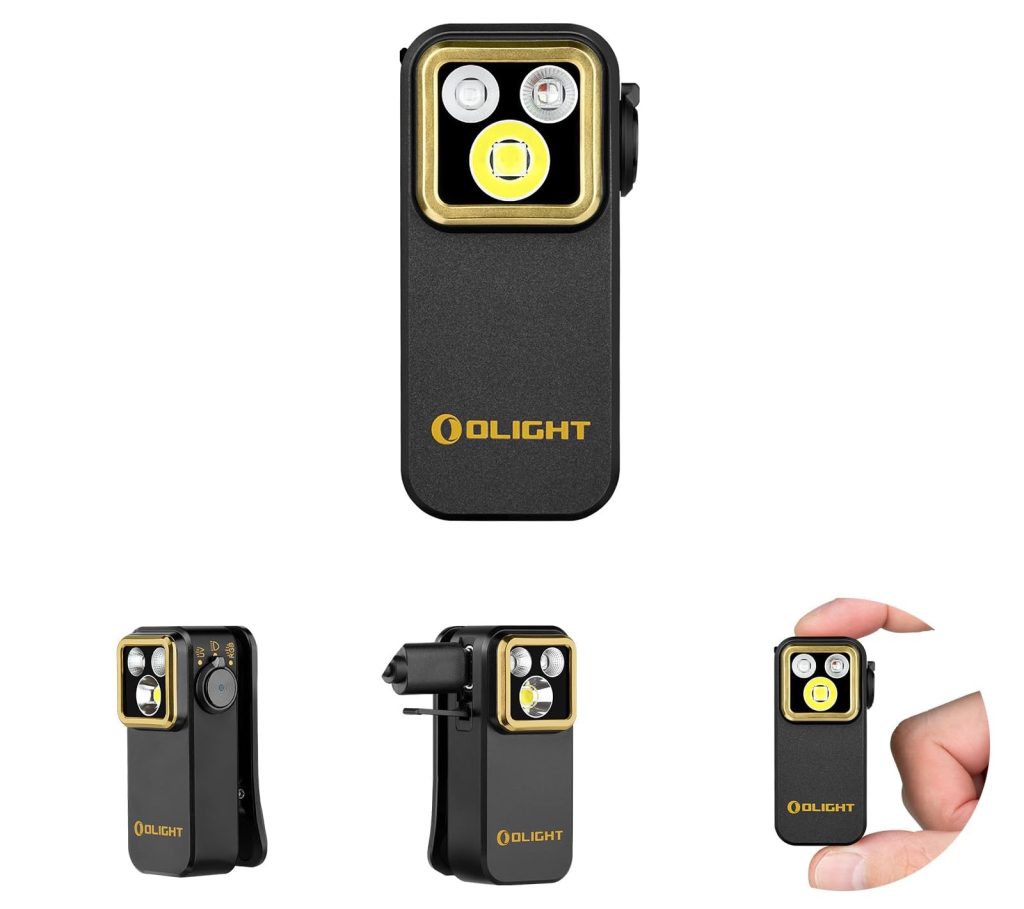
Why I chose it: Most dog walkers need three things from a light: it rides on them, it throws a wide even flood, and it goes red for the bag. The Oclip Pro S does all three in a body about the size of a matchbox car. It clips onto a coat collar, chest pocket, hat brim or harness strap, and the base is magnetic, so it sticks to a steel mailbox too. Olight released it in March 2026 as the update to the Oclip Pro, with white light up to 600 lumens plus red, green, blue and a 365 nm UV. It’s best for neighborhood walkers who want hands free light without wearing anything on their head.
Key specs
- Output: 600 lumens Turbo, 100 lumens Medium, 10 lumens Low, 1 lumen moonlight
- Runtime: 3.5 hours on Medium, 27 hours on Low, up to 144 hours on moonlight
- Red light: 40 or 4 lumens (26 hours on low red), plus green, blue and 365 nm UV
- Beam distance: 80 meters
- Carry: clip plus magnetic base
- Size and weight: 57 x 28 x 27 mm, about 53 g
- Water rating: IPX6, USB-C charging
Pros
- Hands free in a second, on almost anything you’re wearing
- Wide flood lights the sidewalk without a hot spot in drivers’ eyes
- Red mode for cleanup is on a side dial, no button combos
- Tiny and light enough to forget it’s there
Cons
- Medium only lasts about seven 30-minute walks per charge
- Turbo holds 600 lumens for a minute before it drops
- No long throw spotlight like the older Oclip Pro
In real use: Set it to Medium and the flood covers a wide patch of sidewalk without a bright center to dazzle oncoming drivers. That setting runs about 3.5 hours, so plug it in with your phone every few days. Twist the side dial to red at the curb and you can find what the dog left without wrecking your night vision. Turbo is a quick burst for checking a dark driveway or the far side of a parked car. The UV turns out to be handy at home, because dog urine glows under it, which every new puppy owner will appreciate. If you walk open fields and want more reach, the older Olight Oclip Pro keeps a separate spotlight rated to 120 meters.
2. Nitecore NU25 MCT UL: Best Headlamp
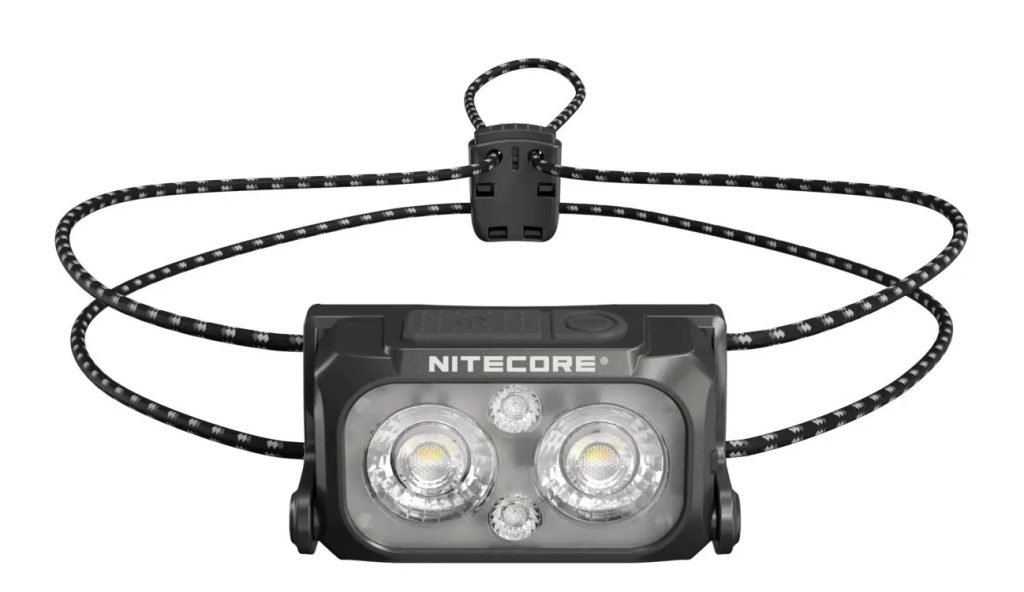
Why I chose it: A headlamp puts light wherever you look, and that counts when you’re bending down with a bag or untangling the leash from a mailbox post. The NU25 MCT UL is the 2025 version of Nitecore’s ultralight favorite, and with its thin cord headband it weighs just 47 grams. The upgrade dog walkers will notice is color: per Nitecore’s spec page, it switches between warm 3,000K, neutral 4,500K and cool 6,500K white. It’s best for park and trail walkers, and for anybody who already runs or hikes in the dark.
Key specs
- Output: 400 lumens max, dual spot and flood beams
- Color temperature: 3,000K, 4,500K or 6,500K
- Runtime: about 5 hours at 200 lumens, 13 hours at 60 lumens, 45 hours at 6 lumens
- Red light: 15 or 5 lumens, up to 26 hours
- Beam distance: 132 meters
- Battery: built-in 700 mAh, USB-C charging
- Weight and rating: 47 g, IP66, 1 meter impact rated
Pros
- So light you stop noticing it
- Warm white shows mud and roots with better contrast
- Separate buttons for white and red
- About ten walks per charge at 200 lumens
Cons
- Lights up anyone you turn to talk to
- Thin cord band isn’t as cushy as a wide strap
- Built-in battery, so no swapping cells on a long trip
In real use: Warm white is the setting to live on. It shows wet leaves, roots and the edge of the pavement with more contrast than cold white, and it’s far gentler on the neighbors’ windows. At 200 lumens it lasts about 5 hours, so roughly ten 30-minute walks between charges, and on lit streets you can drop to 60 lumens and stretch that to 13 hours. Red at 5 lumens is perfect for cleanup. The habit to learn with any headlamp is tipping your head down when you stop to chat, so you aren’t shining 400 lumens into somebody’s face.
3. AVANTO Pro Chest Light: Best Chest Light
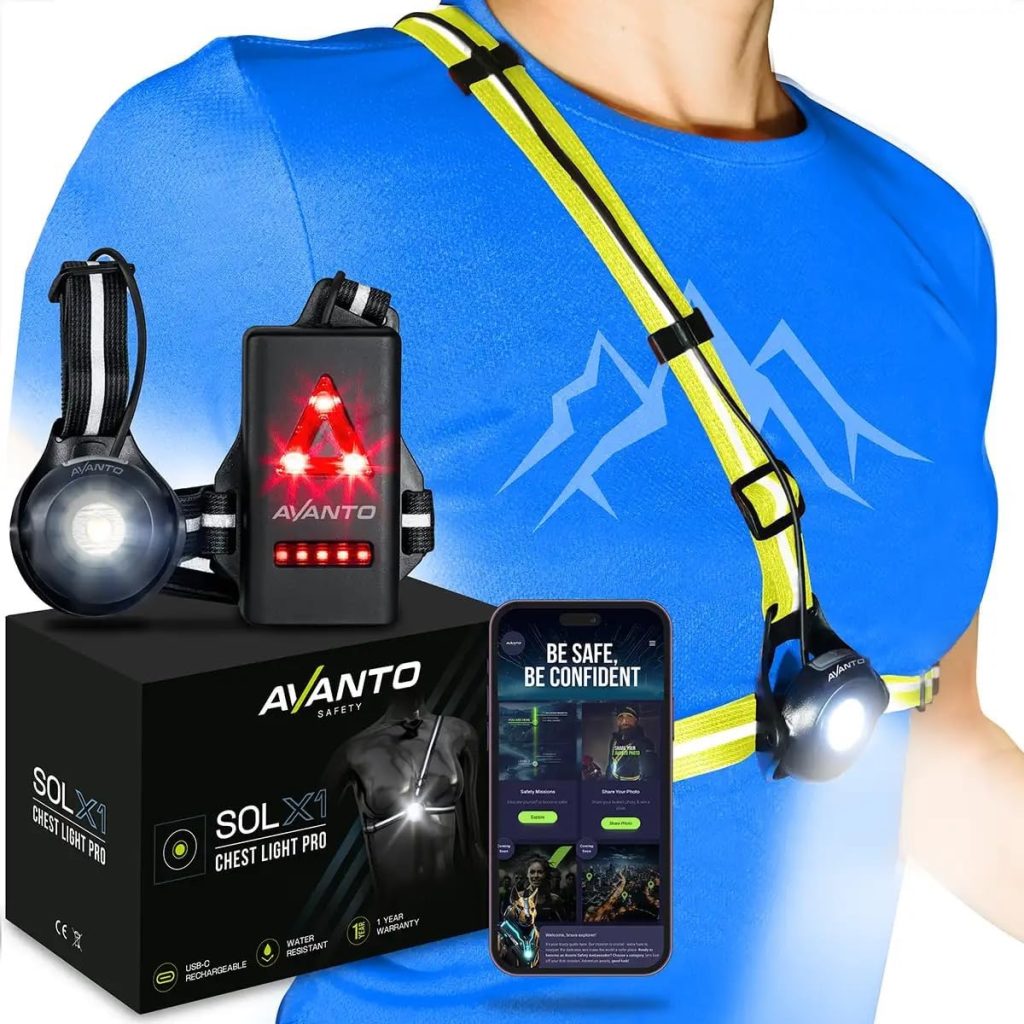
Why I chose it: Chest lights were made for runners, and they fix the two complaints people have about headlamps: the bobbing beam and the glare. The AVANTO Pro straps flat to your chest, so the beam stays level and points straight down the street you’re walking. The back strap carries a red light and the harness is reflective, which matters on roads where cars come up behind you. It’s best for road walkers and anybody who hates wearing things on their head.
Key specs
- Output: 500 or 250 lumens
- Runtime: about 3 hours on high, 5 hours on low
- Beam: tilts through 90 degrees
- Rear visibility: red light on the back strap, reflective straps all around
- Charging: USB-C
- Rating: IP54 dust and rain resistance
- Warranty: 5 years
Pros
- Beam stays steady even when the dog lunges
- Red rear light covers traffic behind you
- Both hands stay free for leash and bags
- Nothing on your head or in your eyes
Cons
- Bulkier than a clip light
- Only two brightness levels
- Rain resistant, not waterproof
In real use: Tilt the head down until the brightest part of the beam lands a few steps ahead of the dog, and the 250 lumen setting is plenty for a street with no lights, with about 5 hours of runtime. Because it sits on your chest, the beam doesn’t swing every time the dog spots a rabbit, and you aren’t lighting up the faces of people you pass. On a road with no sidewalk, the red light on your back is the best part. Most walkers have nothing at all facing the traffic coming up behind them.
4. Fenix E35R: Best for Dark Rural Roads
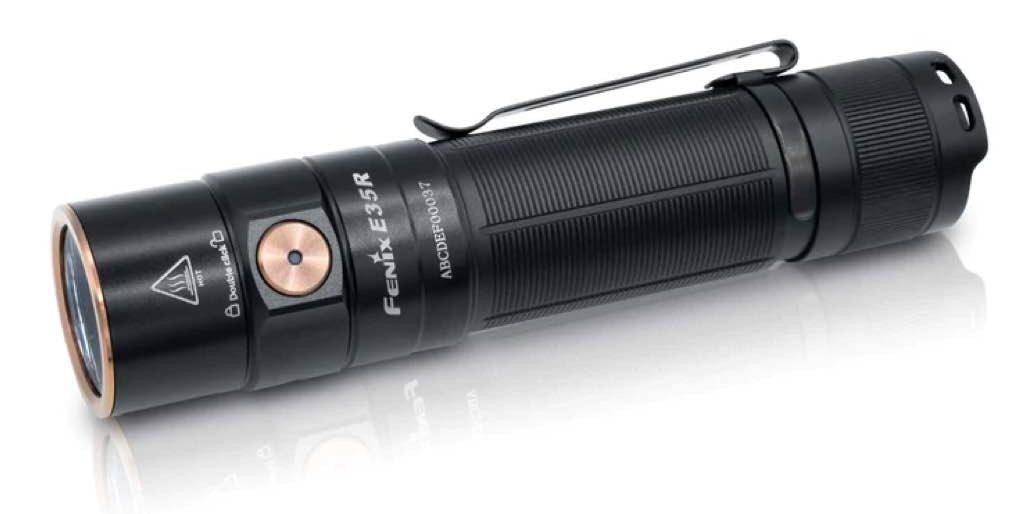
Why I chose it: Out past the last streetlight, a wide flood isn’t enough. You want to see the ditch, the culvert and whatever is standing at the edge of the field. The E35R throws 3,100 lumens out to 260 meters from a body only 4.7 inches long, and its 5,000 mAh 21700 battery runs the 150 lumen Low mode for over 21 hours. The magnetic tail sticks to the mailbox or the truck while you scoop. It’s best for rural walkers, farm roads and coyote country.
Key specs
- Output: 3,100 lumens Turbo, 1,000 High, 350 Medium, 150 Low, 30 Eco
- Runtime: 21 hours 20 minutes on Low, 69 hours on Eco
- Beam distance: 260 meters
- Battery: 21700, 5,000 mAh, included, USB-C charging in about 3 hours
- Carry: pocket clip, lanyard, magnetic tail
- Weight and rating: 148 g with battery, IP68 to 2 meters
Pros
- Roughly 40 walks per charge on Low
- Reaches far enough to check the tree line
- Magnetic tail frees a hand when you need it
- Instant strobe and lockout
Cons
- Way more light than a city sidewalk needs
- It’s a hand light, so one hand is busy
- Heaviest light here
In real use: Walk on Low. 150 lumens from a 21700 cell means around forty 30-minute walks between charges, so this is the light you charge about once a month. When the dog freezes and stares into the dark, click up to High and sweep the tree line. Eyeshine bounces back long before you could make out the animal, which gives you time to shorten the leash and turn around. A press and hold fires the strobe if a loose dog or anything else gets too close, and my guide to using a flashlight as a weapon covers how to use it. Pair it with a clip or chest light for the walking part.
5. Fenix E03R V2.0: Best Keychain Backup
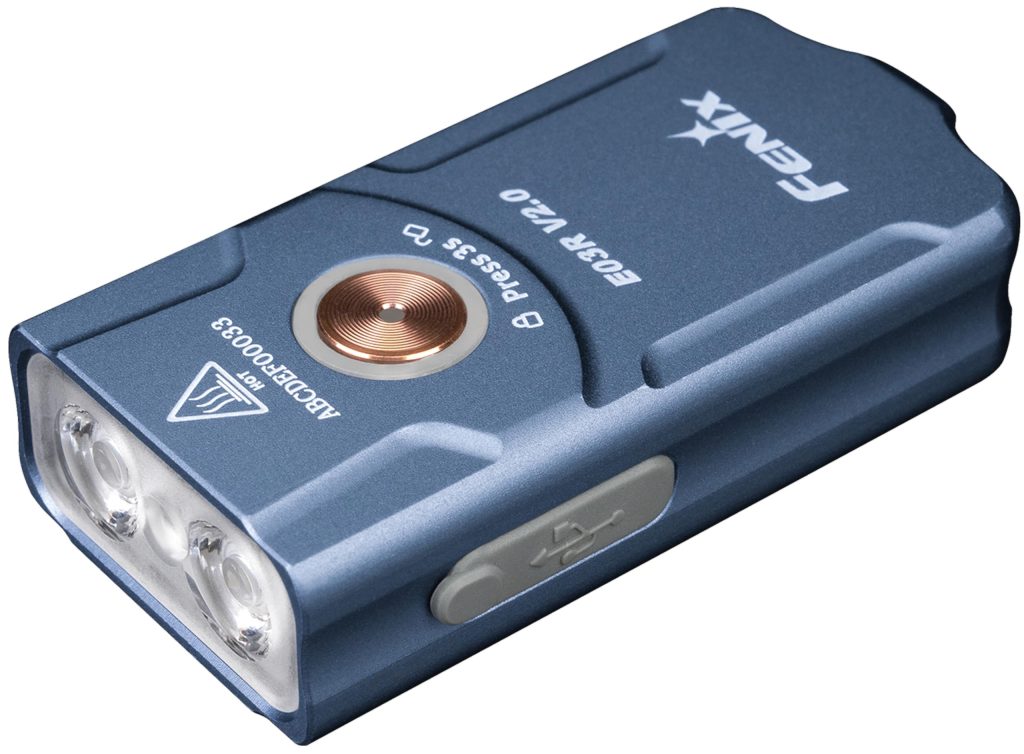
Why I chose it: Lights die. Batteries get left half charged, and somebody borrows the headlamp. The E03R V2.0 lives on your key ring at 30 grams, so you have a backup on every walk without thinking about it. It puts out 500 lumens, has a red light for cleanup, and the switch has a small breathing light so you can find it in the dark bowl by the door. It’s best as a backup for every walker, and as the main light for short walks under streetlights.
Key specs
- Output: 500, 150, 30 and 5 lumens, plus red and red flashing
- Runtime: 1 hour 20 minutes at 500, 2 hours at 150, about 6.5 hours at 30, 30 hours at 5
- Beam distance: 90 meters
- Battery: built-in 400 mAh, USB-C charging
- Size and weight: about 2 inches long, 30 g
- Rating: IP66, 1 meter impact rated
Pros
- Always on you because it’s on your keys
- Red light for the bag
- Lockout keeps it off in your pocket
- Breathing light makes it easy to find
Cons
- Short runtime at walking brightness
- Too small to hold comfortably for a long walk
- Built-in battery can’t be swapped
In real use: Runtime is short at walking brightness. At 150 lumens it runs about 2 hours, and at 30 lumens about 6.5, which is still several walks if the main light quits at the far end of the loop. The 5 lumen red is perfect for finding the bag without blowing out your night vision. It also makes a good everyday light for the rest of your life, the kind you’ll reach for under the sink or in the car more often than you expect.
6. Noxgear LightHound: Best Light for the Dog
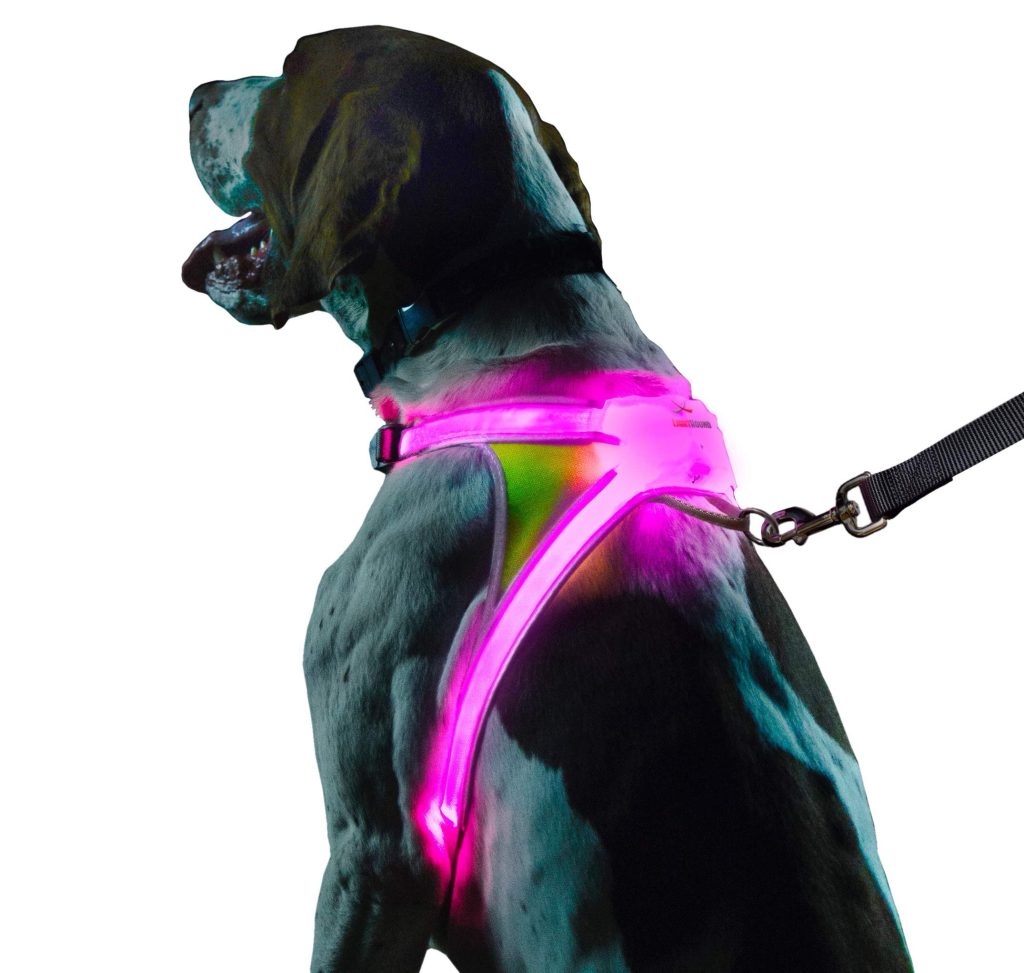
Why I chose it: The LightHound is the piece that makes the dog visible, and for a lot of walks it’s the most important part of the whole setup. It is a harness with light running through the straps, so the whole outline of the dog glows from every side in one of 8 solid colors or 6 flashing modes. It comes in four sizes from under 15 pounds to over 90, and it runs about 12 hours a charge on USB-C. It’s best for dark coated dogs and any walk near traffic.
Key specs
- Light: 8 solid colors and 6 flashing modes
- Runtime: about 12 hours, USB-C charging
- Sizes: S to XL, chest girth 12.5 to 50 inches
- Build: CORDURA nylon, reflective, pull tested to 300 pounds
- Care: light unit pops out, harness is machine washable
- Warranty: 12 months
Pros
- Drivers see a glowing dog shape
- Lights the dog from every angle
- Doubles as a regular everyday harness
- Easy to spot an off leash dog in a dark yard
Cons
- Light unit isn’t waterproof, so pull it before a swim
- One more thing to charge
- Getting the fit right takes a couple of tries
In real use: Drivers judge what they see by shape. A single blinking dot could be a bike or a mailbox, but a glowing dog outline reads as a dog right away, and that buys you a few extra seconds of a driver easing off. On a road I’d use a steady color, and save the flashing modes for spotting the dog when he’s off leash in a field. Noxgear says the light housing isn’t waterproof, so take it out before the pond, and the harness itself goes in the washer. If your dog swims or you want something smaller, the Nite Ize SpotLit Splash is a waterproof IPX7 collar light that runs 12 hours on USB-C.
How Many Lumens Do You Need to Walk a Dog at Night?
Less than most people buy. The right number depends on how much light is already around you, and the trick is using the lowest setting that shows you the ground. Every step up costs runtime and makes the dark outside your beam look darker.
Beam shape matters as much as the number. A flood spreads the light into a wide, even circle, which is what you want on a sidewalk. A spot packs it into a tight beam that reaches far but leaves the ground at your feet dark. If the numbers on the box confuse you, my candela vs lumens guide explains the difference between brightness and reach.
Headlamp, Chest Light or Flashlight: Which Is Best for Dog Walking?
All of them work. The question is which hand you want free and where you want the light to point.
If you already own a light you love, you may not need anything new. A small EDC light with a sturdy pocket clip works fine on a jacket, and my best EDC flashlights and best mini flashlight guides have plenty that fit the bill. For a headlamp you’ll also use around the house and campsite, see my rechargeable headlamp picks.
Is Red Light Better When Walking Your Dog?
For part of the walk, yes. Your eyes take a long time to adjust to the dark, and one blast of bright white light while you’re bent over the grass undoes most of it. Red light doesn’t do that nearly as much, so you can do the cleanup on red and still see the dark street when you look up. It’s also easier on neighbors at 10 p.m. What red isn’t good for is lighting your path or making you visible from the front, so use red for cleanup and standing still, then switch back to white to walk. Every light in my picks except the chest light has a red mode, and the chest light puts its red on your back, where it does the most good near traffic.
How to Make Your Dog Visible to Drivers at Night

A driver sees your light and assumes you’re out there alone. The dog, especially a dark one, is a shape the driver never registers. These are the habits that close that gap:
- Put a light on the dog. A lit harness or collar light shows drivers there’s a second body at the end of the leash.
- Walk facing traffic where there’s no sidewalk, and keep the dog on the side away from the road.
- Shorten the leash after dark. A long retractable lead puts the dog in places drivers don’t expect.
- Wear something light or reflective. A reflective leash and a light colored jacket help more than you’d think once headlights hit them.
- Aim your beam at the ground. A light pointed at a driver’s eyes blinds them right when you need them to see you.
Can You Just Use Your Phone Flashlight to Walk Your Dog?
In a pinch, sure. Every night, it’s a bad plan. It ties up the hand you need for the bag, it drains the battery you might need for a call, and cold weather drains it faster. A phone light is also a narrow, bluish splash that’s hard to aim while you hold a leash, and dropping a phone on the pavement because the dog lunged costs a lot more than a clip light.
Coyotes, Loose Dogs and Other Night Surprises
Most night walks are quiet, but the ones that aren’t usually start the same way: the dog stops, stiffens and stares into the dark. Trust that. Sweep your light toward whatever he’s looking at, because eyeshine shows up long before the animal does. Shorten the leash, stand tall, and back away rather than running. A sudden burst of bright light, or the strobe on a light like the E35R, makes most coyotes and loose dogs think twice. In places where coyotes are common, a light with real reach beats a wide flood every time.
What to Look For in a Flashlight for Dog Walking
Hands free carry
You need one hand for the leash and one for the bag. A clip light, headlamp or chest light keeps both of them free. If you love your handheld, pick one with a clip or a magnet so you can park it when you scoop. And make sure the red mode is easy to reach, ideally a dial or its own button, so you aren’t counting clicks in the dark.
Runtime you can count in walks
Lumens on the box don’t tell you much. What matters is how long the light runs at the setting you’ll actually walk on, because that decides how often you’re charging it.

Weather and cold
Look for IPX6 or better if you walk in rain. Lithium-ion batteries also give up runtime in the cold, so a light that lasts a week in October may only last four or five days in January. Keep it in an inside pocket until you head out, and charge it indoors.
A light for the dog
For most walkers, the biggest safety upgrade of all is putting any light at all on the dog. A brighter light for yourself comes second.
Frequently Asked Questions
What is the best light for walking a dog at night?
A hands free light with a wide flood beam and a red mode, such as the Olight Oclip Pro S clipped to your jacket, plus a light on the dog, such as the Noxgear LightHound harness. Headlamps and chest lights work well too if you prefer to wear your light.
Should my dog wear a light at night?
Yes, especially if the dog has a dark coat or you walk near traffic. Drivers see the walker’s light and often miss the dog entirely. A lit harness or collar light shows them there’s a dog at the end of the leash.
How long should a dog walking light last on a charge?
Aim for at least a week of walks at the setting you use. That means roughly 3 to 5 hours of runtime at 100 to 250 lumens for one walk a day, and more if you walk twice a day or in freezing weather.
Is a headlamp or flashlight better for dog walking?
A headlamp or clip light is better for most walks because it keeps both hands free for the leash and cleanup. A handheld flashlight is better for scanning far ahead on dark rural roads, so many walkers carry one of each.
The Bottom Line
For most dog walkers, the Olight Oclip Pro S is the one to buy first. It clips on in a second, lights the sidewalk without blinding anybody, and goes red for cleanup. Go with the Nitecore NU25 MCT UL if you want a headlamp, the AVANTO Pro Chest Light if you walk roads without sidewalks, and the Fenix E35R for dark country roads. Hang a Fenix E03R V2.0 on your keys as the backup, and put a Noxgear LightHound on the dog, because a driver who sees the dog is the whole point.
Then run your walk through the planner above and see how many weeks of dark walks you’re really in for. If there’s a dog walker on your Christmas list, a clip light and a lit harness make a gift they’ll use every single night, and my tactical gifts guide has more ideas like that.
