
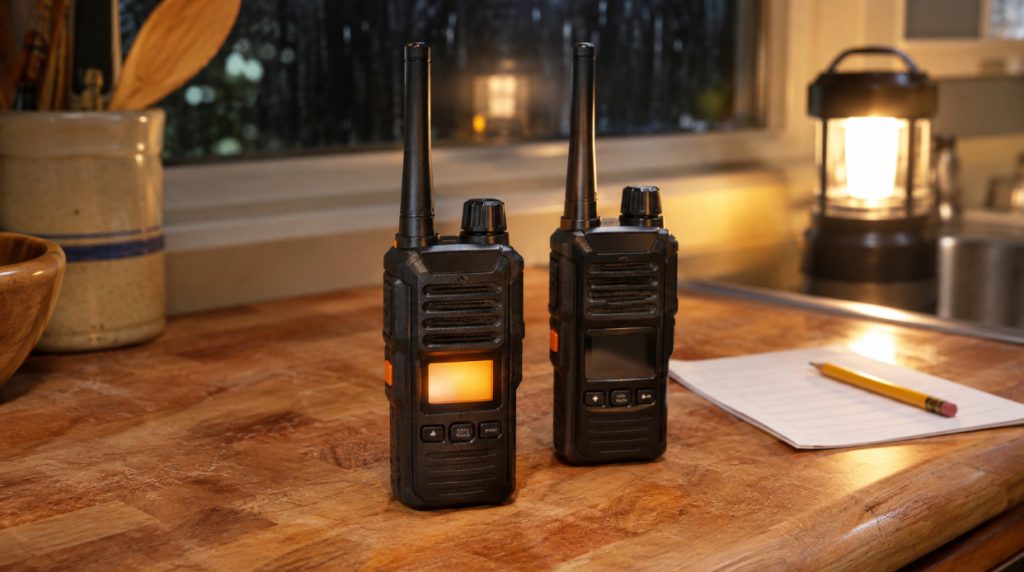
The cell towers usually hang on for a while after the lights go out. Then their backup power runs thin, every phone in town tries to call somebody at once, and the group text with your sister across town turns into a column of little red “Not Delivered” notes. Your teenager is at a buddy’s house six blocks over, the roads are glazed, and you dig out the walkie talkies from the junk drawer. They’re from a camping trip in 2016, they reach about as far as the mailbox, and one has a dead battery fused to the contacts.
A good GMRS radio fixes that, and it’s a lot easier than most folks expect. One FCC license covers your whole family for ten years with no test to take. It opens up 5 watt handhelds, 50 watt radios for the truck and the kitchen counter, and hilltop repeaters that can carry a handheld’s voice across a county.
Here’s what I’d buy. The Rocky Talkie Expedition is the handheld I’d trust when the weather turns ugly. A pair of Midland GXT1000VP4s keeps working on plain AA batteries after every charger in the house is dead. And if you want to reach across town from home, the Midland MXT575 turns your house into a 50 watt base station. Below the picks there’s a planner that tells you whether your radios will actually reach each other, and then builds a channel card you can print and tape inside a kitchen cabinet.
Quick Picks: The Best GMRS Radios
- Rocky Talkie Expedition: best GMRS radio overall, and the handheld I’d carry through a storm.
- Midland GXT1000VP4: best GMRS walkie talkie pair for a family outage kit, since it runs on AA batteries.
- BTECH GMRS-PRO: best GMRS radio for off-grid texting and location sharing.
- Midland GXT67 Pro: best GMRS handheld for reaching local repeaters.
- TIDRADIO TD-H3 Plus: best budget GMRS radio.
- Midland MXT575: best GMRS radio for a home base station or the car.
GMRS Radio Comparison
Will We Reach Each Other? Family GMRS Radio Planner
Range is the question everybody asks, and the box never answers it honestly. Tell the planner how far apart your people will be, or type two ZIP codes, then pick what’s in between and which radio is on each end. It shows whether you’ll hear each other, what would fix it if you won’t, and which radio fits. Underneath, fill in your channels and it builds a family channel card to print.
1. Rocky Talkie Expedition: Best Overall
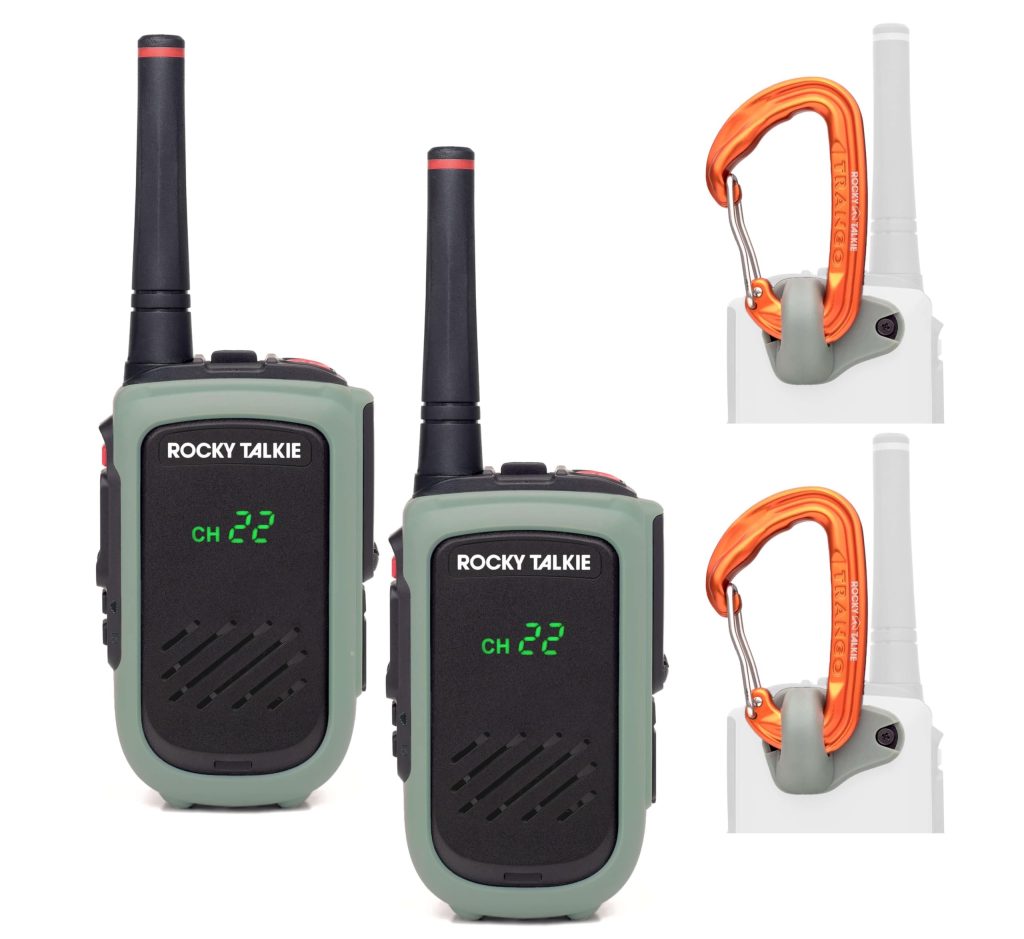
Why I chose it: Rocky Talkie built its name on simple, tough radios for climbers and ski patrol, and the Expedition is its 5 watt GMRS model. I’d hand it to anyone in the family without a lesson. The buttons are big, the screen is shatterproof, and IP67 waterproofing means it shrugs off a dunk in a puddle or a night on the porch rail. The battery is the best part: four to six days on a charge, even in serious cold, and you can swap in a spare. It also picks up NOAA weather alerts and opens up the 8 GMRS repeater channels. It’s best for families who want one radio for storms, hunting camp and the trail.
Key specs
- Power: 5 W
- Channels: 22 plus 8 repeater channels
- Battery: 1,800 mAh lithium-ion, replaceable, 4 to 6 days per charge
- Charging: USB-C
- Weatherproof: IP67
- Weather: NOAA alerts on 11 weather channels
- Antenna: removable, with a longer 17 cm antenna in the box
- Weight: 9.1 oz
Pros
- Battery life measured in days
- Waterproof and built to take a beating
- Easy enough for kids and grandparents
- Removable antenna lets you upgrade later
Cons
- Costs more than most handhelds
- Fewer channels than the programmable radios
- Sold one at a time, so a family set adds up
In real use: Screw on the longer antenna that comes in the box before a storm. It helps both talk range and weather reception. Clip one radio on the kitchen counter tuned to your main channel and keep the other with whoever is out checking on the neighbors. Because it runs for days, it’s the radio I’d keep on all night during an outage so nobody misses a call. A spare battery lives in the radio bag, and the USB-C port charges from any power bank or power station. Rocky Talkie lists range in town at up to a mile and a half, which covers a neighborhood nicely.
2. Midland GXT1000VP4: Best for the Family Outage Kit
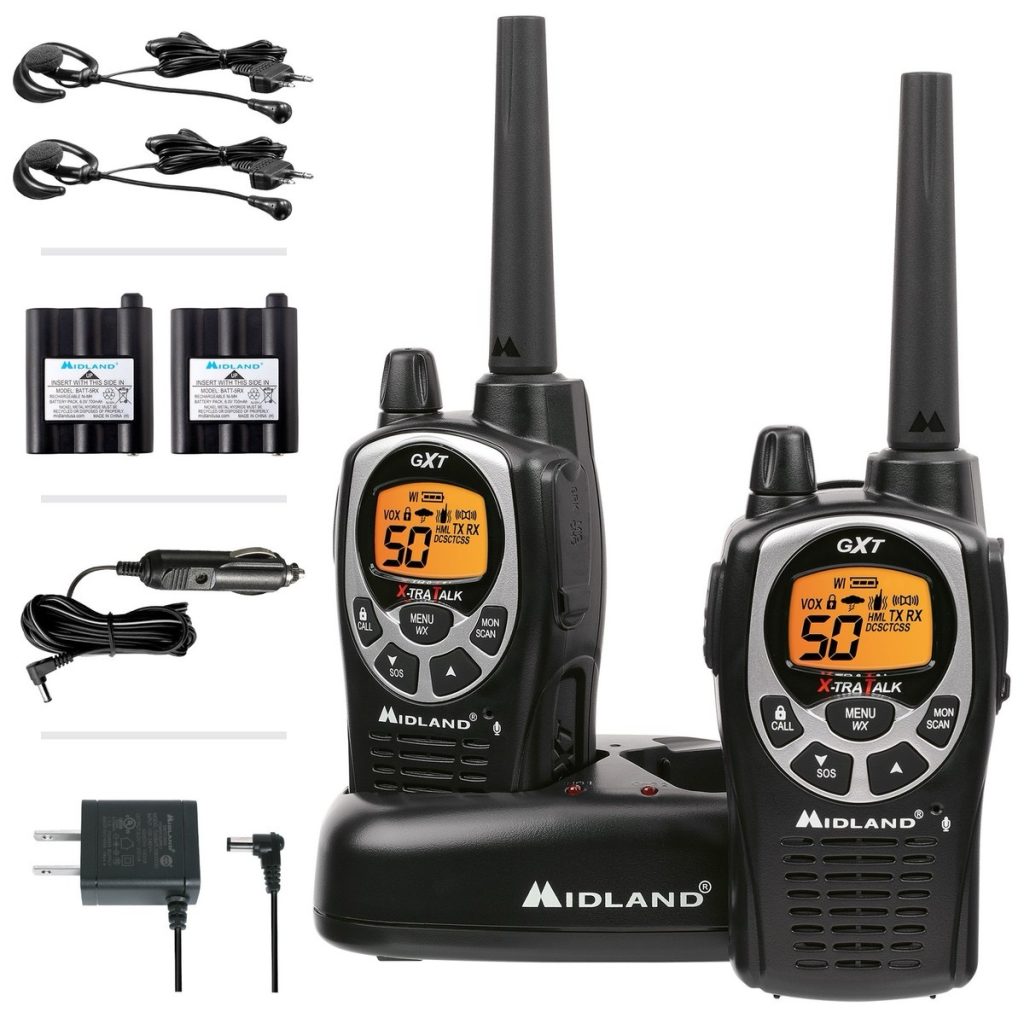
Why I chose it: Midland has sold this pair to campers and hunters for years, and it’s still the one I’d put in the outage tub. Each radio takes Midland’s rechargeable pack or 4 regular AA batteries, so when the power has been out for three days and every charger in the house is useless, you pop in AAs from the junk drawer and keep talking. It also has NOAA weather alerts, an SOS siren, a whisper mode and hands-free VOX, and the pair comes with headsets and a dual desk charger. It’s best for families who want working radios on a budget and for handing to kids.
Key specs
- Channels: 22 GMRS plus 28 Midland preset channels
- Privacy codes: 142
- Power source: 6 V NiMH pack or 4 AA batteries
- Weatherproof: splashproof (JIS4)
- Weather: NOAA scan and alert
- In the box: 2 radios, battery packs, desk charger, AC and DC adapters, 2 headsets
- Repeaters: no
Pros
- Runs on AA batteries when there’s no power to charge
- Affordable pair with everything in the box
- Simple enough for a nine year old
- Talks to any FRS or GMRS radio on the same channel
Cons
- Range is closer to a bubble-pack radio than a 5 watt handheld
- Can’t use repeaters
- Antenna is fixed, so there’s no upgrading it
In real use: Think of this pair as a household radio. Midland doesn’t print the transmit power on newer boxes, and owners who’ve put a meter on the current version report well under 5 watts. Across a yard, a block or a campground, it does the job well. Keep a pack of lithium AA batteries taped to the radio bag, since lithiums hold their charge for years in storage and keep working in the cold. If you need to reach across town, pair these with a 5 watt handheld or the MXT575 at home. They all talk to each other on the same channel.
3. BTECH GMRS-PRO: Best for Texting and Location Sharing
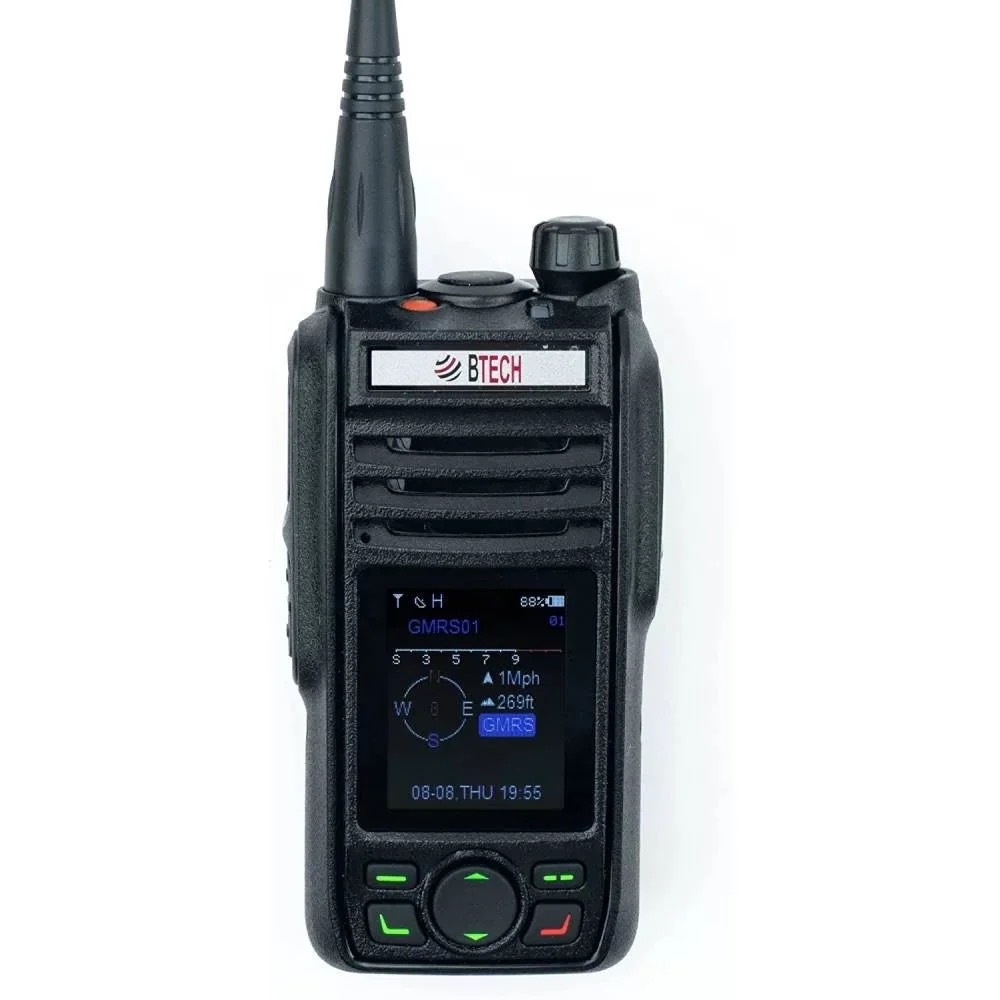
Why I chose it: BTECH’s GMRS-PRO does something no other radio here can. Pair two of them and you can send short text messages and share GPS locations radio to radio, with no cell service and no data plan. That matters when you’re hunting for a family member in a flooded neighborhood. It’s a full 5 watt, IP67 waterproof radio with NOAA alerts and repeater support for voice, and everything can be set up from a free phone app. It’s best for families or groups who’ll all carry the same radio and want texting and location sharing.
Key specs
- Power: 5 W
- Battery: 2,600 mAh, USB-C charging
- Channels: 180 in 6 banks
- Weatherproof: IP67
- GPS: built in, with compass and location sharing
- Texting: radio to radio with other GMRS-PRO units
- Weather: NOAA receiver with alerts
- Programming: free BTECH app, optional
Pros
- Off-grid texting and location sharing
- Waterproof and full power
- Big battery and USB-C charging
- App makes programming painless
Cons
- Texts and locations only work with other GMRS-PRO radios
- Data doesn’t go through repeaters, only voice does
- More buttons and menus than a family radio
In real use: Texting needs every radio in the group to be a GMRS-PRO, so buy them in pairs or more. Data only travels radio to radio on simplex channels, and voice reaches farther than texts when the signal gets weak, so treat texting as a quiet extra and keep voice as the main plan. Location sharing is opt-in. In an outage, set everyone’s radio to share location on a timer, and you’ll see on your screen whether the kids made it to Grandma’s without anyone keying up.
4. Midland GXT67 Pro: Best for Repeaters
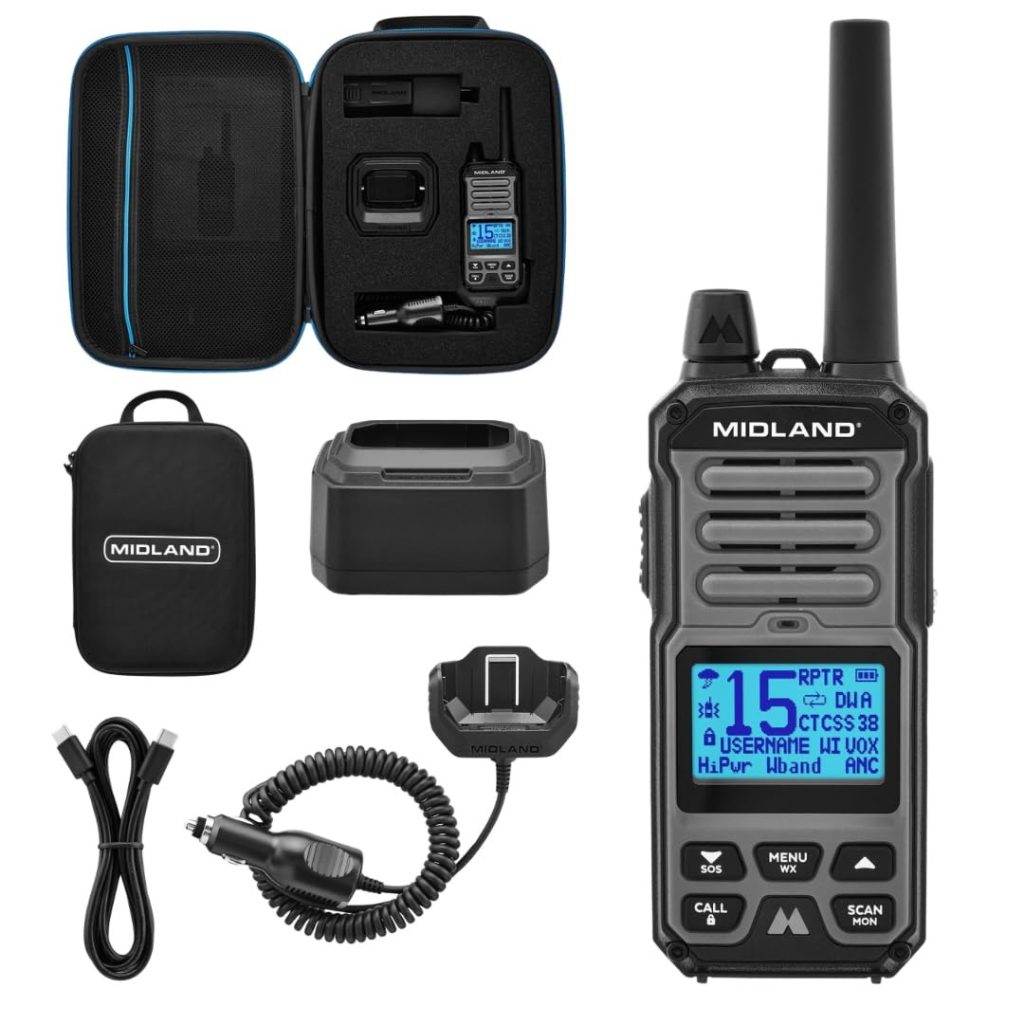
Why I chose it: The GXT67 Pro was Midland’s first 5 watt, repeater-capable handheld. It’s IP67 waterproof, the 2,500 mAh battery is rated for about 16 hours of normal use, and the menu makes it simple to set a repeater’s split tones by hand. A carrying case, a desktop charger and a snap-on charger for the car’s 12 V socket come in the box. It’s best for anyone who wants to use local repeaters and for keeping a radio in the truck.
Key specs
- Power: 5 W, with high, medium and low settings
- Channels: up to 99, including 8 repeater channels
- Battery: 2,500 mAh lithium-ion, about 16 hours
- Charging: desktop charger with USB-C cable, plus a snap-on 12 V car charger
- Weatherproof: IP67
- Weather: NOAA alerts
- Extras: built-in flashlight, VOX, carrying case
Pros
- Easy repeater setup, split tones included
- Waterproof and tough
- Car charger in the box
- Works with every Midland radio in the house
Cons
- Charges through the cradle, not a port on the radio
- Pricier than the budget handhelds
- Computer programming needs an extra cable
In real use: Repeaters are where this radio shines. Look up the nearest one on the myGMRS repeater map, ask the owner for permission and the tones, and save it to a repeater channel. A handheld that reaches a mile or two on its own can then talk across a county. Keep the cradle plugged into a power station during an outage, and drop the radio onto the car charger whenever you’re driving. The flashlight on top is handy for finding the radio in a dark kitchen.
5. TIDRADIO TD-H3 Plus: Best Budget
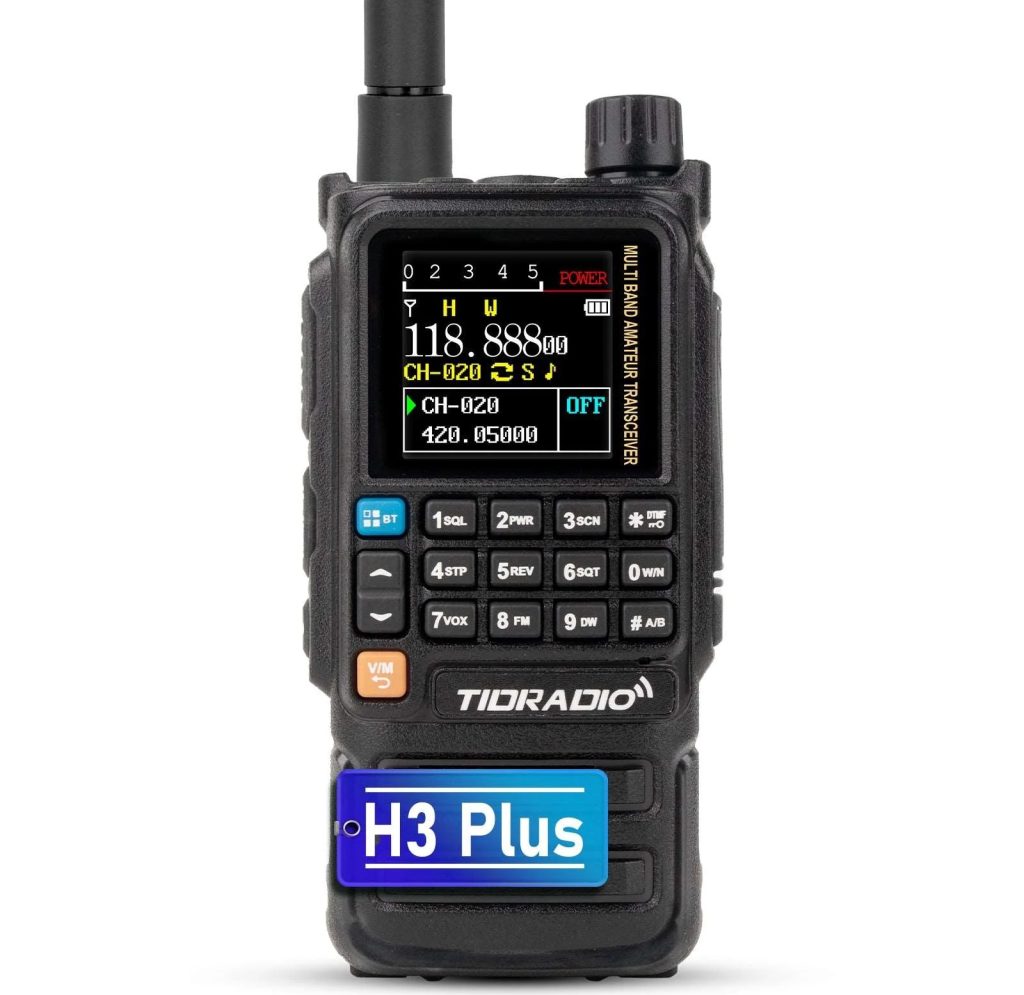
Why I chose it: TIDRADIO’s TD-H3 became a favorite of GMRS beginners because it does a lot for little money, and the Plus adds a few welcome upgrades. It’s a 5 watt radio with a 2,500 mAh battery, USB-C charging and programming, and free phone app programming over Bluetooth. It also receives NOAA weather and AM and FM broadcast radio for the news. It’s best for families who want 5 watt radios for everyone on a tight budget.
Key specs
- Power: 5 W
- Channels: 199
- Battery: 2,500 mAh
- Charging and programming: USB-C, plus the Odmaster phone app
- Receive: NOAA weather, AM and FM radio, air band
- Weight: 7.7 oz
Pros
- Low price for a full 5 watt radio
- Phone app makes setting channels easy
- USB-C charging from any power bank
- Repeater capable
Cons
- No waterproof rating
- Feels less rugged than the Rocky Talkie or Midland
- Menus take some getting used to
In real use: TIDRADIO also sells a ham version that looks almost the same, so order the one marked GMRS. Once it arrives, use the app to name your family channels, so the screen says “Main” and “Backup” instead of a frequency nobody remembers. Keep it in a zip bag in the car kit, since it isn’t waterproof.
6. Midland MXT575: Best Home Base and Car Radio
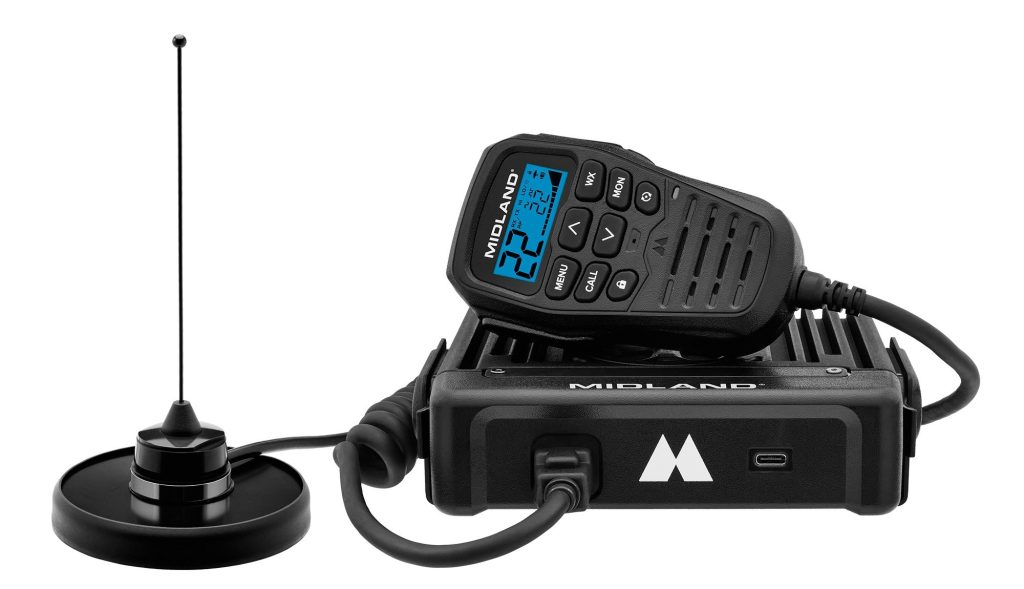
Why I chose it: A handheld’s biggest weakness is its short antenna held at head height. The MXT575 fixes both. It puts out 50 watts, the legal limit for GMRS, through a real antenna mounted up high, and that can stretch your family’s reach from the neighborhood to across town. The radio body hides under a seat or on a shelf, and every control is on the microphone, so it works on a truck’s dash or a kitchen counter. It has 15 GMRS channels, 8 repeater channels, 142 privacy codes, NOAA weather alerts and a USB-C port that charges a phone. It’s best for a home base station during outages, for a family’s main vehicle, and for farms and rural homes.
Key specs
- Power: 50 W, the GMRS legal maximum
- Channels: 15 GMRS plus 8 repeater channels
- Privacy codes: 142
- Power input: 13.8 V DC
- Weather: NOAA scan and alert
- Extras: control microphone with all the buttons, USB-C charging port, magnet mount antenna
- Warranty: 1 year
Pros
- Fifty watts, the most GMRS allows
- Works as a base station or a vehicle radio
- Talks to every FRS and GMRS handheld
- Hideaway design keeps the dash clean
Cons
- Needs a 12 V source and an outside antenna to shine
- Channels 1 through 7 are low power only
- Bigger setup job than a handheld
In real use: In the truck, the included magnet mount antenna goes in the middle of the roof and you’re done. At home, you need two things: power and height. Midland’s LPX-14 power supply turns wall power into the 13.8 volts the radio wants, and during an outage you plug that supply into a portable power station. Then get the antenna as high as you can, on the roof or at least in the attic. It’s the setup I’d build first if family lives more than a couple of miles away. Use channels 15 through 22 for the big signal, since the lower channels are held to low power.
Do You Need a License for a GMRS Radio?
Yes, and it’s the easiest license you’ll ever get. There’s no test. You apply online through the FCC, pay $35, and the license is good for ten years. You have to be 18 or older, and once you have it, any member of your family can use the radios, whatever their age. The FCC’s GMRS page has the details and the link to apply.
The FCC sends you a call sign, something like WRAB123. The rule is to say it at the end of a conversation, and every 15 minutes during a long one. You can add a name after it, so “WRAB123, kitchen” works fine. Write it on your channel card so the kids know it too.
Can you use a GMRS radio without a license?
You can listen to anything without a license. Transmitting on GMRS channels is what takes one. If someone in the family never wants to bother, give them a license-free FRS walkie talkie. It talks to your GMRS radios on the same channels.
GMRS vs FRS: Which Walkie Talkie Do You Need?
FRS is the license-free service. Those are the bubble-pack walkie talkies at every big box store, and they’re capped at 2 watts with a fixed antenna. GMRS uses the same frequencies plus a few more, and with a license you can run 5 watts in a handheld, up to 50 watts in a car or base station, a better antenna, and repeaters.
The two work together. FRS and GMRS radios share channels 1 through 22, so a kid with a cheap FRS radio can talk to your GMRS handheld on the same channel and privacy code. Channels 15 through 22 are the ones to use for a family plan. FRS radios can run their full 2 watts there, and GMRS radios can run full power. Channels 8 through 14 are limited to half a watt, so skip those.
The best GMRS walkie talkie for most families
Most families do best with a mix: a 5 watt GMRS handheld like the Rocky Talkie Expedition or TIDRADIO TD-H3 Plus for each adult, AA-friendly GXT1000VP4s for the kids, and an Midland MXT575 at home if the family is spread out. Everything talks on the same channels.
How Far Can a GMRS Radio Reach?
Ignore the “36 miles” on the package. That number assumes two radios on mountaintops with nothing but air between them. UHF radio waves travel in straight lines, so anything solid in the way, like hills, buildings, trees or the curve of the earth, eats your range. Held at head height, each handheld can only “see” about two and a half to three miles to the horizon, so two handhelds on flat ground top out around five miles even in a perfect world.
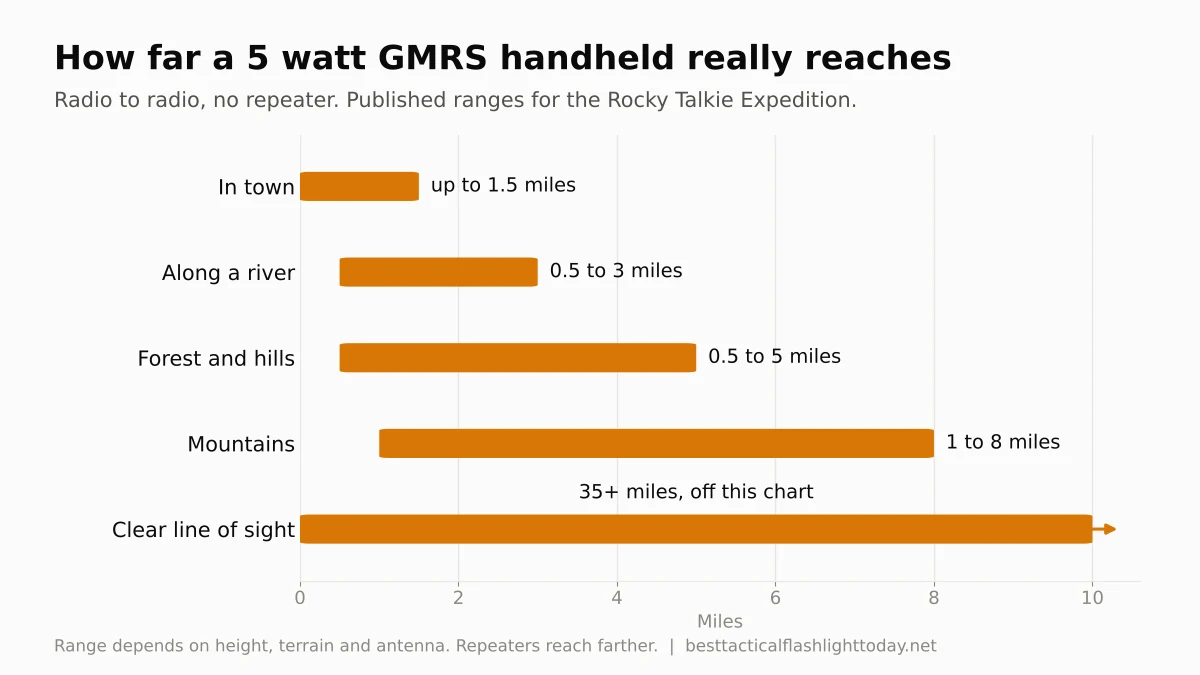
Those are Rocky Talkie’s own published ranges for its 5 watt Expedition, and they’re honest ones: up to a mile and a half in town, half a mile to five miles in forest and hills, and one to eight miles in the mountains. That covers what most families need, which is reaching across a neighborhood or a small town.
How far can a GMRS radio reach without a repeater?
Radio to radio, plan on one to two miles between handhelds in a neighborhood, and more across open farmland or water. A car radio with a roof antenna roughly doubles that. A 50 watt home base with an antenna on the roof can reach several miles across town and much farther from a hilltop.
Height beats watts
Raising an antenna does more than adding power. Going from 5 to 50 watts helps, but moving that antenna from your hand to the roof helps even more. When a handheld call is breaking up, walk outside, climb to the second floor or stand on the porch steps. In the planner above, try switching your end from a handheld to a home base station and watch the rings grow.
GMRS Repeaters: How to Talk Across Town
A repeater is a radio on a tower or hilltop that listens on one frequency and rebroadcasts on another at high power. Your handheld only has to reach the repeater. The FCC puts typical GMRS range at one to 25 miles, and repeaters are how you reach the far end of that.
- Find one: search your town on the myGMRS repeater map. Many repeaters are run by local clubs or individuals.
- Ask first: repeaters are privately owned. Message the owner, ask for permission and the access tones, and most will say yes to a licensed family.
- Program it: save the repeater to one of the 8 repeater channels with its tones. The Rocky Talkie, GMRS-PRO, GXT67 Pro, TD-H3 Plus and MXT575 can all do it. The GXT1000VP4 can’t.
- Have a backup: some repeaters have no backup power, and in a long outage they may go dark. Keep a simplex, radio-to-radio channel on your card too.
Setting Up a GMRS Home Base Station for Power Outages
A base station is just a mobile radio like the Midland MXT575 set up at home with a good antenna. It’s the single biggest range upgrade you can make, and it gives the whole family one place to call. Here’s the simple version:
A base station sips power while listening and only pulls hard when you talk, so a mid-size power station runs it a long time. If you’re not ready for a roof antenna, start with the magnet mount antenna that comes with the MXT575 on a metal surface near a high window. It won’t match a roof antenna, but it beats a handheld by a mile, sometimes literally.
Keeping Your Radios Charged When the Power Is Out
- USB-C radios like the Rocky Talkie, GMRS-PRO and TD-H3 Plus charge from any power bank, a power station’s USB port or the car.
- AA radios like the GXT1000VP4 keep going as long as you have batteries. Lithium AAs store for years and work in the cold.
- Car chargers like the one that comes with the GXT67 Pro top off radios whenever someone drives for supplies.
- Solar panels refill a power bank or station on sunny days. My peak sun hours calculator shows what a panel really makes in your ZIP code in winter.
- Turn power down. Most handhelds have a low power setting. Use it when you’re close together, and the battery lasts much longer.
Cold kills batteries fast. On a freezing night, keep the radios inside your coat or under the blankets, not on the windowsill.
A Family Radio Plan That Actually Works
Radios without a plan just mean more people asking “Is this thing on?” Twenty minutes of planning before storm season pays off the first time the phones go down.
The card builder in the planner above puts all of that on one printable page, along with your call sign. Add your local weather station from my NOAA weather radio frequency finder, and keep one card in every radio bag and one in the car emergency kit.
Walkie Talkies for Emergencies: What Else Goes in the Kit
A GMRS radio lets your family talk to each other. You still want a way to hear the outside world. A weather alert radio wakes you up for tornado and flood warnings, and a hand crank radio keeps the news coming with no batteries at all. Add a rechargeable headlamp for hands-free light while you work, and the rest of the list is on my power outage emergency kit page.
Buying Guide: What to Look for in a GMRS Radio
Real power. Handhelds top out around 5 watts. Plenty of cheap radios print huge mile ratings on the box, so look for the wattage instead. Mobile and base radios go up to 50 watts.
Repeater capable. If there’s a repeater near you, this matters more than anything else on the list. Look for “repeater channels” and support for split tones.
A removable antenna. A better antenna is the cheapest range upgrade there is, and you can only do it if the antenna comes off.
Batteries you can keep going. USB-C charging, a swappable battery or an AA option all count. In a long outage, the radio that can be recharged is the radio that works.
NOAA weather alerts. Most good GMRS radios include them, and they turn every radio in the house into a backup for your weather alert radio.
Weatherproofing. IP67 means the radio survives a dunk. Splashproof is fine for the kitchen but not for a flooded yard.
GMRS certified. Buy radios sold as GMRS radios. Some look-alike handhelds are ham radios that aren’t legal on GMRS frequencies, even though they’ll happily transmit there.
GMRS Radio FAQ
Do I need a license for a GMRS radio?
Yes. A GMRS license costs $35, needs no test and lasts ten years. You must be 18 or older to apply, and once you have it, everyone in your family can use the radios. Listening needs no license.
How far can a GMRS radio reach?
Between two 5 watt handhelds, plan on about one to two miles in a neighborhood, up to a mile and a half in a city, and five miles or more over open ground or from high spots. A car or home base radio with a roof antenna reaches a lot farther, and a repeater on a hilltop can stretch a handheld’s range to 20 miles or more.
Can GMRS radios talk to FRS walkie talkies?
Yes. FRS and GMRS share channels 1 through 22, so they can talk as long as both radios are on the same channel and privacy code. FRS radios can’t use repeaters, though, and their range is shorter.
Will a GMRS radio work when cell service is down?
Yes. GMRS radios talk directly to each other and need no towers, no internet and no cell service. That’s why they’re so useful in outages and storms. The one exception is a repeater, which needs its own power, so keep a radio-to-radio channel in your plan as a backup.
The Bottom Line
For most families, the Rocky Talkie Expedition is the best GMRS radio: waterproof, a full 5 watts and a battery that lasts for days. Put a pair of Midland GXT1000VP4 radios in the outage kit for the AA batteries, pick the BTECH GMRS-PRO if your group wants off-grid texting, and the Midland GXT67 Pro if there’s a repeater nearby. The TIDRADIO TD-H3 Plus gets everyone a real 5 watt radio on a budget, and the Midland MXT575 on a power station turns your house into a base station that reaches across town. Get the $35 license, print your channel card, and practice a check-in before the next storm knocks the phones out.
