
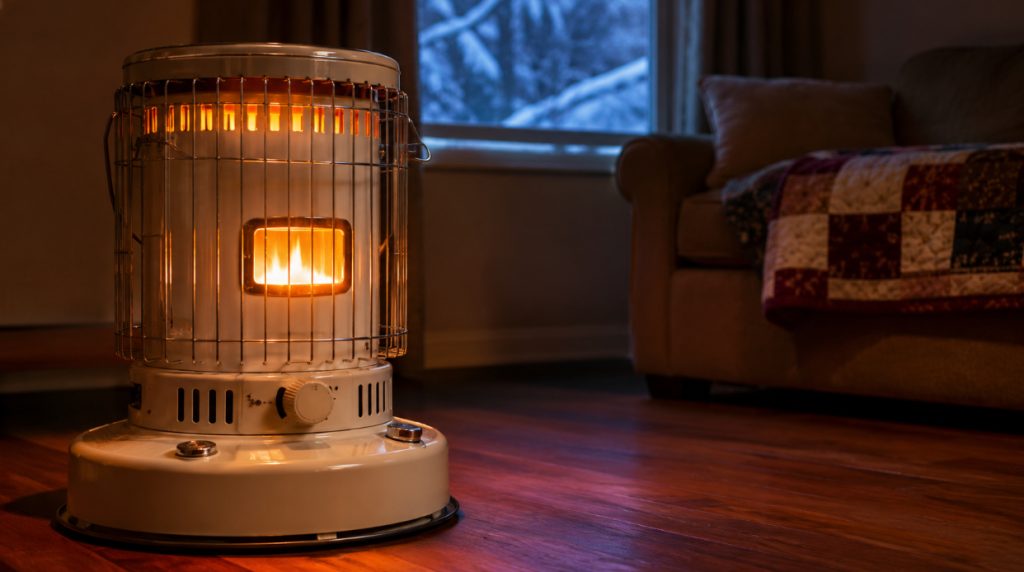
The ice starts ticking against the windows a little after supper. By nine the lights blink twice and quit, and the furnace goes quiet with them, because even a gas furnace needs electricity to run its blower. The first night is fine under a pile of quilts. By the second morning you can see your breath in the kitchen, the dog won’t leave the couch, and every store within thirty miles has a hand-lettered sign on the door that says no heaters.
That’s the moment people in Kentucky, West Virginia and Maine have been dragging the old kerosene heater out of the shed for fifty years. A good one makes real heat with no power at all, runs most of a day on a gallon or two, and doubles as a glowing lamp in a dark house. It also burns its fuel right there in your living room, which is why the rules around fresh air, fuel and bedtime matter as much as the heater you pick.
Here’s what I’d keep ready before the next storm. The DuraHeat DH2304S is my pick for most homes, with enough heat for an open first floor and a tank that lasts through a long evening. If you only need to warm the room you’re sitting in, the Dyna-Glo RMC-55R7 does it on about half the fuel. Every pick here is an indoor kerosene heater, built and labeled for use inside the house. Below the reviews there’s a planner that checks your state’s rules, sizes the heater to your space and counts the kerosene for the whole outage.
Quick Picks: The Best Indoor Kerosene Heaters
Indoor Kerosene Heaters Compared
Rated areas are each maker’s own figure and assume ordinary winter weather. Every heater here has an automatic shutoff that drops the wick if the heater is bumped or tipped.
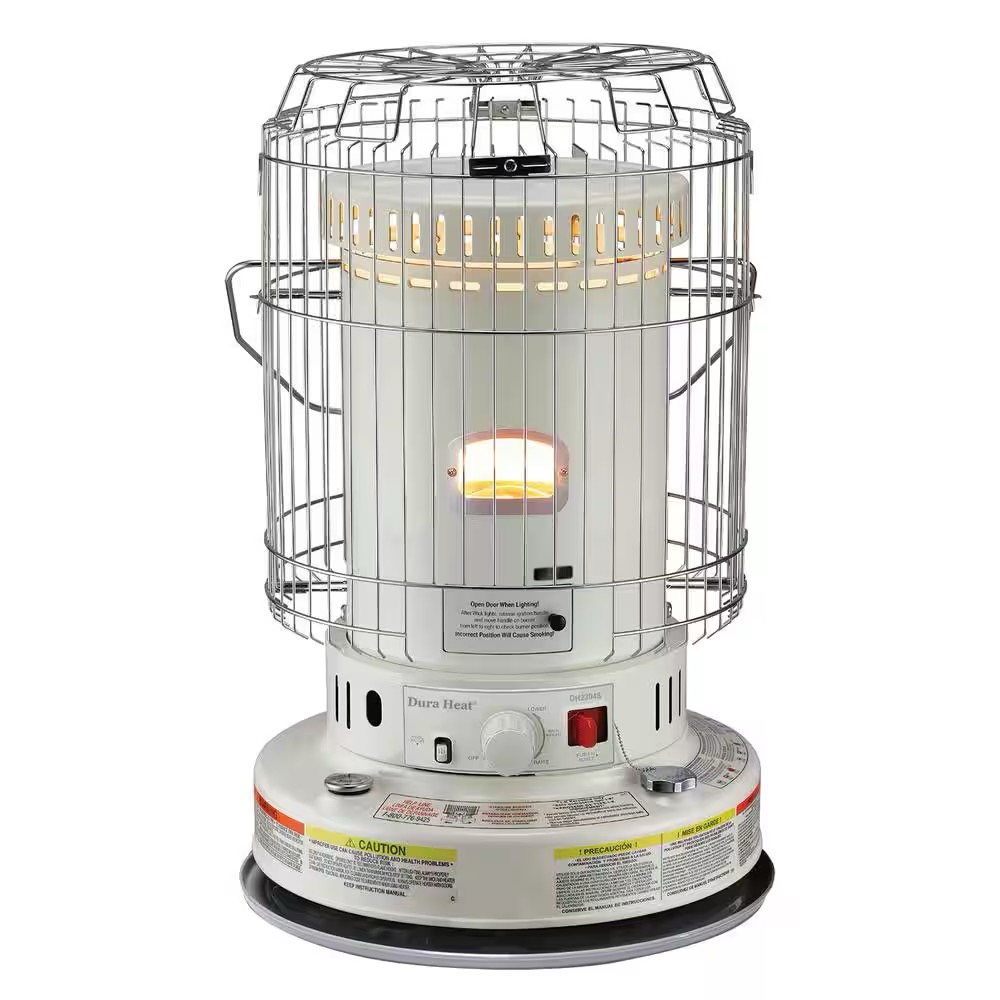
1. DuraHeat DH2304S: Best Overall
Why I chose it and who it’s for
If I could keep one kerosene heater for a long winter outage, it would be this one. It’s a round convection heater that throws 23,800 BTU of heat in every direction, and DuraHeat rates it for up to 1,000 square feet. That’s an open kitchen and living room in most houses, kept comfortable on a single tank.
It lights with a push of the side lever, using two C batteries for the igniter, and the burner is a no-lift design that keeps the smell down when you light it. It’s best for families who want one heater to carry the main floor of the house through a multi-day outage.
Key specs
- Heat output: 23,800 BTU per hour
- Type: convection, 360 degree heat
- Tank: 1.9 gallons, built in
- Runtime (DuraHeat): about 9 to 12 hours per tank, burning up to 0.18 gallons an hour
- Rated area: up to 1,000 sq ft
- Ignition: battery igniter, two C cells
- Safety: automatic tip-over shutoff and a one-touch manual shutoff
- Size and weight: 27 inches tall, about 23 lb empty
Pros and cons
Pros
- The most heat you’ll find in a portable indoor kerosene heater
- Heats evenly all the way around instead of in one direction
- Fuel gauge on the front, so you know when to plan the next fill
Cons
- Too much heat for one closed bedroom, so it needs open doors around it
- The tank is built in, so the whole heater goes outside to be filled
- Not something you want in a cramped apartment
In real use
Plan your fuel around its full output, since a kerosene heater doesn’t really turn down. DuraHeat’s manual is blunt about it: the flame is either on or off, and lowering the wick to cut the heat just makes it smoky and smelly. If the room gets too warm, open a door or shut the heater off for a while. At 0.18 gallons an hour, an eight hour day burns about a gallon and a half, so a 5 gallon can covers three days.
The manual also gives the fresh air rule I use throughout this guide. At 23,800 BTU it wants about 4,760 cubic feet of room, roughly 595 square feet with 8 foot ceilings, before you need a door open to the next room or a window cracked an inch.
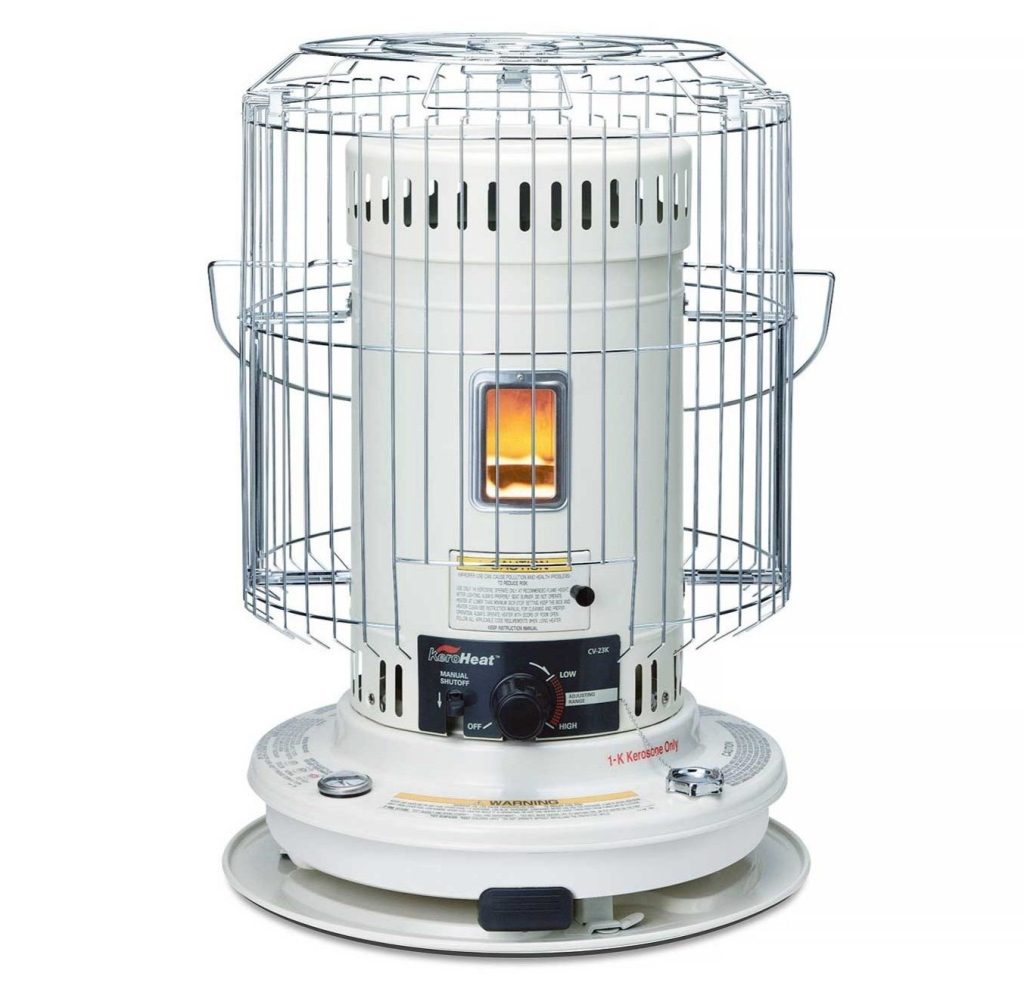
2. Sengoku KeroHeat CV-23K: Most Popular
Why I chose it and who it’s for
Ask around anywhere the power goes out every winter and somebody will have a Sengoku. The CV-23K is the crowd favorite, with well over a thousand owner reviews, and it puts out 23,500 BTU from the same size 1.9 gallon tank as the DuraHeat.
It comes with a siphon pump and the batteries for its push-button igniter, so it’s ready the day it arrives, and it’s UL listed, which matters in states that only allow listed heaters. It’s best for anyone who wants the same big-heater capability with the brand most of their neighbors already trust.
Key specs
- Heat output: up to 23,500 BTU per hour
- Type: convection, 360 degree heat
- Tank: 1.9 gallons, built in
- Runtime (Sengoku): about 9 to 12 hours per tank, burning up to 0.178 gallons an hour
- Rated area: up to 1,000 sq ft
- Ignition: push-button igniter, batteries included
- Safety: tip-over switch, protective grilles, UL listed
- In the box: siphon pump
Pros and cons
Pros
- Comes with a siphon pump and batteries
- UL listed for states that require it
- Slightly lower fuel burn than the 23,800 BTU heaters
Cons
- Owners say the igniter is the first part to give out, so keep a long lighter handy
- Built-in tank means carrying the heater outside to fill it
- Sengoku quotes both 900 and 1,000 sq ft, so treat 1,000 as the top end
In real use
On paper it runs neck and neck with the DuraHeat, and the 500 BTU difference won’t be noticeable in a real room. What you will notice is the wick. Sengoku’s manual has you burn the heater outdoors the first time to cook off the oils from the factory, and it’s worth doing, because the first burn indoors is the one that smells. After that, a clean wick and fresh 1-K kerosene keep it close to odorless once it’s been running a few minutes.
If the igniter does quit years down the road, the heater still works. Replacement igniters are cheap, and in the meantime you can light the wick by hand with a long fireplace lighter as the manual describes.
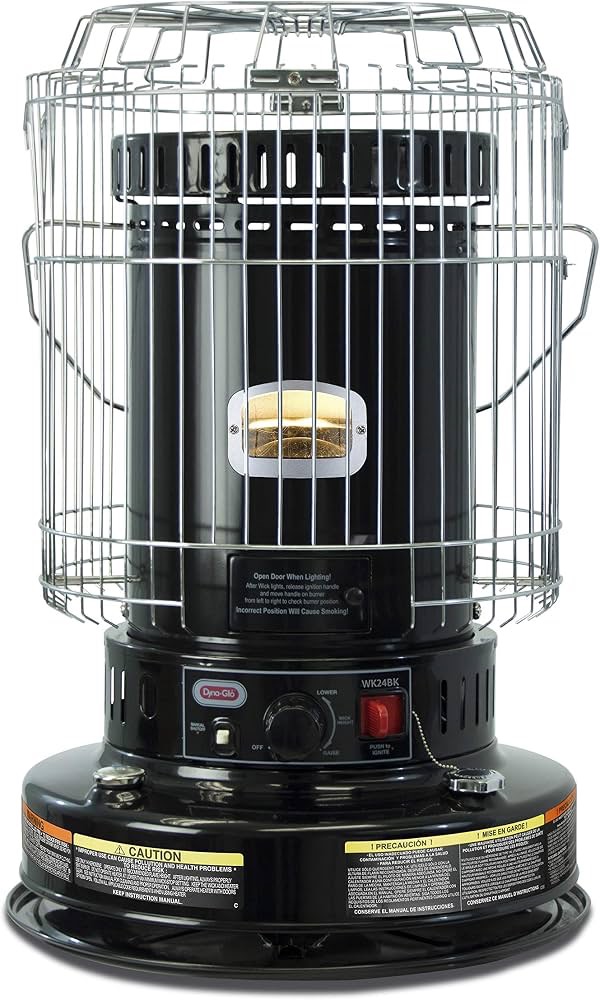
3. Dyna-Glo WK24BK: Best Cool-Top Design
Why I chose it and who it’s for
Dyna-Glo’s WK24BK shares the DuraHeat’s spec sheet almost line for line: 23,800 BTU, a 1.9 gallon tank and 8 to 12 hours per fill. It’s one of the kerosene heaters people search for by name, and it earns its spot with a few touches the others don’t list.
Dyna-Glo builds it with a cool-top design and a full safety grille, and it ships with a siphon pump and batteries. It’s best for households with small children or pets who will inevitably wander over to see what’s glowing.
Key specs
- Heat output: 23,800 BTU per hour
- Type: convection, 360 degree heat
- Tank: 1.9 gallons
- Runtime (Dyna-Glo): 8 to 12 hours per tank, burning up to 0.18 gallons an hour
- Rated area: up to 1,000 sq ft
- Ignition: automatic side ignition, two C cells
- Safety: tip-over shutoff, one-touch extinguish, cool-top design, safety grille, UL listed
- In the box: siphon pump and batteries
Pros and cons
Pros
- Cool-top cabinet and grille suit a busy household
- Everything you need to start comes in the box
- Same heat and runtime as the DuraHeat
Cons
- Cool top doesn’t mean cool sides, so the 3 foot clearance still applies
- Little sets it apart from the DuraHeat besides the cabinet
- Big heat for a small room
In real use
Treat “cool top” as a little extra margin, not a reason to relax. Every one of these manuals asks for 3 feet of clear space around the front and top, and the CPSC says the same. A heater in the middle of a busy room is safer if it sits on a hard floor where nobody walks past it, with the kids’ blankets and the dog bed well back.
Because it shares its fuel rate with the DuraHeat, the fuel math is identical: about a gallon and a half for an eight hour day, and one 5 gallon can for three days of evenings.
4. Dyna-Glo RMC-55R7: Best for One Room
Why I chose it and who it’s for
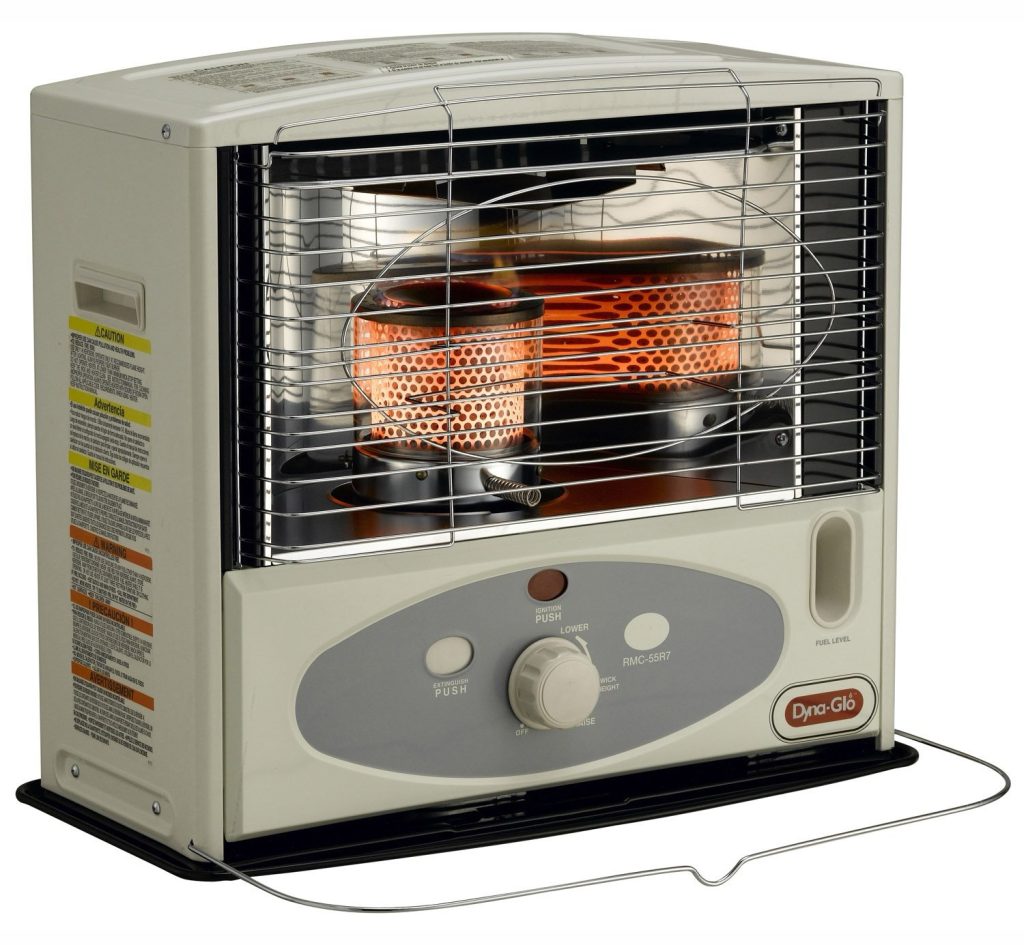
Most outage nights, the whole family ends up in one room anyway. A radiant heater suits that. Instead of warming all the air around it, the RMC-55R7 has a reflector behind the burner that throws 10,000 BTU forward like a campfire, so the people in front of it feel warm long before the far corners do.
Its tank lifts out, so you carry a small cartridge outside to fill instead of the whole heater, and Dyna-Glo rates it for up to 500 square feet. It’s best for a living room or den where everyone gathers.
Key specs
- Heat output: 10,000 BTU per hour
- Type: radiant, with a reflector aimed forward
- Tank: removable cartridge, about 1 gallon
- Runtime: up to about 13 hours per tank
- Rated area: up to 500 sq ft
- Ignition: push-button, two D cells (included)
- Safety: automatic safety shutoff, one-touch extinguish, cool-top design
- In the box: siphon pump
Pros and cons
Pros
- Lift-out tank makes outdoor refills easy
- Radiant heat warms people fast, even in a drafty room
- About half the fuel of a 23,000 BTU heater
Cons
- Heat is directional, so the room behind it stays cool
- Not enough heat for an open floor plan in real cold
- Some owners find the build lighter-duty than the bigger heaters
In real use
Set it a little more than 3 feet in front of the couch and the people sitting there will feel it within minutes. That’s the trick with a radiant heater in an outage: you heat the people, not the house. At 10,000 BTU it needs about 250 square feet of floor space at 8 foot ceilings before the fresh air rule asks for an open door, which a normal living room clears easily.
Dyna-Glo’s manual adds two habits worth keeping. After the very first fill, let the wick soak for a full hour before lighting it. And never pull the cartridge while the heater is hot. You’ll hear a gurgle now and then as fuel drains from the cartridge into the burner, which is normal.
5. Sengoku HeatMate HMN-110: Best Small Kerosene Heater
Why I chose it and who it’s for
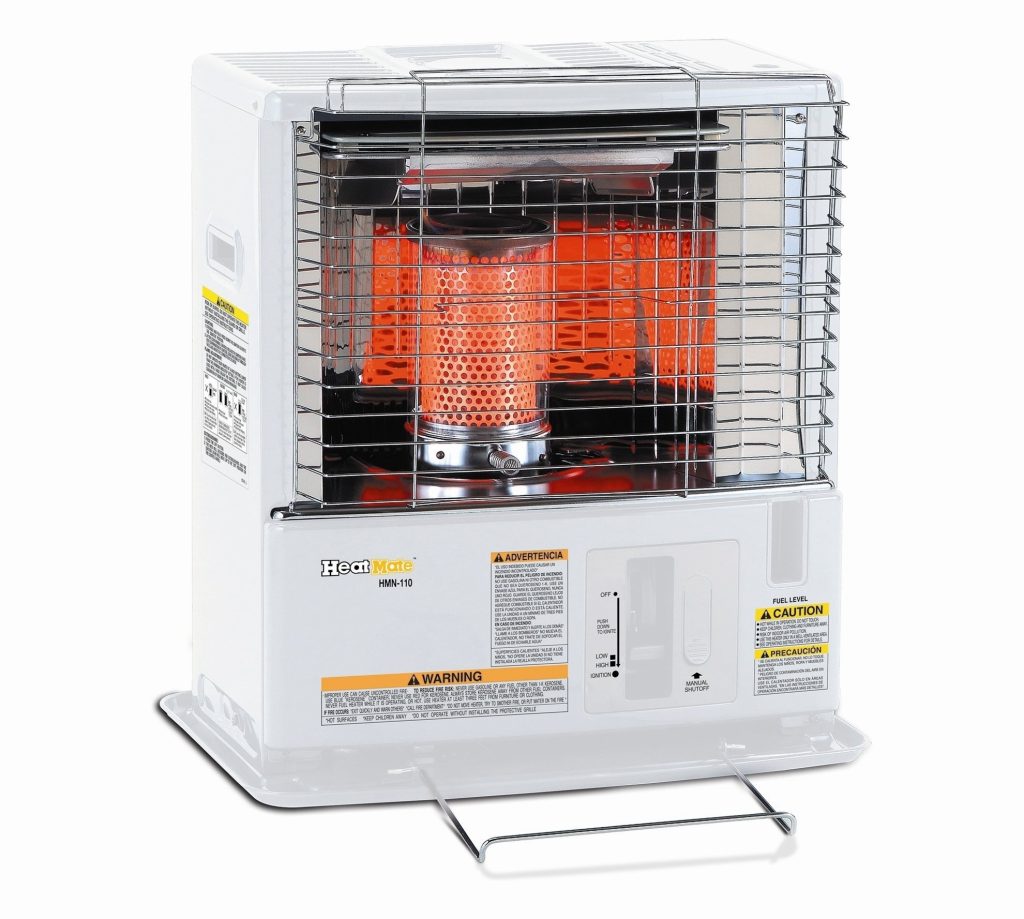
Plenty of people go looking for a mini kerosene heater, and the HeatMate HMN-110 is the one I’d point them to. It’s a 10,000 BTU radiant heater that stands under 20 inches tall, weighs about 20 pounds and runs about 14 hours on its 1.2 gallon lift-out tank.
Sengoku rates it for up to 380 square feet, and it comes with a siphon pump and the four C batteries for its igniter. It’s best for a small room, an office or a cabin, or as a second heater for the bedroom end of the house during the evening.
Key specs
- Heat output: 10,000 BTU per hour
- Type: radiant reflection
- Tank: 1.2 gallon removable cartridge
- Runtime (Sengoku): about 14 hours per tank, burning up to 0.08 gallons an hour
- Rated area: up to 380 sq ft
- Ignition: push-button, four C cells (included)
- Safety: automatic shutoff, tip-over switch, protective grilles, UL listed
- Size and weight: about 20 inches tall, about 20 lb
Pros and cons
Pros
- Long runtime for a small heater
- Light enough to carry from room to room
- Lift-out tank fills outside without moving the heater
Cons
- Directional heat, like any radiant heater
- Too small for an open first floor
- Needs four C cells to light
In real use
Small doesn’t change the rules. A 10,000 BTU heater in a 10 by 12 foot room with the door shut is short of the 2,000 cubic feet the manuals ask for, so that door stays open or the window gets cracked an inch. And a bedroom heater is for warming the room before bed, not for running while you sleep. Every manual here says to turn the heater off and make sure the flame is out before you go to bed.
At 0.08 gallons an hour, an eight hour day uses well under a gallon, so a single 5 gallon can covers a full week of evenings.
6. DuraHeat DH1051: Best Compact 360° Heater
Why I chose it and who it’s for
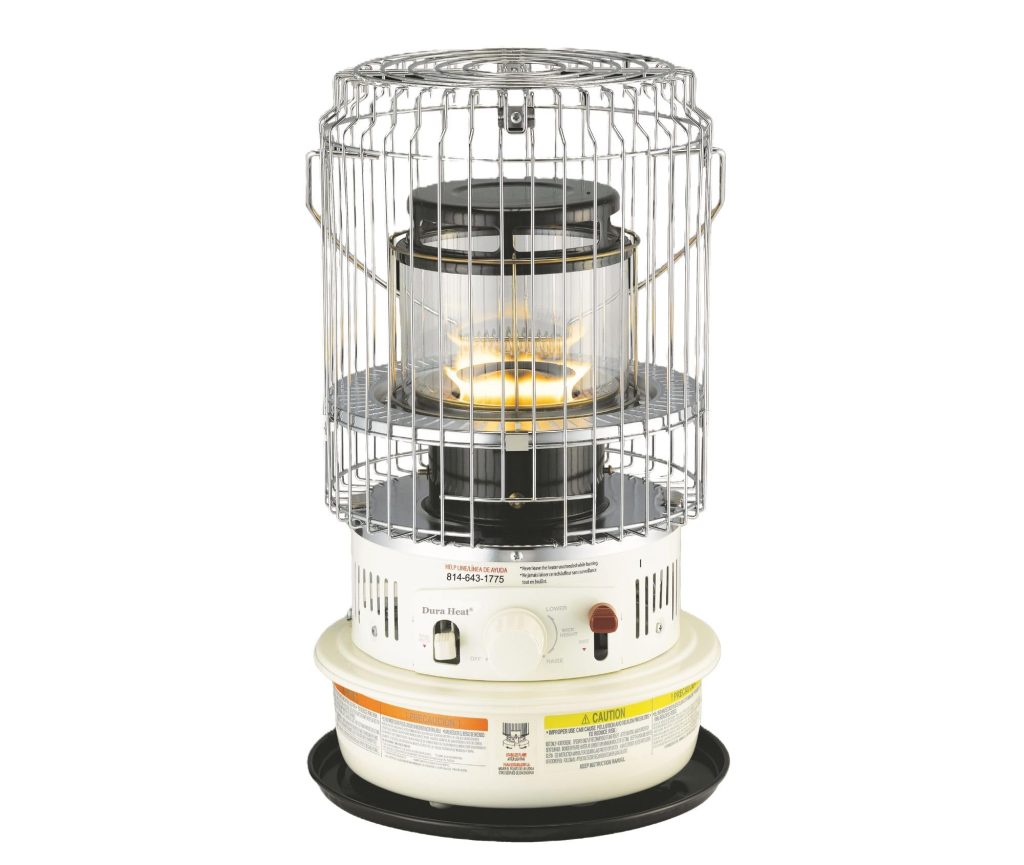
The DH1051 is a small round heater with what DuraHeat calls an omni radiant burner, so it gives off radiant heat all the way around and convection heat above. The result is a 10,500 BTU heater that warms a whole small room evenly instead of one side of it.
It holds 1.1 gallons, runs up to 15 hours per fill and is UL listed, and DuraHeat rates it at about 450 square feet. It’s best for small homes, cabins and corners of the house where a boxy radiant heater won’t fit.
Key specs
- Heat output: 10,500 BTU per hour
- Type: convection and radiant, 360 degree heat
- Tank: 1.1 gallons, built in
- Runtime (DuraHeat): up to 15 hours per tank
- Rated area: about 450 sq ft
- Ignition: push-to-start, two C cells
- Safety: automatic tip-over shutoff, UL listed
- Size and weight: about 21 inches tall, 13 inches across, about 19 lb
Pros and cons
Pros
- Even heat in every direction
- Small footprint for a cabin or small room
- Gives off useful light along with the heat
Cons
- Built-in tank goes outside with the whole heater to fill
- Retailers quote anywhere from 350 to 500 sq ft, so plan conservatively
- Small tank for a long day
In real use
Because it heats in a circle, put it in the middle of the space rather than against a wall, with 3 feet of clear floor all the way around. That makes it a better fit for a cabin or an open studio than a crowded living room. The glow from the burner is enough to see by in a dark room, though you’ll still want a real light for anything that matters.
Its fuel use sits right with the other small heaters, a bit under a gallon for an eight hour day.
Kerosene Outage Planner
Tell the planner where you live, how much space you want to keep warm and how long you’re planning for. It checks your state’s rules, works out the heater size, runs the fresh air check from the manuals and counts the kerosene and 5 gallon cans for the whole outage.
The heat need is an estimate: about 15 BTU per square foot when it’s above 30°F outside, 25 when it’s 10 to 30°F and 35 below that, adjusted for how drafty the house is and how high the ceilings are.
How Long Can You Run a Kerosene Heater Indoors?
As long as you’re awake, in the house and giving it fresh air. There’s no set number of hours in the manuals. What they all say is that a kerosene heater should never run unattended, never while you sleep and never while you’re out of the house. Turn it off before bed, check that the flame is completely out, and light it again in the morning.
A full tank lasts longer than most people stay up. The 23,000 BTU heaters here run about 9 to 12 hours on 1.9 gallons, and the small radiant ones about 13 to 15. So in practice you’ll fill once a day, outdoors, with the heater off and cooled down, and run it from breakfast until bedtime. Warm the bedrooms before you turn in, then let the quilts take over.
How Much Fresh Air a Kerosene Heater Needs
An indoor kerosene heater has no chimney, so everything it burns ends up in the room. The manuals for every heater here use the same rule: you need at least 200 cubic feet of room for every 1,000 BTU of heater output. Below that, keep the door to the next room open or open an outside window at least 1 inch. They also say never to run one in a bathroom or any small room with the door closed.
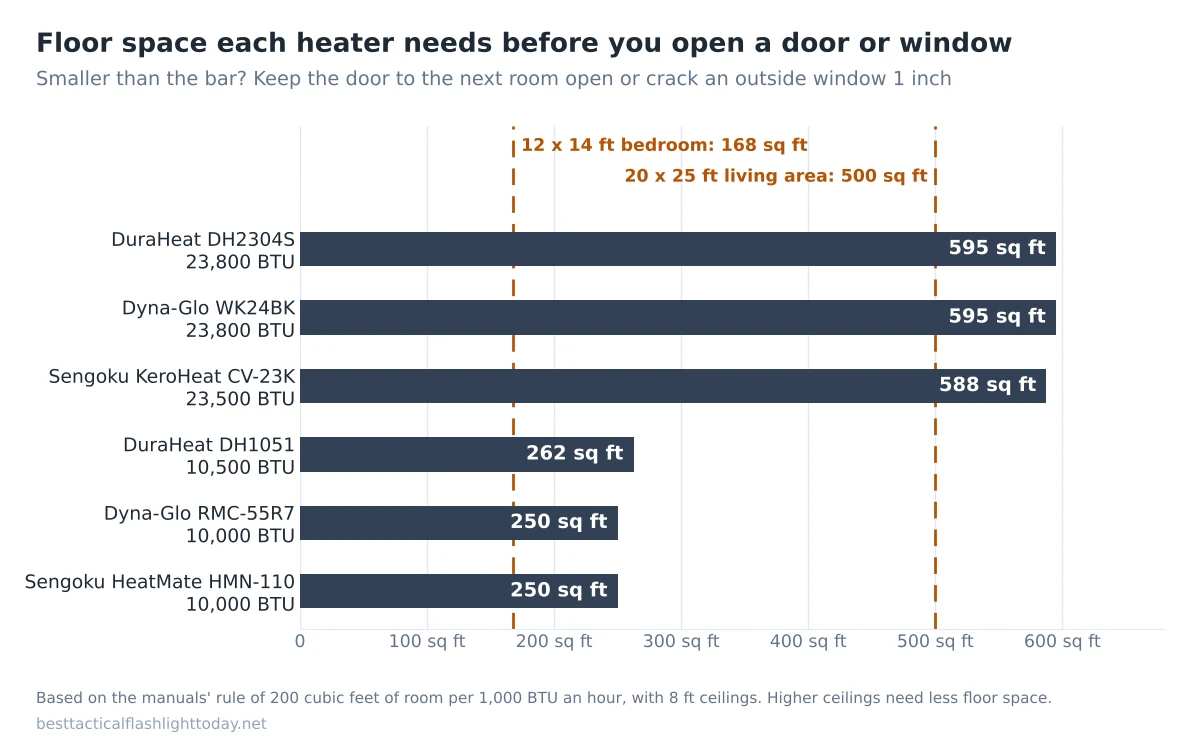
In a normal house, that works out to about 595 square feet for a 23,000 BTU heater and about 250 for a 10,000 BTU one, at 8 foot ceilings. A 12 by 14 foot bedroom is 168 square feet, so even the small heaters need the door open there. The CPSC’s kerosene heater safety sheet goes a step further for newer, tightly sealed homes and older ones that have been weatherized: open an outside window about an inch no matter the room size, because air doesn’t leak in on its own the way it does in a drafty farmhouse.
A heater that runs out of fresh air burns poorly and puts out more carbon monoxide, and none of the six here lists a low oxygen sensor in its specs the way propane Buddy heaters do. They rely on a tip-over shutoff and on you keeping the air moving. That’s why a battery-powered carbon monoxide detector belongs in the same room and another near the bedrooms, and why I’d buy one before I bought the heater.
Where Kerosene Heaters Are Banned or Restricted
Kerosene heaters are legal in most homes in most states, but not everywhere. Here are the places where the rules change the answer:
- Massachusetts: state law bars using or selling an unvented liquid-fired space heater, which covers portable kerosene heaters.
- California: the state bans the sale of unvented heaters designed for use inside a home, other than electric ones.
- New York: only approved, listed portable kerosene heaters may be used, and never in a building with three or more households. New York City prohibits them entirely.
- New Jersey: allowed only in one and two family homes, and some towns ban them outright.
- Delaware: approved heaters are allowed, but not in multi-unit residential buildings.
- Illinois: not allowed in the common areas of apartment buildings or in any building over three stories.
- Connecticut: an older state law bars certain kerosene space heaters in any building people live in, so check with your local fire marshal before you buy.
Outside those states, towns, landlords and insurance policies can still set their own rules, and many apartment leases ban fuel-burning heaters of any kind. The planner above flags the state rules for you. If yours is one of the states that says no, a certified indoor propane heater, a generator or a power station is the way to go.
Kerosene: Which Kind, How to Store It and How Much to Keep
Buy 1-K kerosene and nothing else. It’s the low-sulfur grade made for unvented heaters, and the lower grade, 2-K, gives off more pollutants and a rotten egg smell. Never put gasoline, diesel, camp fuel or paint thinner in a wick heater, even a splash. Dyna-Glo’s manual says the best place to buy it is pre-packaged in a blue container, with a dealer’s pump as second choice, because bulk tanks are more likely to have picked up water.
Store it in a blue 5 gallon kerosene can marked Kerosene, never a red one, since red means gasoline to everybody in the house. Keep it in a shed or detached garage, out of the sun and away from the living space. And don’t carry it over from one winter to the next. Every manual here warns that old kerosene doesn’t burn properly, which means smoke, smell and a ruined wick. Buy fresh at the start of the season and burn it up by spring.
For the amount, a gallon of kerosene holds about 135,000 BTU. The 23,000 BTU heaters burn up to 0.18 gallons an hour, so a day of eight hours takes about a gallon and a half, and three days takes about 4.3 gallons. The 10,000 BTU heaters burn about 0.08 gallons an hour, or a little over half a gallon a day. Kerosene prices vary a lot by town, and pre-packaged cans cost far more per gallon than a dealer’s pump, so the planner lets you put in your own price.
If you’re not sure how long to plan for, my power outages by state page shows how many hours a year customers in your state go without power.
Kerosene vs Propane Heaters for a Power Outage
Kerosene wins on heat and runtime. A 23,000 BTU kerosene heater runs most of a day on one fill, where a portable propane heater on a 1 pound cylinder runs a few hours, and kerosene heaters warm a much bigger space. The fuel is compact too: one 5 gallon can covers three long days.
Propane wins on cleanliness and simplicity. Propane keeps indefinitely in its tank, it doesn’t smell, there’s no wick to look after, and the indoor-certified Buddy heaters carry a low oxygen shutoff. For a small room in a tight house, or anywhere kerosene heaters aren’t allowed, I’d go with one of the heaters in my indoor propane heater guide instead. Plenty of families keep one of each.
What to Look for in an Indoor Kerosene Heater
Convection or radiant
A convection heater is round, warms the air all around it and spreads heat through open doorways, which makes it the right choice for an open floor plan. A radiant heater is boxy with a reflector behind the flame, throws heat forward and warms the people in front of it quickly. Pick convection for the house and radiant for one room.
Size it to the space, not the box
A 10,000 BTU heater suits one room up to about 400 square feet in ordinary cold. A 23,000 BTU heater handles an open first floor. Because a kerosene heater can’t be turned down much, buying too big means a stuffy room and a heater you keep switching off, while buying too small means it never catches up on a bitter night.
A lift-out tank or a built-in one
Every heater has to be filled outdoors. With a lift-out cartridge, like the Dyna-Glo RMC-55R7 and the HeatMate, you carry a small tank outside. With a built-in tank, the whole heater goes out the door, which is fine on a calm day and a nuisance in sleet. Either way, let it cool first.
Tip-over shutoff and a UL listing
All six here drop the wick automatically if they’re bumped or tipped, and that’s the minimum I’d accept. A UL listing matters too, and in New York and Delaware the law only allows approved, listed heaters.
Spare wick and batteries
A wick lasts a long time with clean fuel, but water or old kerosene can ruin it in one night, so keep the replacement wick your manual names on the shelf. Keep spare C or D cells for the igniter, a spare siphon pump and a long lighter, and you’re covered for the whole winter.
Leave the jobsite heaters in the garage
Forced-air kerosene heaters, the torpedo-shaped ones from DeWalt, Mr. Heater and others, are built for construction sites and well-ventilated shops. DeWalt’s manual says plainly that they’re not for home use. They’re fine for a garage with the door cracked, but they don’t belong in a living room or a bedroom.
For the rest of a cold weather plan, see the warmth section of my power outage emergency kit guide, or print the free Lights Out kit, which has a page on staying warm. A battery lantern gives you steady light without another open flame, and a rechargeable headlamp keeps both hands free when you’re refilling outside in the dark.
Frequently Asked Questions
How long can you run a kerosene heater indoors?
As long as you’re awake, at home and keeping the air fresh. The manuals don’t set an hour limit, but they all say never to leave a kerosene heater running unattended, while you’re out or while you sleep. A full tank lasts about 9 to 15 hours depending on the heater, so most people fill it once a day outdoors.
Can you sleep with a kerosene heater on?
No. Every manual here says to turn the heater off and make sure the flame is completely out before you go to bed. Warm the bedroom before you turn in, switch the heater off, and sleep under extra blankets.
Do you need to crack a window with a kerosene heater?
Often, yes. The manuals ask for 200 cubic feet of room per 1,000 BTU. Below that, keep the door to the next room open or open a window at least 1 inch. The CPSC also says to open a window about an inch in any newer or weatherized home.
What is the safest kerosene heater for indoor use?
The safest one is UL listed, has an automatic tip-over shutoff and is sized to your space so it gets the fresh air it needs. All six here meet those marks, and the Dyna-Glo WK24BK adds a cool-top design. Pair any of them with a battery CO alarm.
The Bottom Line
For most homes, the DuraHeat DH2304S is the kerosene heater to buy. It has enough heat for an open first floor and runs most of a day on one fill. The Sengoku KeroHeat CV-23K is the proven favorite with the same power, and the Dyna-Glo WK24BK adds a cool-top cabinet for homes with kids and pets.
To heat one room on less fuel, go with the Dyna-Glo RMC-55R7. The Sengoku HeatMate HMN-110 is the best small kerosene heater for a little room or a cabin, and the DuraHeat DH1051 spreads its heat in a full circle where space is tight.
Whichever you pick, check your state’s rules in the planner above, buy fresh 1-K kerosene in a blue can, keep a door open or a window cracked, put a battery CO alarm in the room, and turn the heater off before bed. Do that, and the next ice storm is a few cozy nights by the glow instead of a long cold week.
