
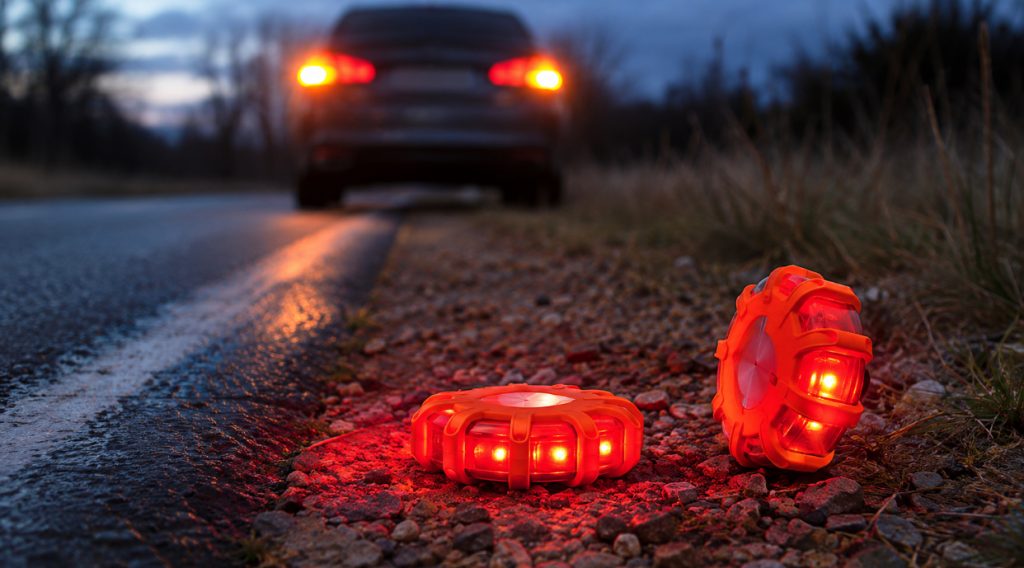
The tire lets go about a mile past the last gas station, and you ease onto a shoulder that’s barely wider than your mirrors. Hazards on. You get out, and the first pickup that comes around the bend passes close enough to rock the whole car on its springs. Those little orange blinkers on your taillights suddenly look awfully small, because they are. To a driver doing 60 with one eye on a phone, a parked car with its flashers on can look a lot like a slow car still rolling along.
That stretch of gravel is a dangerous place to stand. More than 2,100 people were killed outside disabled vehicles at the roadside from 2019 through 2023, and that count includes plenty of ordinary drivers who just stepped out to look at a flat. A road flare’s whole job is to reach the next driver a few hundred feet before your car does, so he’s already slowing and drifting over by the time he sees you. The old burning kind still works, and the newer LED discs do the same job for hours without setting the grass on fire.
Here’s what I’d keep in the trunk. The Ecoangel USB-C Rechargeable LED Road Flares are my pick for most people, since they charge off a USB-C cable and there’s no pack of AAA cells quietly dying in the spare tire well. If you want enough flares to cover a highway shoulder properly, the Tobfit six-pack does it for the least money. And a few Orion burning flares tucked in beside them cover the bright afternoons and foggy mornings when LED lights fade into the background. Below the reviews there’s a placement planner that shows exactly where each flare goes on your kind of road.
Quick Picks: The Best Road Flares in 2026
Road Flare Comparison Chart
1. Ecoangel USB-C Rechargeable LED Road Flares: Best Overall
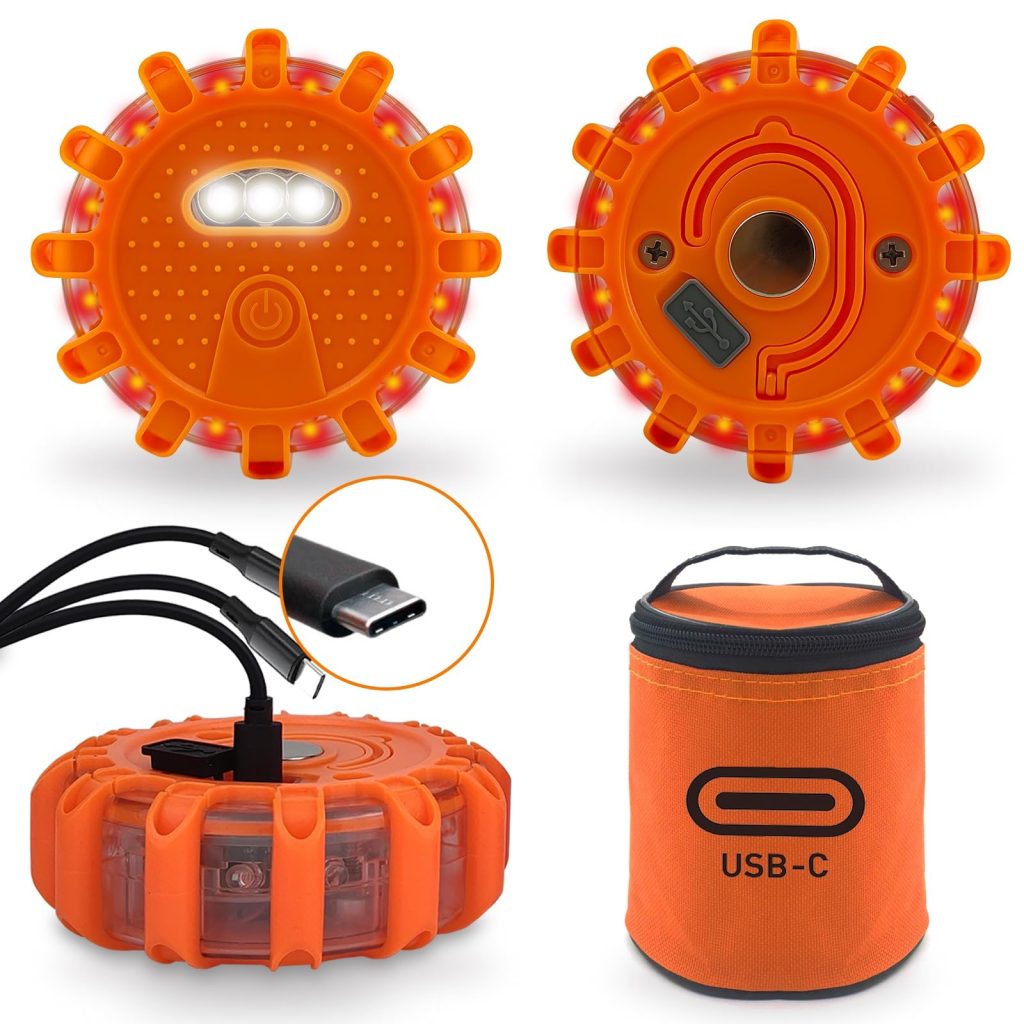
Why I chose it: These are the flares I’d hand most drivers, and the reason is wonderfully dull: nothing inside them goes bad in a glovebox. Each orange disc has its own 1,000mAh lithium-ion battery that charges over USB-C, and one three-way cable tops up all three at once from a car port or a wall charger. Ecoangel rates the battery to hold a charge in storage for over a year. They suit commuters, parents stocking a teenager’s car, and anyone who has ever opened an old flare kit to find crusty AAA cells.
Key specs
- Power: 1,000mAh lithium-ion battery in each flare
- Charging: USB-C, with a 3-in-1 cable that charges three flares together
- Modes: 9 flashing patterns including SOS, plus a white flashlight
- Mounting: magnetic base
- Build: waterproof and crushproof disc with a soft orange rubber edge
- Kit: 3 flares and a storage case (also sold as a 6-pack)
Pros
- No batteries to buy, swap or forget
- One cable charges the whole set
- Rubber edge won’t scratch paint when you stick one on the car
Cons
- You still have to remember to top them up
- The busiest flash patterns run down in a few hours
Performance analysis: Runtime depends a lot on which pattern you pick. The rotating and fast-strobe modes eat the battery and can run down in four or five hours, while a simple single flash keeps going well past ten. For a wait on the shoulder that’s plenty, but it’s worth knowing which button press gives you the long-running blink before you need it. Charge them every time the clocks change, which is also when the evening drive home suddenly turns dark (I dug into that on the dark commute page). Set two on the road and stick the third on the trunk lid with the magnet, and a driver coming up behind you sees a car that’s clearly in trouble.
2. Tobfit 6 Pack LED Road Flares: Best Budget
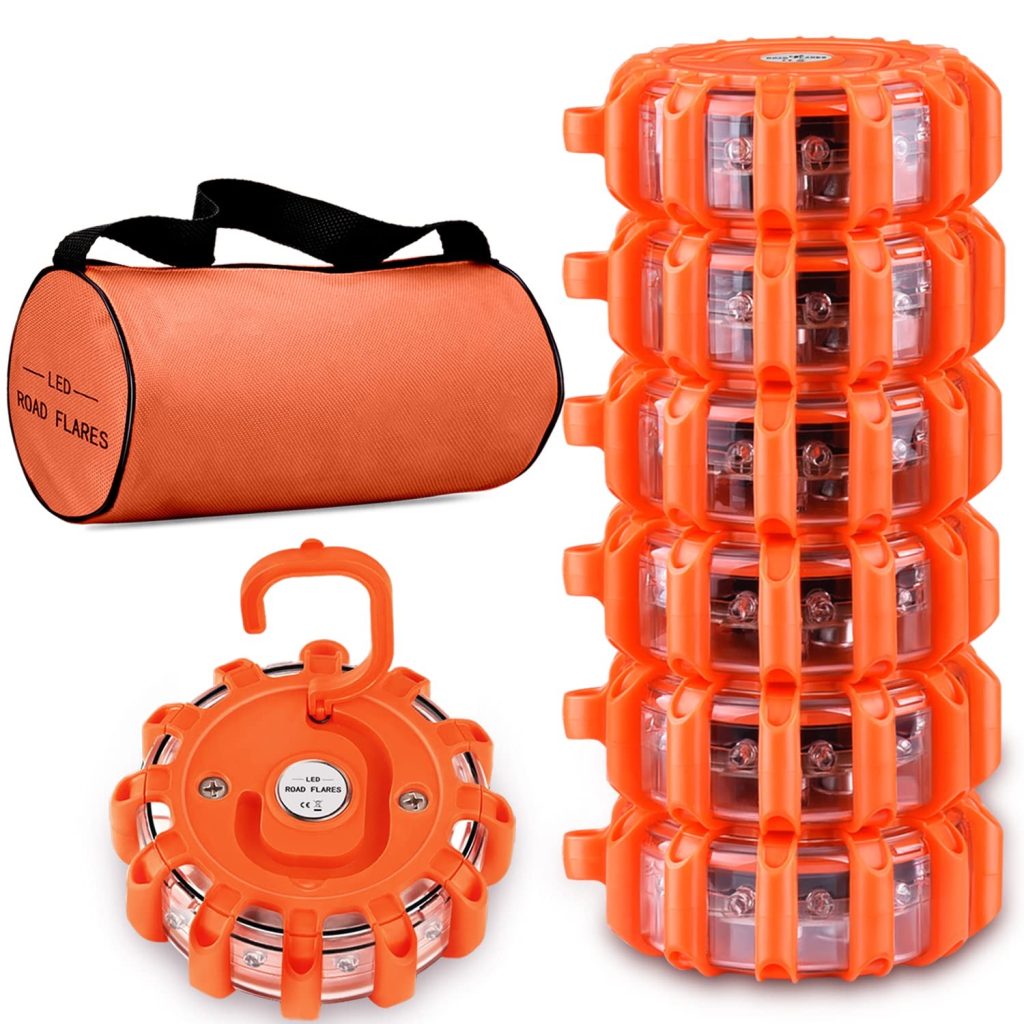
Why I chose it: Most kits stop at three flares, which is exactly the number a highway shoulder needs and leaves you nothing for a bend in the road or a second car. Tobfit puts six in one bag for about what plenty of brands charge for three. Each one is a tough orange disc with a strong magnet, a fold-out hook and nine light patterns. It’s the pick for tight budgets, two-car households and anyone who drives winding back roads where a fourth and fifth flare earn their keep.
Key specs
- Flares: 6
- Power: 3 AAA batteries each (not included)
- Modes: 9 patterns including SOS, plus a white flashlight on a double press
- Build: IP67 waterproof, crushproof ABS shell
- Mounting: neodymium magnet and a fold-out hook
- Kit: zippered storage bag with room for spare batteries
Pros
- Lowest cost per flare here
- Enough to split three and three between two cars
- Strong magnet holds on a fender or tailgate
Cons
- Batteries aren’t included
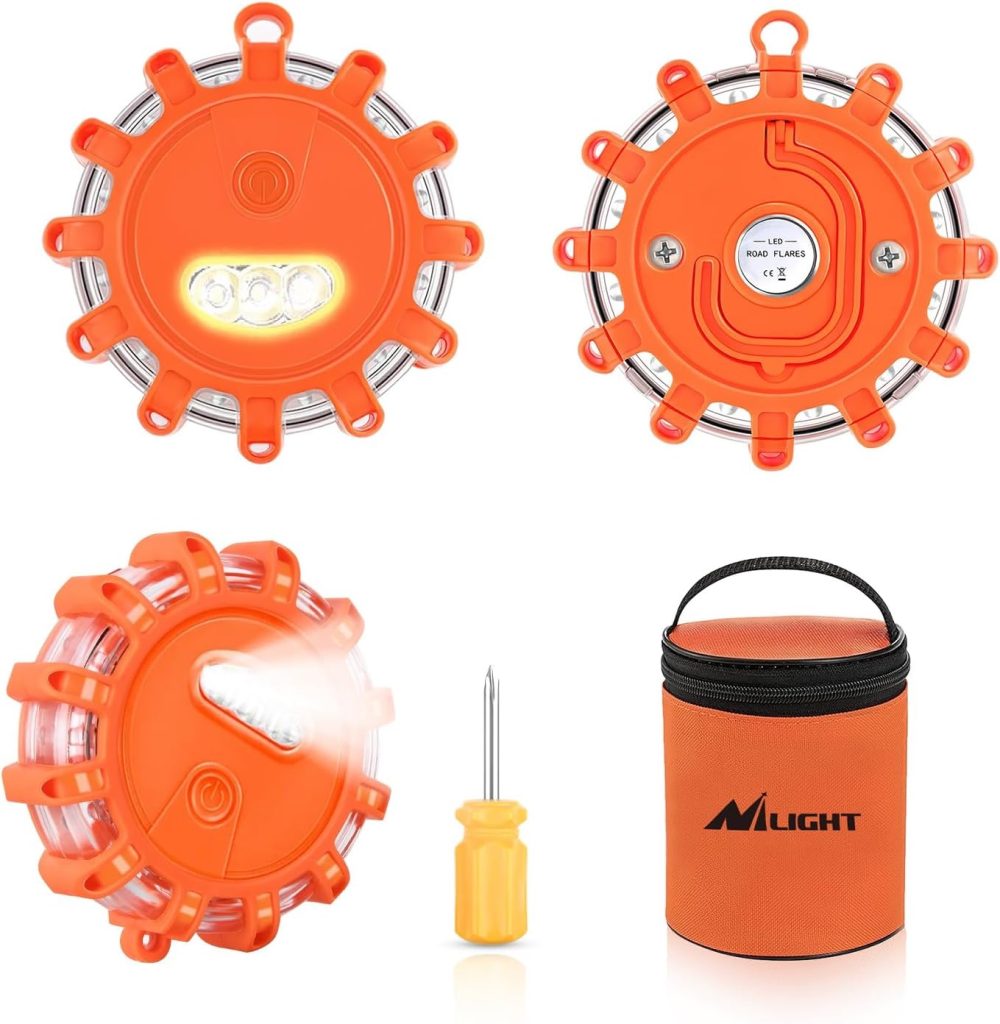
- Two small screws hold the battery door, so keep a screwdriver in the bag
Performance analysis: Spend part of the money you saved on lithium AAA batteries. Alkaline cells are what most people grab, and they’re a poor match for a car that bakes in July and freezes in January, as the chart further down shows. Lithium cells handle both ends and are far less likely to leak inside a flare you won’t touch for two years. Load them once, test every flare in the driveway, and the six of them will be ready to go when you’re the one on the shoulder at midnight.
3. Marcala LED Road Flares 3-Pack: Best Ready-to-Go Kit
Why I chose it: Marcala sends its flares with the batteries already installed and a spare set waiting in the case, so the kit is ready the minute it comes out of the box. Each flare has 15 LEDs and nine patterns, it’s IP67 waterproof and it floats. The case also holds a whistle, a seatbelt cutter and a tiny screwdriver for the battery doors. Marcala is a small family-owned American company and backs the flares with a lifetime warranty. It’s the kit I’d wrap up for a new driver.
Key specs
- Flares: 3, with 15 LEDs each
- Power: 3 AAA each, 9 installed plus 3 spares
- Modes: 9 flashing and steady patterns
- Build: IP67 waterproof, floats
- Extras: whistle, seatbelt cutter, mini screwdriver, carry case
- Warranty: lifetime
Pros
- Works straight out of the box
- Spare batteries already in the case
- Lifetime warranty
Cons
- Ships with alkaline batteries
- Only three flares
Performance analysis: Marcala calls these DOT compliant, and that label means less than it sounds like for a passenger car, which I explain in the DOT section below. The flares themselves are bright and well sealed. The one change I’d make before they ride around for years is to swap the included alkaline cells for lithium ones, then keep the alkalines in the house for the TV remote. Three flares cover a standard two-lane road or a divided highway. If you live where the roads curve through hills, add one or two more from another kit.
4. Scosche ScoFlare LED Road Flares: Best Known Brand
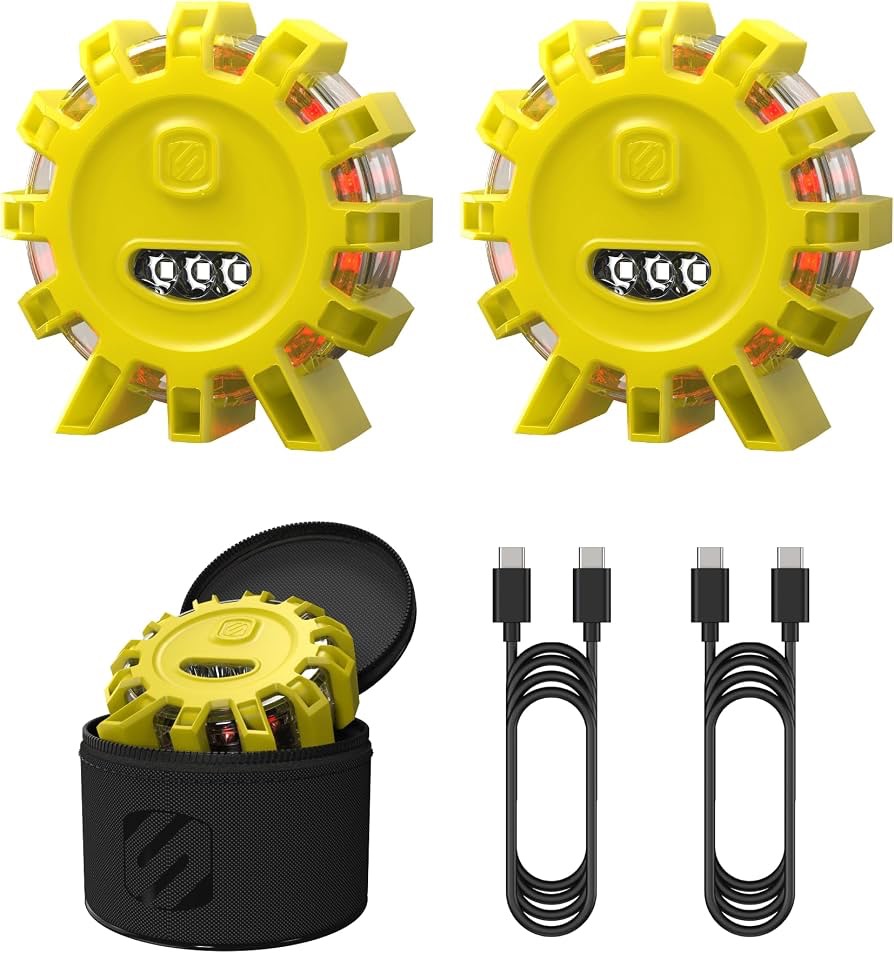
Why I chose it: Scosche is the car-accessory company behind a lot of the phone mounts and chargers already in your dashboard, and the ScoFlare is its take on a rechargeable road flare. Each one has 12 red LEDs around the edge with slow, fast and rotating flash, a steady mode and SOS, plus 3 white LEDs that work as a flashlight. A magnet, a folding hook and built-in feet let it stick, hang or stand on its own. Two USB-C cables and a storage case come in the box. It suits small cars and drivers who’d rather buy a name they recognize.
Key specs
- Flares: 2
- Power: rechargeable lithium-ion battery, USB-C
- Modes: red slow, fast and rotating flash, steady red, SOS and a 3-LED white flashlight
- Mounting: magnet, folding hook and built-in feet
- Kit: 2 USB-C to USB-C cables and a storage case
Pros
- Stands upright on its own feet
- Each flare gets its own charging cable
- Small enough for a glovebox or door pocket
Cons
- Only two flares, and most roads call for three
- Fewer flash patterns than the disc flares
Performance analysis: Two flares is the catch. On a two-lane road you want one close behind the car, one 100 feet back and one 100 feet in front for traffic coming the other way, so a pair leaves a gap. Use the ScoFlares for the two spots behind you and add a single burning flare or a reflective triangle for the third. The feet are a nice touch on a gravel shoulder, where a flat disc can sink between stones and lose some of its glow.
5. Twinkle Star Emergency Roadside Flares Kit: Best Upright Flares
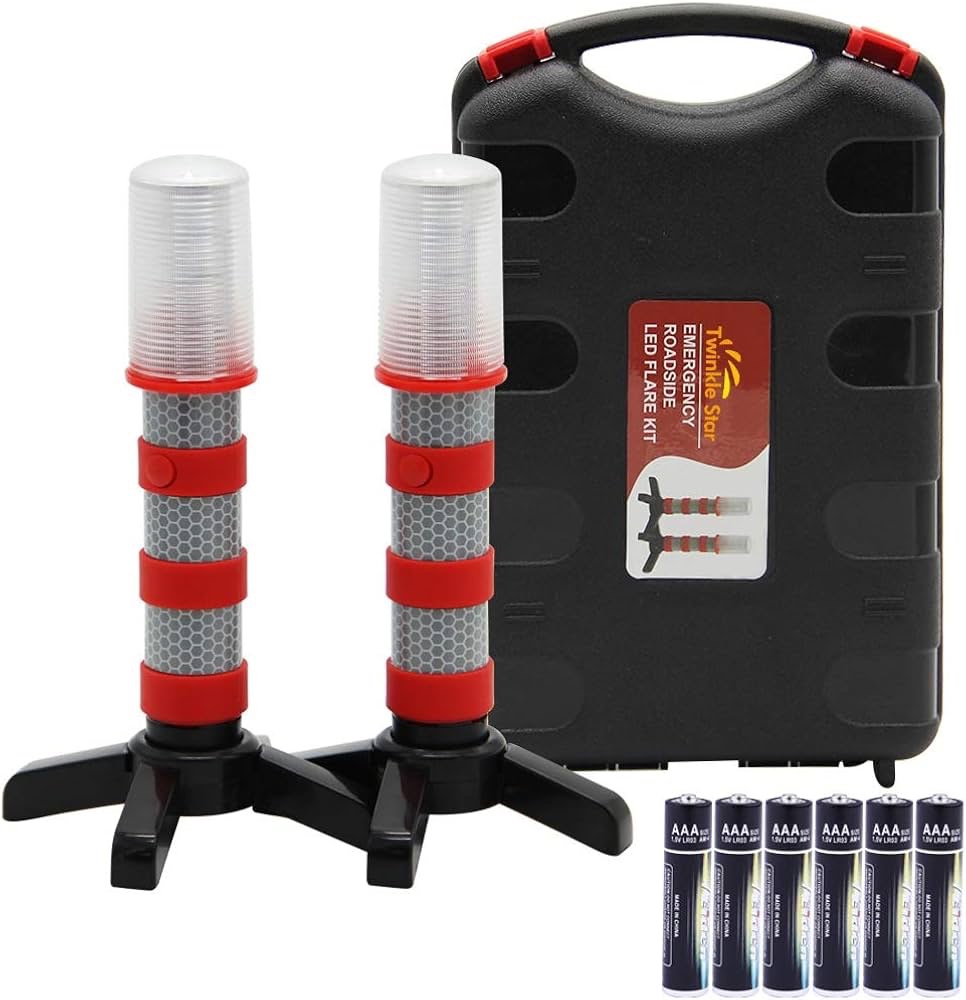
Why I chose it: Disc flares lie flat on the road, and in slush or on a rutted gravel shoulder that puts the light down where it gets buried. Twinkle Star’s flares stand about 7 inches tall on detachable stands, which lifts the red LEDs above the mess. You get four of them in two hard cases, with a strobe mode that flashes SOS, a steady mode and a flashlight. They’re best for snow country, dirt roads and anyone who wants their warning to show over a snowbank.
Key specs
- Flares: 4, about 7 inches tall
- Power: 3 AAA each (12 total)
- Modes: strobe (SOS), steady red and a flashlight
- Mounting: detachable stand and a magnetic base
- Kit: two hard storage cases
Pros
- Height keeps the light above slush and gravel
- Four flares cover a two-lane road with one to spare
- Hard cases survive the bottom of a cluttered trunk
Cons
- Needs 12 AAA cells
- Only three light modes
Performance analysis: Height matters more than most people expect. A flare lying in two inches of slush loses most of its light to the snow around it, while one standing up on a stand shows its full face to traffic. Stick one on the bumper with the magnet and stand the other three down the shoulder. Load them with lithium AAA batteries, because snow country is exactly where alkaline cells give up.
6. Orion 30-Minute Highway Flare Kit: Best Classic Flare
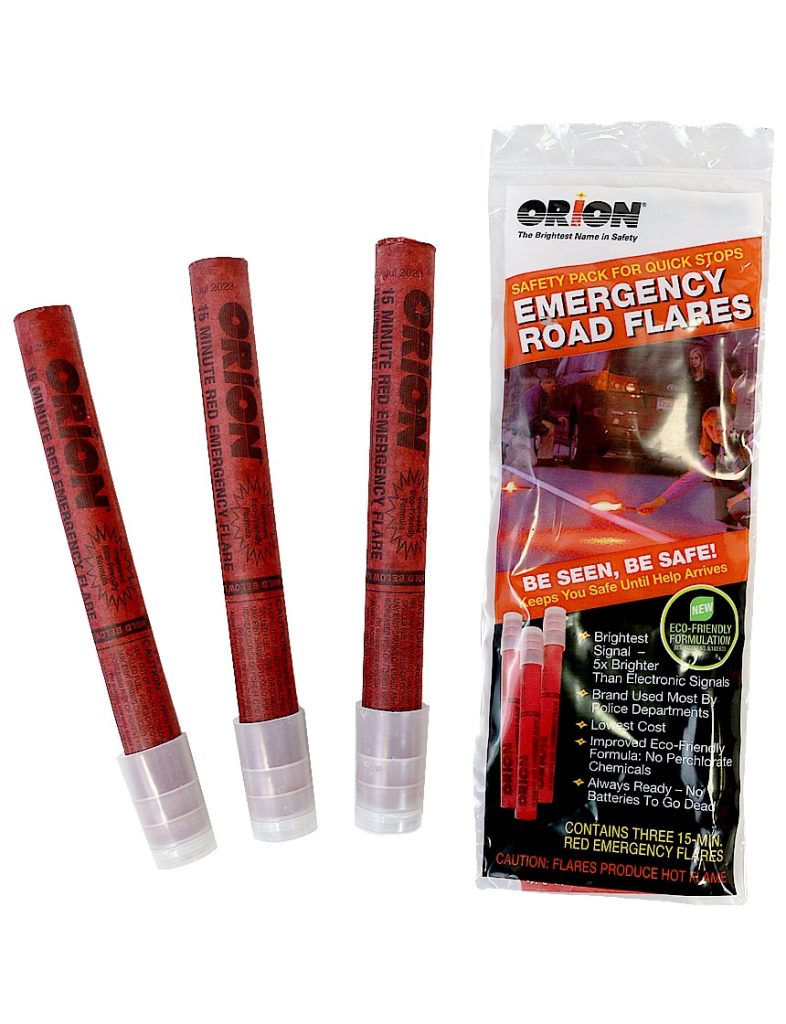
Why I chose it: This is the real thing: six burning road flares, the same red fusees you’ve seen at every crash scene since you were a kid. Each one burns for 30 minutes, which is the length the federal truck rules call for, and the kit comes with an orange safety vest in a polyester bag whose hook-and-loop back grabs the trunk carpet. Orion makes them in the USA. I’d keep this kit next to a set of LED flares for the bright afternoons and thick fog when a live flame beats any LED.
Key specs
- Flares: 6, about 15.5 inches long
- Burn time: 30 minutes each
- Power: self-contained, no batteries
- Extras: orange safety vest
- Bag: polyester with hook-and-loop backing
- Recommended storage: 40°F to 90°F
Pros
- A flame shows up in sun, fog and snow
- No batteries to go dead
- Vest included
Cons
- A fire hazard near leaking fuel or dry grass
- Can’t be switched off once lit, and each one is used up
- The storage range is narrower than what a car goes through
Performance analysis: To light one, pull off the plastic cap, strike the end against the rough top of the cap like a big match, and hold it pointed away from your face and body until it catches. Set it down on bare pavement, never on dry grass or near a puddle of fuel, and never hold it once it’s going. Thirty minutes is a good stretch, and six flares give you three spots lit for an hour if you light the second set as the first burns out. Keep the bag dry and look the flares over once a year. Any with swollen or damp paper go in the trash.
Where to Put Road Flares Behind Your Car
Most people drop one flare right behind the bumper and call it done, which buys a driver at highway speed almost no warning, since a car at 60 mph covers 88 feet every second. The spacing that works comes from the federal rule for stopped trucks and buses: one flare close behind the car on the traffic side, one about 100 feet back, and a third either 100 feet in front of the car on a two-lane road or 200 feet back on a divided highway. If a hill crest or a curve hides you, the warning goes past it, anywhere out to 500 feet. Pick your road below and the planner lays it out, step by step, with the number of paces to walk.
LED Road Flares vs Burning Flares vs Triangles
LED flares are what most people should carry. They run for hours, they can’t start a fire, you can pick them back up when you leave, and a rechargeable set never needs a battery run. Their weak spot is bright sun. On a clear afternoon a little red disc on gray pavement is hard to pick out from far away.
Burning flares are the opposite. A fusee is bright, flickering and impossible to mistake for anything else, day or night, fog or snow. It also burns hot enough to start a grass fire, it can’t be turned off, and it’s gone in 30 minutes. Never light one near leaking fuel, and think twice on a dry summer shoulder.
Reflective triangles need no power at all and show up well in daylight, but they only shine when headlights hit them, so they do little on a dark road until a car is already close. The federal truck rules accept triangles or fusees and treat everything else as an extra. For a car, my answer is a set of LED flares as the main kit, plus either a few burning flares or a set of triangles for daytime, and a reflective vest for whoever walks back to set them.
Keeping Road Flares Ready in a Hot or Frozen Car
A road flare spends years in the trunk and maybe twenty minutes doing its job, so how it handles storage matters more than how bright it is on day one. A car parked in the summer sun is far hotter inside than most people guess, and in the northern states it sits below zero for whole nights in January. Here’s how the common power sources compare.
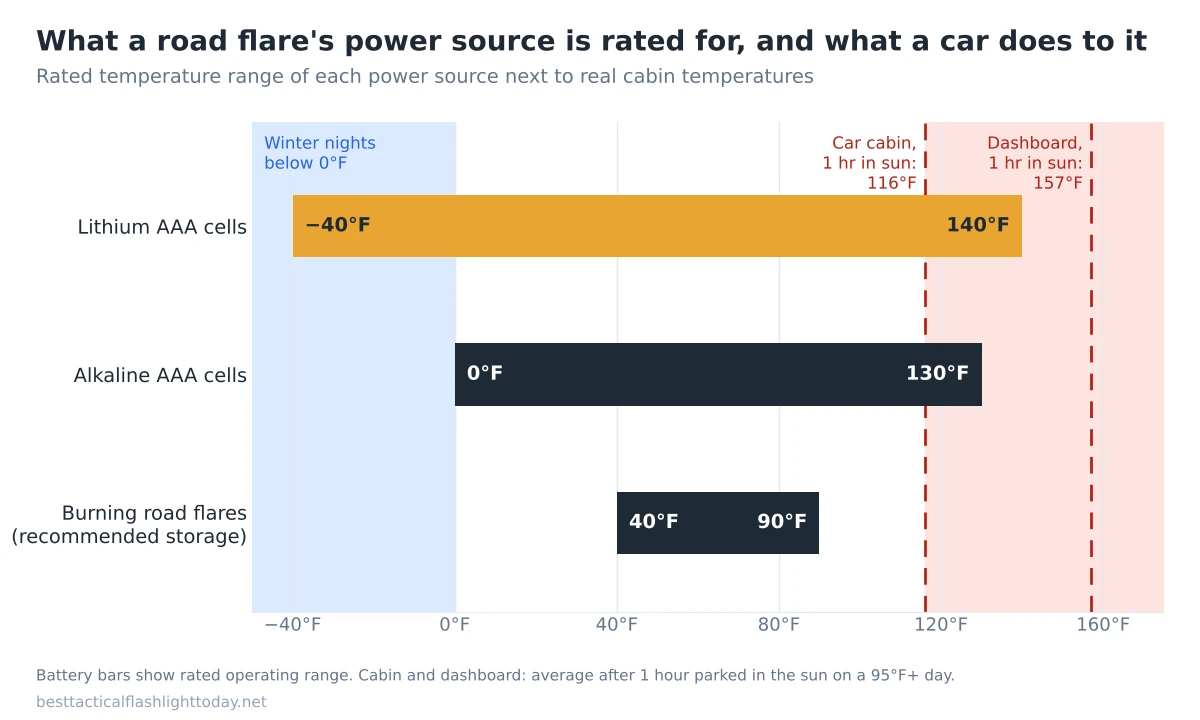
Standard alkaline AAA cells are rated to work only up to 130°F, and a closed car in the sun runs a cabin around 116°F within an hour, with the dashboard near 157°F. Those cells also lose much of their punch below freezing and are the ones that leak and crust over. Lithium AAA cells cover 40 below zero to 140°F, which is why I put them in every battery flare I recommend.
Rechargeable flares like the Ecoangel and Scosche treat the car about the way your phone does. A cold trunk won’t hurt them in storage, but let a frozen set warm up indoors before you charge it, and keep them off the dash and rear shelf in summer. Burning flares want it cool and dry: Orion recommends storing them between 40°F and 90°F, so a sealed bag in the trunk, away from the sun-baked rear window, is the best a car can offer. Whatever you carry, check it twice a year with the rest of your car emergency kit.
What “DOT Compliant” Means on Road Flares
Plenty of LED flares are sold as DOT compliant or DOT approved. The rules people have in mind are the federal ones for commercial trucks and buses. Those rules list exactly two kinds of warning devices a truck has to carry: three reflective triangles, or at least six burning flares rated to burn 30 minutes. Other warning lights are allowed in addition to those, never in place of them. So no LED disc on its own meets the truck rule, whatever the box says.
Those federal rules don’t apply to a passenger car, and no federal rule requires a private car to carry warning devices at all. That doesn’t make the placement advice any less useful, since the spacing in the planner above works just as well behind a sedan. So judge LED flares on how bright and tough they are, and ignore the label. If you drive a commercial truck, carry the triangles or burning flares the rules call for, and treat LED flares as a welcome extra.
What to Look for in Road Flares
Rechargeable or AAA batteries
Rechargeable flares never need a battery run and won’t leak, but they have to be topped up every few months. AAA flares can sit for years on a set of lithium cells and you can swap in fresh ones on the roadside, but they use a lot of batteries. If you’re good about charging your phone, go rechargeable. If you’d rather forget about them until the day you need them, buy AAA flares and lithium cells.
At least three flares
Three is the minimum for any road outside town, because you need one close behind the car, one well back and one either in front or farther back again. Five or six gives you spares for hills, curves and fog. A two-pack is a good start, as long as you add a third flare of some kind.
A magnet, a hook or a stand
A magnet lets you stick a flare on the car itself, which marks the vehicle and keeps one light up high where it’s easy to see. A hook lets you hang one from a guardrail or an open hood. A stand lifts the light out of slush and gravel. The best kits give you at least two of the three.
Waterproof and crushproof
Flares get used in the worst weather, and sooner or later one gets run over. Look for an IP67 rating, which means the flare is sealed against dust and survives a dunk in water, and a crushproof shell. A flare that floats is handy if you boat as well.
The modes you’ll really use
Nine flash patterns sound impressive, but on the roadside you’ll use two: a bright flash for the flares out on the road, and the white flashlight for finding the jack. Learn which button presses get you there in your driveway, not on a dark shoulder. A long-running single flash is the one to pick when you don’t know how long you’ll be waiting.
Light for your own hands
Flares warn traffic, but they won’t light up the lug nuts. Keep a good car flashlight or a rechargeable headlamp with them so both hands stay free, and a portable jump starter and tire inflator so a dead battery or a soft tire turns into a short stop instead of a long wait.
Road Flares FAQ
How many road flares should you keep in your car?
At least three, which covers a two-lane road or a divided highway. Five or six is better if you drive hilly or winding roads, live where fog and snow are common, or want to split a kit between two cars. Add a couple of burning flares or reflective triangles for bright daylight.
How far behind your car should you put road flares?
Put one about 10 feet behind the car on the traffic side and one about 100 feet back. On a two-lane road the third goes 100 feet in front of the car for oncoming traffic, and on a divided highway it goes 200 feet back. If a hill or curve hides your car, put a flare on the far side of it, up to 500 feet away. A normal walking pace is about 2.5 feet, so 100 feet is roughly 40 paces.
Are LED road flares as good as real flares?
At night, yes, and they’re safer and last for hours instead of 30 minutes. In bright sun and thick fog a burning flare is easier to see, so the best setup is LED flares as your main kit with a few burning flares or reflective triangles as backup.
How long do road flares last?
A burning flare like Orion’s lasts 30 minutes once lit, and an unlit one keeps for years if it stays dry, so replace any with swollen or damp paper. An LED flare runs anywhere from a few hours to well over a day depending on the battery and the flash pattern, and the flare itself lasts for years.
The Bottom Line
For most drivers, the Ecoangel USB-C Rechargeable LED Road Flares are the flares to buy. They’re bright, tough and rechargeable, so nothing inside them dies in the trunk. The Tobfit 6 Pack LED Road Flares covers every spot on a highway shoulder for the least money, the Marcala LED Road Flares 3-Pack is the easiest gift for a new driver, and the Scosche ScoFlare LED Road Flares is a tidy rechargeable pair for a small car. In snow country the Twinkle Star Emergency Roadside Flares Kit stands above the slush, and the Orion 30-Minute Highway Flare Kit is the backup I’d keep beside any LED set for daylight and fog.
Whichever you pick, run your usual roads through the planner above so you know how far to walk before you ever need to, put lithium cells in anything that takes AAAs, and keep a good flashlight in the same bag. The next time a tire lets go on a dark shoulder, you’ll have the warning set out down the road in a couple of minutes and be standing well clear of traffic.
