
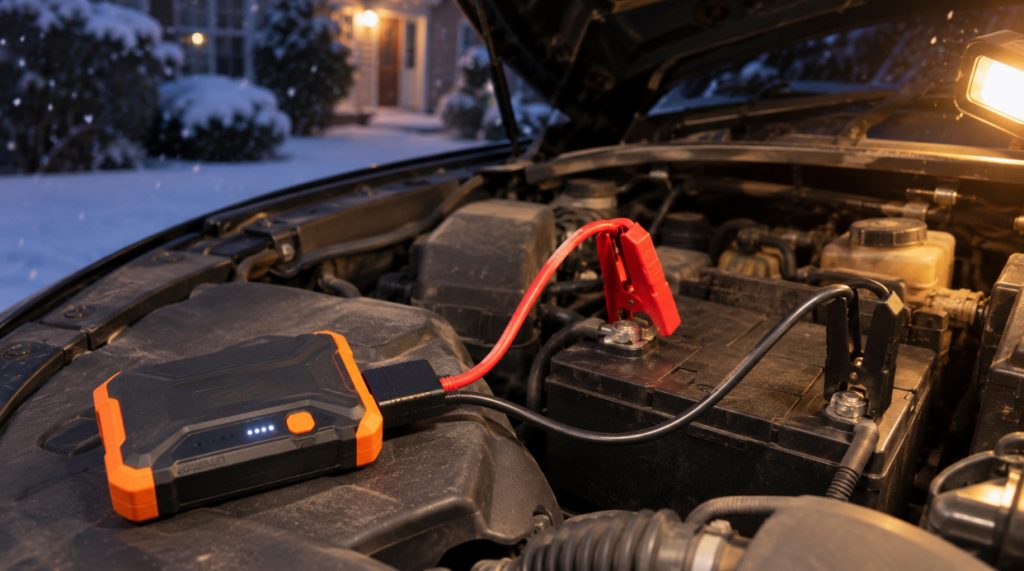
A dead battery picks the worst morning to quit. It’s 6 a.m. and 4°F, you’re already running late, and the car answers the key with one sad click. The only other car on the street belongs to a neighbor who’s still asleep, and knocking on his door in your pajamas to ask for a jump is a conversation nobody wants to start. Down South it tends to happen in August instead, after a summer of heat has worn the battery out from the inside.
A portable jump starter gets you moving without a second car or a set of cables. The good ones are about the size of a paperback and clamp on in under a minute, so you’re on the road before your neighbor’s alarm goes off. Most will charge your phone while the engine warms up, too.
The boxes don’t make the choice easy. Peak amp numbers have turned into a contest, and the specs that decide whether a pack starts your car on a bad day sit in the fine print: the engine size it’s rated for and the temperatures it’s built to work in. I’ve picked seven jump starters for real cars and real weather, from a glovebox pack for a compact sedan to a 4,000 amp unit that warms its own battery at -40°F. There’s also a checker below that tells you what your engine needs on your coldest morning.
Quick Picks: The Best Portable Jump Starters in 2026
Portable Jump Starter Comparison Chart
Will It Start? Check Your Engine and Your Weather
Pick your engine, your coldest morning and where the pack will live. The checker works out how much rating you need once the cold has taken its share, shows which packs on this list clear it, and tells you which ones would be sitting outside their temperature range in your car.
1. NOCO Boost X GBX45: Best Overall
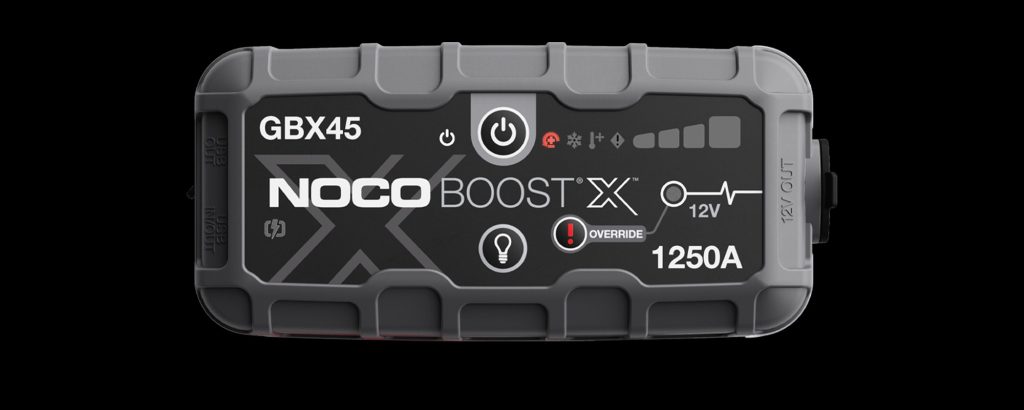
Why I chose it: The GBX45 is the jump starter I’d put in most cars without thinking twice. It’s rated for gas engines up to 6.5 liters and diesels up to 4.0, which covers nearly every sedan, crossover and midsize SUV on the road, and it’s small enough to live in the glovebox. NOCO’s clamps won’t send power until they’re on the battery the right way round, so a nervous first-timer can’t make a spark. It’s best for commuters and families with one or two everyday cars.
Key specs
- Peak current: 1,250 amps
- Engine rating: 6.5L gas, 4.0L diesel
- Battery: 31 Wh lithium
- Works from -4°F to 122°F, charges from 32°F to 104°F
- Charging: 60W USB-C in and out, full in about 48 minutes on a 60W charger
- Build: IP65, 100 lumen light with SOS and strobe, 2.16 lb with clamps
Pros
- Spark-proof clamps with reverse polarity protection
- Fast USB-C recharge, and the same port charges a phone or laptop
- IP65 housing handles rain and snow at the roadside
Cons
- The 100 lumen light is dim next to the GBX75’s
- About a foot of clamp cable, so the pack sits on top of the engine while you work
Performance analysis: NOCO rates its packs by engine size instead of leading with a giant peak number, and that’s the number to trust. A manual override lets you push power into a battery too flat for the pack to detect, which is what you face after a car sits through a cold week. One habit to build: bring it inside to charge, because NOCO’s charging range starts at 32°F. If you drive a V8 truck or your mornings drop below zero, step up to the GBX75 or the GOOLOO GT4000.
2. NOCO Boost X GBX75: Best for Trucks and Big V8s
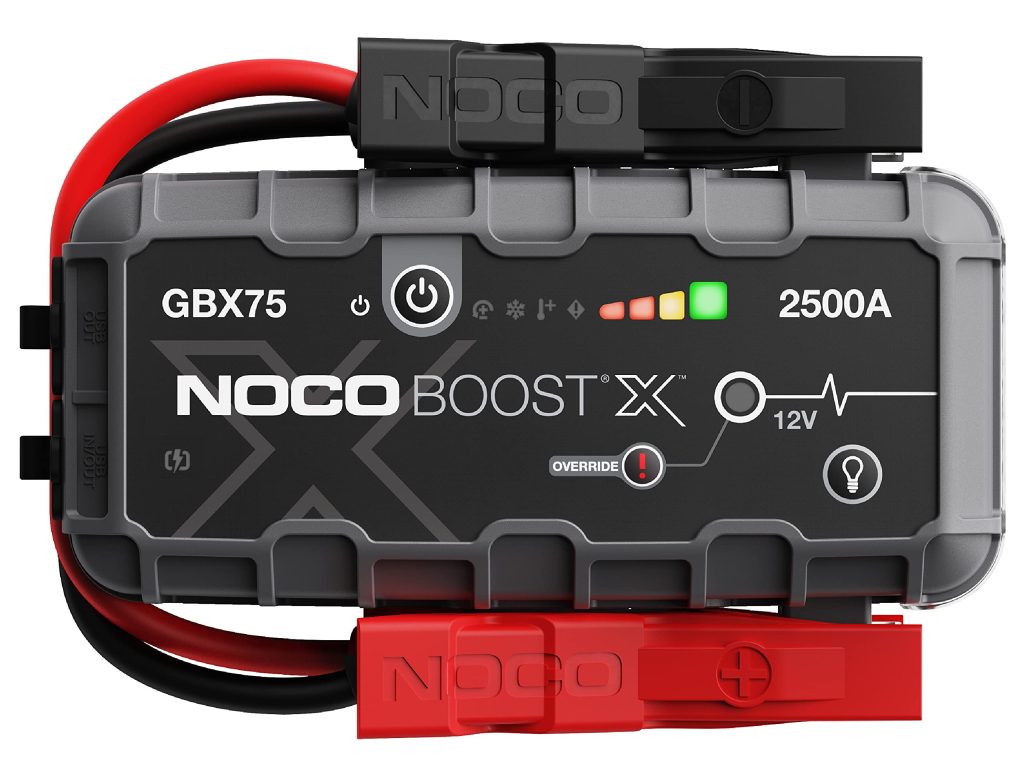
Why I chose it: When the engine gets big, this is the NOCO I’d buy. The GBX75 is rated for gas engines up to 8.5 liters and diesels up to 6.5, enough for a half-ton or three-quarter-ton pickup, a full-size SUV or a V8 that’s been sitting. It has the same protected clamps and USB-C charging as the GBX45 with more than twice the battery. It’s best for truck owners, people who tow, and anyone who wants one pack that starts every vehicle in the driveway.
Key specs
- Peak current: 2,500 amps
- Engine rating: 8.5L gas, 6.5L diesel
- Battery: 74 Wh lithium
- Works from -4°F to 122°F, charges from 32°F to 104°F
- Charging: 60W USB-C in and out, plus USB-A
- Build: IP65, 400 lumen light with six modes, 3.77 lb, 8.4 x 5.4 x 2.5 in
Pros
- Covers nearly every gas pickup and most diesel trucks
- The 400 lumen light is bright enough to work by
- The bigger battery gives you more tries on a stubborn engine
Cons
- At almost 4 lb it won’t fit most gloveboxes
- The same -4°F floor as the smaller NOCOs
Performance analysis: The extra capacity earns its keep on the second and third try. A cold V8 on thick oil can take a few long cranks, and a small pack can run out of punch before the engine catches. The light matters more than it sounds, too, because battery terminals on newer trucks hide under covers you’ll be hunting for in the dark. Keep this one behind the seat or in a door pocket.
3. GOOLOO GT4000: Best for Brutal Cold
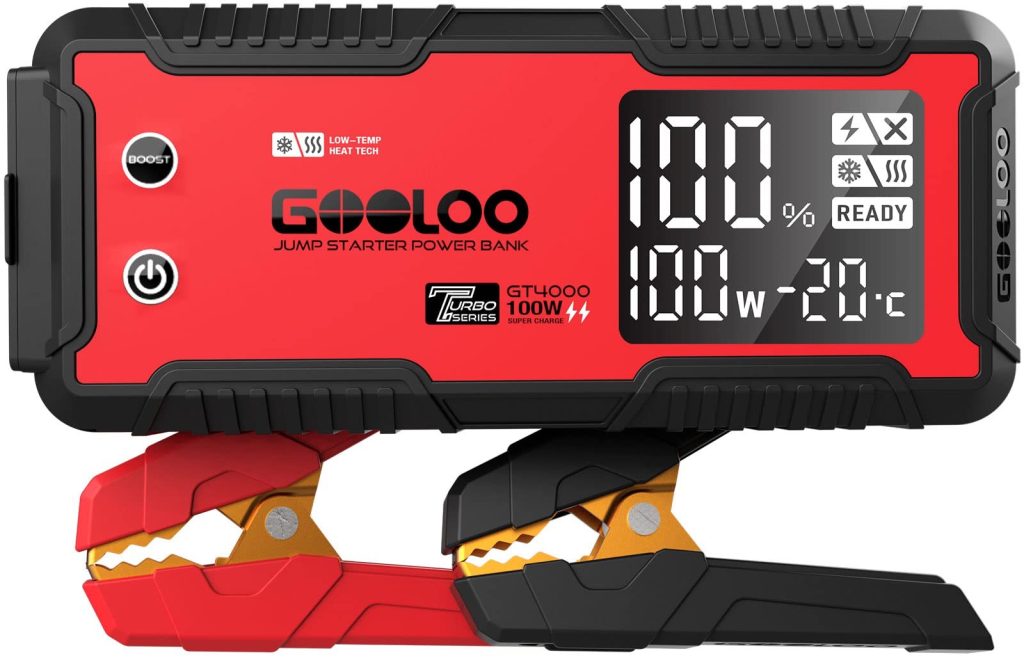
Why I chose it: Most lithium packs stop working around -4°F, which is right when northern drivers need them. The GT4000 gets around that with a built-in battery heater. Clamp it on in deep cold and it warms its own cells, reaching starting temperature within 100 seconds according to Gooloo, then delivers the jump. It’s rated for gas engines up to 12 liters and diesels up to 10. It’s best for anyone in the northern Plains, the Rockies, the upper Midwest or Alaska whose car sits outside all winter.
Key specs
- Current: 4,000 peak amps, 800 amps starting current
- Engine rating: 12.0L gas, 10.0L diesel
- Works from -40°F (with pre-heating) to 140°F
- Charging: 100W USB-C in and out, full in about 1.2 hours on a 100W charger
- Display: 3.2 inch screen showing charge and battery temperature
- Build: IP65, LED light with SOS and strobe
Pros
- The only pick here built to work below -4°F
- Lists its starting current next to the peak, so you know what actually reaches the starter
- 100W USB-C charges a laptop as well as a phone
Cons
- Pre-heating can add up to about a minute and a half before it’s ready
- The near-identical GT4000S has no heater, so the model number matters
Performance analysis: Pre-heating is the reason this pack made the list. AAA says a car battery loses about 60 percent of its strength at 0°F while the engine needs about twice the power to turn over, so a jump pack that’s also too cold to deliver leaves you with nothing. The GT4000 can stay in the car all winter and still be ready on the worst morning. Bring it indoors to recharge, though. No lithium battery should be charged below freezing.
4. GOOLOO GP4000: Best Value for Big Engines
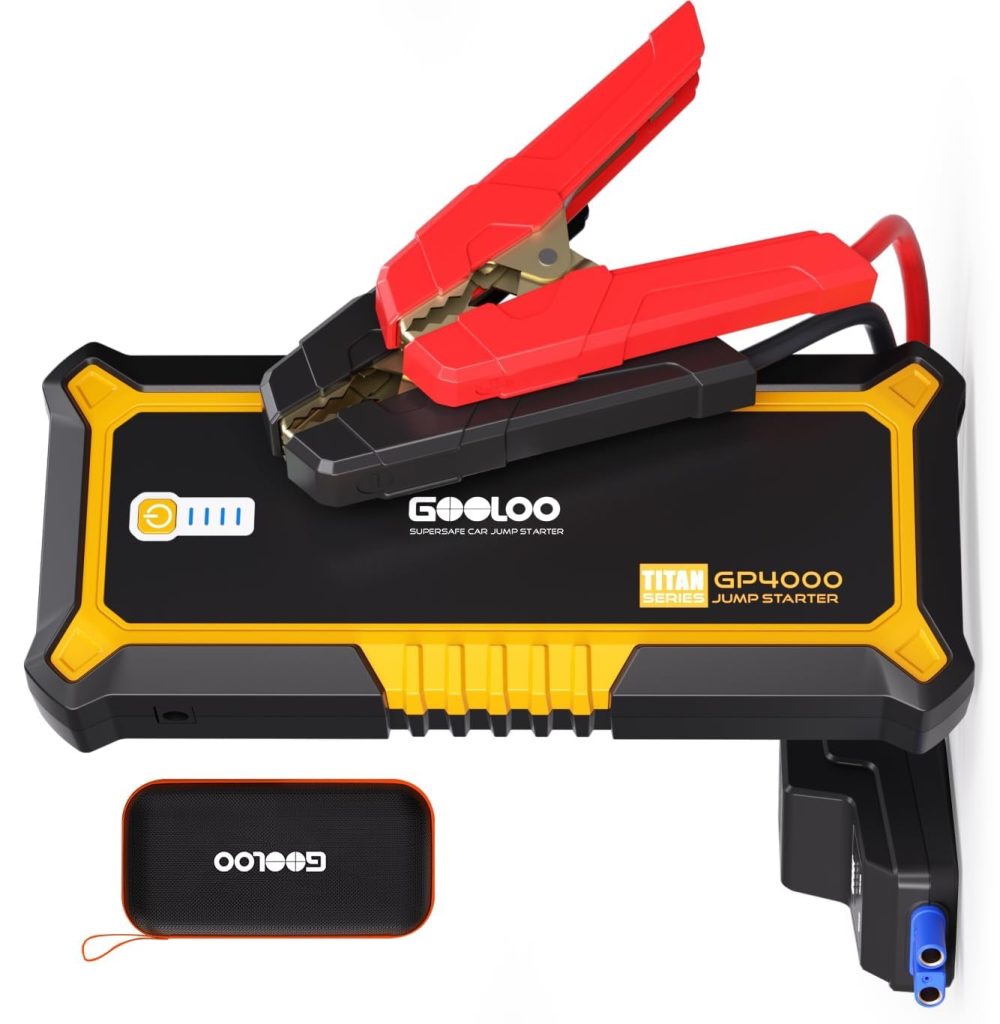
Why I chose it: The GP4000 gives you big-engine coverage for a lot less than the NOCO GBX75. It’s rated for every gas engine and diesels up to 10 liters, and Gooloo lists its starting current, 800 amps, right next to the 4,000 peak. It’s best for drivers with trucks or V8s who want plenty of headroom on a budget and live where winter stays above about -4°F.
Key specs
- Current: 4,000 peak amps, 800 amps starting current
- Engine rating: all gas engines, 10.0L diesel
- Works from -4°F to 140°F
- Certification: UL 2743
- Ports: USB-C input, quick-charge USB-A output
- Build: LED light with solid, strobe and SOS modes, about 1.8 lb
Pros
- Big-engine rating at a mid-size price
- Its 140°F ceiling handles hot climates better than the 122°F NOCOs
- Lists its starting current alongside the peak rating
Cons
- Slow to recharge on its 15W USB-C input
- No heater, so it stops at -4°F like most lithium packs
Performance analysis: Look at the 800 amp number, not the 4,000. That’s what reaches your starter, and it’s plenty for a V8 with a weak battery. The 140°F ceiling makes this a smart pick for the Gulf states and the desert Southwest, where a pack in the trunk sees summer heat that would push a 122°F pack past its limit. If you live up north, spend a little more on the GT4000 and get the heater.
5. WOLFBOX MegaVolt 24Air: Best With a Tire Inflator
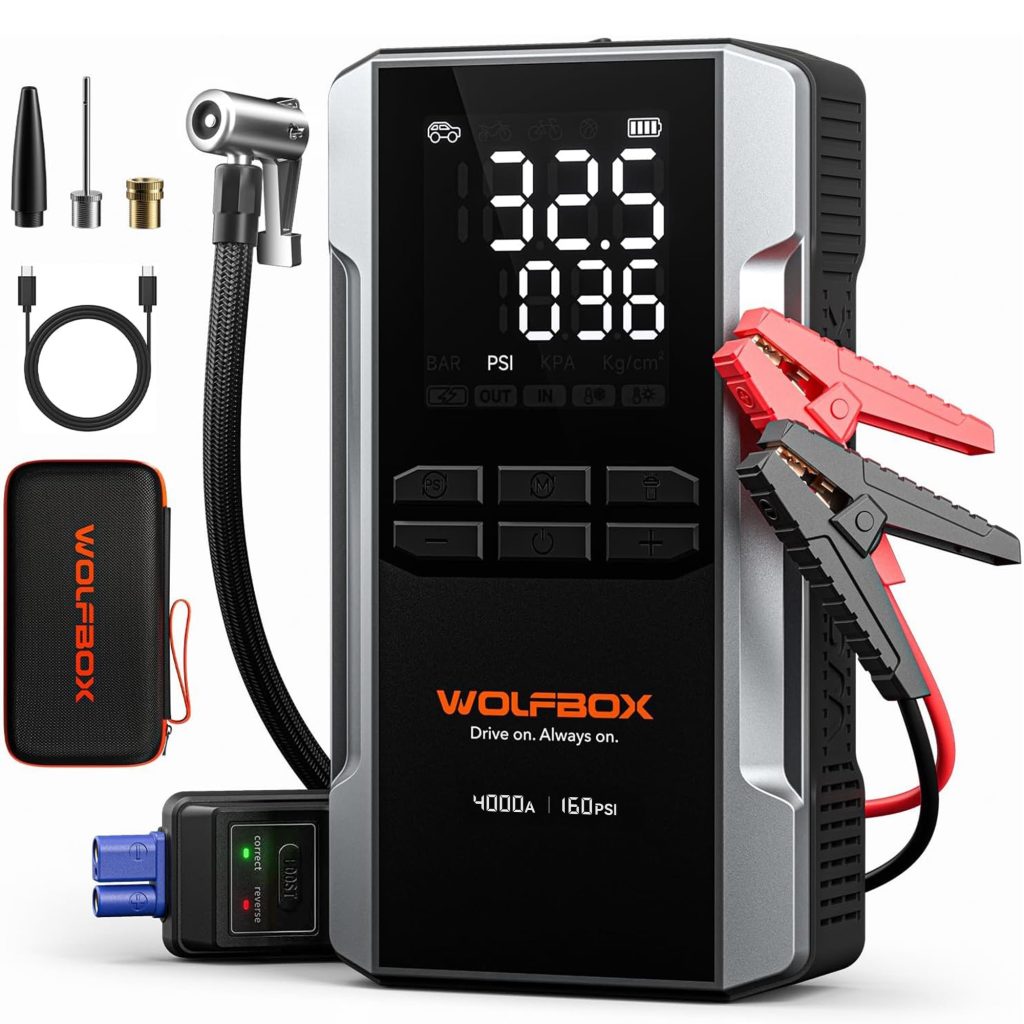
Why I chose it: Cold snaps flatten tires as well as batteries. AAA puts the loss at one to two psi for every 10 degrees the temperature drops, so the morning your car won’t start is often the morning the tire light comes on too. The MegaVolt 24Air puts a 4,000 amp jump starter and a 160 psi inflator in one case running off one battery. It’s best for drivers who want a single emergency tool in the trunk instead of two.
Key specs
- Peak current: 4,000 amps
- Engine rating: 10L gas, 6L diesel
- Inflator: 160 psi, 45 liters per minute, preset pressure with auto shut-off
- Battery: 24,000 mAh (88.8 Wh) lithium, up to 40 jump starts per charge
- Works from -4°F to 140°F
- Ports and build: 65W USB-C, USB-A, 160W DC output, IP64, 400 lumen light, UL 2743
Pros
- Jump starter and inflator share one case and one charger
- Set your tire pressure and it stops on its own
- A 140°F ceiling for hot-state trunks
Cons
- The diesel rating stops at 6 liters, below the GOOLOO packs
- IP64 is a step below the IP65 NOCOs and GT4000
- No wall charger in the box
Performance analysis: Wolfbox times an SUV tire top-up at under two minutes, quick for a pump this size. The inflator draws from the same battery as the jump starter, so recharge the pack after you air up a tire, before you need it to start anything. A low-voltage boost mode handles a battery drained too far for the clamps to sense.
6. Clore Jump-N-Carry JNC660: Best Heavy-Duty
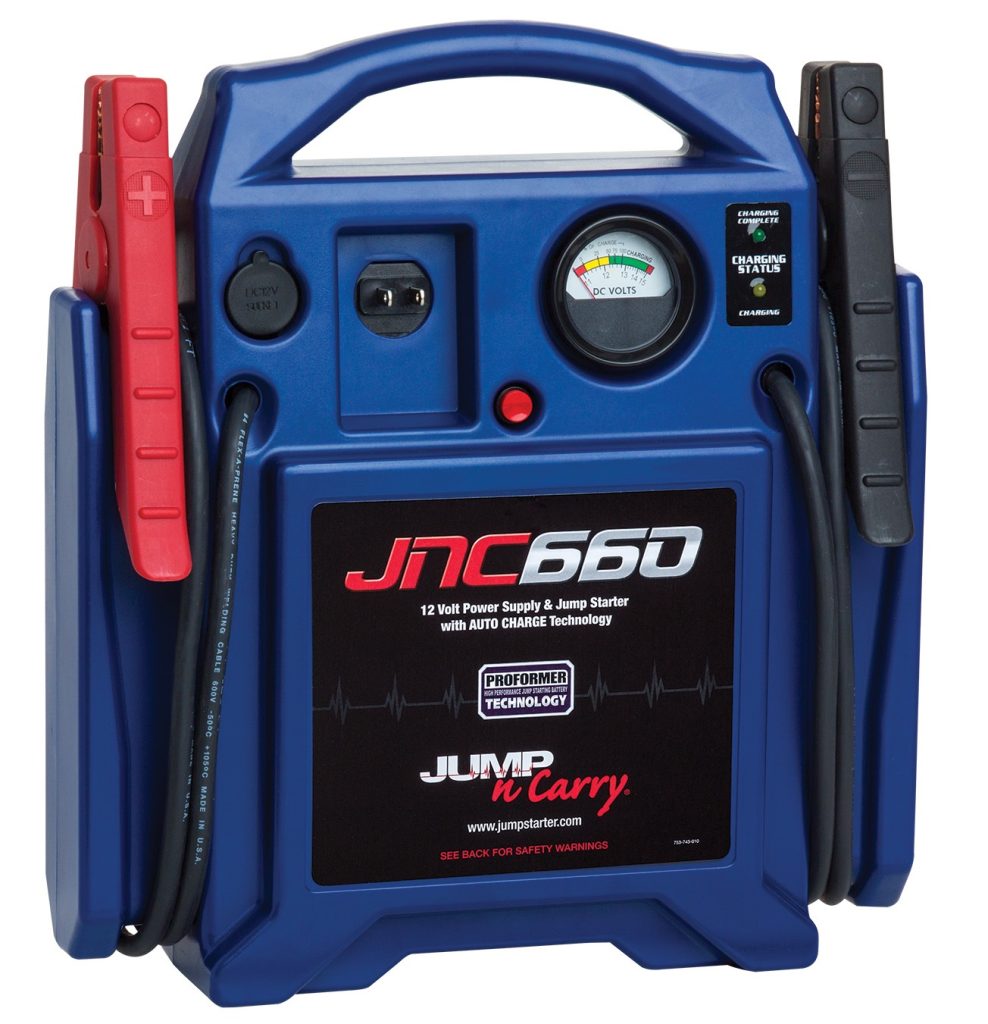
Why I chose it: The Jump-N-Carry has been a fixture in repair shops, dealerships and tow trucks for years. The JNC660 is built differently from everything else here: an 18 pound lead-acid pack with 46 inch #2 gauge cables, rated in cranking amps, 425 of them, instead of a headline peak. It’s best for a farm, a shop, a fleet or a home garage with several vehicles, where it can live on its charger and get used often.
Key specs
- Current: 1,700 peak amps, 425 cranking amps
- Battery: 22Ah Clore Proformer AGM, replaceable
- Cables: 46 inches, #2 AWG, industrial clamps
- Built-in automatic charger and voltmeter
- 12V DC outlet for accessories
- Weight: 18 lb
Pros
- Long, heavy cables reach batteries short lithium leads can’t
- A replaceable battery means the box outlives its first battery
- Rated in cranking amps, a number you can compare with your car battery
Cons
- At 18 lb it’s not something you’ll carry in a compact car
- No smart clamps, so you hook it up carefully with the switch off
- It doesn’t meet California rules, so it isn’t sold for use there
Performance analysis: Those 46 inch cables are why I’d want one in a garage. You set the box on the ground and reach a battery in a truck or a tractor without balancing anything on the engine. Lead-acid packs lose life when they sit drained, so keep it plugged in between uses. Kept that way, it’s ready whenever someone’s car won’t start.
7. AstroAI S8: Best Budget
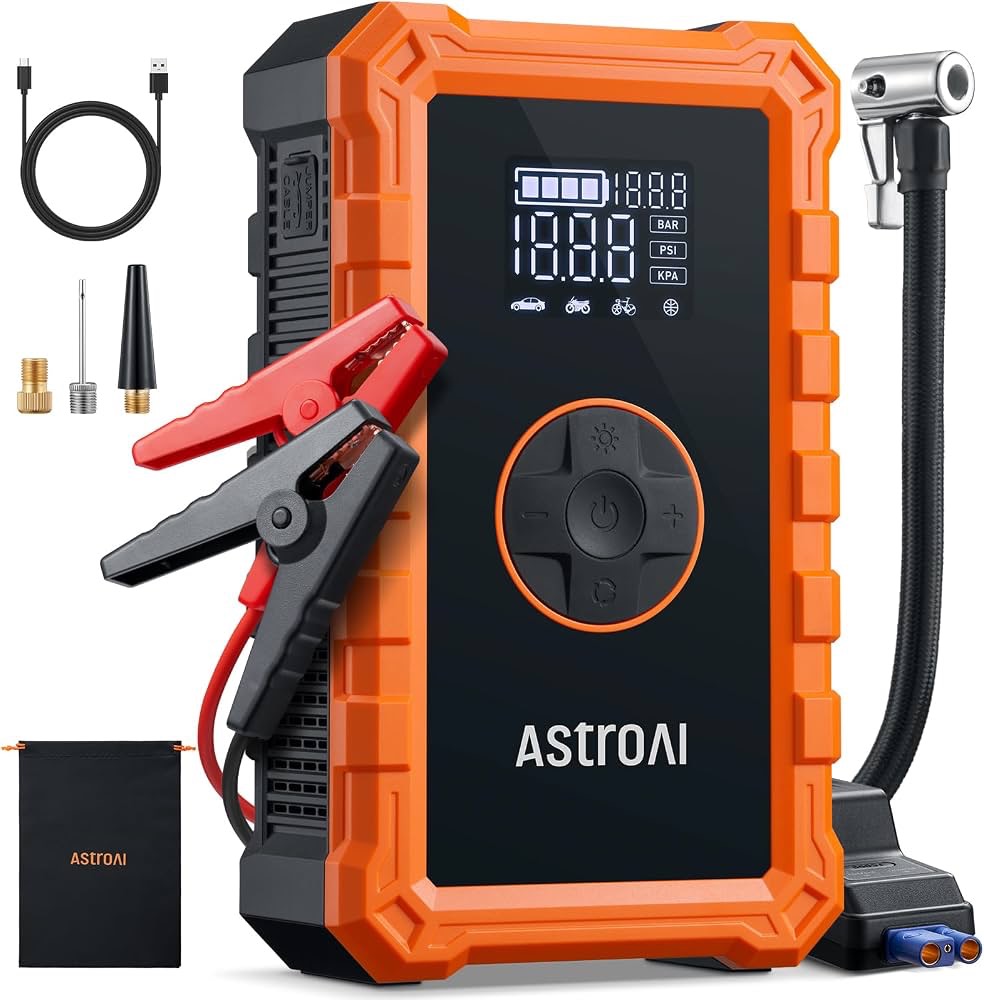
Why I chose it: If you drive a four-cylinder or a V6 and want something small and cheap to drop in the glovebox, the S8 does the job. It’s rated for gas engines up to 6.0 liters and diesels up to 3.0, it weighs under a pound, and its smart clamps glow green when you’ve hooked them up correctly. It’s best for commuters, students and second cars.
Key specs
- Peak current: 1,500 amps
- Engine rating: 6.0L gas, 3.0L diesel
- Battery: 37 Wh lithium
- Works from -4°F to 122°F
- Boost mode for deeply drained batteries
- Build: 0.95 lb, light with flashlight, strobe and SOS, USB-A output
Pros
- Small enough for any glovebox
- Clamp light shows green for a good connection, red for reversed
- Boost button for very flat batteries
Cons
- Not for V8s, big trucks or most diesels
- Slow 5V charging
- A 122°F ceiling makes summer storage tricky in hot states
Performance analysis: Small packs live or die by their charge level. AstroAI’s manual says to top it off every three months, so set a phone reminder the day it arrives. In summer, keep it out of direct sun. A glovebox runs far cooler than a dashboard, and a pack this size heats up fast.
Buying Guide: What to Look For in a Portable Jump Starter
Engine rating first, peak amps second. Peak amps describe a burst that lasts a fraction of a second, and nothing stops a maker from printing a bigger number every year. Starting or cranking current is what actually turns your starter. AstroAI’s own manual for its S8 Air shows the gap: 1,500 peak amps, but a jump-start current of 500 amps for 0.8 seconds. Start with the engine size the maker rates the pack for, then leave yourself some room.
Gas and diesel ratings are different numbers. A diesel squeezes its air much harder than a gas engine, so it takes more cranking to turn over. That’s why every pack here lists a smaller diesel rating. If you drive a diesel, the diesel number is the only one that counts.
Size up for cold. AAA’s winter battery figures say a car battery is about 35 percent weaker at 32°F and about 60 percent weaker at 0°F, while a cold engine can need up to twice the current to start. A pack rated right at your engine size is fine in Atlanta and marginal in Fargo. The checker above does that math for you.
Check the temperature range, both ends. Most lithium packs work from -4°F up to either 122°F or 140°F, and they only charge between roughly 32°F and 104°F. The low end decides whether the pack can live in your car through January. The high end decides whether it can live there through July.
Lithium or lead-acid. Lithium packs are small, hold a charge for months and add USB charging. Lead-acid boxes like the Clore are heavy but come with long, thick cables and a replaceable battery, and they’re happiest kept on a charger in a garage.
Override or boost mode. Smart clamps refuse to send power until they sense a battery. If yours has drained close to zero, they sense nothing, and you need a boost or manual override button to push power through anyway. Every pick here has one except the Clore, which is always live once you switch it on.
Extras that earn their place. A USB-C port that charges at 60W or more turns the pack into a laptop charger during a power outage. A decent light helps more than you’d think when you’re finding terminals at night. An inflator is worth it if you’d otherwise carry a separate pump.
Where to Keep a Jump Starter in Winter and Summer
A jump starter only helps if it’s in the car when the battery dies, so where you keep it matters as much as which one you buy.
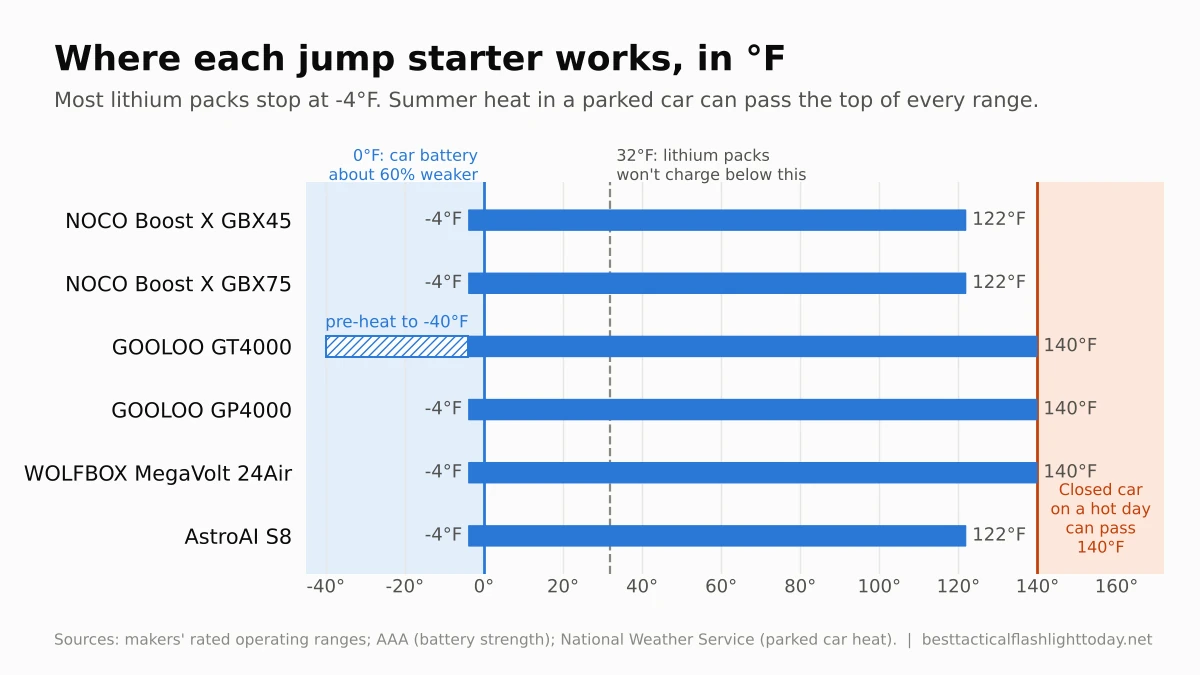
In winter, a pack rated to -4°F can stay in the car on most nights across most of the country. When the forecast drops below that, bring it inside overnight or pick the GT4000, which heats itself. Clore’s own advice for its packs is similar: only in extreme cold, below -10°F, would it bring a jump starter in from the car. Whatever you own, recharge it indoors. Lithium cells shouldn’t be charged below freezing.
In summer, the inside of a parked car gets much hotter than the air outside. The National Weather Service says a closed car can pass 140°F within minutes and a dark dashboard can reach 180°F to more than 200°F. Never leave a pack on the dash or a sunny seat. The glovebox, the trunk or the space under a seat runs far cooler, and the packs rated to 140°F give you more margin in the Gulf states and the Southwest.
All year, check the charge every three months and after any cold snap or heat wave. A pack that’s been sitting at 40 percent may not have enough left for a cold V8.
How to Jump-Start a Car With a Portable Jump Starter
Your pack’s manual comes first, but nearly all of them follow the same order. At night, a rechargeable headlamp keeps both hands free for the clamps.
- Put the car in park, turn the key off, and switch off the headlights, heater fan and radio.
- Check the pack’s charge. AstroAI asks for at least 75 percent before a jump, and that’s a good rule for any pack.
- Connect the red clamp to the positive (+) battery terminal.
- Connect the black clamp to the negative (-) terminal, or to bare metal on the engine block if your manual calls for that.
- Wait for the ready light. Use boost or override only if the pack can’t sense the battery.
- Start the car. Crank for no more than about five seconds, and give the pack a minute or so between tries.
- Once the engine runs, remove the black clamp first, then the red.
- Drive for at least 30 minutes so the alternator can put charge back in, then get the battery tested. AAA suggests testing every year once a battery is three years old.
Portable Jump Starter FAQ
How many amps do I need in a jump starter?
Go by the maker’s engine rating instead of the amp number, then size up for diesel or cold weather. As a reference point, NOCO’s 1,250 amp GBX45 is rated for gas engines up to 6.5 liters and its 2,500 amp GBX75 for 8.5 liters. A pack advertising 4,000 or 6,000 amps isn’t three times stronger than either.
Can you leave a jump starter in your car in winter or summer?
Yes, inside its rated range. Most lithium packs work from -4°F to 122°F or 140°F, so they can ride in the car most of the year. Bring one inside on nights below its low limit unless it heats itself, and keep it off the dashboard in summer.
How long does a portable jump starter hold a charge?
A good lithium pack holds most of its charge for several months, but cold and heat drain it faster. Check it every three months and after any cold snap or heat wave, and top it off before a long trip.
Will a jump starter charge a dead car battery?
No. It gives the battery a short, strong burst so the engine can start, and then the alternator takes over. A battery that keeps going flat needs a real battery charger, a test or a replacement.
The Bottom Line
For most cars, the NOCO Boost X GBX45 is the one to get: protected clamps, fast USB-C charging and a glovebox-size body. If you drive a pickup or a big V8, go up to the GBX75, or save money with the GOOLOO GP4000 if your winters stay above -4°F. Up north, the GOOLOO GT4000 is the only pack here that heats itself for the coldest mornings. Pick the WOLFBOX MegaVolt 24Air if you want your tire pump in the same case, the Clore JNC660 for a garage or farm, and the AstroAI S8 for a small car on a tight budget. Whichever you choose, keep it charged and in the car, next to the rest of your power outage emergency kit and a good survival flashlight.
