
The first time the power stays out overnight, most generator owners learn the same thing. The generator runs fine, but the furnace, the well pump and the sump pump are all hardwired, and no extension cord in the garage can reach them.
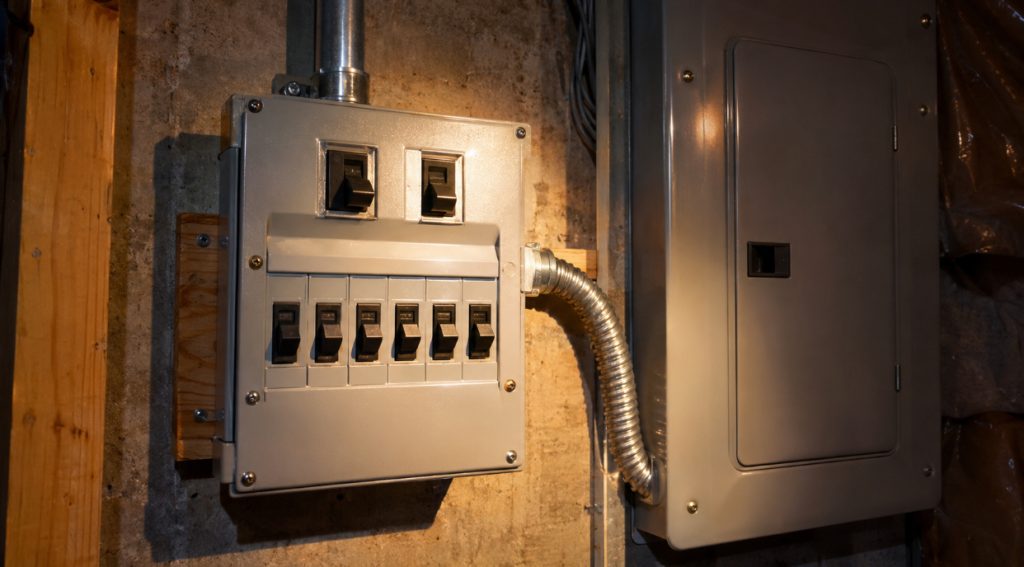
A manual transfer switch fixes that. It’s a small prewired box that mounts beside your breaker panel and takes over a handful of chosen circuits. When the grid goes down, you plug the generator into an inlet on the outside wall, flip those circuits over to generator power, and the furnace fan starts up like nothing happened. Each switch can only connect a circuit to one source at a time, so it can’t send power back out onto the utility line.
Below are my six picks, from a one-circuit switch for a furnace to a 50 amp kit for a big generator. Further down, the Transfer Switch Circuit Planner lets you choose the circuits you want to keep running and tells you which switch fits, and whether your generator can carry the load.
Our Top Picks at a Glance
Generator Transfer Switches Compared
How a Manual Transfer Switch Works
A manual transfer switch sits between your main panel and a few of its circuits. During installation, the electrician disconnects each chosen circuit from its breaker and reconnects it through the switch’s prewired leads, so the circuit now passes through the switch on its way from the breaker to the house. From then on, each circuit runs through a two-way switch with three positions: LINE, OFF and GEN.
On LINE, the circuit gets power from the utility as it always has. On GEN, it takes power from the generator through the inlet box outside. A circuit can only be connected to one source at a time, which is what keeps generator power from flowing back onto the grid. OSHA’s guidance on using portable generators safely says a generator should only connect to a building through a properly installed transfer switch, because a direct connection can put power on lines a long way from your house and electrocute utility workers.
The limit is the one you chose at install time. A six-circuit switch runs six circuits and nothing else. That’s also its strength. Nobody in the house can accidentally switch on the electric water heater or the dryer and overload the generator, because those circuits aren’t on the switch at all.
1. Reliance Controls 306CRK Pro/Tran 2: Best Overall
Why I Chose It and Who It’s Best For
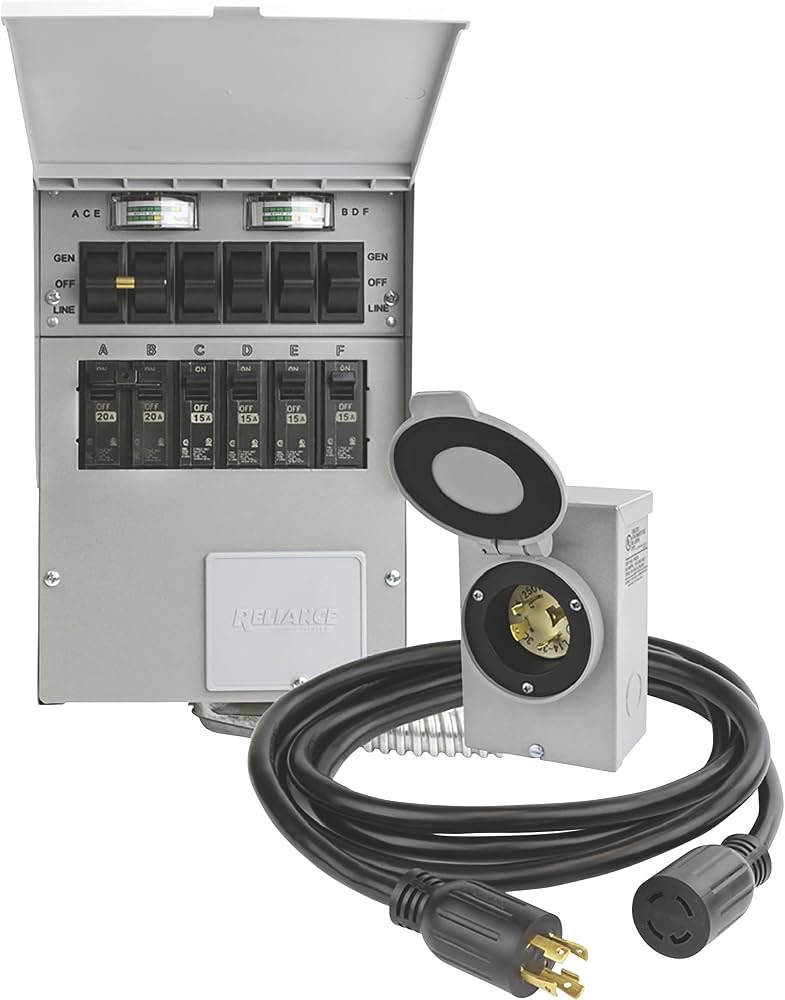
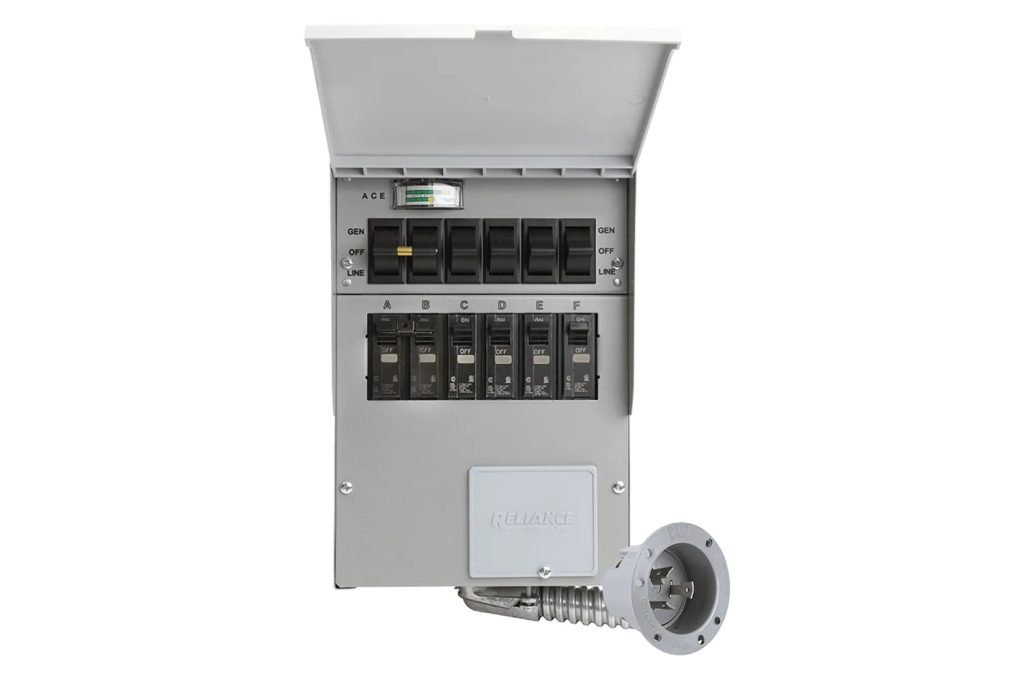
Reliance’s original Pro/Tran kit has been one of the best-selling transfer switches for years. The Reliance Controls 306CRK Pro/Tran 2 is its newer Pro/Tran 2 replacement, and it keeps what made the old one easy to recommend. It’s a six-circuit switch with two wattmeters on the front, sold as a kit with an outdoor inlet box and a cord.
It’s the one I’d point most people to if they own a generator in the 5,000 to 7,500 watt range with an L14-30 outlet and want the furnace, fridge, sump pump and a few light circuits running without thinking about it.
Key Specs
- Circuits: 6 single-pole, 3 double-pole, or a mix of both
- Generator size: up to 7,500 running watts
- Inlet: PB30 outdoor steel inlet box with an L14-30 connector
- Cord: 10 ft, 10 AWG, L14-30 ends
- Breakers: standard 1 in. interchangeable breakers, including AFCI and GFCI types
- Wattmeters: two, one for each side of the generator’s output
- Listing: UL 1008
- Enclosure: indoor, 11.25 x 7.75 x 4.5 in.
- Warranty: 5-year limited
Pros and Cons
Pros
- Wattmeters make it easy to balance the load
- Takes AFCI and GFCI breakers
- Complete kit with inlet box, cord and flexible conduit
Cons
- The 10 ft cord is too short for safe generator placement
- Six circuits fill up fast if you need 240 volt loads
- Indoor enclosure only
Performance Analysis
The wattmeters are the reason I keep coming back to this design. A 240 volt generator has two separate 120 volt sides, and each one can only carry half the total. If the fridge, furnace and sump pump all land on one side, that side overloads while the other sits idle. The two meters show each side’s load, so you can tell at a glance whether to move a circuit.
The Pro/Tran 2 uses ordinary 1 inch breakers, including AFCI and GFCI types, so it works in newer homes where code requires those breakers on bedroom, kitchen and laundry circuits.
The one part I’d change is the cord. Ten feet doesn’t reach a generator set 20 feet from the house, which is the distance the CPSC recommends to keep carbon monoxide out. Reliance sells the same kit with a 20 foot cord as the Reliance 306CDK, or you can pair this one with a longer 30 amp L14-30 generator cord. If six circuits won’t be enough, the Reliance 310CRK is the ten-circuit version of the same switch.
2. Connecticut Electric EmerGen G2 30A Kit: Best 10-Circuit Kit
Why I Chose It and Who It’s Best For
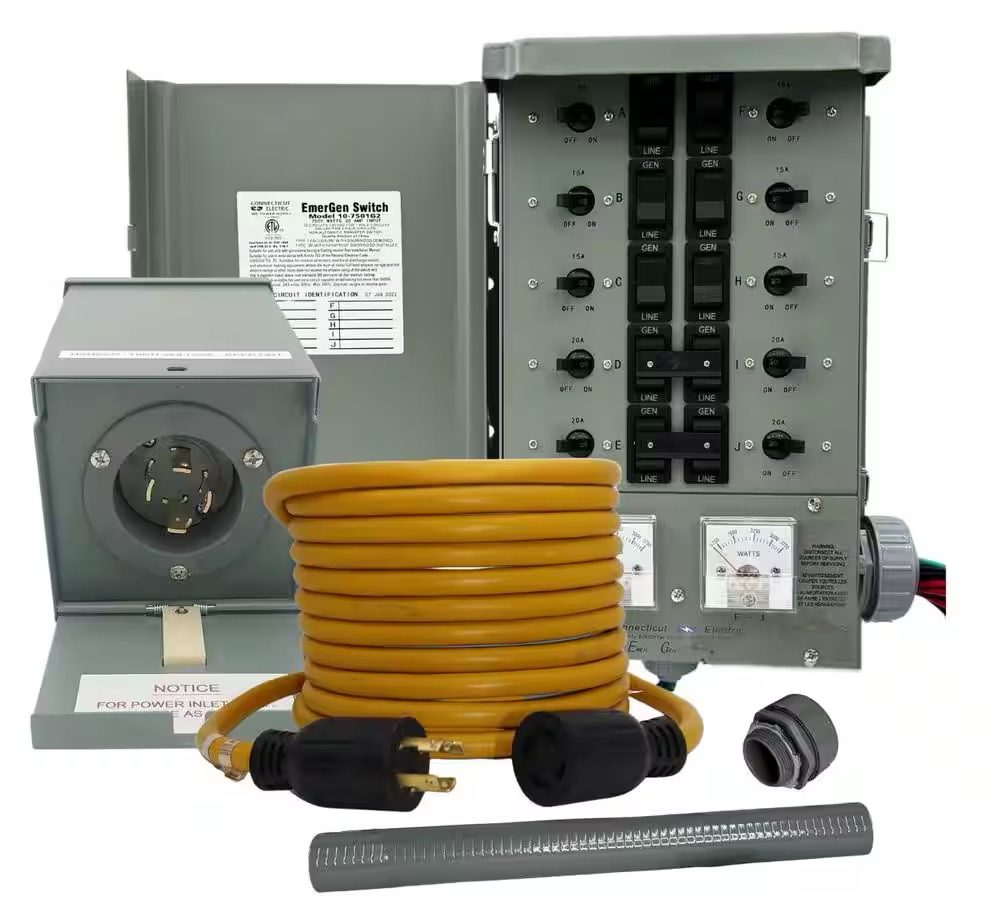
Six circuits sounds like plenty until you list what you’d want running in a January outage. Add a well pump or a second freezer and you’re out of spaces. The Connecticut Electric EmerGen G2 30A Kit gives you ten, and the switch itself sits in a rainproof NEMA 3R steel box, so it can mount on an outside wall or in a damp garage.
It’s for a house on a well, a house with a basement full of things that need power, or anyone whose panel is in a garage or outbuilding where an indoor box would rust.
Key Specs
- Circuits: 10
- Generator size: up to 7,500 watts
- Enclosure: NEMA 3R rust-proof steel, for indoor or outdoor mounting
- Inlet: 30 amp inlet in a NEMA 3R box
- Cord: sold in 10, 25 and 50 ft kit versions
- Switching: a double-throw rocker switch for each circuit
Pros and Cons
Pros
- Ten circuits at 30 amps
- Rated for mounting outdoors
- Kit versions with a 25 or 50 ft cord
Cons
- No wattmeters
- A bigger box to find wall space for than a six-circuit switch
- Ten rocker switches take a minute to learn in the dark
Performance Analysis
I’d buy the 25 foot kit. With it, the generator can sit at the safe distance without an extra cord in the chain, which means one less connection to get wet in the snow.
There are no wattmeters, so you’ll need to know roughly what each circuit draws. That’s what the planner further down is for. Do the math once when the switch goes in, write each circuit’s watts on the label next to its rocker, and you’ll have it on hand in an outage.
Ten circuits on a 30 amp switch doesn’t mean ten heavy loads at once. A 7,500 watt generator still runs a 7,500 watt house. The extra circuits give you choices, like turning off the microwave circuit so the well pump can run. If your generator has a 50 amp outlet, Connecticut Electric makes a Connecticut Electric 50A G2 kit as well.
3. Champion 50A Transfer Switch Kit: Best for 50 Amp Generators
Why I Chose It and Who It’s Best For
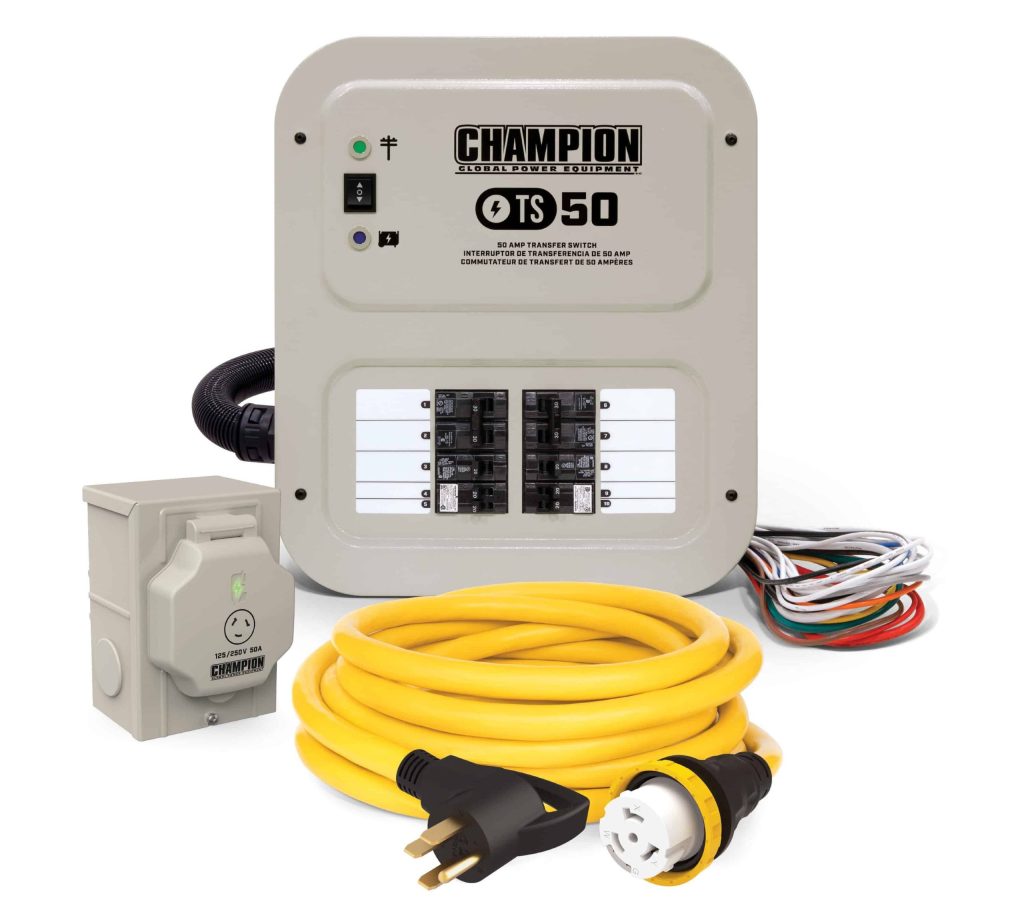
A generator that makes more than about 7,500 running watts needs a 50 amp outlet to deliver all of it, usually a 14-50, and a 30 amp switch would leave part of that power unused. The Champion 50A Transfer Switch Kit is built for those generators, and it arrives as one box with nothing else to buy: the switch, a weather-resistant inlet and a 30 foot cord.
It works with any generator that has a 14-50 outlet.
Key Specs
- Rating: 50 amps at 240 volts
- Circuits: 10, prewired with labeled wires
- Breakers: two 2-pole 30 amp breakers for 240 volt loads, plus 20 amp single and tandem breakers
- Cord: 30 ft, 14-50P generator plug to an SS2-50R locking connector
- Inlet: NEMA 3R weather-resistant inlet box with a power light
- Enclosure: NEMA 1, indoor, surface or flush mount
- Indicators: lights that show whether a circuit is on utility or generator power
- Listing: UL 1008
- Warranty: 5-year limited
Pros and Cons
Pros
- Two 30 amp 240 volt circuits for a well pump and more
- 30 ft cord included
- Lights show each circuit’s source
Cons
- Heavy to mount, close to 50 lb in the box
- Indoor switch only
- No wattmeters
Performance Analysis
The two 30 amp 240 volt circuits set this apart from the 30 amp switches. One can run a well pump and the other something like an electric dryer or a small heat pump, if the generator has the headroom.
The locking connector on the cord twists into the inlet and stays put, which I like in wind and snow. The 30 foot length puts the generator well past the 20 foot mark, with some slack left over.
The other 50 amp switch I’d look at is the Generac HomeLink 50A, which can be upgraded later if you move to a standby generator. Check that its breakers match your panel before ordering.
4. Nature’s Generator 12-Circuit 30A: Most Circuits
Why I Chose It and Who It’s Best For
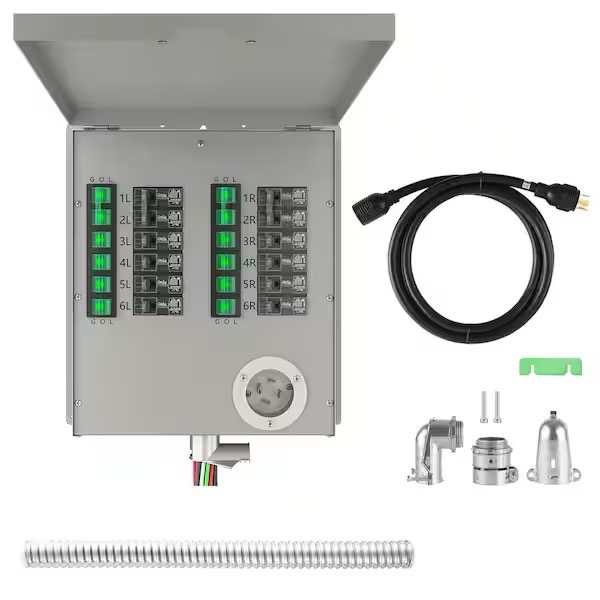
The Nature’s Generator 12-Circuit 30A packs twelve circuits into one panel, more than anything else here at 30 amps. Each circuit has its own lighted rocker switch, so you can see at a glance which circuits are running on the generator.
It’s for a larger house, or a newer one, since it takes AFCI and GFCI breakers. It also works with home battery systems, so it’s a sensible choice if you plan to add batteries later.
Key Specs
- Circuits: up to 12 at 120 volts, or 6 at 240 volts
- Rating: 30 amps, 120/240 volts, about 7,500 watts
- Breakers included: two 2-pole 20 amp (can go up to 30 amp) and eight 1-pole 15 amp (can go up to 20 amp)
- Breaker types: AFCI and GFCI supported
- Switches: lighted rockers that show generator power
- Enclosure: steel
- Listing: UL 1008 and CSA C22.2 No. 178.1
- Inlet: L14-30 inlet sold as a bundle option
Pros and Cons
Pros
- Twelve circuits at 30 amps
- Handles AFCI and GFCI breakers
- Lighted switches are easy to read in the dark
Cons
- Most single-pole breakers ship at 15 amps, so 20 amp circuits need new breakers
- Inlet isn’t in every version, so check the bundle
- No wattmeters
Performance Analysis
Plan on swapping some breakers during the install. Kitchen and bathroom circuits are usually 20 amps, and the breaker in the transfer switch has to match the one in the panel. It’s a small cost, but tell your electrician up front so it’s on the truck.
Make sure you buy the bundle with the L14-30 inlet box unless you already have one. Nature’s Generator sells the switch alone too.
Twelve circuits on a 30 amp generator is a lot of choice and the same 7,500 watts. If you have a 50 amp generator and want this many circuits, the Nature’s Generator 50A 12-circuit switch has the same layout with a 50 amp inlet.
5. EZ Generator Switch: Best Single-Circuit Switch
Why I Chose It and Who It’s Best For
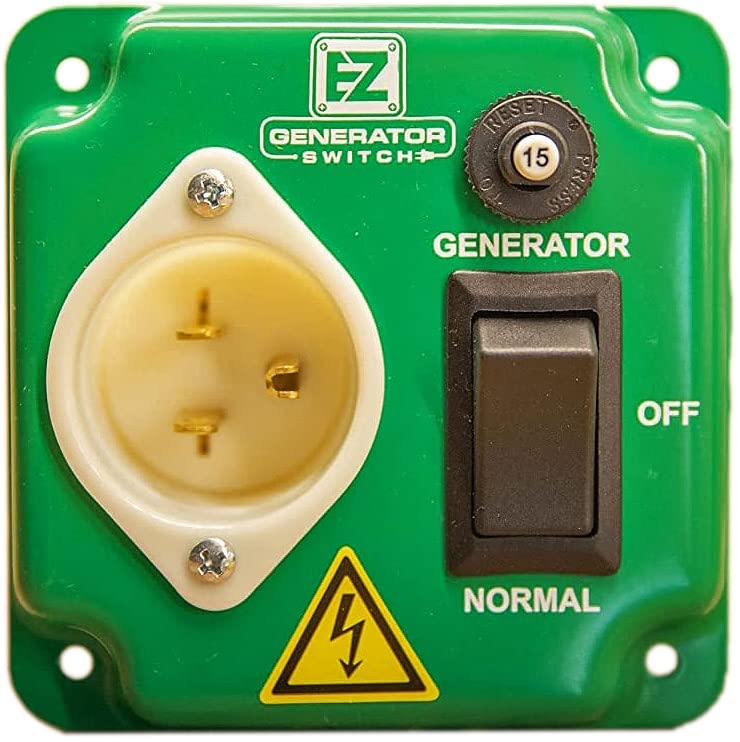
If the furnace is the only thing you need running, a six-circuit switch is more than the job calls for. A gas or oil furnace won’t run without power for its blower and controls, and in a winter outage that’s the circuit that matters most. The EZ Generator Switch switches one hardwired circuit between the house and a generator, and it does it in a box about the size of a large outlet.
It’s for a small inverter generator, a battery inverter, or a power station, where all you want is heat.
Key Specs
- Circuits: 1
- Rating: 20 amps at 120 volts
- Switch: ON-OFF-ON rocker
- Listings: UL, CSA and ETL
- Works with: bonded or floating neutral generators and battery inverters
- In the box: offset nipple, wire nuts and about 24 in. of 12 gauge stranded leads
- Size: 4 x 4 x 4 in., 1 lb
- Made in: USA
Pros and Cons
Pros
- A low-cost, proper way to run a furnace on a generator
- Works with bonded or floating neutral sources
- Small enough to mount right at the furnace
Cons
- One 120 volt circuit only
- Needs a metal box for the wire connections
- Instructions are written for electricians
Performance Analysis
The neutral setting is the detail that makes this switch useful with small inverter generators and battery systems. It ships set up for a bonded neutral generator, and it can be rewired for a floating neutral source. Ask your electrician to match it to what you’ll actually plug in.
It can mount near the furnace or near the panel, wherever the furnace circuit is easiest to reach. The wire splices go in a metal handy box or box extension, which isn’t included. Plastic boxes aren’t suitable.
A furnace blower draws several hundred watts, so even a 3,000 watt inverter generator or a mid-size power station can keep the heat on through the night.
6. EcoFlow Home Backup Transfer Switch: Best for Power Stations
Why I Chose It and Who It’s Best For
Big power stations have reached the point where they can run a house’s essentials, and EcoFlow sells its own transfer switches for them. The EcoFlow Home Backup Transfer Switch comes in two versions, and both connect one of EcoFlow’s larger stations to your panel with the cable included in the box.
It’s for anyone who’d rather not run a gas engine at all. A power station runs quietly and makes no exhaust, so it can sit indoors and there’s no cord across the yard.
Key Specs
- 30 amp version: 6 circuits, 125 volts, NEMA L5-30 inlet, for the DELTA Pro, DELTA Max and similar 120 volt stations
- 10-circuit version (A510A): 125/250 volts, NEMA L14-30 inlet, for the DELTA Pro Ultra, DELTA Pro 3 and DELTA Pro 3 Plus
- A510A breakers included: six 15 amp single-pole, one 20 amp 2-pole and one 30 amp 2-pole
- Wattmeters: color-coded, on both versions
- In the box: EcoFlow power station connection cable
- Listing: cULus 1008
- Install: indoor breaker panels, by a licensed electrician
- Warranty: 5 years
Pros and Cons
Pros
- Matched cable for EcoFlow stations included
- Wattmeters on both versions
- The 10-circuit version handles 240 volt loads
Cons
- The 30 amp version is 120 volts only
- Made for EcoFlow’s own stations
- Indoor panels only
Performance Analysis
Pick the version by your station. The DELTA Pro 3 and DELTA Pro Ultra have 240 volt output, so the EcoFlow A510A can run a 240 volt well pump. The 30 amp version is 120 volts only and is limited to 120 volt circuits.
With a station, battery capacity sets how long you can run. The wattmeter readings tell you how fast you’re draining it, which is useful when you’re trying to stretch a charge until morning. My power station guide covers how long the larger EcoFlow units last on typical loads.
EcoFlow’s switches use the same prewired, wattmeter-equipped design as the Reliance Pro/Tran 2. If you have a station from another brand with an L14-30 outlet, the Reliance or Nature’s Generator switches will do the same job.
Transfer Switch Circuit Planner
Pick your generator or power station outlet and tick the circuits you’d want running. The planner counts the switch spaces they need, adds up the load against your generator, and shows the switch that fits.
How to Choose a Generator Transfer Switch
Match the amps to your generator outlet
Look at the largest outlet on your generator. An L14-30 is a round four-prong twist-lock and pairs with a 30 amp switch. A 14-50 is the big straight-blade outlet and pairs with a 50 amp switch. The switch, the inlet box and the cord all need to match that outlet. A 30 amp switch on a 50 amp generator works, but it caps you at 30 amps.
Count the spaces each circuit needs
Every 120 volt circuit takes one space on the switch. A 240 volt circuit, like a well pump, takes two. So a well pump plus four 120 volt circuits fills a six-circuit switch. Make your list before you buy, and leave a spare space or two if you can.
Know whether you need 240 volts
If any circuit on your list is 240 volts, you need a 120/240 volt switch and a generator outlet that supplies both, like an L14-30 or 14-50. The L5-30 and TT-30 outlets on some smaller generators are 120 volts only. A 120 volt switch such as the Nature’s Generator 30A 6-circuit 120V switch can work with them, but only for 120 volt circuits.
Check your breakers
Newer homes often use AFCI and GFCI breakers on bedroom, kitchen and laundry circuits. When one of those circuits moves to the transfer switch, it should keep the same protection, so the switch has to take those breakers. The Reliance Pro/Tran 2 and the Nature’s Generator switch both do. If your panel uses plug-on neutral breakers, ask your electrician how the switch will handle them before you order.
Indoor or outdoor
Most transfer switches mount indoors beside the panel. If your panel is outside or in a damp space, choose a NEMA 3R enclosure like the Connecticut Electric. The inlet box always goes outside, and it should be weather rated whatever the switch is.
Wattmeters
Meters show the load on each side of a 240 volt generator. They aren’t required, but they make balancing easy, especially in the first outage while you’re learning what each circuit draws.
Listing
Look for UL 1008, the safety standard for transfer switches. Inspectors check for it. The Reliance, Champion, Nature’s Generator and EcoFlow switches all carry it, and the single-circuit EZ has its own UL, CSA and ETL listings.
Which Circuits to Put on the Switch
Start with what keeps the house safe and livable, then add comfort. For most homes the list looks like this: the furnace or boiler, the refrigerator, the well pump if you have one, the sump pump, a freezer, and a couple of lighting circuits. After that come the outlets where you’ll charge phones and run the internet router, and a kitchen circuit for the microwave or coffee maker.
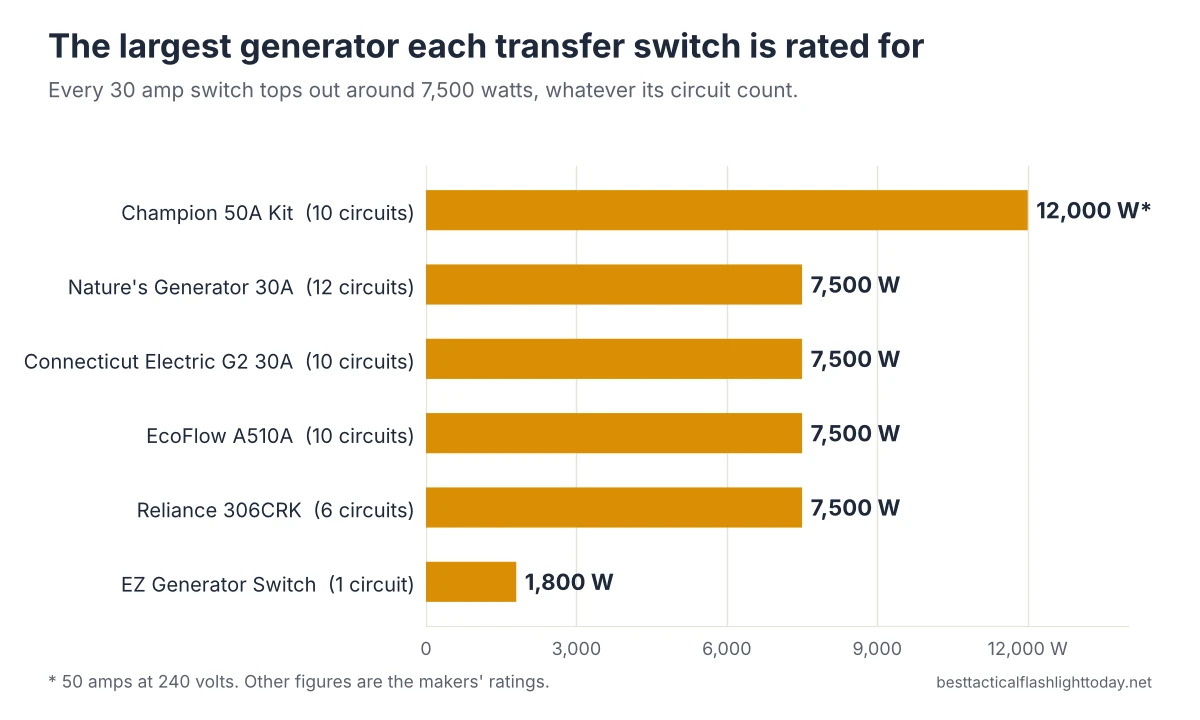
The chart shows the largest generator each pick is rated to carry. The 30 amp switches all top out around 7,500 watts, so more power takes a 50 amp switch and a generator to match.
Leave off the big heat makers. An electric water heater, electric range, electric dryer or central air conditioner can each use most or all of what a portable generator makes, and putting one on the switch tempts someone to turn it on. If you want them available, you need a bigger generator and probably a load-shedding switch, and that’s a different project.
Inlet Box and Cord
Most of these kits include the inlet box and a cord. If yours doesn’t, or the cord is too short, the cord ends need to match the generator outlet and the inlet exactly. A 30 amp hookup uses an L14-30 cord with 10 gauge wire. A 50 amp hookup uses a 14-50 plug at the generator and, for the Champion, an SS2-50 style connector at the inlet. My interlock guide walks through the inlet and cord options for each outlet type.
Transfer Switch or Interlock Kit?
An interlock kit is the other common way to connect a generator. It’s a plate on your main panel that lets you power any circuit in the house, one at a time, as long as you stay under what the generator can carry. For most homes with a portable generator, it’s the more flexible choice and costs less to install, which is why I lean toward it in my interlock guide.
A transfer switch earns its place in a few situations. If someone else in the house will run the generator and you want fewer ways to get it wrong, the switch limits them to the circuits you chose. If no interlock is made for your panel, a transfer switch works with any panel. And if you’re connecting a power station, the matched EcoFlow switches and their cables make the job simpler.
Using a Power Station Instead of a Generator
A large power station can feed a transfer switch the same way a generator does, through an inlet or a hardwired connection. The difference is that you’re limited by battery capacity instead of fuel. A station that runs the fridge, furnace and lights for a night will need recharging the next day, from solar panels, a car or a generator.
The station also needs the right output. To run a 240 volt well pump through a transfer switch, the station needs a 240 volt outlet, like the DELTA Pro 3 or a pair of stations linked together. For 120 volt circuits only, a 120 volt switch and a single 120 volt station are enough.
One more thing to bring up with your electrician: the neutral. Portable generators usually ship with the neutral bonded to the frame, while some power stations and inverters float it. Most transfer switches don’t switch the neutral, so the electrician needs to know which kind of source will plug in. I cover this in more detail in my interlock kit guide, and it applies to transfer switches the same way.
Permits and Installation
In most places a transfer switch needs a permit, and in many it has to be installed by a licensed electrician. It means working inside the main panel, moving circuit wires, and running a line to the outside inlet. The prewired kits save a lot of time, but the main lugs in the panel stay live even with the main breaker off.
Expect a transfer switch install to take longer than an interlock. Each circuit has to be found, moved and labeled, so a ten-circuit switch takes more work than a six. Ask your electrician to quote the switch, the inlet box, any replacement breakers and the permit together.
FAQ
Do I need a transfer switch for a portable generator?
If you want to power anything hardwired, like a furnace, well pump or sump pump, you need a transfer switch or an interlock kit. Plugging a generator into a wall outlet to feed the house is dangerous and can electrocute utility workers. For appliances that plug in, extension cords run straight from the generator work without either one.
What size transfer switch do I need for my generator?
Match the switch to the generator’s largest outlet. A generator with an L14-30 outlet pairs with a 30 amp switch rated for about 7,500 watts. A generator with a 14-50 outlet pairs with a 50 amp switch. Then choose the circuit count from your list of essentials, counting 240 volt circuits as two spaces.
Can I install a generator transfer switch myself?
The prewired kits are made to simplify the job, but it still means working inside a live main panel. Many areas require a permit and a licensed electrician, and an inspector will check the work. Most homeowners should hire an electrician.
Can I use a transfer switch with a power station?
Yes. A large power station with an L14-30 or L5-30 outlet can feed a transfer switch the same way a generator does. EcoFlow sells switches matched to its whole-home stations, and other brands work with switches like the Reliance Pro/Tran 2. How long the circuits run depends on the station’s battery capacity.
The Bottom Line
For most homes with a 30 amp generator, the Reliance Controls 306CRK Pro/Tran 2 is the switch to get. It takes modern breakers, has wattmeters, and comes as a kit. If you need more circuits or an outdoor-rated box, go with the Connecticut Electric EmerGen G2 30A Kit. For a 50 amp generator, the Champion 50A Transfer Switch Kit has everything in one box, and the Nature’s Generator 12-Circuit 30A gives you the most circuits at 30 amps. If all you need is heat, the EZ Generator Switch covers the furnace, and for an EcoFlow station, the EcoFlow Home Backup Transfer Switch is made for the job.
Before you buy, list your circuits and run them through the planner above, so the switch you order has room for everything on the list. If you haven’t chosen the generator yet, my home generator guide has a planner that sizes one to those same circuits.
