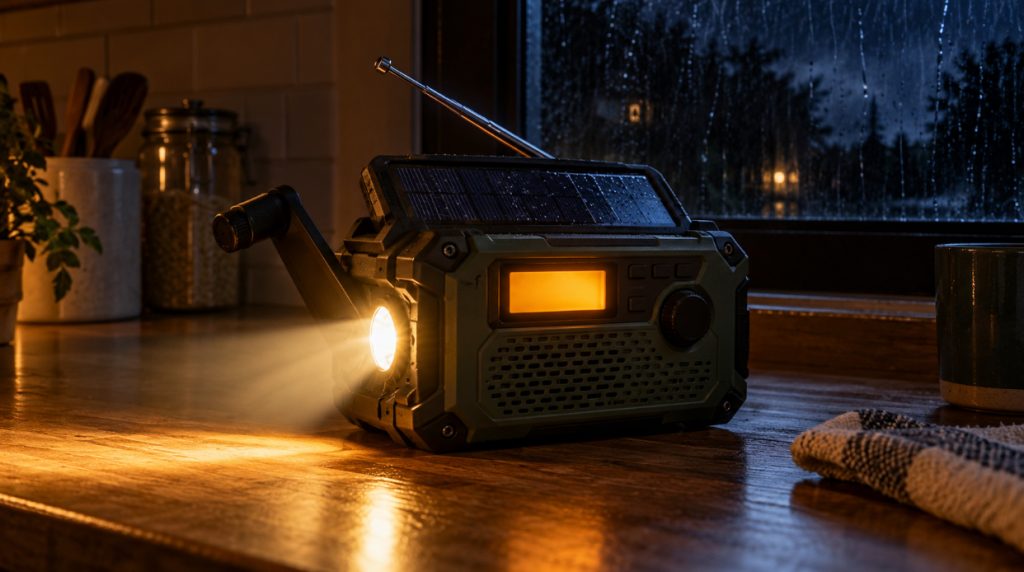
When a storm takes the power out, most people reach for their phone. That works until the battery runs low, or until the cell tower down the road runs through its own backup power and goes quiet. A hand crank radio keeps working through all of it. It picks up the National Weather Service’s NOAA broadcasts and your local AM news station, and when the battery runs flat you can turn the handle and keep listening.
The feature I care about most is one that most listings bury. A radio with a weather band lets you hear NOAA if you happen to tune in. A radio with a weather alert mode sits quietly and switches itself on when the Weather Service sends a warning, and that’s the one that wakes you at 3 a.m. when a tornado warning goes out for your area. Every radio in this guide has an alert mode.
I stuck to Midland, Sangean, Eton and C. Crane, chose the newest model each one sells, and matched each radio to a different kind of household. Further down, the NOAA Station Finder gives you your local frequency and your county’s six digit SAME code, so you can set the radio up before you need it.
Quick Picks
Hand Crank Radios Compared
All six run from a built-in rechargeable battery, a hand crank and a solar panel. The NOAA Station Finder below tells you which weather channel to set.
How I Picked These Radios
I started with one rule: every radio had to have a weather alert mode, and a radio that only plays the weather band didn’t make the cut. That ruled out a lot of popular crank radios, and plenty of no-name brands that print NOAA on the box without saying how they handle alerts.
From there I went with the newest model each brand sells, because several old favorites have been replaced. Midland’s ER310PRO took over from the ER310 in late 2025, and Sangean’s MMR-99 replaced the MMR-88. Then I matched each radio to a household: a main radio for the house, a tough one for the truck, a shortwave set, a long-outage radio that takes AA batteries, a small one for a bag, and a simple one for someone who won’t read a manual.
1. Midland ER310PRO: Best Overall
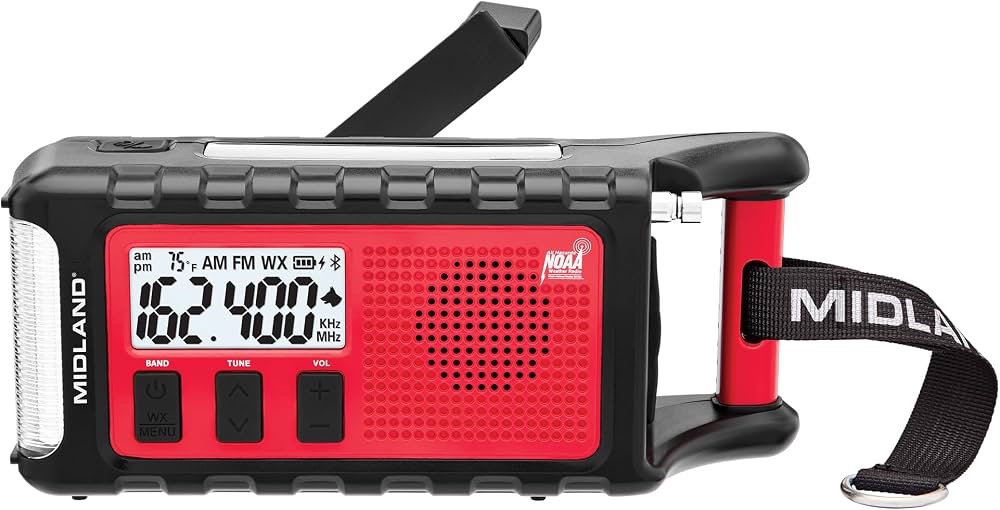
Why I chose it and who it’s for
For years the Midland ER310 sat at the top of most crank radio lists. In November 2025 Midland replaced it with the Midland ER310PRO, and the changes are the ones that matter in a long outage. The battery grew to 10,000 mAh, charging moved to USB-C, and the alert mode stayed.
This is the radio I’d keep in a house that loses power for days at a time. It’s big enough to recharge a phone a few times and still run the radio through the week, and light enough at 1.3 lb to carry from room to room.
Key specs
- Bands: AM, FM and all 7 NOAA weather channels, plus Bluetooth audio
- Weather alert: stays on standby and switches itself on when NOAA sends an alert
- Battery: 10,000 mAh, 3.7 V lithium-ion, replaceable
- Charging: USB-C (6 to 8 hours to full), solar panel, hand crank
- Crank: 1 minute gives about 10 to 20 minutes of playback, by Midland’s figure
- Phone charging: USB-A at 5 V, 2.1 A, about three charges for most phones
- Light: LED flashlight with high, low and SOS strobe, plus a soft reading light
- Extras: ultrasonic dog whistle, clock, temperature display
- Size and weight: 8.1 x 3.4 x 2.8 in, 1.3 lb
Pros and cons
Pros
- By far the biggest battery in this guide
- Works as a real power bank for phones
- Clear alert mode that runs on standby
Cons
- No AA or AAA backup, which the old ER310 had
- No water resistance rating
- The dog whistle won’t matter to most owners
Performance analysis
Midland rates the ER310PRO at up to 200 hours of radio on a full charge. That number assumes modest volume with the light and Bluetooth off, but even half of it covers a week of evening news and weather. Midland is also upfront that the crank and solar panel are for topping up. Charge it over USB-C first, then leave it on a sunny windowsill to stay full.
Setting the alert takes ten seconds. Switch to the weather band, tune the station from the finder below, then hold the Alert button until the icon shows. The radio goes quiet and waits.
One thing to know: the alert sounds for every warning on the station you tune, and one NOAA transmitter can cover several counties. If you’d rather hear only your own county, that takes a radio with SAME, which I cover in the buying guide. A small quirk: the temperature on the display comes from a sensor in the handle, and Midland notes it can read high while you’re holding the radio or charging it.
2. Sangean MMR-99: Most Rugged
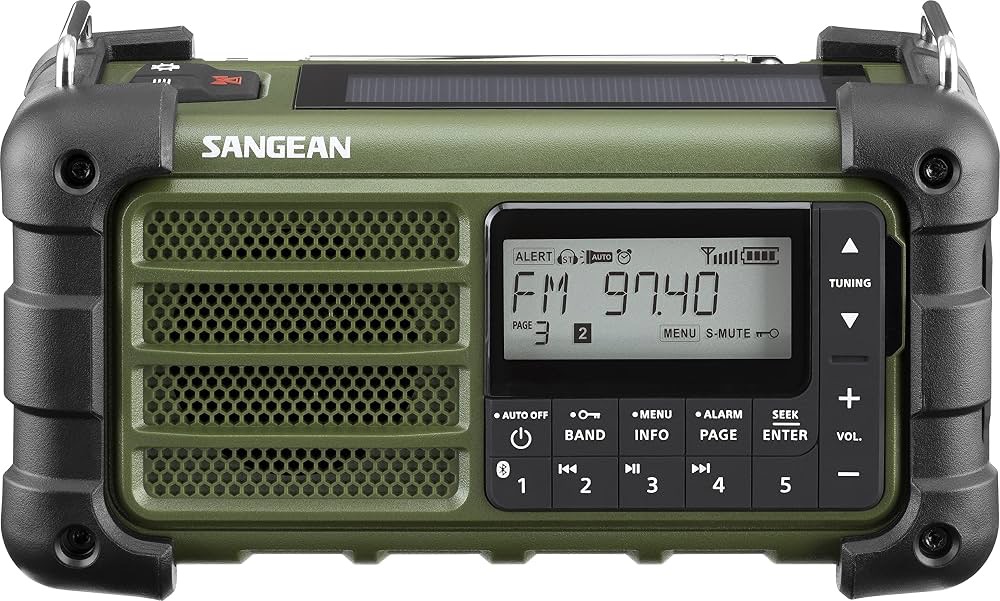
Why I chose it and who it’s for
Sangean’s MMR-88 was a long-time favorite in this category, and the Sangean MMR-99 is its newer replacement. Sangean built it for rough handling. The cabinet is rubber armored and rated IP55 against dust and water, the battery is 2,600 mAh where the old model had 850 mAh, and it charges over USB-C.
It’s the one to keep somewhere a radio gets knocked around: a truck, a garage shelf, a boat or a camping box. It also has the most useful flashlight of the six.
Key specs
- Bands: AM, FM with RDS, all 7 NOAA weather channels, Bluetooth and aux in
- Weather alert: weather alert with a loud alarm
- Battery: 2,600 mAh, 3.7 V lithium
- Charging: USB-C in at 5 V, 2.4 A, solar panel, fold-out hand crank
- Phone charging: USB-A out at 5 V, 1 A
- Light: high and low, wide and focused, blinking, SOS and Morse code, plus a red night light
- Extras: two-tone rescue alarm, 40 station presets, clock with alarm
- Water and dust: IP55
- Size and weight: 8 x 4.5 x 3.5 in, close to 2 lb
Pros and cons
Pros
- Toughest build in this guide
- USB-C charging and Bluetooth
- Flashlight with a red mode that keeps your night vision
Cons
- Heaviest pick here
- 1 A phone output charges slowly
- No AA or AAA backup
Performance analysis
IP55 means it’s sealed against dust and protected from jets of water. That covers rain on a porch rail or a soaking in the back of a pickup, but it shouldn’t go under water.
The phone output is 5 V at 1 A, which is slow by today’s standards. It’s enough to keep a phone alive through a long night, just slowly. The crank folds into the back and is larger than most, so a few minutes of cranking is easier on the wrist.
The red light is worth calling out. It lets you check on kids or read a map at night without wrecking your eyes for the dark, and none of the other radios here has a steady red light.
3. Eton Odyssey: Best All-Band
Why I chose it and who it’s for
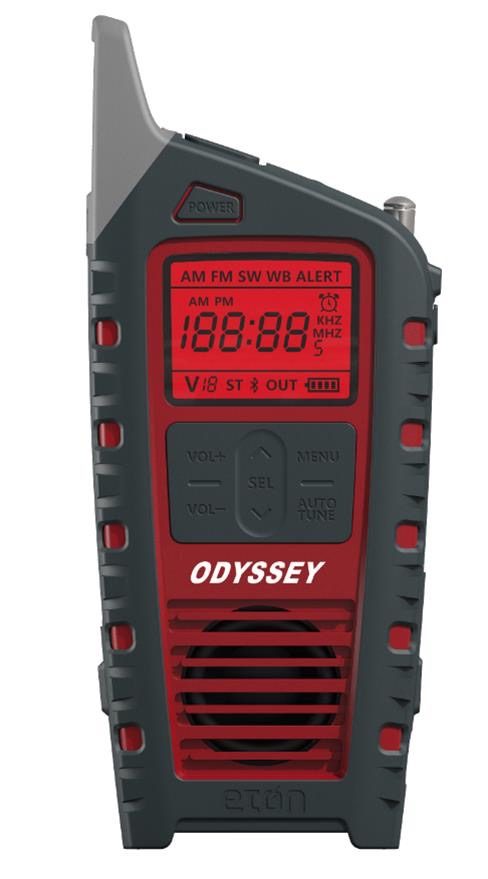
The Eton Odyssey is Eton’s newest emergency radio, sold in an American Red Cross edition, and it’s the only pick here with shortwave. Shortwave covers 3.2 to 22 MHz, so at night you can hear broadcasters hundreds or thousands of miles away when local stations are off the air.
It also has a proper alert mode, charges over USB-C, and runs on three AAA batteries if the internal cell is empty. That makes it the pick for anyone who likes to listen beyond the local news, or who wants a backup that takes batteries from any store.
Key specs
- Bands: AM 520 to 1710 kHz, FM 76 to 108 MHz, shortwave 3.2 to 22 MHz, all 7 weather channels
- Weather alert: Alert mode turns the audio off, keeps watching your weather station and turns the sound back on when an alert goes out
- Battery: 18650 lithium cell (Eton lists 2,600 mAh), or three AAA alkaline batteries
- Charging: USB-C, solar panel (10 to 12 hours of sun for a full charge), hand crank
- Crank: 4 minutes gives 10 to 15 minutes of radio, by Eton’s figure
- Phone charging: USB-A at 5 V, 2 A
- Light: spotlight, floodlight or both, plus a red SOS beacon
- Extras: Bluetooth 5.0 speaker, headphone and aux jacks
- Water: IPX4 splash resistant
- Weight: 1 lb 6 oz
Pros and cons
Pros
- Only shortwave radio in this guide
- Runs on AAA batteries when the cell is flat
- Uses a standard 18650 cell you can replace
Cons
- Slowest crank here for the radio time you get
- Shortwave takes some practice to tune
- Needs the antenna out near a window for weak stations indoors
Performance analysis
The 18650 cell is the detail I like most. It’s the same size cell many flashlights run on, so a spare charged in an 18650 battery charger gets the Odyssey back to full in the time it takes to swap it. If you already carry an 18650 flashlight, you may have spare cells that fit.
The crank is the weak spot. Four minutes of turning for 10 to 15 minutes of radio is enough to hear the next forecast, but it won’t run the radio all evening. Keep the cell charged and treat the crank as a last resort.
For alerts, tune your weather station first, then press the Menu button until Alert shows. The manual notes that NOAA sends a test alert each Wednesday, which is a handy way to confirm it’s set up right.
4. C. Crane CCRadio Solar BT: Best for Long Outages
Why I chose it and who it’s for
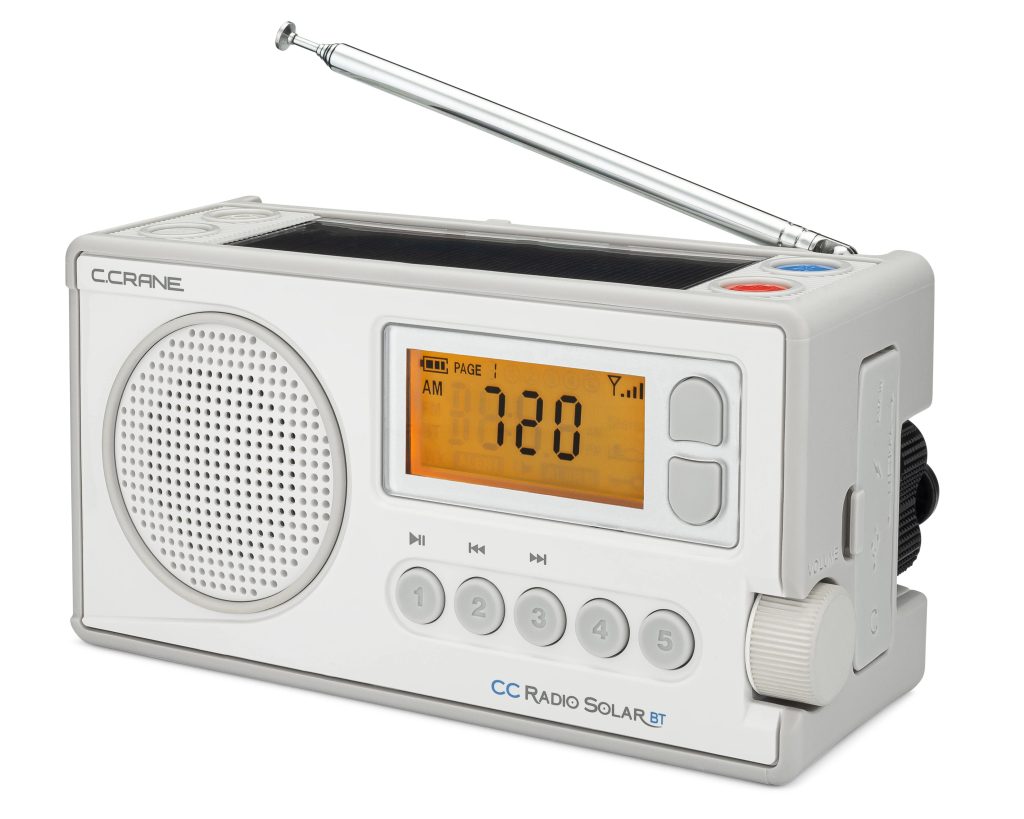
C. Crane built its name on AM reception, and AM is where local news and emergency information live when a disaster hits. The C. Crane CCRadio Solar BT brings that to a crank radio with the longest runtime in this guide. C. Crane rates it at more than 50 hours on its 3,400 mAh cell, and when that’s gone it runs on three AA batteries.
It’s the one I’d pick for places where outages run for a week, like hurricane country or rural areas at the end of the line.
Key specs
- Bands: AM 520 to 1710 kHz, FM 87.5 to 108 MHz, all 7 weather channels
- Weather alert: alert monitor set for 4, 8 or 16 hours or left on; beeps for two minutes when NOAA sends an alert
- Battery: 3,400 mAh 18650 lithium-ion, or three AA alkaline batteries
- Runtime: more than 50 hours on the cell; about 35 hours on AA in high power mode and 50 in low power mode
- Charging: micro USB, solar panel, hand crank
- Phone charging: USB out, enough to take a phone from about half to full
- Speaker: 2 inch, 3 W, with Bluetooth in, line in and a headphone jack
- Size and weight: 6 x 3 x 2.5 in, 1.1 lb
Pros and cons
Pros
- Longest rated runtime here
- AA backup you can buy anywhere
- Weather alerts stay armed while you listen to AM or FM
Cons
- Micro USB rather than USB-C
- Solar charging is very slow
- Modest phone charging
Performance analysis
The alert monitor works differently from the others. You set it to watch for 4, 8 or 16 hours, or leave it on, and you can keep listening to AM or FM while it watches. When NOAA sends an alert, it beeps for two minutes straight, which is hard to sleep through.
C. Crane gives a plain number for solar. Its own figure is about 42 hours of direct sun to fill the battery from one bar, so treat the panel as a trickle that keeps a charged radio topped up. For a long outage, a box of AA batteries is the real backup.
The 18650 cell is replaceable here too. C. Crane specifies a protected cell, which runs a little longer than a bare one, so buy spares that match.
5. Midland ER210: Best Compact
Why I chose it and who it’s for
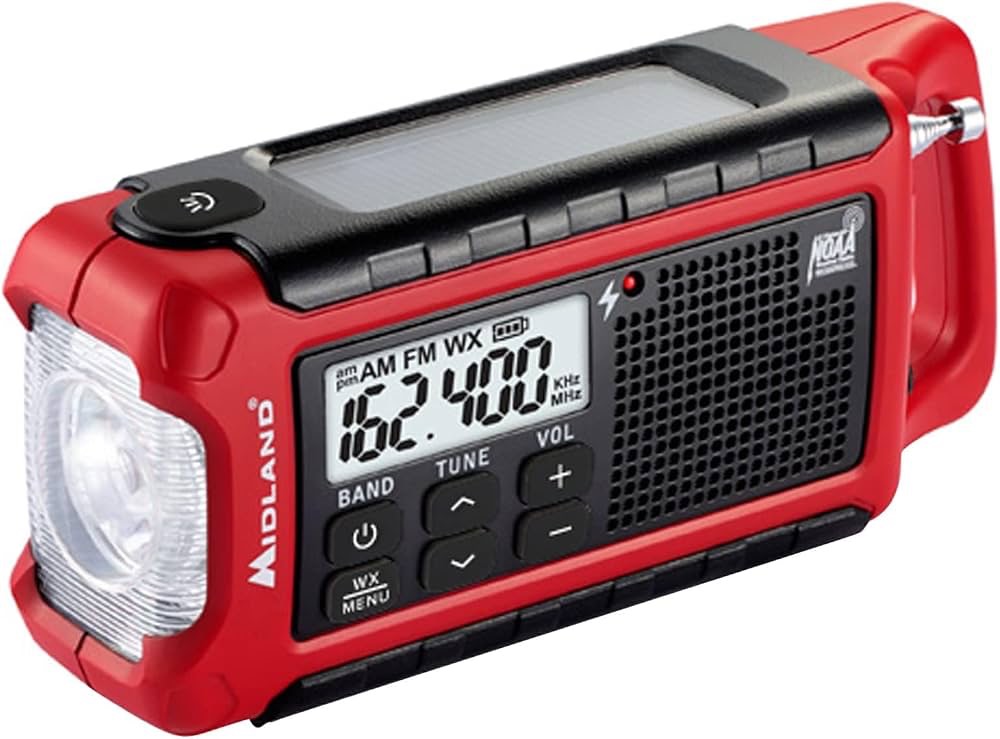
The Midland ER210 is the radio for a glove box, a go bag or a desk drawer at work. It measures 6.5 x 2.8 x 1.9 inches, and it keeps the feature that counts: weather alerts that sound on their own when the Weather Service issues one for your channel.
Midland also gave it a brighter flashlight than its size suggests, at 130 lumens, with an SOS beacon that flashes Morse code.
Key specs
- Bands: AM, FM and all 7 weather channels
- Weather alert: sounds automatically for alerts on your local channel, including the weekly test
- Battery: 2,600 mAh lithium-ion
- Runtime: up to 25 hours of normal use, by Midland’s rating
- Charging: micro USB, solar panel, hand crank
- Light: 130 lumen flashlight with high and low, plus an SOS Morse beacon
- Size: 6.5 x 2.8 x 1.9 in
Pros and cons
Pros
- Smallest radio in this guide
- Bright flashlight for its size
- Alerts sound with no menu to set
Cons
- Micro USB rather than USB-C
- Midland says many newer phones may not charge from it
- The alarm also sounds for the weekly test, with no off setting listed
Performance analysis
Midland’s support page says the ER210 sounds an 8 second alarm for every alert on its channel, the weekly test included, and its FAQ lists no way to turn that off. Hold the WX button for two seconds to silence it. I see that as a plus for a radio that lives in a drawer, because the weekly chirp tells you it still works.
The phone charging is the weak spot. Midland’s own FAQ warns that many newer iPhones and Android phones may not charge from its power bank. If topping up a phone matters to you, step up to the Midland ER310PRO. And if it rides in a glove box, bring it inside on the hottest summer days, since heat is hard on any lithium battery.
6. Eton FRX3+: Simplest to Use
Why I chose it and who it’s for
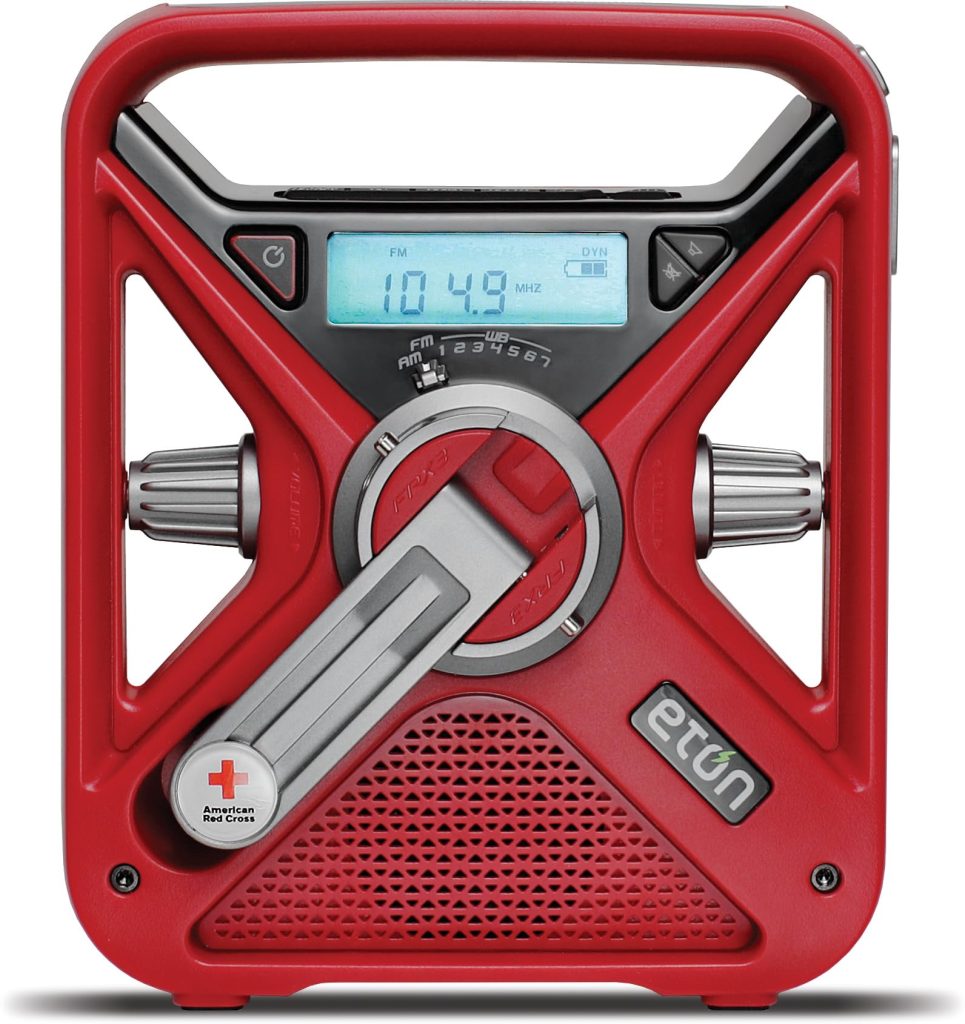
The FRX3 has been a staple of Red Cross emergency kits for years, and the Eton FRX3+ is the current version. It’s the radio I’d hand to a child, a grandparent or anyone who will never read a manual. There are few buttons, the turbine crank is easy to grab, and a glow-in-the-dark locator helps you find it in a dark closet.
It’s an older design, and the mini USB charging port shows it. I kept it in because Eton doesn’t sell a newer crank radio with an alert mode in this size, and the simple layout still earns its place.
Key specs
- Bands: AM and FM with digital tuning, all 7 weather channels
- Weather alert: with Alert on, the radio switches itself on for NOAA alerts
- Battery: 2,600 mAh rechargeable
- Charging: mini USB, solar panel, turbine hand crank
- Crank: 1 minute gives 15 to 20 minutes of radio, by Eton’s spec sheet
- Phone charging: USB port for most smartphones
- Light: LED flashlight, red flashing beacon and a glow-in-the-dark locator
- Extras: alarm clock, aux in, headphone jack
- Size and weight: 6.9 x 5.8 x 2.6 in, 0.93 lb
Pros and cons
Pros
- Simplest controls of the six
- Lightest full-size radio here
- Best crank-to-radio-time figure in the lineup
Cons
- Mini USB cables are getting hard to find
- No water resistance rating
- Phone charging is slower than a wall charger
Performance analysis
Eton’s spec sheet puts the crank at 15 to 20 minutes of radio per minute of cranking, the best ratio here, though its FAQ quotes a more cautious 10 to 15 minutes. Either way, a few minutes of cranking gets you the next forecast.
Keep the mini USB cable it comes with in a zip bag taped to the radio. Most homes don’t have a spare anymore, and a radio you can’t charge from the wall leans entirely on its crank and panel.
NOAA Station Finder: Your Frequency and County Code
A weather alert only works if the radio is tuned to the transmitter that covers you. Pick your state and county below to see which NOAA station that is, the frequency to tune, the weather channel number most radios use for it, and whether NOAA lists it as on the air. You’ll also get your county’s six digit SAME code for any radio that takes one.
NOAA covers most of the country with about a thousand transmitters, and many counties are reached by two or more. If the first station comes in weak, tap the next one in the finder and try that.
How to Choose a Hand Crank Radio
Weather alert or just a weather band
This is the first thing I check. A weather band means the radio can play the NOAA broadcast while you listen. A weather alert means the radio sits in standby, listens for the Weather Service’s alert tone, and switches its sound on by itself. Only the second one wakes you up.
Many cheap crank radios list “NOAA” on the box and have only the band. Every radio in this guide has a true alert mode, though you have to turn it on and tune it to your station.
What SAME adds
SAME stands for Specific Area Message Encoding. The Weather Service attaches a code to each warning that names the counties it covers, and a SAME radio only sounds when your county’s code is on the list. The National Weather Service’s SAME page explains how it works and how to get your code, which the finder above also gives you.
None of the six crank radios here has SAME. They sound for every alert on the station you tune, and one transmitter can cover several counties. That’s fine for a radio you use during an outage. For a radio on the nightstand all year, a tabletop SAME alert radio is the better tool, and your crank radio covers you when the power is out.
How much cranking really buys you
Cranking is the backup to the backup. One minute of cranking gives about 10 to 20 minutes of playback on the Midland ER310PRO and 15 to 20 minutes on the Eton FRX3+, while the Eton Odyssey needs four minutes for 10 to 15 minutes of radio. Turn on the flashlight or charge a phone and that time drops fast.
The plan that works is simple. Charge the radio from the wall before storm season, top it up every few months, and save the crank for when everything else is gone.
Solar is a trickle
The small panel on top keeps a charged radio full on a sunny windowsill. It won’t refill an empty battery quickly. C. Crane says its panel needs about 42 hours of direct sun to fill the CCRadio Solar BT from one bar, and Eton quotes 10 to 12 hours for the Odyssey’s smaller panel. Put the radio in a south-facing window during an outage and let it work all day.
Battery size and backup batteries
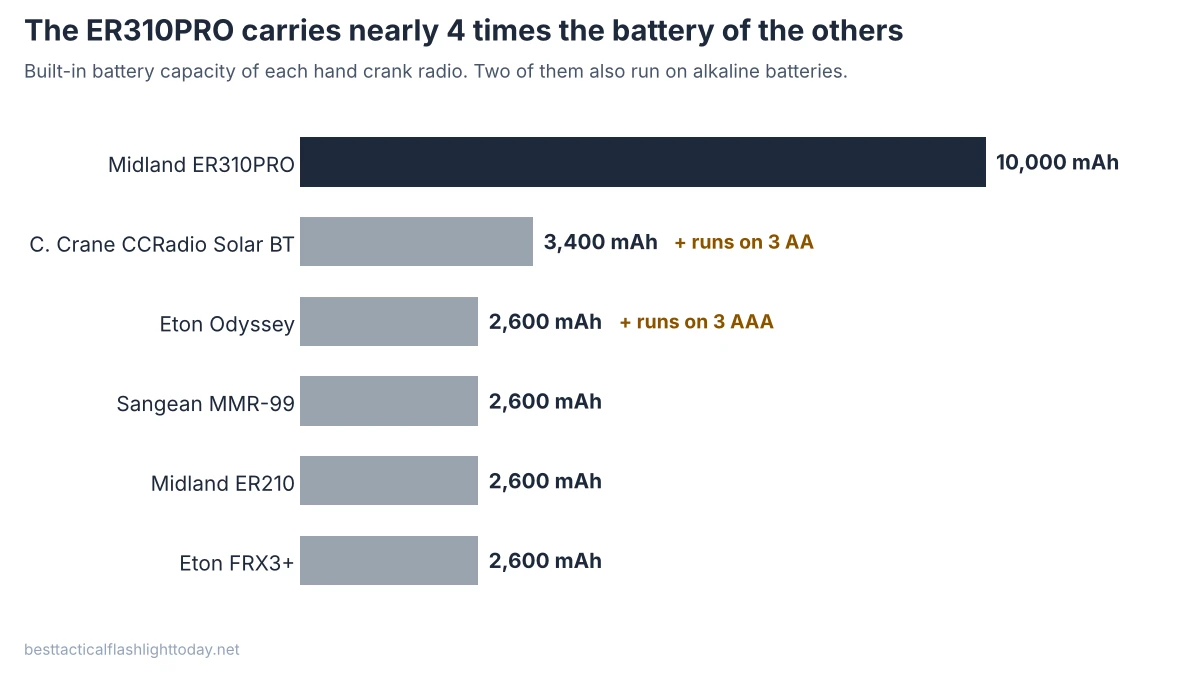
The ER310PRO’s 10,000 mAh battery is nearly four times the size of most of the others, which is why it can charge phones and still run for days. Capacity isn’t the whole story, though. The Eton Odyssey runs on three AAA batteries and the C. Crane on three AA, so a drawer of alkaline batteries keeps them going long after any built-in battery is empty. If you live where outages last a week, I’d want one of those two.
Phone charging
Most crank radios have a USB port for phones, but only a big battery makes it useful. The ER310PRO can recharge most phones about three times, by Midland’s figure. The rest give a phone enough for a call or two and the weather radar. For keeping phones and a CPAP running for days, a portable power station does that job properly.
The flashlight and other extras
Every radio here has a flashlight, and the Sangean’s is the most useful. A radio light is still a backup, though. For moving around a dark house, a proper rechargeable headlamp keeps your hands free, and a battery lantern lights a whole room.
Shortwave matters if you want news from farther away, and only the Odyssey has it. Bluetooth is nice for music on a normal day, but it drains the battery, so I’d leave it off during an outage.
AM, FM and shortwave
In a big storm, AM is the band I’d tune first. AM signals carry farther than FM, especially at night, and FEMA’s Primary Entry Point program gives dozens of radio stations, many of them on AM, backup generators so they can keep broadcasting through a disaster. FM sounds better and carries the local stations that often run emergency coverage. Shortwave is for distant news, and it works best at night, when signals travel farthest.
Weather channel numbers
Most radios label the seven NOAA frequencies as weather channels 1 to 7 instead of showing the frequency. The usual order puts channel 1 at 162.550 MHz, channel 2 at 162.400, channel 3 at 162.475, channel 4 at 162.425, channel 5 at 162.450, channel 6 at 162.500 and channel 7 at 162.525. The finder above shows both the frequency and the channel number, but check your radio’s manual, since a few models order them differently.
Where to keep it and how to test it
Keep the radio where the whole family knows to find it, with its cable and a set of spare batteries if it takes them. Ready.gov’s basic supply kit lists a battery-powered or hand crank radio along with a NOAA weather radio with tone alert, so a crank radio with an alert mode covers both lines.
Most Weather Service offices send a test alert once a week, usually on Wednesday. Leave the alert mode on one Wednesday and listen for it. If you hear it, the radio is set up right. The rest of an outage plan, from lights to food, is in my power outage emergency kit guide, and the power outages by state page shows how long outages tend to last where you live.
Frequently Asked Questions
Do hand crank radios really work?
Yes, as long as you treat the crank as a backup. A charged hand crank radio from a known brand runs for a day or more on its battery and picks up AM, FM and NOAA weather. The crank keeps it going when the battery is empty, at roughly 10 to 20 minutes of radio per minute of cranking on the better models.
How long do you have to crank a hand crank radio?
It depends on the radio. Midland rates one minute of cranking on the ER310PRO at about 10 to 20 minutes of playback, while the Eton Odyssey needs about four minutes for 10 to 15 minutes. Running the flashlight or charging a phone uses that power much faster, so crank for a few minutes at a time and listen at low volume.
Can a hand crank radio get NOAA weather alerts?
Some can. A radio with only a weather band plays NOAA when you tune in, but a radio with an alert mode switches itself on when the Weather Service sends a warning. All six radios in this guide have an alert mode. For alerts limited to your own county, you need a radio with SAME.
What frequency is NOAA weather radio?
NOAA Weather Radio broadcasts on seven frequencies: 162.400, 162.425, 162.450, 162.475, 162.500, 162.525 and 162.550 MHz. Most radios label them as weather channels 1 to 7. The NOAA Station Finder above shows which one covers your county.
The Bottom Line
For most homes, the Midland ER310PRO is the hand crank radio to buy. Its 10,000 mAh battery runs the radio for days, charges your phone, and the alert mode wakes you when a warning goes out.
If the radio will live in a truck, garage or camp box, get the Sangean MMR-99. Shortwave listeners should pick the Eton Odyssey, and for outages that last a week, the C. Crane CCRadio Solar BT keeps going on AA batteries. The Midland ER210 fits a glove box or go bag, and the Eton FRX3+ is the easy one for kids and older relatives.
Whichever you pick, look up your station in the NOAA Station Finder above, set the alert, and listen for the weekly test. Keep a flashlight for power outages next to it, and grab the free Lights Out kit for the rest of the plan.
