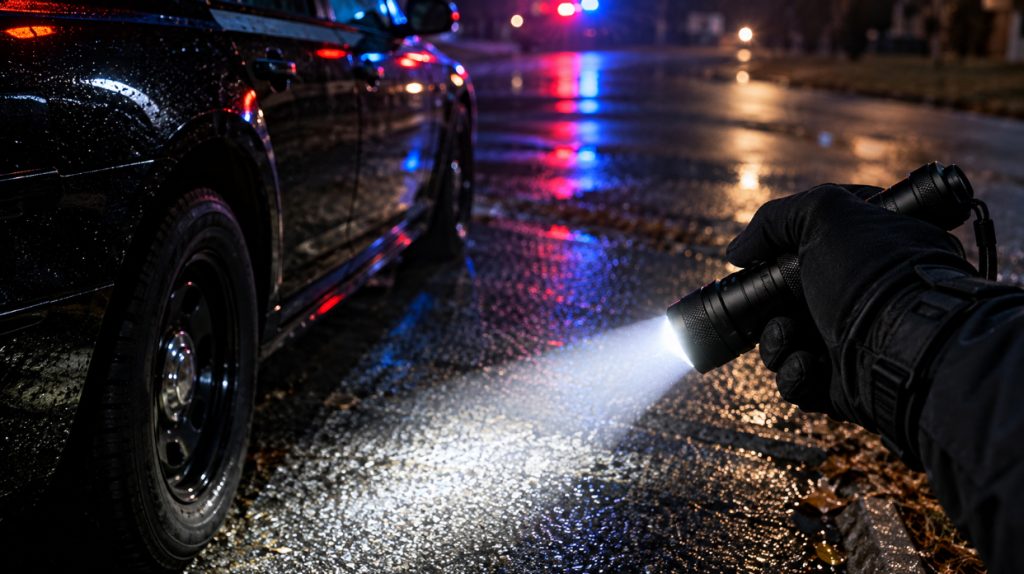
A police flashlight gets used in short, hard bursts all shift long. You light a driver’s hands at a traffic stop, check a back seat, clear a dark stairwell and read a VIN plate, then do it again an hour later. Across ten or twelve hours that adds up, and a light picked for its Turbo number can be close to dead by the end of the night.
I compared six duty lights from Fenix, Streamlight and Olight on what matters at work: the output each one holds at a usable working level, how long it runs there, how it charges and how it carries on a belt, a vest or in a pocket. Every spec below comes from the maker’s own figures.
Further down, the Duty Light Matcher takes your shift length, your main job, how you carry and where you can charge, and shows how much battery each light has left when your shift ends.
Quick Picks
Police Flashlights Compared
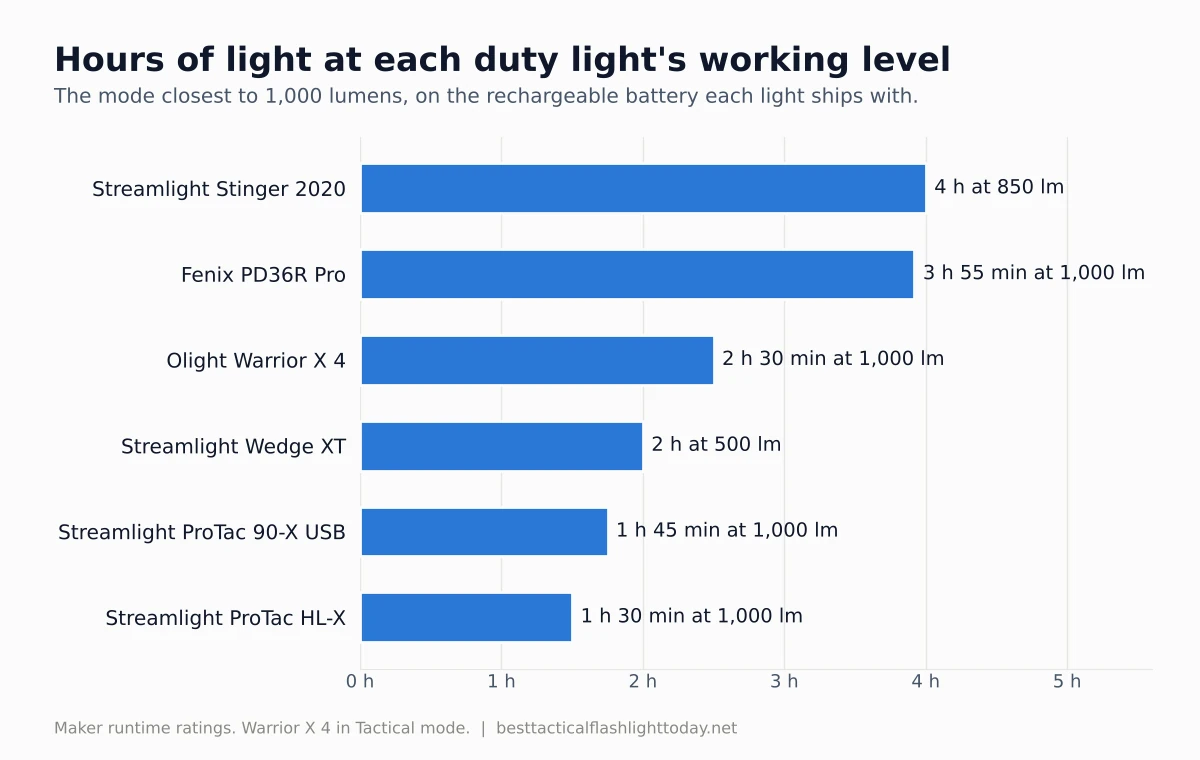
Working level is the mode closest to 1,000 lumens, which is plenty for most duty tasks. Runtimes are the maker’s ratings for the rechargeable battery each light ships with.
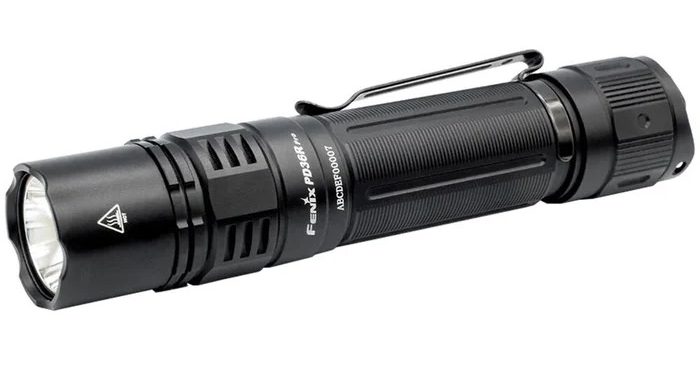
1. Fenix PD36R Pro: Best Overall
Why I chose it and who it’s for
The PD36R Pro is the light I’d put on most duty belts. Two buttons sit side by side on the tail. The round one gives momentary or constant on, and the oval one changes brightness and fires strobe, even from off. Your thumb never has to leave the back of the light.
It holds 1,000 lumens for 3 hours 55 minutes, enough for a long shift of stops and calls without a spare. It’s best for patrol officers and security guards who want one light for the whole shift.
Key specs
- Output: 2,800 Turbo, 1,000 High, 350 Medium, 150 Low, 30 Eco, plus strobe
- Reach: 36,600 candela, 380 m beam
- Runtime: 3 h 55 min on High, 8 h 15 min on Medium
- Battery: Fenix 5,000 mAh 21700, USB-C port on the light, about 3 hours to charge
- Build: waterproof to 2 m, 5.74 in, 5.96 oz
- In the box: holster, lanyard, clip
Pros and cons
Pros
- Both tail switches work through gloves
- A useful 1,000 lumens for nearly four hours
- Works with Fenix’s AER-05 remote switch for a long gun mount
Cons
- Fenix only recommends its own ARB-L21 cells
- It remembers the last mode, so leave it on High
Performance analysis
Fenix says the Turbo runtime counts time at reduced output after the light heats up, and Turbo won’t engage below about half charge. High is the level you’ll actually live on, and at 1,000 lumens it’s more than enough indoors.
The light comes back on at the last mode you used. If you dropped to Eco to read a license, click back to High before it goes in the holster.
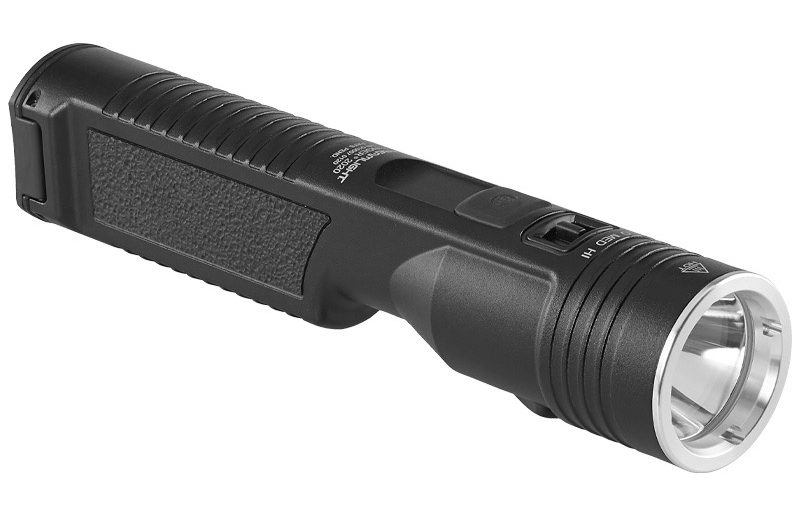
2. Streamlight Stinger 2020: Best for the Cruiser
Why I chose it and who it’s for
The Stinger has ridden in patrol cars since the early 1990s, and the 2020 is the current design. Streamlight says it charges in existing Stinger chargers, so a car already wired for Stingers needs no new hardware. It also charges by USB.
A slide switch on the body sets High, Medium or Low before you press anything, so the light comes on at the level you chose every time. It’s best for officers whose car has a Stinger charger.
Key specs
- Output: 2,000 High, 850 Medium, 100 Low, plus strobe
- Reach: 25,000 candela, 315 m beam on High
- Runtime: 2 h High, 4 h Medium, 24 h Low
- Battery: two SL-B26 packs; Stinger chargers, USB or bank charger
- Build: IPX7, 2 m impact tested, 7.67 in, 12.3 oz
- Holster: nylon or leather, sold separately
Pros and cons
Pros
- Fits chargers many cars already have
- Mode selector removes the guesswork
- Anti-roll body with a textured grip
Cons
- 12.3 oz is heavy on a full duty belt
- Holster costs extra
Performance analysis
Medium is the setting to leave it on. At 850 lumens for 4 hours it covers searches and stops, and High is there for open ground. Streamlight’s smart charger refills it in about 6 hours on 12V, so a light that rides in the dock is full at the start of every shift.
The newer Stinger 2020 S runs on one 5,200 mAh pack and adds a PiggyBack charger that tops up a spare at the same time. Both charge in existing Stinger chargers, so check which version the listing shows.
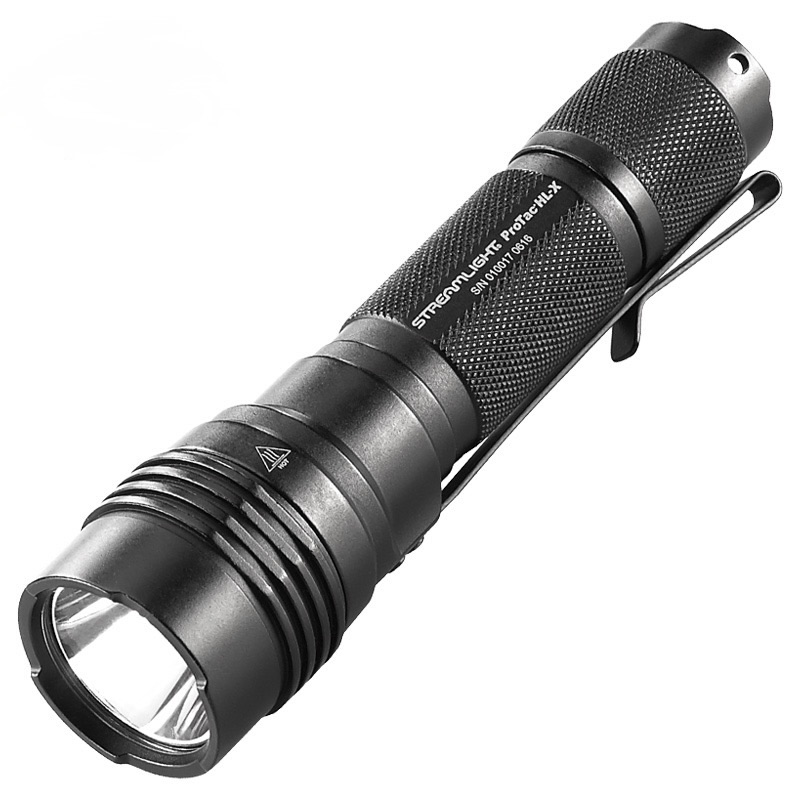
3. Streamlight ProTac HL-X: Best Value
Why I chose it and who it’s for
The HL-X is the light I’d suggest to an academy recruit or a new security guard. It’s a small Streamlight with a proper tail switch, 1,000 lumens and TEN-TAP programming, so you can set it to High only and get the same light every time.
It runs on Streamlight’s SL-B26 rechargeable pack or two CR123A cells you can buy almost anywhere. It’s best for anyone who wants a proven duty light without paying for a flagship.
Key specs
- Output: 1,000 High, 400 Medium, 65 Low, plus strobe
- Reach: 27,100 candela, 330 m beam
- Runtime (SL-B26): 1.5 h High, 3.5 h Medium, 23 h Low
- Battery: SL-B26 pack with micro-USB port, or 2x CR123A
- Programs: High/strobe/Low, High only, or Low/Medium/High
- Build: IPX7, 2 m impact, 5.43 in, 6.2 oz; holster and clip included
Pros and cons
Pros
- CR123A backup power
- High only program for duty use
- Holster and pocket clip in the box
Cons
- 1.5 hours on High is short for a long shift
- Charges by micro-USB, not USB-C
Performance analysis
The short High runtime is the weak spot. On a busy ten hour shift you’ll likely need a refill, so carry two CR123A cells in a pocket. The light runs on either, and lithium cells keep for years in a gear bag.
If most of your work is close range, the low/medium/high program starts you at 65 lumens and saves the battery for when you need it.
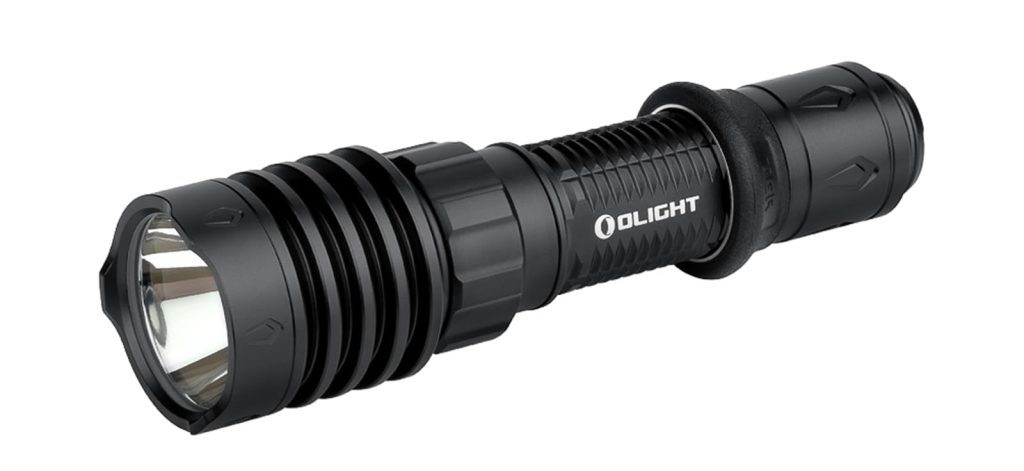
4. Olight Warrior X 4: Best Long Reach
Why I chose it and who it’s for
On a highway shoulder, a field or the far end of a big lot, reach matters more than lumens. The Warrior X 4 puts out 99,310 candela, rated to 630 meters, the most reach here. Tactical mode holds 1,000 lumens for 150 minutes and keeps the full 2,600 lumens for strobe.
It also vibrates when the battery runs low, so you find out without looking at an indicator. It’s best for rural deputies, highway patrol and security on large sites.
Key specs
- Output: 2,600 Turbo for about 3 min, then 1,000; 300 Low for 8 h
- Tactical mode: 1,000 lm for 150 min, 2,600 lm strobe
- Reach: 99,310 candela, 630 m beam
- Battery: Olight 5,000 mAh 21700, USB-C or MCC3 magnetic
- Build: IPX8, 2 m impact, 5.87 in, 8.78 oz
- In the box: holster
Pros and cons
Pros
- Longest reach in this group
- Vibrating low battery alert
- Two ways to charge
Cons
- Tight hotspot with little spill for room work
- 8.78 oz is heavier than the Fenix
Performance analysis
ANSI beam distance is where the light falls to about the brightness of a full moon, so you’ll identify a person well short of 630 meters. Even so, nothing else here reaches as far across open ground.
Indoors, that tight hotspot is a drawback. It lights a small circle and leaves the edges of a room dark, so pair it with a floodier light if you clear buildings often.
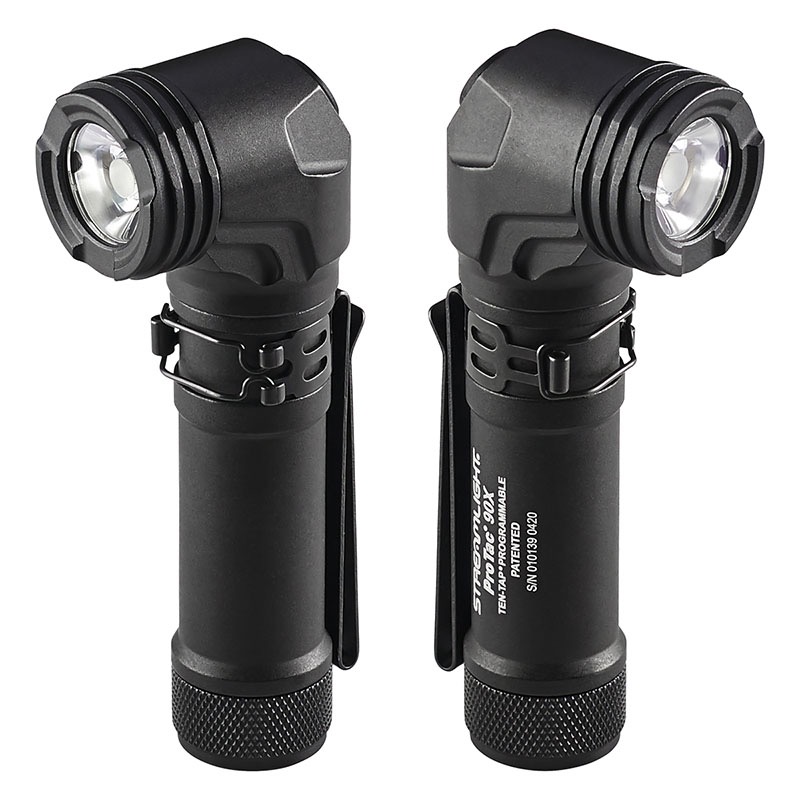
5. Streamlight ProTac 90-X USB: Best Hands-Free
Why I chose it and who it’s for
Traffic stops, crash scenes and notebook work all need light while both hands are busy. The 90-X puts a 1,000 lumen head at a right angle, and its removable clip attaches to MOLLE, belts and harnesses, so the beam points where you face.
It uses the same multi-fuel setup as the HL-X: an SL-B26 pack or two CR123A cells. It’s best as a second light on the vest, or for anyone who often has a radio or a pen in hand.
Key specs
- Output: 1,000 High, 300 Medium, 65 Low, plus strobe
- Reach: 171 m beam on High
- Runtime (SL-B26): 1 h 45 min High, 4 h 45 min Medium, 24 h Low
- Battery: SL-B26 pack or 2x CR123A
- Build: IPX7, 2 m impact, 4.39 in, 4.9 oz
- Carry: removable clip for MOLLE, belts and harnesses; nylon holster
Pros and cons
Pros
- Hands-free on a vest
- Short enough for a pocket
- CR123A backup power
Cons
- 171 m is short for open ground
- Micro-USB on the battery pack
Performance analysis
Medium at 300 lumens for 4 h 45 min is the level for close work, like a license or a dashboard. High is useful for a quick look down an alley, but the beam is wide and won’t reach far.
That’s why I’d pair it with a handheld like the PD36R Pro rather than carry it alone.
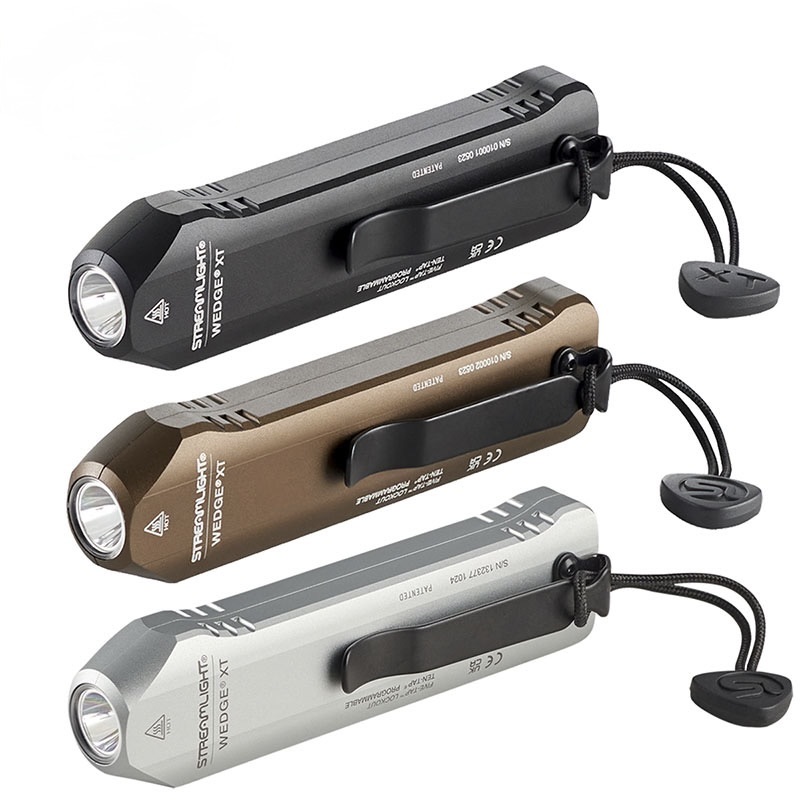
6. Streamlight Wedge XT: Best Plainclothes and Backup
Why I chose it and who it’s for
Detectives, plainclothes officers and off duty carriers need a light that doesn’t print through a shirt. The Wedge XT is a flat bar 4.25 inches long and 0.6 inch thick, and it weighs 2.62 ounces.
It still has a tail switch with momentary on, and a Five-Tap lockout stops it switching on in a pocket. It’s best as a plainclothes light and as the backup on a uniform.
Key specs
- Output: 500 High, 50 Low
- Reach: 1,900 candela, 87 m beam
- Runtime: 2 h High, 11 h Low
- Battery: built-in 950 mAh, USB-C, about 6 hours to charge
- Build: IPX7, 1 m impact, 2.62 oz
- Controls: tail switch, Five-Tap lockout, TEN-TAP mode order
Pros and cons
Pros
- Disappears in a pocket
- Lockout for pocket and bag carry
- USB-C charging
Cons
- Built-in battery can’t be swapped
- 87 m of reach is close range only
Performance analysis
Five hundred lumens lights a face across a room or a parking space, which is the job of a backup light. It won’t search a field.
The fixed battery means no spares, so charge it with your phone each night. For more flat lights, see my best EDC flashlights guide.
Duty Light Matcher: Which Light Lasts Your Shift?
Pick your shift length, the work you do most, how you carry and where you can charge. The tool works out how much battery each light has left at the end of the shift at the level that job needs, then ranks all six.
Estimates use each maker’s rated runtime and a typical amount of light use for each job, shown under the result. A busy night will use more.
How to Choose a Police Flashlight
Judge the working level, not Turbo
The biggest number on the box is usually a burst. The PD36R Pro is rated at 2,800 lumens, but the figure that decides your shift is 1,000 lumens for 3 hours 55 minutes. Compare lights at the level you’ll use for a search, not at their peak.
Candela for reach, spill for close work
Lumens tell you how much light comes out. Candela tells you how far the beam reaches. A tight, high candela beam suits roads and fields, and a wider beam suits rooms and car interiors. My candela vs lumens guide explains the math, and my best throw flashlights go further if reach is everything.
A tail switch with momentary on
All six picks put the main switch at the tail, with momentary on. That’s what the common duty grips assume, since your thumb works the light while your hand stays on it. My guide to using a flashlight as a weapon walks through those grips.
Plan for the whole shift
Work out where you’ll charge. A car dock or USB port lets you top up between calls. If you can only charge at home, pick a light with long runtime at its working level, or one that takes CR123A cells as a backup, like the HL-X and 90-X.
How you carry it
A belt holster suits a full size light, and a vest needs a clip or a MOLLE holster. Weight adds up on a duty belt, so the 5.96 oz PD36R Pro is easier to live with than the 12.3 oz Stinger. Plainclothes carry calls for something flat, like the Wedge XT.
Handheld light vs weapon light
A handheld light is for searching and identifying. A weapon light only comes into play when pointing a gun is justified, so it never replaces a handheld. If you need one, see my best pistol lights and best AR-15 lights.
Check your agency’s policy
If your agency keeps an approved equipment list, check it before you buy. A toothed strike bezel can also draw questions after a use of force. My self defense flashlight guide covers the trade-offs of bezels and strobe.
For security guards
Foot patrols mean more time with the light on at a lower level. The PD36R Pro runs 8 h 15 min at 350 lumens and the Warrior X 4 runs 8 hours at 300, which covers most security shifts on one charge. Check your employer’s rules on strobe and on what you can carry.
Frequently Asked Questions
What flashlight do most police officers use?
There isn’t one standard light across U.S. agencies. Many issue or approve a short list, and Streamlight’s Stinger and ProTac lines, Fenix and SureFire are common on duty belts. Almost all are rechargeable LED lights with a tail switch.
How many lumens does a police flashlight need?
About 500 to 1,000 lumens covers most duty work, and more mainly helps outdoors. For reach, look at candela instead. A light with 25,000 candela or more will light a person across a parking lot.
Is a rechargeable flashlight better for police work?
For daily use, yes. A rechargeable light costs less to run and can charge in the car. A multi-fuel light that also takes CR123A cells is the safest choice, since a flat battery never leaves you without light.
Why do police hold flashlights over the shoulder?
The overhand grip keeps the beam at eye level and pointed where they look, and it lets the light shine down over a car door or a dashboard. My flashlight grips guide shows how each grip works.
The Bottom Line
For most officers, the Fenix PD36R Pro is the one to buy. It has dual tail switches and holds 1,000 lumens for almost four hours, and it ships with a holster.
If your car has a Stinger charger, get the Streamlight Stinger 2020. Pick the Streamlight ProTac HL-X on a budget, the Olight Warrior X 4 for highways and fields, the Streamlight ProTac 90-X USB for hands-free work and the Streamlight Wedge XT for plainclothes or as a backup.
Whichever you choose, run it at its working level, keep it charged and carry a backup. For more lights built for this kind of work, see my best tactical flashlight picks.
