
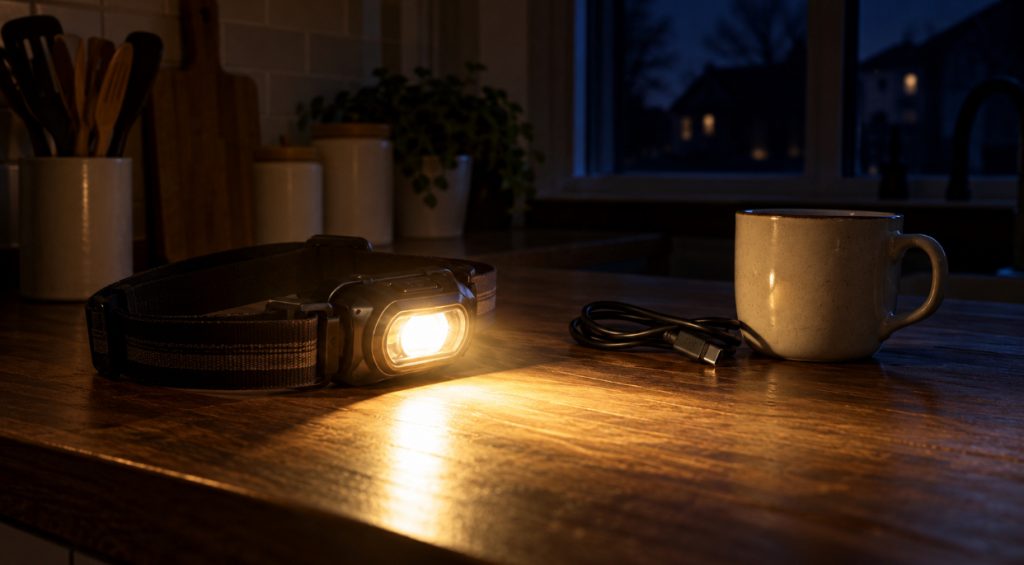
Most headlamp boxes lead with one number: max lumens. It’s the least useful number on the package. On most of these lights, turbo lasts a few minutes before the light steps itself down, and nobody walks a trail or cooks dinner in a blackout on turbo.
What you actually live on is the middle of the range, the 100 to 300 lumen modes, and how many hours you get there before the battery quits. That’s what this guide is built around. Every pick below comes with the maker’s runtime for each mode, and where independent bench tests found a lumen claim inflated, I say so.
There’s a pick for outages, running, hard hats and wet weather. To jump ahead, the Will It Last the Night? tool shows which of the seven gets you through the hours you need.
Quick Picks
Rechargeable Headlamps Compared
Max output is the maker’s figure. Independent tests measured less on the two marked “claimed”.
1. Petzl Actik Core: Best Overall
Why I chose it and who it’s for
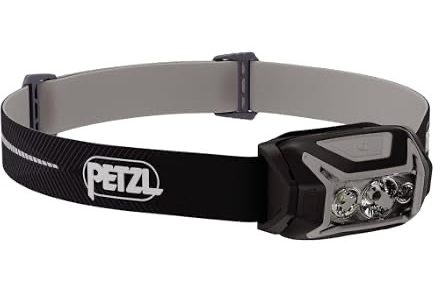
The Actik Core is the headlamp I’d hand to someone who wants one light for everything. It’s bright enough for a trail at 625 lumens, simple enough that you won’t need the manual, and its best trick matters more than any spec: when the rechargeable CORE battery is dead, three AAA batteries drop right in.
Petzl moved the CORE battery to USB-C on the 2025 version, which fixed owners’ main complaint. It suits hikers, campers and anyone building a home kit.
Key specs
- Max output: 625 lumens, 115 m beam
- Runtime: 625 lm for 2 h, 100 lm for 7 h, 7 lm for 100 h
- Battery: 1,250 mAh CORE pack, or 3 AAA batteries
- Charging: USB-C on the 2025 version
- Red light: steady and strobe
- Weight: 88 g
- Water rating: IPX4
Pros and cons
Pros
- Runs on AAA batteries when you can’t charge
- Brightness holds steady through the rated time on the CORE battery
- Light at 88 g, with a reflective band
Cons
- IPX4 handles rain, not a dunking
- The 100 lumen mode lasts 7 hours, which is short for a long outage
- Older stock still charges over micro-USB, so check that the listing says 625 lumens
Performance analysis
Medium at 100 lumens is where you’ll spend most of your time, and Low at 7 lumens is plenty for a tent or a midnight bathroom trip. On the CORE battery the output is regulated, so there’s no slow fade like you get on alkaline AAAs. Keep a pack of lithium AAAs as the spare and the Actik Core never really runs out.
2. Wurkkos HD20: Best for Power Outages
Why I chose it and who it’s for
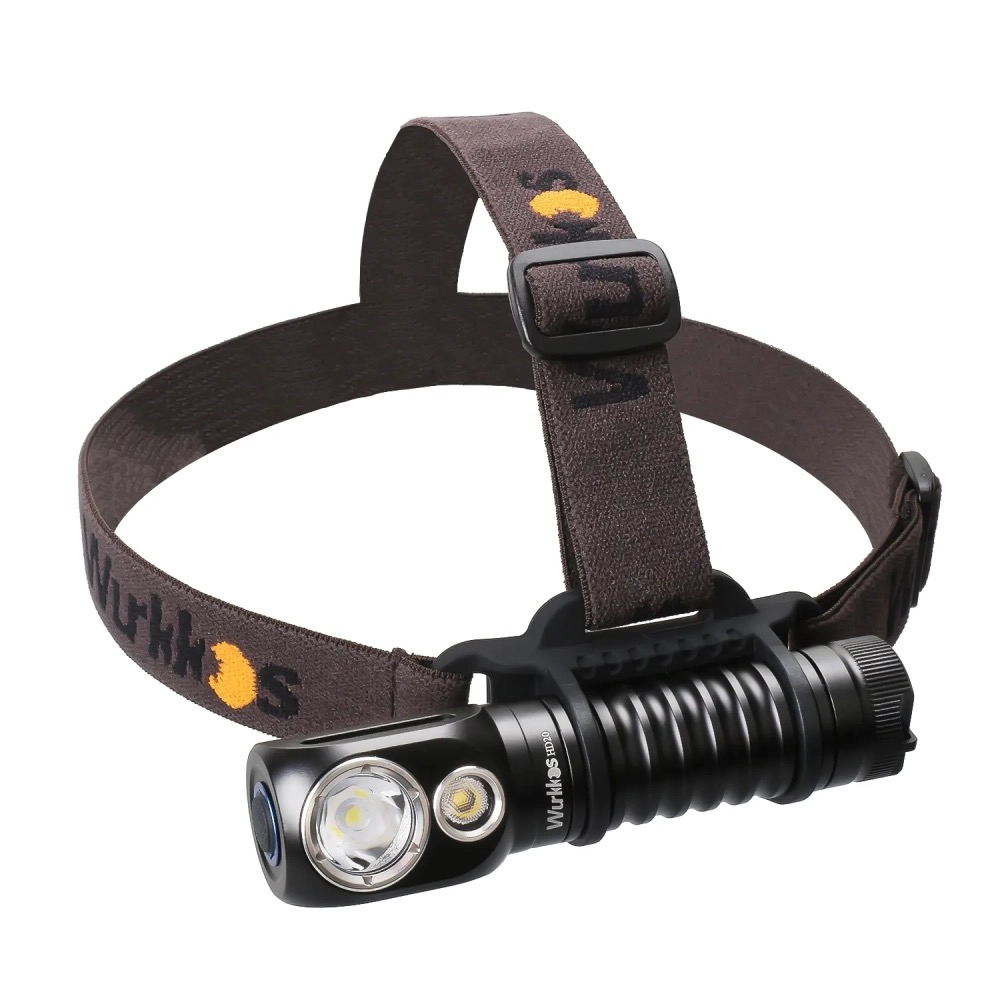
In a blackout you care about two things: does it last, and can it do more than light your face. The HD20 runs on a 21700 cell, far bigger than the packs built into most headlamps, and Wurkkos rates its 85 lumen mode at over 56 hours.
It doubles as a phone power bank, and the magnetic tail sticks to a fridge or breaker panel as a hands-free work light. It’s best for a home emergency kit.
Key specs
- Max output: 2,000 lumens claimed, spot and flood together
- Runtime (Wurkkos): 850 lm for 5 h 19 min, 260 lm for 22 h, 85 lm for 56 h, 2 lm for 960 h
- Battery: removable 21700, with an 18650 sleeve in the box
- Charging: USB-C, plus power bank output
- LEDs: XP-L spot and 90 CRI LH351D flood
- Extras: magnetic tail, lockout
Pros and cons
Pros
- Huge runtime on the low and medium modes
- Charges a phone in a pinch
- Magnetic tail turns it into a hands-free work light
Cons
- No red light
- An independent bench test measured about 1,213 lumens on turbo, well short of the 2,000 claim
- Heavier than built-in headlamps, about 130 g before the cell
Performance analysis
Take the 2,000 lumen figure with a grain of salt: the lower modes came in under the label too. In an outage you’d live on the 85 or 260 lumen setting anyway, and the cell keeps those going for nights. The 90 CRI flood shows colors properly, so food and labels look right. My 18650 vs 21700 guide explains why the bigger cell runs so much longer, and the Lumen Claim Checker in my budget guide lets you sanity check claims like this one.
3. Fenix HM65R V2.0: Brightest
Why I chose it and who it’s for
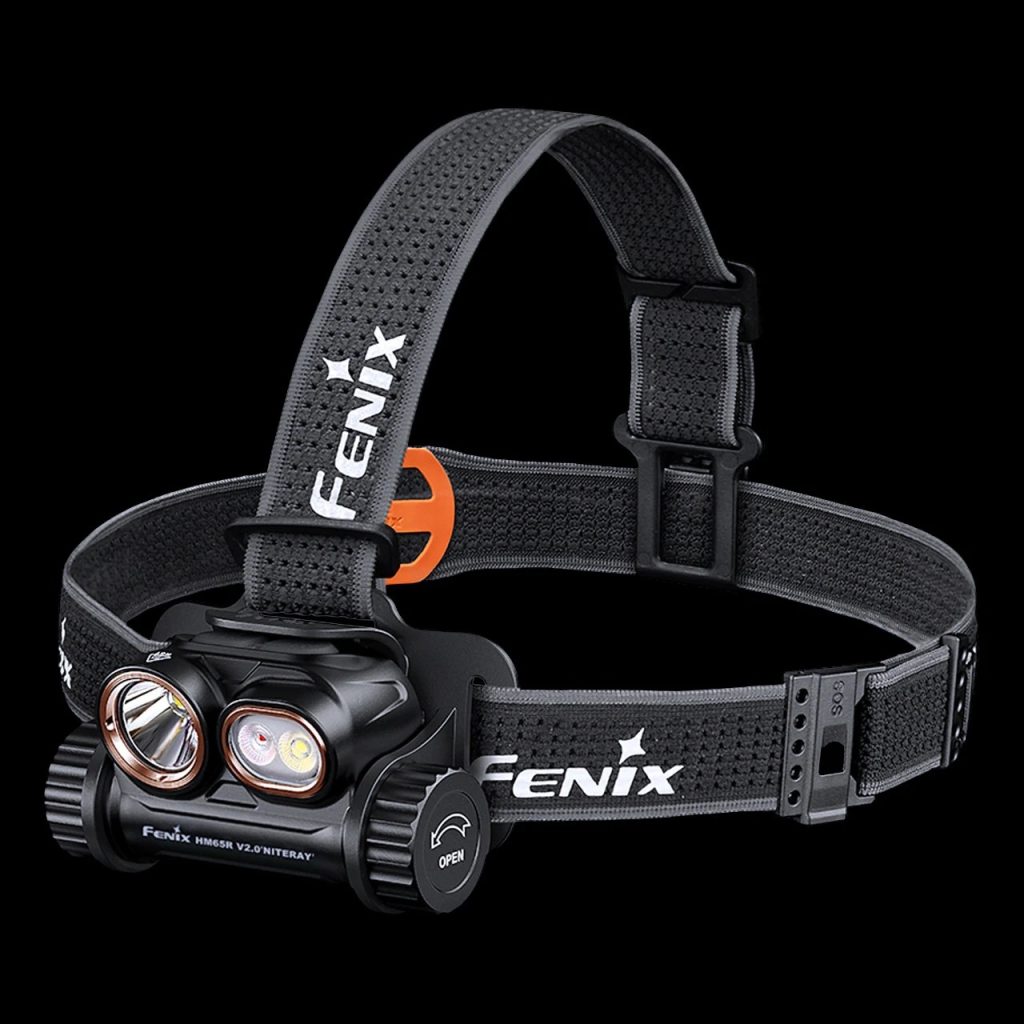
This is the most light you can wear from a brand that publishes real test numbers: 2,200 lumens with both LEDs on turbo, and a spot that throws 230 meters.
The part that matters is lower down: 600 lumens of spot for almost 9 hours, on an 18650 you can swap in seconds. It’s best for search work, long night hikes and anyone who already carries 18650s.
Key specs
- Max output: 2,200 lumens, 230 m throw
- Runtime (Fenix, ANSI FL1): spot 600 lm for 8 h 50 min, spot 150 lm for 22 h 30 min, flood 30 lm for 45 h, low 5 lm for 296 h
- Battery: removable 18650, 3,400 mAh, included
- Charging: USB-C behind a sealed inner port
- Durability: IP68, 2 m impact
- Weight: 144 g
Pros and cons
Pros
- Published runtime for every mode
- Sealed to IP68
- Spare 18650s are easy to find
Cons
- 144 g is noticeable on a long run
- One of the pricier picks here
- Turbo steps down to protect the cell, so plan around the 600 lumen mode
Performance analysis
Fenix rates every mode under the ANSI FL1 standard, so the numbers come from a fixed test method. Spot at 150 lumens for 22 and a half hours is the line that sells me: a full night on the trail on one cell, and a second 18650 doubles it. The 45 hour flood mode makes it a strong outage light too. If spot and flood are new to you, my guide to throw and flood beams covers the difference.
4. Black Diamond Spot 400-R: Best Waterproof
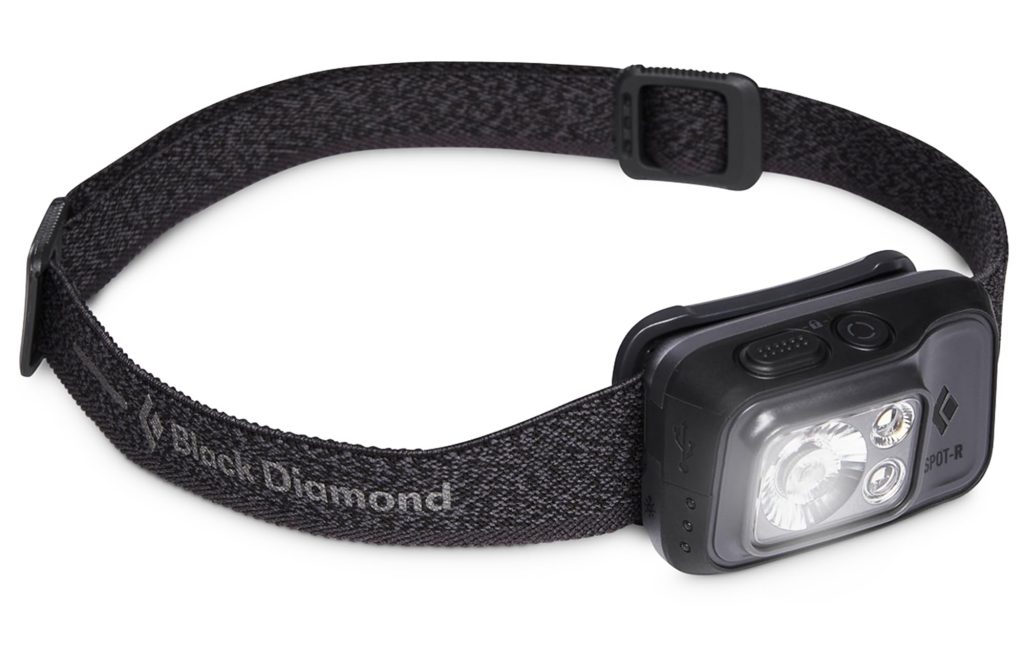
Why I chose it and who it’s for
Black Diamond rates the Spot 400-R to keep working after 30 minutes a meter underwater. That’s the toughest water rating on this list, and it’s why I’d pick it for paddling, soaked hikes or night fishing.
It’s also light at 86 g, and the battery meter shows the exact percentage left, so you’re never guessing.
Key specs
- Max output: 400 lumens, 100 m
- Runtime: 400 lm for 4 h, 200 lm for 8 h, 6 lm for 225 h
- Battery: built-in 1,500 mAh
- Charging: micro-USB
- Water rating: IP67, works after 30 min at 1 m
- Weight: 86 g
- Extras: battery meter, PowerTap, lockout, red light with dimming
Pros and cons
Pros
- Toughest water rating on the list
- PowerTap jumps between full and dimmed power with one tap
- Battery meter shows the percentage left
Cons
- Still micro-USB, so it needs its own cable
- Built-in battery, so no swapping
- 400 lumens is modest at the top end
Performance analysis
Four hours at 400 lumens is about right for a 1,500 mAh pack, and 225 hours on low is generous. PowerTap is the standout: tap the housing and it switches between full power and your dimmed setting, handy when someone walks into your beam. Keep the micro-USB cable that comes with it in your pack.
5. Sofirn HS21: Best Budget
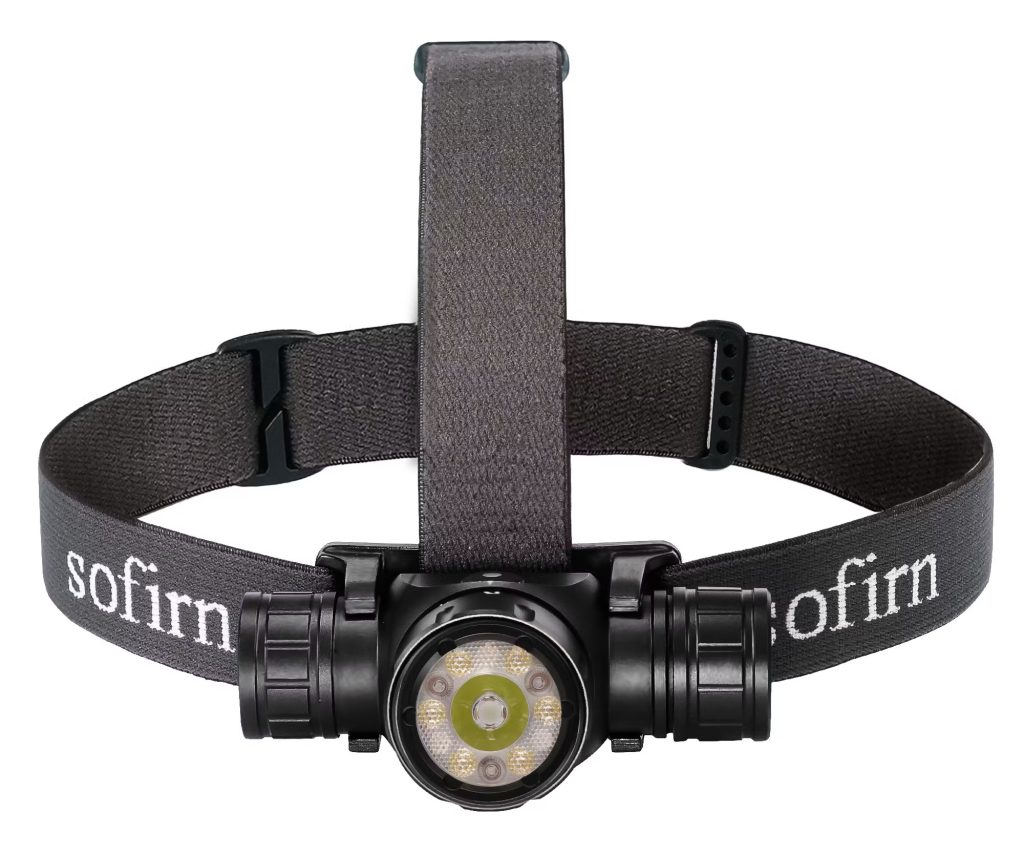
Why I chose it and who it’s for
The HS21 gives you spot, flood and red light on a removable 18650 for budget money. It also has a wave sensor, so a hand passed in front of it switches modes, which helps with gloves on or greasy hands.
It’s best for the garage, the car kit or a second light for the house when you don’t want to spend name brand money.
Key specs
- Max output: 2,200 lumens claimed; an independent test measured 1,550 at 30 seconds
- Runtime (Sofirn): 400 lm for 3.5 h, spot 50 lm for 37 h, flood 30 lm for 45 h, red 20 lm for 29 h
- Battery: removable 18650, 3,000 mAh, included
- Charging: USB-C
- Extras: infrared wave sensor, red light with five levels
- Weight: 87 g without the battery
Pros and cons
Pros
- Spot, flood and red in one inexpensive light
- Removable 18650 you can swap or upgrade
- Wave sensor for hands-free switching
Cons
- Turbo lasts about 2 minutes before stepping down
- Lumen claims run high
- Sofirn doesn’t publish an IP rating
Performance analysis
The HS21’s turbo is a sprint, holding for 2 minutes before it steps down, and independent testing measured about 70% of the claimed output. Look past that, because the modes you’d actually use are strong, with the low spot and flood settings running 37 and 45 hours. The red light goes up to 100 lumens, bright enough to read a map or work on a car without wrecking your night vision.
6. Milwaukee 2115-21: Best for Work and Hard Hats
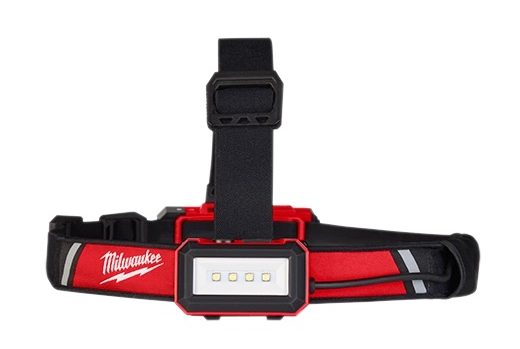
Why I chose it and who it’s for
Milwaukee built this one for the jobsite. The head is an inch thick so it sits flat on a hard hat, the clips come in the box, and the 125 degree flood lights your whole work area.
The battery pack is removable, so a spare means no downtime. It’s best for electricians, mechanics and anyone working in an attic.
Key specs
- Max output: 600 lumens flood
- Runtime: 600 lm for 2 h, 350 lm for 6 h, 125 lm for 10 h, 25 lm for 27 h
- Battery: removable REDLITHIUM USB pack
- Charging: USB-C, 50% in under 30 min, full in 2 h
- Beam: 125 degree flood
- Durability: IP54, 2 m drop rating
- Warranty: limited lifetime on the light, 2 years on the battery
Pros and cons
Pros
- Fast charging
- Even, wide flood with no hot spot
- Clips onto a hard hat with no extra parts
Cons
- No spot beam for distance
- IP54 handles splashes, not soaking
- No red light
Performance analysis
A work light spends most of its life on medium, and 350 lumens for 6 hours or 125 lumens for 10 covers a shift. The charging speed is the real win: Milwaukee rates it at 50% in under 30 minutes on USB-C, so a lunch break refills most of the battery.
7. Nitecore NU25 UL: Best for Running
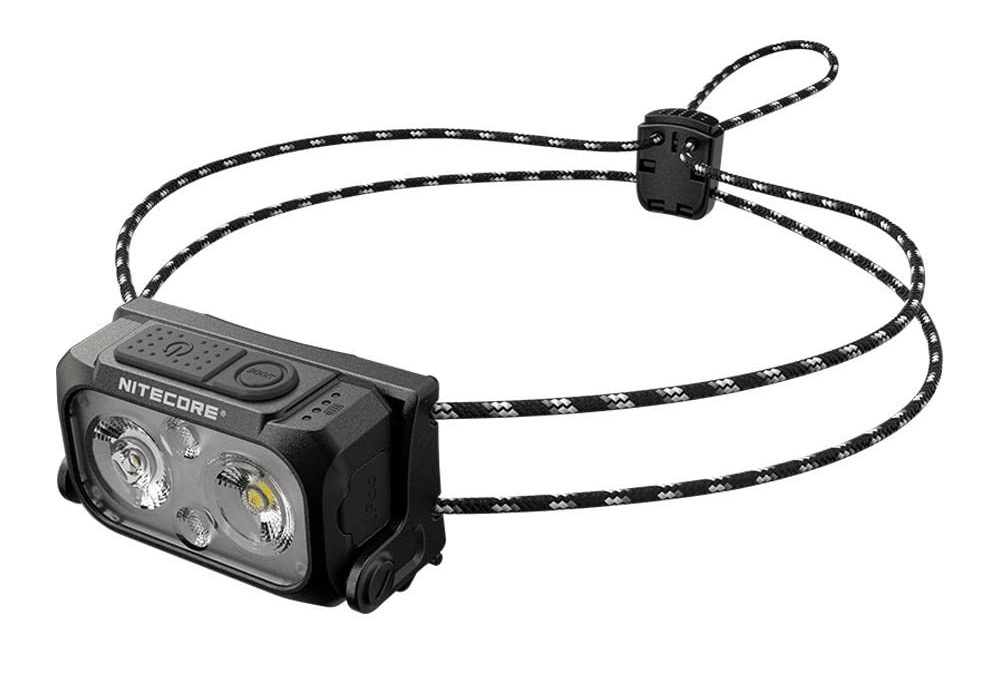
Why I chose it and who it’s for
At 45 grams with the band, the NU25 UL is light enough to forget it’s there, so there’s nothing to bounce on a run. 400 lumens on the mixed beam lights a trail or a dark road well.
It’s best for runners, ultralight hikers, and anyone who wants a backup headlamp that lives in a jacket pocket.
Key specs
- Max output: 400 lumens, 64 m
- Runtime (Nitecore): 400 lm for 2 h 40 min, 200 lm for 4 h 40 min, 60 lm for 10 h 25 min, 6 lm for 45 h, red 10 lm for 16 h
- Battery: built-in 650 mAh
- Charging: USB-C, about 1 h 25 min
- Water rating: IP66
- Weight: 45 g with the band
Pros and cons
Pros
- Lightest pick by a wide margin
- Recharges in about 85 minutes
- Separate spot, flood and red modes
Cons
- Small battery, under 3 hours on high
- Built-in battery can’t be swapped
- Short reach for fast technical trails
Performance analysis
The trade here is battery for weight. Still, 200 lumens for 4 hours 40 minutes covers almost any training run, and for longer races you can top it up from a small power bank between loops. Runners who need hours of high output should look at the Fenix HM65R V2.0 instead.
Will It Last the Night?
Pick what you need the light for and how many hours it has to run on one charge. The tool checks every mode on all seven headlamps and shows the brightest setting that makes it, using each maker’s runtime figures.
Turbo modes are left out because they step down within minutes. Wurkkos and Sofirn figures are their own claims, and real output on those two runs lower.
What to Look For in a Rechargeable Headlamp
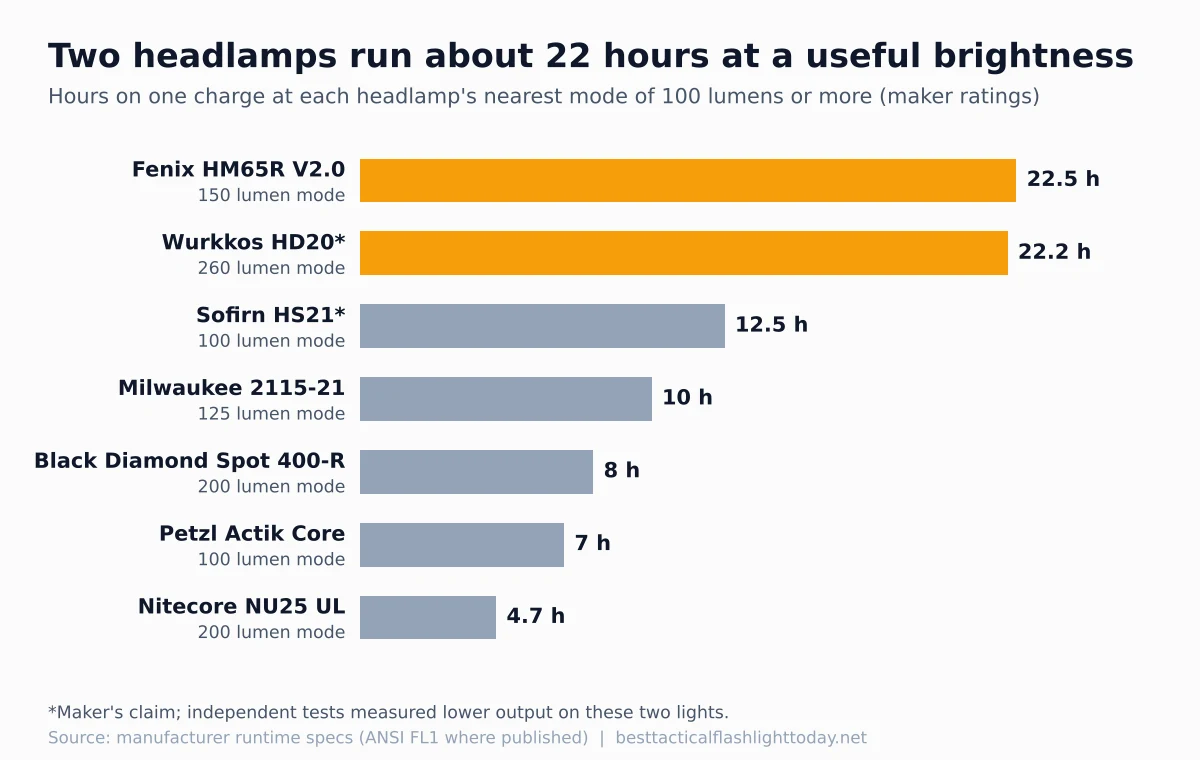
The chart shows the gap that max lumens hide. At a brightness you’d actually use, the two lights with big swappable cells run close to five times longer than the ultralight one.
Built-in battery, swappable cell, or both
A built-in battery keeps a headlamp small and light, but when it’s empty, you wait. Lights that take a removable 18650 or 21700 cell let you carry a spare and swap in seconds, and the cells hold far more. The Actik Core splits the difference with a rechargeable pack that can be swapped for three AAAs.
Runtime at the brightness you’ll use
Ignore the top number and read the middle of the runtime table. Most night tasks need 100 to 300 lumens. Runtimes rated under ANSI FL1 run until output drops to 10% of where it started, so a regulated light holds its brightness for most of that time while an unregulated one fades as it goes.
Spot, flood and red
A spot beam reaches down a trail, a flood lights everything within arm’s reach, and red light keeps your night vision intact. Most of the picks here have all three. If the numbers on the box confuse you, my candela vs lumens guide explains which one tells you about reach.
USB-C and charge time
Six of the seven picks charge over USB-C; the Spot 400-R is the holdout on micro-USB. Charge times run from about 85 minutes on the tiny NU25 UL to around 3 hours on the bigger cells.
Water rating
IPX4 handles rain, IP54 adds dust protection, IP66 survives strong water jets, IP67 handles a dunk to 1 meter for 30 minutes, and IP68 goes deeper, to a depth the maker sets. Most people are fine with IPX4. For paddling or fishing, go IP67 or better.
Using a Headlamp in a Power Outage
A headlamp frees both hands for cooking, resetting the breaker or getting kids to bed, which makes it the best outage light. Run it at 50 to 100 lumens to stretch the battery for days, and keep a spare cell or lithium AAAs with it.
Pair it with a battery lantern for lighting the whole room, and see my power outage flashlights and power outage emergency kit for the rest of the plan.
Frequently Asked Questions
How many lumens do I need in a headlamp?
For camp chores and reading, 50 to 100 lumens is plenty. Night hiking and running usually call for 200 to 400. Search work, fast trail running or spotting something far away is where 600 lumens and up earns its keep.
How long does a rechargeable headlamp battery last?
Per charge, it ranges from about 2 hours on high to over 200 hours on the lowest setting for the picks here. Over its life, a lithium-ion battery typically handles a few hundred full charge cycles before its capacity drops noticeably. Lights with removable cells let you replace the battery instead of the whole headlamp.
Are rechargeable headlamps better than battery powered ones?
For regular use, yes. They’re cheaper to run and hold their brightness better than alkaline AAA lights. Disposables still make sense for a kit that sits for years or very cold trips, which is why a hybrid like the Petzl Actik Core is a smart middle ground.
Can you use a headlamp while it’s charging?
Some can, but many can’t, so check the manual before you count on it. If you need light while you charge, a headlamp with a removable cell is the simple answer: charge the spare while you use the other.
The Bottom Line
For one headlamp that does everything, get the Petzl Actik Core. It’s bright, light, and it runs on AAA batteries when the rechargeable pack is empty.
For outages, the Wurkkos HD20 lasts for days on its low modes and can top up your phone. If you want the most reach, the Fenix HM65R V2.0 is the brightest, best documented pick here. Paddlers should get the Black Diamond Spot 400-R, tradespeople the Milwaukee 2115-21, runners the Nitecore NU25 UL, and if budget comes first, the Sofirn HS21 covers the basics well.
Not sure which one gets you through the night? Run your numbers through the Will It Last the Night? tool above.
