
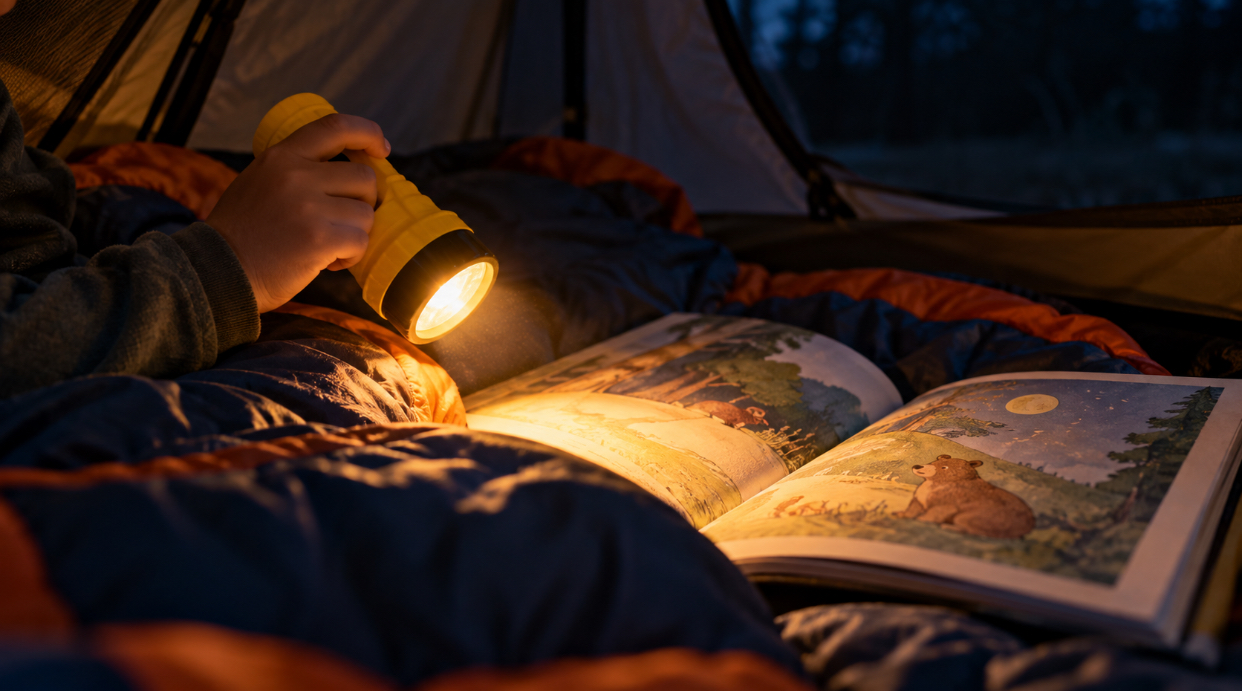
The best flashlight for a kid is not a small adult flashlight. Most of the lights I write about are built to be as bright as possible, and that’s exactly what you don’t want pointed at a sibling’s face at bedtime. A good kids light puts out a soft, wide glow and survives being dropped down the stairs. It also has a switch a four year old can find in the dark.
There’s one more thing most guides skip: the battery door. A light that a toddler can open in ten seconds is a light that hands them a battery. Every pick below either locks its batteries behind a screw or is meant for a child old enough to handle them.
I’ve arranged the seven picks by age, from a first toy light for a one year old to a real headlamp a twelve year old can take to scout camp. If you only want one answer, the Dorcy Floating Flashlight is the light I’d buy for most kids between five and ten. If your child is younger or older than that, scroll to the pick for their age.
Quick Picks
Kids Flashlight Comparison Chart
Here’s how the seven compare. Toy lights from VTech and Melissa & Doug don’t publish a lumen rating, so I’ve described their output instead of guessing a number.
1. Dorcy Floating Waterproof Flashlight: Best Overall
Why I chose it
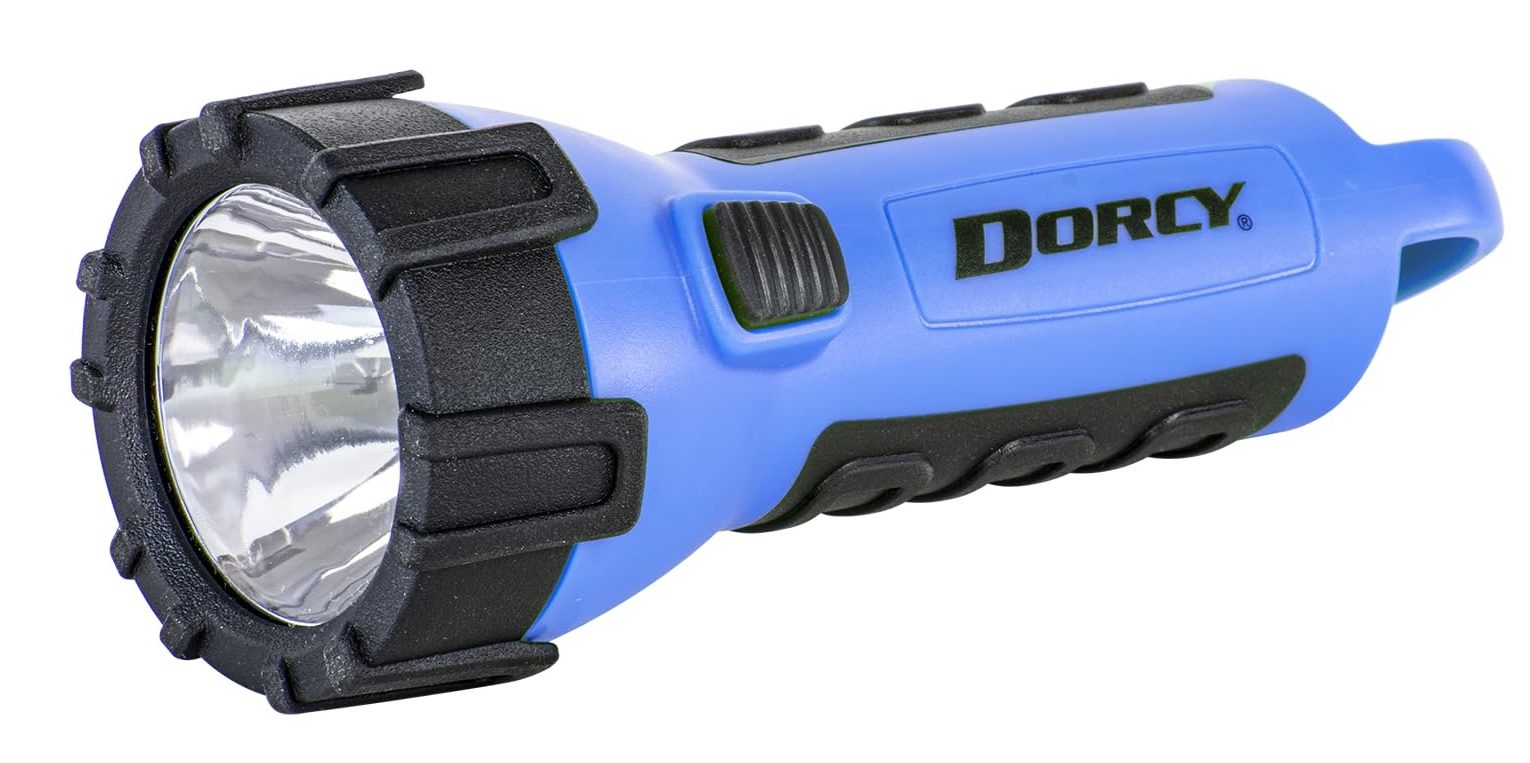
This is the flashlight most kids should get first. It looks like a real flashlight, which matters to a seven year old who doesn’t want a toy, but it’s wrapped in shock absorbing rubber and has nothing fiddly to break. The tail cap has a carabiner built in, so it clips to a backpack or a belt loop instead of getting left in the grass. And if it goes off the dock, it floats.
It’s best for kids from about five to ten who are ready for their own light for camping, backyard games and power outages.
Key specs
- Output: 150 lumens, single mode (older 4 LED stock is rated at 55 lumens)
- Runtime: 6 hours 30 minutes (older 55 lumen version: 8 hours 45 minutes)
- Battery: 3x AA alkaline, included
- Switch: push button
- Water: water resistant and floats, anti roll body
- Size and weight: 6.5 inches long, about 4 oz
Pros & Cons
Pros
- Floats, so a dropped light can be fished out instead of lost
- Rubber covered head and body take drops well and give small hands a good grip
- Built in carabiner means it actually stays attached to the kid
Cons
- Only one brightness level, so there’s no dim setting for reading in a tent
- Two versions are on sale under nearly the same name, so check the listing for 55 or 150 lumens
Performance analysis
The current version puts out 150 lumens from a single LED. That’s plenty for a backyard or a campsite trail and bright enough that you should set one rule on day one: never in anyone’s eyes. If your child is on the young end of the range, the older 55 lumen stock is honestly the better kids light. It runs longer, too.
Dorcy rates the beam at 230 meters. I’d treat that number as generous for a light this size. What you actually get is a wide, even beam that lights up the ground around a child’s feet, which is what a kid needs.
The battery cap isn’t obvious to open, so hang on to the instructions. With a curious five year old in the house, I count that as a feature. Keep a spare set of AAs in the camping bin and this light will outlast your child’s interest in it.
2. VTech Spin and Learn Color Flashlight: Best for Toddlers
Why I chose it
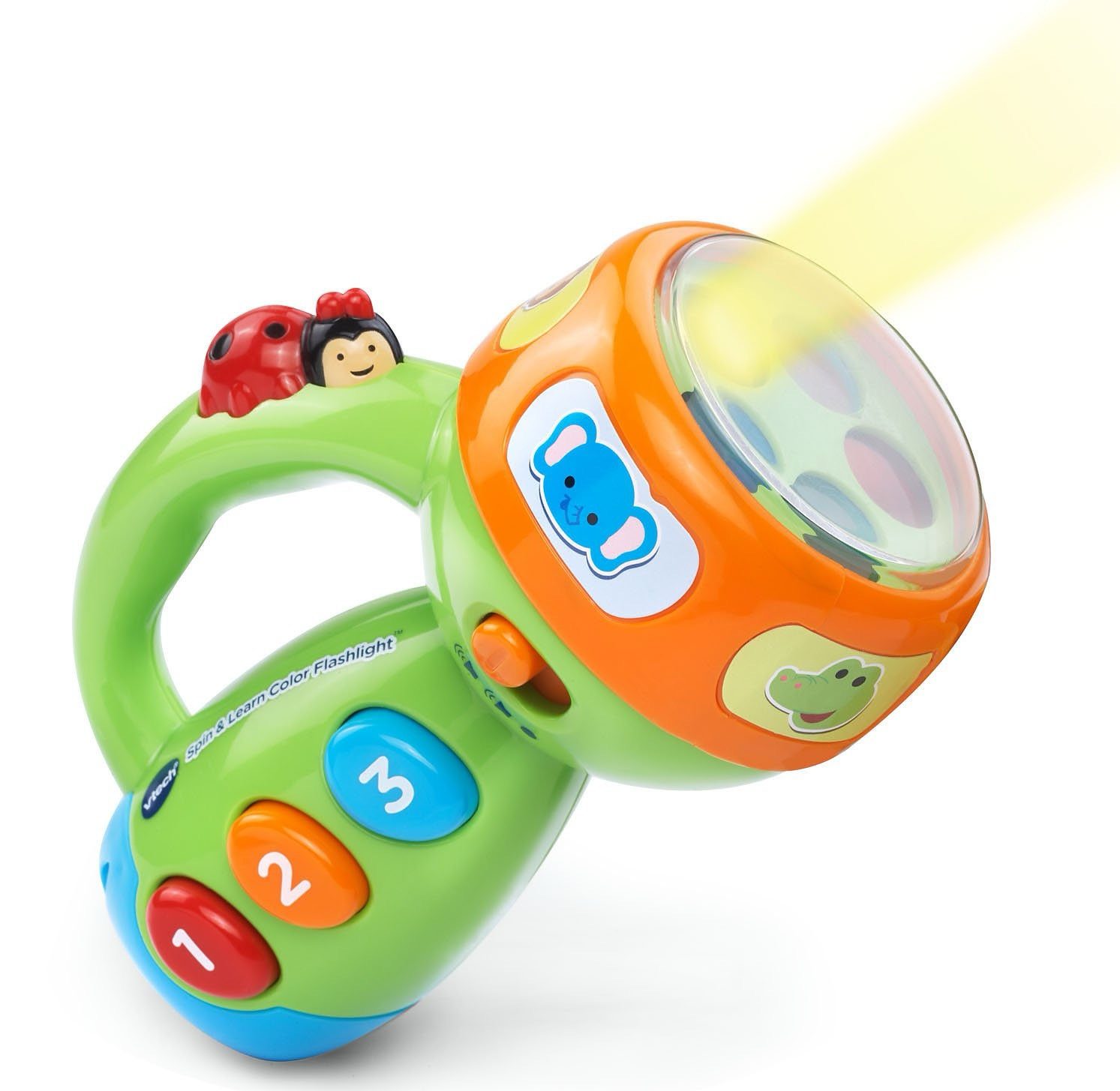
A one year old doesn’t need a flashlight. They need something shaped like one that they can carry around and point at the ceiling without anyone getting hurt. VTech gets that right. The light is soft and colored rather than a hard white beam, and the toy turns itself off after 45 seconds of no play, so it isn’t dead the next morning.
It’s best for toddlers from 12 to 36 months who want to copy the grown up with the flashlight.
Key specs
- Output: dim colored light in five colors, no lumen rating
- Battery: 2x AAA, included
- Auto off: after 45 seconds without use
- Sound: songs, animal sounds and phrases, with two volume levels and an off setting
- Age: 12 to 36 months
Pros & Cons
Pros
- Light is soft enough that a toddler staring into it isn’t a worry
- Chunky handle sized for a one year old’s grip
- Auto off saves the batteries from little hands that never switch anything off
Cons
- It’s a toy first and a light second, and it won’t help you find anything in the yard
- The included batteries are only meant for the store demo, so plan on replacing them
Performance analysis
Judge this one as a toy and it does its job very well. Spinning the color ring changes the light and plays a sound, which keeps a toddler busy far longer than a plain flashlight would. Like most toys made for children under three, its battery compartment is screwed shut.
The volume control matters more than it sounds. At full volume it’s loud in a small room, so use the lower setting or switch the sound off entirely for bedtime. In flashlight mode it’s quiet and works like a little night light under the covers.
When your child turns three or four and starts asking for a light that actually lights things up, move on to the Melissa & Doug Sunny Patch pick below or the TIKKID headlamp.
3. Melissa & Doug Sunny Patch Flashlight: Best for Preschoolers
Why I chose it
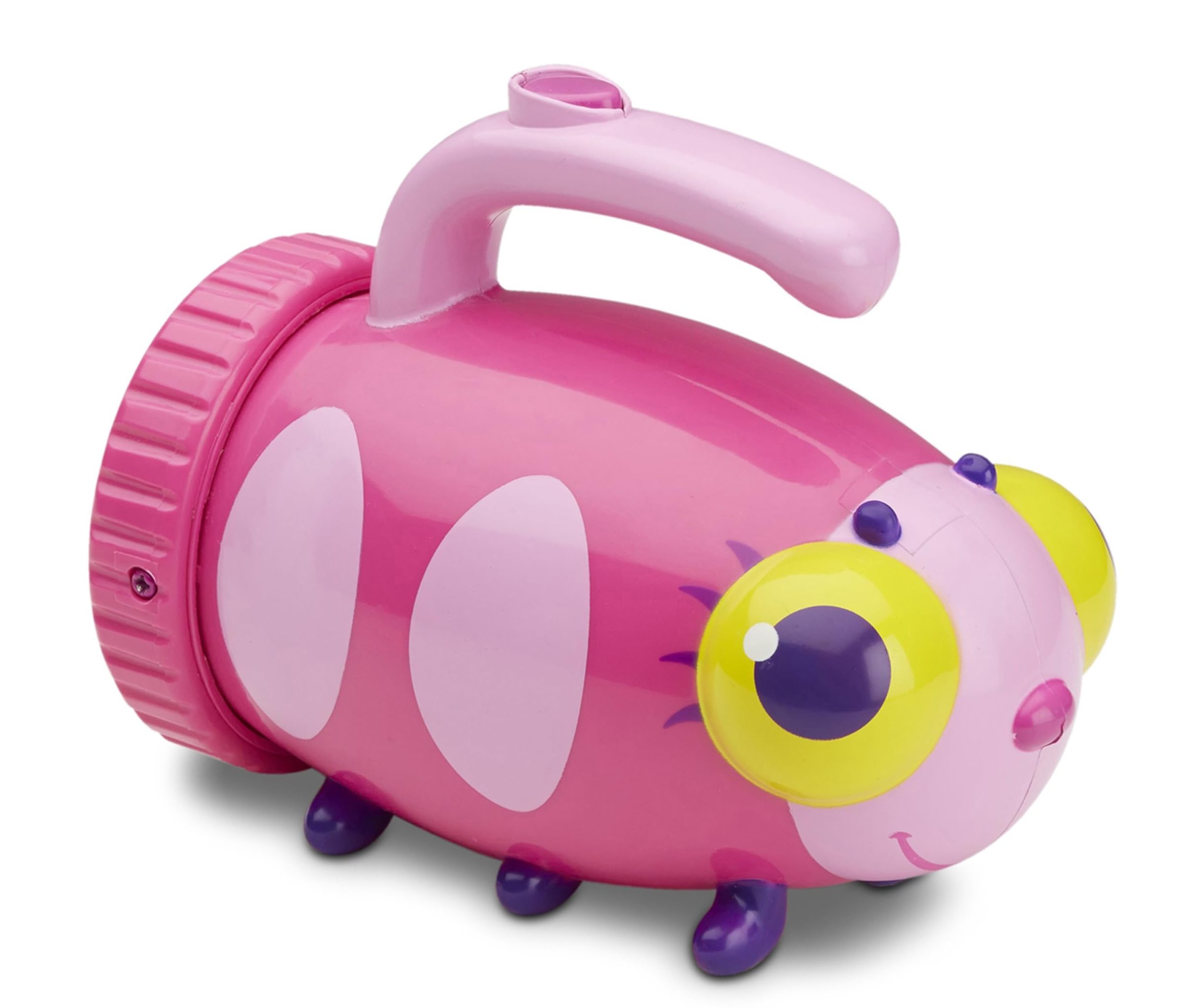
Three to six is the age when a child wants a light that really works but still can’t be trusted with loose batteries. The Sunny Patch flashlights split the difference well. They’re big, bright plastic bugs and flowers with a handle built for a small fist, and the battery door is held shut with a screw.
The bug and ladybug versions sit on little feet, so they stand on a table or the floor pointing at the wall. That’s perfect for shadow puppets and for a child who’s nervous about the dark.
It’s best for preschoolers and kindergarteners who want “their own” flashlight at bedtime.
Key specs
- Output: soft white spot, no lumen rating
- Battery: 2x AA, not included
- Battery door: closed with a screw
- Shapes: Giddy Buggy, Trixie Ladybug, Pretty Petals flower and Flash Firefly
- Size (Giddy Buggy): about 10.5 x 8.2 x 3.3 inches
- Age: 3 to 6 years
Pros & Cons
Pros
- Screwed battery door keeps AA cells away from little hands
- Integrated handle and big switch are easy for a three year old
- Feet on the bug styles let it stand on its own as a lamp
Cons
- No auto off, so expect it to be left on under the bed now and then
- Light is soft, and older kids will find it too dim for outdoor use
Performance analysis
The light from these is a gentle spot rather than a real beam. That’s the point. It’s enough to read a picture book under a blanket or walk to the bathroom at night, and it’s not harsh if it ends up in someone’s face.
Each shape is sold separately, so let your child pick their favorite. The search link below brings up all of them.
One caution. A small number of owners have reported a unit arriving without the battery door screw in place. When yours arrives, make sure the screw is there and tight before you hand it over. Keep a small Phillips screwdriver in the drawer for battery changes and keep the screw itself out of reach, since it’s a small part too.
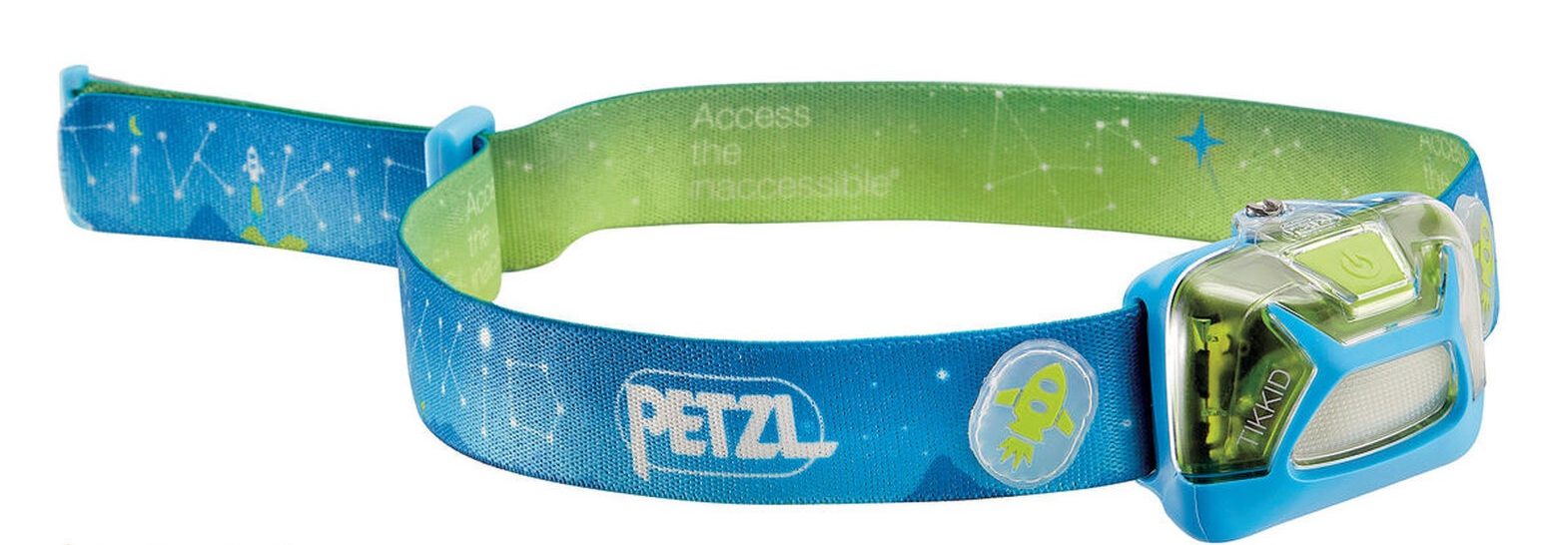
4. Petzl TIKKID: Best Kids Headlamp
Why I chose it
Most “kids headlamps” are adult headlamps in brighter colors. The TIKKID is one of the few designed for children from the inside out. Petzl caps it at 20 lumens on purpose. In its own words, the cap is there to limit photobiological risk and protect young eyes. The battery pack only opens with a flat head screwdriver, and the headband pops loose if it gets yanked or snagged.
It’s best for kids from three up who want their hands free, whether they’re reading in a tent or exploring the yard after dark.
Key specs
- Output: 20 lumens, wide flood beam
- Modes: low for reading, high for playing, and a 20 lumen white strobe
- Battery: 3x AAA, included, or Petzl’s CORE rechargeable pack
- Auto off: after 1 hour
- Water: IPX4, handles rain and splashes
- Weight: 80 g
- Age: 3 years and up
Pros & Cons
Pros
- Output capped at a level that’s comfortable for a child’s eyes
- Screw locked battery pack and a breakaway strap
- One hour auto off lets it double as a night light without draining overnight
Cons
- At 20 lumens it won’t light a dark trail for an older kid
- Rechargeable CORE pack is sold separately
Performance analysis
Twenty lumens sounds tiny next to the lights on the rest of this site. Inside a tent or under a blanket, it’s all a child needs, and the wide beam fills the space instead of making a hot spot. Kids also have a habit of looking straight at each other while wearing a headlamp. With this one, that’s not a problem.
The single button is easy for a preschooler, and the glow in the dark reflector means a lost headlamp can be found in a dark tent. I like the one hour auto off most of all. A child can fall asleep with it on, and you don’t find dead batteries in the morning.
When your child hits eight or nine and starts doing real night hikes, they’ll outgrow it. That’s where the Black Diamond Astro 300 at the bottom of this list takes over.
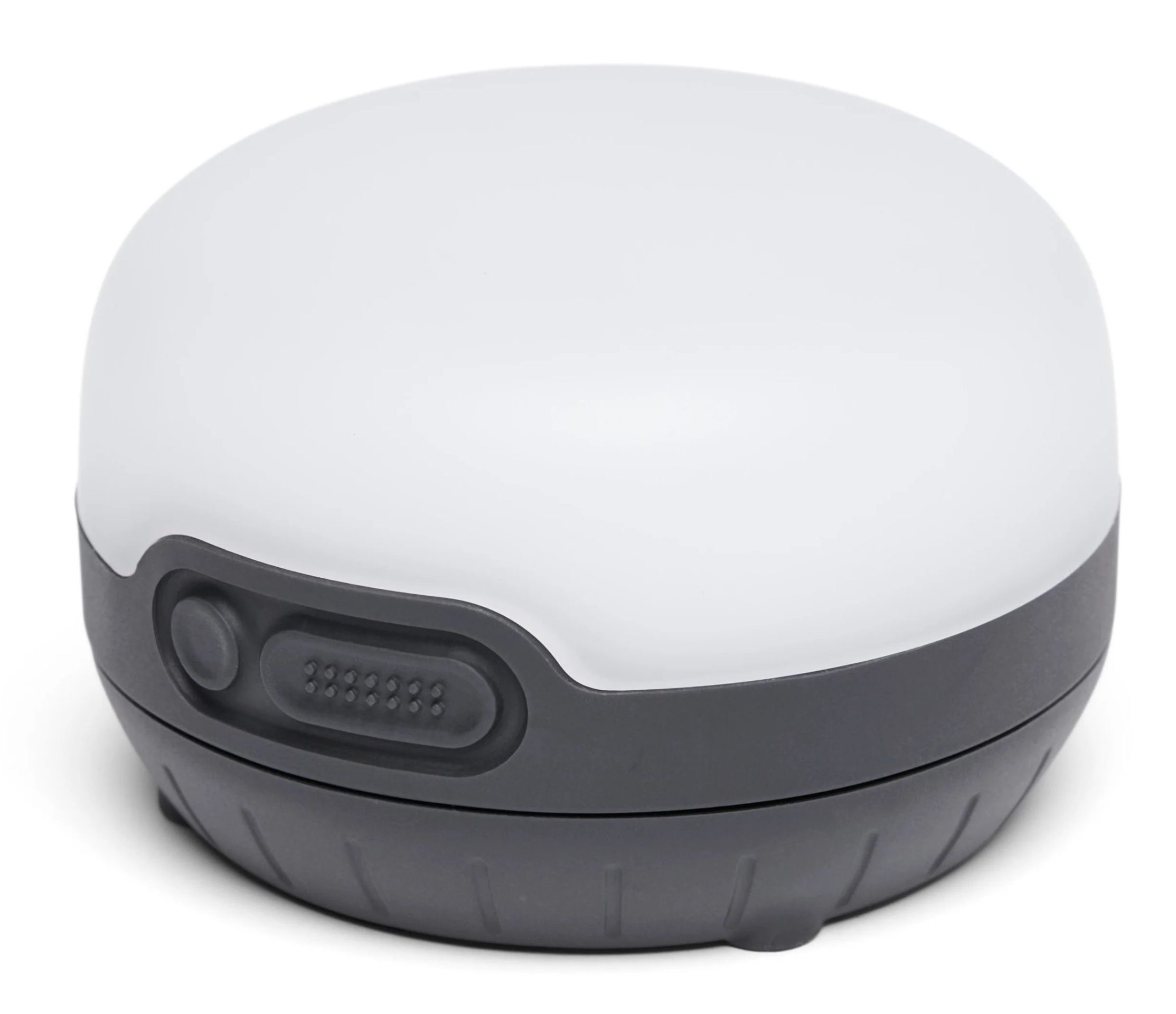
5. Black Diamond Moji+: Best Tent Lantern
Why I chose it
A flashlight points light at one spot. A lantern fills the whole tent or bedroom, and for a child who’s scared of the dark, that’s often what actually helps. The Moji+ is a palm sized lantern with a frosted globe that throws soft, even light with no glare.
Kids get more than a plain lantern here. One button cycles through a full rainbow of colors, and there’s a flickering campfire mode that turns a tent into story time. For parents, a lockout stops it from switching on and draining inside a duffel bag.
It’s best for family camping and for any child who wants a glow in the room rather than a beam.
Key specs
- Output: 200 lumens max, dimmable
- Modes: white (steady or strobe), rainbow cycle, solid colors, campfire
- Runtime: 5.5 hours on high with alkaline AAAs, up to 120 hours on low
- Battery: 3x AAA (not included), or Black Diamond’s BD 1500 rechargeable pack
- Mounting: double hook hang loop and four magnets
- Water: IPX4
- Weight: about 107 g with AAAs
Pros & Cons
Pros
- Frosted globe spreads light evenly, so there’s no beam to shine in eyes
- Color and campfire modes make it a favorite with kids
- Lockout prevents dead batteries after a trip in the pack
Cons
- AAA batteries aren’t in the box
- Two buttons and several modes take a short lesson for kids under five
Performance analysis
Two hundred lumens through a frosted globe looks much softer than 200 lumens from a flashlight. Hung from the loop at the top of a tent, the Moji+ lights the whole space. Turned down low, it makes a comfortable night light that runs for days on one set of batteries.
The magnets are strong enough to stick it to a car door or a metal bunk bed frame. That turns out to be handy at home, too.
A quick note on the name. Black Diamond also sells a plain Moji without the color and campfire modes. For kids, the Moji+ is the one to get, so check the “+” in the listing title.
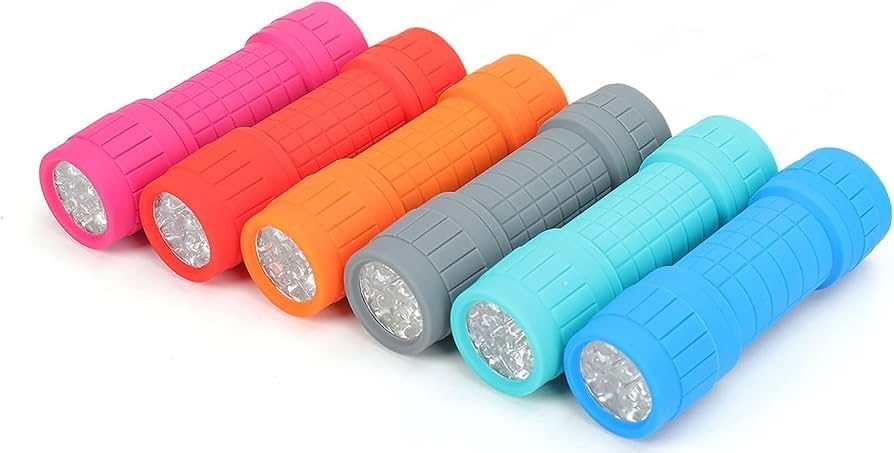
6. EverBrite Glow in the Dark Mini Flashlights (6-Pack): Best Budget Multi-Pack
Why I chose it
Some kids lose a flashlight a week. Some parents need six of them for a birthday party or a scout den. For both, a multi-pack makes more sense than one good light.
This EverBrite set is the one I’d pick for kids, and it’s not the brightest pack out there. That’s the reason. It uses soft yellow LEDs instead of the harsh blue white you get from most cheap multi-packs, and the handles glow in the dark, so a dropped light is easy to spot in the grass.
It’s best for kids five and up, and for families who want a light in every backpack.
Key specs
- Output: about 50 lumens, warm yellow light
- Battery: 3x AAA per light, all 18 included
- Body: aluminum with a glow in the dark handle
- Carry: wrist lanyard on each light
- Pack: six lights in assorted colors
Pros & Cons
Pros
- Warm, soft light that’s easier on young eyes than typical bargain lights
- Glowing handle makes a lost light easy to find at night
- Enough lights to cover every kid, plus a spare for the kitchen drawer
Cons
- The tail cap unscrews by hand, so the AAA cells aren’t locked away from small children
- No water resistance rating, so keep them out of the creek
Performance analysis
Fifty lumens of warm light is a sweet spot for kids. It’s enough for a backyard game of flashlight tag and soft enough that nobody is seeing spots afterward. The aluminum body handles drops better than the plastic party favor lights at the dollar store.
The glow handle needs a charge first. Leave the lights in a sunny window, or shine another light on them for a few minutes, and they’ll glow for a while after dark.
Because the batteries are only behind a screw cap, I wouldn’t give these to a child under five without an adult around. AAA cells aren’t the button batteries that cause the worst ingestion injuries, but they’re still a choking hazard for a toddler.
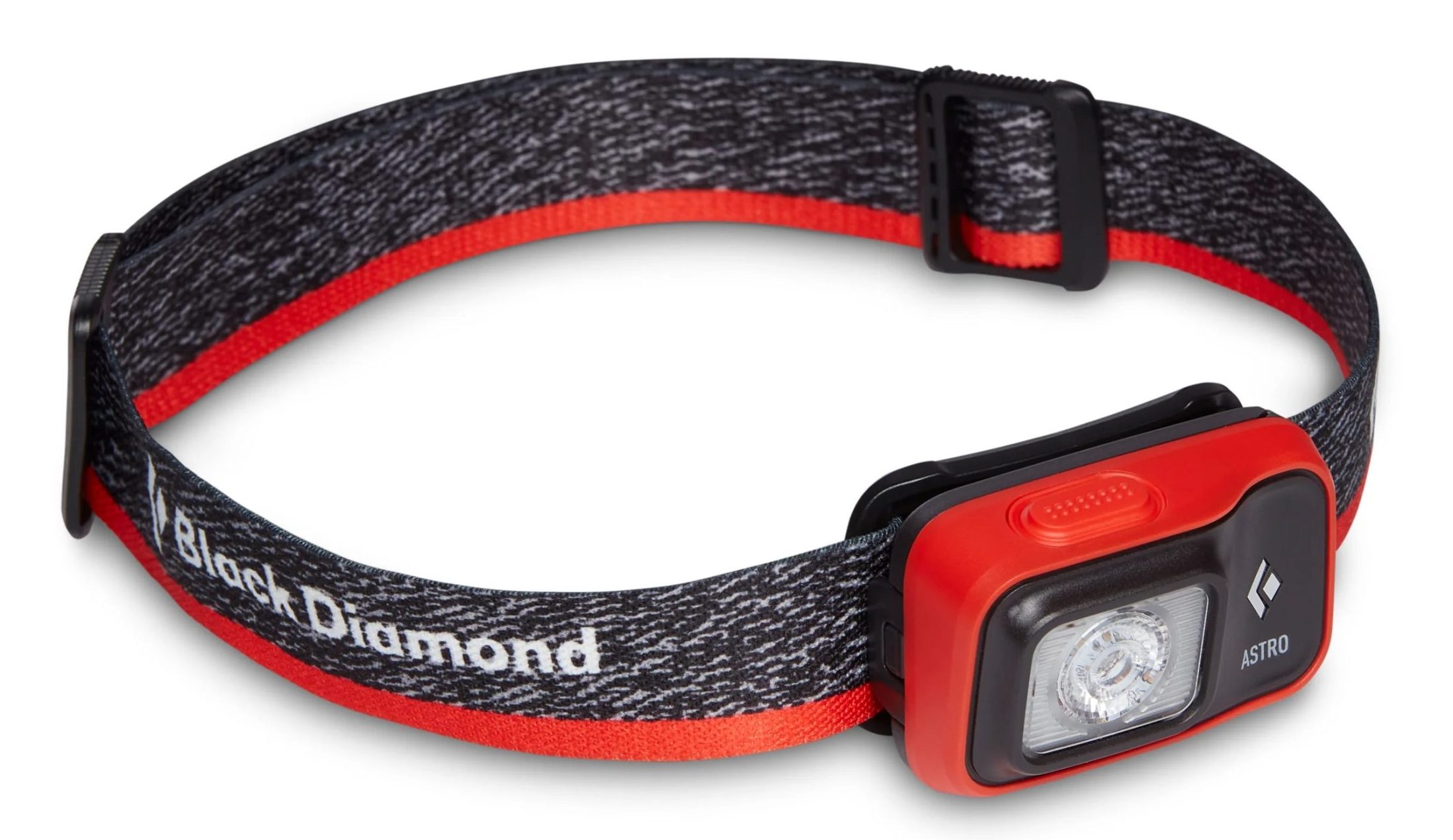
7. Black Diamond Astro 300: Best for Older Kids and Scouts
Why I chose it
Somewhere around eight or nine, a child outgrows toy lights and needs real gear for night hikes and scout campouts. The Astro 300 is the headlamp I’d hand them. It’s a proper adult headlamp, but it has two features that make it work for a kid.
The first is brightness memory. Set it to medium once, and it comes back on at medium every time instead of jumping to full power in someone’s face. The second is a digital lockout, so it can’t switch on in a backpack and be dead by the time it’s needed.
It’s best for kids eight and up who need a light that keeps up with the adults on the trail.
Key specs
- Output: 300 / 150 / 6 lumens, plus strobe
- Runtime (AAA): 4 hours high, 8 hours medium, 140 hours low
- Beam distance: 55 m high, 35 m medium, 8 m low
- Battery: 3x AAA, included, or Black Diamond’s BD 1500 rechargeable pack
- Water: IPX4
- Weight: 75 g with batteries
Pros & Cons
Pros
- Brightness memory stops it from blasting at 300 lumens every time it turns on
- Lockout keeps the batteries from draining in a pack
- The 6 lumen low mode runs for about 140 hours, which covers a week of camp
Cons
- At 300 lumens on high, it needs a talk about not shining it in faces
- No screw locked battery door, so it’s not for younger siblings
Performance analysis
The low mode is where this headlamp earns its spot. Six lumens is enough to read in a sleeping bag or walk around a tent site without waking anyone. At that level, one set of AAAs lasts longer than most scout camps.
Medium, at 150 lumens and 35 meters, is the setting most older kids will live on for trail walking. High is there for the moment someone hears a noise in the woods. With brightness memory doing its job, high only comes on when your child chooses it.
The strap fits a child’s head once it’s tightened down, and at 75 g it doesn’t bounce around. If your child already has a TIKKID, this is the natural next step up.
How Bright Should a Kids Flashlight Be?
There’s no official lumen limit for children’s flashlights, so here’s the rule of thumb I use. Start low and add brightness as a child gets old enough to follow the “never in the eyes” rule.
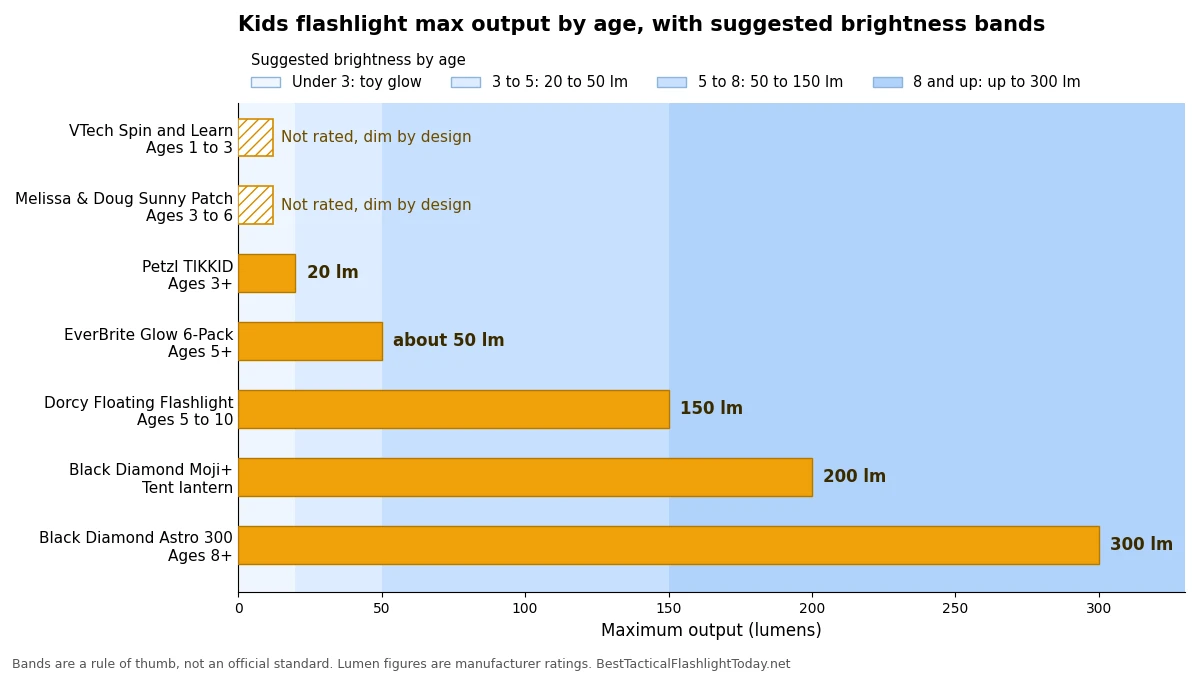
- Under 3: a toy light with a soft or colored glow and no real beam. The goal is play, not seeing.
- 3 to 5: about 20 to 50 lumens with a wide flood beam. That’s enough for a tent or a picture book under the covers.
- 5 to 8: 50 to 150 lumens. Now the light needs to work in the backyard and at a campsite.
- 8 and up: up to about 300 lumens, but only with a low mode under 10 lumens and something that stops it from coming on at full power.
Beam shape matters as much as the number. A wide flood spreads light over a big area, so it never feels harsh up close. A tight spot packs the same lumens into a small circle, which is what makes cheap “tactical” lights so unpleasant to look at. Our guide to throw vs flood flashlights explains the difference, and candela vs lumens covers why intensity, not just total output, is what your eyes feel.
What to Look for in a Kids Flashlight
A battery door your child can’t open
This is the first thing I check, and most guides never mention it. Coin and button batteries are the real danger. A swallowed button cell can cause severe internal burns within hours. Since March 2024, U.S. rules under Reese’s Law require consumer products that use these batteries to keep the compartment shut through use and abuse testing. In practice, that usually means a screw or a cap that takes two separate motions to open.
None of the lights on this list use button cells. For children under five, I’d still go further and pick a light whose AA or AAA door needs a screwdriver, like the TIKKID or the Melissa & Doug. Skip the tiny keychain lights that run on coin cells until your child is much older. Our mini flashlight guide covers those for adults.
Output and beam
More lumens is not better for a child. Use the age guide above, and favor a wide flood beam over a tight spot. A light with a dim mode below 10 lumens is the most useful one at bedtime.
Auto off and lockout
Kids leave lights on. An auto off timer, like the TIKKID’s one hour shutoff, saves batteries and lets a light double as a night light. A lockout, like the one on both Black Diamond picks, stops a light from switching on inside a bag. Either feature means fewer dead batteries on the night you actually need the light.
Toughness and water resistance
Rubber or aluminum bodies survive drops far better than thin plastic. For water, look at the IP rating. IPX4 means the light handles rain and splashes from any direction, but it shouldn’t go under water. The Dorcy goes a step further and floats, which is the feature you want around docks and creeks.
Headlamp, flashlight or lantern?
It depends on what your child will be doing with their hands.
- Flashlight: best for pointing at things and for games like flashlight tag. Easy for young kids to understand.
- Headlamp: best once a child is climbing or reading, because both hands stay free. Choose one with a breakaway strap for younger kids.
- Lantern: best for a tent or bedroom and for kids who are afraid of the dark. It lights the whole space with no beam to shine in anyone’s eyes.
Many families end up with two: a headlamp for the child and a lantern for the tent.
Batteries
For kids, I prefer lights that run on standard AA or AAA cells. They’re easy to replace on a camping trip, and every light on this list takes them. Alkalines are fine for daily use, but they can leak if a light sits in a drawer for months. For an emergency kit, lithium AA or AAA cells are a better choice. Our guides to the best AA flashlight and the best AAA flashlight go deeper on which cells to buy.
If you’re putting together a kit for storms, add a light for each child. Our best flashlight for power outages guide covers the adult side of that kit.
Kids Flashlight FAQ
How many lumens is safe for a child?
There’s no official limit, but lower is better for young kids. Petzl caps its children’s headlamp at 20 lumens to protect young eyes. As a rough guide, keep toddlers on dim toy lights, give children three to five about 20 to 50 lumens, and save lights over 150 lumens for kids eight and up who understand not to shine them in faces.
Can a flashlight hurt a child’s eyes?
A quick flash from a low output light causes glare and spots, not lasting harm. The concern is strong, focused lights held close to the eyes or stared into, which is why bright “tactical” lights don’t belong in a small child’s hands. Choose a dim light with a wide beam, and teach the “never in the eyes” rule from the start.
What age can a child have their own flashlight?
Toddlers from about 12 months can play with a toy light like the VTech, as long as the battery door is screwed shut. From three, a simple kids flashlight or a headlamp like the TIKKID works well. Most children are ready for a real adult style light around eight, once they can handle brightness settings and keep track of batteries.
Is a headlamp or a flashlight better for kids?
For children three and older, a headlamp is often the better buy because both hands stay free for climbing and carrying. Younger kids find a handheld flashlight easier to understand. For camping, many families pair a headlamp for each child with one lantern for the tent.
The Bottom Line
For most kids between five and ten, get the Dorcy Floating Waterproof Flashlight. It survives being dropped and floats if it goes off a dock.
Match the light to the age if your child is younger or older. Toddlers are happiest with the VTech Spin and Learn, and preschoolers do best with a Melissa & Doug Sunny Patch light behind its screwed battery door. If you want a headlamp, the Petzl TIKKID is the safest first one, and the Black Diamond Astro 300 is the one to move up to around eight. For the tent, add a Black Diamond Moji+. If you need lights for a whole group, the EverBrite six pack covers everyone.
Whatever you choose, check the battery door before you hand it over, and teach the “never in the eyes” rule on the first night. For lights for the adults in the house, start with our best budget flashlight picks.
