
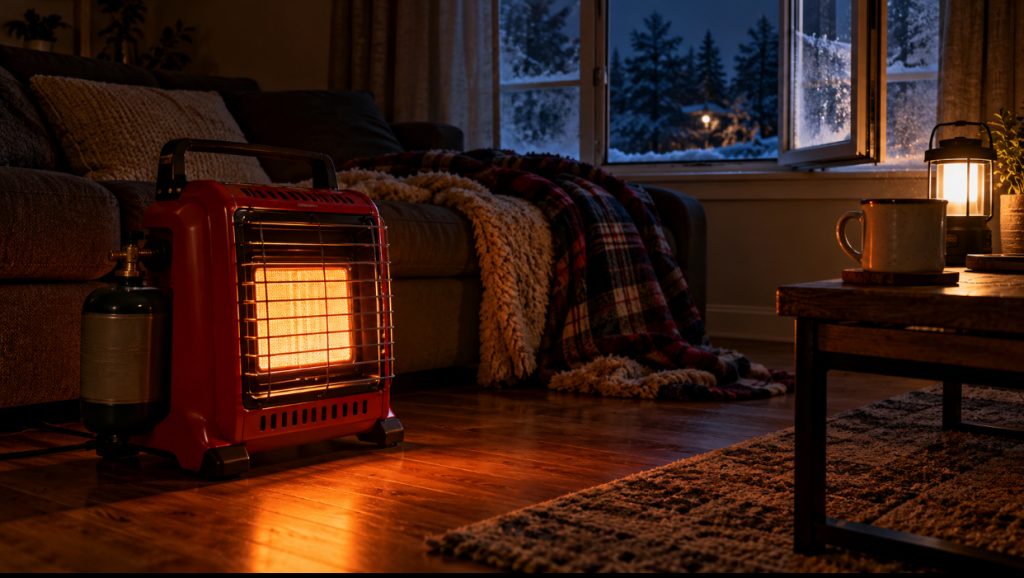
When the power goes out in January, the furnace goes with it. Even a gas furnace needs electricity to light and to run its blower, so most homes lose their heat at the same moment they lose their lights.
An indoor propane heater is the simplest way to keep one room warm until the power comes back. But “indoor safe” on the box comes with conditions: a fresh air opening, an altitude limit, a rule about sleeping, and a couple of places where the indoor version isn’t sold at all.
I went through the heaters that are actually certified for indoor use, checked every runtime against the makers’ manuals, and worked out how much propane each one burns. Below are six picks, the rules that keep them safe, and an Outage Heat Planner that tells you which heater fits your room and how much propane to keep on hand.
Quick Picks
Indoor Propane Heaters Compared
Room sizes are each maker’s own rating. Every heater here has a low oxygen shutoff, and all five portable ones also shut off if they tip over.
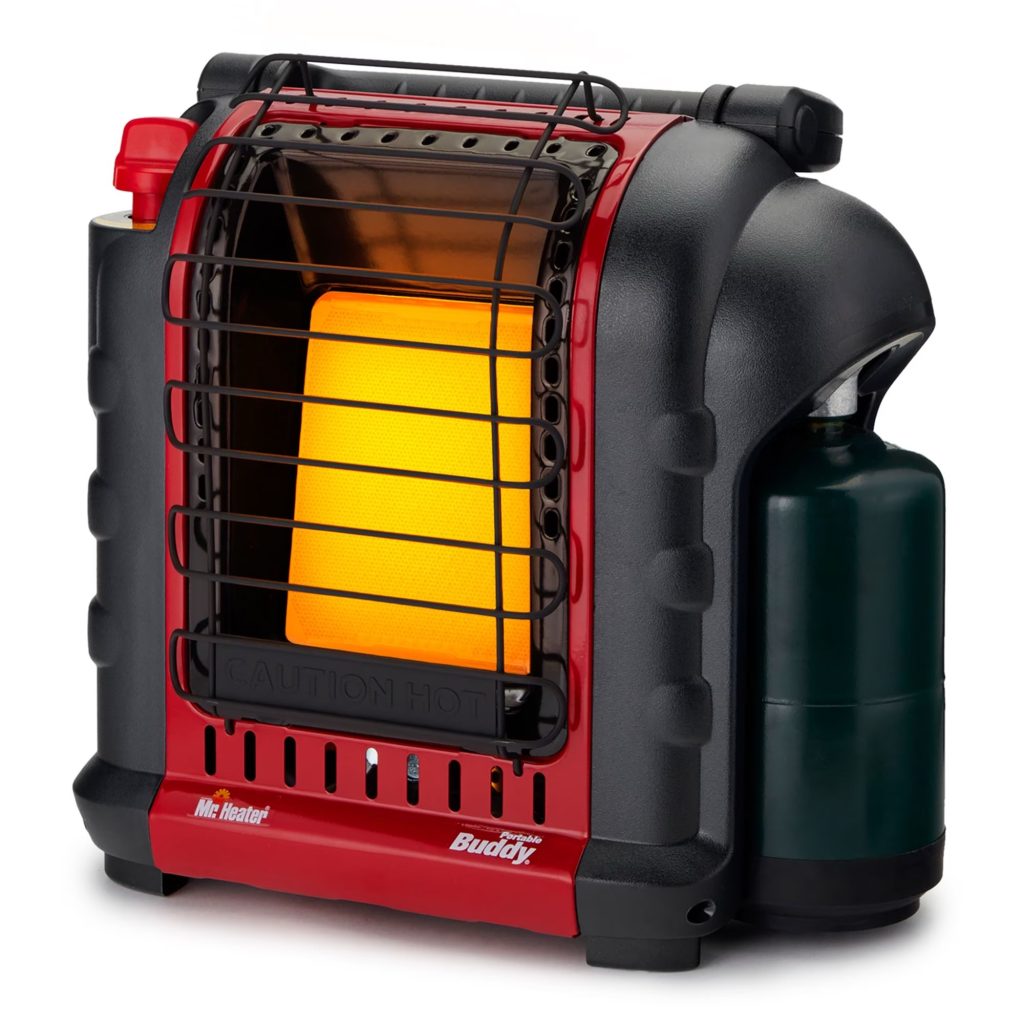
1. Mr. Heater Portable Buddy: Best Overall
Why I chose it and who it’s for
If I could keep only one heater for outages, it would be this one. At 4,000 or 9,000 BTU it suits a bedroom, a home office or a small living room, and Mr. Heater rates it for up to 225 square feet.
It lights with a push and turn of the knob, so there’s no battery to go flat in a drawer, and it runs on 1 lb cylinders from any hardware store or a 20 lb tank outside. It’s best for most households who want one heater for one room.
Key specs
- Heat output: 4,000 or 9,000 BTU per hour
- Rated room size: up to 225 sq ft
- Runtime (Mr. Heater): 3 to 6 hours per 1 lb cylinder, 48 to 110 hours on a 20 lb tank
- Safety: low oxygen shutoff (ODS) and tip-over shutoff
- Ignition: piezo, no batteries
- Fresh air needed: 9 square inch opening
- Max elevation: 7,000 ft
- Weight: 10.6 lb
Pros and cons
Pros
- Simple, proven design with nothing to charge
- Runs on cylinders you can buy anywhere, or a 20 lb tank outside
- Light enough to carry from room to room
Cons
- No fan, so it warms what’s in front of it first
- A 1 lb cylinder lasts only a few hours on High
- The Massachusetts and Canada version is outdoor only
Performance analysis
Plan your fuel around Low. At 4,000 BTU a cylinder lasts close to 6 hours, an evening of heat. High burns more than twice as fast, so I use it to take the chill off and then drop back to Low. For a multi-day outage, run it from a 20 lb tank that stays outdoors.
The Portable Buddy manual asks for at least 9 square inches of fresh air opening, and it’s blunt about sleep: never run the heater while sleeping.
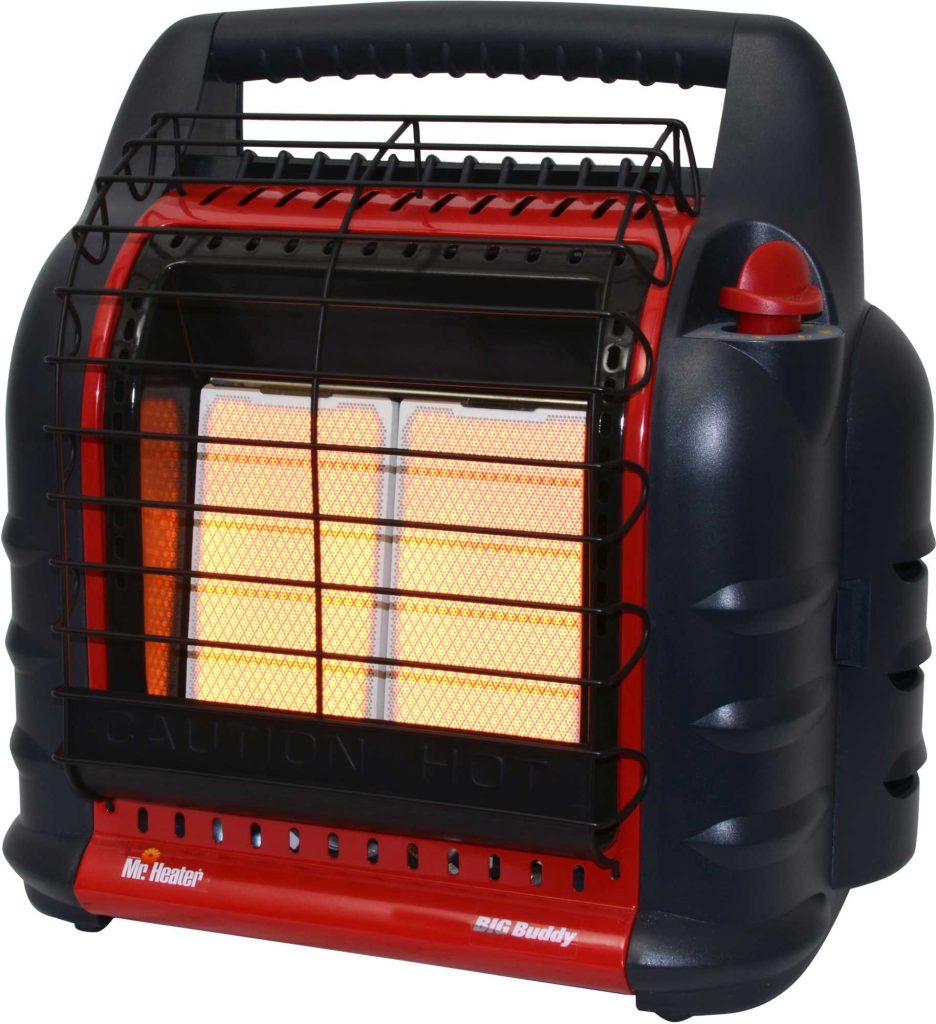
2. Mr. Heater Big Buddy: Best for Large Rooms
Why I chose it and who it’s for
Open floor plans need more than a small heater can give. The Big Buddy has three settings, 4,000, 9,000 and 18,000 BTU, and Mr. Heater rates it for up to 450 square feet.
It holds two 1 lb cylinders at once, so it runs twice as long as a single cylinder heater on the same setting, and it takes a 20 lb tank outside with a hose. It’s best for families who gather in one big room, or anyone in a drafty older house.
Key specs
- Heat output: 4,000 / 9,000 / 18,000 BTU per hour
- Rated room size: up to 450 sq ft
- Runtime (Mr. Heater): about 11 hours on Low, 4.8 on Medium and 2.8 on High with two 1 lb cylinders; 24 to 108 hours on a 20 lb tank
- Safety: ODS and tip-over shutoff
- Ignition: piezo
- Fresh air needed: 18 square inch opening
- Max elevation: 7,000 ft
- Fan: runs on 4 D batteries on models that include it
Pros and cons
Pros
- Enough heat for an open living area
- Three settings let you match the heat to the weather
- Two cylinders on board double the runtime
Cons
- Mr. Heater has dropped the fan on some current units, so check the listing
- Bulky for a single bedroom
- High empties a 20 lb tank in about a day
Performance analysis
Medium is where most people will live. At 9,000 BTU it handles a good-sized room in freezing weather, and two cylinders last close to 5 hours. Save High for bitter cold.
About the fan: Mr. Heater’s product page says it removed the fan from some Big Buddy models because of import tariffs. It still heats without one, since it’s a radiant heater, but warmth spreads more slowly. If the fan matters, check that the listing mentions it.
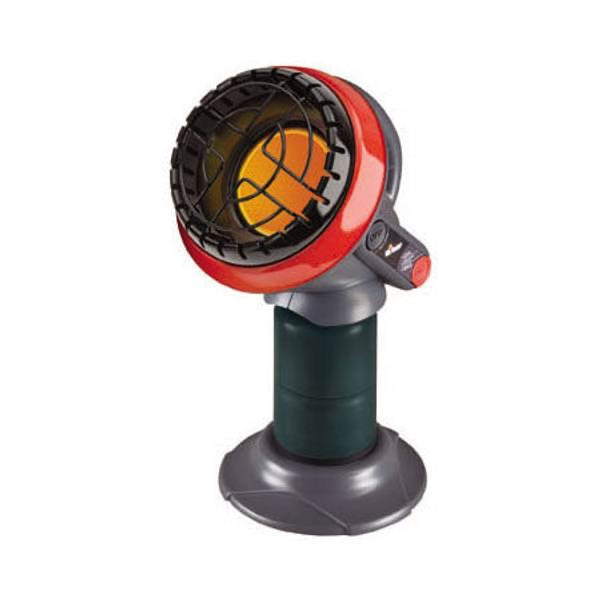
3. Mr. Heater Little Buddy: Best for One Small Room
Why I chose it and who it’s for
Sometimes the goal is one small room, kept warm for a child, an older parent or a home office. The Little Buddy does that with a single 3,800 BTU setting for up to 95 square feet, and it’s the cheapest indoor certified heater here.
It screws onto a 1 lb cylinder and lights with one button. It’s best as a second heater, or for someone who lives alone in a small space.
Key specs
- Heat output: 3,800 BTU per hour
- Rated room size: up to 95 sq ft
- Runtime (Mr. Heater): about 5.6 hours per 1 lb cylinder
- Fuel: 1 lb cylinder only
- Safety: ODS and tip-over shutoff
- Ignition: push-button piezo
- Fresh air needed: 4 square inch opening
- Max elevation: 7,000 ft
- Weight: 5.85 lb
Pros and cons
Pros
- Lowest cost of the six
- Small enough to store anywhere
- Needs the smallest fresh air opening
Cons
- No hose option, so you’ll swap cylinders every 5 to 6 hours
- One setting only
- Too little heat for a living room in real cold
Performance analysis
3,800 BTU won’t heat a living room, but in a 10 by 9 foot room it makes a real difference, and a cylinder lasts most of an evening. A 3 day outage at 8 hours a day takes about 5 cylinders, so keep a six-pack with it.
4. DeWalt DXH12B: Best With a Fan and USB Charging
Why I chose it and who it’s for
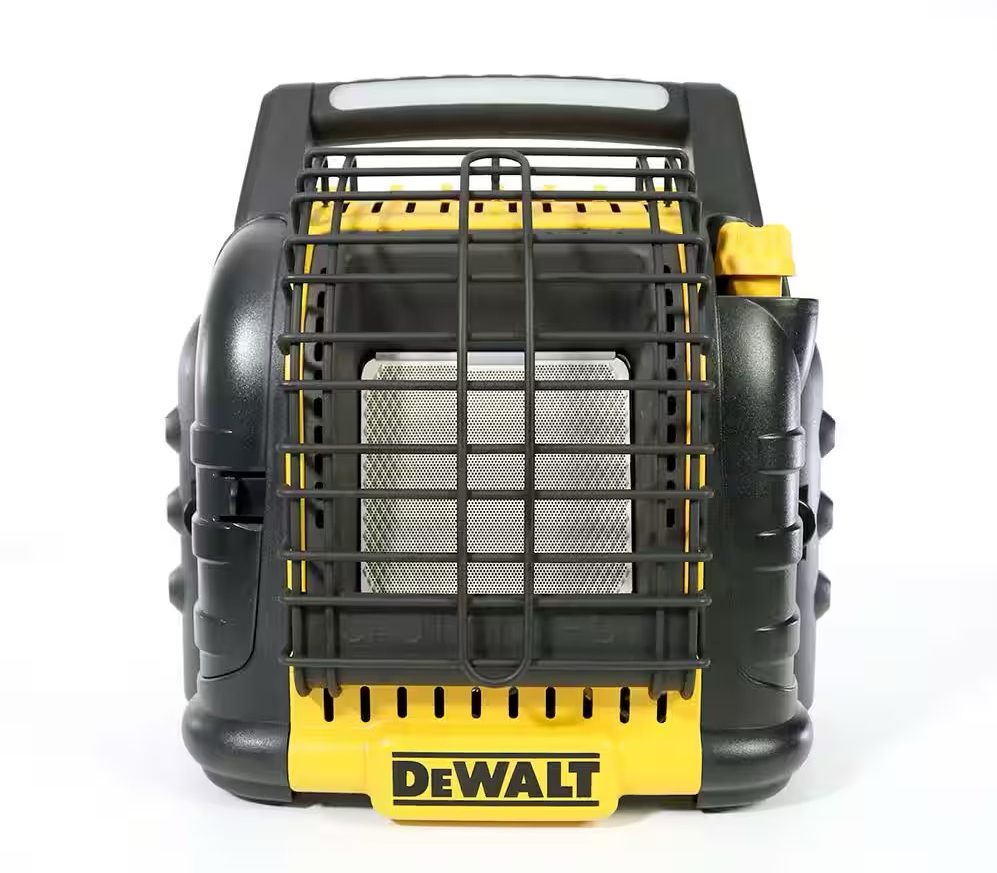
The DXH12B is the one to get if you already own DeWalt 20V tools. Its burner has the same low oxygen and tip-over shutoffs as a Buddy, but a DeWalt battery adds a fan, an LED light bar and three USB ports for phones.
The igniter runs on an included AA battery, so the heater works without a DeWalt pack too. It burns at 6,000 or 12,000 BTU from one or two 1 lb cylinders and is listed for about 300 square feet. It’s best for tool owners who want heat, light and phone charging from one unit.
Key specs
- Heat output: 6,000 or 12,000 BTU per hour
- Rated room size: about 300 sq ft
- Runtime (DeWalt): 3.5 hours on Low or 1.5 on High per 1 lb cylinder, doubled with two
- Ignition: electronic, one AA battery (included)
- Fan, LED light and 3 USB ports: need a DeWalt 20V MAX or FLEXVOLT battery (not included)
- Safety: ODS, tip-over switch and thermoelectric safety valve
- Fresh air needed: 12 square inch opening
- Max elevation: 7,000 ft
Pros and cons
Pros
- The fan spreads heat faster than radiant-only heaters
- USB ports charge phones during the outage
- Built-in light bar
Cons
- Fan, light and USB need a DeWalt battery you buy separately
- About 1.5 hours per cylinder on High
- Outdoor-only version in Massachusetts and Canada
Performance analysis
On Low with both cylinders it runs about 7 hours, a full evening. The fan sets it apart: a radiant heater warms whatever it faces, while the fan moves warm air around the room, so a larger space feels warmer sooner. Keep a charged 20V pack with it.
5. Mr. Heater Buddy FLEX: Best Wide Heat Spread
Why I chose it and who it’s for
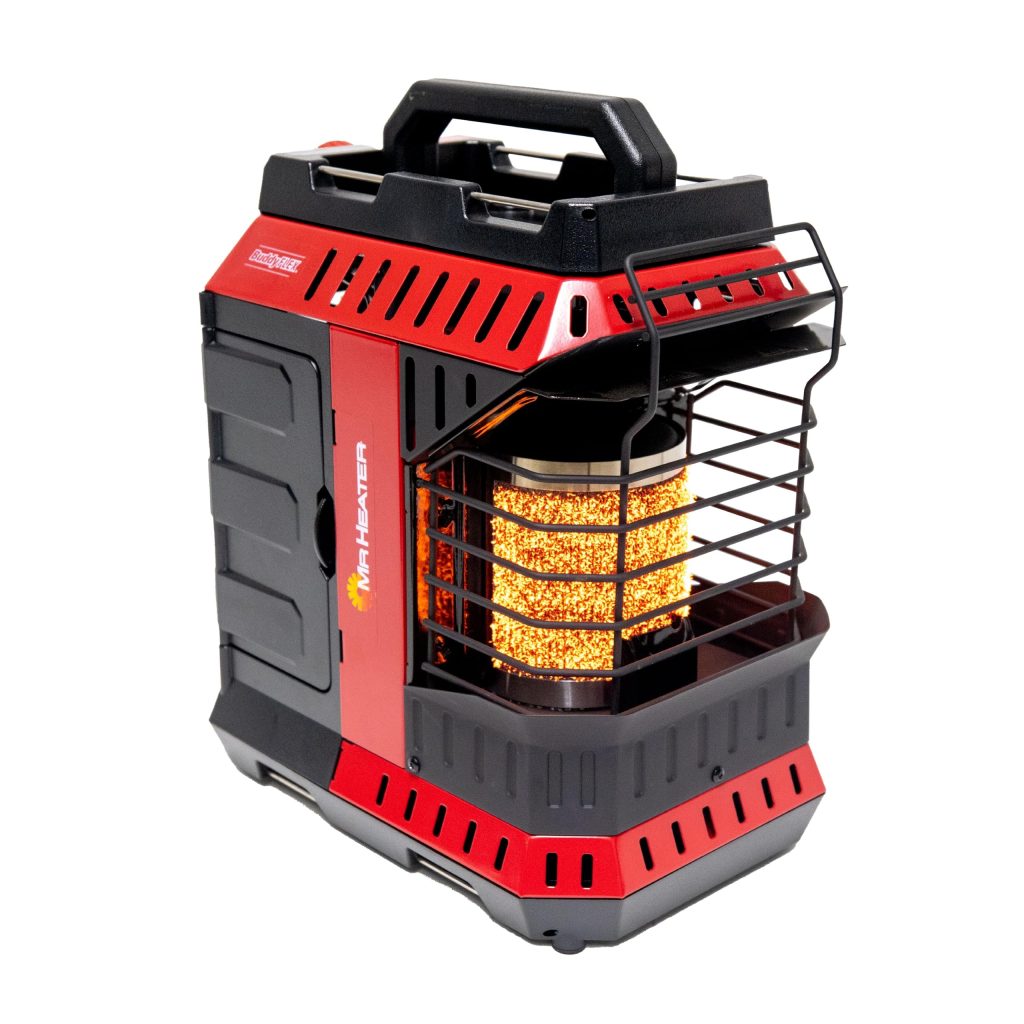
The Buddy FLEX is Mr. Heater’s newer take on the Buddy. Its mesh burner throws heat across a 180 degree spread, so a whole couch feels it, and it adds a thermal shutdown to the low oxygen sensor and tip switch.
It runs from 8,000 to 11,000 BTU for about 275 square feet and lights with a push button powered by an included AAA battery. It’s best for a family room where people sit spread out.
Key specs
- Heat output: 8,000 to 11,000 BTU per hour
- Rated room size: up to 275 sq ft
- Runtime (Mr. Heater): 1.5 to 3.5 hours per 1 lb cylinder, 36 to 72 hours on a 20 lb tank
- Safety: ODS, tip switch and thermal shutdown
- Ignition: push button, one AAA battery (included)
- Fresh air needed: 11 square inch opening
- Max elevation: 7,000 ft
- Weight: 11 lb
Pros and cons
Pros
- Wide heat spread warms more of the room
- Three separate safety shutoffs
- Takes a 20 lb tank outside with a hose
Cons
- Shortest cylinder runtime of the Buddy family
- The igniter needs a battery, unlike the original Buddy
- Its low setting is still a lot for a small bedroom
Performance analysis
Even its lowest setting burns a 1 lb cylinder in a few hours, so for outages I’d run it from a 20 lb tank outside, where Mr. Heater rates it at 36 to 72 hours. The accessory rail takes add-ons like a cooker; I’d treat those as outdoor gear.
6. Mr. Heater 20,000 BTU Vent-Free Blue Flame: Best Permanent Backup
Why I chose it and who it’s for
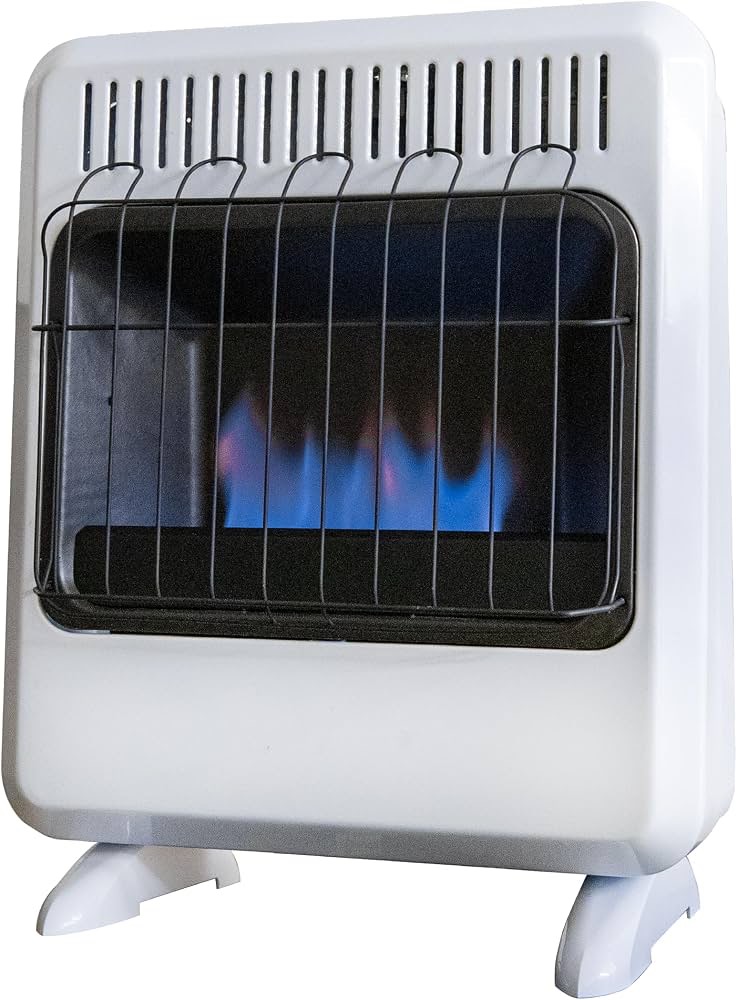
If you lose power every winter, a heater you plan around beats one you pull from a closet. This vent-free wall heater runs at up to 20,000 BTU with a thermostat, and Mr. Heater rates it for up to 700 square feet.
It needs no electricity apart from a battery for the igniter, and it runs from a 20 lb or larger tank outdoors. It’s best for homeowners in outage-prone areas who want a fixed backup heater in a living room or den.
Key specs
- Heat output: up to 20,000 BTU per hour, with thermostat
- Rated room size: up to 700 sq ft (Mr. Heater)
- Fuel: 20 lb propane tank or larger, kept outdoors
- Runtime (Mr. Heater): about 21.6 hours at full output on a 20 lb tank
- Safety: ODS and high limit shutoff
- Ignition: battery electronic igniter
- Max elevation: 4,500 ft
- Install: wall or floor mount, connected by a qualified installer; not for bedrooms or bathrooms
Pros and cons
Pros
- Thermostat holds a set temperature and saves fuel
- Heats a whole living area
- Always ready, with nothing to set up when the power drops
Cons
- Needs a proper gas connection from an outdoor tank, put in by a pro
- Not allowed in bedrooms or bathrooms, and not sold in California or Canada
- Rated only to 4,500 ft
Performance analysis
The thermostat makes the difference. A Buddy burns at whatever setting you pick, while this heater cycles to hold your set point, so on a mild night it uses a fraction of its rating. At full output a 20 lb tank lasts about 21 and a half hours, so for long outages ask your propane dealer about a bigger tank.
The room also needs enough air. The installation manual for this heater family asks for at least 50 cubic feet of room per 1,000 BTU unless more air comes from outside, so 20,000 BTU wants about 1,000 cubic feet, a 12 by 11 foot room with an 8 foot ceiling.
Outage Heat Planner
Tell the planner about the room you want to keep warm, how cold it gets and how long the outage might last. It works out the heat you need, checks all six heaters against your room, your elevation and your state’s rules, and counts the propane for the whole outage.
The heat need is an estimate: about 20 BTU per square foot when it’s chilly, 30 when it’s freezing and 40 in bitter cold. Mr. Heater’s room ratings work out to about 40, so they assume real cold. An older, drafty house will need more.
How to Choose an Indoor Propane Heater
What “indoor safe” actually means
An indoor certified heater has a low oxygen shutoff, called an ODS. A small pilot flame sits on a sensor, and if the oxygen in the room drops, the flame lifts and the gas shuts off. Add a tip-over switch and you have the two features that separate these heaters from the propane heaters sold for patios and job sites.
An ODS doesn’t measure carbon monoxide, though. A CO alarm does, and the CPSC recommends battery-operated alarms, or alarms with battery backup, on every level of the home and outside sleeping areas. These heaters are temporary heat for getting through an outage, not a replacement for your furnace.
Size the heater to the room
Multiply the room’s square footage by 20 BTU when it’s chilly outside, 30 when it’s freezing and 40 in bitter cold. A 12 by 14 foot room is 168 square feet, so it needs about 5,000 BTU in freezing weather. That’s the Portable Buddy on High, or the Big Buddy on Medium if the room is draftier than most.
Stay within the maker’s room rating too. A heater that’s too small runs flat out and never catches up.
Plan the propane
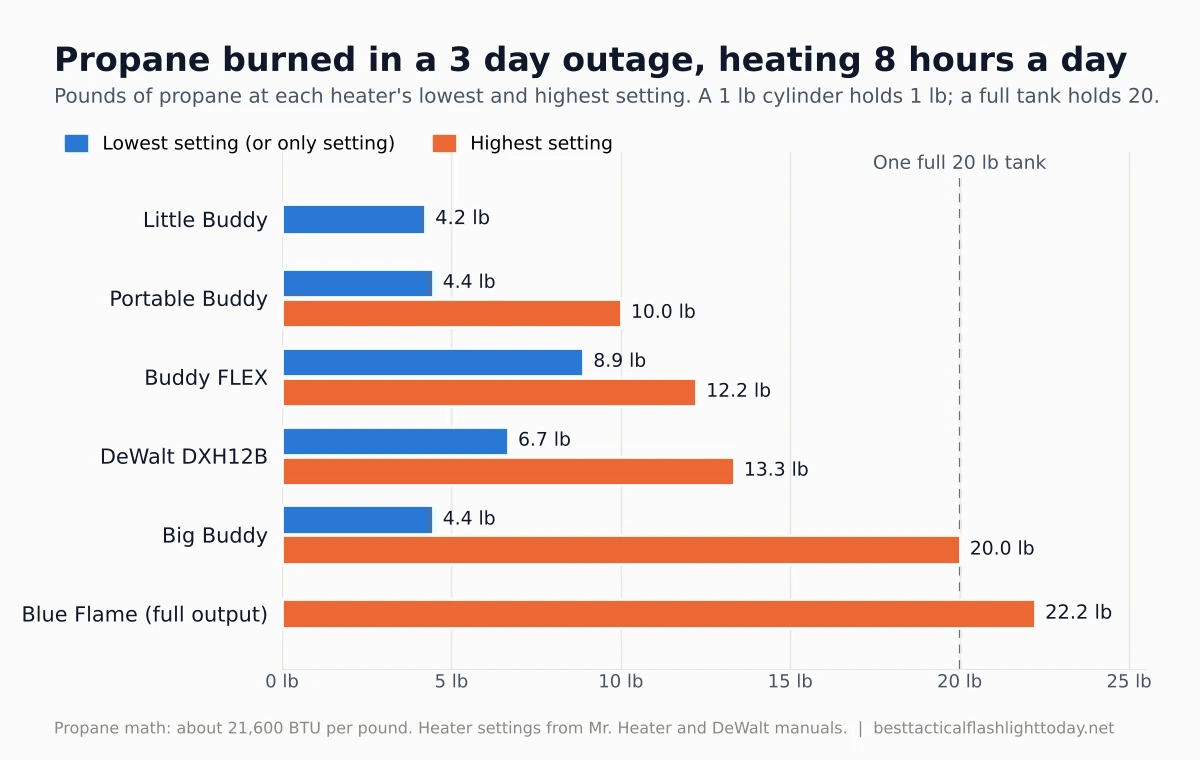
A pound of propane holds about 21,600 BTU, which is where the makers’ runtimes come from. A Portable Buddy on Low burns about a fifth of a pound an hour, and the Big Buddy on High burns close to a pound. Over a 3 day outage at 8 hours a day, that’s the gap between 5 cylinders and a full 20 lb tank. If you’re not sure how long to plan for, my power outages by state page shows how many hours a year customers in your state go without power.
For anything longer than a day, I’d run the heater from a 20 lb tank. Mr. Heater’s manuals allow that indoors only when the tank stays outside, with the hose running in. Use Mr. Heater’s own Buddy Series hose, which its manuals list as needing no fuel filter. Older Mr. Heater hoses need an inline fuel filter, replaced every year.
Fresh air, sleep and the CO alarm
Every one of these heaters burns oxygen from the room, so each manual gives a minimum fresh air opening. It works out to about 1 square inch per 1,000 BTU: 4 square inches for the Little Buddy, 9 for the Portable Buddy and 18 for the Big Buddy. A window opened half an inch across a 3 foot width gives you 18. Leaving the door to the rest of the house open helps too.
Take the sleeping rule seriously. Every Buddy and DeWalt manual says never to run the heater while sleeping and never to leave it unattended. Warm the room before bed, turn the heater off, and sleep under extra blankets.
Altitude and state rules
The low oxygen sensor reads thinner air as low oxygen. Mr. Heater says its Buddy heaters may shut off above 7,000 feet, and the vent-free Blue Flame is rated only to 4,500. That matters in the high parts of Colorado, Wyoming and the rest of the Mountain West, where searches for these heaters run highest. Check your elevation before you count on one.
Location matters as well. The Buddy heaters and the DeWalt are sold as outdoor-only versions in Massachusetts and Canada, so a heater bought there isn’t certified for indoor use. The vent-free Blue Flame isn’t sold in California or Canada at all, and in Massachusetts a vent-free heater needs a permit from your local fire department before it’s installed.
Two add-ons worth buying
Heaters you should never run indoors
Tank-top heaters, forced air torpedo heaters and patio heaters are built for outdoors or well ventilated job sites, not a living room. The same goes for a gas oven, a grill or a camp stove used for heat. If the box says outdoor use only, believe it.
A portable power station won’t save you here either. An electric space heater drains even a large one in a few hours, which is why propane is the better fuel for heat and a station is better kept for the fridge, lights and phones. For the rest of a cold weather plan, see the warmth section of my power outage emergency kit guide, or print the free Lights Out kit, which has a page on staying warm.
You’ll want light while the heater runs, too. A battery lantern on a shelf lights the whole room for hours, and a rechargeable headlamp keeps your hands free when you swap cylinders in the dark.
Frequently Asked Questions
Are indoor propane heaters safe to use in a house?
They can be, with the right heater and the right habits. Use only a heater certified for indoor use with a low oxygen shutoff, give it the fresh air opening its manual asks for, keep a battery CO alarm nearby, and never run it while you sleep. Treat it as temporary heat for an outage, not a replacement for your furnace.
Can you sleep with a propane heater on?
No. Mr. Heater’s manual for every Buddy model says never to operate the heater while sleeping, and DeWalt’s says the same. Warm the room before bed, turn the heater off, and sleep under extra blankets or in a sleeping bag.
How long does a 1 lb propane tank last in a Buddy heater?
On the Portable Buddy, 3 to 6 hours depending on the setting, by Mr. Heater’s figures. The Little Buddy gets about 5.6 hours, and the Big Buddy about 11 hours on Low from its two cylinders. Cold shortens that: Mr. Heater notes that runtimes drop when you run continuously below 20°F.
Do you need to crack a window with an indoor propane heater?
Yes. Each manual gives a minimum fresh air opening, about 1 square inch per 1,000 BTU: 4 square inches for the Little Buddy, 9 for the Portable Buddy and 18 for the Big Buddy. A window opened about half an inch covers most of them, because the heater burns oxygen the whole time it runs.
The Bottom Line
For most homes, the Mr. Heater Portable Buddy is the one to buy. It heats a normal room, runs on fuel you can find anywhere and has nothing to charge.
Go with the Mr. Heater Big Buddy for an open living area, the Mr. Heater Little Buddy for one small room, the DeWalt DXH12B if you already own DeWalt batteries, and the Mr. Heater Buddy FLEX for a wide family room. If outages are a yearly event where you live, the vent-free Blue Flame is the permanent fix.
Whichever you choose, buy a battery CO alarm with it, keep a window cracked and turn it off before bed. Then run your room through the Outage Heat Planner above to see how much propane to keep.
