
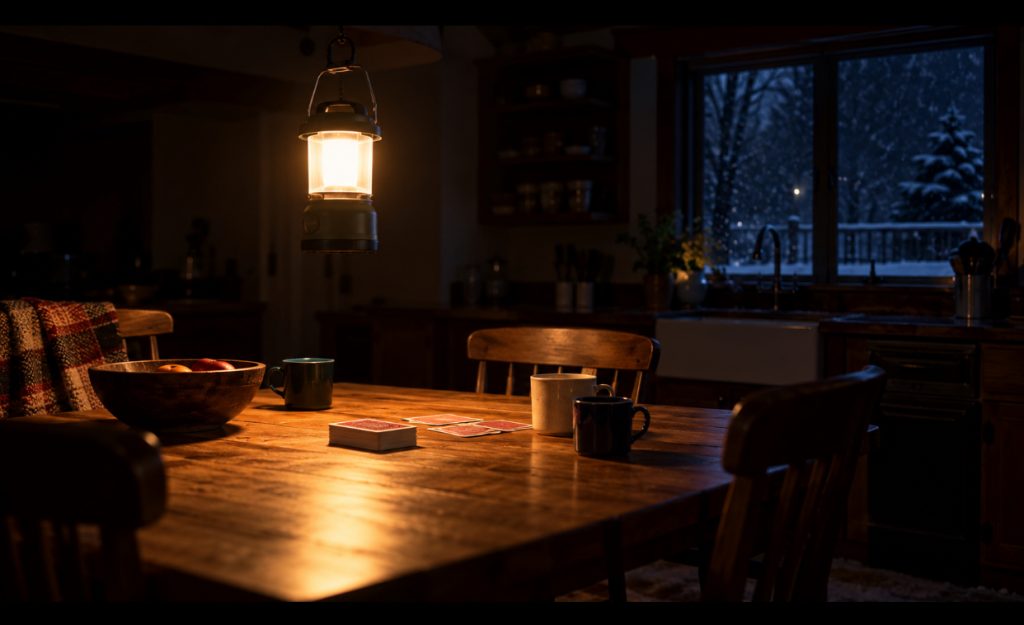
When the power goes out after dark, a flashlight shows you one spot at a time. A lantern lights the whole room, and that matters more on the second night of an outage than the first.
Most lanterns are sold as camping gear, rated for a weekend and a fresh set of batteries. An outage asks for something else: a lantern that runs for days on batteries you can store, and dims down to stretch them.
I picked six that do that, checked every runtime against the maker’s published figures, and built a simulator that shows how each one lights a real room. Short version: for one outage lantern, get the Streamlight Siege. If you’d rather never buy batteries, the Fenix CL30R is the rechargeable I’d pick.
Quick Picks
Battery Lanterns Compared
Look at the runtime on high first. It tells you how many nights a lantern can carry a room before you swap or recharge anything.
Room Glow Simulator: How Much Light Does Your Room Need?
Pick a room and a lantern. The simulator lights the room at the setting you’d actually use, then works out how long one set of batteries or one charge lasts, and how many spares get you through the outage.
Loading the room glow simulator. If it doesn’t appear, the comparison above and the buying guide below cover the same runtime numbers.
How I Chose These Lanterns
Every pick throws light all the way around, comes from a brand that publishes real runtime figures, and has a low setting for the long nights. I skipped the no-name lanterns claiming 5,000 lumens from four AA cells. Those numbers aren’t physically possible, and a lantern that lies about brightness usually lies about runtime too.
1. Streamlight Siege: Best Overall
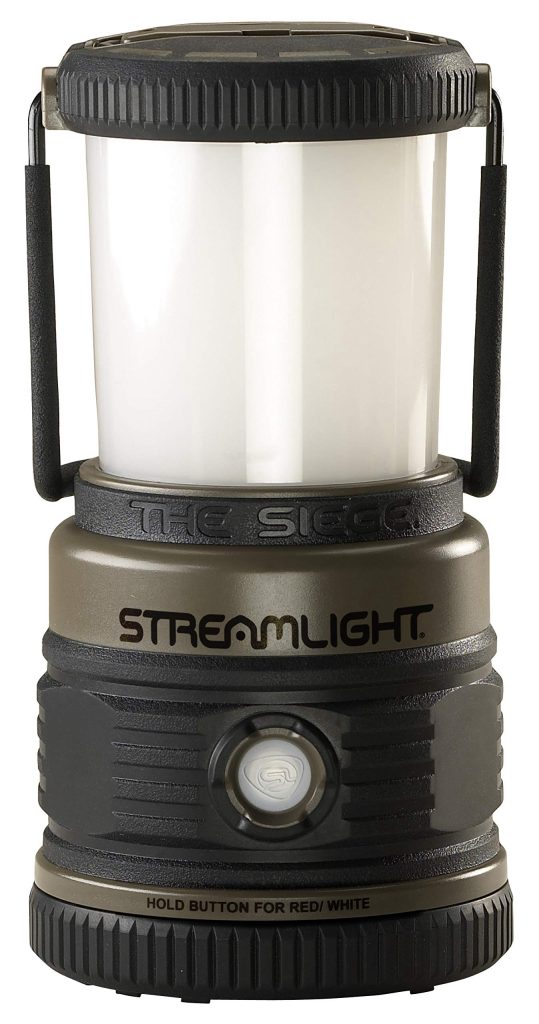
Why I chose it and who it’s for
The Siege is the lantern I’d hand anyone asking what to keep for outages. Three D cells give it a deep tank, it lights a room evenly, and its low mode runs for more than twelve days. It’s built like a work light and it’s waterproof, so a night on a wet porch won’t end it.
Key specs
- Output: 540 lumens high, 275 medium, 55 low, plus a 10 lumen red mode
- Runtime: 30 hours high, 70 medium, 295 low, 235 red
- Power: 3 D cells (not included)
- Waterproof and floats, 1 lb 15 oz with batteries
- Hanging hook plus D-rings top and bottom
Pros and cons
Pros
- Thirty hours on high is six five-hour evenings on one set
- Red mode finds the bathroom without waking the house
- D cells store for years and turn up in every hardware store
Cons
- D cells make it heavy, so it’s a house lantern rather than a pack lantern
- No rechargeable option in this model
Performance analysis
Most lanterns trade brightness for runtime. The Siege gets 540 lumens for 30 hours because three D batteries hold far more energy than any small rechargeable pack. Medium is the setting I’d live on: 275 lumens is enough to cook by, and one set lasts 70 hours.
The frosted dome spreads light evenly, so nobody squints at a hot spot across the table. Hang it from a cabinet handle or a ceiling fan and the whole room fills in.
2. Coast EAL22: Brightest
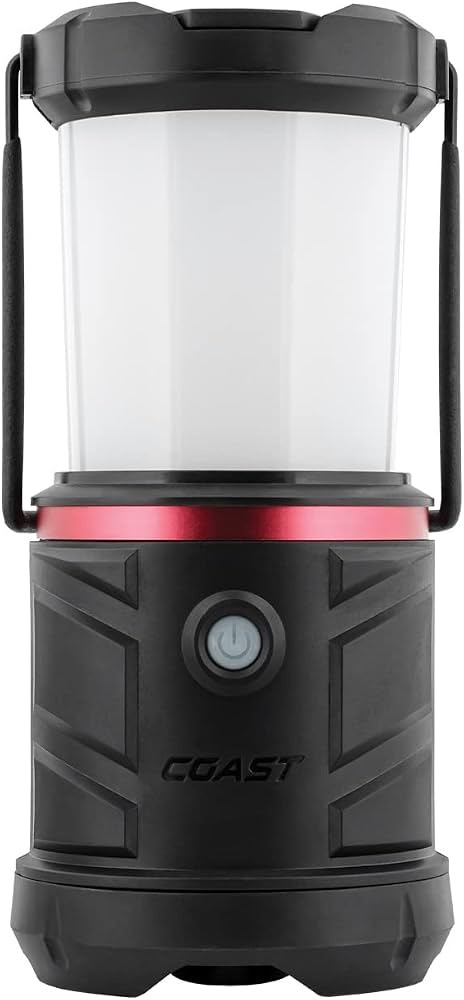
Why I chose it and who it’s for
If your outage plan centers on one big room, like an open kitchen and living area, the EAL22 actually fills it. It also runs on three D cells or Coast’s rechargeable pack, so you can charge it for everyday use and still fall back on alkalines.
Key specs
- Output: 1,250 lumens high, 640 medium, 95 low, plus red and flashing red
- Runtime: 9 hours high, 17 medium, 135 low (Coast publishes the full table)
- Power: 3 D cells or the Coast ZX1010 rechargeable pack
- IP54 dust and water resistance, 34.6 oz
- Warm and cool light colors
Pros and cons
Pros
- By far the brightest lantern in this guide
- Dual power: rechargeable for daily use, alkaline as backup
- Red mode for night trips through the house
Cons
- High mode empties a set of D cells in nine hours
- Rechargeable pack sold separately
Performance analysis
At 1,250 lumens it can light a living room and the kitchen beside it, which no other pick does alone. Save high for the first hour while everyone settles in. Medium at 640 lumens is still brighter than the Siege on high and runs 17 hours, and low lasts more than five days.
The dual power matters more than it sounds. Use the rechargeable for backyard evenings, and when a storm warning hits, a fresh set of D cells turns it into a long-haul outage light.
3. Energizer WeatheReady Emergency Lantern: Best Budget
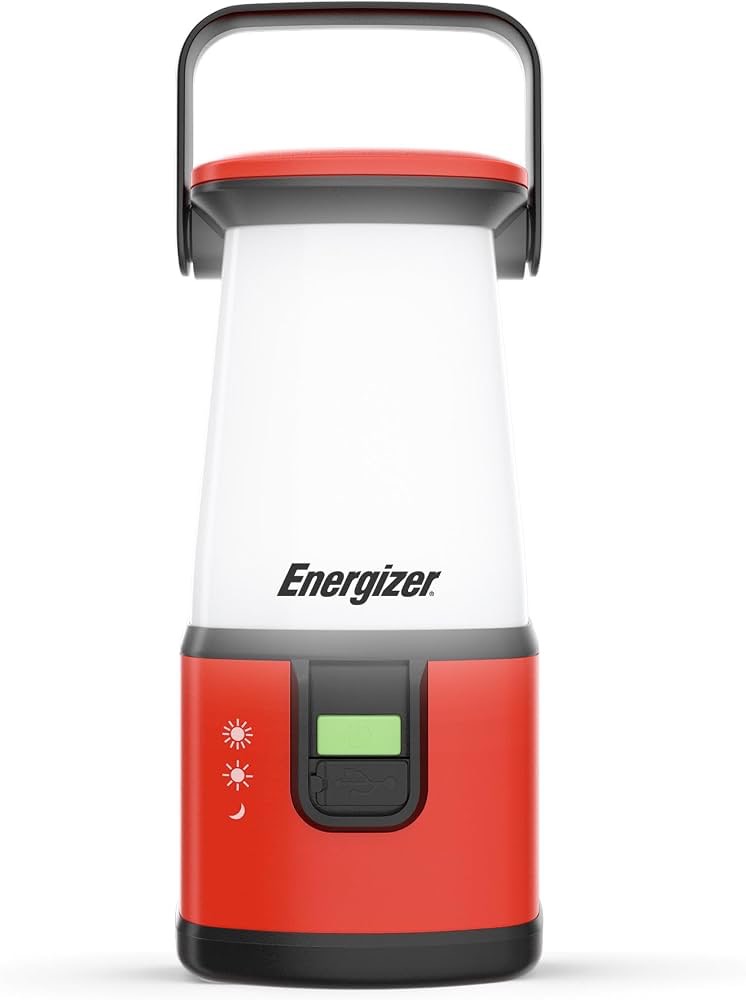
Why I chose it and who it’s for
Energizer designed the WeatheReady around the moment the lights go out. The power switch glows in the dark, and it takes three D cells or three AA cells. That second part is why it’s here. In a surprise outage, you use what’s in the drawer.
Key specs
- Output: 500 lumens high, 100 low, plus a nightlight mode
- Runtime: 30 hours high, 90 low with D cells, 500 in nightlight mode
- Power: 3 D or 3 AA cells (not included)
- IPX4 water resistance, 1 meter drop rating
- USB output port for a phone
Pros and cons
Pros
- Takes D or AA cells, the most flexible power here
- Glow in the dark switch is easy to find in a black room
- Nightlight mode runs for weeks
Cons
- No published runtimes for AA cells, which hold far less than Ds
- Plastic body is less rugged than the Siege
Performance analysis
On D cells it matches the Siege’s 30 hours on high at slightly lower brightness, a strong showing for a budget lantern. Low at 100 lumens suits a bedroom and runs 90 hours.
On AA cells expect a fraction of that, since an AA holds roughly a sixth of what a D cell does. Fine for a short outage, but for a real kit, keep a pack of D batteries with it.
4. Fenix CL30R: Best Rechargeable
Why I chose it and who it’s for
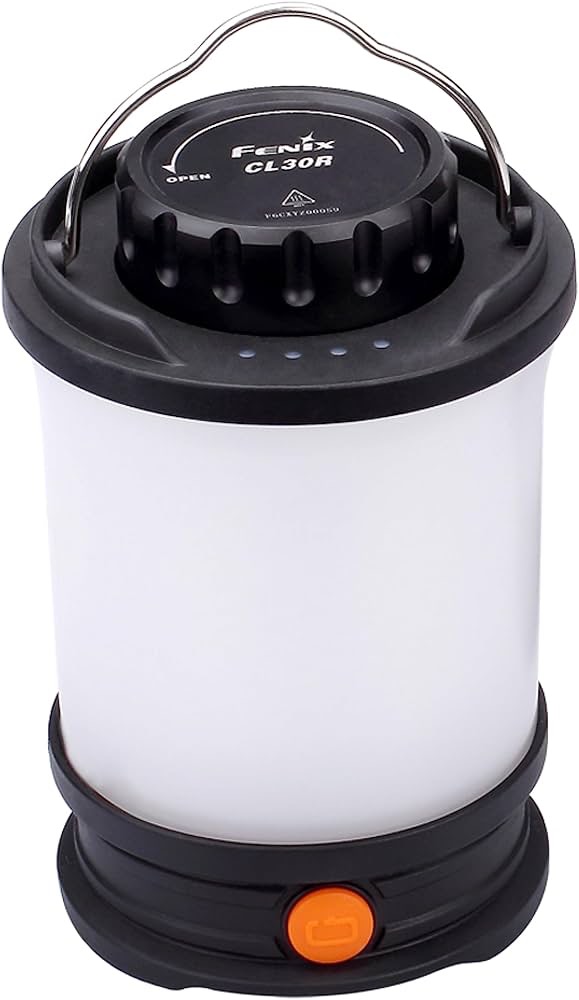
If you’d rather charge than stockpile, the CL30R gives the most runtime per charge of any rechargeable here. It runs on three 18650 cells, the same cells used in our best 18650 flashlight picks, and Fenix includes them.
Key specs
- Output: 650 lumens turbo, 350 high, 100 mid, 50 low, 10 eco
- Runtime with included cells: 4.5 hours turbo, 9 high, 38 mid, 70 low, 300 eco
- Power: 3 x 18650 cells, 2,600 mAh each (included), Micro USB charging
- IPX7 waterproof, 14.5 oz without batteries
- Works as a power bank
Pros and cons
Pros
- Nine hours at 350 lumens is the best rechargeable runtime here
- Swappable cells, so charged spares extend it as far as you like
- Waterproof enough for a picnic table in the rain
Cons
- Micro USB charging takes about 8.5 hours
- Needs button top 18650 cells
Performance analysis
Mid at 100 lumens lights a bedroom or small kitchen for 38 hours, enough for most short outages without a charger. High at 350 lumens is a living room setting and still gives 9 hours.
For a long outage, keep a spare set of charged button top 18650 cells. Swap them in and you’ve doubled your runtime without power. New to 18650s? Our 18650 vs 21700 guide covers how to store them safely.
5. Goal Zero Lighthouse 600: Best Hand Crank Backup
Why I chose it and who it’s for
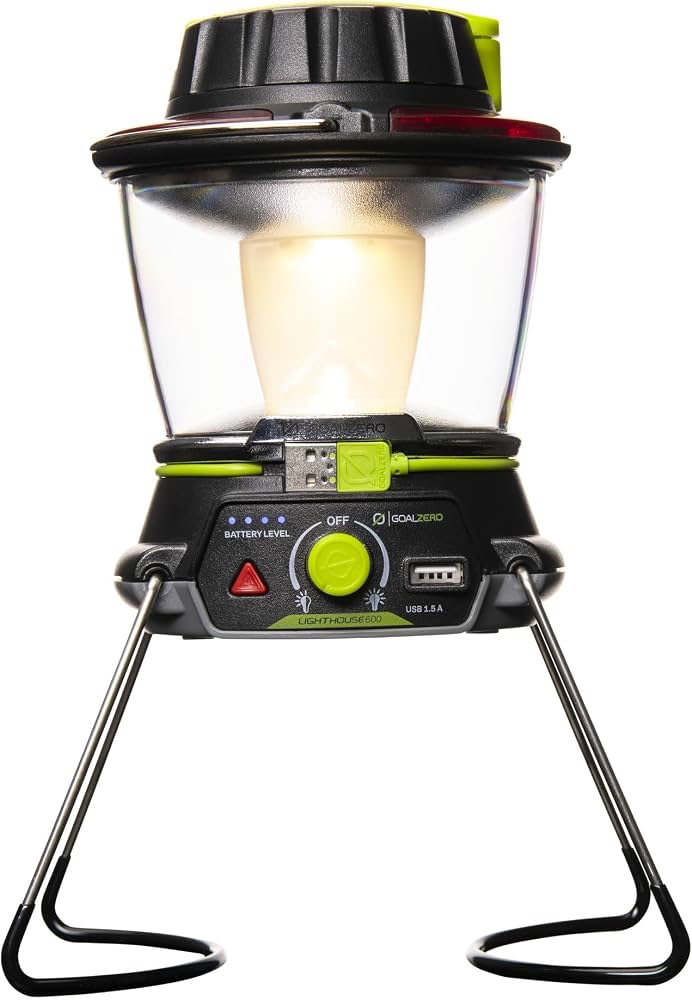
The Lighthouse 600 is the lantern in our power outage emergency kit guide because it can’t completely run dry. Charge it by USB before a storm, from a solar panel during one, and if everything fails, turn the crank.
Key specs
- Output: up to 600 lumens, dimmable, each side switchable
- Runtime: 2.5 hours high on both sides, 5 hours on one side, 180 hours low
- Battery: built-in 5,200 mAh lithium
- Charging: USB (about 6 hours), solar or hand crank
- USB output: 5V, up to 1A for phones
Pros and cons
Pros
- Hand crank means it’s never totally dead
- Light one side against a wall to double runtime
- Smooth dimmer instead of fixed steps
Cons
- High lasts only 2.5 hours, the shortest here
- Built-in battery can’t be swapped
Performance analysis
Don’t buy it to run on high. Dim it to a comfortable level and light one side against a wall, and it stretches for days. Goal Zero rates low at 180 hours on both sides and 320 on one.
The crank is insurance. A minute of cranking gives about ten minutes of light on low, enough to get the kids to bed when the battery is flat. Goal Zero rates a full charge from its Nomad 10 solar panel at about six hours of good sun.
6. LuminAID PackLite Max 2-in-1: Best Solar
Why I chose it and who it’s for
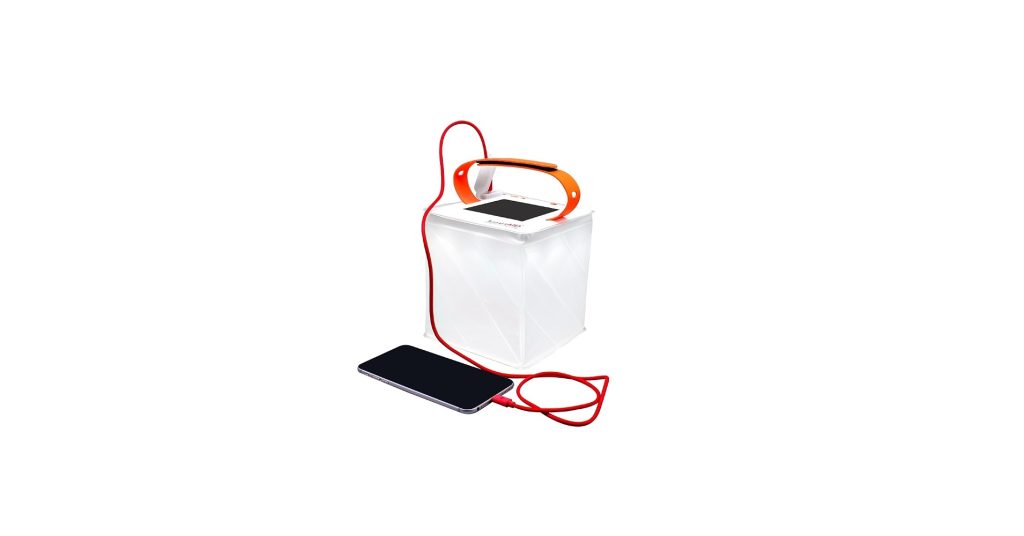
The PackLite Max is for the go bag, the car or the family that wants a light that never needs batteries. It folds flat to about an inch and charges from its own solar panel. It’s the dimmest pick here, so treat it as a bedroom or bathroom light.
Key specs
- Output: 150 lumens maximum
- Runtime: up to 50 hours on its lowest setting
- Battery: built-in 2,000 mAh, about one phone charge
- Charging: solar (16 to 20 hours of sun) or USB
- Packs flat to about 1 inch, floats
Pros and cons
Pros
- Solar charging means no battery runs
- Flat enough to live in a glovebox
- Doubles as a phone charger
Cons
- 150 lumens won’t light a living room
- A full solar charge takes two or three sunny days
Performance analysis
Leave it on a sunny windowsill by day and it’s ready for a bedroom at night. The soft glow suits a child’s room, where a bright lantern would keep everyone awake. Charge it by USB before the storm and let the sun keep it topped up.
Because it packs so flat, it’s the easiest lantern to keep in several places, one in each car and one in the kit.
Got DeWalt Batteries? Read This First
Plenty of people search for a DeWalt lantern because they own a drawer full of 20V packs. DeWalt doesn’t make a true lantern. Most lanterns sold under that name come from small brands that fit DeWalt packs, and DeWalt doesn’t make or back them.
DeWalt’s closest option is the DeWalt DCL077B, a compact task light rated up to 2,000 lumens. It runs on 12V MAX, 20V MAX and FLEXVOLT packs, carries an IP54 rating and has a handle that rotates a full circle. It’s directional, so bounce it off the ceiling to light a room. DeWalt doesn’t publish runtimes for it, so test it with your biggest pack before you count on it.
How Long Each Lantern Runs on High
This chart shows each maker’s rated runtime on the brightest setting, and it makes one thing clear: lanterns on D cells go far longer at high output than lanterns with small built-in batteries.
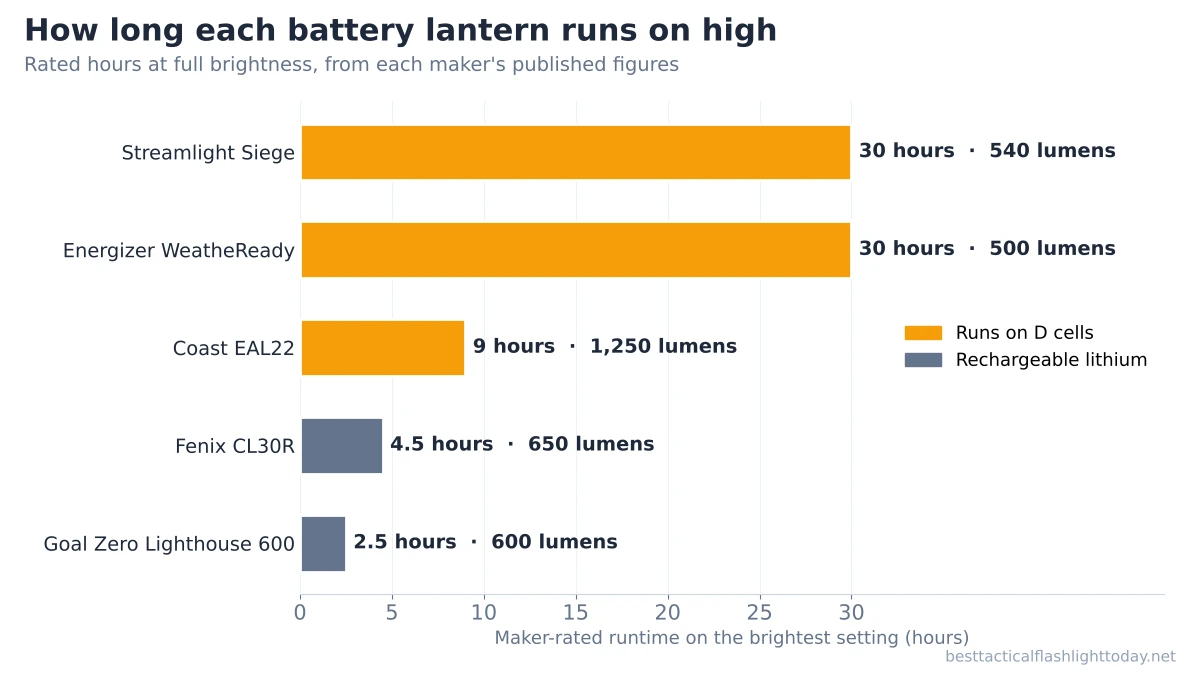
That doesn’t make rechargeables a bad choice. You just plan them differently: a middle setting plus a power bank or solar panel nearby. The LuminAID isn’t charted because LuminAID only publishes runtime for its lowest setting.
How to Choose a Battery Lantern for Power Outages
Shop by runtime, then brightness
A camping lantern needs to last a weekend. An outage lantern needs to last until crews reach your street, which can be a week after an ice storm. Compare runtime on medium, not the headline lumens. A 1,000 lumen lantern that dies in a night is worse than a 300 lumen one that runs all week. Our power outages by state data shows how long outages run where you live.
D cells, AA cells or rechargeable
D cells hold the most energy and store for years, which is why the two longest running lanterns here use them. AA cells are easier to find but hold much less. Rechargeables cost less over time, but only help if you keep them topped up. The safest plan is one lantern on stored batteries and one rechargeable. Our best rechargeable flashlight guide covers handheld lights that charge the same way.
Hang it high
Where you put a lantern changes how bright the room feels. Hang it from a ceiling fan or a hook over the table and light spreads over everything. Set it in the middle of the table and it blinds whoever sits across. A pale ceiling bounces light back down, so the room feels brighter than the lumen rating suggests.
Check the low mode and look for red
Low is the setting that carries you through a long outage, so check its runtime as carefully as high. Red light keeps your eyes adjusted to the dark, so you can check on the kids at 3 a.m. without waking the house.
Keep a flashlight too
A lantern lights the room you’re in. A flashlight takes you to the basement or the breaker box. Our best flashlight for power outages guide covers that side.
Store it so it works
Alkalines can leak in a lantern that sits for a year and ruin the contacts. Store the batteries out, bagged and taped to the lantern, or use lithium AA cells, which resist leaking. Top up rechargeables twice a year when the clocks change.
Frequently Asked Questions
What is the best lantern for a power outage?
For most homes, the Streamlight Siege. It gives 540 lumens for 30 hours on three D cells, drops to a low mode that lasts 295 hours, and floats. For a rechargeable, the Fenix CL30R is the best choice.
How many lumens does a lantern need to light a room?
For an outage, about 50 lumens in a bathroom or hallway, 100 in a bedroom, and 300 to 400 in a kitchen or living room. That’s far below your normal ceiling lights, but enough to cook, read and move around safely, especially with the lantern hung high.
Are battery or rechargeable lanterns better for power outages?
Battery lanterns are better for long outages, because spare D or AA cells store for years and swap in seconds. Rechargeables suit short outages and everyday use, as long as you have a power bank or solar panel to refill them. One of each covers you either way.
Is it safe to use a gas or oil lantern indoors during a power outage?
No. Gas, propane and kerosene lanterns give off carbon monoxide, which you can’t see or smell. The CDC warns never to use gasoline, propane or charcoal burning devices inside your home or garage. Use a battery lantern indoors, and keep a battery powered CO alarm, like the one in our power outage emergency kit guide.
The Bottom Line
If you buy one lantern for outages, make it the Streamlight Siege. Thirty hours on high and nearly two weeks on low is the runtime that gets a family through a long one. For big rooms, the Coast EAL22 is the brightest here, and on a tight budget the Energizer WeatheReady Emergency Lantern runs on whatever batteries you have.
Prefer charging? The Fenix CL30R has the best rechargeable runtime, the Goal Zero Lighthouse 600 adds a crank you can always fall back on, and the LuminAID PackLite Max 2-in-1 keeps a small room lit on sunshine. Whichever you pick, load it now, before the storm warning, and hang it high when the lights go out.
