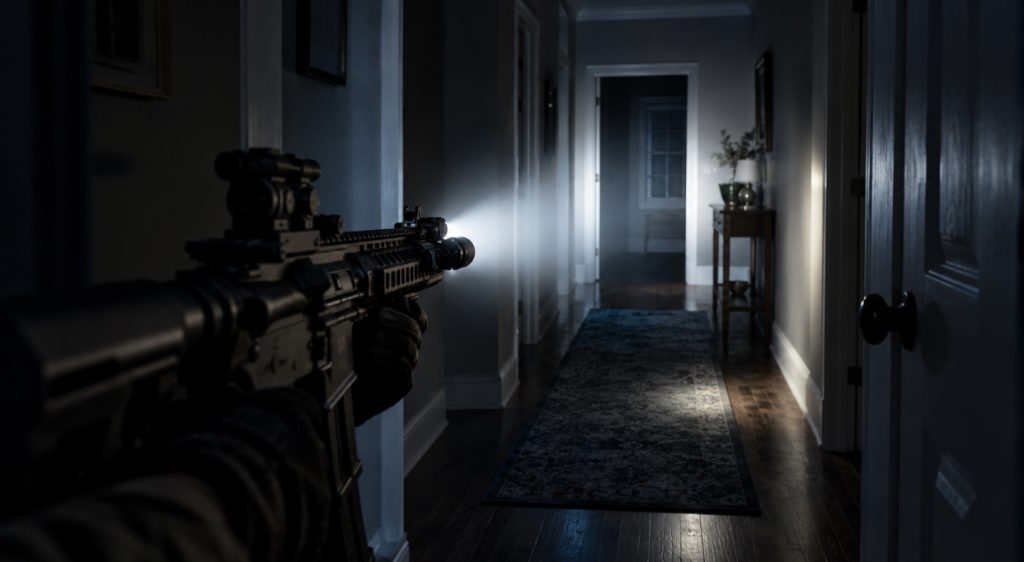
A rifle without a light is a daytime tool. The AR-15 is one of the most common rifles kept for home defense in America, and the moments it’s kept for tend to happen after dark, in a hallway or across a yard you can’t see into. Before anything else, a good AR-15 light lets you see who’s there.
The trouble is that rifle lights are sold on lumens, and lumens are the wrong number to shop by. Candela decides how far the light reaches and how well it punches through fog, smoke and glare. The mount decides whether it fits your handguard at all. Where you put it on the rail decides whether there’s a barrel shadow in the middle of your beam.
This guide covers all of that. I picked six lights from brands that stand behind their warranties, checked every spec against the maker’s published figures, and built a setup tool that matches a mount, switch and rail position to your rifle.
Short version: for the strongest light here, get the REIN 3.0. For the most reach per dollar, the Streamlight ProTac HL-X is the one I’d buy first.
Quick Picks
AR-15 Lights Compared
Candela sets how far each light reaches, so start there. Every light below runs on lithium cells and ships with a way to mount it.
AR Light Setup Builder: Mount, Position and Switch
Tell the builder about your rifle and how you’ll use it. It suggests a light from this guide, the mount and switch to pair with it, and the rail position that suits your hands. Then tap the clock positions to try other spots and watch what happens to the beam.
Loading the AR light setup builder. If it doesn’t appear, the comparison above and the buying guide below cover the same mount and position advice.
How I Picked These Lights
Every light here had to come from a maker with a long record on duty rifles and a real warranty, because recoil finds weak switches and mounts fast. Each one had to ship with a way to mount it and run on lithium cells you can trust in the cold. I checked lumens, candela, runtime and what’s in the box against each maker’s published specs, and where a figure has changed between batches, I’ve said so.
I left out bargain lights that only list lumens, since a missing candela figure usually means a weak beam. I also skipped lights you can’t easily buy through a mainstream store, so every pick here is one you can order today.
1. Cloud Defensive REIN 3.0: Best Overall
Why I chose it and who it’s for
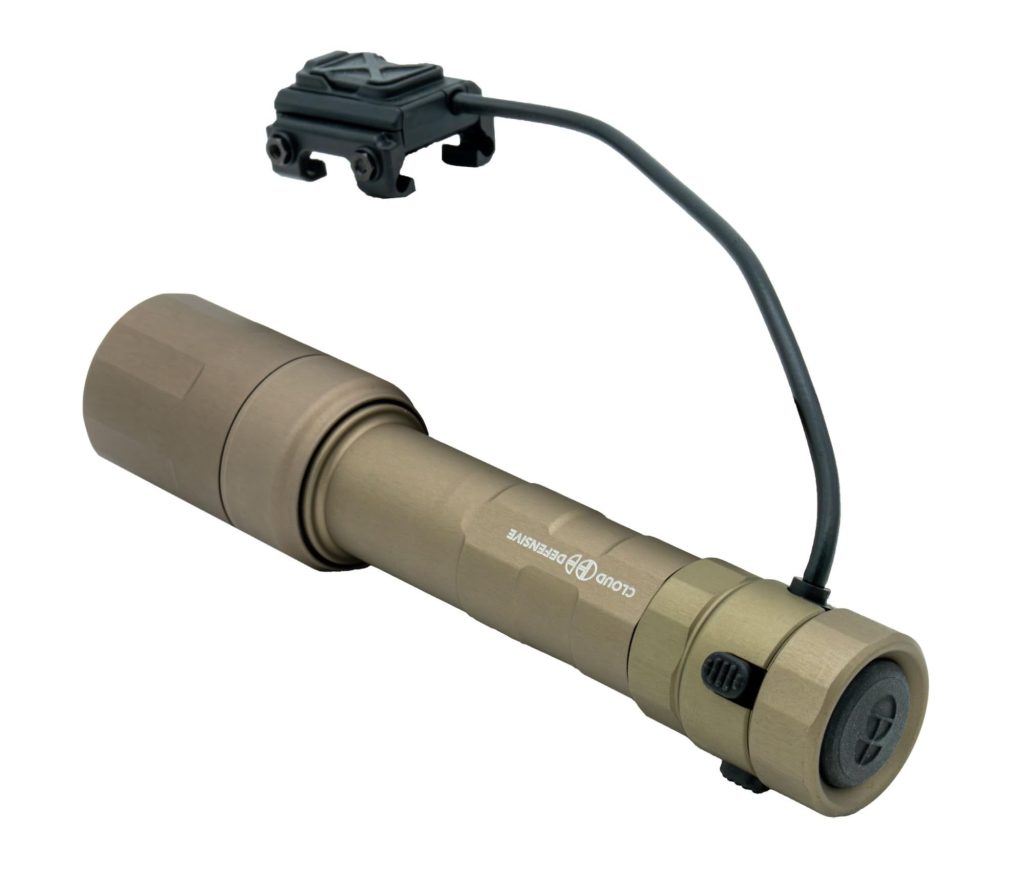
The REIN 3.0 is the light the rest of this list gets measured against. Cloud Defensive rates it at 100,000 candela and 1,250 lumens on an 18650, which puts a hard, bright hotspot on a target far past anything a house will ask of it, with enough spill left over to see the room around it. It does that from a 1.3 inch bezel, so it sits neatly on rifles where older high output lights looked like a soup can bolted to the rail. It’s for the owner who wants one light that covers the hallway and the back fence line, and doesn’t want to buy another.
Key specs
- 100,000 candela and 1,250 lumens on an 18650 (lower on two CR123A)
- Dual fuel: one 18650 (included, with a charger) or two CR123A
- Runtime on high listed between 65 and 95 minutes, depending on the listing
- 6.17 in long, 6.91 oz with battery and remote switch, 1.3 in bezel
- IPX8, rated submersible to 100 ft for 24 hours, 3 mm thick glass lens
- In the box: remote switch and tailcap, inline M-LOK mount; made in the USA with a lifetime warranty
Pros and cons
Pros
- Highest candela and lumens of any light here
- Small bezel for this much output
- Remote switch, battery and charger included
Cons
- Ships with an M-LOK mount, so Picatinny rails need a Scout-pattern mount
- Uses Cloud Defensive’s own switches, not SureFire-pattern ones
- Top of the price range
Performance analysis
Indoors, the 1,250 lumens give the beam enough spill that the hotspot never feels like a pointer. Outdoors, the 100,000 candela is the reason to buy it. That much intensity cuts through rain, fog and the glare of a neighbor’s porch light far better than a high lumen, low candela light can.
Run it on the 18650. Two CR123As are a fallback for when the charger isn’t handy, and the output drops on them. The tailcap cartridge can be turned to tuck the switch cable out of the way without taking the light off, which helps on a crowded handguard. As with any weapon light, treat the box figure as a best case. High candela lights often measure a little under their rating, and this one still leads the field.
2. Streamlight ProTac Rail Mount HL-X: Best Value
Why I chose it and who it’s for
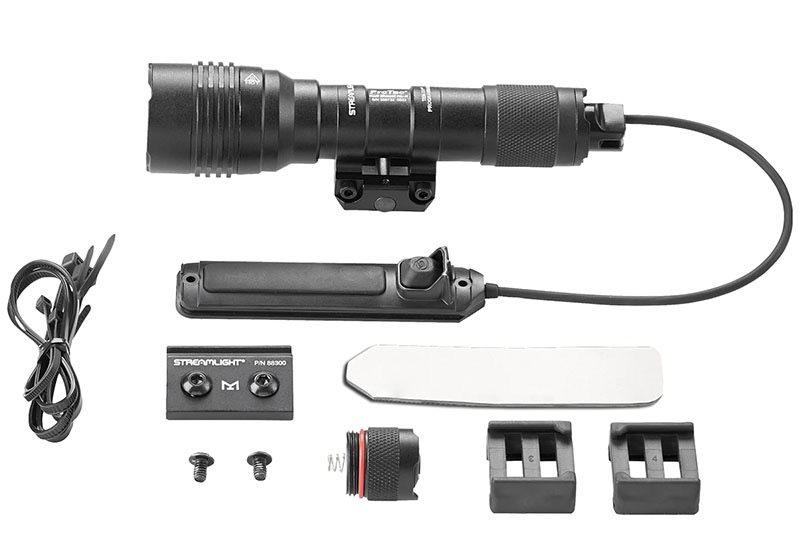
The HL-X is the light I’d point most first-time buyers to. It costs a fraction of the REIN or the SureFire Turbo, clamps straight onto Picatinny, and comes with an M-LOK mount, a remote pressure switch and a regular tail switch, so there’s nothing else to buy. Streamlight’s current listing rates it at 50,000 candela and 1,000 lumens, which is enough reach for any house and most yards. Searches for it have climbed sharply, and the interest is earned. It’s for anyone setting up a first AR light who wants it to still be on the rifle in ten years.
Key specs
- 1,000 lumens, 50,000 candela, 447 m beam (Streamlight’s current rating)
- Older boxes list 27,600 candela and 332 m, so check the beam figure on the package
- 1.25 hours on two CR123A, 1.75 hours on the SL-B26 rechargeable pack
- Low: 60 lumens for 21 to 24 hours
- 5.43 in long, 6.4 to 6.9 oz
- IP67 with the tail switch, IP54 with the remote switch fitted
Pros and cons
Pros
- Picatinny clamp built in, M-LOK mount included
- Pressure switch and tail switch both in the box
- Runs on CR123A or a rechargeable pack
Cons
- Bigger and heavier than the SureFire Mini
- Less water resistant with the remote switch fitted
- The TEN-TAP menu takes a minute to learn
Performance analysis
The beam has a defined hotspot with a broad, usable spill, so it works inside a house and still reaches across a yard. TEN-TAP lets you choose between three programs, and on a defensive rifle I’d set it to high only. Nobody wants to cycle past a strobe or a low mode under stress.
It’s also the light I recommend for railed shotguns in my best shotgun light guide. The SL-B26 pack charges over USB, so you can keep the light topped up without a separate charger. If you run one on each gun, your hands learn one switch, which counts for a lot when you’re half awake at 3 a.m. Pay attention to the candela on the box: Streamlight’s own figure has risen, and the newer rating is the one worth paying for.
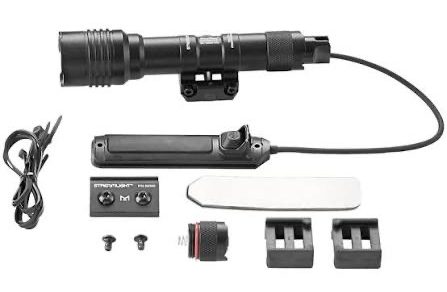
3. Streamlight ProTac Rail Mount 2: Best Budget
Why I chose it and who it’s for
Cheap no-name rifle lights are where a lot of AR builds go wrong. Recoil works their switches loose and their mounts walk along the rail. The ProTac Rail Mount 2 keeps you in a brand with a lifetime warranty at the low end of the price range. It has the same clamp-on body and the same kit in the box as the HL-X, with less output. It’s for a first build, a second rifle or a truck gun that needs a light that works more than one that wins on paper.
Key specs
- 625 lumens, 22,000 candela, 297 m beam
- Low: 60 lumens, 2,000 candela, about 21 hours
- 2 hours on high from two CR123A (included)
- 5 in long, 5 oz
- In the box: pressure switch, tail switch, retaining clips, M-LOK mount
- IPX7 with the tail switch, IPX4 with the remote switch
Pros and cons
Pros
- Complete kit, ready to mount
- Lightest Streamlight in this guide
- Same switch layout as the HL-X
Cons
- Lowest candela of the full-size picks
- CR123A only, no rechargeable option
- Less punch through fog and smoke than the bigger lights
Performance analysis
22,000 candela will identify a person anywhere inside a house and out to the edge of most suburban yards. Where it falls behind is open ground and bad weather, where the bigger lights keep their hotspot and this one spreads thin. Indoors, the lower output is almost an advantage, since there’s less glare off white walls and doors.
Keep a pack of spare CR123A lithium batteries with the rifle. They store for years and work in the cold, which suits a light that may sit unused for months. If you want rechargeable cells later, read my guide to rechargeable CR123A batteries before swapping, since not every light is built for their higher voltage.
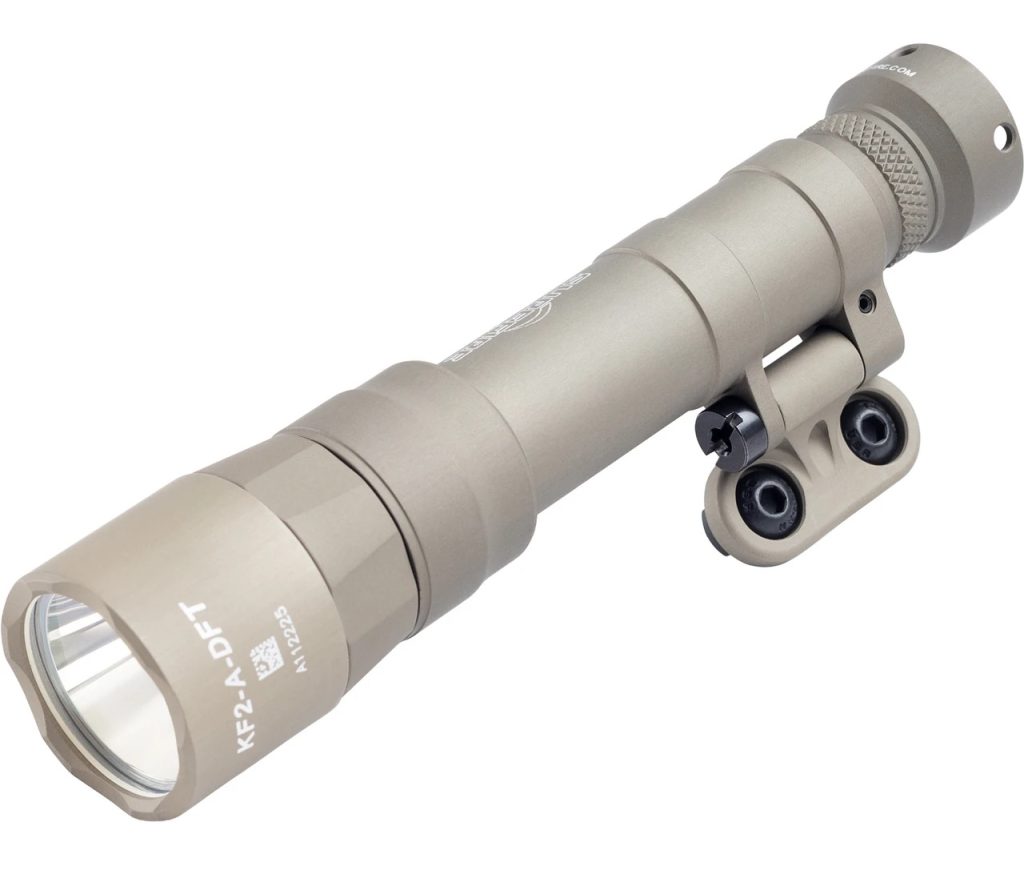
4. SureFire M640DFT Turbo Scout Light Pro: Best Throw
Why I chose it and who it’s for
If your rifle watches over acreage, a barn or a long driveway, reach is what you’re paying for. SureFire’s Turbo reflector squeezes the beam into a tight, intense hotspot rated at 100,000 candela on the included SF18650. That’s the same peak as the REIN, but SureFire gets there with 700 lumens, which tells you how focused the beam is. It’s for rural owners, ranchers and anyone whose problem is more likely to be 100 yards out than 10 feet away.
Key specs
- 100,000 candela and 700 lumens on the included SF18650
- 90,000 candela and 600 lumens on two 123A cells
- 2.75 hours on high with the SF18650, 1.75 hours on 123A
- 632 m rated beam distance
- 5.9 in long, 5.5 oz
- Low-Profile Mount with Picatinny and M-LOK cleats, ZE68 click tailcap, IPX7
Pros and cons
Pros
- Ties the REIN for the most candela in this guide
- Longest high mode runtime here
- Both mounts and a rechargeable battery included
Cons
- Tight beam has less spill for searching a room
- Remote switch sold separately
- Top of the price range
Performance analysis
Indoors, a turbo beam can feel narrow, and its very hot center bounces harder off white walls at close range. That’s the trade. Outdoors, nothing on this list does more with each lumen. SureFire lists the drop to 90,000 candela when you swap to 123A cells, so the backup batteries cost you very little reach.
The Scout Light Pro body works with a long list of SureFire remote switches and aftermarket mounts, so you can set it up exactly how you like. Its Low-Profile Mount also lets you shift the light’s position relative to the rail, which helps it sit tight beside a laser or a sling mount. If the tailcap sits out of thumb reach in your chosen spot, add a SureFire remote tape switch and put the pad under your support hand.
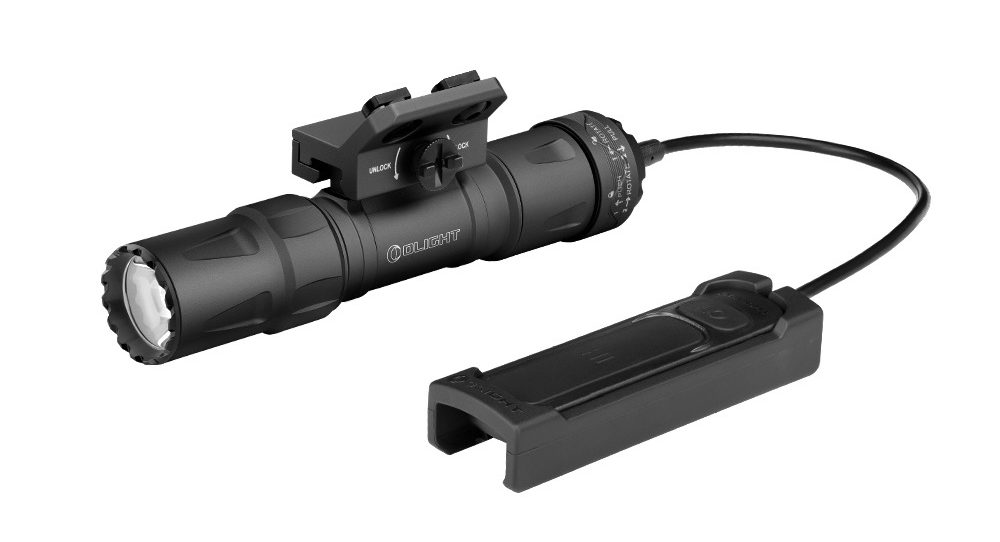
5. Olight Odin: Best Rechargeable
Why I chose it and who it’s for
Most weapon lights make charging a chore. You pull the battery or the whole light, hunt for the right charger, and then remember to put it all back. The Odin charges in place through a magnetic cable that snaps onto the tail, so topping it up is as easy as charging a phone. It’s rated at 2,000 lumens and 22,500 candela, and its remote pressure switch attaches magnetically too. It’s for owners who’d rather keep the rifle ready with a cable than with a drawer of CR123As.
Key specs
- 2,000 lumens at burst, 22,500 candela, 300 m beam
- Output steps down: 2,000 lumens for about 2 minutes, then 1,000, 760 and 300
- Low: 300 lumens for 8 hours
- Olight’s own 5,000mAh 21700 battery, MCC3 magnetic charging
- 5.37 in long, 7.62 oz, IPX8
- In the box: magnetic remote pressure switch and a rail mount
Pros and cons
Pros
- Charges without coming off the rifle
- Highest lumen rating in this guide
- IPX8 with a remote switch included
Cons
- 2,000 lumens lasts about two minutes before stepping down
- Proprietary battery, so spares come from Olight
- Mount type varies by listing, so check M-LOK or Picatinny before you order
Performance analysis
Read the 2,000 lumen figure as a burst. After a couple of minutes it drops to 1,000, then holds around 760 for most of its runtime, which is still plenty bright indoors. That flood of light makes it good at lighting a whole room at once. With 22,500 candela, though, it won’t reach across a field the way the HL-X or the Turbo does. The magnetic pressure switch can sit on any steel surface or its own stand, so placing it under your thumb takes seconds and moving it later is just as easy.
The big cell is why it runs so long on its middle levels, and my 18650 vs 21700 guide explains what the larger battery buys you. Make charging part of a routine, like the first of every month, and it’ll always be ready.
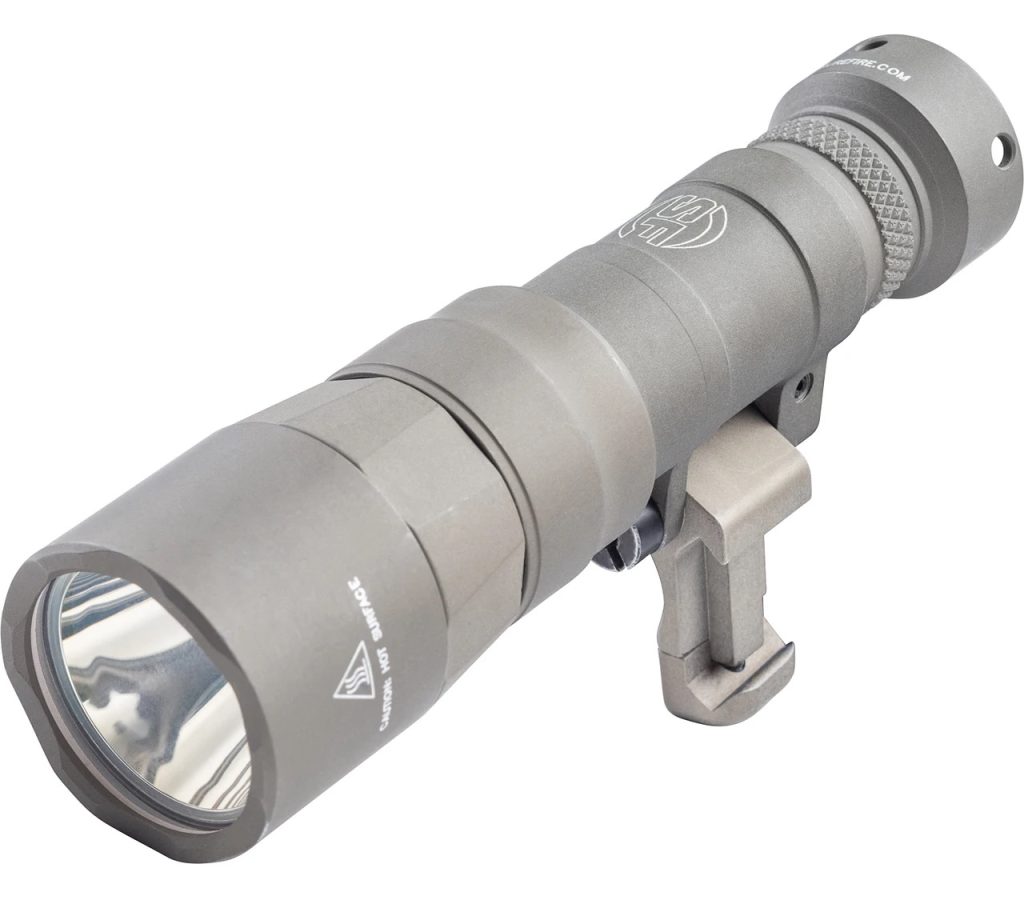
6. SureFire Mini Scout Light Pro: Best Compact
Why I chose it and who it’s for
Not every AR is a full-size carbine. On a short barreled rifle, a pistol caliber carbine or a slim lightweight build, a big light hangs off the handguard and gets in the way. The Mini Scout Light Pro weighs 3.65 oz with its single CR123A, measures 4.1 inches and comes with both Picatinny and M-LOK mounts. It’s for compact builds that will spend their lives inside a house, where size matters more than reach.
Key specs
- 500 lumens, 7,600 candela, about 175 m beam
- 1 hour on one CR123A (included)
- 4.1 in long, 3.65 oz
- Low-Profile Mount with Picatinny and M-LOK cleats, Z68 click tailcap
- IPX7, TIR lens with a hybrid beam
Pros and cons
Pros
- Smallest and lightest light here
- Both mounts in the box
- SureFire build quality in a tiny body
Cons
- Lowest candela in the guide
- One hour runtime on high
- No remote switch in the base kit
Performance analysis
7,600 candela is honest indoor power. It’ll identify someone at the end of a long hallway, and the softer hotspot won’t bounce off walls as hard as the bigger lights. It’s not a yard light, and I wouldn’t put it on a rifle meant for open ground.
If you love the size but want more reach, SureFire’s Turbo Mini Scout Light Pro is the step up, at a higher price. For a rifle that lives in a safe by the bed, the standard Mini Scout is all the light a house needs.
Short barrels help it, too. On most compact builds the handguard runs nearly to the muzzle, so barrel shadow is rarely a problem and you can put the light wherever your thumb lands.
How Far Each Light Actually Reaches
Spec sheets list beam distance in meters, and it’s worth knowing what that number means. Under the ANSI/PLATO FL 1 standard, beam distance is the point where the light falls to 0.25 lux, about the light of a full moon. Streamlight’s ANSI guide shows the formula: beam distance is calculated from candela, not walked out with a tape. That’s why a light with four times the candela only reaches twice as far.
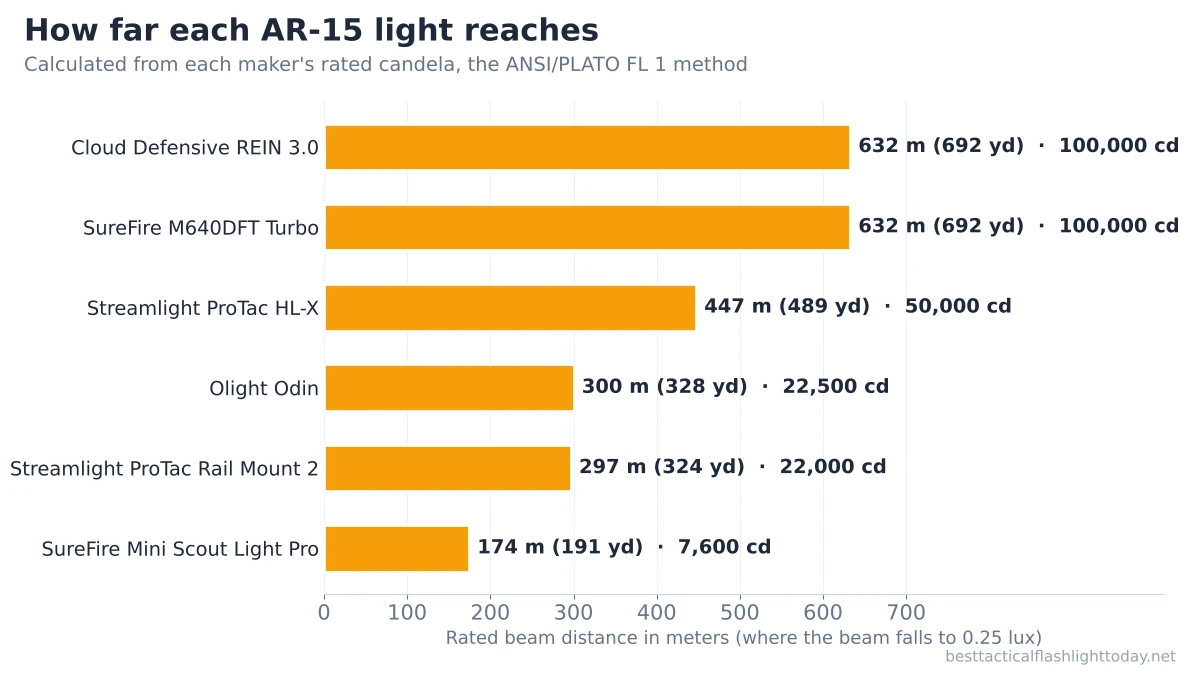
Moonlight shows you a shape. It won’t show you what’s in someone’s hands. For identifying a person you want far more light on target, so treat the rated distance as a ceiling and expect clear identification at a fraction of it.
The chart also shows why candela matters more than lumens on a rifle. The Odin puts out nearly three times the lumens of the SureFire Turbo, yet it has less than a quarter of the candela and less than half the reach.
How to Choose an AR-15 Light
Shop by candela first, then lumens
Lumens measure the total light coming out of the head. Candela measures how intense the brightest part of the beam is, and that decides reach and how well the light cuts through smoke, fog and glare. My candela vs lumens guide goes deeper. For a rifle, the rough rule is that around 20,000 candela covers a house, 50,000 covers most yards and 100,000 is for open ground.
Lumens still matter. They set how much of the room you see around the hotspot. Indoors, 600 to 1,000 lumens is plenty, and a light with far more candela than lumens can feel like looking down a straw in a small room.
Match the mount to your handguard
Most modern AR handguards use M-LOK slots. Older and budget rifles often have Picatinny quad rails, and a few use KeyMod. Five of the six lights here ship with an M-LOK mount, and the two Streamlights also clamp straight onto Picatinny. For KeyMod, the simplest fix is a short KeyMod Picatinny rail section bolted where you want the light.
An offset M-LOK light mount is worth knowing about too. It holds the light beside the rail at an angle, so you can put it at 11 or 1 o’clock and still reach the tail button with your thumb.
Mount it as far forward as you can
When the barrel or a muzzle device sticks out past the front of the light, it blocks part of the beam and throws a dark wedge into it. That’s barrel shadow, and a suppressor makes it worse. Push the light to the very front of the handguard. If the barrel still sticks out a long way, mount the light near the top so any shadow falls low in the beam, below where you’re looking. The setup builder above shows the effect.
Mind the bounce indoors
A 100,000 candela hotspot on a white wall six feet away comes back hard enough to wash out your own vision. Inside a house, point the hotspot at the floor ahead of you or the edge of a doorway and let the spill light the room. Lights with plenty of lumens next to their candela, like the REIN and HL-X, handle this better than a pure thrower.
Put the switch where your hand already is
A tail button is simple and very reliable, as long as your support thumb can reach it without changing your grip. If it can’t, use a remote pressure switch and stick the pad where your thumb or fingers already rest. Home defense is where pressure switches earn their keep, because you can light a room, check it and go dark without shifting your hands. Clip or tie the cable down so it can’t snag on a door frame or a sling.
You’ll run into three kinds of switch. A click tailcap turns the light on and leaves it on until you click again. A momentary button lights only while you hold it, and most also click on for constant light. A pressure pad, often called a tape switch, sits at the end of a cable and works by squeezing it. For a defensive rifle, momentary on with a firm press for constant light is the setup to aim for.
Pick a battery you’ll actually keep up with
CR123A cells store for years and work in the cold, so they suit a rifle that sits for months. Rechargeable 18650 and 21700 cells give more output and longer runtime and cost almost nothing to run, but only if you charge them. Dual fuel lights like the REIN, HL-X and SureFire Turbo give you both. My best 18650 flashlight guide covers the cell sizes in more detail.
Check the size against your build
Weight out at the end of the handguard is felt more than weight near your shoulder. The lights here run from 3.65 oz for the SureFire Mini to about 7.6 oz for the Odin. On a full-size rifle that difference hardly registers. On a light build or a short barreled rifle you’ll notice it every time you raise the gun, so pick the smallest light that reaches as far as you need.
White light or infrared
All six lights here are white light only. If you run night vision, you’ll want an infrared illuminator or a head that switches between white and IR. That’s a separate category, and a far pricier one, so don’t expect a standard rifle light to work under night vision.
Make sure it can take recoil
A 5.56 round is mild on your shoulder but hard on electronics. Cheap lights fail at the switch, the battery contacts or the mount long before the LED gives out. All six lights here come from makers with long track records on duty rifles. Whatever you buy, shoot a few hundred rounds with it fitted and check that it’s still tight before you trust it.
Where to Put the Light on Your Rail
Picture your handguard from behind, like a clock face with 12 o’clock on top. Every position trades something, and the right one depends on which hand you shoot with and what else lives on the rifle.
- Any barrel shadow falls low in the beam
- Works for either hand with a pressure switch
- Fights with a laser or optic mount on top
- Support thumb reaches the tail button
- Small, angled shadow if the barrel sticks out
- The most popular spot, and for good reason
- Easy for the thumb or fingers to reach
- Widest shadow when the barrel sticks out
- Adds width that catches on doorframes
- Clear of optics and lasers
- Needs a pressure switch to reach easily
- Crowds a vertical grip or a hand under the rail
For most right-handed shooters, 11 o’clock with the tail button under the left thumb is the place to start. Left-handers mirror it at 1 o’clock. If a laser already sits on top, drop to 10 or 9 o’clock and accept a little more width. Try your spot with the rifle shouldered and your eyes closed. If you can’t find the switch by feel, move it.
Common AR-15 Light Mistakes
Buying on lumens alone
A 2,000 lumen light with low candela lights the room beautifully and fades fast outdoors. Check both numbers, and lean toward candela if the rifle will ever be used outside.
Mounting it behind a long barrel
A light at the back of a short handguard on a 16 inch barrel will throw a shadow through the beam. Move it forward, raise it toward 12 o’clock, or fit a longer handguard.
Leaving strobe as the first mode
Strobe disorients you about as much as anyone you point it at, and it makes identification harder. Set your light to come on steady high with the first press.
Never using it in the dark
Practice turning the light on and off in your own house at night with an unloaded rifle. You’ll learn where the switch sits and how much the walls bounce the beam back at you. It’s also where you’ll find out if your light is in the wrong spot.
Frequently Asked Questions
How many lumens does an AR-15 light need?
For a home, 600 to 1,000 lumens is plenty, paired with 20,000 to 50,000 candela so the beam still reaches across a yard. For open property, put candela first and look for 75,000 or more. Lumens above about 1,000 mostly add spill, which helps indoors more than at distance.
Where should a light go on an AR-15?
As far forward on the handguard as it will go, on the side your support thumb can reach. For a right-handed shooter that’s usually 9 to 11 o’clock, and for a left-handed shooter 1 to 3 o’clock. Keep it clear of your optic and any laser on top, and check that your hand doesn’t block the beam when you grip the handguard.
Mounting at 12 o’clock works too if you run a pressure switch. Our best pistol lights guide covers the smaller lights that also fit on rifle rails.
Can you put a pistol light on an AR-15?
Yes. A pistol light like the SureFire X300 clamps onto a short Picatinny section on your handguard. Most pistol lights have far less candela than a rifle light, though, and their switches are built for a trigger finger, not a support hand, so plan on a remote switch. They’re a fine way to start, especially if the light comes off your handgun, but a dedicated rifle light will reach much farther.
Is candela or lumens more important for a rifle light?
Candela, for most rifles. It decides how far the light reaches and how well it cuts through fog and glare. Lumens decide how much of the scene around the hotspot you see. The best rifle lights have plenty of both, and the brightest flashlight figures you see on handhelds rarely translate to a weapon light.
The Bottom Line
If you want one light that does everything, the Cloud Defensive REIN 3.0 is the one I’d mount first. For most people, the Streamlight ProTac Rail Mount HL-X gives the most reach for the money, with everything you need in the box. On a tight budget, the Streamlight ProTac Rail Mount 2 still keeps you in a brand that will stand behind it.
Guarding open ground? The SureFire M640DFT Turbo Scout Light Pro throws farthest per lumen. If you’d rather charge than buy batteries, the Olight Odin charges right on the rifle. For a short or light build, the SureFire Mini Scout Light Pro is the one to fit.
Whichever you choose, mount it forward, put the switch under your support hand and practice with it in the dark. For more on lights in home defense, read our guide to using a flashlight as a weapon.
