
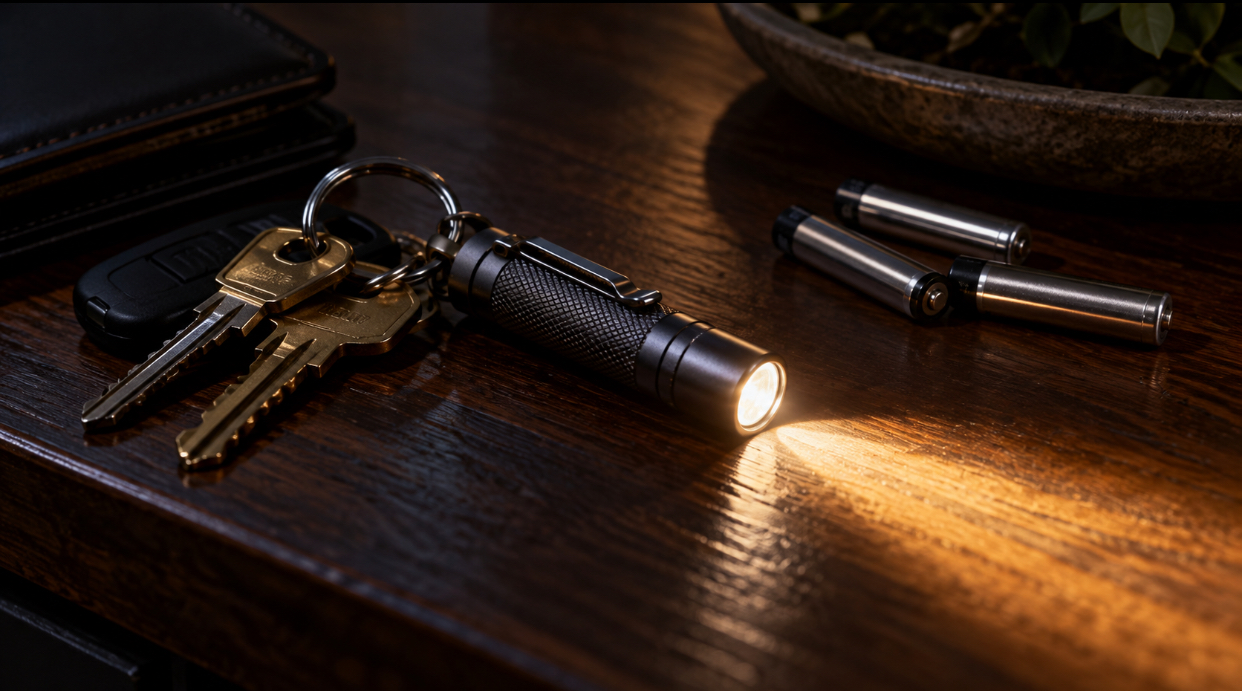
A AAA flashlight earns its place by being there. It rides on your keys or clips inside a jacket, and it runs on a battery you can buy at any gas station in the country.
Here’s the problem with most “best AAA flashlight” lists: a lot of their picks don’t take AAA at all. They have built-in batteries, so when the cell wears out, the light goes in the trash. Every light in this guide takes a standard AAA. Two of them also accept a rechargeable 10440 cell when you want more output.
I’ve covered small lights since 2014. These six get the basics right, and each one wins a specific job.
Quick Picks: The Best AAA Flashlights in 2026
The Best AAA Flashlights Compared
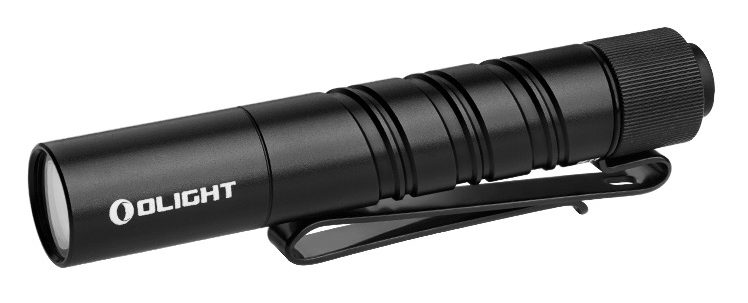
1. Olight i3T 2 EOS: Best Overall
Why I chose it and who it’s for
If someone asks me for one AAA light and doesn’t want to think about it, this is the one I name. It has two modes, 5 and 200 lumens, and they sit far enough apart that each one has a clear job. The clip locks between the battery cover and the body, so it can’t slide off.
It’s best for anyone who wants one pocket light for daily chores, and anyone who might try a rechargeable 10440 later without buying a new light.
Key specs
- Output: 200 lumens high (settles to 100), 5 lumens low
- Runtime on alkaline: 7 minutes at 200 lumens, then 28 minutes at 100; 21 hours on low
- Beam: 62 meters, 963 candela
- Battery: 1x AAA (alkaline included) or a protected 10440 up to 44 mm long, which lifts max output to 300 lumens
- Size: 89 mm long, 15 mm wide, about 1.5 oz with the battery
- Water rating: IPX8, 2 meters
Pros and cons
Pros
- Tail switch with momentary on, so you can flash it without clicking
- You choose whether it starts in low or high
- Clip can’t fall off and also fits a hat brim
- 10440 support is built in, not a hack
Cons
- No medium mode between 5 and 200 lumens
- Full 200 lumens lasts about 7 minutes before the drop to 100
Performance analysis
Two hundred lumens is close to the ceiling for one AAA, and Olight says plainly that it holds for about seven minutes before settling at 100. That covers a breaker panel or a walk to the car. The 5 lumen low is where this light lives, with 21 hours on a fresh alkaline. For 10440 use you’ll need an external charger, since the light has no port.
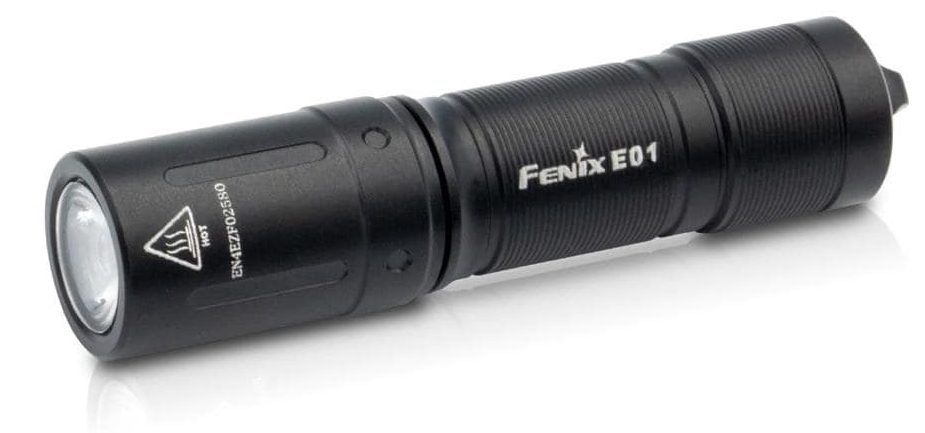
2. Fenix E01 V2.0: Best Keychain
Why I chose it and who it’s for
The E01 V2.0 is barely longer than the battery inside it, at 66.5 mm and 13 grams without the cell. You turn it on by twisting the head, so there’s no button to get pressed in a pocket full of keys. It also resets to its 5 lumen low whenever it’s been off for more than a second and a half.
It’s best for keychain carriers, and anyone who wants a light to leave in a glovebox and forget about.
Key specs
- Output: 100 / 25 / 5 lumens
- Runtime on alkaline: 50 minutes / 4 hours 50 minutes / 25 hours
- Beam: 35 meters, 304 candela
- Battery: 1x AAA (alkaline included); also takes lithium AAA or NiMH
- Size: 66.5 mm long, 13 g without the battery
- Water rating: IP68, 2 meters; 1 meter impact rated
Pros and cons
Pros
- Smallest light in this guide
- Always starts on low
- Same 100 lumen rating on NiMH as on alkaline
- No button to bump on a crowded key ring
Cons
- No pocket clip; it’s built for a split ring
- Fenix doesn’t list 10440 support, so stick to 1.5V or NiMH cells
Performance analysis
The beam comes through a thin optic, so it’s soft and even, which suits close work like a lock or the inside of a bag. To change modes, loosen and retighten the head within about a second and a half. The 25 lumen medium is the sweet spot, running close to five hours on one alkaline. Fenix’s 50 minute rating for high includes the thermal step-down.
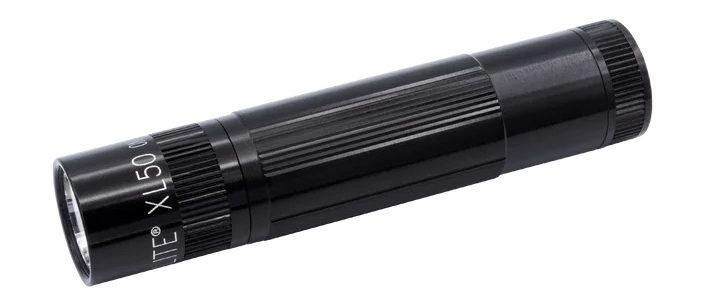
3. Maglite XL50: Longest Reach
Why I chose it and who it’s for
Every other light here runs on one AAA. The XL50 runs on three, and that changes what an AAA flashlight can do. It’s rated at 12,533 candela and 224 meters of beam, which is about 13 times the intensity of the i3T 2. It also holds its 200 lumen high for 6 hours 45 minutes.
It’s best for homeowners and drivers who want a real handheld that runs on the AAAs already in the drawer.
Key specs
- Output: 200 lumens high, 50 lumens low, plus strobe
- Runtime: 6 hours 45 minutes on high, 25 hours on low
- Beam: 224 meters, 12,533 candela
- Battery: 3x AAA alkaline (included)
- Size: 4.8 in long, 1 in diameter, 3.68 oz with batteries
- Water rating: IPX4; 1 meter drop rated
Pros and cons
Pros
- Longest reach of any AAA light in this guide by a wide margin
- Holds 200 lumens for nearly seven hours
- Simple controls with no programming
- Made in the USA
Cons
- IPX4 means splash resistant, not submersible
- At 1 inch thick it’s a jacket or glovebox light, not a pants pocket light
Performance analysis
Three cells hold roughly three times the energy of one, and Maglite spends it on runtime rather than a short burst. The beam is a tight, focused spot that picks out a house number across the street. Controls stay simple: one click for full power, two quick clicks for 25%, and three for strobe.
4. Acebeam UC3A: Best Rechargeable That Takes AAA
Why I chose it and who it’s for
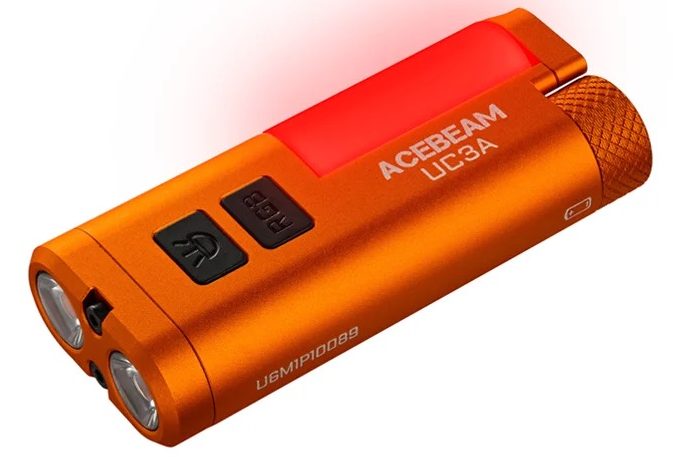
The UC3A launched in May 2026. It ships with a 400 mAh 10440 cell that has its own USB-C port, so you charge the battery, not the light. When that cell runs dry and there’s no outlet around, a plain AAA gets you home. It also adds a 270 degree side light in white, red, green and blue, which no other light here offers.
It’s best for people who like USB-C convenience but don’t want a light that’s dead the moment its battery is.
Key specs (on the included 10440)
- Main light: 900 / 400 / 90 lumens on high, 210 / 30 on medium, 80 on low, 4 on ultra low
- Runtime: high runs 15 seconds at 900, then 14 minutes at 400, then 26 minutes at 90; 1 hour 50 minutes on low; 23 hours on ultra low
- Beam: 85 meters, 1,806 candela
- Side light: white at 35 lumens (3 hours) or 2 lumens (23 hours), plus red, green and blue
- Battery: 400 mAh USB-C 10440 included; accepts standard 10440 or AAA
- Water rating: IP68, 2 meters; 1.5 meter drop rated
Pros and cons
Pros
- Charges through a USB-C port on the cell itself
- A dead battery doesn’t leave you in the dark if you carry a spare AAA
- Side light works as a tent lantern, a red night light or a signal
- Magnetic tail and a metal clip
Cons
- Much dimmer on AAA, around 80 lumens at most
- The interface takes some learning, with two separate light sources to control
Performance analysis
Read the 900 lumen figure carefully. The spec sheet from Acebeam shows it lasts 15 seconds on a full 10440, then the light holds 400 lumens for about 14 minutes, and top output needs a well-charged cell. On a standard AAA, expect about 80 lumens at most, and Acebeam publishes runtimes only for its 10440. That’s still more than the MicroStream‘s full output, so a spare AAA in your bag keeps you covered.
5. Fenix LD02 V2.0: Best with UV
Why I chose it and who it’s for
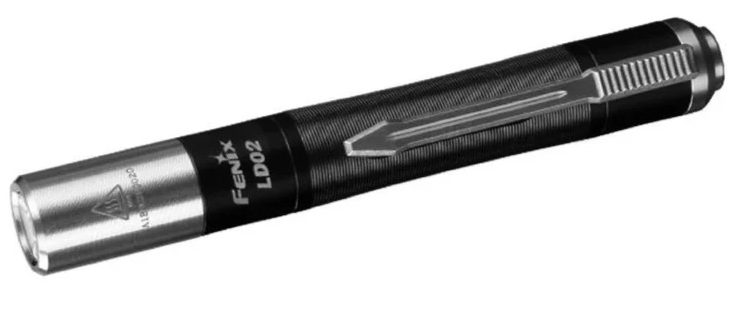
This is the only light here with a dedicated ultraviolet LED, and it’s the right kind. The 365nm UV makes fluorescent material glow without washing everything in purple, which cheaper 395nm lights tend to do. The white side is just as thoughtful: a warm 3000K LED rated at 90 CRI, so colors look the way they do in daylight.
It’s best for pet owners hunting for stains, renters checking a place before they sign, campers in scorpion country, and anyone who checks bills or ID watermarks.
Key specs
- White output: 70 / 25 / 1 lumens
- Runtime on alkaline: 40 minutes / 2 hours 40 minutes / 75 hours
- UV: 365nm at 200mW; 4 hours on alkaline, 3 hours on NiMH
- Beam: 48 meters, 580 candela
- Battery: 1x AAA (alkaline included); Fenix recommends NiMH
- Size: 92 mm long, 13.5 mm wide, 24 g
- Water rating: IP68, 2 meters; 1 meter impact rated
Pros and cons
Pros
- True 365nm UV in a pocket body
- Warm, high CRI white shows skin tones and wire colors accurately
- The 1 lumen low runs 75 hours on alkaline
- Stainless steel tail switch and head
Cons
- 70 lumen max is low, and it steps down to 50 after 90 seconds on high
- UV sits at the end of the mode cycle, so switching between white and UV takes several taps
Performance analysis
Seventy lumens of warm white is a close-range light, and at that distance high CRI matters more than raw output. Fenix steps it down to 50 lumens after a minute and a half on high to manage heat. The UV is the reason to buy it. At 200mW and 365nm, it makes pet urine stains glow on carpet and lights up the security thread in US paper money. The light remembers your last mode, so if you mostly use UV, it comes back on in UV. Keep the UV beam out of anyone’s eyes, which Fenix warns about too.
6. Streamlight MicroStream: Simplest Backup
Why I chose it and who it’s for
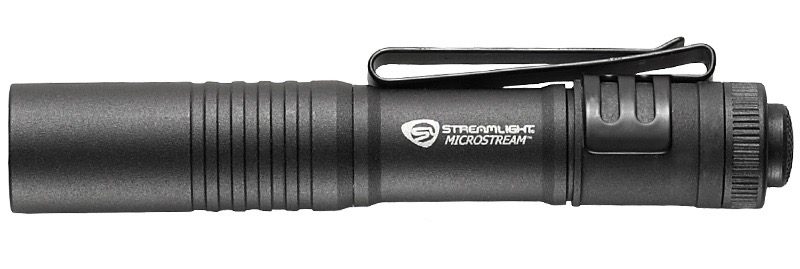
Some people don’t want to learn modes at all. They want to press a button and get light. The MicroStream does exactly that: one 45 lumen output behind a push button tail switch, in an aluminum body 3.6 inches long. There’s almost nothing on it that can go wrong.
It’s best for older family members, and anyone stocking several kits who wants every light to work the same way.
Key specs
- Output: 45 lumens (single mode)
- Runtime: 2 hours 15 minutes
- Beam: 41 meters, 420 candela
- Battery: 1x AAA alkaline (included)
- Size: 3.6 in long, 0.6 in diameter, 1.04 oz
- Water rating: IPX4; 1 meter impact rated
Pros and cons
Pros
- Nothing to learn; press for momentary, click for constant on
- Removable clip fits a pocket or a hat brim
- Includes a breakaway safety lanyard
- Streamlight backs it with a limited lifetime warranty
Cons
- No low mode for saving battery or night vision
- One AAA lasts 2 hours 15 minutes, while every other light here has a low mode rated for 21 hours or more
Performance analysis
Forty-five lumens is modest, but it’s enough to find a dropped key under a car seat or read the labels in a fuse box. The reflector gives it a defined hotspot that reaches 41 meters, farther than the Fenix E01 V2.0 with less than half the output. With one level, a fresh alkaline lasts about two and a quarter hours, so for long outages the i3T 2 or E01 V2.0 is the better choice. What you get in return is a light anyone can use in a second.
How Long a AAA Flashlight Really Runs
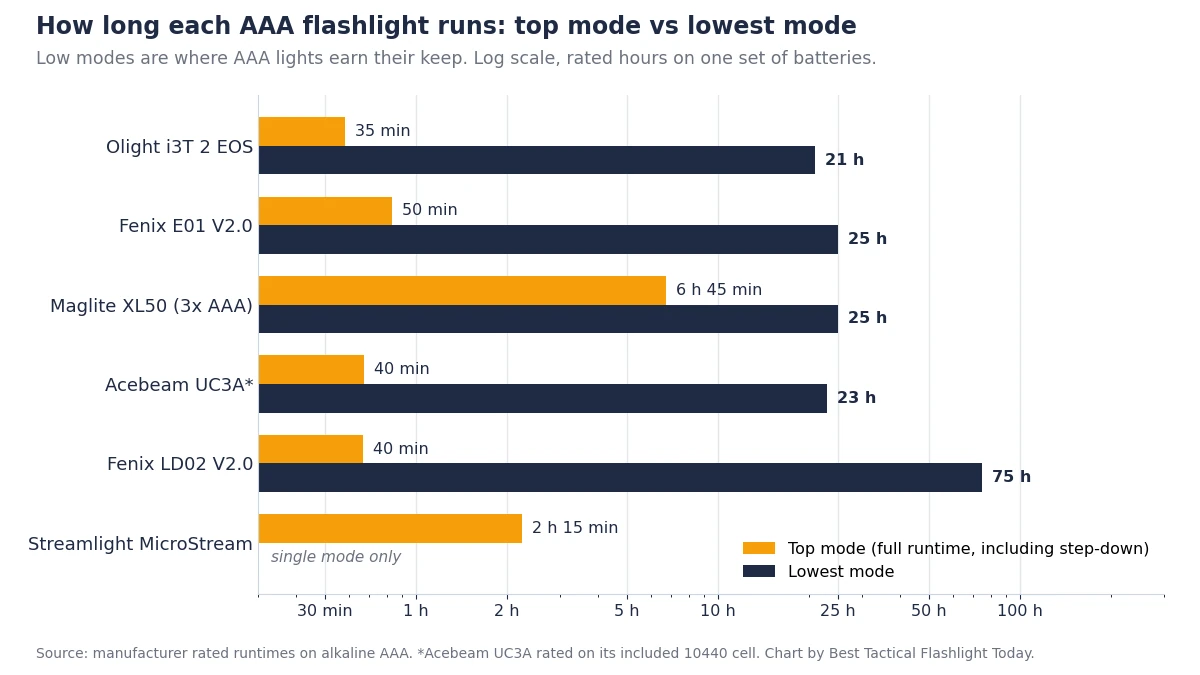
A single AAA holds very little energy, so every light here makes a choice between brightness and time. The headline lumen number is almost always a short burst. After that, the driver steps the output down to protect the cell and keep the body from overheating.
The low modes are where AAA lights shine. Every light here except the MicroStream has a low rated for 21 hours or more, and the LD02 V2.0 runs 75 hours at 1 lumen. In a power outage, that’s the number to look at.
Which AAA Battery Should You Use?
Alkaline. It comes in the box with most of these lights. Its voltage sags under heavy draw, so high modes fade sooner. Alkalines can also leak if they sit in a light for years, so pull them out of anything you store long term.
NiMH rechargeable. These run at 1.2 volts instead of 1.5, and a lot of guides claim that makes your light dimmer. In a regulated light it usually doesn’t. Fenix rates the E01 V2.0 at the same 100 lumens on NiMH as on alkaline, and it recommends NiMH for the LD02 V2.0.
Lithium primary AAA. These are disposable 1.5 volt cells, like Energizer Ultimate Lithium. Energizer rates them to work from minus 40°F to 140°F and lists a 25 year shelf life on its L92 datasheet. That makes them the right cell for a car, a winter pack or an emergency kit. Check your light’s manual before using them.
10440 lithium-ion. A 10440 is the same size as a AAA but runs at 3.7 volts. Only use one in a light that says it supports it. Here, that’s the i3T 2 (protected cells up to 44 mm long) and the UC3A, which ships with one. Put a 10440 in a light built only for 1.5 volt cells and you can burn out the driver in seconds.
How to Choose the Best AAA Flashlight
One cell or three?
Cell count sets everything else. A single AAA light fits on a key ring or in a coin pocket, but its high mode lasts minutes, not hours. A three-cell light like the XL50 is the size of a small cigar and runs 200 lumens for almost seven hours. If it’s for your keys, one cell. If it’s for the car, the extra length is worth it.
Switch type
Tail switches give you momentary on, which is handy for a quick look. They can get pressed in a pocket, though, so check whether the switch is recessed or stiff. Twist switches like the E01 V2.0’s can’t be bumped on, but they’re slower to work in a hurry.
Water rating
IPX4 means the light handles rain and splashes. IPX8 and IP68 mean it survives full submersion, usually to 2 meters. For a keychain light that might land in a puddle or a laundry load, go with IPX8 or IP68.
How many lumens you actually need
For finding things around the house, 25 to 50 lumens covers almost everything. For walking a dark trail or checking the yard, you want 100 or more. Candela tells you how far the beam reaches, which is why the 200 lumen XL50 reaches about three and a half times farther than the 200 lumen i3T 2. Our candela vs lumens guide explains the difference in detail.
Looking for a penlight?
Pen-shaped 2xAAA lights are their own category, and we cover them separately. See our guide to the best penlights, or the best medical penlights if you need a light for pupil checks.
AAA Flashlight FAQ
What is the brightest AAA flashlight?
On a standard AAA, about 200 lumens is the practical ceiling. The Olight i3T 2 EOS hits it from one cell, and the Maglite XL50 holds it for hours from three. With a rechargeable 10440 the ceiling rises. The i3T 2 reaches 300 lumens, and the Acebeam UC3A bursts to 900 for about 15 seconds.
How long does a AAA flashlight last?
It depends on the mode. Single-AAA lights usually run 35 to 50 minutes on high, including step-down. On low, they run 21 to 75 hours. For outages, judge a light by its low mode, not its high.
Can I use rechargeable batteries in a AAA flashlight?
NiMH rechargeables work in almost every AAA light, and regulated lights like the Fenix E01 V2.0 are rated at the same output on NiMH as on alkaline. A 10440 lithium-ion cell is different. It runs at 3.7 volts, so only use one in a light that lists 10440 support, like the i3T 2 or UC3A.
Is a AA or AAA flashlight better?
A AA light runs longer and usually gets brighter, because a AA cell holds more than twice the energy. A AAA light is smaller and easier to carry every day. If the light lives on your keys, get AAA. If it lives in a kit, see our picks for the best AA flashlight.
The Bottom Line
For most people, the Olight i3T 2 EOS is the best AAA flashlight. It’s simple enough to hand to anyone, and it grows with you if you add a 10440 later. If it’s going on your keys, get the Fenix E01 V2.0 instead.
For distance, the Maglite XL50 is the only AAA light here built for it. The Acebeam UC3A suits anyone who’d rather charge than buy batteries, and the Fenix LD02 V2.0 is the pick when UV checks matter. For a no-thinking backup, the Streamlight MicroStream still does the job.
Want something smaller still? Our best mini flashlight guide covers the tiniest rechargeable lights. For a full-size daily carry light, see our best EDC flashlights. And if you’re building an outage kit, our best flashlight for power outages guide pairs well with a stash of lithium AAAs.
Several of our best flashlight for kids picks run on AAA, including two headlamps with lockouts.
