
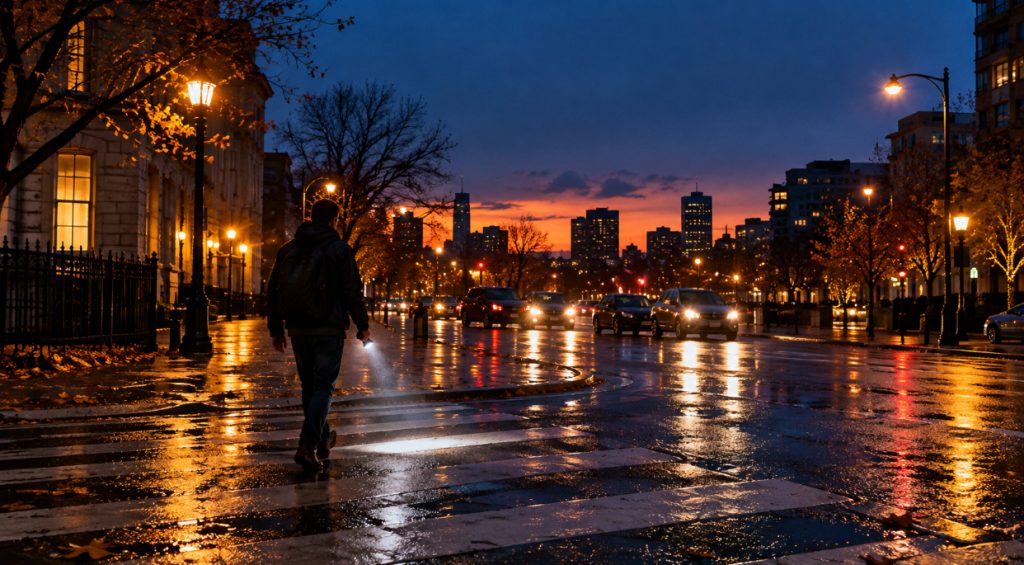
On Sunday, November 1, clocks fall back an hour. The sun sets at almost the same moment it did on Saturday, but every clock now reads an hour earlier. People still leave work at 5. So a walk home that was in daylight on Friday happens in the dark on Monday.
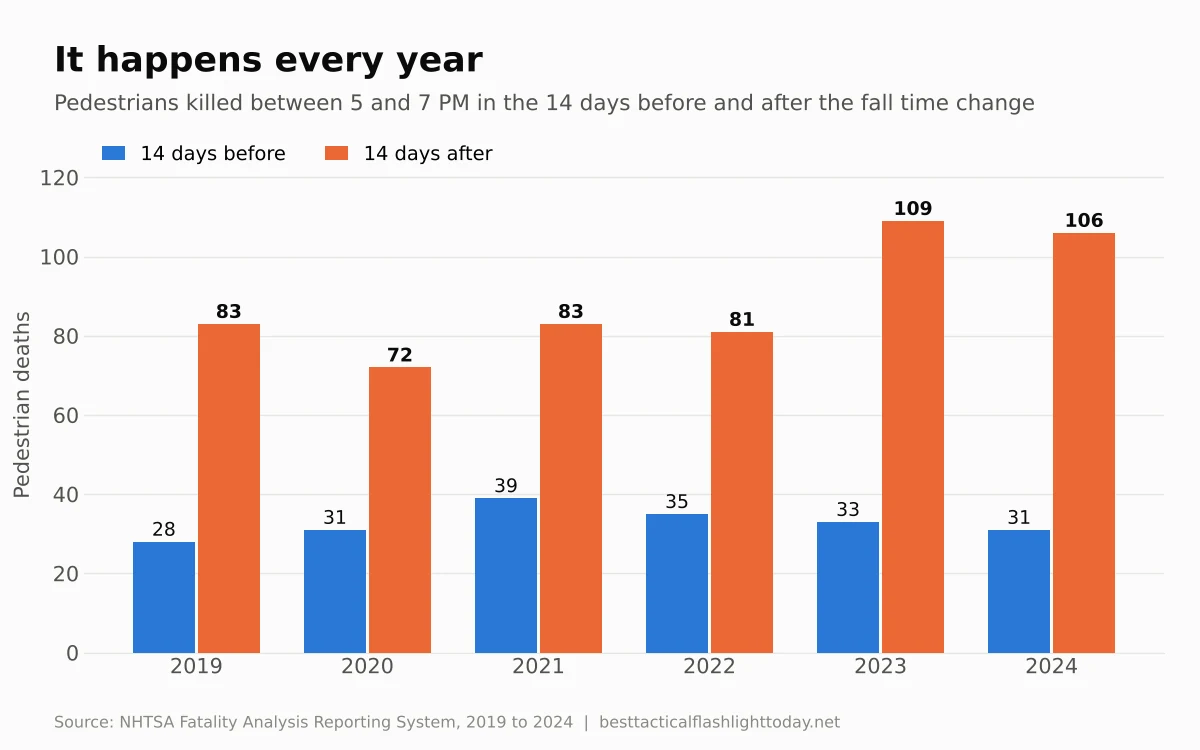
I went through every fatal crash in federal records from 2019 to 2024 to see what that hour costs. In the 14 days before the change, 197 pedestrians were killed between 5 and 7 PM. In the 14 days after, 534 were. That’s 2.7 times as many, and the jump showed up in all six years.
Two details point to the darkness rather than the season. Mornings get lighter after the change, and pedestrian deaths between 6 and 8 AM fell 42% over the same two weeks. Arizona doesn’t change its clocks, and its 5 to 7 PM count barely moved, from 16 to 20.
Look up your city
Pick any of the 342 US cities with 100,000 or more people. You’ll see when the sun sets and when it’s fully dark on Halloween and on the day after, how much of the 5 to 7 PM rush slips into darkness, and what the crash records show for your state.
What the clock change does to the evening commute
Take Chicago. On Saturday, October 31, the sun sets at 5:46 PM. On Sunday it sets at 4:45 PM. Nothing changed in the sky. The clocks moved, and the evening rush moved with them into the dark.
Across the 328 large cities that change their clocks, the typical rush hour goes from 22 minutes of full darkness between 5 and 7 PM to 83 minutes, overnight. On Halloween night, not one of those cities has more than half of its rush hour in the dark. By Sunday, 240 do. None of them is fully dark before 6 PM on Saturday. On Sunday, 238 are.
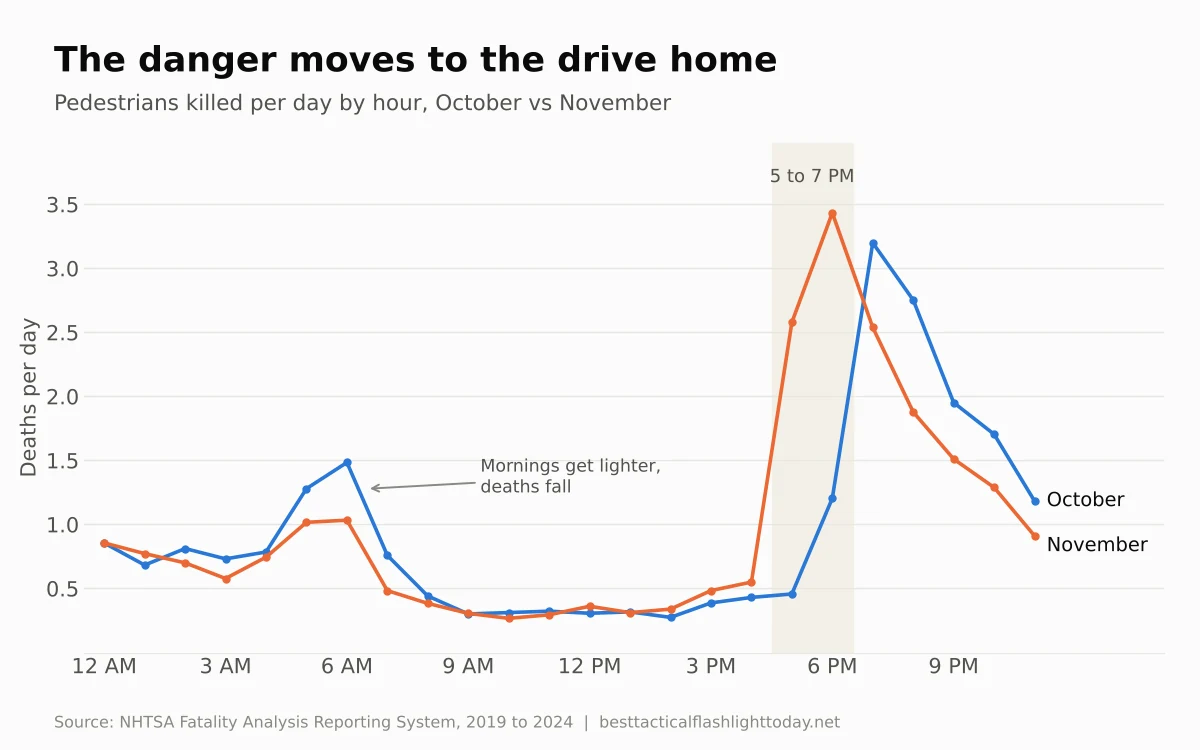
The crash records show the same shift. In October, pedestrian deaths peak around 7 PM, after dark has fallen. In November the peak moves up to 6 PM, and 5 PM climbs nearly as high, right in the middle of the drive home. Early mornings, meanwhile, get safer.
It happens every year
Here are the 14 days on either side of the change for each year. The before count stayed between 28 and 39. The after count never dropped below 72.
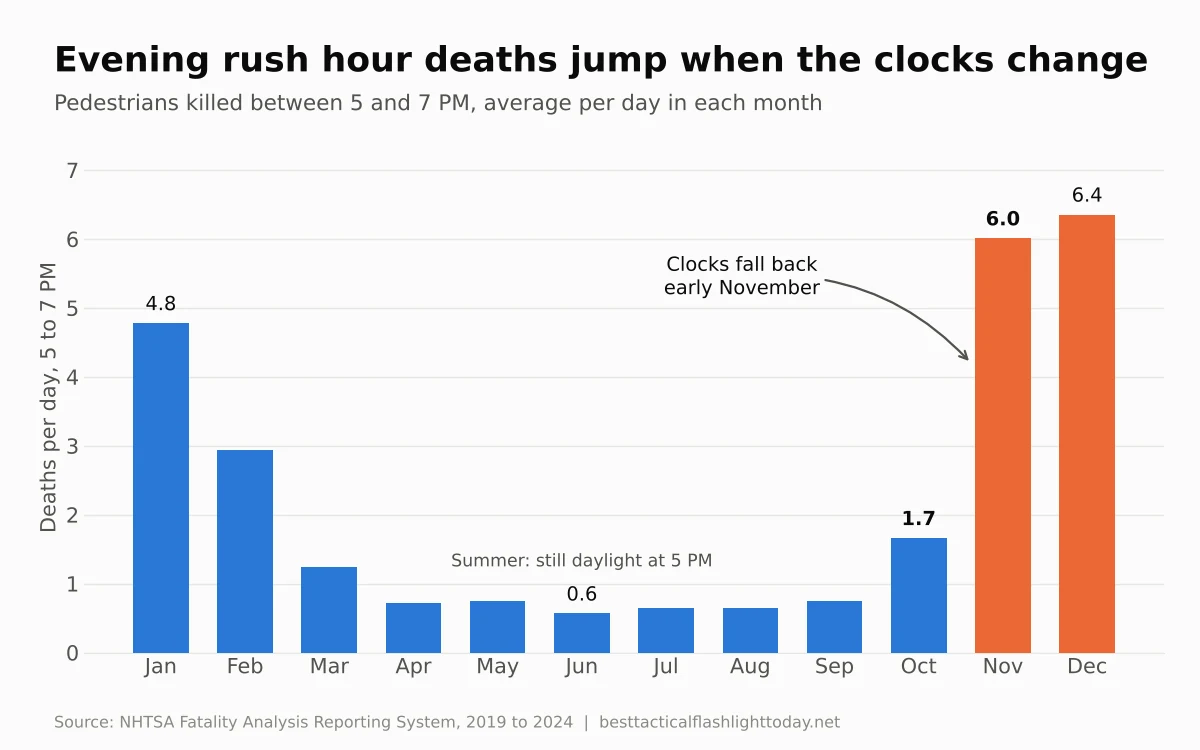
Zoom out to the whole year and you get the same picture. From April through September, the 5 to 7 PM window averages well under one pedestrian death a day. October averages 1.7. November jumps to 6.0 and December to 6.4. The rate eases through late winter as the evenings stretch out again.
Arizona and Hawaii, the states that don’t switch
Arizona stays on standard time all year, apart from the Navajo Nation, and so does Hawaii. That makes Arizona a useful comparison. In the 14 days after the rest of the country falls back, Arizona’s 5 to 7 PM pedestrian deaths went from 16 to 20 across the six years. In the states that switch, the same count went from 181 to 512.
Arizona’s numbers are small, so I wouldn’t lean on them alone. Its evenings also get darker through the fall, just gradually instead of all at once. But it points the same way as the morning drop: the problem is the sudden hour of darkness, not November itself.
Where the drive home goes dark first
These cities sit far north or on the eastern edge of their time zone, so full dark comes first. Spokane Valley gets there by 5:04 PM on November 1. At the other end, Odessa and Midland in West Texas stay light until about 6:25 PM.
Dark here means the end of civil twilight, when the sun is 6 degrees below the horizon and streetlights and headlights are doing all the work.
States with the biggest November jump
Totals for 2019 to 2024 combined, counting pedestrians killed between 5 and 7 PM. Smaller states have too few deaths in that window for a fair comparison, but every state is in the lookup above.
How to stay visible after the change
Most of this comes down to being seen. Here’s what helps in the first few weeks after the change, when everyone’s habits still run on summer time.
Carry a light and actually use it. A small flashlight aimed at the ground a few steps ahead tells a driver exactly where you are, and a quick flash toward a car that hasn’t slowed is hard to miss. Our mini flashlight picks fit in a jacket pocket, and the EDC flashlight guide covers clip lights that ride on a pocket edge all day.
Runners and dog walkers should add something reflective that moves, like ankle bands or a vest, because headlights catch motion before shape. Cross where the street is lit, even if it means a longer walk to the corner.
Drivers, the first two weeks are the ones to watch. Leave a few minutes earlier so you’re not rushing, clean the inside of the windshield, and expect people at crossings you’d normally sail through at that hour.
This year Halloween falls on the last night before the change, so trick-or-treaters still get the later sunset. They’ll be out well past dark anyway. A light in every kid’s hand is cheap insurance.
How I worked this out
Crash figures come from NHTSA’s Fatality Analysis Reporting System, which records every fatal traffic crash on US public roads. I used the 2019 to 2024 files and counted people listed as pedestrians who died, 42,347 in all. Of those, 76.3% were killed in the dark, meaning lighting coded as dark, dark and lit, or dark with unknown lighting. Dawn and dusk are counted separately.
The 5 to 7 PM window covers crashes from 5:00 to 6:59 PM local time. Fall time changes were on the first Sunday of November each year. The before window is the 14 days ending on the Saturday before the change, and the after window is the 14 days starting on the day of the change. Arizona and Hawaii are left out of the switching states group.
Sunset and full dark were calculated for each city’s Census location point with standard solar formulas, then spot checked against the U.S. Naval Observatory. Full dark is the end of civil twilight. The city list is every incorporated place with at least 100,000 residents in the Census Bureau’s 2024 population estimates, plus Urban Honolulu.
Two limits worth knowing. These counts show when deaths happened, not how many people were out walking. If anything, fewer people walk once the weather turns cold, which would pull November’s numbers down rather than up. And NHTSA can still revise the newest crash year.
Using these numbers? Please credit Best Tactical Flashlight Today and link to this page. The city data, including every city’s sunset, dark time and state crash counts, is free to download.
Frequently asked questions
When do the clocks fall back in 2026?
Sunday, November 1, at 2 AM local time. Clocks go back to 1 AM, so you get an extra hour that night. They spring forward again on Sunday, March 14, 2027.
Why do pedestrian deaths go up after the time change?
The evening rush suddenly happens in the dark. Drivers see walkers later, and walkers keep summer habits like dark clothes and no light. In the two weeks after the change, pedestrian deaths between 5 and 7 PM run 2.7 times higher than in the two weeks before, while morning deaths fall.
Which states don’t change their clocks?
Arizona, except for the Navajo Nation, and Hawaii. US territories like Puerto Rico and Guam also stay on one time all year.
What time does it get dark after daylight saving time ends?
It depends on where you live. In the big cities I checked, full dark on November 1 ranges from 5:04 PM in Spokane Valley to 6:25 PM in Odessa. Use the city lookup above for your exact times.
If your winter worries run more to the lights going out at home, our look at power outages by state ranks every state by hours without power.
