
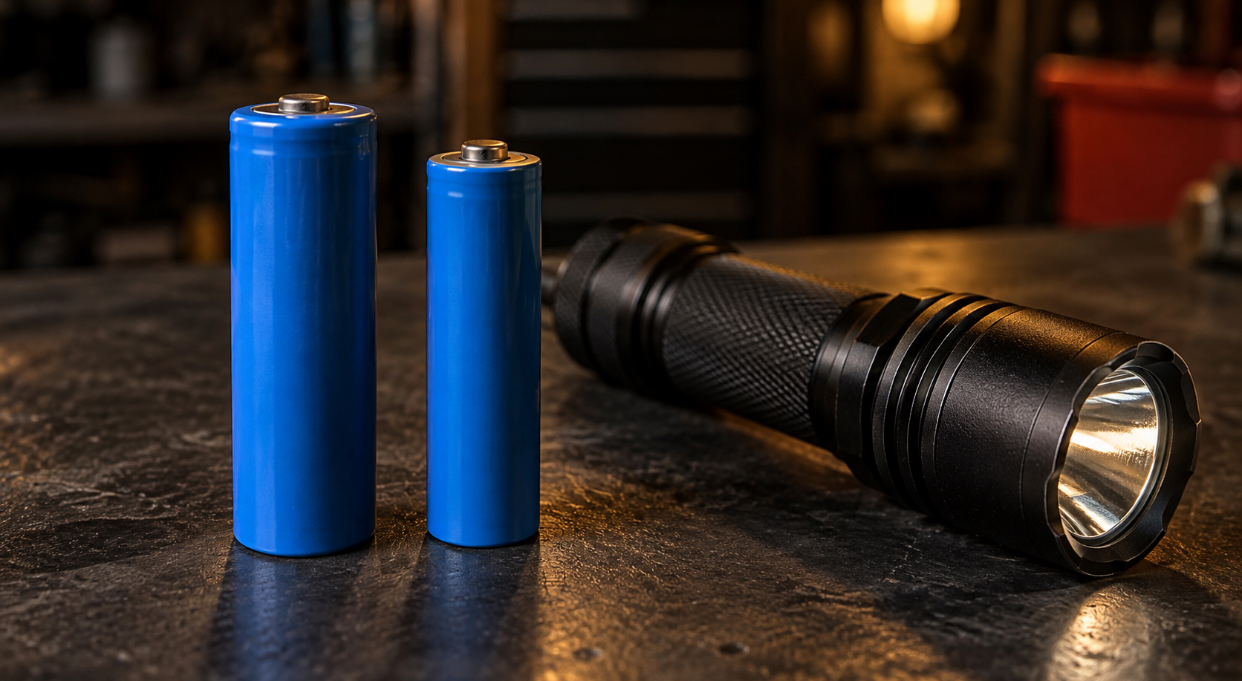
Set an 18650 next to a 21700 and they look like brothers. The 21700 is 3mm wider and 5mm longer, and that small bump holds somewhere between a quarter and half again as much energy, depending on which two cells you compare.
What that extra energy does inside a real flashlight is not quite what the battery charts suggest. So instead of stopping at cell specs, I’ll walk you through two lights that are nearly identical except for the battery, and show you where the 21700 pulls ahead and where it doesn’t.
The Short Answer
Choose an 18650 light if it rides in your pocket every day and you want the slimmest, lightest body that still runs a serious LED. Choose a 21700 light if you care more about runtime and about holding real brightness for minutes instead of seconds. Duty belts, glove boxes and outage kits all fall on that side.
If you already own a drawer full of one size, that usually settles it. Spare cells and chargers are where the money goes over the years, and switching sizes means buying both again.
18650 vs 21700 at a Glance
The names are just the dimensions. An 18650 is 18mm wide and 65mm long, a 21700 is 21mm by 70mm, and the trailing zero means the cell is round. Flashlight cells usually measure a few millimeters longer because most carry a protection circuit and a raised button top.
Capacity is where buyers get tangled up, because the internet can’t agree. You’ll find guides insisting no honest 18650 goes past 3,600mAh, and others listing 4,000mAh as normal. Both are half right. Most quality 18650s top out around 3,500mAh, and Fenix now ships a genuine 4,000mAh cell, the ARB-L18-4000, in its PD35R ACE. On the 21700 side, flashlight cells mostly land between 4,000 and 5,000mAh. Cell makers have pushed bare 21700s past 6,000mAh for e-bikes, but those industrial cells have no protection circuit and aren’t meant to be dropped into a flashlight.
Anything listed at 9,900mAh in either size is fiction. Weight catches most fakes: a good 18650 weighs roughly 45 to 50 grams, and a good 21700 lands between 60 and 75. A “high capacity” cell that feels light in your hand is hiding something.
Look at Watt-Hours, Not mAh
Milliamp-hours tell you charge, not energy. Multiply the nominal voltage by the amp-hours and you get watt-hours, which is the number that predicts runtime. It’s the same formula the FAA uses for its lithium battery rules.
A 3,500mAh 18650 at 3.6V holds about 12.6Wh. Fenix’s 4,000mAh cell holds 14.4Wh. A 5,000mAh 21700 holds 18Wh. That’s 43 percent more energy than the common 18650, but only 25 percent more than the very best one.
What the Extra Capacity Buys You in a Real Flashlight
Cell specs only get you so far, because you don’t carry a bare battery. The cleanest comparison I know uses two Fenix lights. The PD35R ACE runs a 4,000mAh 18650, and the PD36R V2.0 runs a 5,000mAh 21700. Both use the same Luminus SFT40 LED and the same two-switch layout, and their lengths differ by 0.2mm.
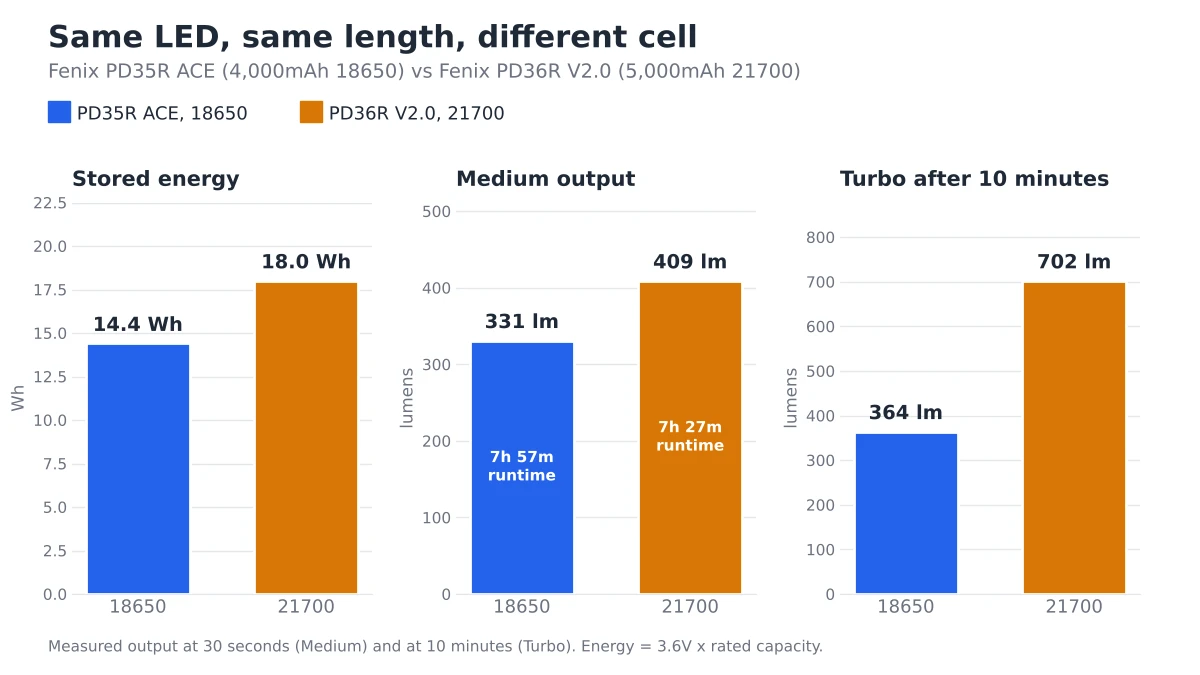
Two things stand out in the measured results.
On Medium, both lights run about eight hours: 7 hours 57 minutes for the 18650 light and 7 hours 27 minutes for the 21700 light. The difference is output. The PD36R V2.0 ran at about 409 lumens on Medium, while the PD35R ACE ran at 331. Same runtime, roughly a quarter more light. That’s the extra energy showing up exactly where the math says it should.
On Turbo, the gap is bigger than the battery math predicts. Ten minutes in, the PD35R ACE had settled to about 364 lumens. The PD36R V2.0 was still putting out around 702. Both lights throttle back once the head reaches 60°C (140°F), so heat sets the ceiling. The wider 21700 body carries more aluminum to soak up that heat, and the bigger cell handles high current with less strain. Together they nearly double the sustained output.
Here’s the part spec sheets bury. Neither light holds its peak for long, and both start above 1,900 lumens before dropping within a couple of minutes. A 21700 doesn’t make a light brighter at turn-on. It keeps the light brighter once it’s warm. If you want to know which numbers predict what you’ll actually see, my guide to candela vs lumens breaks that down.
How Much Bigger Is a 21700 Light?
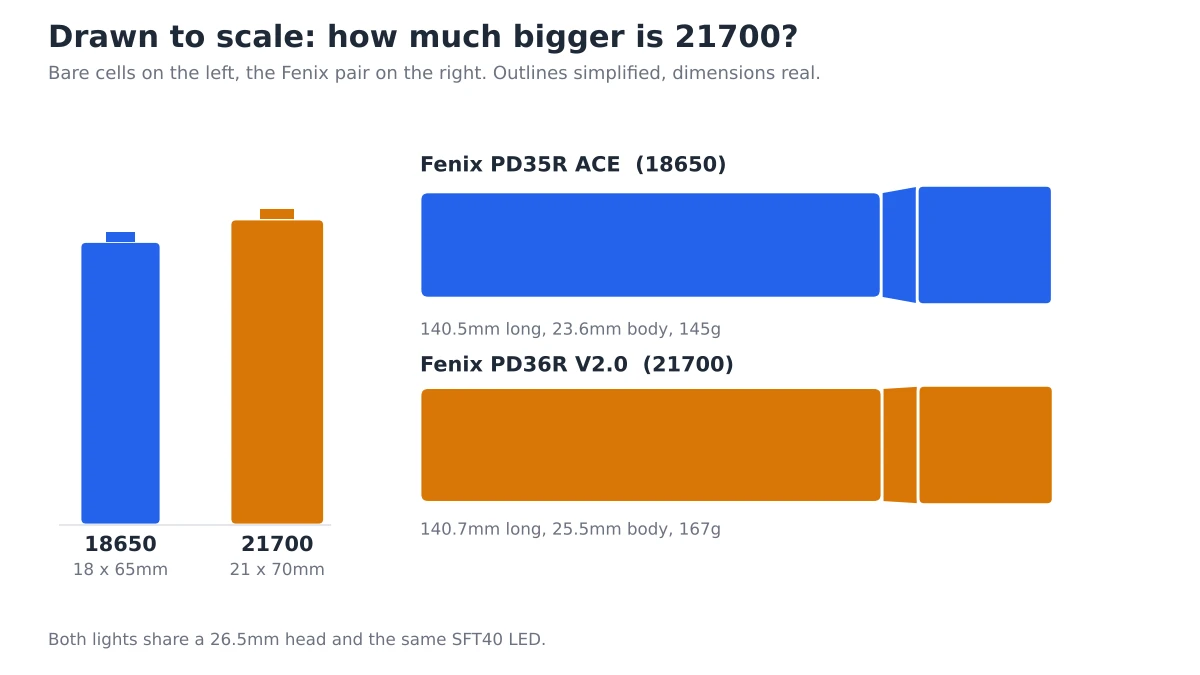
Less than you’d guess. In that Fenix pair, the 21700 light’s body measures 25.5mm across against 23.6mm for the 18650 light, and it weighs 167 grams against 145. The tube grows by about 2mm and the light gains 22 grams.
You’ll notice that in a jeans pocket. On a belt, in a door pocket or in a pack, you won’t. The bigger jump comes from lights that spend the extra room on a larger head. The Fenix TK20R V2.0 runs 153mm and 204 grams, and long-range throwers grow far wider at the bezel to fit a big lens.
Can You Swap Them?
A 21700 won’t go into an 18650 light. It’s simply too wide for the tube.
Going the other way often works with a sleeve. Fenix’s ALF-18 holder is a plastic tube with a copper-plated contact that centers an 18650 inside a 21700 light, and it takes button tops and flat tops. Fenix lists a long run of compatible models on the ALF-18 page, including the PD36R V2.0, PD36 TAC and TK20R V2.0.
Know what you give up. You lose the capacity the light was designed around. On many Fenix lights, the built-in USB-C charging and battery gauge also only work with Fenix’s own 21700 cells, so treat the 18650 as a backup you charge in an external charger. Skip the paper or tape shims. A loose cell makes poor contact, and the light flickers when you need it most.
Fit Traps That Catch People Out
Even inside one size, not every cell fits every light. These are the ones I see trip people up most.
- Protected cells run longer. The protection circuit sits under the wrapper and adds length, so a protected 18650 often measures around 69mm instead of 65mm.
- Button top vs flat top matters in some lights. A flat-top Samsung 40T was too short to make contact in the PD36R V2.0, which has a spring only at the tail. Lights with mechanical reverse-polarity protection usually need a button top to reach the contact.
- USB-C cells can be longer still. Cells with a charging port pack extra electronics inside, and the longest of them won’t close up in tight tubes.
- Chemistry isn’t always the same. 3.2V LiFePO4 18650s exist, and some lights ban them outright. The PD35R ACE manual does.
- Some brands build lights around their own cells. Several Olight models that charge through a magnetic tail cap need Olight’s own batteries.
If you’re checking a specific spare, the battery fit checker in my best 18650 flashlight guide runs through common lights and cell types.
What About 20700 and 26650?
The 26650 is 26mm wide and 65mm long. For years it was the go-to for big-runtime single-cell lights, until the 21700 matched its capacity in a much slimmer body. You’ll still find 26650 lights, but few new designs use it.
The 20700 was a short-lived middle size, 20mm by 70mm, that never caught on in flashlights. If you own a light built for one, use exactly the cell its manual names.
Which One Should You Pick?
Daily pocket carry. Go 18650. The slimmer tube and the 20-odd grams you save matter when the light rides with you all day. My best EDC flashlights list has more options in this size.
Duty belt, security rounds and farm chores. Go 21700. These are long sessions on High, and the sustained-output gap shows up right away.
Power outages and emergency kits. A 21700 gives you the most runtime per charge. There’s a good case for an 18650 light that also takes CR123A primaries, though, like the PD35R ACE. Primaries sit in a drawer for years and still work when the grid’s been down for three days. See my picks for flashlights for power outages, the guide to rechargeable CR123A batteries, and how often your state actually loses power on the outage map by state.
Reaching far. Nearly every serious long-range thrower now runs a 21700 or larger. My best throw flashlight guide covers the field. Not set on a battery size yet? My guide to the best rechargeable flashlights compares seven lights across 18650, 21700 and proprietary packs, including ones that charge in a holder or run on AAAs.
Lights Worth Buying in Each Size
Want to run 18650 spares in a Fenix 21700 light? The Fenix ALF-18 holder costs very little and lives happily in a spare-battery case.
FAQ
Is a 21700 battery better than an 18650?
For runtime and sustained brightness, yes. A 5,000mAh 21700 stores about 18Wh against 12.6Wh for a typical 3,500mAh 18650. The 18650 still wins on size, weight and the sheer number of lights built for it.
Can I put an 18650 in a 21700 flashlight?
Often, with a proper sleeve such as the Fenix ALF-18, if your light’s maker lists it as compatible. Expect shorter runtime, and on many lights the built-in charging and battery gauge won’t work with the 18650.
Are 18650 and 21700 batteries the same voltage?
Yes. Both are lithium-ion cells rated at 3.6 to 3.7V nominal and charged to 4.2V. The difference is how much energy they store, not their voltage.
Can I fly with 18650 and 21700 batteries?
Yes, in your carry-on. The FAA requires spare lithium-ion cells to stay out of checked bags and to have their terminals protected from short circuits. Both sizes sit far below the 100Wh per-battery limit. Check your airline too, since some set stricter rules.
The Bottom Line
The 18650 is the right cell for a light you carry every day without thinking about it. The 21700 is the right cell for a light you run hard and long, because it keeps putting out real light after the first few minutes. Pick the size that fits how you use your light, then stick with it so your spares and chargers keep working for you.
