Quick Answer – Our Top 5:
🔥 Best Overall Survival Flashlight
High output, long runtime, USB-C rechargeable and extremely durable. A true do-everything survival light.
Price and availability may vary.
🛡 Best Tactical Survival Pick
Compact tactical build with strong candela output and excellent durability for defensive use.
💰 Best Value Survival Light
Reliable 18650 performance at a budget-friendly price. Great backup survival option.
❄ Best for Cold Weather & Reliability
Dual fuel flexibility and dependable performance in harsh and freezing conditions.
⚡ Best High-Output EDC
Massive lumen output in a compact body. Ideal when maximum brightness matters.
My neighbor lost power for six days after a hurricane. He had three flashlights. One took a battery type nobody sells locally anymore. One had a dead battery he’d never replaced. The third worked fine but he’d left it in the garage and couldn’t find it in the dark.
None of them were bad flashlights, exactly. They were just never set up to actually work in a real emergency.
That’s the problem with most people’s approach to survival lighting. They buy something, stick it in a drawer, and assume they’re covered. Then something goes sideways and the gear that was supposed to save them is the first thing that lets them down.
This guide isn’t about finding the brightest flashlight on Amazon. It’s about finding a light you can stake your safety on something built with the right battery strategy, the right runtime, and the right durability for genuine survival scenarios. I’ve researched every spec directly from manufacturer documentation and trusted testing sources. Every number in this article is verified. No inflated claims, no guesswork.
Here’s what actually belongs in your kit.
What I Look for in a Survival Flashlight
The criteria that matter for survival use are different from the ones that matter for your everyday carry or hiking trips. Here’s exactly what I evaluate:
Sustained output, not peak lumens.
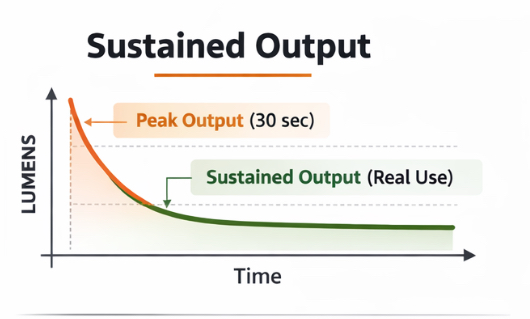
The lumen number on the box is almost always measured in the first 30 seconds, in a lab, with a fresh battery. In real use, lights step down as they heat up. A light claiming 3,000 lumens might sustain 900 after five minutes. I’ll tell you both numbers when I have them. For pure beam distance and candela-focused performance, I break that down in my best throw flashlights guide.
Battery flexibility.
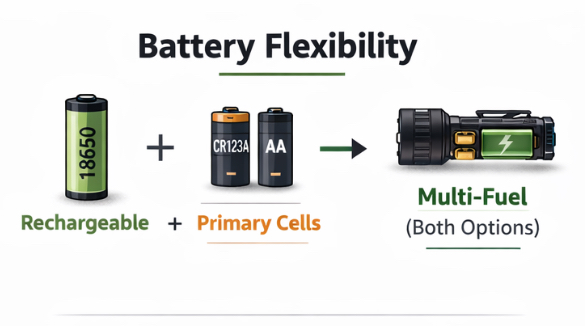
A USB-C rechargeable light is useless when the grid has been down for 72 hours and your power bank is dead. The best survival lights either have serious battery capacity, run on common primary cells (CR123A or AA) that you can buy anywhere, or both. Multi-fuel lights ones that accept rechargeable packs and standard batteries are worth the extra cost. If you want budget-friendly multi-fuel options, see my best budget flashlights guide.
Waterproofing that means something.
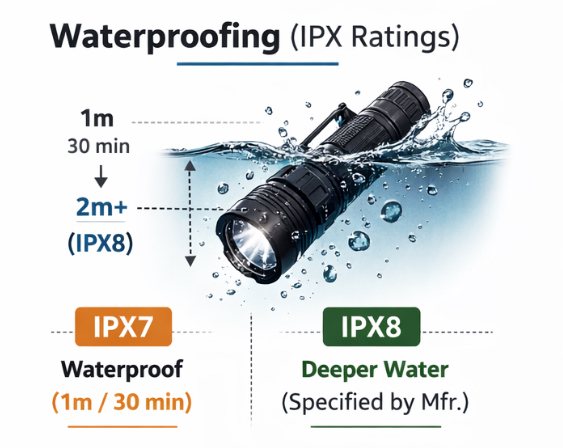
IPX7 means it was tested at 1 meter for 30 minutes. IPX8 means the manufacturer tested it deeper than that (they specify the depth). Both ratings are meaningful, but only if the O-rings are maintained. I won’t include anything below IPX7 here.
A real low mode.
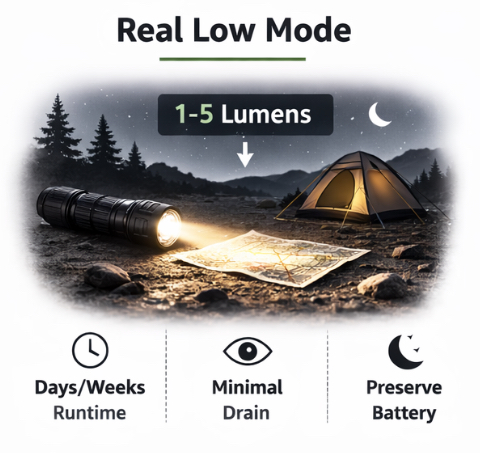
High lumens look good on spec sheets. In a survival situation, a moon mode or firefly mode at 1-5 lumens that extends runtime to days or weeks is what keeps you going when you’re rationing power and don’t know when you’ll be able to recharge.
Durability you can feel. Impact resistance specs are tested in labs under ideal conditions. Build quality the tightness of the threads, the quality of the anodizing, how the switch feels after the tenth use — tells you more than any single drop test number.
Survival flashlights aren’t the same as everyday carry lights or duty lights. If you’re looking for compact daily options, check out my guide to the best EDC flashlights. If you need something more defense-oriented, see my breakdown of the best tactical flashlights.
The 5 Best Survival Flashlights in 2025
1. Fenix PD36R Pro — Best Overall Survival Flashlight
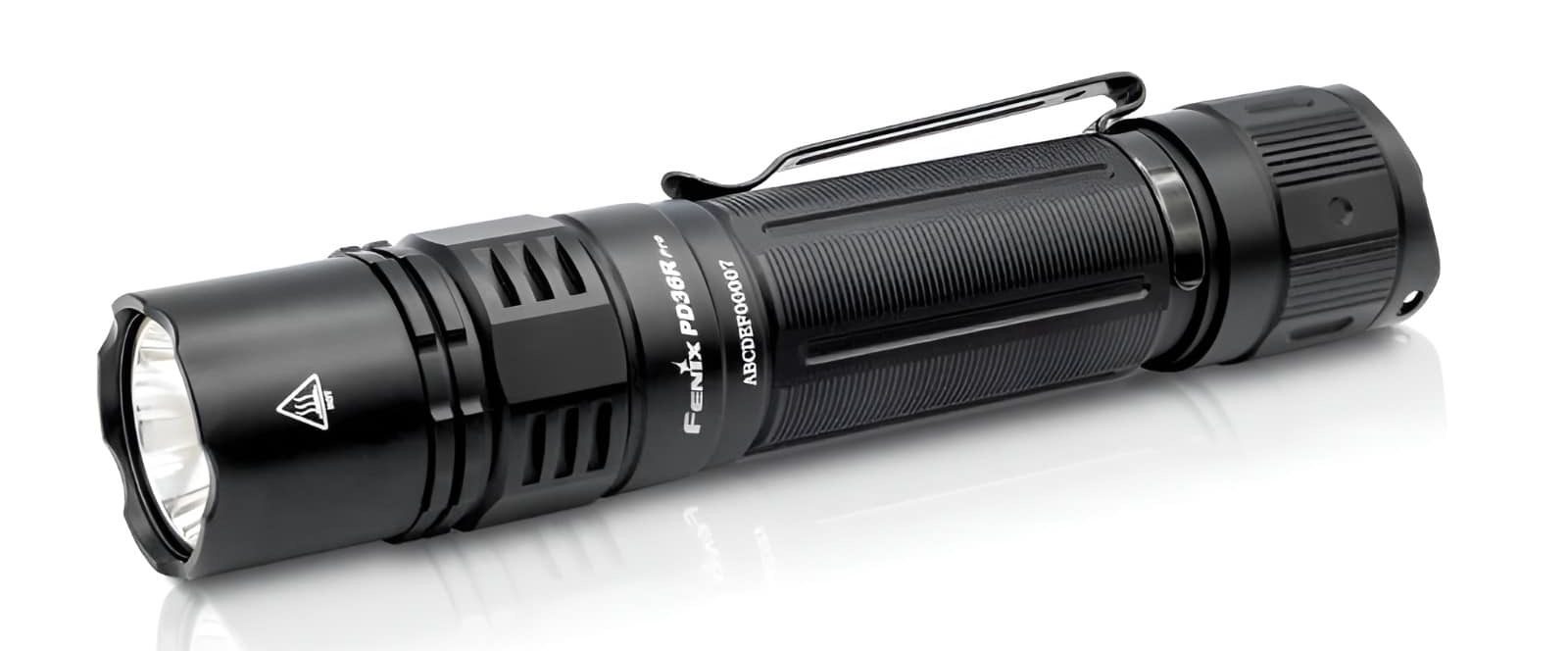

If I had to hand someone one flashlight for a genuine emergency situation hurricane, extended power outage, bug-out scenario and tell them to get by on it for as long as needed, it’s the Fenix PD36R Pro. Not because it has the highest lumen count on this list. It doesn’t. But because it gets everything right that the other lights only get partially right.
The headline spec is 2,800 lumens turbo a real number from a company that publishes honest data. But here’s the thing: turbo mode on the PD36R Pro is something you’ll use in bursts, not continuously. The body is compact, which limits heat dissipation, and when the head reaches 60°C the light steps down automatically. Fenix is upfront about this the full turbo runtime in their own documentation is measured including those stepped-down periods. What this means in practice: use turbo when you need to see 380 meters away, then drop to High for sustained work.
And on High, the PD36R Pro earns its reputation. It holds 1,000+ lumens for well over two hours before any meaningful output drop. That’s what survival use actually looks like long, sustained, reliable illumination, not a five-second burst of 2,800 lumens into a wall.
The included 5,000mAh 21700 battery charges in about three hours via USB-C. The battery indicator gives you a real-time charge level every time you power on, so you’re never surprised. Run it down to eco mode 5 lumens and you’ll get 42 hours of runtime. That’s nearly two full days of continuous use in a blackout scenario.
The build quality is where Fenix has always justified its price. The body is AL6061-T6 aluminum with a HAIII hard-anodized finish. It’s IP68 rated to 2 meters, and impact tested to 1.5 meters. The dual tail switch design deserves a specific mention: one switch controls on/off and momentary activation, the other cycles brightness modes. Once you’ve used it for five minutes, it becomes instinctive including with gloves on.
One real-world flag: turbo mode is locked out when the battery drops below roughly 50% charge. This is a protective feature, not a defect, but if you rely on turbo for self-defense or distance signaling, keep the battery above half.
Best for: Anyone who wants one flashlight that covers every survival scenario without major compromises. Home emergency kit, bug-out bag, vehicle carry.
Not ideal for: Preppers who specifically need CR123A compatibility, or anyone who needs to keep total kit cost under $70
2. Olight Seeker 4 Pro — Best Tactical Survival Flashlight
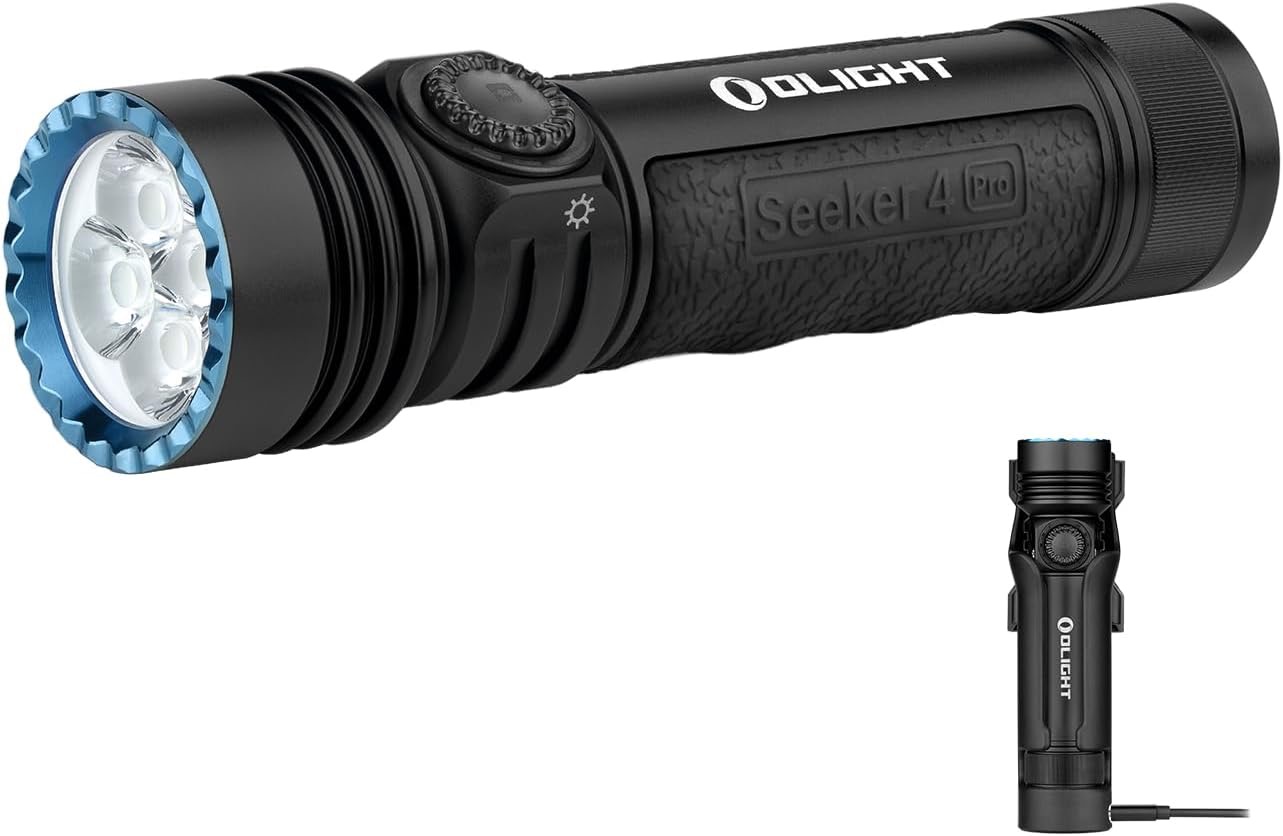
The Seeker 4 Pro isn’t a “tactical light” in the traditional narrow-beam sense. It’s something different. It’s a controlled flood monster and in a lot of real-world survival situations, that matters more.
When you’re lighting up a backyard after a storm, scanning a wide treeline, checking a damaged structure, or moving around a dark property, the 4,600-lumen turbo through Olight’s large TIR optic doesn’t give you a tight spotlight. It gives you a massive wall of usable light. Broad, even coverage. No harsh rings. No weird artifacts.
It throws to 260 meters, which is plenty for property scanning, but the real strength here is how evenly it fills space. Point it across a field and you see everything in front of you, not just a hot center and darkness around it.
The new rotary-dial interface is what separates this from earlier Seeker models. Instead of cycling blindly through modes, you rotate the dial and smoothly ramp brightness up or down. It feels mechanical and precise. In cold weather or gloves, that matters. There’s also a digital display in the dial showing brightness level and battery status. That’s not gimmicky. It’s practical.
Turbo holds 4,600 lumens for about 2.5 minutes before stepping down — which is expected at this output. After that it stabilizes around 1,200 lumens for extended runtime. High mode runs 1,200 lumens for roughly 3.5 hours. Medium gives you 300 lumens for around 14 hours. Low stretches to 50 lumens for about 49 hours. Moon mode is 5 lumens for approximately 15 days.
That’s serious usable runtime.
Build quality is what you expect from Olight’s upper tier. Solid machining, thick anodizing, smooth threads, and a balanced feel despite the larger head. It’s IPX8 rated and impact resistant to 1 meter. This isn’t a delicate high-output toy.
The limitation is the same conversation as most modern Olights: proprietary battery and magnetic charging system. It uses Olight’s 21700 5,000mAh battery and the included magnetic charging dock/cable. It’s convenient at home. In a long-term grid-down scenario, you’ll want a spare battery stored properly.
If your survival plan prioritizes wide-area visibility over maximum throw distance, the Seeker 4 Pro makes a very strong case.
Best for:
Wide-area illumination, property scanning, post-disaster visibility, and users who want extremely high flood output with controlled runtime.
Not ideal for:
Long-term preppers who prioritize battery standardization and multi-fuel compatibility over output and convenience.
3. ThruNite TN12 V6 — Best Value Survival Flashlight
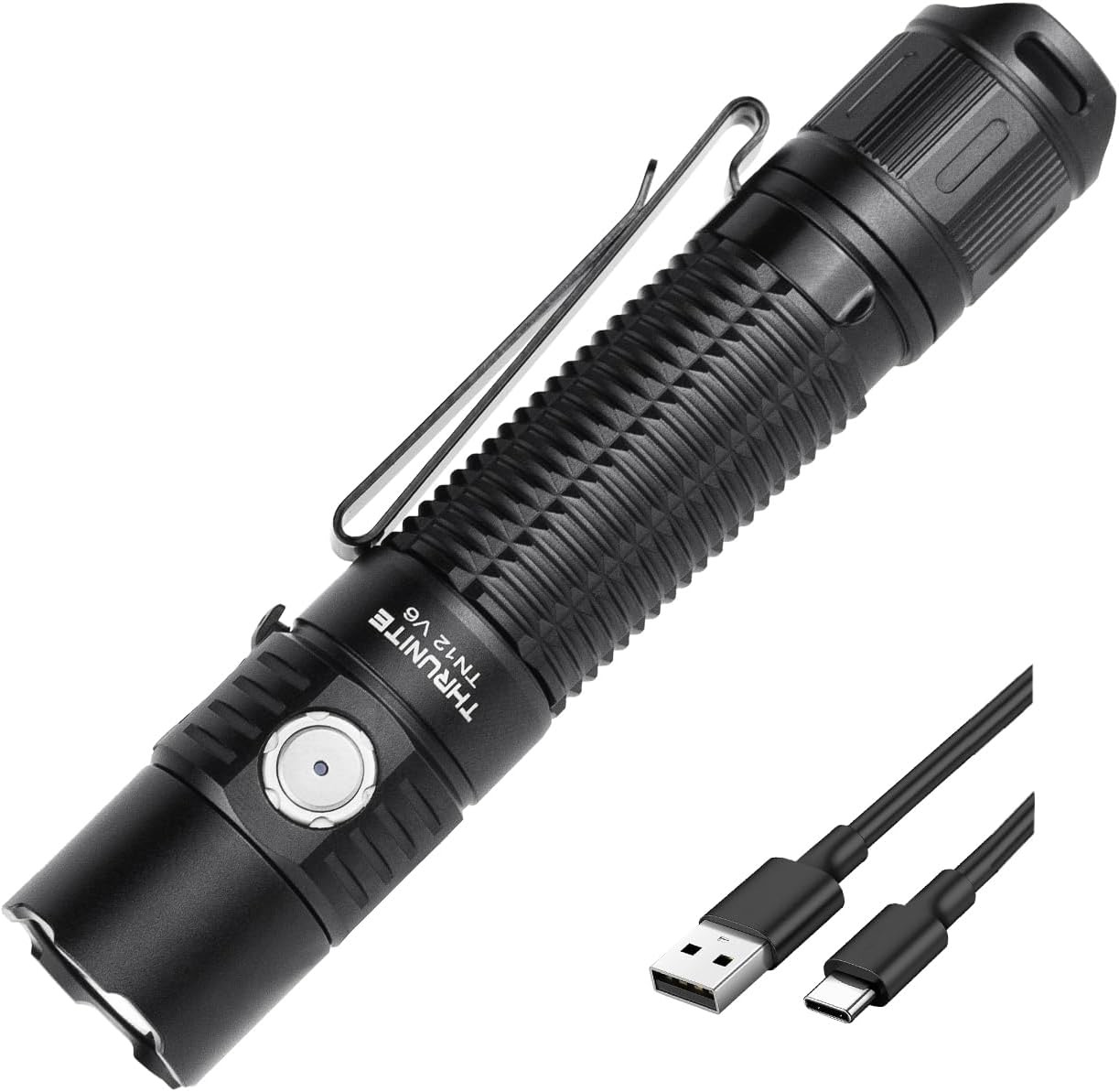
The ThruNite TN12 V6 exists to prove that serious survival capability doesn’t require serious money. At around $50 with a quality 3,400mAh 18650 cell included, it undercuts the Fenix by over $60 while delivering on every survival fundamental that actually matters.
The turbo output is rated at 1,950 lumens a real number, not a marketing fantasy. The Luminus SST-70 emitter in a smooth reflector produces a defined hotspot with meaningful throw, reaching out to approximately 259 meters. Turbo is useful for distance spotting and emergency signaling. In real use, you’ll live in High or Medium for most tasks.
The mode that makes the TN12 V6 a legitimately smart survival pick is Firefly. At 0.5 lumens, it runs for 41 days on a single 18650 cell. Forty-one days of continuous light from one battery. That’s not a gimmick it’s the mode you use when you’re in a tent, when you need just enough light to find something without destroying your night vision, or when you’re genuinely uncertain how long you need to stretch a battery. Most flashlights at this price point have a low mode around 10-20 lumens. Getting down to 0.5 lumens is rare and valuable.
The rest of the package is solid throughout. IPX8 waterproofing. 1.5-meter impact resistance. AL6061-T6 body with Type III anodizing. USB-C charging built in with a rubber-sealed port. Memory function that recalls your last mode (excluding turbo and strobe) so you’re not accidentally turning on full blast every time.
The dual-switch interface tail switch for on/off, side switch for mode changes is one of the more intuitive setups in this price range. The tail switch also gives you direct turbo access, which matters when you need maximum output fast.
Where you’ll feel the budget: the body runs warmer on sustained high output than the Fenix does, and thermal stepdown on turbo is faster. Use turbo for bursts, High for sustained work. That’s the right operating pattern anyway.
Best for: Anyone who wants genuine survival-capable performance without spending over $60. First serious flashlight purchase. Budget preppers building multiple-light kits.
Not ideal for: Extended tactical use requiring sustained high output, or scenarios where body heat buildup could be a problem
4. Streamlight ProTac 2L-X — Best for True Field Reliability
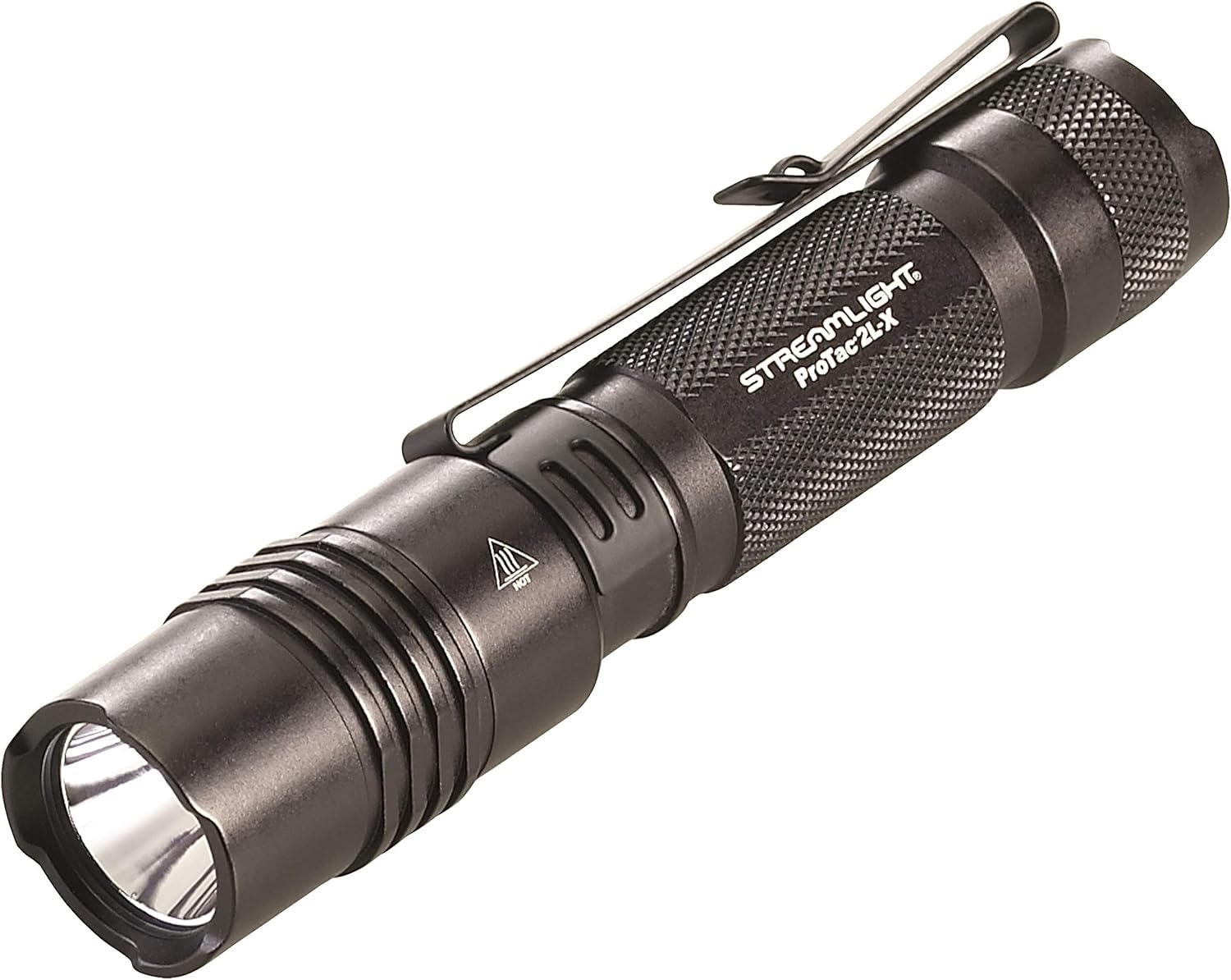
Let me give you the spec that wins no arguments but matters most in the field: the Streamlight ProTac 2L-X runs on two CR123A lithium batteries with a 10-year shelf life, and it can also run on a rechargeable 18650 pack. You buy it, throw in fresh CR123As, toss it in your kit, and you can forget about it for years confident it’ll work the moment you need it.
That’s not nothing. That’s actually the core survival ask for a backup or emergency-only light.
At 500 lumens max, the ProTac 2L-X doesn’t win any brightness contests. But 500 regulated, steady lumens Streamlight’s C4 LED technology maintains consistent output throughout battery life rather than dimming steadily from the moment you turn it on handles every real-world scenario I actually encounter in survival contexts. Power outages, road emergencies, camp navigation, threat identification at close range. The beam reaches 165 meters on high, 49 meters on low. It’s not going to let you see half a mile, but that’s not what most people actually need.
The real differentiator is the TEN-TAP programmable switch. You can set it to three modes: High/Strobe/Low (factory default), High only, or Low/High. If this light is in a home defense kit, program it to High only. Grab it in the dark, one press, immediate maximum output. No mode cycling, no accidentally getting strobe when you need sustained light. It sounds like a small thing. In a stressful scenario, it’s enormous. For weapon-mounted setups, see my guide to the best pistol lights.
Two meter impact resistance more than most lights in this guide. IPX7 waterproofing. Aircraft aluminum construction. Limited lifetime warranty from a company that’s been making lights since 1973. The ProTac 2L-X is the kind of gear that still works after being dropped, forgotten, and found years later.
The dual-fuel aspect deserves specific attention for cold-weather preppers. Below -10°C / 14°F, lithium-ion rechargeable cells lose meaningful capacity. CR123A lithium primaries maintain better performance in extreme cold. If you’re in Alaska or anywhere with harsh winters, this is the battery system that won’t fail you.
Best for: Cold-weather preppers. Anyone building a long-shelf-life emergency kit. Backup survival light where battery access matters more than USB charging convenience.
Not ideal for: Primary survival light for scenarios requiring 800+ lumens, or anyone who won’t carry spare CR123As
5. Acebeam E70 AL — Best High-Output Survival EDC
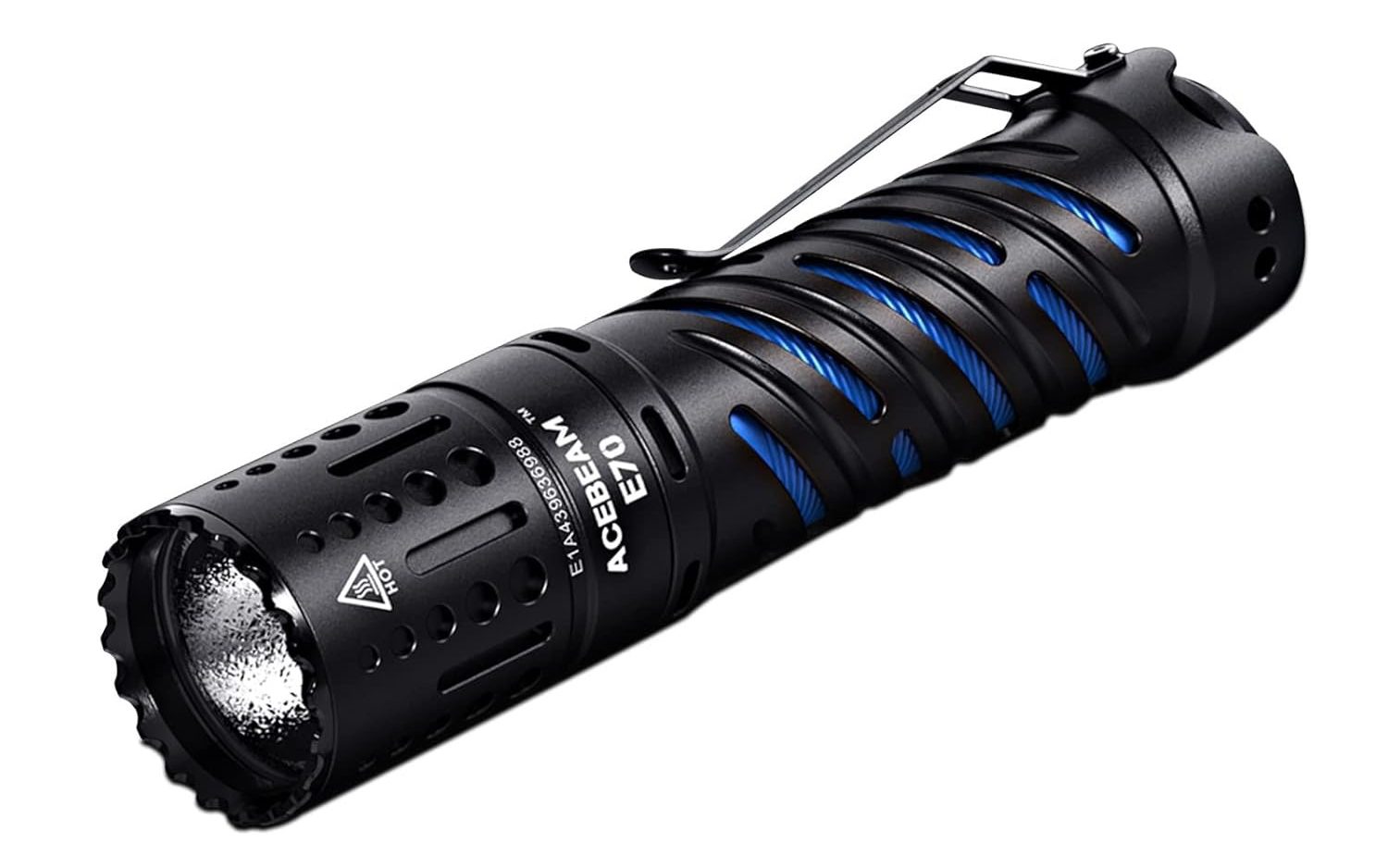
The Acebeam E70 AL is the outlier on this list a light that earns its spot through a combination of genuine high-output performance, long moonlight runtime, and a design that makes it one of the more comfortable daily-carry options at this power level.
The peak output is 4,600 lumens from a CREE XHP70.2 LED. In a compact 21700-powered body that’s just over 5 inches long and weighs 3.6 oz without a battery, that’s a serious achievement. Real-world testing confirms it sustains over 1,100 lumens for an hour after the initial turbo stepdown which puts it ahead of many lights with lower peak specs on sustained performance.
The moonlight mode is what makes the E70 AL more than just a high-power novelty. At the lowest output, it runs for 11 days continuous. That’s the survival number you need an almost indefinite low-level illumination option that keeps you functional without burning through your battery. Five brightness levels give you genuine range from that near-zero moonlight mode all the way up to turbo.
The build quality is characteristic of Acebeam excellent anodizing, tight machined tolerances, clean threads. The distinctive double-wall design with slots showing the inner aluminum tube looks unusual, but the extra material actually contributes to heat management. Waterproof to IPX8 at 2 meters. Impact resistant to 1 meter.
The single tail switch design keeps operation simple: double-click to turn on (prevents accidental activation in a pack), then cycle modes from there. Shortcuts exist to moonlight from off, and to strobe from on. Once learned, it’s faster than a two-switch design for most common uses.
The battery situation requires a note: the E70 AL runs on one 21700 cell, which is not included at the standard price point. You’ll need an Acebeam 21700 with a USB-C charging port, or any quality protected 21700 capable of supplying at least 10A. Budget for that extra $15–20. It also accepts standard 18650 cells, which gives you a fallback battery option with reduced output useful in a true emergency.
Best for: Anyone who wants extreme output capability in a compact package. Survivalists who prioritize high-performance EDC over multi-fuel flexibility.
Not ideal for: Anyone who wants a plug-and-play light with battery included. Cold-weather scenarios where 21700 performance drops
Side-by-Side Comparison
How to Pick the Right One for Your Situation
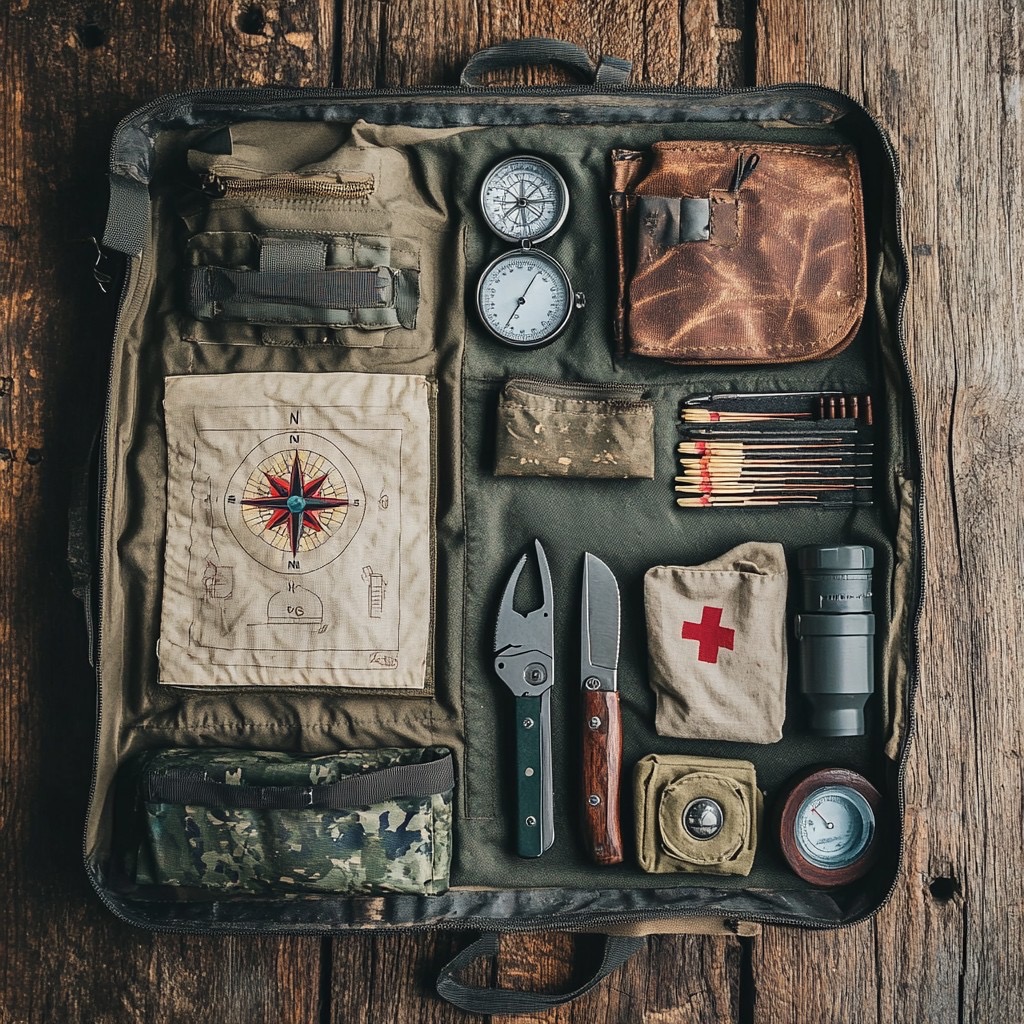
Building a bug-out bag? Weight and battery strategy are the two decisions. The ThruNite TN12 V6 is the weight champion here around 140 grams with battery, IPX8 waterproof, 41-day firefly mode. If budget allows, upgrade to the Fenix PD36R Pro for better sustained output and the 42-hour eco runtime. Best strategy: carry the TN12 V6 as primary and a Streamlight ProTac 2L-X loaded with CR123As as your backup. Different battery systems, different failure modes, combined weight under 300 grams.
Building a home emergency kit? Weight doesn’t matter, so buy up. The Fenix PD36R Pro or Olight Seeker 4 Pro both make sense here high output, good runtime flexibility, rechargeable first with fallback options. Buy a spare battery for whichever you choose, keep it at 50% charge, store it with the light. Test everything every six months.

Cold weather or extreme environments? The Streamlight ProTac 2L-X on CR123A batteries is the answer. Lithium primary cells perform significantly better in temperatures below -10°C than lithium-ion rechargeable cells. If you’re in mountain terrain, northern latitudes, or anywhere with serious winter conditions, the ProTac 2L-X reliability edge over rechargeable lights becomes a real-world advantage.
Tight budget? The ThruNite TN12 V6 with battery included is genuinely excellent not “good for the money,” actually good. It delivers 1,950 lumen turbo, 41-day firefly mode, IPX8 waterproofing, and USB-C charging in a compact package. At this price it belongs in every prepper kit, even as a backup to a more expensive primary.
What the Lumen Number on the Box Actually Means
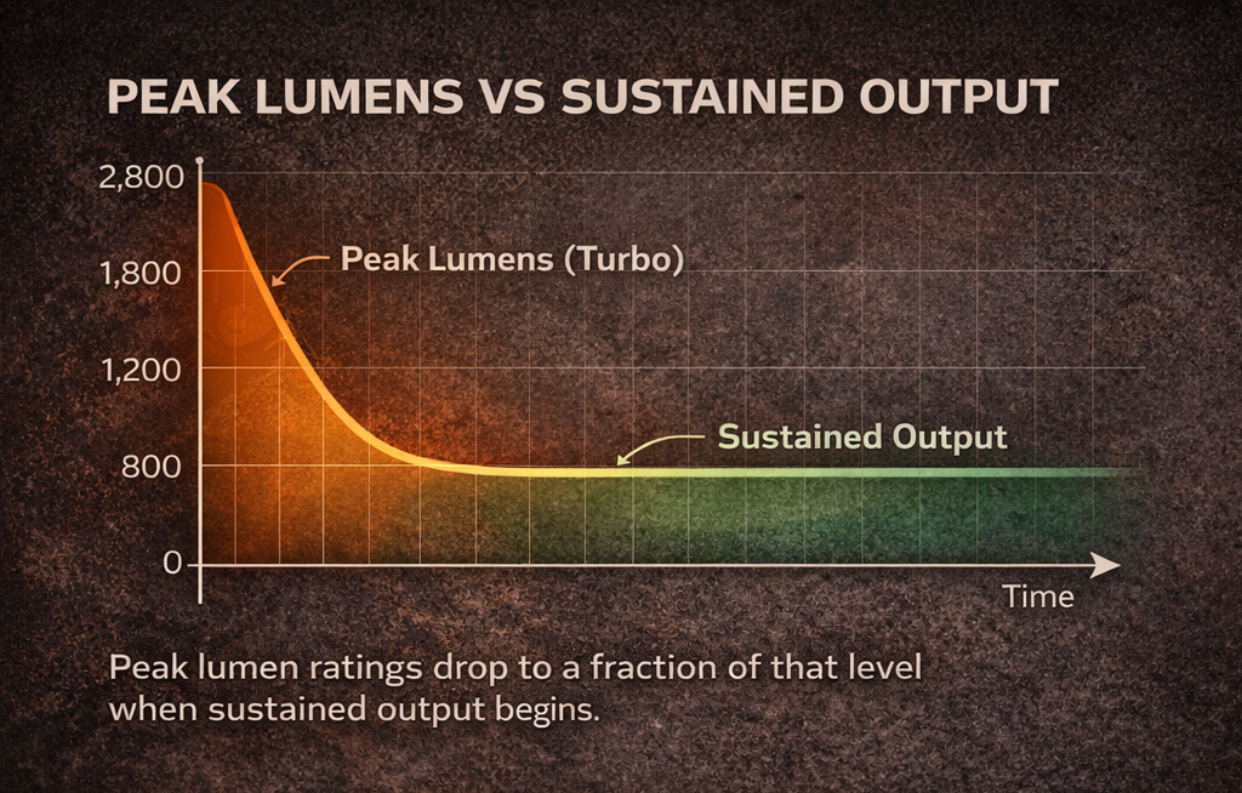
Here’s the thing that every survival flashlight guide should tell you but most don’t: the lumen number on the box is measured 30 seconds after you turn the light on, in a climate-controlled lab, with a fresh battery. It is peak output. It is not the number you’ll see in 20 minutes of actual use.
Every light with significant output goes through thermal stepdown the driver reduces power to the LED when the body reaches a certain temperature, usually around 55-65°C. This is not a defect. It’s what prevents the LED from burning out and what keeps the light safe to hold. But it means a “2,800 lumen flashlight” might be running at 1,000 lumens after five minutes of continuous high use in warm weather.
Fenix publishes this honestly in their documentation. ThruNite does too. Some brands don’t, which tells you something. When a company is transparent about stepdown behavior and sustained output rather than just putting the biggest turbo number on the box that’s a signal about their overall honesty as a manufacturer.
For survival use, the spec that matters more than peak lumens is the output you’ll actually get for the runtime you actually need. That’s why the mode breakdowns in each review above matter more than the headline number
Survival Flashlight Battery Strategy
You’re buying the flashlight, but you’re really buying the battery system. Here’s how to approach stockpiling correctly.
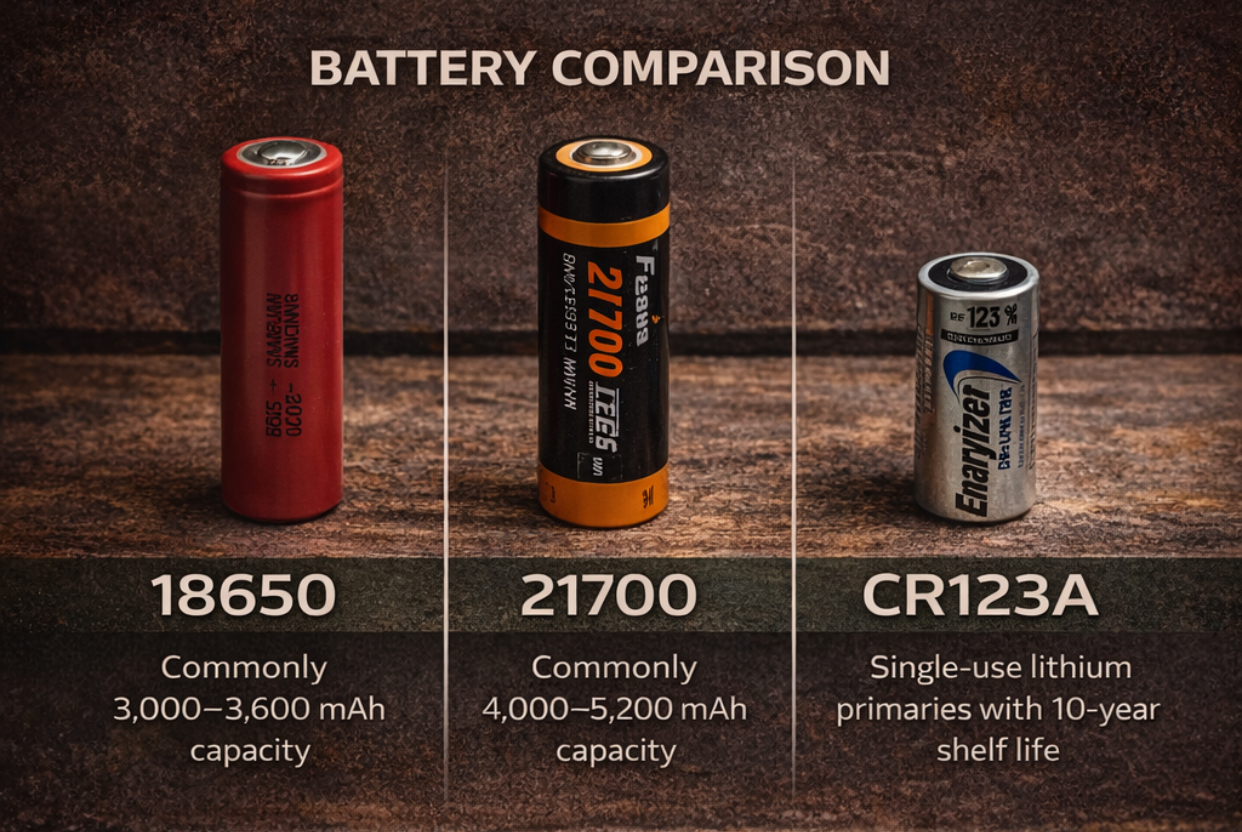
For 18650 lights (ThruNite TN12 V6): Buy Samsung 30Q, Molicel P26A, or Sanyo/Panasonic NCR18650GA from reputable sellers. Fake 18650 cells are extremely common on Amazon marketplace buy from authorized distributors or directly from established brands. Keep two charged cells per light stored at 50–70% capacity. Rotate annually.
For 21700 lights (Fenix PD36R Pro): The included Fenix ARB-L21-5000 is a quality cell. Stock one or two spares purchased directly from Fenix. The PD36R Pro also works with ARB-L21-5000U (USB-C charging built into the cell itself), which is a useful upgrade for field charging without carrying a separate cable.
For CR123A lights (Streamlight ProTac 2L-X): Buy Energizer Ultimate Lithium or SureFire CR123A primaries. Both have 10-year shelf lives from fresh stock. Buy more than you think you need two four-packs minimum and store them cool and dry. CR123As are available at Walmart, pharmacies, and sporting goods stores in most of the US, which matters more than people realize in a post-disaster supply scenario.
For proprietary batteries (Olight Seeker 4 Pro): Buy at least one spare Olight ORB-217C50 from Olight directly. Store it at 50% charge. Keep the magnetic charging cable with the light if you lose the cable, you lose your charging option until a replacement arrives
Features Worth Paying For vs. Marketing You Can Ignore
Worth paying for:
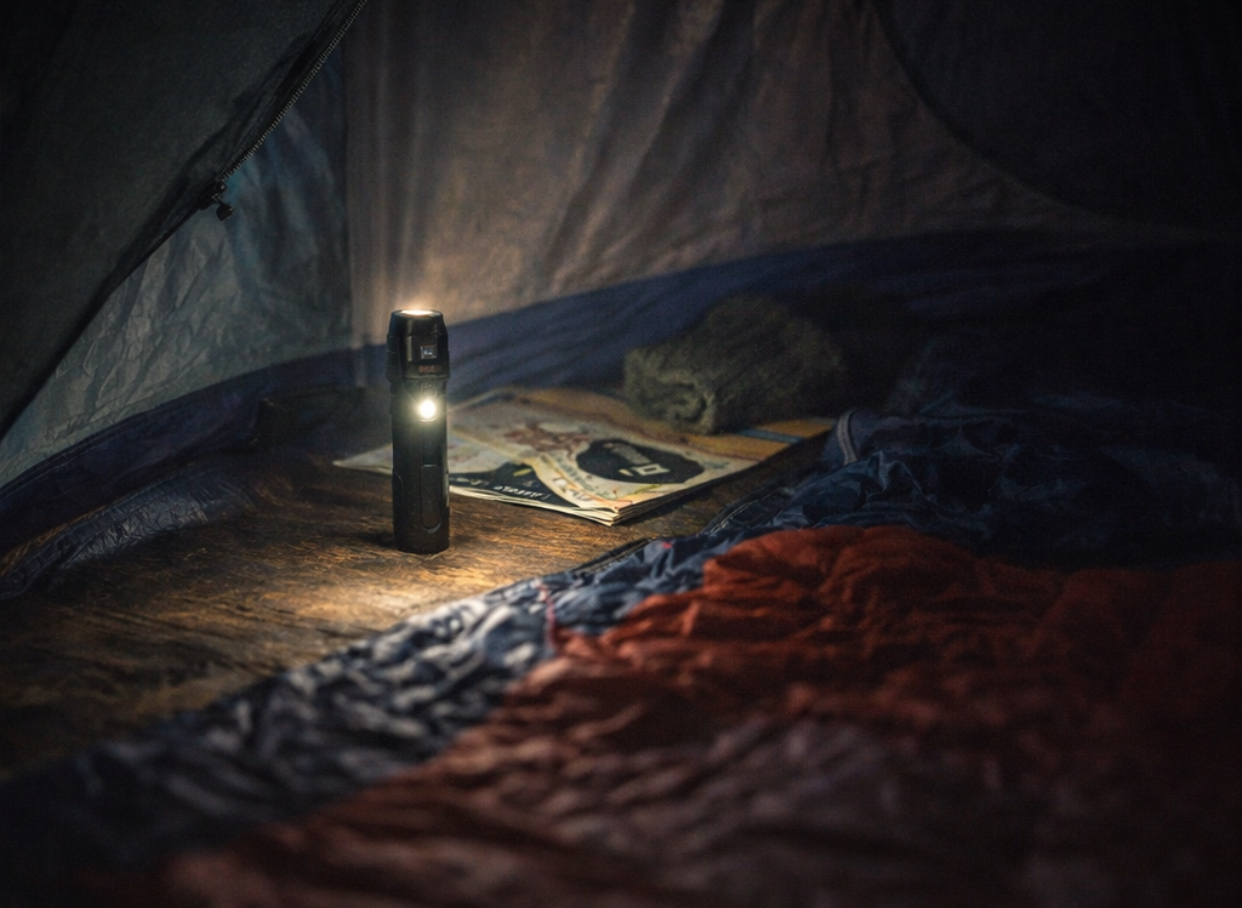
Firefly / Moonlight mode: A mode at 0.5–5 lumens that dramatically extends runtime. This is what you use when you’re genuinely rationing power over days or weeks. Not every light has it. The lights on this list that do (TN12 V6 at 0.5L/41 days, Seeker 4 Pro at 5L/15 days, E70 AL at 11 days moonlight) are meaningfully better for survival use because of it.
Regulated output: Output remains constant throughout battery life rather than fading as voltage drops. The Streamlight uses this explicitly (C4 regulated output). It matters when you need to know your light will perform identically at 20% battery as it does at 100%.
Memory mode: Light returns to last used setting (excluding turbo/strobe) when switched on. Means you’re not cycling through brightness levels every time you need the light.
Multi-fuel capability: Accepting both rechargeable cells and standard primaries (CR123A, AA) is worth real money. The Streamlight ProTac 2L-X is the standout here.
Marketing you can mostly ignore:
“Military grade”: This phrase appears on $12 Amazon lights and $400 SureFire products alike. It’s meaningless without a specific specification reference. Ask about the aluminum alloy instead 6061-T6 or 7075-T6 are specific, meaningful designations. “Military grade aluminum” is not.
“Anti-strobe” bezels: The crenellated or serrated bezels on many tactical lights are largely decorative. They have very limited practical use cases.
Peak lumen claims over 5,000 from small lights: Physics limits what a compact flashlight can sustain. A genuine 5,000-lumen burst lasting five seconds from a compact light is real. Five thousand lumens sustained from a light you can hold in one hand is almost never real
Frequently Asked Questions
What is the best survival flashlight overall? The Fenix PD36R Pro is the best all-around survival flashlight for most people in 2025. It delivers honest, sustained output of 1,000+ lumens for extended periods, runs 42 hours in eco mode on its included 21700 battery, is IP68 waterproof to 2 meters, and backed by a company with a strong warranty and support record. For the widest range of survival scenarios handled by a single light, nothing on this list does it better.
How many lumens does a survival flashlight actually need? For most real survival scenarios power outages, navigation, camp tasks, vehicle emergencies 300-600 reliable, sustained lumens handles everything. 1,000 lumens is excellent for outdoor navigation and distance identification. Beyond 2,000 lumens is rarely critical for survival use, where battery runtime and reliability matter more than peak brightness. The lumen calculator on this site can help you find your specific number.
What battery type is best for a survival flashlight? It depends on your scenario. USB-C rechargeable 21700 is the most practical for everyday use and modern convenience. CR123A lithium primaries are better for cold weather, long-term storage without attention, and guaranteed availability in a post-disaster supply environment. The ideal setup: one rechargeable-primary light as your main, one CR123A-capable light as your backup.
Are rechargeable flashlights reliable for survival use? Yes, with caveats. Rechargeable lights are the right choice for everyday use and most emergency scenarios. The risk is extended grid-down situations where you can’t recharge which is exactly when you need your flashlight most. Address this with: extra charged batteries stored at 50%, a small solar charger that supports USB-C, and a backup light on primary cells.
How long should a survival flashlight battery last? Modern 21700 and 18650 lithium-ion cells, stored at 50–70% charge in cool, dry conditions, retain the majority of their capacity for 3-5 years. CR123A primaries have a 10-year shelf life unopened. Build a rotation habit: check and recharge your lithium-ion cells every six months. Replace CR123As every 8-10 years proactively, not after they’ve failed.
Can a flashlight actually be used for self-defense? A 200-300 lumen light pointed at dark-adapted eyes at close range causes significant temporary visual disruption. This is a real and legitimate defensive use not a movie concept. Lights with instant-on momentary capability (half-press of a tail switch) and 300+ lumens are sufficient for this application. All five lights on this list exceed that threshold.
What’s the difference between IPX7 and IPX8? IPX7 means the flashlight was tested at 1 meter submersion for 30 minutes. IPX8 means the manufacturer tested beyond 1 meter they specify the depth (Fenix’s IP68 rating covers 2 meters, Olight’s IPX8 is also 2 meters, Acebeam’s IPX8 is 2 meters). Both are meaningful waterproof ratings for survival use. The practical difference is margin IPX8 lights have more buffer for accidental deep submersion
The Bottom Line
Buy the light, test it, know how it works before you need it. That’s the advice that all the gear research in the world comes down to.
If you want one recommendation and you don’t want to think about it: the Fenix PD36R Pro is the light. Buy a spare battery. Done.
If you’re watching the budget, the ThruNite TN12 V6 will surprise you it genuinely punches above its price.
If you live somewhere cold, or if you need a light that can sit untouched in a kit for years and still work: the Streamlight ProTac 2L-X on fresh CR123As is the most dependable option here.
Don’t wait for an emergency to find out if your gear works.
All specifications verified against manufacturer documentation (Fenix Lighting, Olight, ThruNite, Streamlight, Acebeam) and trusted independent testing sources. Prices are approximate and may vary. This article contains affiliate links purchases made through them support this site at no additional cost to you. Last verified: February 2026.
